
TítuloPolymer biomass carrier modification in electric and magnetic fields
7
0
0
Texto completo
(2) 292. M.V. KOROTKIY, L.S. PINCHUK, A.V. MAKAREVICH, A.G. KRAVTSOV, A.S. SAMSONOVA, .... possess high porosity and specific surface, enhanced physical-chemical activity of fiber surface layers exposed to oxidation and display increased adhesive interaction with microorganisms and contaminants of the media (Pinchuk et al., 2002). Intensive thermal and mechanical stress applied to melted polymeric mass in the course of FPC shaping results in autocharging of fibers and their transit into electret state (Pinchuk et al., 1998, 2002). The carriers retaining a spontaneous bipolar electric charge (stable in aqueous media) generate in the environment electric field that may effect metabolism of microbial degraders. Melt-blowing process is attractive for biotechnologists not merely for unique opportunity to modify in broad range structure and physical-chemical features of FPC. Improvement of the method allowed to combine in one cycle production and modification of FPC leading to new functional properties aimed at increased microbial compatibility and elevated activity of the latter (Pinchuk et al., 2002). For instance, designed magnetic FPC contain fibers filled with particles of magneto-solid ferrites (Makarevich, 2001). Such FPC generate a weak magnetic field inducing favorable response in immobilized microorganisms which raises efficiency of wastewater biorecovery. The present paper discusses new experimental data testifying to high efficiency of bioremediation of water and air contaminated with aromatic hydrocarbons using microorganisms immobilized on electret and magnetic melt-blown FPC. 2 MATERIALS AND METHODS 2.1 Manufacture of FPC, analysis of structure, electric and magnetic characteristics FPC were manufactured from polypropylene (PP) of CAPLEN® brand (Moscow Oil Refinery Joint-Stock Company) and PP filled with disperse strontium ferrite (20% of weight, particle size 1-2 µm) by melt-blowing technique (Pinchuk et al., 2002). Volume density ( ȡ ) of FPC was estimated by measuring and weighing samples (dimensions 20×10×5 mm) cut out from tubes. Total porosity (P) was calculated according to the formula: P = 1– ȡ(Xp/ ȡ p +Xf/ ȡ f), where ȡ − sample volume density; ȡ p and ȡ f − density of PP and strontium ferrite; Xp and Xf − their respective proportions. Average values of fiber diameter d f in FPC and Feret diameter d l of pore sections (Nadler and Smith, 1993) were defined by analytical processing of electron microscopic pictures of samples (microscope Cam Scan-4). Effective surface charge density ı ef of electret FPC (on the external surface of tubes) was assessed according to Russian standard 2509-82 by compensatory method (vibrating electrode technique). Residual magnetic induction on the surface of magnetic carriers was evaluated by magnetic induction meter. 2.2 Microorganisms Experiments were conducted with strain Rhodococcus ruber 2B degrading aromatic compounds kindly provided by microbial culture collection, Institute of Microbiology, Belarus Academy of Sciences (Lobanok, 1997). In addition, microorganisms actively breaking down oil products were isolated from soil contaminated with diesel oil by enrichment culture technique. These were strains Rhodococcus ruber 1KR (IEJM AS 73) and Rhodococcus opacus 31KR (IEJM AS 247) identified by chemotaxonomic and genetic methods (Bell et al., 1999). Non-identified microbial association able to degrade mixture of benzene, toluene, ethylbenzene, ortho-, para-, meta-xylenes (BTEX mixture).
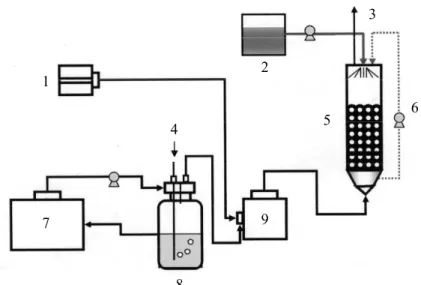
(3) POLYMER BIOMASS CARRIER MODIFICATION IN ELECTRIC AND MAGNETIC FIELDS. 293. was isolated from an activated sludge process treating domestic wastewater (Hu et al., 2001). 2.3 Microorganisms hydrophobicity tests and kinetics of immobilization on the carriers Hydrophobicity of Rhodococcus bacteria was estimated via relative weight of cells adsorbed on hexane drops emulsified in aqueous suspension (Kovalenko et al., 1998). Two series of experiments were carried out to immobilize microbial cultures on the carriers. The first experimental series was focused on adsorption immobilization of strains Rhodococcus ruber 2B, Rhodococcus ruber 1KR and Rhodococcus opacus 31KR on PP supports carrying different (in polarity and absolute magnitude) electret charge. For biomass growth meat-wort agar and liquid mineral medium E-8 of the following composition were used (g l–1) − NaCl (0.5), MgSO4·7H2O (0.8), KH2PO4 (0.7), (NH4)2HPO4 (1.5), pH 7.3-7.4 and diesel oil (0.2% v v–1). 5 day cultural liquid at concentration 1.0·109 cells ml–1 (2-4 g l–1) was introduced in 50 ml aliquots into 250 ml Erlenmeyer flasks and subsequently 3g support samples were supplied. 2 hours later media were supplemented with 0.2% (v v–1) diesel oil as nutrient source and culture was resumed at temperature 302 K on the shaker (180 rpm). Biofilm build-up on the carrier was controlled gravimetrically. Measurements were carried out by 2, 48, 120 and 192 hours in triplicate. In the second test series bacterial association degrading aromatic hydrocarbon BTEX mixture was immobilized on samples of electret (PP) and magnetic (PP filled with ferrite) supports. Biomass was grown on liquid mineral medium (mg l–1) − NaNO3 (1000), K2SO4 (170), MgSO4·7H2O (37), K2HPO4 (530), FeSO4·7H2O (22.3), H2SO4 (9.8), CaSO4·2H2O (8.6), ZnSO4·7H2O (0.6), CuSO4·5H2O (0.5), MnSO4·H2O (0.3), KI (0.2), H3BO3 (0.1). 100 ml of cultural liquid with initial microbial concentration 50-130 mg l–1 was inoculated into 250 ml Erlenmeyer flasks where BTEX mixture was fed as carbon source (200 mg l–1). The culture was performed at temperature 303 K on the shaker (180 rpm). 3g supports either lacked in the media (control variant) or were added. Gravimetric method (biomass build-up after drying at 343-353 K during 2 hours) was used for evaluation of kinetics of biomass immobilization on the support (mg g–1 support) by periodic measurements at 2, 48, 72, 96 hours. Amount of residual suspended microorganisms was traced by filtration through glass fiber microfilter (WHATMAN, mesh size 1.2 µm) and subsequent registration of increased filter weight after desiccation (378-383 K, 2 hours). Overall specific weight (mg l–1) of microorganisms − suspended and fixed on the support was taken into account. In similar way immobilization of pure culture Rhodococcus ruber 2B was investigated. 2.4 Biodecontamination tests Degradation kinetics of BTEX mixture introduced into sealed Erlenmeyer flasks with native or immobilized on FPC microbial cultures was examined via reduction in time of BTEX components level. Total content of hydrocarbons in liquid and gaseous phases was monitored by gas chromatography (Hewlett Packard-6890). Scheme of lab trickling biofilter (volume 10 dm3) for disposal of toluene fumes from air is presented in Figure 1. Volume of toluene tank, evaporating and mixing chambers − 20, 2 and 2 dm3, respectively. Gas retention time − 1.25 and 2.5 min at volume of FPC bed 2.5 and 5 dm3, respectively. Flow rates of air and toluene fumes − 1 l min–1 and 8 l min–1, respectively. Rate of feeding mineral solution equaled 9 l day–1. Biodecontamination efficiency was assessed by gas chromatography as reduced toluene concentration in air at trickling filter output..
(4) 294. M.V. KOROTKIY, L.S. PINCHUK, A.V. MAKAREVICH, A.G. KRAVTSOV, A.S. SAMSONOVA, .... 3 2. 1. 6. 5. 4. 9. 7. 8 Figure 1. A diagram of bench scale trickling filter system, 1 – air blower, 2 – mineral solution, 3 – off gas, 4 – air intrusion, 5 – biofilter with FPC, 6 – water recirculation, 7 –toluene reservoir, 8 – vaporization chamber, 9 – mixing chamber.. 3 RESULTS 3.1 Structural, electrical and magnetic characteristics of the carriers The FPC are composed of chaotically spaced and cohesively bound in contact points polymeric fibers with smooth surface. In between are voids, i.e. winding pores with sections anisotropic in form. Ferrite particles in magnetic FPC are encapsulated in a plastic binder. Parameters characterizing composition, fibrous-porous structure, electret and magnetic properties of FPC samples are provided in Table 1. Their advantages as microbial supports are considerable porosity (P, Table 1) and specific surface 80-100 m2 kg–1 (Pinchuk et al., 2002). Table 1. Composition and structural parameters of FPC samples. Sample no.. Sample composition (wt%). ı efa (nK cm–2). ȡ (kg m–3). Structural parameters P df. dl. (µm). (µm). 0.73-0.78. 40±2. 167±5. PP (80) + SrO·6Fe2O3 220-280 0.75-0.80 –b (20) a -on the external surface of tubular samples, b-undefined electret charge. 55±3. –. 1 2 3 4 5. PP (100). – 0.7 ĺ0 + 4.1 – 7.1. 200-250. FPC carry spontaneous electret charge ıef reaching 0.7 nC cm–2 (Table 1, sample 1). The charge is removed by treatment of the carrier in hot ethanol vapor (sample 2). It was.
(5) 295. POLYMER BIOMASS CARRIER MODIFICATION IN ELECTRIC AND MAGNETIC FIELDS. established that hydrophobicity of PP carrier is not changed after treatment. FPC elements exposed to impact of positive or negative corona discharge are electrified to ı ef values 4−7 nC cm–2 (samples 3, 4). Ferrite-filled magnetized FPC (sample 5) shows residual surface magnetic induction Br = 0.2 mT. 3.2 Effect of electric and magnetic fields generated by the carriers on microorganisms immobilization Adsorption immobilization leads to significant accumulation of biomass, namely of Rhodococcus (Table 2), on FPC samples based on PP. Table 2. Kinetics of Rhodococcus bacteria accumulation on FPC samples. Specific adsorption (mg g–1) of different strains in time (h) Rhodococcus ruber 2B Rhodococcus ruber 1KR Rhodococcus ɨ p ɚ cus 31KR 2 48 120 192 2 48 120 192 2 48 120 192 100 73 21 98 102 115 14 61 69 67 96 17 63 60 33 5 30 60 60 12 30 52 60 3 63 63 37 15 35 61 70 14 32 59 13 61 57 133 30 13 17 40 86 130 15 49 70 100. Sample no. 1 2 3 4. Electret FPC charge was found to cause significant effect on kinetics of biomass accumulation. Rhodococcus cells are adsorbed best on FPC samples 1 and 4 carrying prevalently negative surface charge. Sample 3 treated in the field of positive corona discharge trails in this parameter. Zero-charged sample 2 is characterized by the lowest values of specific biomass sorption in examined time span. It was evident from the second series of experiments aimed at microbial immobilization that presence of electret FPC in the tested system increases biomass accumulation in time course as compared to the control, if bacterial cells adsorbed on the support and suspended in cultural liquid are counted. Magnetic field generated by ferrite-containing FPC sample promotes microbial growth more greater (Figure. 2). It causes beneficial influence both on biomass growth and immobilization of tested bacterial cultures on magnetic carrier.. Total biomass (mg l–1). a 200 150. 2. 100 50 0. 1 0. ɛ. 3. 20. 40. 60. Time (h). 80. 100. 250. 3. 200. 2. 150 100. 1 0. 20. 40. 60. 80. 100. Time (h). Figure 2. Kinetics of accumulation of total biomass (both immobilized on FPC and suspended in cultural liquid). (a) Microbial association; (b) Rhodococcus ruber 2B strain. Symbols: (ż) control, (Ɣ) in presence of FPC sample 4, (Ŷ) in presence of sample 5..
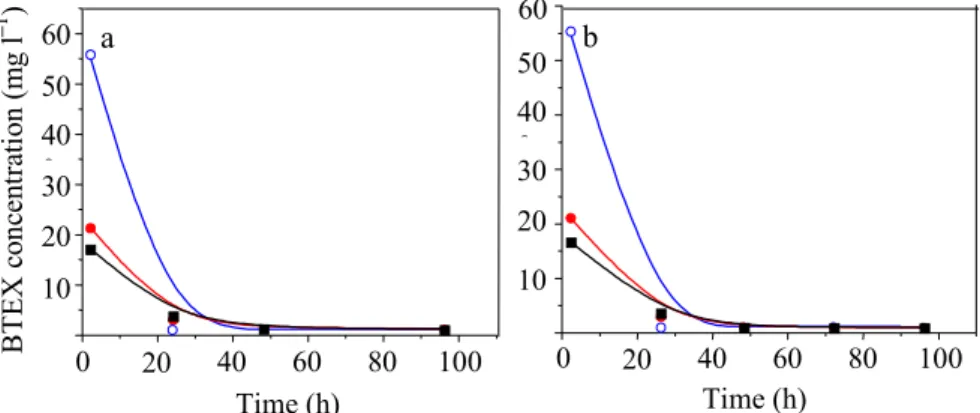
(6) 296. M.V. KOROTKIY, L.S. PINCHUK, A.V. MAKAREVICH, A.G. KRAVTSOV, A.S. SAMSONOVA, .... BTEX concentration (mg l–1). 3.3 Parameters of removing volatile hydrocarbons from water and air by immobilized microorganisms It was found that immobilization of microorganisms on tested FPC drastically accelerates biodegradation of BTEX mixture (Figure. 3). Effect of BTEX absorption by the support material (PP) was negligible. High rate of xenobiotic decomposition is a major advantage of bioreactors with immobilized microorganisms operating in continuous flow regime. In particular, efficiency of air biorecovery from vapor toluene contamination in lab biofilter packed with FPC on PP basis reached 75% and 99%, respectively, with volume of support bed 2.5 and 5 dm3.. 60. 60 a. b. 50. 50. 40 0 30. 40 0 30. 20. 20. 10. 10 0. 20. 40 60 80 Time (h). 100. 0. 20. 40 60 Time (h). 80. 100. Figure 3. Kinetics of BTEX biodegradation. (a) Microbial association; (b) Rhodococcus ruber 2B strain. Symbols: (ż) control, (Ɣ) in presence of FPC sample 4, (Ŷ) in presence of sample 5.. 4 DISCUSSION High sorption capacity of Rhodococcus bacteria on PP carriers may be related to substantial cell hydrophobic potential (Mozes et al., 1987). Evaluated via hexane affinity, cell hydrophobicity of Rhodococcus ruber 2B and Rhodococcus opacus 31 KR constitutes 96−97% and approximately 100% for cells of Rhodococcus ruber 1KR. Favorable impact of FPC electret charge on sorption of Rhodococcus is probably correlated with polarization of bacterial cells in electric field of the support and enhanced interaction of polarized cells with surface of charged polymeric fibers (Makarevich et al., 1998). Besides, support-induced field can exert stimulating effect on growth of bacterial cultures. Impact of weak electric and magnetic fields induced by the supports on growth and immobilization of microorganisms could be explained by specific electrophysical properties of the latter. Biochemical processes occurring in microbial cells are known to be accompanied by electron transport and alteration of charge state in cellular structures (Volkenshtein, 1980; Damjanovich et al., 1997). Such phenomena require more detailed comprehensive studies. Summing up, PP-based FPC manufactured by melt-blowing technology display elevated sorption capacity towards bacteria-degraders of aromatic hydrocarbons. They meet technological and economic criteria set for microorganism supports in aerobic biofilters and possess many advantages in operation and maintenance over standard carriers. Established earlier (Makarevich, 1999; Pinchuk et al., 2002) and confirmed by these experimental findings effects of weak electric and magnetic fields of polymeric electrets and magnetoplastics on vital functions and sorption potential of microbial cells may find application prospects in bioremediation practice. Efficiency of biotechnological.
(7) POLYMER BIOMASS CARRIER MODIFICATION IN ELECTRIC AND MAGNETIC FIELDS. 297. processes may be considerably raised by engineering active biomass carriers that control microorganisms immobilization and biodegradation by means of self-generated electromagnetic fields. 5 REFERENCES Bell, K.S., Kuyukina, M.S., Heidbrink, S., Philp, J.C., Aw, D.W.J., Ivshina, I.B. and Christofi, N. (1999) Identification and environmental detection of Rhodococcus species by 16S rDNA-targeted PCR. J. Appl. Microbiol. 87: 472−480. Lobanok, A. and Astapovich, N. (Eds). (1997) Catalogy of Microbial Cultures, Politsvet, Minsk. Damjanovich, S., Gaspar, R. and Pieri, C. (1997) Dynamic receptor superstructures at the plasma membrane. Quartery Reviews of Biophysics. 30: 67-106. Hu, H.-Y., Lim, B.-R., Goto, N., Bhupathiraju, V.K. and Fujle, K. (2001) Characterization of microbial community in an activated sludge process treating domestic wastewater using quinone profiles. Water Sci. Technol. 43 (1): 99-106. Kovalenko, G.A., Kuznetsova, E.V. and Lenskaya, V.M. (1998) Carbon-mineral carriers for adsorption immobilization non-growing bacterial cells. Biotechnology. 1: 47-56. Lobova, A.B., Shamolina, I.I., Stavskaya, S.S. et al. (1991) Method of water biochemical cleaning from anionic surface active agents. Patent publication 1623982 SU. Makarevich, A.V. (1999) Effect of magnetic fields of magnetoplastics on the growth of microorganisms. Biophysics (translated from Biofizika). 44: 70–74. Makarevich, A.V. (2001) Biomass carrier for wastewater biological cleaning filters. Patent publication 3903 BY. Makarevich, A.V., Dunaitsev, I.A. and Pinchuk, L.S. (1999) Biomass carrier for wastewater biological cleaning filters. Patent publication 2753 BY. Makarevich, A.V., Dunaitsev, I.A. and Pinchuk, L.S. (2000) Aerobic treatment of industrial wastewaters by biofilters with fibrous polymeric biomass carriers. Bioproc. Eng. 22: 121– 126. Makarevich, A.V., Pinchuk, L.S. and Goldade, V.A. (1998) Electrical fields and electrically active materials in biotechnology and medicine, MPRI NASB, Gomel. Mozes, N., Marchal, F., Hermesse, M.P., Van Haecht, J.L., Reuliaux, L., Leonard, A.J. and Rouxhet, P.G. (1987) Biotechnol. Bioeng.. 30: 439-450. Nadler M., Smith E.P. (1993) Pattern Recognition Engineering, John Wiley & Sons, New York. Pinchuk, L.S., Goldade, V.A., Makarevich, A.V. and Kestelman, V.N. (2002) Melt blowing: equipment, technology and polymer fibrous materials, Springer, Berlin - Heidelberg - New York. Pinchuk, L.S., Kravtsov, A.G., Voronezhtsev, Y.I. and Gromyko, Y.V. (1998) On the charge state of melt-blown polymer materials. Int. Polym. Process. 13: 67-70. Valeutis, G. and Lesavre, J., (1990) Support de fixation des microorganismes dans l′épuration et le traîtement des eaux et procédés et réacteurs d´épuration utilisant un tel support. Patent application 2639342 FR. Volkenshtein, M.V. (1980) Physics and Biology, Nauka, Moscow..
(8)
Figure

Documento similar
The present chapter studies the global performance of Peltier coolers but also the details of displacements, temperature, voltage, stresses, electric and heat fluxes, magnetic
The self-assembly of axial dipolar subphthalocyanine molecules in the presence of electric fields leads to uniaxially oriented columnar liquid crystalline materials that exhibit
We show here that the channel ensemble {T n } of few atom contacts remains unchanged up to temperatures and magnetic fields approaching the critical temperature and the critical
Previous experimental and simulation studies of superparamagnetic colloids in a strong external field have systematically shown a nonequilibrium aggregation process in which chains
Mazarío, “Effect of the surface charge on the adsorption capacity of chromium (VI) of iron oxide magnetic nanoparticles prepared by microwave-assisted synthesis,”.
Remembering that positive charges have outwards electric fields lines, and negative charges have inwards electric field lines; we have that the directions of the electric field
Cytocompatibility of biomimetic magnetic nanoparticles mediated by magnetosome proteins (BMNPs) on 4T1 (A,C) and MCF-7 (B,D) cells in the absence/presence of a gradient magnetic
The posts amplify the magnitude of the electric field at the gap, therefore, voltages of 250, 200, and 150 V DC were applied to produce electric fields with the same magnitudes as
