
Developing Digital Skills and Literacies in UK Higher Education: Recent developments and a case study of the Digital Literacies Framework at the University of Brighton, UK
18
0
0
Texto completo
(2) PUBLICACIONES, 48(1) - 2018 pp. 109 - 126. INTRODUCTION The increasing need for students to have digital skills to better engage with their learning, and to contribute to a rapidly changing work environment after their graduation, has meant that there is increasing scrutiny of the role of universities and other higher education providers in developing students as technology users. The emphasis has been placed on embedding technology enhanced learning into the curriculum, and to facilitate this, improving the digital abilities of academic staff. Various approaches to enhancing the use of technology in teaching and learning have been developed over the last decade, which have highlighted the tensions between the complexities of institutional change management, innovating teaching practices, diversity within disciplinary contexts, the appropriateness of responding to external drivers, and the challenges of staff development within higher education. Universities face a constant pressure to “keep up” (Selwyn, 2016) with technological change which suggests that staff and student skills and the curriculum are always lagging behind wider society (Davies et al, 2017; Selwyn, 2016). However, the aspirations for the digital university (PWC, 2018) and a step change in teaching and learning practices that reflect the perceived digital transformation of wider society are hard to meet (Facer, 2011). There is pressure from the results of the National Student Survey which includes questions on teaching and on IT resources. There are also mixed messages from academic disciplines with a spectrum of approaches including a desire to embrace technology hampered by lack of time (Garrison and Vaughn, 2008 p. 50, Selwyn, 2016). The technological capabilities of staff, and their willingness to engage with technology, as well as the struggles to introduce it into the curriculum and teaching practices are often cited as key barriers to the development of technology use within higher education (HEFCE, 2015; Johnson et al, 2014, 2015, 2016; UCISA, 2015). Business continues to be a key external driver for university digital change (HM Government 2013, UK Commission, 2014). This paper examines the UK higher education sector’s recent response to these issues, through examining a major funding initiative called Changing the Learning Landscape (CLL), and projects that were developed by the organisations involved in its activities. The CLL was funded by HEFCE (the Higher Education Funding Council for England, the UK higher education sector’s main funding and regulatory body), led by the Leadership Foundation for Higher Education, and partnered by Jisc (a key organisation in pro110.
(3) PUBLICACIONES, 48(1) - 2018 Developing Digital Skills and Literacies in UK Higher Education: Recent developments and a case study of the Digital Literacies Framework at the University of Brighton, UK.. moting and supporting digital infrastructure and services in UK higher and further education), the Association for Learning Technology (the UK’s main organisation representing learning technologists), the Higher Education Academy (the body promoting learning and teaching in UK higher education) and the National Union of Students (representing 7 million higher and further education students).This was the first time that this group of organisations had worked together in partnership. CLL ran from 2012-2014 and engaged with over 145 UK universities and colleges to promote strategic change in the institutions’ approaches to technology enhanced learning (HEFCE, 2015). The programme worked with people from all levels within institutions: students, academic staff, learning support staff and institutional leaders. There were various strands within the initiative, including a Strategic Change Programme which targeted those responsible for strategic leadership of teaching to develop their skills in change management, a consultancy strand where institutions bid for 6 days of consultancy support, and a series of continuing professional development events where academic and learning support staff could gain important practical digital skills. A notable out come was the development of the ‘Strategic Conversation’ approach to identifying institutional needs, based on a whole day event involving all members of the institutional community, including students, and facilitated by a CLL consultant who then developed potential activities to be commissioned from the CLL in collaboration with the institutional lead. The partners continued with their own projects which ran alongside and often overlapped with the CLL work. In particular, Jisc’s work on promoting digital skills of staff and students through initiatives such as Learning Literacies for the Digital Age, and Supporting Effective Learners in a Digital Ageled to the Developing Digital Literacies(DLL) programme, which ran from 20112013. The definition of digital literacy was based on capabilities that prepared individuals “for living, learning and working in a digital society” (Jisc, 2014). Jisc’s use of the term literacy emphasised the ability to make an informed decision about gaining and using digital skills, rather than simply gaining the skills to use particular technologies which would become quickly outdated. The DLL’s main streams of work were a programme of funding that supported 12 digital literacies projects that were developed into a series of case studies and best practice examples. Alongside these were guidance and recommendations, and a series of national staff development workshops. The rich body of case studies collected from all of these initiatives gave Jisc a strong base from which to monitor and evaluate changes in the wider field of 111.
(4) PUBLICACIONES, 48(1) - 2018 pp. 109 - 126. digital literacies. By the end of CLL and DLL, broad patterns could be discerned in institutional approaches to the development of technology for learning in higher education. These included providing students with devices such as iPads to use in learning, and the relationship of this to Bring Your Own Devices (BYOD), the creation, purchase, development, and review of virtual learning environments (such as Blackboard and Moodle), and a focus on institutional level change through an examination of digital leadership and policy creation. The challenge of the lack of staff and student digital skills was a theme that ran through all of these case studies, and were addressed through projects that aimed to categorise and organise the types of skills needed in higher education for example through the creation of workshop toolkits, evaluation frameworks (both individual and institutional), and lists of discipline specific literacies. Supporting these were further initiatives to get staff and students to engage with the resources, including projects led by or in partnership with students. DIGITAL SKILLS FRAMEWORKS During this period (2007-2015) a number of digital skills frameworks were piloted and developed by various UK and European institutions and agencies. These had been outlined in a scoping report for the Learning Literacies for a Digital Age project (Beetham et al, 2009) and later updated (McGill and Beetham, 2015). An important influence both on the concept of literacies and on the development of frameworks came from the libraries sector, which had a long-standing interest in identifying and supporting information literacies as they became increasingly digitally focussed (SCONUL, 1999; 2011). SCONUL’s 7 Pillars of Information Literacy outlined capabilities that were based on evaluative, reflective and planning abilities that would allow information skills to be gained and updated. Although the 2011 iteration of the 7 Pillars included digital media and skills, in 2013 a ‘Digital Lens’ on the 7 Pillars was published (SCONUL, 2013) (see table 1). Table 1 SCONUL’s 7 Pillar’s model 2011, with a summary of the 2013 digital lens added.. 112.
(5) PUBLICACIONES, 48(1) - 2018 Developing Digital Skills and Literacies in UK Higher Education: Recent developments and a case study of the Digital Literacies Framework at the University of Brighton, UK.. Pillar Identify. Scope. Plan. Gather. Evaluate. Manage. Present. 2011 2013 Digital Lens - Summarised Able to identify a perso- Concept of digital literacy; lifecynal need for information cle and evolution of digital content and technology; identifying gaps in digital knowledge Can assess current Copyright, accessibility, digital puknowledge and identify blication; impact of online collabogaps ration; identify, assess and use digital tools Can construct strategies How to search for digital publicafor locating information tion and media; impact of sharing and data digital content; use of online communication tools; appropriate publishing; assign meta-data tags Can locate and access the Issues of academic quality in digital information and data they media; risks of operating in a digital need world; access, read and download digital information Can review the research Need to make choices, assess profiprocess and compare and le and visibility using analytics; beevaluate information and ing a critical user; citation of digital data sources; maximise discoverability of own digital material Can organise information Need to handle, store and disseprofessionally and ethica- minate digital information; plagially rism; how technologies can be used to personalise digital environments; security profiles; tools for organising and managing digital information and data Can apply the knowled- Suitable communication approage gained: presenting the ches; online security and privacy; results of their research, appropriate communication online; synthesising new and old digital self; develop online profile; information and data to stay safe in the digital world create new knowledge and disseminating it in a variety of ways 113.
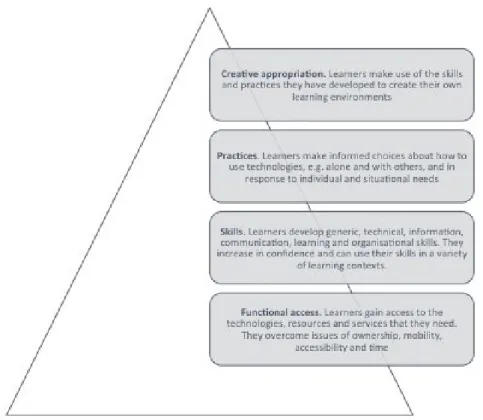
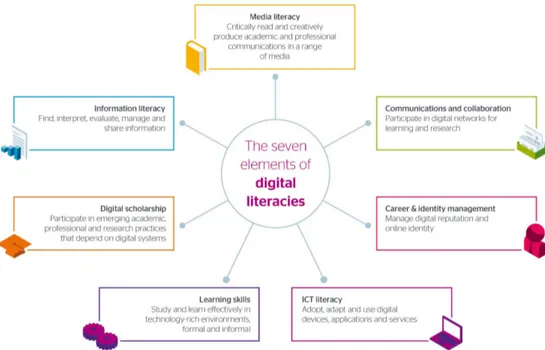
(6) PUBLICACIONES, 48(1) - 2018 pp. 109 - 126. Figure 1. A developmental model of effective e-learning redrawn from Sharpe and Beetham 2010.. The burst of interesting technology enhanced learning that the CLL and DLL programmes drew on and developed was also reflected in the publication of two edited volumes of academic papers that set out the pedagogic rationale for bringing new media types into teaching practices (Beetham and Sharpe, 2007; Sharpe, Beetham and de Freitas, 2010). The 2010 volume contained a paper by Sharpe and Beetham that described a developmental model of effective e-learning (Sharpe and Beetham, 2010,see figure 1), based on a hierarchical pyramid. This model, in a slightly modified form (access and awareness, skills, practices, and identity moving up the pyramid) (Jisc, 2014) appears as the originator of the first Jisc framework, created by Helen Beetham and called the Digital Capabilities Framework (see figure 2).The model was influenced by the language of SCONUL’s Pillars around media and information literacies, but also captured more technology inspired language such as collaboration and communication, and was presented in a visually engaging hub and spoke design. 114.
(7) PUBLICACIONES, 48(1) - 2018 Developing Digital Skills and Literacies in UK Higher Education: Recent developments and a case study of the Digital Literacies Framework at the University of Brighton, UK.. Figure 2. Jisc’s 2014 Digital Literacies Framework (source https://www.jisc.ac.uk/ guides/developing-digital-literacies).. In 2013 the European Commission published DigComp, an influential framework that aimed to improvecitizen’s digital skills, help policy makers develop policy, and inform education and training initiatives. While it was not aimed at the higher education sector specifically the first iteration was particularly used in the context of employment, education and training, and lifelong learning (Vuorikari et al, 2016 p.5). Initially, DigComp was divided into 5 categories (information, communication, content creation, safety and problem solving) including 21 competencies with three proficiency levels described for each competence (Ferrari, 2013). The next version of the DigComp framework (Ferrari et al, 2014) again contained 21 competencies (slightly modified) divided into 5 areas: 1. Information and data literacy; 2. Communication and collaboration; 3. Digital content creation; 4. safety; 5. problem solving, again with 3 proficiency levels for each competency. The five areas have different characteristics: “information, communication, and content creation are rather linear while safety and problem solving are more transversal. This means that while areas 1 to 3 deal with competences that can be re-traced in terms of specific activities and uses, areas 4 and 5 apply to any type of activity that is carried out through digital means” (Ferrari et al, p.7). 115.
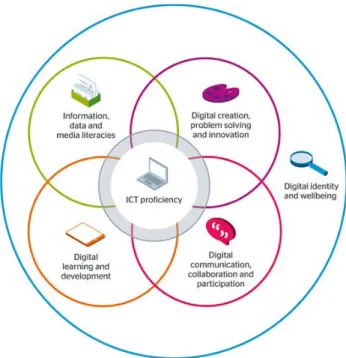
(8) PUBLICACIONES, 48(1) - 2018 pp. 109 - 126. The shift in use of language and the streamlining of descriptors during that period reveals changes in terminology around digital skills and technology use (see Vuorikari et al, 2016), but also demonstrates the development of more nuanced approaches to characterising digital skills that reflected a deeper exploration of what being digitally literate meant in practice.. Figure 3. Jisc’s 2015 Digital Capabilities Framework (source https://www.jisc.ac.uk/ rd/projects/building-digital-capability).. The most recent iteration of Jisc’s Digital Capabilities Framework was released in 2015,(see figure 3), based on evaluation of its use and on going referencing to other frameworks such as SCONUL’s (see Clay, nd). Visually the change in the Framework design includes a shift to overlapping areas to suggest the way that capabilities support each other, and a shift to having ICT proficiency at the centre as an access point to other skills. It also pulls out Digital Identity and Wellbeing as encompassing issues. This suggests a developmental model which draws on the original eLearning model merging “the ‘elements’ of digital literacy with the pyramid model, showing basic ICT operations as foundational, and digital identity as the capstone or culmination of the other digital practices” (Beetham, 2015). The incorporation of digi116.
(9) PUBLICACIONES, 48(1) - 2018 Developing Digital Skills and Literacies in UK Higher Education: Recent developments and a case study of the Digital Literacies Framework at the University of Brighton, UK.. tal wellbeing into this framework identifies a new type of digital capability, the ability to manage the issues relating to digital technology use, such as work-life balance. Both DigComp and Jisc’s frameworks were developed, published, evaluated and updated in a short period of time. Their evolution demonstrates a move towards standardisation of high level categories based on finding information, communicating information, creating content, safety, and digital learning, and identifies the on-going challenge of ensuring that vocabulary remains up to date and engaging. There is increasing recognition of how the different characteristics of literacies shape their use, including a move towards hierarchies and transversal skills which draw on values and awareness of the implications of digital technology use. THE UNIVERSITY OF BRIGHTON’S DIGITAL LITERACIES FRAMEWORK The University of Brighton’s Digital Literacies Framework is an online resource that identifies the key digital literacies that academic staff at the University of Brighton are encouraged to have. It contains brief rationales for each of the literacies and links through to online resources that help staff develop literacies and their associated digital skills. The development of the Framework is deeply rooted in the developments in the sector outlined above. The initial idea for developing a project on digital literacies began in 2012 with the development of a draft Digital Literacies policy in response to the University’s strategic commitment to digital transformation. The decision was made to focus on increasing academic staff skills that would then support the development of students’ digital skills. The existing support and expertise around digital literacies and skills was widely distributed across the institution, so it quickly became apparent that the solution would involve all of these partners working in an implementation group, including staff from the library, the Centre for Learning and Teaching, and learning technologists. This combination of expertise addressed the range of digital needs of academic staff, provided access to support and skills development materials, helped develop technical solutions to presenting the initiative, and importantly, brought a solid pedagogical rationale to the initiative’s development. The University applied for and won one of the consultancy packages offered as part of the CLL scheme, and worked alongside the consultant to iden117.
(10) PUBLICACIONES, 48(1) - 2018 pp. 109 - 126. tify a project and create a plan for taking it forward. It was decided to create a framework which would be a web based portal based around literacies with links to (rather than containing) supporting materials. Following extensive consultation and piloting this developed into a framework consisting of 38 literacies divided into four categories: Learning and Teaching, Research, Communication and Collaboration, and Administration. The development of the DLF, including the institutional policy environment and management are described in Newland and Handley (2016). The terms digital literacies was used explicitly to differentiate between literacies and digital skills.Digital literacy is a reflective skill about judging when to use particular technologies. This influenced the development of the DLF as, in principle, none of the literacies referred to a particular technology, but rather to broader issues or groups of technologies, for example ‘Finding and creating resources’. In practice this was hard to avoid, but in these instances the emphasis was placed on an awareness of a technology rather than an ability to use it.. 118.
(11) PUBLICACIONES, 48(1) - 2018 Developing Digital Skills and Literacies in UK Higher Education: Recent developments and a case study of the Digital Literacies Framework at the University of Brighton, UK.. Table 2 The list of literacies in the University of Brighton’s original Digital Literacies Framework.. Core. Further. Learning and Teaching. Research. Communication Administration and Collaboration. Detecting plagiarism; eMarking and eFeedback; eSubmission; Finding and creating resources; Implementing Blended Learning effectively; Minimum usage - studentcentral. Evaluating information; Keeping legal; Keeping up to date; Managing information; Open access publishing; Planning a research project; Publishing your work; Referencing; Understanding copyright. Programming. Collecting Tweeting; and analysing Using mobile tedata chnologies in field work/work placements. Blogging; Emailing; Managing digital identity; Presenting; Texting; Using discussion forums; Using mobile technologies in lectures; Using social networks; Using wikis. Managing digital media – images, video, audio; Managing time; Protecting your data; Using spreadsheets; Word processing. Knowing your digital environment; Managing budgets; Managing tasks; Managing projects; Understanding data analytics. The DLF was developed before either the Jisc Digital Literacies Framework or DigComp were published. Its four categories of learning and teaching, research, communication and collaboration, and administration were there forebased on the needs of the University of Brighton at the time. The learning 119.
(12) PUBLICACIONES, 48(1) - 2018 pp. 109 - 126. and teaching category, and many of the literacies within communication and collaboration, were developed with a clear idea of supporting staff in developing their teaching and assessment practices. The research and administrative categories were included partially to reflect the way that UK academics’ workloads are distributed between teaching, research and administrative roles. This also served the purpose of making it inclusive to academic staff involved solely in research, and to professional services staff involved in administration. The literacies within the categories were proposed by the project partners and included core and further literacies to identity those required by the digital literacies policy and those which it was felt were important to include. The first iteration of the Framework was intended to be adapted to the needs of particular disciplines through being supplemented by discipline specific competences developed by Schools across the University (see Newland and Handley, 2016).. Figure 4. The logo of the original Digital Literacies Framework.. After a pilot period the original DLF was launched in summer 2014with a distinctive colour scheme and logo which represented the colour ways of the categories and their associated literacies (figure 4). The use of the DLF was evaluated over the following 18 months. During this time, both DigComp and the latest version of the Jisc’s Digital Capabilities Framework were published, 120.
(13) PUBLICACIONES, 48(1) - 2018 Developing Digital Skills and Literacies in UK Higher Education: Recent developments and a case study of the Digital Literacies Framework at the University of Brighton, UK.. and it was felt it was time for a more profound review. This drew on comparison to these frameworks, relevancy to current University initiatives, sector currency, and staff interest based on data gathered from web pages visits and demand for face-to-face sessions. As a result, the number of digital literacies in the framework was reduced from 39 to 20. Even within the space of two years some of the terminology was out dated (e.g. social networks) and was changed or removed, and the technology landscape had shifted, partially as a result of more standardised approaches to considering digital skills through the development of frameworks, but also the realisation that phenomena such as programming were having less impact on higher education than expected, while others e.g. learning analytics were growing in importance. The refresh was also an opportunity to ensure that the Framework continued to clearly support current university processes and initiatives, and the links to support materials were updated to include resources on Lynda.com which the University had recently subscribed to. The site was moved to a WordPress platform, and relaunched in summer 2016, see the Digital Literacy Framework. USING AND DEVELOPING FRAMEWORKS One of the key issues that came out of the evaluation of the first DLF was that the Framework was not being used in the main way that it was intended (Newland and Handley, 2016). It had been developed for individual academic staff to explore, using a record to monitor how they engaged with the literacies, and through formal professional development. However, in reality, individual use of the DLF was through individuals looking at particular literacies rather than exploring the whole framework. Individuals who did engage with the whole framework were undertaking formal staff development through taking the University of Brighton’s externally accredited Professional Recognition and Development Scheme and Postgraduate Certificate in Learning and Teaching in Higher Education (PGCert), which required this engagement. The evaluation also demonstrated that course leaders were using the DLF to identify expectations around digital skills and generate ideas for developing the capabilities of their course teams. The DLF is less of a complete solution for developing an individual’s literacies, and is more a starting point for individual and course reflections on digital skills, leading to other activities such as requests for, or attendance at face-to-face sessions. It is also being used to supporting changes to the under121.
(14) PUBLICACIONES, 48(1) - 2018 pp. 109 - 126. graduate curriculum through helping course teams reflect on blended learning practice. A student-facing version of the DLF is in development based on partnership with the many people support students’ digital literacies across the University, including the library, the careers service, learning technologists and study skills support. This development will be shaped through partnership with students by aligning this to University of Brighton initiatives such as Peer Assisted Study Sessions. Externally, Brighton’s DLF has been cited as a case study by a range of institutions including the QAA (Quality Assurance Agency), UCISA, and by Jisc through its website (Beetham, 2017) and through participation in various Jisc events such as DigiFest and ConnectMore, which also promote their own Digital Capabilities Framework. This now sits at the centre of Jisc’s building digital capabilities project. The basic model has been supplemented by the creation of seven digital capability profiles (HE and FE teachers, learners, library and information staff, learning technologists, researchers, and leaders) which support its implantation within institutions. It is being used in initiatives such as developing institutional leadership and in supporting teams in developing curricula. It also forms the basis the Digital Capability Discovery Tool, which is an online tool in development, that allows individuals to reflect on their digital confidence. The journey of the development of the University of Brighton’s DLF, Jisc’s Frameworks and DigComp reflects the rapid development of thinking about digital skills and literacies, and their central role in staff and institutional development is being recognised internationally (Adams Becker et al, 2017 p.22). While the aim of the frameworks was initially to structure engagement with digital skills and literacies, the linear route and complete solutions that a framework suggests is being challenged by evidence for complex and partial engagement with frameworks, for example through the overlapping of Jisc’s categories and the use of the Brighton framework as a starting point for reflection. Embracing these diverse of using frameworks and creating framework designs that acknowledge that is key, not least because these local, partial and adaptive uses of frameworks are totally appropriate to the concept of digital literacy. It will be interesting to discover through further research how useful the more linear elements that remain in frameworks such as DigComp’s proficiency levels are in practice. The University of Brighton’s framework remains distinctive through being very specific to the needs of academic staff within this particular institution and this remains its key strength. It remains relevant because it sets out both 122.
(15) PUBLICACIONES, 48(1) - 2018 Developing Digital Skills and Literacies in UK Higher Education: Recent developments and a case study of the Digital Literacies Framework at the University of Brighton, UK.. institutional expectations and the wider context of digital literacies in the HE sector. It acts as a catalyst for institutional change by generating ideas for staff development, and its institutional focus means that it can be used effectively in new initiatives such as the current redesign of the undergraduate curriculum, and easily evolved to incorporate, for example, student-facing literacies. CONCLUSIONS The past seven years have seen a rapid development of frameworks being created, used, evaluated and modified in higher education. The pace of this change reflects the rapid evolution of terminology relating to technology, but also an increasingly sophisticated understanding of the contexts within which people learn and use digital skills. Raising awareness of this context, and encouraging people to reflect on it is becoming an increasingly important part of developing digital literacies. While the use of frameworks is unpredictable, the way that people appear to be using and adapting frameworks for their own needs is a positive sign of digital literacy in action. It seems likely that there will now be a period of stability in the development of existing frameworks, as the projects and initiatives that they have generated are rolled out. The emphasis will now turn to an evaluation of their effectiveness in promoting digital skills and literacies. REFERENCES CITED Adams Becker, S., Cummins, M., Davis, A., Freeman, A., Hall, A., Giesinger, C. & Ananthanarayanan, V. (2017).NMC Horizon Report: 2017 Higher Education Edition, Austin, Texas:The New Media Consortium. Beetham, H. (2015). ‘Revisiting Digital Capability for 2015’, JISC Digital Capability Codesign Challenge Blog, (11 June 2015)https://digitalcapability.jiscinvolve.org/wp/2015/06/11/revisiting-digital-capability-for-2015/. Beetham, H. (2017). ‘Case Studies: Journeys towards digital expertise’, Jisc Building Digital Capability Blog, (20 March 2017) https://digitalcapability.jiscinvolve.org/wp/2017/03/20/case-studies-journeys-towards-digital-expertise/.. 123.
(16) PUBLICACIONES, 48(1) - 2018 pp. 109 - 126. Beetham, H., McGill, L. and Littlejohn, A. (2009).Thriving in the 21st Century: Learning Literacies for the Digital Age (LLiDA project). Glasgow:Caledonian University. Beetham, H. & Sharpe, R. (Eds.), (2007).Rethinking Pedagogy for a Digital Age: Designing learning for the 21st century, 1st edition. Abingdon: Routledge. Clay, J. (nd). Building Digital Capability, SCONUL Focus, 67 pp. 43-46. Facer, K. (2011).Learning futures: education, technology and social change. London:Routledge. Ferrari, A. (2013).DIGCOMP: A Framework for Developing and Understanding Digital Competence in Europe. Luxembourg:Publications Office of the European Union. Ferrari, A., Brecko, B. & Punie, Y. (2014). DIGCOMP: A Framework for Developing and Understanding Digital Competence in Europe, eLearning Papers, 38 (May 2014) pp. 1-15. Garrison, D. R. & Vaughan, N. D. (2008).Blended Learning in Higher Education: Framework, Principles and Guidelines. London:John Wiley and Sons. HM Government (2013).International Education: Global Growth and Prosperity. London:Department for Business, Innovation and Skills. HEFCE (2015).Changing the Learning Landscape: Connect to the future. Final Report. Bristol:HEFCE. HEPI, Davies, S., Mullan, J. & Feldman, P. (2017).Rebooting Learning for the Digital Age: What next for technology-enhanced higher education?. Oxford:Higher Education Policy Institute. JISC (2014). Developing Digital Literacieshttps://www.jisc.ac.uk/guides/developing-digital-literacies. Johnson, L., Adams Becker, S., Cummins, M., Estrada, V., Freeman, A. & Hall, C. (2016).NMC Horizon Report: 2016 Higher Education Edition. Austin, Texas:The New Media Consortium. Johnson, L., Adams Becker, S., Estrada, V. & Freeman, A. (2014).NMC Horizon Report: 2014 Higher Education Edition. Austin, Texas:The New Media Consortium. Johnson, L., Adams Becker, S., Estrada, V. & Freeman, A. (2015).NMC Horizon Report: 2015 Higher Education Edition. Austin, Texas:The New Media Consortium.. 124.
(17) PUBLICACIONES, 48(1) - 2018 Developing Digital Skills and Literacies in UK Higher Education: Recent developments and a case study of the Digital Literacies Framework at the University of Brighton, UK.. McGill, L. & Beetham, H. (2015).Framing Digital Capabilities for UK HE and FE staff: frameworks reviewhttps://docs.google.com/document/ d/1Uq0lw18XVqow5sUBQniJrpcV1qF1sPqKSC73SdvhPQU/edit#heading=h.6klyzwujaliv Newland, B. & Handley, F. (2016). Developing the Digital Literacies of Academic Staff: An institutional approach, Research in Learning Technology, 24. PWC (2015) The 2018 Digital University: Staying relevant in the Digital Age. London:PWC SCONUL (1999).Information skills in higher education: briefing paper. London: SCONUL. SCONUL (2011). The SCONUL 7 Pillars of Information Literacy: Core Model for Higher EducationLondon: SCONUL. SCONUL (2013).7 Pillars of Information Literacy through a Digital Literacy ‘lens’ https://www.sconul.ac.uk/publication/digital-literacy-lens-on-the-sconul-seven-pillars-of-information-literacy Selwyn, N. (2016).Education and technology: Key issues and debates. London, United Kingdom:Bloomsbury Academic. Sharpe, R. & Beetham, H. (2010). Understanding students’ uses of technology for learning: Towards creative appropriation. In Sharpe, R., Beetham, H. & De Freitas, S. (Eds.), Rethinking Learning for a Digital Age: How Learners are Shaping Their Experiences,Abingdon: Routledge, pp. 8599. Sharpe, R., Beetham, H. & De Freitas, S. (Eds.), (2010).Rethinking Learning For a Digital Age: How learners are shaping their own experiences. Abingdon:Routledge. UCISA (2015).Digital Capabilities Report 2014. Oxford:UCISA. UK Commission (2014). The Future of Work. Jobs and skills in 2030. Rotheram: UK Commission for Employment and Skills. Vuorikari, R., Punie, Y., Carretero, S. & Van den Brande, L. (2016).DigComp 2.0: The Digital Competence Framework for Citizens. Update Phase 1: the Conceptual Reference Model. Luxembourg: The Publication Office of the European Union.. 125.
(18) 126.
(19)
Figure
Documento similar
We advance the hypothesis that fraudulent behaviours by finan- cial institutions are associated with substantial physical and mental health problems in the affected populations.
Regarding the question of how higher education institutions can affect the development of entrepreneurship and innovation, the analyzed case study shows that the methodologies evolved
Epidemiological study of latent and recent infection by Toxoplasma gondii in pregnant women from a regional population in the UK.. Journal
The aim of this research is to comparatively analyze the results in terms of literacy itself, digital skills and digital resources and experiences according to the PISA 2018 report
The main purpose of the present study is to validate a test, based on the Framework for Developing and Understanding Digital Competence in Europe (DigComp), for
Student Support & Wellbeing Intercultural Issues in Education Secondary Education Experiences ICT Skills and Digital Literacy Research on Higher Education
The Dwellers in the Garden of Allah 109... The Dwellers in the Garden of Allah
This paper explores students’ perceptions of their level of digital competence in the context of higher education, based on a case study of students at Gansu Agricultural University
