
Study of the reasons for and measures to avoid plagiarism in young students of education
25
0
0
Texto completo
(2) Study of reasons for and meausures to avoid plagiarism in young students of education. Resumen Internet se ha convertido en una fuente de información para la mayoría de los jóvenes. Ofrece oportunidades, pero también plantea peligros para los que deben adquirir habilidades digitales. Este es el caso de los jóvenes estudiantes que pretenden convertirse en maestros, quienes a su vez deberán capacitar a otros jóvenes en estas habilidades digitales. La investigación se centra en las opiniones de los estudiantes sobre dos temas relacionados con prácticas deshonestas: a. la razón o las razones por las cuales ellos y sus compañeros estudiantes plagian y, b. Buscar soluciones para evitar el plagio académico. El estudio analiza datos de 539 estudiantes de facultades de educación de ocho universidades y dos países diferentes (Portugal y España). Se ha encontrado un modelo común para los jóvenes desde instrumentos validados. Existe un patrón común en los estudiantes de todas las universidades y países estudiados, justificado por tres razones interrelacionadas para plagiar: razones “internas” y “externas” a los estudiantes y la falta de motivación requerida para la tarea.. Palabras clave: formación inicial de docentes; plagio; trabajo ético. 1. Introduction In the specialized literature of the last decade, we can see that the studies first aim to agree on what constitutes dishonest behaviours and describe how many of these students practice according to anonymous surveys and later go on to other studies that analyze the reasons and explanations that students offer for such behaviours, the factors that favor them, along with strategies for their prevention. More recently the studies have been grouped under the same topic: academic integrity, as it is included in the Bretag Handbook (2016), where we find Fishman's (2016, p.8) definition as "acting in accordance with values and principles consistent with ethical teaching, learning, and scholarship". When the factors that are related to this problem are analyzed, it is observed that it is a multi-causal phenomenon (Sureda, Comas & Urbina, 2005; Sureda, Comas & Morey, 2009), because it involves not only issues related to the social context and technological development such as the ease of access, manipulation, distribution, ... information, but also personal aspects (motivations, beliefs and values of each individual) and institutional aspects, such as the academic organization and teacher training (Cebrián-Robles, Raposo-Rivas & Sarmiento-Campos, 2016). So, we cannot ignore that we are facing a problem that not only affects the true authors of intellectual works, but also the integrity and ethics of future teachers. This is the main context for this study. Therefore, we will study the reasons and possible solutions against plagiarism, from the students´ own vision, as well as the preventive measures that have been successful. This is without a doubt, the most realistic way to face this problem: talking to those who promote it, knowing their reasons, and asking how they could be avoided. If we do not have the opinion and experience of the students, we will only be tackling the problem from a punitive or decontextualized view, without paying attention to the origin.. 51.
(3) Study of reasons for and meausures to avoid plagiarism in young students of education. In this way, the two questions of this investigation arise: . What is the reason for the plagiarization of young university students of Education Sciences?. . What are the possible solutions to plagiarism that these young people consider?. Next, we review the main reasons for plagiarism, together with the solutions and preventive measures identified in the specialized literature, to finally describe the research carried out and the main results and conclusions obtained. 1.1.. Reasons for the plagiarism. To understand the motives and reasons for plagiarizing, more and more research is coming to light that seeks a more comprehensive and explanatory understanding of the reasons, causes and actions that can prevent rather than punish (Adam, Anderson, & Spronken-Smith, 2017; Amiri & Razmjoo, 2016). One of the first works to identify the reasons for plagiarism was that of Ashworth, Bannister & Thorne (1997). These authors identified as reasons for cheating and plagiarism in academic work and assessment: lack of awareness of students about whether they are plagiarizing or not, the low probability of being detected, the pressure from of the level of exigency and the terms established for the deliveries and the own writing of the activities provided by the teachers. In the study of Rebollo-Quintela, Espiñeira-Bellón & Muñoz-Cantero (2017) with 128 university students identify that the answer to the different items with homogeneity, alluding to non-controllable external factors, such as the lack of coordination of the teaching staff in their demand for work from the students, followed by work overload for the students as well as the impossibility of teachers being able to assess all assignments with the attention to detail required. The number of exams and lack of time are also quoted. One of the most common causes of plagiarism can be the excessive demands (in terms of volume and deadlines) for the delivery of research projects. This, coupled with the students’ problem of self-management of time, self-regulation of their learning and procrastination (Sureda-Negre, Comas-Forgas & Oliver-Trobat, 2015), understood as "unnecessary and unjustified delay of the tasks related to the studies" (Rodríguez & Clariana, 2017, p.45) are factors that correlate with dishonest practices. Thus, it has been found that when procrastination is high it correlates with a low academic performance of students, at the same time as it correlates with a low motivation towards homework (Garzón & Gil, 2017). Also, in many cases, the ignorance of the APA norms on how to cite the homework of others, is a motive for dishonest practices (Montenegro, 2017) which places the responsibility on the institution to develop a targeted training programme to this end. The digital and generational gap between students and teachers plays an important role too, where the students feel more confident in the digital domain, and. 52.
(4) Study of reasons for and meausures to avoid plagiarism in young students of education. think that they will not be detected by teachers (Sureda, Comas & Urbina, 2005). Several of these factors could have a common denominator: the self-regulation of learning. This does not have an innate or spontaneous development. From the perspective of teachers, according to Sureda, Comas & Morey (2009) the four most relevant causes associated with academic plagiarism among students, are: the comfort, the facilities offered by the Internet, the feeling of impunity and not knowing how to perform academic works. So, in the Ibero-American context, studies on plagiarism are recent, being Comas-Forgas & Sureda-Negre, (2010) pioneers in a solid body of studies research, and there has been a recent increase in studies on this topic. Montecinos (2013) studies the increase of plagiarism in scientific research associated to the current technological development and with the culture of copypaste. Sureda-Negre, Comas-Forgas & Oliver-Trobat (2015) focus their research on preuniversity levels investigating the prevalence of plagiarism and its relation to gender and procrastination. With the participation of 2.794 persons, the results show that the practices that constitute plagiarism are widespread. Ochoa & Cueva (2016) through a qualitative study identify personal, social and academic factors that explain plagiarism behaviors. Among the first are the lack of time and vocational disorientation; as social factors, the conditions of precariousness in which teachers work and the low cultural capital of the students and as academic factors the lack of accompaniment by teachers in academic writing processes and methodologies that do not encourage the construction of knowledge. Cebrián-Robles, Raposo-Rivas & Sarmiento-Campos (2016) and Cebrián-Robles, Raposo-Rivas, Cebrián-de-la-Serna & Sarmiento-Campos (2018) analyze this phenomenon in Faculties of Education from Spanish public universities. Results show lack of mechanisms to prevent dishonest practices and allow confirming the poor attention paid to plagiarism. Despite these studies, it is still necessary to do more in depth research, from broader frameworks than a university or a country, as it would be within the framework of the European Higher Education Area (EHEA). The study that we present below analyzes data collected in two countries (Spain and Portugal). 1.2.. Solutions and preventive measures of plagiarism. The literature review shows four preventive actions of success against plagiarism: a. Preventive vs. punitive actions. Ethical training moves away from punishment as a strategy and aims to focus all efforts on prevention (Sattler, Wiegel & Veen, 2017), asking students to become aware of the importance of respect for copyright. For this to be possible, the literature 53.
(5) Study of reasons for and meausures to avoid plagiarism in young students of education. makes different recommendations. For Gómez-Espinosa, Francisco & Moreno-Ger (2016) the relationship between the academic and students should be closer, creating a space where students can offer their own ideas. Along the same lines, RamírezBarreto (2017) proposes to involve students in building ethics committees. This author talks about a "device for ethics" or "ethics with devices" to refer to collegiate bodies, whose purpose is to cultivate a sense of ethics in scientific and academic work as well as combating what she calls "self-absolution" for faults committed. No doubt addressing the problem in a conversation with students is to address the problem directly with them, not against them. b. Initiatives of libraries and information skills training. The institution as a whole and the staff must consider the problem of plagiarizing and participate in the strategies that are planned and developed. However libraries are the most suitable service to centralize and offer training in "informational competence", such as promoting changes in the university community towards an "ethical use of information" (Domínguez-Aroca, 2012). In fact, they are the centers where the majority of students consult resources, books and journal databases. The proximity of libraries to users, together with faculty and center teachers, is an essential requirement to address the difficult behavioural changes that students and the entire university community require. This collaboration between the entire university community becomes necessary, because as was proven in the study by Adiningrum (2015), there was a pattern of behaviour regarding plagiarism with both students and faculty members. Therefore, informational competence goes through training on how to quote and make references, how to manage information for academic work, talks about plagiarism and develops feedback on formative and summative evaluations, as integral and successful training measures, as the work of Eaton, Guglielmin & Otoo (2017) concludes. c. Antiplagiarism tools and standards. Rules alone do not change behaviours. Likewise, the plagiarism detection tools, beyond the technical efficacy of the same, are not sufficient measures to avoid dishonest behaviours. The institutional measures that have combined preventive strategies together with dissuasive regulations and plagiarism tools have been the most successful. Examples are found in the work of Youmans (2011), where plagiarism correlates inversely with the knowledge of the tools and the preventive work of the norms. However, what makes standards and codes of honour more valuable is to be a cause for debate and discussion, as Fishman (2016) says of "shared values", who believes that we should analyze the values of training as a value in itself, and not so much as an instrument for the achievement of objectives to which one is tempted "to take shortcuts to speed up the process" (p.19).. 54.
(6) Study of reasons for and meausures to avoid plagiarism in young students of education. d. Review of the programs, the design of tasks and the workload (workload). We must consider the design of tasks that are more motivating, appropriate to the real workloads and times of the students, with demands for clear, explicit and transparent evidence for their purpose. As proposed by Heckler, Forde & Bryan (2013) when they checked the preventive design of tasks, when they requested a reflection on the type of information used by students, the sources and the quotes extracted from the internet are justified. In this way, the exercises were more transparent about the information used, and this may even lead to an opportunity to facilitate a formative and peer assessment (McGowan & Lightbody, 2008). At the same time, analyzing all the different successful strategies that institutions can implement, we can deduce four main factors of institutional success: a) To know in more depth what are the causes and reasons are for students plagiarizing at each institution, implicating them (the students) in the problem; b) promote training programmes and evaluate their impact; b) review the clarity and pertinence of the standards involving students and setting up technological systems for the detection of plagiarism; c) and finally, analyze the curricular programs to eliminate possible temptations to employ dishonest practices (for example, review the workload of the subjects). These four factors are basic, because as Sattler, Graeff & Willem (2013) would say, students' behaviors are based on a "rational decision" where there is a balanced balance between utility, internalized norms and the facility to plagiarize. Therefore, a review and analysis of these four factors that explain their existence and why they occur, can lead us to a better understanding of the problem and to making more informed decisions.. 2.. Methodology. This work is part of a broader I+D+i (1) project, linked to evaluation practices in the Faculties of Education. Its objective is to study the motivations, together with the preventive practices and possible solutions, that identify future young graduates of the Faculties of Education in the Iberian Peninsula (Spain and Portugal). This study is aimed at finding possible common patterns that justify the reasons and motives for these dishonest practices to occur. It is based on a non-experimental research design of an exploratory-descriptive sequential nature (Hernández, Fernández & Baptista, 2014) that evolves towards an explanatory approach.. 55.
(7) Study of reasons for and meausures to avoid plagiarism in young students of education. 2.1. Research participants Information has been collected from students of the Faculties of Education in eight universities belonging to Spain and Portugal. A strategic and intentional sampling is used (Perelló, 2009) responding to three criteria: . Belonging to the universities that participate in the aforementioned R+D+i project.. . That the levels of degree/master study are represented.. . Presence of different university degrees in the field of Educational Sciences: Primary education, Infant education, Social education, Pedagogy, Master of Secondary Education (specific for the training of teachers of secondary education), and other masters related to education (for example, in learning difficulties, in specific needs of educational support).. Participants were 539 students, 418 (77.6%) women and 121 men (22.4%), aged between 18 and 22 years old (320 young people, 59.4%), and 219 are older than 22 years old (40.6%), taking as a reference the most common age interval that who are being trained to be teachers (18-22 years old) in the spanish and portuguese faculties of education. 2.2.. Data collection. The instrument for collecting information was a validated on-line questionnaire (Comas-Forgas & Sureda-Negre, 2010; Ehrich et al., 2016; Sureda-Negre, Comas-Forgas & Oliver-Trobat, 2015). It has a total of 17 questions with variable response options (dichotomous, scale and open response) organized into four sections (Cebrián-Robles, Raposo-Rivas, Cebrián-de-la-Serna & Sarmiento-Campos, 2018): contextualization data (university, gender, age, degree and course); plagiarism and its motivations and reasons ; solutions to avoid plagiarism, measures to be taken in case of plagiarism and specific training on the subject. Cronbach's alpha in the questionarie is 0.881. According to George and Mallery (2003), these are good values (> 8) or excellent values (> 9). In order to answer the two research questions posed, this article focuses only on three questions of the questionnaire allow us to find out if there is a relationship between three positions of the plagiarism phenomenon: a) “Me in face of the plagiarism”, the motivation that the students have to plagiarize (question 1, with 17 items) b) “others and plagiarism”, the attribution of the behavior of plagiarism in the rest of students (question 2 with 16 items). 56.
(8) Study of reasons for and meausures to avoid plagiarism in young students of education. c) “possible solutions", the possible solutions to the act of plagiarizing (question 3, with 13 items) If this relationship exists, what is the structure of such relationships and if age is a determining factor. These 46 items that are studied from a five-degree Likert-type scale, in which the level of agreement or disagreement existing with them is indicated.. 3.. Data analysis and results. In a previous work (Cebrián-Robles, Raposo-Rivas, Cebrián-de-la-Serna & Sarmiento-Campos, 2018) we have identified a factorial model that allows us to relate: the concept that young university students have over the construct "plagiarism"; the actions in which they perform "partial" and "total" plagiarism; the reasons for plagiarism, which can be "internal" (something I do not know, I do not understand ...) and "external" (lack of time, skills, ...); as well as "disinterest" or lack of motivation for the subject or the task. From it, the possible solutions to this phenomenon are linked. Of this pentagonal model of five variables (concepts, actions, reasons, disinterest and solutions), here we focus on the analysis of two of them (reasons vs solutions) with age as a determinant of plagiarism. For this, a factorial and exploratoy analysis is carried out. A factorial analysis is performed to know the structure and relationships of the 46 items of the 3 questions. As we are more interested in the relations among questions and among elements of the same, and not so much to discover underlying factors, the analysis of main components is used as a method of extraction and normalization Oblimin with Kaiser as rotation method. KMO and the Bartlett sphericity test have been used as measures of sample adequacy. Their results are 0.825 and 8080.846 (p = 0.000) respectively, which comes to conform the adequacy of the sample for the statistical test. With this analysis, 10 factors have been identified that explain 63% of the variance (see Table 1). Table 1 Extracted factors and variance explained. Kaiser criteria. Factor. Initial Eigenvalues. Extraction Sums of Squared Loadings. Total. % of Variance. Cumulative %. Total. % of Variance. 1. 9,729. 21,150. 21,150. 9,729. 21,150. 2. 4,680. 10,174. 31,324. 4,680. 10,174. 3. 3,193. 6,941. 38,265. 3,193. 6,941. 4. 2,769. 6,020. 44,285. 2,769. 6,020. 5. 2,057. 4,472. 48,757. 2,057. 4,472. 6. 1,587. 3,451. 52,208. 1,587. 3,451. 57.
(9) Study of reasons for and meausures to avoid plagiarism in young students of education. 7. 1,344. 2,921. 55,129. 1,344. 2,921. 8. 1,311. 2,849. 57,978. 1,311. 2,849. 9. 1,144. 2,488. 60,466. 1,144. 2,488. 10. 1,115. 2,425. 62,890. 1,115. 2,425. Table: Own elaboration. * p =0.00. Given that the three questions studied are made up of a relatively high number of items (46), an exploratory factor analysis (EFA) to identify the structure, see to what extent it coincides with the reference and discover the possible relationships among its elements. To carry out the EFA, the recommendations of Pérez_López (2004), Hair, Anderson, Tatham & Black (1999) and Martínez & Sepúlveda (2012) have been followed regarding the size, composition, suitability and adequacy of the sample. As a method for extracting factors, the principal components were used and the indications of Alaminos, Francés, Penalva-Verdú & Santacreu (2015) and Lloret-Segura, Ferreres-Traver, Hernández-Baeza & Tomás-Marco (2014) when choosing oblimin as a factor rotation method. This method of rotation generates two matrices: the "configuration matrix" where the factorial loads are collected and the "structure matrix", where the correlation between factors and variables is collected. As it was said, our interest focuses on the relationships between questions and their elements, not so much in discovering underlying factors, so they are used, in addition to descriptive analysis, factor analysis with Oblimin as rotation method and cluster analysis, a combination recommended by authors such as González, Carbonell & Santana (2011); Lebart, Morineau & Piron (1995) and Pardo (2007). This combination facilitates the simultaneous analysis from variables and cases. This specific interest in the relationship between questions and items that form them is what leads us to choose the Kaiser (1974) rule, based on the eigenvalue or "eigenvalue greater than one", as a criterion for selecting the number of factors and no other more recommended in the scientific literature. 3.1. Findings 3.1.1. Solutions and motivations to plagiarism that young people find One of the two this research questions are “what are the possible solutions to plagiarism that these young people consider?” So, the average scores obtained in each of the items in question 3 of the questionarie show that the solutions against plagiarism of proactive type are, in general, the statements that obtain higher values (> 4): . Better coordination between the subjects regarding the time required for the tasks given to students (Mean=4,35 and Std.Dev= ,905).. . Clear and specific rules for each case (Mean=4,32 and Std.Dev= ,919). 58.
(10) Study of reasons for and meausures to avoid plagiarism in young students of education. . More follow-up and support by teacher during the task (Mean=4,22 and Std.Dev= ,994).. . Training on copyright and how to prevent plagiarism (Mean=4,10 and Std.Dev= 1,061).. . Have sources of information that explain and help prevent (Mean=4,08 and Std.Dev= ,971).. . Advice for consultations at any time and place (Mean=4,06 and Std.Dev= 1,063).. . If someone is caught plagiarizing repeat the task (Mean=4,01 and Std.Dev= 1,174).. On the other hand, participants have a high degree of disagreement about coercive solutions or inaction: "if someone is caught plagiarizing to expel him from the university" (Mean=1,55 and Std.Dev= ,971) or that it is not necessary to take "any action, because in education the plagiarism can be considered as learning from others by imitation "(Mean=2,0 and Std.Dev= 1,255). Secondly, the motivations for the plagiarism of young university students of the Faculties of Education are related above all to ignorance, disinterest and improvement in qualifications: . For acquiring a higher rating (Mean=3,85 and Std.Dev= 1,176).. . Because I didn’t know how to quote (Mean=3,79 and Std.Dev= 1,254).. . There are many tasks, time is badly organized and they did it at the end (Mean=3,78 and Std.Dev= 1,163).. . For lack of interest in the task (Mean=3,78 and Std.Dev= 1,220).. . For writing about something they do not understand (Mean=3,77 and Std.Dev= 1,081).. . For writing about something they do not know (Mean=3,74 and Std.Dev= 1,100).. . For having to write a very extensive work to which they were not accustomed (Mean=3,61 and Std.Dev= 1,187).. . For not knowing the proper use of citations (Mean=3,5 and Std.Dev= 1,551).. On the contrary, they do not agree (values < 2) with external justifications such as the lack of measures and the teaching role: "no action is taken in cases of plagiarism" (Mean=1,64 and Std.Dev= 1,085), "teachers do not have many skills to detect it" (Mean=1,69 and Std.Dev= 1,106), "it is difficult to find out where I copied" (Mean=1,76 and Std.Dev= 1,141), "teachers do not have much time to know if there was plagiarism" (Mean=1,86 and Std.Dev= 1,212) and "plagiarism is justified when teachers ask for too many tasks" (Mean=1,87 and Std.Dev= 1,251). 59.
(11) Study of reasons for and meausures to avoid plagiarism in young students of education. As it was said, with the factorial analysis, 10 factors have been identified that explain 63% of the variance. These factors are (table 2) Table 2 Factors and items asociated with factor load. Factors Factor 1.. Items. Factor load. Write about something I do not know. 0,668. Write about something I do not understand. 0,645. Write a very extensive work that I'm not used to. 0,586. Acquire a higher grade. 0,492. I do not know write so much text in such a short time. 0,480. Ignore the proper use of quotations. 0,461. Factor 2.. Have sources of information that explain and help prevent. 0,771. Solutions against. An advice for consultations at any time and place. 0,771. plagiarism of. Clear and specific regulations for each case. 0,759. Better coordination between the subjects regarding the time. 0,731. Lack of own expertise. Internal motivations. preventive type. required for the tasks given to students More monitoring and support from the teaching staff during the task. 0,660. We need more training on copyright and how to prevent plagiarism Creating an ethical code among all the members of the University. 0,531 0,437. Factor 3.. Teachers do not have sufficient time to know if there was plagiarism. Opportunism in the. It is thought that the teachers do not have enough competence to. plagiarism of the. detect it. others. External. It is difficult to find out where you copied. motivations. 0,838. 0,829. Because there is no danger, no action is taken in cases of plagiarism. 0,775. Plagiarism is justified when the teacher demands too much work of. 0,680. us 0,534 Factor 4.. Writing about something they do not understand. 0,847. Lack of expertise. Writing about something they do not know. 0,824. of the others.. They do not know how to write so much in such a short time. 0,610. They are many tasks, they organize time badly and they did it at. 0,441. Internal motivations. final 0,413. 60.
(12) Study of reasons for and meausures to avoid plagiarism in young students of education. Because they had to complete a very extensive piece of working and they no used to that Factor 5.. Ignore the institutional regulations. 0,711. Lack of expertise. For not knowing the proper use of citations. 0,666. Factor 6.. If you catch someone plagiarizing repeat the subject. 0,818. Remedies against. If you catch someone plagiarizing eject him from the university. 0,807. plagiarism of. Plagiarism detection software. 0,491. Positive actions such as recognizing <the best student of the month>. 0,432. of the others and ignorance. punitive reactive type. If you catch someone plagiarizing that you repeat the task 0,356. Factor 7.. No measures, because in education plagiarism can be considered as. Inaction against. learning from others by imitation. 0,698. plagiarism as a solution Factor 8.. For acquiring a higher grade. 0,785. Desire to improve. Because others copy and have good grades. 0,740. own qualifications.. I felt tempted because others copy and have good grades. 0,490. I never did any of the previous practices. 0,759. Factor 10.. Because there is no danger, no action is taken in cases of plagiarism. 0,759. Opportunism in. Teachers do not have sufficient time to know if there was plagiarism. own plagiarism. Because they did not learn much in the subject. Internal motivation Factor 9. No personal accomplishment of malpractice,. 0,752. It is difficult to find out where I copied The teachers don no have enough competence to detect it. 0,659. For lack of interest in the task. 0,657. Plagiarism is justified when the teacher demands too much work of. 0,634. us. 0,615. I do not know the regulations institutional. 0,570. Are many tasks, I organize time badly and I do it at the end 0,497 0,467 Table: Own elaboration. * p > .03. 61.
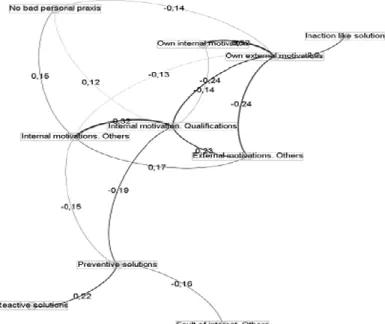
(13) Study of reasons for and meausures to avoid plagiarism in young students of education. Through the interpretation of the factors obtained, the motivations for plagiarism of internal and external type, both own and attributed to others, and proactive and preventive differentiated solutions together with other more reactive and punitive ones are verified. There are no differences in the attributions they make over others and inaction as a solution to plagiarism. To facilitate the visualization of the relations between the factors (Figure 1), from oblimin as a rotation technique we have used Gephi, a tool for visualization, exploration and analysis of all types of networks that is interactive and open source. Its usefulness has been contrasted in several investigations (Álvarez, Kuz & Falco, 2013; Cherven, 2013). The figure 1, Gephi shows the structure of the relationships defined as significant (r> 0.12) among the factors obtained (primary) crystallizes in the secondary factors, alluded to above. The link between preventive and reactive solutions (r = 0.22) is highlighted; the own external motivations and the solution of the no action or "not doing anything before the plagiarism" (r = 0,2). This is not surprising, because if the motivations are external and opportunistic, it is the wish of those who carry out such actions to do nothing about them to stop them. Figure 1. Relationships between the factors that affect plagiarism.. Source: Own elaboration.. 3.1.2. Relations between plagarism and age So, according to age (Figure 2), we found significant differences in factor 1 and 10; notable differences, but not significant, in the block "own motivations in me and in others and external motivations in me".. 62.
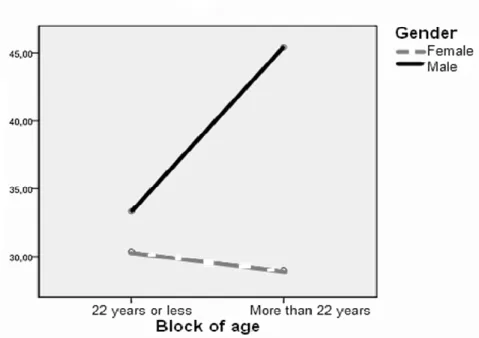
(14) Study of reasons for and meausures to avoid plagiarism in young students of education. Figure 2. Relationship between factors for plagiarism and age.. Source: Own elaboration.. Figure 2 relates age, which appears on the x axis, to the confidence interval (95%) of the values of the factors that present significant differences (factors 1, 4 and 10). The external own motivation (factor 1) to plagiarize seems to be the one that most differs between the two age ranges. In addition, to verify the possible existence of interaction between age and gender, the Univariate General Linear Model that shows a significant interaction (F = 5,249, Sig. =, 022) with respect to the number of plagiarism behaviors has been used as a statistic. what the students do Among men, plagiarism increases significantly with age (Figure 3, in the x-axis the age and in the y-axis the marginal average about the gender), while among women, the level of plagiarism being lower, hardly varies.. 63.
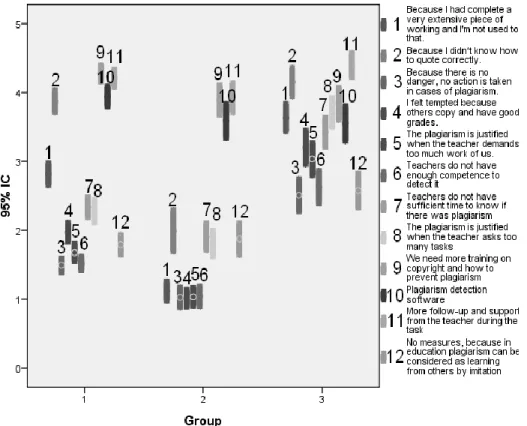
(15) Study of reasons for and meausures to avoid plagiarism in young students of education. Figure 3. Relationship between plagiarism, gender and age.. Source: Own elaboration.. 3.1.3. User profiles in the face of plagiarism After the factorial analysis, a study of the results was carried out from the perspective of the students (not from the variables), by means of a hierarchical conglomerate analysis. We obtained three clearly differentiated groups that underlie the data. . Group I: High scores "internal locus" (perception that he controls his plagiarism), means in "external locus" (perception that the dishonest practice is caused by external factors) and high in solutions against plagiarism. Group II: Low scores in "internal locus" and "external" and high in solutions against plagiarism. Group III: High scores in "internal locus" and "external" and in solutions against plagiarism. We perform a k-means analysis. Taking the cluster of belonging as a dependent variable, by means of a regression analysis, we obtain those 12 items that best predict the dependent variable. Figure 4 relates the conglomerate of belonging obtained through K-means (x-axis) with the confidence interval (95%) of the values of the 12 items that best predict the respective cluster of belonging (y-axis).. 64.
(16) Study of reasons for and meausures to avoid plagiarism in young students of education. Figure 4. Items that predict the plagiarism variable.. Source: Own elaboration.. Subsequently, considering the age of the participants (Figure 5), there are differences between the groups (Pearson Chi-square=, 001). Although the distribution is maintained with age, group I (high locus internal scores, mean in locus external and high in solutions against plagiarism) is significantly higher in the population of 22 years or less. They are also the most numerous in Group II (lows in "internal and external locus" and high in solutions against plagiarism). However, those over 22 are slightly higher in Group III (high in "internal and external locus" and in solutions against plagiarism). Figure 5 on the y-axis shows the frequency of subjects according to the age group, while on the x-axis the three conglomerates obtained are visualized.. 65.
(17) Study of reasons for and meausures to avoid plagiarism in young students of education. Figure 5. Relations between groups and age.. Source: Own elaboration.. Finally, groups I, II, and III are correlated with the 10 factors by means of the correlation coefficient eta (η), which quantifies the degree of association between a quantitative variable, measured on an interval or ratio scale and a categorical variable, measure in nominal or ordinal scale. They emphasize the relationships of the three groups with the Factor 10, opportunism in own plagiarism (η =, 678), Factor 1, lack of own expertise, internal motivations (η =, 556) and Factor 8, desire to improve own qualifications, internal motivation (η =, 516). In the following graph (Figure 6) these data are linked with age. Figure 6. Relations between groups, factors and age.. Source: Own elaboration.. 66.
(18) Study of reasons for and meausures to avoid plagiarism in young students of education. In figure 6 the x axis represents the value of the factor I (luck of own expertise, internal motivations) in the y axis the factors VIII (desire to improve own qualifications) and X (opportunism in own plagiarism) are represented. At the same time, the conglomerates are shown in a differentiated way, as well as the age groups. Regarding the opportunism in own plagiarism (factor 10), young people under 22 are concentrated around group I, while older people show more dispersed values. The desire to improve own grades and internal motivation (factor 8) presents high values associated with group II regardless of age. Also striking is the displacement of the groups in 180 degrees between factors 10 and 8.. 4. Discussion In this work we have investigated the main causes that motivate dishonest practices linked to plagiarism and its possible solutions, from the perspective of 539 university students from eight Faculties of Education belonging to the Iberian Peninsula. As Ruiz (2016) indicates, the reasons why students plagiarize "will help to take measures that improve the teaching-learning processes" (p. 221). In the sample studied, the items with the highest level of agreement are: . Regarding the reasons: stated are that plagiarism is for "acquiring a higher grade" (3.85) and "not knowing the proper use of citations" (3.79). We are, therefore, faced with an extrinsic motivation and plagiarism that González Díaz (2016) calls by ignorance, one in which the different documents as well as the authors are cited incorrectly throughout the entire writing. Montenegro (2017) also confirms that the lack of knowledge, if any, of the APA standards is a reason for dishonest practice.. . As possible solutions to plagiarism: a "better coordination between the subjects regarding the time required for the tasks given to students" (4,35) and a "clear and specific regulation for each case" (4,32).. The data obtained confirm the model shown by Cebrián-Robles, Raposo-Rivas, Cebrián-de-la-Serna & Sarmiento-Campos (2018) that identifies, on the one hand, motivations to plagiarize, internal and external, both their own and attributed to others. The former are linked to the perception that one controls one’s plagiarism: "I write a very extensive work that I'm not used to", "because I do not know the proper use of quotations". The latter link the dishonest practice to external factors such as: the number of tasks, which others copy or that the teacher does not have skills or time to detect. On the other hand, various solutions are identified in two categories: the proactive and preventive types ("training on copyright and how to prevent plagiarism", "more follow-up and support by teachers during the task", "plagiarism detection software") along with others of a more reactive and punitive nature such as repeating the subject or expelling the offending student from the university.. 67.
(19) Study of reasons for and meausures to avoid plagiarism in young students of education. At the same time, the interaction between age and gender has a significant effect on the number of plagiarism behaviors utilized by students, related to internal motivations and opportunism. Plagiarism difers significantly with age among men (figure 3). With women, the level of plagiarism being lower than with men, it hardly varies. These data match with the findings of Sureda-Negre, Comas-Forgas & OliverTrobat (2015) in Secondary Education: boys tend to commit more plagiarism than girls. These results, together with the reading of the literature and related research, make us debate about the general strategies to avoid plagiarism: . The familiarization of the students with the citation regulations. This should not be considered as a punishment, study the APA regulations in their entirety, with all their meanings. The ideal is to introduce gradually its use from an early age, as Morató (2012) says, starting with the most used systems. Thus, we respond to the solutions that students present in this study, recognizing the need for training on copyright and how to prevent plagiarism, as well as the need to have sources of information to explain and help prevent plagiarism.. . Involve the student more in a formative evaluation; that is, an evaluation that goes beyond the final grade and becomes a strategy to learn. In this way, the student can participate in a more committed way in the evaluation and peer evaluation. With this, it is easier to capture the interest of the student, because among the motivations to plagiarize the students alleged disinterest in the task.. . Teaching practice as an example of ethical use of information. This must be reflected in each subject, not as something external. The figure of the teacher should be the example of this, provinding information on where to go. As Domínguez-Aroca (2012: 500) says among the reasons for committing plagiarism, there is ¨insufficient dissemination by teachers of the resources available to the library to locale quality information¨. This responds to the solution provided by the students of ¨more follow-up and support of the teaching staff during the task¨.. . Connect students with the ethics of their behavior as future professionals. The students answered among the motivations to commit plagiarism the ¨acquire a higher grade¨. This end as a reason for plagiarism is contrary to the profession for which they aspire. Therefore, prevention should not be limited to educating students so that they do not comment on plagiarism for fear of being penalized, but for showing morally illicit behavior (Gallent & Tello, 2017).. In short, the Internet is a tool that we must learn to use properly. It is necessary to work on the ability to decode information, which (Comas & Sureda, 2003) recognizes as the process by which information becomes knowledge. This highlights, once again, the need to develop specific training initiatives in general, and particularly for future professionals in education, on copyright (Gullifer & Tyson, 2014) and the development of information competence that facilitates an "ethical use of information" (DomínguezAroca, 2012).. 68.
(20) Study of reasons for and meausures to avoid plagiarism in young students of education. 5. Conclusions With regard to plagiarism, young university students, younger than 22 years old, related to plagiarism, attribute high scores to the "internal locus", a medium score to "external locus" and high scores to solutions against plagiarism (Figure 5, group I). This is positive since the transition from group III (high in "internal locus", "external locus" and also in solutions against plagiarism) to group I, means a greater awareness of the problem of plagiarism, fundamentally when the motivations are external to the students and more focussed on the teaching staff. It has also been observed that the external motivation to plagiarize increases abruptly with age. The relationships established between the motivations for plagiarism (own and in others) and the ten factors that explain 63% of the variance, go in the same direction. They are significant and positive in factors 1 (lack of own expertise, internal motivations), 2 (solutions against plagiarism of preventive type), 7 (inaction against plagiarism as a solution) and 10 (opportunism in own plagiarism), and negative in the rest. That is, those who consider having little training or expertise, are also those who recognize plagiarism because it is difficult to detect or has no consequences. They understand that the best solutions against plagiarism are those of a preventive nature, or even, doing nothing. We can conclude that the number of plagiarism actions committed by students is directly correlated to taking “no action” as a solution to the problem of plagiarism, as well as the desire to improve their qualifications through this type of practice and reactive solutions. When plagiarism is attributed to others, the positive relationship with preventive and proactive solutions is added. However, since plagiarism is a multidimensional phenomenon, the study carried out may suggest future research, for example, from a qualitative perspective, to interview university professors working in the Faculties of Education of Spain and Portugal on the subject; perform a case analysis of real plagiarism, etc. Comparative studies could also be carried out, both with future teachers from other countries and with other areas of knowledge (university students of Educational Sciences, compared to those of Philosophy, History or Engineering).. Bibliographic references Adam, L., Anderson, V., & Spronken-Smith, R. (2017). ¨It´s not fair´: policy discourses and students´ understandings of plagiarism in a New Zealand university. Higher Education, 74(1), 17-32. Retrieved from https://doi.org/10.1007/s10734-0160025-9. 69.
(21) Study of reasons for and meausures to avoid plagiarism in young students of education. Adiningrum, T. S. (2015). Reviewing plagiarism: An input for indonesian higher education. Journal of Academic Ethics, 13(1), 107-120. Doi: 10.1007/s10805015-9226-6 Alaminos, A., Francés, F., Penalva-Verdú, C., & Santacreu, O. (2015). Análisis multivariante para las Ciencias Sociales I. Índices de distancia, conglomerados y análisis factorial. PYDLOS Ediciones. Retrieved from http://rua.ua.es/dspace/handle/10045/52627 Álvarez Ferrando, A., Kuz, A. & Falco, M. (2013). Gephi: Análisis de Interacciones en un Foro, a través de ARS en el aula. [Gephi: Analysis of Interactions in a Forum, through ARS in the classroom]. Revista Iberoamericana de Educación en Tecnología y Tecnología en Educación. 11, 66-75. Retrieved from https://goo.gl/k8WiAs Ashworth, P., Bannister, P., & Thorne, P. (1997). Guilty in whose Eyes? University Students’ Perceptions of Cheating and Plagiarism in Academic Work and Assessment. Studies in Higher Education, 22(2), 187-203. DOI: http://dx.doi.org/10.1080/030750797123313 -81034 Amiri, F., & Razmjoo, S. (2016). On iranian EFL undergraduate students’ perceptions of plagiarism. Journal of Academic Ethics, 14(2), 115-131. DOI: 10.1007/s10805-015-9245-3 Bretag, T. (Ed.). (2016). Handbook of academic integrity. Singapore: Springer. Retrieved from https://goo.gl/LNRkN7 Cebrián-Robles, V., & Raposo-Rivas M y Sarmiento-Campos J. (2016). ¿Ética o prácticas deshonestas? El plagio en las titulaciones de Educación. Revista de Educación, 374, 161–182. DOI: https://doi.org/10.4438/1988-592X-RE-2016-374-330 Cebrián-Robles, V., Raposo-Rivas, M., Cebrián-de-la-Serna, M., & Sarmiento-Campos, J. A. (2018). Percepción sobre el plagio académico de estudiantes universitarios españoles. Educación XX1, 21(2), 105-129. DOI: https://doi.org/10.5944/educxx1.20062 Cherven, K. (2013). Network Graph, Analysis Gephi. Birmingham: Packt Publishing Ltd.. and. Visualization. with. Comas, R. & Sureda, J. (2003). Academic cyberplagiarism: tracing the causes to reach solutions. Digithum (10). DOI:10.7238/d.v0i10.505 Comas-Forgas, R., & Sureda-Negre, J., (2010). Academic Plagiarism: Explanatory Factors from Students’ Perspective. J. Acad Ethics, 8, pp. 217–232. DOI: 10.1007/s10805-010-9121-0 Domínguez-Aroca, M.I. (2012). Lucha contra el plagio desde las bibliotecas universitarias. [Fight against plagiarism from university libraries]. El. 70.
(22) Study of reasons for and meausures to avoid plagiarism in young students of education. profesional de la información 21(5). https://doi.org/10.3145/epi.2012.sep.08. 498-503.. DOI:. Eaton, S., Guglielmin, M., y Otoo, B. (2017). Plagio: Pasar de enfoques punitivos a proactivos [Plagiarism: Moving from punitive to proactive approaches]. In AP Preciado Babb, L. Yeworiew y S. Sabbaghan (Eds.), selected proceedings of the IDEAS Conference 2017: Leading the Conference on Educational Change (pp. 2836). Calgary, Canadá: Werklund School of Education, Calgary University. Ehrich, J., Howard, S. J., Mu, C., & Bokosmaty, S. (2016). A comparison of Chinese and Australian university students' attitudes towards plagiarism. Studies in Higher Education, 41(2), 231-246. DOI: 10.1080/03075079.2014.927850 Fishman, T. (2016). Academic Integrity as an Educational Concept, Concern, and Movement in US Institutions of Higher Learning. In T. Bretag (Ed.), Handbook of Academic Integrity (pp.7-21). Singapore: Springer. Retrieved from https://goo.gl/WPX1xo Gallent, C. & Tello, I. (2017). Percepción del alumnado de traducción de la Universidad Internacional de Valencia (VIU) sobre el ciberplagio académico. [Perception of translation students of the International University of Valencia (VIU) on academic cyber-plagiarism]. Revista Digital de Investigación en Docencia Universitaria, 11(2), 90-117. DOI: 10.19083/ridu.11.563 Garzón, A. & Gil, J. (2017). El papel de la procrastinación académica como factor de la deserción universitaria. [The role of academic procrastination as factor of university abandonment]. Revista Complutense de Educación, 28(1), 307-324. DOI: 10.5209/rev_RCED. 2017.v28.n1.49682 George, D. & Mallery, P. (2003). Spss for Windows step by step: A Simple Guide and Reference. 11.0 Update (4.ª ed.). Boston: Allyn & Bacon. González, E. L., Carbonell, A. P., & Santana, G. R. (2011). Modelos complementarios al Análisis Factorial en la construcción de escalas ordinales: un ejemplo aplicado a la medida del Clima Social Aula. [Models to Complement Factor Analysis in the construction of ordinal scales: One customised example]. Revista de educación, 354, 369–397. González Díaz, L. (2016). La escala de grises dentro de los criterios éticos de la citación bibliográfica [The gray scale within the ethical criteria of the bibliographic citation]. Revista Finnova, 3(2), 71-77. Retrieved from http://revistas.sena.edu.co/index.php/finn/article/download/566/632 Gómez-Espinosa, M., Francisco, V. & Moreno-Ger, P. (2016). The Impact of Activity Design in Internet Plagiarism in Higher Education. Comunicar, 48, 39-48. DOI: 10.3916/C48-2016-04. 71.
(23) Study of reasons for and meausures to avoid plagiarism in young students of education. Gullifer, J.M. & Tyson, G.A. (2014) Who has read the policy on plagiarism? Unpacking students' understanding of plagiarism, Studies in Higher Education, 39(7), 12021218. DOI: https://doi.org/10.1080/03075079.2013.777412 Hair, J.F.; Anderson, R.E.; Tatham, R.L. y Black, W. (1999). Análisis Multivariante. Madrid: Prentice Hall. Heckler, N. C., Forde, D. R., & Bryan, C. H. (2013). Using writing assignment designs to mitigate plagiarism. Teaching Sociology, 41(1), 94-105. DOI: 10.1177/0092055X12461471 Hernández, R., Fernández, C. & Baptista, P. (2014). Metodología de la investigación. México: McGrawHill. Kaiser, H.F. (1974). An index of factorial simplicity. Psychometrika, 39, 31-36. Lebart, L., Morineau, A. & Piron, M. (1995). Statistique exploratoire multidimensionnelle. [Multidimensional exploratory statistics]. Paris: Dunod. Lloret-Segura, S., Ferreres-Traver, A., Hernández-Baeza, A., & Tomás-Marco, I. (2014). El análisis factorial exploratorio de los ítems: una guía práctica, revisada y actualizada. Anales de Psicología, 30(3). DOI: https://doi.org/10.6018/analesps.30.3.199361 Martínez, C. M., & Sepúlveda, M. A. R. (2012). Introducción al análisis factorial exploratorio. Revista Colombiana de Psiquiatría, 41(1), 197-207. DOI: https://doi.org/10.1016/S0034-7450(14)60077-9 McGowan, S., & Lightbody, M. (2008). Enhancing students' understanding of plagiarism within a discipline context. Accounting Education, 17(3), 273-290. DOI: 10.1080/09639280701612168 Montecinos, A. (2013). Plagio y ética de la investigación científica. [Plagiarism and ethics of scientific research]. Revista Chilena De Derecho, 40(2), 711-726. Retrieved from http://www.jstor.org/stable/23729633 Montenegro, J. (2017). Los derechos de autor y la propiedad intelectual en los trabajos universitarios [Copyright and intellectual property in college work]. Revista Científica Hacedor AIAP/EC, 1(1). Retrieved from http://revistas.uss.edu.pe/index.php/HACEDOR/article/view/503 Morató, Y. (2012). Una reflexión necesaria sobre cómo prevenir el plagio en el EESS [A necessary reflection on how to prevent plagiarism in the SSE]. UPON INNOVA: Revista de Innovación Docente, 1, 361-368. Retrieved from https://goo.gl/bnKhig Ochoa, L. & Cueva, A (2016). Percepciones de estudiantes acerca del plagio [Perceptions of students about plagiarism]. Encuentros, 14(2), 25-41. Retrieved from https://goo.gl/qgwSkV. 72.
(24) Study of reasons for and meausures to avoid plagiarism in young students of education. Pardo, C. E. (2007). Combinación de métodos factoriales y de análisis de conglomerados en R: el paquete FactoClass [Combination of factorial methods and analysis of conglomerates in R: the FactoClass package]. Revista Colombiana de Estadística, 30(2), 231-245. Retrieved from https://goo.gl/6DeEcq Perelló, S. (2009). Metodología de la Investigación Social [Social research methodology]. Madrid: Dykinson S.L Pérez López, C. (2004). Técnicas de análisis multivariante de datos: aplicaciones con SPSS. Madrid: Pearson Prentice Hall. Ramírez-Barreto, A. C. (2017). El plagio académico. experiencias y algunas ideas para desalentarlo de manera más efectiva [Academic plagiarism experiences and some ideas to discourage it more effectively]. Ciencia Nicolaita, 70, 7-22. Retrieved from https://goo.gl/c5LwQM Rebollo-Quintela, N., Espiñeira-Bellón, E.M. & Muñoz-Cantero, J.M. (2017). Atribuciones causales en el plagio académico por parte de los estudiantes universitarios [Causal attributions in academic plagiarism on the part of university students]. Revista de Estudios e Investigación en Psicología y Educación, (6), 192-196. DOI: https://doi.org/10.17979/reipe.2017.0.06.2453 Rodríguez, A. & Clariana, M. (2017). Procrastinación en Estudiantes Universitarios: su Relación con la Edad y el Curso Académico [Procrastination in University Students: The relationship to Age and Academic Year]. Revista Colombiana de Psicología, 26(1), 45-60. Doi: 10.15446/rcp.v26n1.53572 Ruiz Bejarano, A. M. (2016). Fuentes digitales y fuentes impresas. Prácticas letradas y plagio en el marco universitario [Digital sources and printed sources. Legal practices and plagiarism in the university framework]. Revista Chilena de Literatura, (94), 215-230. DOI: https://dx.doi.org/10.4067/S071822952016000300011 Sattler, S., Wiegel, C., & Veen, F.V. (2017). The use frequency of 10 different methods for preventing and detecting academic dishonesty and the factors influencing their use. Studies in Higher Education, 42(6), 1126-1144. DOI: https://doi.org/10.1080/03075079.2015.1085007 Sattler, S., Graeff, P. & Willem, S. (2013). Explaining the decision to plagiarize: An empirical test of the interplay between rationality, norms, and opportunity. Deviant Behavior, 34(6), 444-463. DOI:10.1080/01639625.2012.735909 Sureda, J., Comas, R. & Urbina, S. (2005). The ¨copy and paste¨ generation: plagiarism amongst students, a review of existing literature. International Journal of learning, 12, 161-168. Retrieved from https://goo.gl/1Bimqh Sureda, J., Comas, R. & Morey, M. (2009). Las causas del plagio académico entre el alumnado universitario según el profesorado. [The causes of academic 73.
(25) Study of reasons for and meausures to avoid plagiarism in young students of education. plagiarism among university students according to the teaching staff]. Revista Iberoamericana de Educación, 50, 197-220. Retrieved from https://rieoei.org/historico/documentos/rie50a10.pdf Sureda-Negre, J., Comas-Forgas, R., & Oliver-Trobat, M.F. (2015). Academic Plagiarism among Secondary and High School Students: Differences in Gender and Procrastination. Comunicar, 22(44), 103-111. DOI: 10.3916/C44-2015-11 Youmans, R. J. (2011). Does the adoption of plagiarism-detection software in higher education reduce plagiarism? Studies in Higher Education, 36(7), 749-761. DOI: 10.1080/03075079.2010.523457. Acknowledgments and financing of the article: (1) Project R+D+i titled “Study of the impact of the federated erúbricas in competences assessment in practicum” (2014-2017). Call for Excellence of Ministry of Economy and Competitiveness (Spain), nº EDU 2013-41974P.. Cómo citar este artículo: Cebrían Robles, V., Raposo Rivas, M. & Sarmiento Campos, J.A. (2020). Study of the reasons for and meausures to avoid plagiarism in young students of education. Profesorado. Revista de Currículum y Formación de Profesorado, 24(1), 50-74. DOI: 10.30827/profesorado.v24i1.8572. 74.
(26)
Figure

+2

Documento similar