
Marine macrophytes and the Water Framework Directive: preliminary studies in southern Spain
11
0
0
Texto completo
(2) Hernández, I;. Bermejo, R; García, P; Brun, F and. Vergara, J. ecológico de las aguas costeras y de transición del sur de la Península Ibérica.. Con respecto al BQE. “macroalgas” se han estimado dos índices: el CFR (calidad de los fondos rocosos) y el RSL (lista reducida de especies). Las diferencias ecológicas entre las zonas costeras de la ecoregión Atlántico Norte donde se han desarrollado estos métodos de evaluación (norte de España y Reino Unido respectivamente) y la costa atlántica de Cádiz, sugirieron la necesidad de una adaptación de ambos índices para el sur de España. Los muestreos intensivos han permitido la elaboración de una lista reducida de especies para las costas rocosas sudoccidentales de España. El presente trabajo muestra los esfuerzos y resultados preliminares de la evaluación de BQEs basados en macrófitos marinos en el sur de España. Se discuten también algunos interrogantes sobre la necesidad de una reevaluación de las herramientas propuestas para la ecorregión Atlántico Norte cuando se aplican a las masas de agua de Andalucía. Palabras clave: Andalucía, angiospermas marinas, Elementos de Calidad Biológica, macroalgas. 1. THE ANDALUSIAN CONTEXT. personal and increased time consuming sampling. In Spain, the management of coastal and transitional waters of the river basin districts has been. transferred. celebrating 10 years since the publication of the. Autonomic. European WFD is to present the state of the art of. Communities). Andalusia (Fig. 1) is the only. the results obtained with the biological quality. territory. and. elements (BQEs) macroalgae and angiosperms in. transitional waters lay within two different. both coastal and transitional waters of Andalusia.. Ecoregions: the (North) Atlantic Ocean (region 1). Additionally, future prospects on the use of these. and the Mediterranean Sea (region 6). In addition,. biological elements to assess the ecological status. in the Strait of Gibraltar, which connects both. of both surface waters in Andalusia are discussed.. in. different. The goal of this article for the special issue. territories. (administrative. to. and data analysis.. divisions. Spain. called. where. the. coastal. Ecoregions, there is an important water exchange between the inflowing Atlantic waters and the outflowing Mediterranean waters (Farmer and. 2. MACROALGAE AND ANGIOSPERMS AS BQEs. Armi 1988). This exchange markedly affects the. FOR THE ATLANTIC ECOREGION. characteristics of the coastal waters and their algal. Macroalgae (Rhodophyta, Chlorophyta and. communities. Andalusia also has the largest. Heterokontophyta) are an heterogeneous group. length of coast in Spain (almost 1000 km).. of macroscopic photosynthetizers that are not the. properly a taxonomic group. In fact they are. to. placed into Plantae and Chromista kindoms in the. implement the European Water Framework. tree of life (Brodie and Lewis 2007). Marine. Directive (WFD) double the effort is required to. angiosperms are rooted flowering plants that are. classify the ecological status of the water bodies.. successfully adapted to grow in the marine. This implies more economic resources, more. environment. These two groups of photosynthetic. Therefore, administrative. unlike. divisions. the of. the. rest. of. country,. organisms have been selected as BQEs to estimate Ambientalia SPI (2010). 2.
(3) Hernández, I;. Bermejo, R; García, P; Brun, F and. Vergara, J. the ecological quality of coastal and transitional. SRL index, which only considers the presence or. waters.. absence of the species.. Regarding macroalgae, two main indices. In addition, the ecological differences. have been proposed to estimate the ecological. between the coastal zones where these two. status of coastal waters: the CFR (Quality of Rocky. methods were developed (Northern Spain; CFR. Bottoms; Juanes et al. 2008, Guinda et al. 2008). and the United Kingdom; RSL) and the Atlantic. and the RSL (Reduced Species List; Wells et al.. coasts of the province of Cadiz (Fig. 1), suggest a. 2007). These two indexes have been tested on the. need for reassessment of both indices within. coasts of Andalusia after a large field sampling. Andalusia. In order to compare each method,. programme carried out since 2006. The CFR index. following Wells at al. (2007), the subjective. estimates the ecological status of the water mass. ecological quality status of shores was preliminary. taking into account the macroalgal species. classified by expert judgment as “high”, “good”. richness, the presence of opportunistic species. and. and the cover of hard substrates. The RSL index. subjectively as “poor” or “bad”). The calculation of. has a more complex metric scoring system and. the scores for the CFR index as well as the. estimates the species richness, the percentages of. characteristics. of. Chlorophyta, Rhodophya and opportunistic algae,. communities. along. the ESG ratio (ESG I/ESG II) (Ecological Status. suggested that the specific richness was the only. Group; Orfanidis et al. 2001) and a shore. significant factor to discriminate among sites and. description. The ESG concept (see also Orfanidis. therefore this index may not be the best choice to. 2007) is based on the functional groups of Littler. be recommended. Nonetheless, the limits given by. and Littler (1984) and assembles macroalgae. Guinda (2008) were recalculated according to. within two groups: EGS I (late successional or. Wells et al. (2008) if the CFR index is used in the. perennials) and ESG II (opportunists or annual. southern Atlantic coasts (table I). The CFR has. species).. been also estimated in sublittoral zones near Tarifa. The. main. difference. between. both. methods is that RSL is based on species number and composition whereas CFR depends on the relative abundance of species. This becomes very important when results are intercalibrated, as the ecological sensitivity as well as the temporal and. “moderate”. (no. shores. the the. were. shores. classified. and. algal. Andalusian. coast. Island, Cádiz (Hernández et al. 2010). The ecological status classification of the body of water according to all sites was “high”, which coincided with the experts perception. Therefore, this index seems to be suitable to assess the ecological status in subtidal rocky substrates.. spatial scales of both indices, depend on this subtle differentiation in data treatment. For example,. the. cover. of. the. opportunistic. macroalgae Ulva spp. changes seasonally on many shores. That would be very significant for the CFR index, which considers variations in percentage cover but it might be irrelevant for the. Ambientalia SPI (2010). 3.
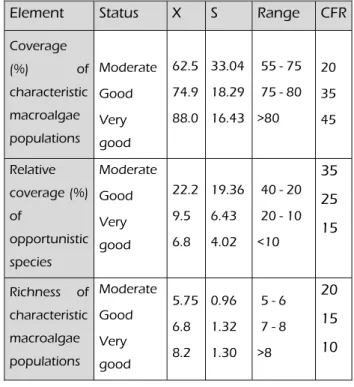
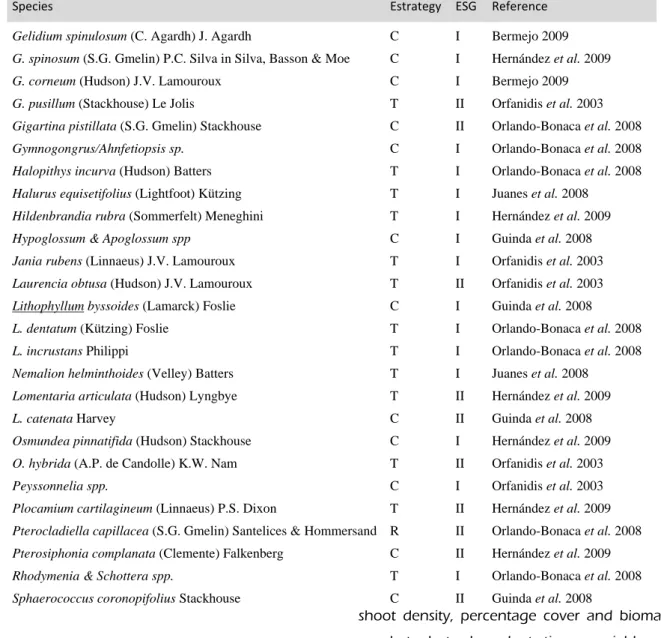
(4) Hernández, I;. Bermejo, R; García, P; Brun, F and. Vergara, J. according to the macroalgal intertidal flora via hierarchical-cluster analysis (Bermejo 2009): Atlantic Atlantic. Gibraltar. zone.. Strait. Interestingly,. and. Western. these. regions. coincided with the coastal boundaries between the Algibic and Gaditano littoral districts of the biogeographical classification of Andalusia (RivasMartínez 1997). Overall, the SRL index, as adapted for. Figure 1: Map of sampling sites of. the southern. demonstrated. a. Atlantic better. coasts of. capacity. to. Spain, detect. macroalgae and marine angiosperms in southern. differences in the ecological status of the Atlantic. Iberian Peninsula. Provinces of Andalusia are. coastal waters than the CFR.. separated by bars. P01 and P02: Ria Formosa; HU01: Huelva (Guadiana river mouth); CA01 and CA02: Cádiz (Río San Pedro and Guadalete river estuary in Cadiz Bay Natural Park); MA01: Maro (Málaga); GR01: Granada (Cambriles); AL01, AL02 and AL03: Almeria (Carboneras, El Palmer y San José).. Table 1. Mean (X), standard deviation (S), quality thresholds and proposed score system with classification status ranges for the CFR index according to the field data from the Andalusian Atlantic coast (Bermejo 2009). Element. The RSL index was also adjusted to the. Status. X. S. Range. CFR. 62.5 33.04. 55 - 75. 20. 75 - 80. 35. Coverage of Moderate. particularities of the southern Atlantic coast of. (%). Andalusia (Bermejo 2009; Bermejo et al. in prep.).. characteristic Good. 74.9 18.29. macroalgae. Very. 88.0 16.43 >80. populations. good. Relative. Moderate. This reassessment involved adjusting the number of species included on the reduced species list and recalculating. boundaries. between. classes,. following the recommendations given by Wells et al. (2007). Three main results were derived from intense field sampling along the Atlantic coast of Cadiz: a reduced species list (table II), which is composed of 10 chlorophytes, 15 phaeophyceans and 39 rhodophytes, a relationship between the species richness (SR) and the score of the shore description (SD) (SR = e(5,14 – 23,9. SD). ; R2 = 0,77) and. 35 40 - 20. coverage (%) Good of Very. 22.2 19.36 9.5. 6.43. 20 - 10. opportunistic good species. 6.8. 4.02. <10. Richness. of Moderate. characteristic Good macroalgae. Very. populations. good. 45. 5.75 0.96. 5-6. 6.8. 1.32. 7-8. 8.2. 1.30. >8. 25 15. 20 15 10. the existence of two ecological regions defined. Ambientalia SPI (2010). 4.
(5) Hernández, I;. Bermejo, R; García, P; Brun, F and. Vergara, J. Table II. Reduced species list for the Atlantic coasts of Spain. The ecological strategy of algae is classified based on Grime (1977). T: Stress tolerator; R: ruderal, C: competitor. * Species considered as opportunistic.. Species. Estrategy. ESG. Reference. Bryopsis spp.*. T. II. Orfanidis et al. 2003. Chaetomorpha linum (O.F. Müller) Kützing*. T. II. Orfanidis et al. 2003. Cladophora spp.*. R. II. Orfanidis et al. 2003. Codium spp like-tree. T. II. Orfanidis et al. 2003. Codium spp encrusting. T. II. Bermejo 2009. C. bursa (Olivi) C. Agardh. T. II. Orfanidis et al. 2003. Flabellia petiolata (Turra) Nizamuddin. C. I. Orfanidis et al. 2003. Pedobesia simplex (Meneghini ex Kützing) M.J. Wynne & Leliaert. T. II. Hernández et al. 2009. Ulva spp.*. R. II. Orfanidis et al. 2003. Valonia utricularis (Roth) C. Agardh. T. II. Orfanidis et al. 2003. Cladostephus spongiosus (Hudson) C. Agardh. T. II. Orlando-Bonaca et al. 2008. Colpomenia sinuosa (Mertens ex Roth) Derbès & Solier. R. II. Panayotidis et al. 2004. Cystoseira compressa (Esper) Gerloff & Nizamuddin. T. I. Orfanidis et al. 2003. C. mauritanica Sauvageau. C. I. Orfanidis et al. 2003. C. tamariscifolia (Hudson) Papenfuss. C. I. Orlando-Bonaca et al. 2008. C. usneoides (Linnaeus) M. Roberts. T. I. Orlando-Bonaca et al. 2008. Dictyota dichotoma (Hudson) J.V. Lamouroux. R. II. Orfanidis et al. 2003. Dictyopteris polypodioides (A.P. De Candolle) J.V. Lamouroux. R. II. Orfanidis et al. 2003. Fucus spiralis Linnaeus. C. I. Guinda et al. 2008. Halopteris filicina (Grateloup) Kützing. T. II. Orfanidis et al. 2003. Laminaria ochroleuca Bachelot de la Pylaie. C. I. Guinda et al. 2008. Padina pavonica (Linnaeus) Thivy in W.R. Taylor. T. I. Orfanidis et al. 2003. Saccorhiza polyschides (Lightfoot) Batters. C. I. Guinda et al. 2008. Sargassum vulgare C. Agardh. C. I. Orfanidis et al. 2003. Stypocaulon scoparium (Linnaeus) Kützing. T. II. Hernández et al. 2009. Zanardinia typus (Nardo) P.C. Silva in W. Greuter. T. I. Orlando-Bonaca et al. 2008. Delesseriaceae (Acrosorium, Cryptopleura, Haraldiophyllum spp.). C. I. Guinda et al. 2008. Asparagopsis armata Harvey. T. II. Hernández et al. 2009. Bonnemaisonia asparagoides (Woodward) C. Agardh. T. II. Bermejo 2009. Botryocladia botryoides (Wulfen) Feldmann. C. I. Hernández et al. 2009. Caulacanthus ustulatus (Mertens ex Turner) Kützing. T. I. Hernández et al. 2009. Ceramium spp.. R. II. Orfanidis et al. 2003. Chondracanthus acicularis (Roth) Fredericq. R. I. Hernández et al. 2009. Corallina spp.. R. I. Orfanidis et al. 2003. Cryptonemia seminervis (C. Agardh) J. Agardh. C. I. Bermejo 2009. Gastroclonium ovatum (Hudson) Papenfuss. T. II. Guinda et al. 2008. G. clavatum (Roth) Ardissone. T. II. Guinda et al. 2008. Ambientalia SPI (2010). 5.
(6) Hernández, I;. Bermejo, R; García, P; Brun, F and. Vergara, J. Tabla II (cont).. Species. Estrategy. ESG. Reference. Gelidium spinulosum (C. Agardh) J. Agardh. C. I. Bermejo 2009. G. spinosum (S.G. Gmelin) P.C. Silva in Silva, Basson & Moe. C. I. Hernández et al. 2009. G. corneum (Hudson) J.V. Lamouroux. C. I. Bermejo 2009. G. pusillum (Stackhouse) Le Jolis. T. II. Orfanidis et al. 2003. Gigartina pistillata (S.G. Gmelin) Stackhouse. C. II. Orlando-Bonaca et al. 2008. Gymnogongrus/Ahnfetiopsis sp.. C. I. Orlando-Bonaca et al. 2008. Halopithys incurva (Hudson) Batters. T. I. Orlando-Bonaca et al. 2008. Halurus equisetifolius (Lightfoot) Kützing. T. I. Juanes et al. 2008. Hildenbrandia rubra (Sommerfelt) Meneghini. T. I. Hernández et al. 2009. Hypoglossum & Apoglossum spp. C. I. Guinda et al. 2008. Jania rubens (Linnaeus) J.V. Lamouroux. T. I. Orfanidis et al. 2003. Laurencia obtusa (Hudson) J.V. Lamouroux. T. II. Orfanidis et al. 2003. Lithophyllum byssoides (Lamarck) Foslie. C. I. Guinda et al. 2008. L. dentatum (Kützing) Foslie. T. I. Orlando-Bonaca et al. 2008. L. incrustans Philippi. T. I. Orlando-Bonaca et al. 2008. Nemalion helminthoides (Velley) Batters. T. I. Juanes et al. 2008. Lomentaria articulata (Hudson) Lyngbye. T. II. Hernández et al. 2009. L. catenata Harvey. C. II. Guinda et al. 2008. Osmundea pinnatifida (Hudson) Stackhouse. C. I. Hernández et al. 2009. O. hybrida (A.P. de Candolle) K.W. Nam. T. II. Orfanidis et al. 2003. Peyssonnelia spp.. C. I. Orfanidis et al. 2003. Plocamium cartilagineum (Linnaeus) P.S. Dixon. T. II. Hernández et al. 2009. Pterocladiella capillacea (S.G. Gmelin) Santelices & Hommersand R. II. Orlando-Bonaca et al. 2008. Pterosiphonia complanata (Clemente) Falkenberg. C. II. Hernández et al. 2009. Rhodymenia & Schottera spp.. T. I. Orlando-Bonaca et al. 2008. Sphaerococcus coronopifolius Stackhouse. C. II. Guinda et al. 2008. shoot density, percentage cover and biomass in Regarding. angiosperms,. we. are. developing an index for marine angiosperms (Zostera marina, Zostera noltii and Cymodocea. nodosa) based on the multivariate index proposed for Posidonia oceanica (Romero et al. 2007). The index is called SISIP (Seagrass Indicator for South Iberian Peninsula) and it is being tested in Cadiz Bay and Ria Formosa (Portugal). This index follows recommendations. given. by. other. authors. (Romero et al. 2007, Fernandez-Torquemada et al. 2008) and includes not only the estimation of. quadrats but also plant tissue variables (non structural carbohydrates, tissue N, C, P, tissue stable isotope ratios) and variables at the individual,. population. and. community. level. (biometry, foliar necrosis, rhizome burial, etc). Preliminary data for Z. noltii has classified the Río San Pedro, Cádiz (an arm of the sea or semi enclosed tidal inlet) as “good” (García-Marín et al. 2009). However, further research is still necessary to establish a more accurate and integrated ecological quality ratio considering other water bodies within the same biogeographical region.. Ambientalia SPI (2010). 6.
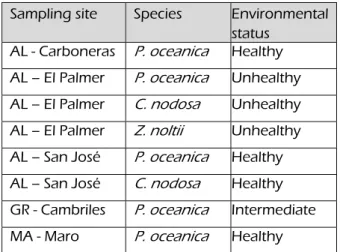
(7) Hernández, I;. Bermejo, R; García, P; Brun, F and. Vergara, J. We are sampling meadows of Cymodocea nodosa. Guadiana estuary) where we have samples that. in several sites along the Atlantic coast so that. still have to be analysed.. future intercalibration with results obtained by the Portuguese research groups may be possible. There have been relatively few attempts to determine the biological quality of Atlantic transitional waters using macroalgae as BQEs (e.g. Borja et al. 2004). There are methods proposed in the UK and Portugal based on opportunistic macroalgal blooms (Scanlan et al. 2007, Patricio et al. 2007, WFD-UKTAG 2009) and above all, the extent of upstream penetration of perennial fucoid algae (Wilkinson et al. 2007). The methods based on opportunistic algae may be difficult to apply,. as. coverage. or. algal. density. of. opportunistic Ulvaceans is highly variable both spatially. and. seasonally. among. estuaries. (Hernández et al. 1997). In addition, in some. 3. MACROALGAE AND ANGIOSPERMS AS BQEs FOR THE MEDITERRANEAN ECOREGION As for the Atlantic coasts, the ecological status of the different bodies of Mediterranean coastal waters in Andalusia has to be assessed using macroalgae and angiosperms as BQEs. It is expected to use macroalgae to apply the methods proposed. in. other. Spanish. Mediterranean. territories with the already available CARLITBENTHOS index (Ballesteros et al. 2007, Pinedo et al. 2007), although possibly some adjustments for the Andalusian Mediterranean coast may be needed. Alternatively, the RSL index should be developed for the Mediterranean.. cases, opportunistic algal cover responds to. Regarding seagrasses, an extensive field. environmental variables not necessarily related to. campaign along the Mediterranean coastal waters. pollution, as water clarity and salinity (Krause-. from Málaga to Almería has been carried out (Fig.. Jensen et al. 2007). These methods could be used. 1, Table III). As a result, the environmental status. during peak bloom periods but still needs an. of 8 sampling points was established by expert. assessment in Andalusian transitional waters. The. judgement,. method based on fucoids cannot be applied in the. pressures in each zone. Data from the meadows. Spanish south Atlantic estuaries as there are few. have been collected in order to implement the. records of fucoids in transitional waters.. POMI (Posidonia Oceanica Multivariate Index;. The ecological status of transitional waters in Andalusian estuaries can be evaluated with the angiosperm quality index (AQI) developed by. considering. the. anthropogenic. Romero et al. 2007) and SISIP multifactorial indexes. We are at present processing all this information.. García et al. (2009). A previous version of this multi-metric method was applied in the Guadalete estuary (Garcia de Lomas et al. 2007). Based on the composition, abundance, coverage and loss of spatial extent of the estuarine habitat, the assessed section of this estuary was classified as “moderate”. In addition, the SISIP index can be tested in meadows of Cymodocea nodosa thriving in some Iberian Atlantic transitional waters (e.g. Ambientalia SPI (2010). 7.
(8) Hernández, I;. Bermejo, R; García, P; Brun, F and. Vergara, J. Table 3. Seagrass species and environmental. information. status in selected sampling stations surveyed. seagrasses as BQEs is still rather scarce compared. along the Mediterranean coast of Andalusia. AL:. with other Spanish Autonomic Communities.. Almería, GR: Granada, MA: Málaga.. Investment. available. in. field. for. macroalgae. data. acquisition. and. and. monitoring is therefore needed, especially for the Mediterranean. There is, however, information for Sampling site. Species. AL - Carboneras. P. oceanica. Environmental status Healthy. AL – El Palmer. P. oceanica. Unhealthy. AL – El Palmer. C. nodosa. Unhealthy. AL – El Palmer. Z. noltii. Unhealthy. AL – San José. P. oceanica. Healthy. AL – San José. C. nodosa. Healthy. GR - Cambriles. P. oceanica. Intermediate. MA - Maro. P. oceanica. Healthy. both the CFR and SRL indexes in the Atlantic. Each one has their own strengths and limitations (Hernández 2008) but data suggest that the RSL is more convenient to assess the ecological status of the rocky shores in Andalusia. Both the AQI (atlantic transitional waters) and the SISIP (coastal and transitional waters) indexes are promising and should be developed and intercalibrated with data from other water bodies. We are at present in. contact with groups developing and/or. assessing methods for macroalgae in Spain and There are seven water bodies classified as. Portugal (PmarMAT, CYMOX; Marta Pérez com.. transitional waters on the Andalusian coast.. per., POSIMED network) and the Andalusian. However no information is available either for. environmental management company EGMASA,. macroalgae or seagrasses. The SISIP index could. which develops specific environmental programs. be tested in the scarce meadows of Zostera noltii. for seagrass monitoring. The perspectives are. growing in some estuaries, as in Palmones river. therefore that reliable information for BQEs will be. estuary (Peralta et al. 2000), and perhaps metrics. available within the next couple of years.. based on the growth of opportunistic green algae could be tested, but again with the same. ACKNOWLEDGEMENTS. limitations imposed for the Atlantic waters. Recently, a macrophyte quality index (MAQI) has been proposed to assess the ecological status of Italian marine transitional environments (Sfriso et al. 2009). The dichotomical key for the assessment of the ecological status developed in this method may be also applied in the Andalusian bodies of transitional Mediterranean waters.. Funding support for this synthesis of the research carried out in macroalgae and seagrasses as BQEs was provided by the following projects: 1). CTM2008-00012/MAR. from. the. Spanish. Ministry of Science and Innovation and FEDER funds (IMachydro); 2) SOE1/P2/F153 from the Territorial Cooperation Programme Interreg IV B SUDOE (ECOLAGUNES) and 3) contract OT 2008/055 with the Environmental Division of the. 4. FUTURE PROSPECTS As it can be deduced from the information. Junta de Andalucía. We thank Dr E.P. Morris for revising the English grammar of the manuscript.. described above, despite the vast extension of the Andalusian coastal and transitional waters, the Ambientalia SPI (2010). 8.
(9) Hernández, I;. Bermejo, R; García, P; Brun, F and. Vergara, J. LITERATURE CITED. García de Lomas, J., Bermejo, R., Hernández, I.,. Ballesteros, E., Torras, X., Pinedo, S., García, M.,. Vergara, J.J. (2007). Aplicación de la métrica. Mangialajo, L., de Torres, M. (2007). A new. indicaora de macrofitos (índice IQM). Estuario del. methodology. Guadalete 2 (identificador 520011). EDEA-UCA.. based. on. littoral. community. cartography dominated by macroalgae for the implementation. of. the. European. water. García-Marín, P., Cabaço, S., Brun, F.G., Barro, S., Hernández, I., Vergara, J.J., Newton, A. (2009).. Framework Directive. Mar. Pol. Bull. 55: 172-180.. Using seagrasses as biological quality elements for Bermejo, R. (2009). Utilización de macroalgas. the european Water Framework Directive: a. como bioindicadores para la Directiva Marco de. comparative study in South Atlantic Iberian. Aguas (DMA): costas atlánticas de Andalucía. Tesis. Peninsula. de Master. Universidad de Cádiz.. Mediterranean Seagrass Workshop 09, Hvar,. (2009).. Proceedings. of. the. Croatia. Di Carlo, G., Calladine, A., Zuljevic, A.. Borja, A., Franco, J. Valencia, V., Bald, J., Muxica, I.,. (eds): 48-49. Belzunce, M.J., Solaun, O. (2004). Implementation of the European water framework directive from. Guinda, X. (2008). Desarrollo de procedimientos. the. a. aplicables a la evaluación del estado ecológico de. methodological approach. Mar. Pol. Bull. 48: 209-. las masas de agua costera sensu Directiva Marco. 218.. de Agua. Tesis Doctoral. Universidad de Cantabria.. Brodie, J., Lewis, J. (2007). Unravelling the algae:. Guinda, X., Juanes, J.A., Puente, A., Revilla, J.A.. the past, present, and future of algal systematics.. (2008). Comparison of two methods for quality. CRC Press.. assessment of macroalgae assemblages, under. Basque. country. (northern. Spain):. different pollution types. Ecol. Indicators 8: 743Farmer, D.M., Armi, L . (1988). The flow of Atlantic. 753.. water through the Strait of Gibraltar. Prog. Oceanog. 21: 1-105.. Grime, J.P. (1977). Evidence for the existente of three primary strategies in plants and its relevante. Fernández-Torquemada, Y., Diaz-Valdés M., Colilla,. to ecological and evolutionary theory. Am. Nat.. F., Luna, B., Sánchez-Lizaso, J.L., Ramos-Espl,á A.. 111: 1161-1194.. (2008). Descriptors from Posidonia oceanica (L.). Delile meadows in coastal waters of Valencia,. Hernández, I. (2008). Consideraciones sobre la. Spain, in the context of the EU Water Framework. utilización de dos indicadores basados en. Directive. J. Mar. Sci. 65:1492-1497.. macroalgas marinas para la estimación de la calidad ecológica del agua en la región atlántica. Garcia, P., Zapico, E., Colubi, A. (2009). An. española. Algas 40: 17-21.. angiosperm quality index (AQI) for Cantabrian estuaries. Ecol. Indicators 9: 856-865.. Hernández, I., Bermejo, R., Pérez-Lloréns, J.L., Vergara, J.J. (2009). II Informe sobre la aplicación de indicadores basados en macrófitos marinos en. Ambientalia SPI (2010). 9.
(10) Hernández, I;. Bermejo, R; García, P; Brun, F and. Vergara, J. aguas costeras de cara a la aplicación de la. Orfanidis, S., Panayotidis, P., Stamatis, N. (2001).. Directiva Marco de Agua en las costas de. Ecological evaluation of transitional and coastal. Andalucía. EDEA-UCA para la Consejería de. waters: A marine benthic macrophytes-based. Medio Ambiente.. model. Med. Mar. Sci. 2/2: 45-65.. Hernández, I., Peralta, G., Pérez-Lloréns, J.L.,. Orfanidis, S., Panayotidis, P., Stamatis, N. (2003).. Vergara, J.J., Niell, F.X. (1997). Biomass and. An insight to the ecological evaluation index (EEI).. growth dynamic of Ulva species in Palmones river. Ecol. Indicators 3: 37-33.. estuary. Journal of Phycology 33: 764-772. Orlando-Bonaca, M., Lipej, L., Orfanidis, S. (2008). Hernández, I., Pérez-Lloréns, J.L., Mourente, G.,. Benthic macrophytes as a tool for delineating,. Vergara, J.J., Brun, F, Olivé, I., de los Santos, C.B.,. monitoring and assessing ecological status: The. Bermejo, R. (2010). Estudio sobre las comunidades. case of slovenian coastal waters. Mar. Pol. Bull. 56:. de macroalgas en la zona oriental de la Isla de. 666-676.. Tarifa y el entorno de Punta Camorro. Influencia de. los. posibles. hidrodinámico. cambios. sobre. las. en. el. régimen. macroalgas. como. Panayotidis, P., Montesanto, B., Orfanidis, S. (2004).. Use. of. low-budget. monitoring. of. consecuencia del proyecto de ampliación del. macroalgae to implement the European Water. Puerto de Tarifa. EDEA-UCA para la Autoridad. Framework Directive. J. Appl. Phycol. 16: 49-59.. Portuaria del Puerto de Algeciras.. Patrício, J., Neto, J.M., Teixeira, H., Marques, J.C. Krause-Jensen, D., Carstensen, J., Dahl, K. (2007).. (2007). Opportunistic macroalgae metrics for. Total and opportunistic algal cover in relation to. transicional Waters. Testing Tools to assess. environmental variables. Mar. Pol. Bull. 55: 114-. ecological quality status in Portugal. Mar. Pol. Bull.. 125.. 54: 1887-1896.. Juanes, J.A., Guinda, X., Puente, A., Revilla, J.A.. Peralta, G., Pérez-Lloréns, J.L., Hernández, I., Brun,. (2008). Macroalgae, a suitable indicator of the. F.G., Vergara, J.J., Bartual, A., Gálvez, J.A., García,. ecological status of coastal rocky communities in. J.A. (2000). Morphological and physiological. the NE Atlantic. Ecol. Indicators 8: 351-359.. differences between two morphotypes of Zostera. Littler, M.M., Littler, D.S. (1984). Relationships. noltii Hornem. from the south-western Iberian. between macroalgae functional form groups and. Peninsula. Helgol. Mar. Res. 54: 80-86.. substrata stability in a subtropical rocky-intertidal Pinedo, S., García, M., Satta, M.P., de Torres, M.,. system. J. Exp. Mar. Biol. Ecol. 74: 13-34.. Ballesteros, E. (2007). Rocky-shore communities as Orfanidis.. S.. the. indicators of water quality: A case study in the. development of new macroalgal index to assess. Northwestern Mediterranean. Mar. Pol. Bull. 55:. quality within the Mediterranean Sea. Mar. Pol.. 126-135.. (2007).. Comments. on. Bull. 54: 626-627.. Ambientalia SPI (2010). 10.
(11) Hernández, I;. Bermejo, R; García, P; Brun, F and. Vergara, J. Rivas-Martínez, S., Asensi, A., Díez-Garretas, B.,. Wilkinson, M., Wood, P., Wells, E., Scanlan, C.. Molero, J. (1997). Biogeographical síntesis of. (2007). Using attached macroalgae to assess. Andalusia (southern Spain). J. Biogreog. 24: 915-. ecological status of British estuaries for the. 928.. European Water Framework Directive. Mar. Pol. Bull. 55: 136-150.. Romero, J., Martínez-Crego, B., Alcoverro, T., Perez, M. (2007). A multivariate index base don the seagrass Posidonia oceanica (POMI) to assess ecological status of coastal Waters under the water Framework directive (WFD). Mar. Pol. Bull. 55: 196-204.. Scanlan, C.M., Foden, J., Wells, E., Best, M.A. (2007).. The. monitoring. of. opportunistic. macroalgal blooms for the water Framework directive. Mar. Pol. Bull. 55: 162-171. Sfriso, A., Facca, C., Ghetti, P.F. (2009). Validation of the Macrophyte Quality Index (MaQI) set up to assess the ecological status of Italian marine trnasitional environments. Hydrobiologia 617: 117-141.. WFD-UKTAG (Water Framework Directive United Kingdom Technical Advisory Group) (2009). UKTAG transicional and coastal water assessment methods.. Macroalgae.. Macroalgal. Bloom. assessment (opportunistic macroalgae). Wells, E. (2008). Water Framework Directive Marine Plant Task Team. Intertidal coastal waters macroalgae.. Rocky. shore. tool.. Paper. nº. MPTT/MAT01.. Wells, E., Wilkinson, M., Wood, P., Scanlan, C (2007). The use of maroalgal species richness and. composition on intertidal rocky seashores in the assessment of ecological quality under the European Water Framework Directive. Mar. Pol. Bull. 55: 151-161.. Ambientalia SPI (2010). 11.
(12)
Figure

Documento similar
The present-day water masses in the Gulf of Cadiz are driven by the density contrast between the water masses of Atlantic (cold, normal sa- linity, less dense) and Mediterranean
Of special concern for this work are outbreaks formed by the benthic dinoflagellate Ostreopsis (Schmidt), including several species producers of palytoxin (PLTX)-like compounds,
In the previous sections we have shown how astronomical alignments and solar hierophanies – with a common interest in the solstices − were substantiated in the
Finally, experiments with solar [17–34], atmospheric [35–45], reactor [46–50], and long-baseline accelerator [51–59] neutrinos indicate that neutrino flavor change through
Plotinus draws on Plato’s Symposium (206c4–5) – “procreate in what is beautiful” – 3 in order to affirm that mixed love (which is also a love of beauty) is fecund, although
Even though the 1920s offered new employment opportunities in industries previously closed to women, often the women who took these jobs found themselves exploited.. No matter
The exhibition and the catalogue provide a series of samples that exemplify a phase in the ongoing dialectic between local identities versus connected and communicative
In the “big picture” perspective of the recent years that we have described in Brazil, Spain, Portugal and Puerto Rico there are some similarities and important differences,
