
Heterostructured materials synthesized via AACVD applied for direct water splitting irradiated with an AAA solar Simulator
12
0
0
Texto completo
(2) 9.21 Use of the TixCuyOz oxide catalyst in water electrolysis A. Velázquez-Osorio; J.L. Reyes-Rodríguez; F.D. Fernández-Galván; O. Solorza-Feria; H.Yee-Madeira 1. Escuela Superior de Física y Matemáticas - Instituto Politécnico Nacional SN, Av. Instituto Politécnico Nacional SN, U.P. Adolfo López Mateos, San Pedro Zacatenco, De. Gustavo A. Madero, 07738, CDMX. Mexico. 2. Centro de Investigación y Estudios Avanzados CINVESTAV-IPN, Av. Instituto Politécnico Nacional 2508, San Pedro Zacatenco, Del. Gustavo A. Madero, 07738, CDMX. Mexico. * Corresponding author: +52-55-5729-6000 ext. 55156, [email protected]. ____________________________________________________________________________. ABSTRACT. Transition from fossil fuels to renewable energy is of paramount importance to halt the growing pollution associated to conventional energy production. A long-term and sustainable alternative to fossil fuels is the use of fuel cell technology. Fuel cells are devices capable of transforming chemical energy into electricity in a very clean and efficient manner. However, their operation is conditioned by the continuous supply of oxygen O2, and hydrogen H2. Presently, these gasses are obtained from complex and contaminant gas reformation and purification processes. Through water electrolysis, it is possible to produce O2 and H2 without the harmful carbon emissions implicit to gas reformation. A challenge in mass electrolysis implementation is that electrolyzers require the use of catalytic materials; often transition metal groups like Pt, Pd, and Ir are used. However, their scarcity and restrictive costs limit the possibilities of water electrolysis. This work presents a synthesis of a TixCuyOz catalyst with excellent activity compared to pure platinum in the oxygen evolution reaction. High-energy ball milling of Ti and Cu powders was performed for 2, 4, 6, 8, and 10 h; afterwards, the milled powders were subjected to a thermal treatment at air atmosphere and characterized through X-Ray diffraction (XRD), scanning electron microscopy (SEM), elemental chemical characterization (SEM-EDS), and voltammetries (cyclic, linear, and cronoamperometry).. Keywords: TixCuyOz catalyst, oxygen, electrolysis. 490 | P á g i n a.
(3) 9.22 Synthesis and characterization of ni-mo2c catalysts supported on hydroxyapatite for hydrogen production reactions Jonathan Jesús Malpica Maldonado, José Aarón Melo Banda, Ana Lidia Martínez Salazar, Margarita García Hernández 1. Centro de Investigación en Petroquímica Secundaria, Instituto Tecnológico de Ciudad Madero, Prol. Bahía del Aldair, Av. de las Bahías. Parque Industrial Tecnia, Altamira, Tamaulipas, México, 89608. *833-261-13-32, [email protected] ____________________________________________________________________________. ABSTRACT. The search for new catalytic material to hydrogen production is very important for generation of new more efficient process and low cost. On the other hand, biomass is a renewable source for hydrogen production by green methods. Also, the green methods for hydrogen production are not emitting greenhouse gases. So, these methods can be considered friendly with the environment. Several studies have demonstrated Ni-Mo2C catalysts exhibits high activity and selectivity in hydrogen production processes. While the molybdenum carbide has shown a catalytic behavior similar as some noble metals, the loads of nickel act as a promoter increasing selectivity and stability of the materials. In this research, Ni-Mo2C nanoparticles were synthesized by carburization of nickel and molybdenum oxides as precursors using sucrose as a carbon source. The carburization condition was varied in function of temperature (873 K to 1073 K), under Ar/H2 flow. Hydroxyapatite was used as a support due its main constituent is CaO, which improve selectivity by CO adsorption capacity in the cases of hydrogen production processes with CO presence as a byproduct. All samples were characterized by Infrared Spectroscopy with Fourier Transform (FTIR), Scanning Transmission Electron Microscopy (STEM) and X-Ray Diffraction (XRD) to confirm the structure of the nanoparticles and observe the effects of thermal treatment in the thermal stability of the materials. The catalyst Ni-Mo2C supported on hydroxyapatite could be a very well option to be used in green processes for hydrogen production. The properties of active phase and the properties catalytic support make the catalytic material have excellent thermal and mechanical stability.. Keywords : Ni-Mo2C Catalyst, Mo2C nanoparticule, hydrogen production, hydroxyapatite. ____________________________________________________________________________. 1. Introduction 491 | P á g i n a.
(4) The necessity of use more energy every day, is a big problem because in the actually the most used energy sources are hydrocarbons. The use of hydrocarbons increases greenhouse gases by the combustion of hydrocarbons. Hydrogen could be an alternative energy source from renewable resources, also, the use hydrogen as clean fuels has benefits in the environment, because it doesn´t emit greenhouse gases. The main processes for hydrogen production implicate the use hydrocarbons; being the natural gas the main source for hydrogen production through reforming steam methane [1-2]. Transition metal carbides have shown a special catalytic behavior similar to the noble metals [3-5]. Transition metals carbide have been using at extreme conditions of pressure and temperature [6]. The use at extreme conditions of these carbides is because of their great strength and durability. The physical and mechanical properties of carbides are similar to that of ceramic. The physical and chemical properties of transition metal carbides including high thermal stability and mechanical hardness, superconductivity and show catalytic activity similar to those of metals noble in various catalytic reaction for hydrogen production as methane reforming, conversion biomass, water gas shift reaction, among other reaction [5,7]. The actual methods for the synthesis of molybdenum carbide involve direct carbonization of molybdenum at high temperature (> 1000 °C). Some authors [8,9] studied the effect of temperature on the synthesis of molybdenum carbide and concluded that the optimum temperature for the synthesis of molybdenum carbide is around 800 °C. The modification of traditional catalysts Mo2C with Ni shows an increase in thermal and mechanical stability, as well as in the catalytic activity of materials. The catalytic activity increase respect to the increases in the amount of Ni, but the Ni increase causes an oxidation of the material [10]. Some research [11 - 14] shows the use of calcium oxide to remove emissions of CO2 in reaction for hydrogen production, also, CaO increase the hydrogen production. On the other hand, materials as hydroxyapatite have a high content of calcium oxide [15] and other compounds that give a high mechanical and thermal stability.. 2. Materials and Methods 2.1 Preparation of Mo2C The preparation of Mo2C precursors were prepared by an aqueous solution of ammonium heptamolybdate tetrahydrate [(NH4)6Mo7O24 4H2O] and an aqueous solution of sucrose with a molar ratio of C/Mo = 2 to form the hexagonal crystalline 492 | P á g i n a.
(5) structure of molybdenum carbide (β-Mo2C) [16,17]. Then homogenize the two solutions the sucrose solution was added over ammonium heptamolybdate tetrahydrate solution stirring constantly for 15 min. the final solution was dried at room temperature at 120 °C for 24 h. The Mo2C precursors were thermally treated in situ in a quartz fix bed reactor under a reducing atmosphere of Ar/H2 to get Mo2C. The temperature was increased linearly at 10 °C/min, the conditions of reactor are show in the table 1. Table 1. Carburization conditions used on the quartz fix bed reactor on Mo2C precursors. Sample Temperature Pressure Flow (Ar/H2) Ramp Time (°C) (atm) (l/min) (°C/min) (min) 1 700 1 4 10 120 2 800 1 4 10 120 3 900 1 4 10 120 2.2 Preparation of Ni-Mo2C catalysts The synthesis of Ni-Mo2C is similar to Mo2C. The Ni-Mo2C precursors were prepared by aqueous solution using nickel nitrate dihydrate as source of nickel. The load of nickel on the materials is 15 wt% and molar ratio C/Mo = 2. The nickel solution was added over ammonium heptamolybdate tetrahydrate solution stirring constantly for 4 h. the final solution was dried at temperature room at 120 °C for 24 h The powder was dissolved using the minimum amount of water possible. The solution of sucrose was added over powder solution stirring constantly for 1 h the final solution was dried at temperature room at 120 °C for 24 h The Mo2C precursors were thermally treated in situ in a quartz fix bed reactor under a reducing atmosphere of Ar/H2 to get Ni-Mo2C. The temperature was increase linearly at of 10 °C/min, for 2 h and the temperature of reactor was 800 °C. 2.3 Extraction of hydroxyapatite For extraction of hydroxyapatite were used bovine bones following the methodology of C.K. Rojas-Mayorga [18] by thermal decomposition. 2.3.1 Bovine bone preparation The bovine bones were cleansed by water and acetone to remove the impurities and fasts. After clean the bovine bones were reduced to size of 1 mm. The powder was dried at 120 for 24 h The bovine bones were thermally treated (pyrolysis) in quartz reactor by synthesis of bone char. The synthesis of bone char needs specific condition of heating rate, temperature and time of thermal treatment. For the pyrolysis process, nitrogen gas (400 ml/min) was used to 493 | P á g i n a.
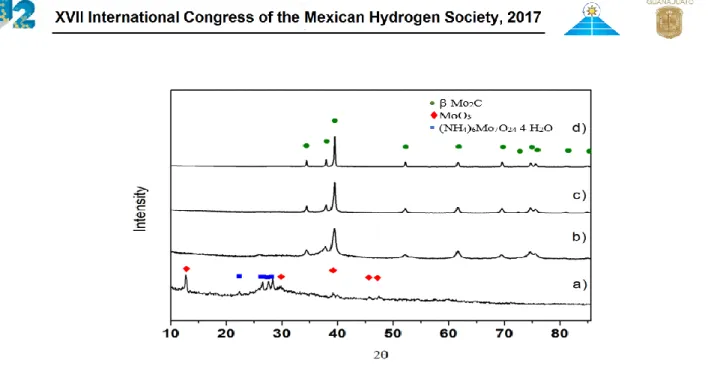
(6) provide an inert atmosphere during the thermal treatment. The conditions of synthesis are show in table 2. Table 2. Synthesis of hydroxyapatite. Sample Temperature Pressure Flow (Ar/H2) Ramp Time (°c) (atm) (ml/min) (°c/min) (min) 1 700 1 400 10 120 2 800 1 400 10 120 3 900 1 400 10 120 3. Results and Discussion 3.1 X-ray diffraction Fig. 1 shows the experimental x-ray diffraction patterns of Mo2C synthesized at different temperature of carbonization and also shows the experimental x-ray diffraction patterns of Mo2C precursor. According with the fig. 1 the experimental x-ray diffraction patterns correspond with hexagonal structure of Mo2C [17]. Mo2C presented XRD patterns with different diffraction peaks at 34.40°, 38.10°, 52.26°, 61.78°, 69.77°, 74.94° and 75.98 of 2θ, corresponding to the (021), (200), (221), (023), (321), (223) and (104) diffraction planes. The crystallite size was calculated with Scherrer Equation; the table 3 shows the crystallite size of Mo2C sample at different carbonization temperature.. 494 | P á g i n a.
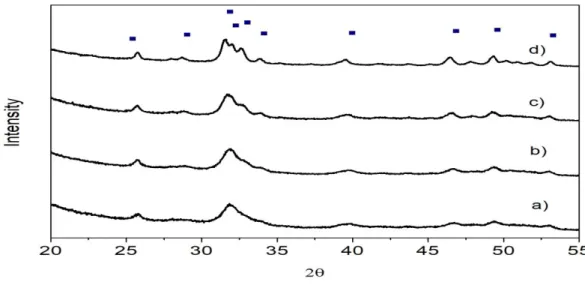
(7) Fig. 1. Experimental X-ray diffraction patterns of Mo2C a) Mo2C precursor b) Mo2C synthesized at 700 °C, c) Mo2C synthesized at 800 °C, d) Mo2C synthesized at 900 °C.. Fig. 2. Experimental x-ray patterns diffraction of Ni-Mo2C synthesized at 800 °C. Table 3. Crystallite Size of Mo2C. Sample Temperature Crystallite size (°c) (nm) 1 700 1.9335 2 800 3.6169 3 900 5.7199 Also, the experimental x-ray diffraction patterns of Mo2C show a high thermal stability by showing the same diffraction patterns at different temperature synthesis. 495 | P á g i n a.
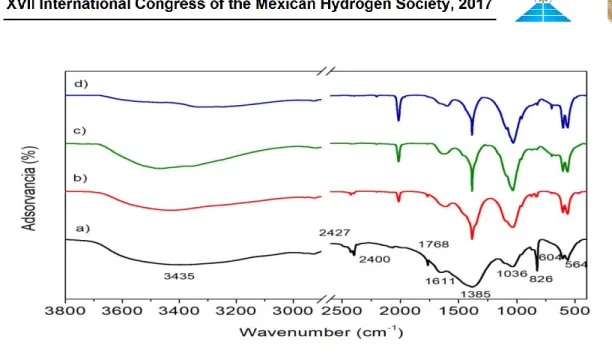
(8) of Mo2C. According to Malinee Kaewpanha et al. [19] the optimal temperature to synthesis of Mo2C is at 800 °C. Fig. 2 shows the experimental x-ray diffraction pattern of Ni-Mo2C synthesized at 800 °C. According with experimental x-ray diffraction patterns the crystalline structure of Mo2C corresponds with hexagonal. Also, the experimental x-ray diffraction patterns show that the crystalline structure of Ni3C correspond with hexagonal. Fig. 3 shows the experimental x-ray diffraction pattern of hydroxyapatite extracted from bovine bone and heat treatment at different temperature. The XRD patterns show a gradual increase in the degree of sharpness of peak with heat treatment [15]. P. Shipman [20] reported that results of XRD patterns in terms of alteration in crystal size. They found that there was gradual increase in hydroxyapatite crystal size associated with increased heat-treating temperature. This alteration in hydroxyapatite crystal size could be for a recrystallization [15].. Fig. 3. Experimental X-ray patterns diffraction of precursor and bone chars obtained at different pyrolysis temperature. a) Raw bone, b) 700 °C, c) 800 °C and d) 900 °C.. 3.2 FT-IR analysis The FT-IR spectra show a decomposition of organic material and a dihydroxylation on bovine bone by effect of heat treatment staring at 700 °C. But the structure remains almost point Fig. 4 shows spectra of bovine bones and bone char after the pyrolysis process, and In table 4 shows the compounds / bond of FTIR spectrum.. 496 | P á g i n a.
(9) Fig. 4. FT-IR spectra of precursor and bone chars obtained at different pyrolysis temperature. a). precursor b) 700 °C, c) 800°C d) 900°C. Table 4. bands of FT-IR spectra. Band (cm-1) Bond Band (cm-1) 3435 Group O-H 826 2427 P 604 2400 P 564 1768 -C=O ---1611 -NH ----2 1385 CO3 ---1036 PO4-3 ----. Bond CO3-2 PO4-3 CO3-2 ------. 3.3 Scanning Electron Microscopy (SEM) and Energy-dispersive X-ray spectroscopy analysis Fig. 5 shows the SEM images and EDS analysis of samples Mo 2C synthesized at different temperature. As it can be seen in the figure 5 the carbide is composed of large particle which seem the particles to be covered with some small particles. The EDS analysis shows the composition of three samples corresponds to molybdenum carbide. The Results of EDS are shows in table 5.. 497 | P á g i n a.
(10) a). b). c). Fig. 5. SEM images and EDS analysis of Mo2C samples synthesized at different temperature. a) Mo2C T-700 °C, b) Mo2C T-800 °C, Mo2C T-900 °C. Table 5. EDS analysis of Mo2C samples. Sample a) b) c). Element Mo C Mo C Mo C. Weight% 80.70 19.30 80.00 20.00 80.19 19.61. Atomic% 34.29 65.31 40.13 59.86 38.91 61.12. 4. Conclusion The method of Mo2C synthesis using sucrose as carbon source is effective to synthesize Mo2C with hexagonal structure, also, it is show that Mo2C has a high thermal stability, and it is confirmed that the optimal temperature of Mo2C synthesis is at 800 °C. The variation of this method is effective for doping Ni in Mo2C. The results of hydroxyapatite extraction showed the heat treatment remove organic materials, and the hydroxyapatite has a thermal and mechanical stability to be used as a catalytic support.. 498 | P á g i n a.
(11) Acknowledgements The Authors want to acknowledge the Instituto Tecnológico de Ciudad Madero – Centro de Investigación en Petroquímica by resources and equipment provided for this research.. References [1] Mohamm Asadullah, Shin-ichi Ito, Kimio Kunimori, Muneyoshi Yamada, Keiichi Tomishinge. Biomass gasification to hydrogen and syngas at low temperature: Novel catalytic system using fluidized-bed reactor. Journal of catalysis. 2002;255:259-208 [2] Kamel Bennaceur, Brian Clark, Franklin M. Orr, Jr, T. S. Ramakrishan, Claude Roulet, Ellen Stout. El hidrógeno: ¿un future portador energético? 2005;35:47. [3] L. Delannoy, J.- Giraudon, P. Granger, L. Leclercq, G. Leclercq. Group VI transition metal carbides as alternatives in the hydrodechlorination of chlorofluorocarbons. Catalysis Today. 2000;231:240-59. [4] M. J. Ledoux, Cuong Pham Huu, Jean Guille, H. Dunlop. Compared Activities of platinum and high specific superface area Mo2C and WC Catalysts for reforming reactions. Journal of catalysis. 1982;383:398-134. [5] Yufei Ma., Guoquing Guan, Xiaogang Hao, Ji Cao, Abulitu Abudula. Molybdenum carbide as alternative catalyst for hydrogen production – A review. Renewable and Sustainable Energy Review. 2017;1101:1129-75. [6] S. Ted Oyama. The chemistry of transition metal carbides and nitrides. New York: BLACKIE ACADEMIC & PROFESSIONAL; 2012 [7] Hua-Min Wang, Xiao-Hui Wang, Ming-hui Zhang, Xiao-Young Du, Wei Li, Ke-Yi Tao. Synthesis of Bulk and supported molybdenum carbide by a single-step thermal carburization method. Chem Mater. 2007;1801:1807-19. [8]. Franco C, Pinto F, Gulyurtlu I, Cabrita I. The study of reactions influencing the biomass steam gasification process. Fuel. 2003;835:842-82. [9] Alex C.C. Chang, Hsin-Fu Chang, Fon-jou Lin, Kuo-Hsin Lin, Chi-Hung Chen. Biomass gasification for hydrogen production. Hydrogen Energy. 2011;1452:14260-36. [10] Chuan shi, Anjie Zhang, Xiosong Li, Shaohua Zhang, Amimin Zhu, Yufei Ma. Chaktong Au. Ni-modified Mo2C catalysts for methane dry reforming. Applied catalysis A: General. 2012. 431:432. [11] Nicholas H. Florin, Andrew T. Harris. Enhanced hydrogen production from biomass with in situ carbon dioxide captre using calcium oxide sobernts. Chemical Engineering Science. 2008;287:316-63.. 499 | P á g i n a.
(12) [12] Piyarat weerachanchai, Masayuki Horio, Chaiyot Tangsathitkulchai. Effects of gasifyng conditions and bed materials on fluidized bed steam gasification of wood biomass. Bioresource Technology. 2009;1419:1427-100. [13] Bishnu Acharya, Animesh Dutta, Prabir Basu. An investigation into steam gasification of biomass for hydrogen enriched gas production in presence of CaO. 2010;1582:158935. [14] Bing-shun huang, Hsin-Yi Chen, Kui-Hao Chuang, Ren-Xuan Yang, Ming-Yen Wey. Hydrogen production by biomass gasification in a fluidized-bed reactor promoted by and Fe/CaO catalyst. 2012;6511:6518-37. [15] M. Younesi, S. Javadpur, M. E. Bharolooom. Effect of heat treatment temperature on chemical compositions of extracted hydroxyapatite from bovine none ash. Journal of Materials Engineering and Performance. 2011;1484:1490-20. [16] G. Vitale, M.L. Frauwallner, C. E.Scott, Prereira-Almao. PRepatation and characterization of low-temperature nano-crystalline cubic molybdenum carbides and insights on thei r structure. Applied catalysis A: General. 2011;178:186-48. [17] Gerardo Vitalea, Héctor Guzmán, Maria L. Frauwallner, Carlos E. Scott, Pedro Pereira-Almao. Synthesis of nanocrystalline molybdenum carbide materials and their characterization. Catalysis Today. 2015;123:133-250. [18] C.K. Rojas-Mayorga, A. Bonilla-Petriciolet. I. A. Aguayo-Villareal, V. HernándezMontoya, M.R. Moreno-Virgen, R. Tovar-Gómez, M.A. Montes Morán. Optimization of pyrolysis conditions and adsorption properties f bone char for fluoride removal from water. Journal of Analytical and Applied pyrolysis. 2013;10:18-104. [19] Malinee Kaewpanha, Guoqing Guan, Yufei Ma., Xiaogang Hao, Zhonglin Zhang, Prasert Reubroychareon, Katsuki Kusakabe, Abuliti Abudula. Hydrogen production by steam reforming of biomass tar over biomass char supported molybdenum carbide catalyst. International journal of hydrogen energy. 2015;7974:7982-40. [20] P. Shipman, G. Foster, and M. Schoeninger. Burnt Bones and Teeth: an Experimental Study of Color, Morphology, Crystal Structure and Shrinkage. Journal of Archaeological Science. 1984;307:325-11.. 500 | P á g i n a.
(13)
Figure

+2

Documento similar