
Universidad y Cooperación al Desarrollo
15
0
0
Texto completo
(2) Palabras clave: Cooperación al Desarrollo, Universidad, Formación, Investigación, Sensibilización. Introduction On 20 January 1949, the then president of the United States, Harry S. Truman, in his inaugural speech as he was being sworn in for his second Presidential term, introduced the concept of development, under the precept of helping less “developed” countries. “Suddenly, the world was structured into developed and underdeveloped countries, which would later be known as the First and Third World, respectively” (Cabrero 2006: 21). Since then, development has been the subject of constant debate and academic-scientific reflection. What kind of development model should be pursued? What kinds of elements integrate the concept of development itself? Should we follow the same development scheme for every country? (Iáñez 2012: 80). Given these questions, Sen (2000) highlights a concept of development associated to the process by which people increase their capacities and options in life; thanks to development, people expand their options for the future, and their choices for improvement increase with respect to their past. In conclusion, development allows the accomplishment of rights that were previously denied to people, therefore reaching higher levels of freedom. Regarding International Cooperation for Development, as it is known nowadays, we should now remind that this concept begun after World War Second, as the resulting process of decolonization initiated in 1947 by India independence. Decolonization brought, as immediate consequences, important changes in the international system, and new perspectives in the relationships between countries. From that scenario until today, cooperation for development has evolved through multiple situations, changing its importance and orientation, and always conditioned to the changes that have taken place in economical order and in international relationships (Unceta and Yoldi 2000:15). After several decades of Cooperation for Development, inequalities between wealthy and poor countries have not diminished considerably, which introduces a new issue to the debate: is the cooperation system itself immersed in an important identity crisis? (Pérez 2000). Universities have the specific task of delivering specialised education and research, but in turn they must also educate in and promote the values of solidarity and commitment towards a more balanced and just society. This means accepting a clear responsibility towards social change, which many Spanish universities have taken up, showing their commitment to more impoverished countries through cooperation for development. Through this strategy, universities could succeed by highlighting a civilizing value of responsibility and compromise as the funding principle for a modern (responsible and committed) society (Alonso 2004: 49-56). It was in the Nineties when the Spanish University System started to incorporate, among their goals, the design of institutional programs with explicit solidarity compromises towards a better world (Arias and Molina 2008: 18). The universities have been creating services that stimulate the social participation of the university community and have been setting up as agents for social change, taking on “a leading role in processes of human development, exploring and putting into practice new strategies aimed at building a more just and participatory society through volunteering, cooperation, and work in the third sector” (Spanish University Committee of International Relations – CEURI – 2001: 1). University International Cooperation is defined as “a group of activities performed by Superior Education Institutions that, through multiple modalities, involve association and collaboration in the context of institutional management, training, research, connection to institutional objectives of strengthening and projection, teaching quality improvement, increase of scientific and technological transfers, and contribution to cooperation for development” (Sebastián 2004: 20).. In the case of cooperation for development, universities have created specific structures and have increased their activities in this area. International Journal for 21st Century Education, vol. 1, (2016), 5-19. ISSN: 2444-3921. 6.
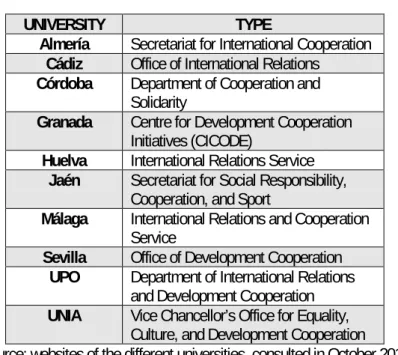
(3) On the back of this reality, the Andalusian Observatory of University Volunteering, based on its interest in studying social participation in Andalusian Universities, proposed this research with the primary objective of identifying actions carried out by Andalusia’s public universities with regard to development cooperation. The specific objectives set out were: to define the structures put in place to carry out actions, analyse the types of actions developed in this area (education/training, research, promotion and awareness, etc.), investigate cooperation issues and ascertain the priority targets countries, and indicate the main difficulties encountered when promoting university development cooperation and the proposals for improvement indicated by the policy-makers and/or agents. The actions identified are directly related with development cooperation, excluding for the purposes of this study any actions encompassed by the field of international cooperation. Analysis has focused on the direct actions carried out through the specific structures set up for the task of university development cooperation within each Andalusian public university. University Cooperation for Development Even though nowadays Universities are seen as an additional agent on cooperation for development, these institutions have undertaken important efforts to define University Cooperation for Development (UCD). “Defining the profile and content of UCD has been possible thanks to an intense reflection, concretized in a number of key documents to understand the mission, the scope, the objectives, the instruments, and the specificity of the University as an agent for development” (Hernández 2010: 182).. So, taking steps forward in the contextualization and definition of the term UCD, different authors of considerable relevance in the academic sphere have for example stated: “I want to think that cooperation is a way of being academic, and not an activity performed because of being academic…Cooperation is not an activity but rather a way of being, doing, and understanding” (Gabilondo 2006:19). In conclusion, University Cooperation for Development is nowadays seen as an additional social function of the University, sustained in the capacities and relevant knowledge for cooperation of the academic sphere (Sebastián 2006:202). In 1999, universities began to draft a University Development Cooperation Strategy (ESCUDE). The document was approved by CEURI on 3 March 2000 and adopted by the Conference of Spanish University Chancellors (CRUE) at its AGM held on 28 September of that same year. This document encapsulated the institutionalisation of development cooperation within the sphere of universities. ESCUDE (2000: 3) understands university development cooperation to be “the cooperation of universities in processes of socio-economic development”, looking to achieve one fundamental goal: “the search for social improvement, by modifying unfair, inefficient, and irrational structures, through programmes that foster the generation and dissemination of knowledge, the training and education of people, and the promotion of applied projects”.. CRUE, as part of its character and commitment to promoting social participation, approved a document entitled Universities: social commitment and volunteering in June of 2001 – coinciding with the International Year of Volunteering –, which to a certain extent complements the University Development Cooperation Strategy. Although it is geared more towards participation in acts of solidarity, fundamentally as volunteers, it also points to participation as voluntary workers or professionals in the third sector. Since the approval of these two documents, “the participation of Spanish universities in the promotion of development and international cooperation has grown demonstrably” (Ortega, Sianes and Cordón 2013: 87). University development cooperation is defined more specifically in section 9 of the University Code of Conduct with regard to Development Cooperation (2006: 4):. International Journal for 21st Century Education, vol. 1, (2016), 5-19. ISSN: 2444-3921. 7.
(4) “the activities carried out by the university community aimed at the social transformation of more underprivileged countries, in favour of peace, fairness, human development, and the environmental sustainability of the world, a transformation in which institutional and academic consolidation play an important role”. This document has become an ethical benchmark for the behaviour and actions of Spanish universities, and also “strengthens the commitment of universities to working in cooperation and development education” (Ortega, Sianes and Cordón 2013: 89).. In January of 2008, the University Development Cooperation Observatory (OCUD) was launched. It pursues two fundamental objectives: on the one hand, to create an integrated information system for University Development Cooperation so that universities can work on joint strategies; and on the other, to provide the Government with precise information about cooperation activities, in order to improve the planning and evaluation of the Spanish System of Cooperation. The involvement and achievements of Spanish universities in activities related with development cooperation led to their recognition in the Spanish Cooperation Master Plan 20052008, considering them to be agents of development: “Universities provide a privileged setting for development cooperation, from two fundamental perspectives: firstly, as an institution that offers technical and highly qualified human resources, encompassing all fields of knowledge, and whose projection towards the development of countries and societies that receive aid from Spain can be extremely important; secondly, because they constitute an immensely interesting space when it comes to raising awareness and educating a significant segment of the population, and for the dissemination of humanitarian and universalistic values among a segment of the young populous destined to play an important social role in the future” (Master Plan 2005-2008: 108).. Today, the University and its solidarity structures are recognized as legitimate actors in the context of the Spanish Cooperation for Development and particularly in the process of Education for Development (Boni and Pérez-Foguet 2006: 78). One example of this is the fact that, in the last few years, Spanish Universities, by using resources and financing available on each moment, have undertaken a well-known job within the process of Education for Development, recognized by every actor involved (Hernández 2010: 183). All this work developed in the last few years by Spanish Universities on Cooperation for Development has constituted an enormous challenge that has progressively been assumed by the academic community. This adaptation process has converted the new assignment of Cooperation for Development into an additional task for University professionals, together with their jobs of teaching, research, and knowledge transfer (Arias 2006-2007: 11). The experience gained over fifteen or more years, since universities developed the ESCUDE, and the consolidation of certain actions within some universities are now reflected in the Good Practices Guide published by CRUE (2015), through the Internationalisation and Cooperation Committee, which sets out the significant activities developed in recent years. Furthermore, the different Congresses about Universities and Development Cooperation held since the beginning of this century also provide another space in which the role of universities in development cooperation is consolidated and acknowledged: Valladolid 2001, Murcia 2004, Madrid 2006, Barcelona 2008, Cádiz 2011 and Valencia 2013. Since the ESCUDE was drawn up, Andalusian public universities have all institutionalised development cooperation within their university structures. It is a relatively young activity within universities, although some, such as the University of Cordoba, have an extensive background in this arena. Similarly, with the exception of the University of Huelva, they have all signed up to the Code of Conduct (Table 1). By adhering to this code, “each university becomes responsible for its dissemination within its respective university community by all means necessary to ensure said International Journal for 21st Century Education, vol. 1, (2016), 5-19. ISSN: 2444-3921. 8.
(5) community knows and debates its implications within the task of university development cooperation” (section 30 of the Code). Table 1. Adherence of Andalusian universities to the Code of Conduct. UNIVERSITY DATE Almería 25/06/2009 Cádiz 20/12/2006 Córdoba 02/02/2007 Granada 12/04/2007 Huelva N/A Jaén 25/07/2007 Málaga 12/02/2009 Sevilla 30/09/2008 UPO 31/10/2006 UNIA 24/11/2006 Source: OCUD, consulted in October 2015. Materials and methods The scope of this research encompassed public universities within Andalusia (a total of 10): Universidad de Almería, Universidad de Cádiz, Universidad de Córdoba, Universidad de Granada, Universidad de Huelva, Universidad de Jaén, Universidad de Málaga, Universidad Pablo de Olavide de Sevilla (UPO), Universidad Hispalense (Seville) and Universidad Internacional de Andalucía (UNIA). Qualitative research was conducted, carrying out in-depth semi-structured interviews with key informants (development cooperation officers and policy-makers) from each of the above universities. The interview script encompassed all the variables of interest in relation to each university, which would in turn allow for a comparative analysis to be conducted a posteriori. The main variables contemplated were: structure (type, administrative reporting structure, origin, evolution, functions, coordination), staff (political, technical, administrative, interns), actions (training/education, research, promotion, awareness, exchange, work out in the field, emergency, technology transfer), subjects, priority countries, funding, difficulties and proposed improvements. The structure in place at each university to carry out development cooperation activities was contacted by telephone to inform them about this research and interview the person deemed to be most appropriate by the structure itself. The research process was structured into three stages. The first stage focused fundamentally on obtaining general information about the organisational structures of Andalusia’s ten public universities, in order to detect which structures and services dealt with university development cooperation activities. This information was obtained directly from the universities’ webpages. The second stage was geared towards fieldwork. In order to carry out the interviews, the key informants were visited in situ at their respective universities using the script designed and recording each interview. Finally, in stage three, the interviews were transcribed and analysed, and a report was drafted with the results. Hence, the sources used were: the webpages of Andalusia’ public universities, interviews with key informants, and the webpage of the OCUD. The study took place between May and December of 2012 (eight months) and the team was made up of two lead researchers with technical support from the Andalusian Observatory of University Volunteering and the Volunteering and Solidarity Office at Pablo de Olavide University in Seville.. International Journal for 21st Century Education, vol. 1, (2016), 5-19. ISSN: 2444-3921. 9.
(6) Results All public universities in Andalusia include development cooperation within their organisational structure. In universities with the longest track record in this area, it was introduced by a member of the teaching staff who was aware of this issue. These teachers came from a broad range of different disciplines, which means that cooperation is more a way of understanding development than an issue pertaining to any specific discipline. This idea was also noted by Arias and Simón (2004: 9) in their research into humanitarian structures, indicating that “cooperation is not a simple activity; it is a way of being and of doing, and of understanding”. The other universities that incorporated development cooperation later on have done so at the initiative of their governing teams. Since universities have autonomy in terms of the functioning and organisation of these structures, there are a number of different formulas in place: department, service, centre, secretariat, and office (Table 2). The panorama is, in this respect, very heterogeneous. Table 2. University Development Cooperation Structures. UNIVERSITY Almería Cádiz Córdoba. TYPE Secretariat for International Cooperation Office of International Relations Department of Cooperation and Solidarity Granada Centre for Development Cooperation Initiatives (CICODE) Huelva International Relations Service Jaén Secretariat for Social Responsibility, Cooperation, and Sport Málaga International Relations and Cooperation Service Sevilla Office of Development Cooperation UPO Department of International Relations and Development Cooperation UNIA Vice Chancellor’s Office for Equality, Culture, and Development Cooperation Source: websites of the different universities, consulted in October 2015. All these structures are staffed and receive funding for the organisation and development of their actions. Although all the universities have at least one staff member within their structure (Table 3), staffing levels dedicated to development cooperation are not equal. The universities of Córdoba, Granada, Jaén, Málaga and Sevilla have technical staff members dedicated exclusively to development cooperation. Huelva, UPO and Cádiz have technical staff members who share their time with more than one department (international relations, social action). And the universities of Almería and UNIA do not have technical staff members but they do have technical directors. Some of the universities have interns who help with development cooperation tasks, such as the universities of Córdoba, Granada and Sevilla. Furthermore, all the universities provide administrative support staff either within the structure itself or from the Vice Chancellor’s Office into which the structure is integrated. The management, responsibility and/or coordination of the specific structure created for development cooperation rest largely with the teaching staff, who take on political responsibilities within this area, with the exception of the universities of Huelva, UPO and UNIA, where these responsibilities fall to technical-political staff from outside the faculty teaching body.. International Journal for 21st Century Education, vol. 1, (2016), 5-19. ISSN: 2444-3921. 10.
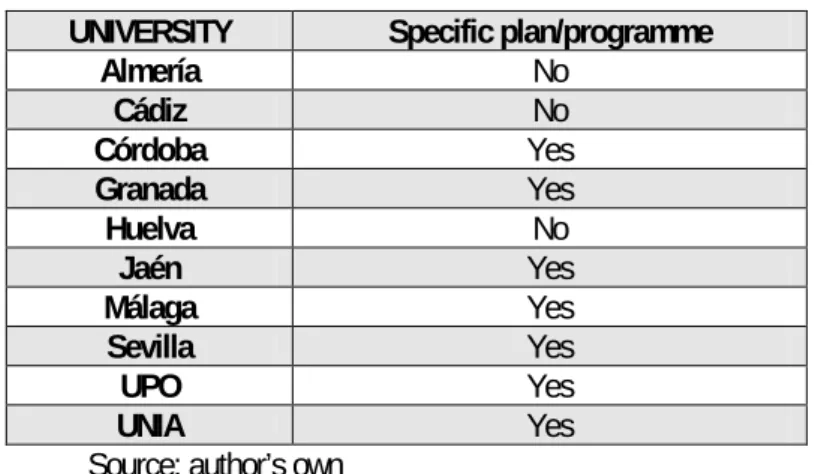
(7) Table 3. Human Resources. UNIVERSITY Almería Cádiz Córdoba Granada Huelva Jaén Málaga Sevilla UPO UNIA. Management of the Structure Teacher Teacher Teacher Teacher Technical-political officer Teacher Teacher Teacher Technical-political officer Technical-political officer Source: Author’s own. Technical Staff Member(s) No Yes Yes Yes Yes. Dedication. Interns. Part time Full time Full time Part time. Administ rative Support Yes Yes Yes Yes Yes. Yes Yes Yes Yes. Full time Full time Full time Part time. Yes Yes Yes Yes. No No Yes No. No. -. Yes. No. No No Yes Yes No. As for funding, the following administrative bodies provide financial support for development cooperation actions: Central Government, through the Spanish Agency for International Development Cooperation -AECID- (Ministry for Foreign Affairs and Cooperation); Regional Government, through the Andalusian Agency for International Development Cooperation – AACID- (Regional Department for Equality and Social Policy); Local Government, through provincial and local councils; and the universities themselves, through their budget allocations. From the funding allocated to development cooperation, some of the universities have specific Plans/Programmes (Table 4), or more generic plans with a specific line/strategy for development cooperation: this is the case of the universities of Córdoba, Granada, Jaén, Málaga, Sevilla, UPO and UNIA. Table 4. Specific Plans/Programmes for Development Cooperation. UNIVERSITY Almería Cádiz Córdoba Granada Huelva Jaén Málaga Sevilla UPO UNIA Source: author’s own. Specific plan/programme No No Yes Yes No Yes Yes Yes Yes Yes. Although, a priori, the existence of this type of action could be evaluated as an indicator of the university’s involvement with development cooperation, it must be taken with some caution, since in order to assess its repercussions properly, the budgetary allocation must be taken into account. In this aspect, there is huge variation from one university to another. Practically all those interviewed felt that the budget allocated to development cooperation was insufficient, also stating. International Journal for 21st Century Education, vol. 1, (2016), 5-19. ISSN: 2444-3921. 11.
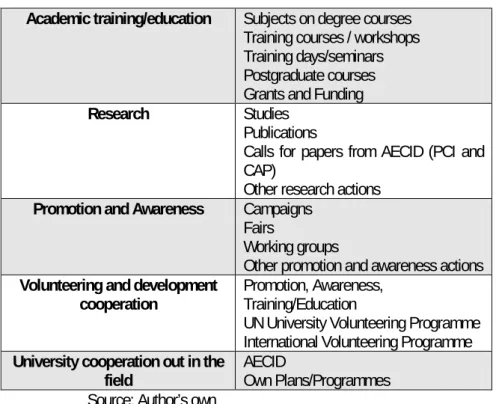
(8) in some cases that their budget is conditioned by the budget allocated to similar areas or more general areas that encompass this issue. Analysing the actions carried out by Andalusia’s public universities with regard to development cooperation (Table 5) – the fundamental objective of this research – we find that they can be grouped into five blocks: (1) academic training/education, (2) research, (3) promotion and awareness, (4) university volunteering, and (5) cooperation out in the field. Table 5. Types of development cooperation actions developed. Academic training/education. Research. Promotion and Awareness. Volunteering and development cooperation University cooperation out in the field Source: Author’s own. Subjects on degree courses Training courses / workshops Training days/seminars Postgraduate courses Grants and Funding Studies Publications Calls for papers from AECID (PCI and CAP) Other research actions Campaigns Fairs Working groups Other promotion and awareness actions Promotion, Awareness, Training/Education UN University Volunteering Programme International Volunteering Programme AECID Own Plans/Programmes. (1) The curricular training/education offer (subjects) offered by universities within their undergraduate and postgraduate courses are not widely known by the cooperation structures, even though these structures organise courses and/or workshops and training activities aimed at the university community. Furthermore, they collaborate actively with public and/or private entities from the cooperation sector in publicising and supporting any training/education activities they might organise. All universities offer postgraduate training 3 (masters’, advanced, specialisation courses, etc.) aimed at development, education, the culture of peace, Human Rights, humanitarian action, etc. As Unceta points out (2006: 74) “perhaps there has been growing professionalisation in the world of. development cooperation, which has generated demand for qualified experts that could only be satisfied by universities, or at least through collaboration between cooperation institutions and universities”.. From that we can infer that the training activities proposed are usually offered in the context of postgraduate studies. Therefore, as noted by Ortega (2008: 103), "it is necessary the mainstreaming of Education for Development within academic careers, and the introduction of specific subjects in particular degrees such as Education, Communication, Law, etc.". Also in relation to education and training, some universities offer grants or scholarships using their own funds to enable undergraduate and postgraduate students to undertake work placements, undergraduate or postgraduate dissertations and projects within the sphere of cooperation and development. Cordoba, Granada and Sevilla are the three universities that offer. 3. See: http://ocud.es/es/Formacion-Relacion_Postgrados_2015_2016. International Journal for 21st Century Education, vol. 1, (2016), 5-19. ISSN: 2444-3921. 12.
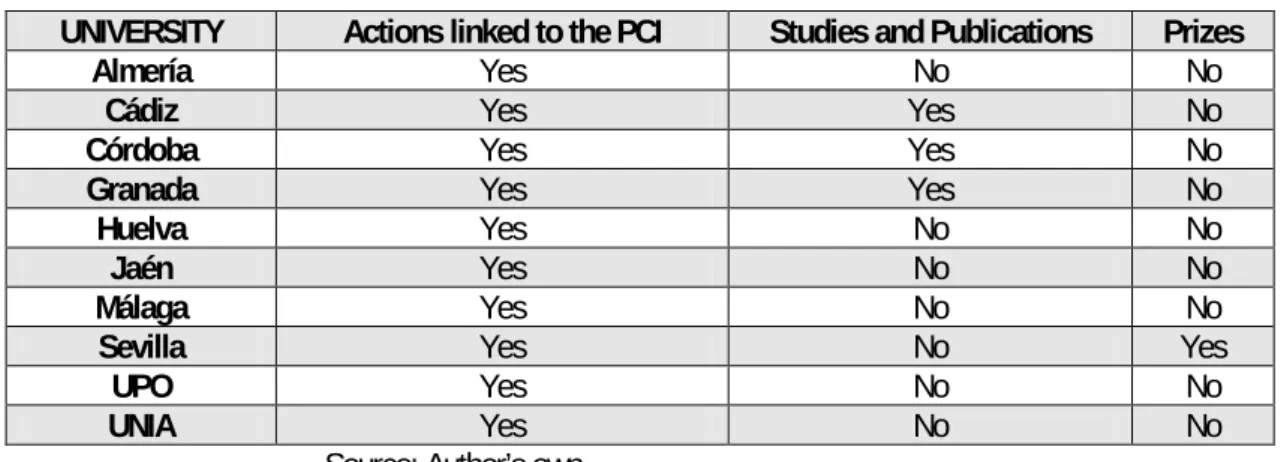
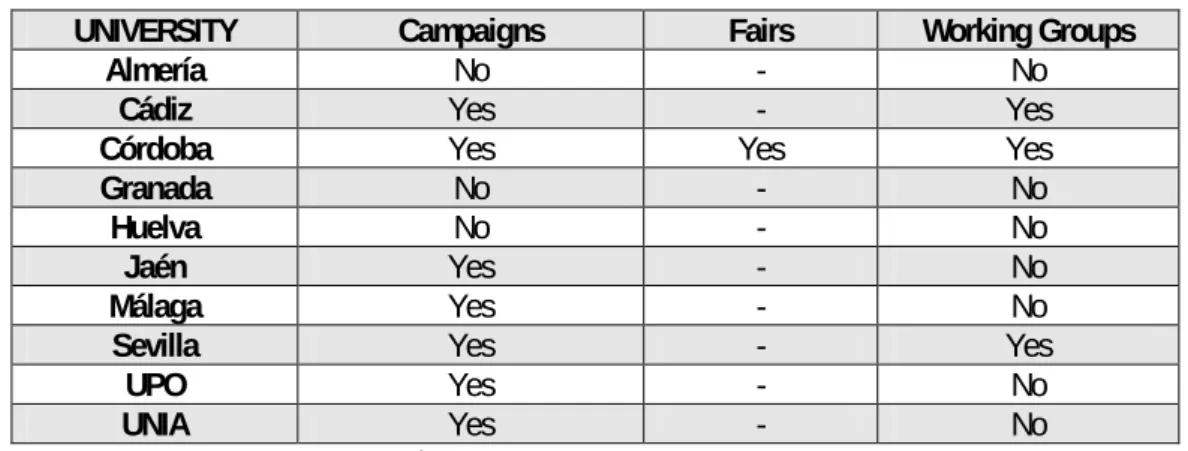
(9) these kinds of grants or funding. There are also universities that offer grants giving foreign students the chance to study on their different programmes: the University of Granada offers grants to students from Haiti and Equatorial Guinea; Jaen offers funding for students from Equatorial Guinea, and Sevilla offers scholarships on its Advanced Course in Gender and International Development Cooperation. (2) In terms of the different research actions developed within the realm of development cooperation (Table 6), the Inter-University Cooperation and Scientific Research Programme (PCI) is the main instrument available to teaching staff to conduct research with impoverished countries that are a priority for AECID. Although some universities have accessed the Open and Permanent Programme (CAP), it is always to a lesser extent when compared with the PCI. In spite of the importance of PCI for universities as a whole, this programme has now been cut as a result of the Spanish Government’s budget tightening measures. Some universities carry out studies and publish research from within their own cooperation structures. The University of Cádiz, for example, has published a study entitled “Universities in the face of natural disasters: humanitarian action and development”, and the University of Córdoba has published a report on “Fair Trade in Andalusia”. This university also publishes a journal entitled UCooperación and has brought out a Guide to Responsible Consumption in Universities. The University of Granada publishes Colección Periferias, a space for debate and reflection about current affairs: poverty, North/-South inequalities, peace, Human Rights, human and sustainable development etc. The University of Sevilla awards a Prize to teachers linked with the publication of books, journals or articles within the sphere of development cooperation. Table 6. Research Action. UNIVERSITY Almería Cádiz Córdoba Granada Huelva Jaén Málaga Sevilla UPO UNIA. Actions linked to the PCI Yes Yes Yes Yes Yes Yes Yes Yes Yes Yes Source: Author’s own. Studies and Publications No Yes Yes Yes No No No No No No. Prizes No No No No No No No Yes No No. (3) Actions developed with the primary aim of promoting and raising awareness of university development cooperation can be classified into three basic types: Campaigns, Fairs, and Working groups (Table 7). The Campaigns developed by universities are diverse, ranging from Annual Campaigns about “Responsible Consumption”, as in the case of the University of Córdoba, to Campaigns such as the one promoted by the University of Cádiz entitled “Yasuní Green Gold”, raising awareness about the need to conserve Ecuador’s Yasuní national park against oil prospecting, the campaigns run by the University of Jaén to promote the consumption of fair trade projects, and the “Cooperation Week” run by the University of Sevilla, to promote the construction of a space for work, dissemination, and reflection about the actions undertaken by the university with regard to international development cooperation, as well as other stakeholders that collaborate with the university. In general, the area of Fairs and Working groups has received less attention. The University of Córdoba has for some years run its Annual “Fair Trade” Fair in addition to on-going “Peace Groups”, which basically coordinate student organisations working on issues related directly with. International Journal for 21st Century Education, vol. 1, (2016), 5-19. ISSN: 2444-3921. 13.
(10) development cooperation. The University of Sevilla has recently set up a University Group for Fair Trade. For a while, the University of Cádiz also took part in the Working group on “Cities and Fair Trade” promoted by Puerto Real’s City Council. In addition to these three modes of action, there are other more specific and innovative initiatives such as Exhibitions, Conferences, “International Fair Trade Day”, and the awarding of Prizes related with Development cooperation. Table 7. Promotion and awareness actions. UNIVERSITY Almería Cádiz Córdoba Granada Huelva Jaén Málaga Sevilla UPO UNIA. Campaigns No Yes Yes No No Yes Yes Yes Yes Yes Source: Author’s own. Fairs Yes -. Working Groups No Yes Yes No No No No Yes No No. (4) Actions carried out in the area of university volunteering and development cooperation are aimed mostly at promotion and awareness, training and education at different levels (optional subjects, freely configured subjects, advanced courses, masters’ degrees), and the participation of university volunteers in international development cooperation programmes (Table 8). Although the offer for the first two actions is extensive and diverse, it is less so for the participation of university volunteers in international projects. Perhaps the most prominent programme is the United Nations University Volunteering Programme for the achievement of the Millennium Development Goals. The Universities of Cádiz, Sevilla and UPO have signed up to this Programme. In addition, the Universities of Granada, Málaga and Sevilla have their own funding programmes for international development cooperation volunteering initiatives. Table 8. Actions related with University Volunteering. UNIVERSITY. Almería Cádiz Córdoba Granada Huelva Jaén Málaga Sevilla UPO UNIA. Promotion and Awareness Yes Yes Yes Yes Yes Yes Yes Yes Yes Yes Source: Author’s own. Training/Education. Yes Yes Yes Yes Yes Yes Yes Yes Yes Yes. Participation in International Programmes No Yes No No No No No Yes Yes No. Funding for International Volunteering No No No Yes No No Yes Yes No No. (5) Andalusian public universities also work directly out in the field in impoverished countries, in collaboration with partner universities and/or entities, aiming to contribute to development and. International Journal for 21st Century Education, vol. 1, (2016), 5-19. ISSN: 2444-3921. 14.
(11) mitigate situations of inequality, poverty, and social exclusion. The actions carried out geared towards two aims: on the one hand, to strengthen universities in the destination country (in terms of studies, research, teaching staff, technology, etc.); and on the other, focusing on direct intervention with the local population. Many of these types of actions derive from AECID programmes (PCI, fundamentally, and CAP), and from the universities’ own programmes, many of which are funded by AACID contributions. As for the issues and countries and/or regions on which universities focus their development cooperation actions, in general, the programmes launched have largely determined and conditioned the issues tackled and, logically, the target countries. However, the majority of issues relate to Development Education in the broad sense of the term and with regard to priority countries and/or regions, particularly Latin America, the Maghreb, and Sub-Saharan Africa (Table 9). Table 9. Issues and countries by targeted by Universities. UNIVERSITY Almería Cádiz Córdoba. Granada. Huelva Jaén. Málaga. Sevilla UPO UNIA. Issues Agri-Food Industry. Countries Latin America, Maghreb, SubSaharan regions, China Development education Nicaragua, Morocco, Peru Education for citizens and critical Mozambique, Peru, Morocco, Bolivia, thinking Paraguay, Brazil, Venezuela Responsible consumption Food sovereignty Repercussions of multinationals in cooperation issues Reflection on policies and local actions Cooperation and Gender Sub-Saharan Africa, Magreb, Cooperation and the Environment Latin American (Bolivia, Peru, Ecuador, Guatemala, Haiti, Colombia), Southern Africa (Togo) Depending on PCI Defined by AECID. Health (Human Rights and Child Burundi, Morocco, Republic of Mali, Protection) Mozambique, Senegal, Colombia, Remodelling and Infrastructures Nicaragua (water, supplies) Knowledge of certain business organisation positions (agriculture) Childhood and Gender Education and communication Bolivia, Guatemala, Mexico, Peru, Gender and communication Dominican Republic, Ecuador, Awareness, social and community Paraguay, Morocco intervention Gender Latin America (particularly Mexico), Volunteering Africa, occupied Palestine Immigration Latin America, Maghreb (especially Social development Morocco and Algeria), Sub-Saharan Environment Africa Interculturality and conflicts Morocco (Tangiers and Tetouan, Environment and interculturality Casablanca), Senegal, Mauritania, Nicaragua Source: Author’s own. International Journal for 21st Century Education, vol. 1, (2016), 5-19. ISSN: 2444-3921. 15.
(12) Another aspect examined by this research has been intra and interuniversity coordination in the arena of development cooperation. Coordination between the structure responsible for development cooperation and other structures within the university (volunteering, equality, social action, etc.) can be divided into two types: on the one hand, there are universities that have a clear division of functions without the existence of mechanisms to connect with other areas; and on the other, some universities have specific forums for coordination in place (committees, etc.). Of particular note is the University of Córdoba. In addition to having such forums, it also strives to ensure cooperation is a transversal element running through any of the services organised by this university. With regard to interuniversity cooperation, the results obtained indicate a need for greater coordination between Andalusian universities. The work carried out by the Observatory for University Development Cooperation (OCUD) is felt to be positive, although meeting spaces are lacking. From a broad perspective, in relation to the actions undertaken by each Andalusian public universities in the area of development cooperation, the participants in this research identified two types of difficulties: related with structural and organisational aspects of the university itself, and a second type related with financial issues. In relation to the structural and organisation aspects, many participants identified the inexistence of a specific development cooperation area or a lack of stability thereof. Such an area is subject to continual changes as a result of policy changes. In general, these areas are insufficiently staffed, and in some cases technical officers have to divide their time between this and other areas. In addition, the overarching university policy governing this issue is poorly defined or inexistent. Furthermore, the actions promoted are not always coherent with the idea and concept of Development Cooperation held by the university, if indeed it has one. A further weakness identified is that these structures do not reach the entire university community, particularly administrative and services staff, and there is a lack of internal coordination and organisation, along with a lack of coordination between Universities. In short, the current configuration of these universities does not appear to foster the existence of development cooperation. As for financial matters, two possible situations are identified that inhibit the existence and/or stability of a specific area for university development cooperation or any actions it might develop. On the one hand, there is no specific budget for such matters. And on the other, this area’s funding is dependent on more general budgets that have to be divided up internally, in such a way that does not favour this particular area. Both scenarios place university development cooperation in a situation of instability characterised by difficulties establishing growth plans or enabling greater projection in the mid to long term. In addition to the difficulties identified when it comes to rolling out development cooperation initiatives, the participants also made a series of proposals aimed at tackling the difficulties detected. Firstly, they feel that a change of vision and stance is needed in terms of what cooperation development signifies for universities. There is a need to raise awareness internally regarding the need for development cooperation actions that do not fall into the trap of anticooperation 4, in addition to a critical approach and an attitude of social transformation among the general public and universities in particular. To achieve this, teachers and students must be more concerned about these matters, about social life. As for finance, specifically, universities need a clearer better-defined policy, with a specific budget for this area that minimises its dependence on subsidies. Furthermore, putting together and implementing a specific Development Cooperation Plan that is as participatory as possible in universities where this does not yet exist would help to consolidate and give greater projection, Anti-cooperation refers to any actions that interfere negatively with impoverished peoples. Llistar (2009) defines it as any action carried out in and from the North, the effects of which are directly or indirectly harmful to the South.. 4. International Journal for 21st Century Education, vol. 1, (2016), 5-19. ISSN: 2444-3921. 16.
(13) visibility, and recognition to what universities are doing in the field of cooperation. Efforts must be redoubled to ensure greater interaction and joint work with Non-Governmental Organisations dedicated to development cooperation, and in order to guarantee the quality of work carried out, there must be internal evaluations within the universities themselves funded by the Andalusian Cooperation Agency. The final proposals for improvements include the need for greater interuniversity coordination and the creation of an interuniversity movement that would drive a different model of university. Conclusions and discussion University policy regarding development cooperation is unclear. There is a lack of coherence detected at times between policy and the specific actions developed. Each university must clarify and define with greater precision what it understands by University Development Cooperation, in spite of the efforts made by CEURI-CRUE in this regard. This need is patent given the documents published and analysed previously. The position and stance adopted by each university with regard to development cooperation in general and university development cooperation in particular should be made public at an internal (university community) and external level (society as a whole) using any instruments deemed appropriate by each university. In fact, section 30 of the Code of Conduct (2006) incites just such a debate and reflection, also stating that each university should appoint a body to monitor the application of said Code, although the research conducted here indicates that few universities have done this. The need for universities to debate and take a clear stance with regard to university development cooperation would promote not only greater knowledge and awareness about this issue at an internal level, but it would also raise the profile of universities as social agents that pursue and are involved in social transformation at a global level. The periodic renewal of governing bodies, with the resulting changes in institutional priorities established on their agendas, often leads to a lack of stability in relation with the development cooperation area or department. Since cooperation structures were created in the different universities, the majority have experienced different situations at an institutional level resulting from changes in the governing teams. Logically, these changes have translated into an increased or decreased level of stability, protagonism, budget allocations, social projection, etc. for these structures. It is particularly important to have a specific structure in place for development cooperation that is separate from international relations. Universities that have a more autonomous and independent structure rate its capacity for self-management positively along with its possibilities for organising activities. The research performed by Martínez and Sancho (2011: 78) also highlighted the possibilities that universities had, when trying to foster actions towards Cooperation for Development, when this was a priority topic for the corresponding Vicerectorship. In turn, this structure should have sufficient human resources, since the lack of staff members in some cases who are not dedicated exclusively to cooperation activities limits the possibility of implementing more actions within the university. The availability of technical staff dedicated exclusively to development cooperation is an important variable when assessing the strength or weakness of the university in this area. There is a direct relationship between staff and actions launched. The actions carried out by each university in this area are conditioned by the interests of the governing team at any given time, as well as the structure and the staff allocated to it. The universities that carry out the most development cooperation actions are those with a defined and stable structure, and with consolidated staffing levels. The current configuration of universities also does not favour intra and interuniversity coordination. At the level of internal organisation, the implementation of coordination mechanisms. International Journal for 21st Century Education, vol. 1, (2016), 5-19. ISSN: 2444-3921. 17.
(14) would be useful so as to facilitate communication between the specific cooperation structures of each university and other similar structures (volunteering, equality, social action, etc.), as well as between teachers running projects in relation to this issue, postgraduate training, etc. This would enable universities to capitalise more and better on what has been developed, sometimes exclusively by ‘a few’ without the knowledge of ‘others’. It would also favour joint actions that are coherent with the university’s philosophy and approach to this matter, and would similarly avoid the development of anti-cooperation actions within a single institution. Understanding development cooperation as a transversal element running through any of the services organised by the university also provides an interesting working formula, since development cooperation should be part of a social awareness that everyone should possess to fight against inequalities and social exclusion. If, in addition to this intrauniversity coordination, coordination between universities along this same line were also strengthened, Andalusia’s public universities would offer great potential for development cooperation. The lack of a specific allocated budget and the narrow choice of funding options mean that university development cooperation finds itself in a situation characterised by instability and difficulties establishing growth plans and greater projection in the mid to long term. The position of extreme budgetary dependence, fundamentally on central and regional government, puts the stability and continuity of this area within Andalusian public universities at risk, particularly in periods of crisis such as the present situation. For this reason, it would be important to promote and pursue diversification in funding channels in order to develop specific programmes. Drawing up a specific Development Cooperation Plan within universities that do not yet have one, and maintaining such a plan within universities that do have one in place, is important to raise the profile of development cooperation and to take action in this arena. The diversification of funding channels would also mean that work could be developed in relation to a greater range of issues and regions/countries. Currently, as a result of the Spanish government’s budget tightening measures, development cooperation is having a hard time. However, we understand that the efforts and achievements attained in recent years within universities should provide stimulus and motivation to continue consolidating this task. Development Cooperation should be an essential part of universities’ social commitment. Solidarity and commitment are part of universities and, at the same time, they are the grounding principles of development. Acknowledgements We would like to thank all those who have made this research project possible, through their attention and dedication: the Andalusian public universities, the Andalusian Observatory for University Volunteering, and the Office of Volunteering and Solidarity at Pablo de Olavide University in Seville, in addition to the Vice Chancellor’s Office for Social and Cultural Promotion at Pablo de Olavide University, who supported the funding of this work. Bibliographic references Alonso, J. A. (2004). La universidad como agente de cooperación al desarrollo. En Actas II Congreso Nacional Universidad y Cooperación al Desarrollo. Murcia: Instituto Universitario de Cooperación al Desarrollo, pp. 49-56 Arias, S. (2006-2007). La cooperación universitaria al desarrollo. Un desafío permanente. Tabenque. Revista Pedagógica, 20, pp. 11-26 Arias, S. and Molina, E. (2008). Universidad y cooperación al desarrollo. La experiencia de las universidades de la ciudad de Madrid. Madrid: Catarata Arias, S. and Simón, A. (2004). Las estructuras solidarias de las Universidades Españolas: Organización y Funcionamiento. Madrid: Fundación Telefónica. International Journal for 21st Century Education, vol. 1, (2016), 5-19. ISSN: 2444-3921. 18.
(15) Boni, A. and Pérez-Foguet, A. (2006). Construir la ciudadanía global desde la Universidad: propuestas pedagógicas para la introducción de la educación para el desarrollo en las enseñanzas científico-técnicas. Barcelona: IO-ISF Cabrero, F. (2006). El tercer mundo no existe. Diversidad cultural y desarrollo. Barcelona: Intermón Oxfam Comité Español Universitario de Relaciones Internacionales (2006). Código de conducta de las universidades en materia de cooperación al desarrollo. Madrid: CURI-CRUE Comité Español Universitario de Relaciones Internacionales (2000). Estrategia de cooperación universitaria al desarrollo. Madrid: CURI-CRUE Conferencia de Rectores de las Universidades Españolas (2015). Guía de Buenas Prácticas de Cooperación Universitaria para el Desarrollo. Madrid: CRUE Conferencia de Rectores de las Universidades Españolas (2001). Universidad. Compromiso social y voluntariado. Madrid: CURI-CRUE Gabilondo, A. (2006). Misión y valores de la Universidad en un mundo en cambio. Cuadernos Solidarios de la Universidad Autónoma de Madrid, nº 1, pp. 15- 28 Hernández, R. (2010). Balance y perspectivas de la cooperación universitaria al desarrollo en España. Revista Española de Desarrollo y Cooperación, 26, pp. 177-191 Iáñez, A. (2012). Universidad y Cooperación al Desarrollo. Revista Universitas Científica, 2012, pp. 80-83 Llistar, D. (2009). Anticooperación. Interferencias Norte-Sur. Los problemas del Sur Global no se resuelven con más ayuda internacional. Barcelona: Icaria Martínez, R. and Sancho, I. (coord.) (2011). Las estructuras solidarias de las universidades públicas andaluzas. Sevilla: Dirección General de Voluntariado y Participación, Junta de Andalucía Ortega, Mª. L., Sianes, A. and Cordón, Mª. Rosa (2013). Las estructuras solidarias de las universidades españolas y su papel en la promoción del desarrollo y la cooperación internacional. Cuadernos del Cendes, 84, pp. 85-111 Ortega, Mª. L. (2008). Estrategia de educación para el desarrollo de la cooperación española. Madrid: MAE-AECID Pérez, K (2000). Diccionario de Acción humanitaria y cooperación al desarrollo. Barcelona: Ucaría. Recuperado de: http://dicc.hegoa.efaber.net Secretaría de Estado de Cooperación Internacional (2005). Plan Director de la Cooperación Española 2005-2008. Madrid: Ministerio de Asuntos Exteriores y Cooperación. Sebastián, J. (2004). Cooperación e internacionalización de las universidades. Madrid: Biblos Sebastián, J. (2006). Oportunidades y desafíos de la cooperación universitaria al desarrollo. In Arias, S. and Molina, E. (coords.): Universidad y cooperación al desarrollo, colección de cuadernos solidarios (pp. 37-50). Madrid: UAM Ediciones. Sen, A. (2000). Desarrollo y libertad. Barcelona: Planeta. Unceta, K. (2006). La cooperación al desarrollo en las universidades españolas. Madrid: AECID Unceta, K. and Yoldi, P. (2000). La cooperación al desarrollo: surgimiento y evolución histórica, Cooperación Pública Vasca. Gobierno Vasco. Recuperado de: http://www.dhl.hegoa.ehu.es/ficheros/0000/0029/La_cooperacion_al_desarrollo._manual_1 _castellano.pdf. International Journal for 21st Century Education, vol. 1, (2016), 5-19. ISSN: 2444-3921. 19.
(16)
Figure

+3
Documento similar
In the preparation of this report, the Venice Commission has relied on the comments of its rapporteurs; its recently adopted Report on Respect for Democracy, Human Rights and the Rule
As such, this study proposed five variables: (1) Promoting environmental sustainability through the mission of the university; (2) Assessment of universities’
In the light of this, the discrete-time version of the classical “on/off” heavy-tailed source model, proposed in the following, is of interest in the simulation, modelling
In this context, “CYD Report 2014” on Spanish universities performance, places the University of Santiago de Compostela in the 4th position in number of priority patent
In the context of relationship marketing and based on the online reality, the objective of this research, as mentioned, is to analyse the capacity of the main
An approximation to the configuration of Spain’s audiovisual media in 2014. The case of Canal Sur TV
Based on the analysis of the most important developments in the configuration of the Spanish and Andalusian public audiovisual sector up until the summer of 2014, this
This article analyses the coverage of the Andalusian elections campaign of 25 March, 2012, by the Andalusian editions of three Spanish national newspapers: Abc, El Mundo and El
In the “big picture” perspective of the recent years that we have described in Brazil, Spain, Portugal and Puerto Rico there are some similarities and important differences,
