
Holistic Assessment: Effective or Lenient in Translation Evaluation?
18
0
0
Texto completo
(2) Abkari & Gholamzadeh. Holistic Assessment: Effective or Lenient in Translation Evaluation?. considerarse un método adecuado y efectivo. No obstante, dicha hipótesis no pudo probarse. En consecuencia, este estudio llegó a la conclusión de que no existe una conexión estricta en cuanto a la mejora de la competencia traductora mediante el uso de la evaluación holística en los ejercicios de los estudiantes de estudios de traducción, especialmente si se tiene en cuenta la direccionalidad de la traducción como factor decisivo. Palabras clave: evaluación, evaluación holística, competencia traductora, la direccionalidad de la traducción.. Sumario: 1. Introduction. 2. State of the Art. 2.1. The Holistic Method of Translation Assessment. 3. Methodology. 3.1. Description of the participants and study conditions. 3.2. Advance Translation (II) Exam. 3.3. The application of Holistic Method of Translation Assessment. 4. Data analysis and results. 5. Discussion. 6. Conclusion. 1. Introduction Inasmuch as translation mistakes, translation methods, approaches, and strategies are multifarious, it’s a painstaking process for translation teachers and trainers to evaluate the translation students’ performance and address all these incongruities in translation. All the same, approaching translation mistakes by one single strategy on the part of translation teachers might not be an appropriate practice. In the same way, addressing the linguistic, semantic, stylistic, and cultural mistakes in like manner is not applicable. Otherwise, it demands that these mistakes should be treated differently, and be evaluated in their own right (Hatim 2014: 155). A circumstantial survey on Translation Quality Assessment (TQA) indicates that the majority of studies carried out in this field are based on theoretical notions ranging from issues such as ‘text linguistic analysis (House 1981)’, ‘criteria for good and poor translation (Newmark 1991; Williams 2009)’, ‘translation error versus language error (Kussmaul 1995; Wongranu 2017)’, ‘the nature and the sources of errors (ibid.)’, ‘linguistic and pragmatic levels (Williams 2013)’, ‘the psycholinguistic theory of scenes and frames (Geeraerts 2009; Snell-Hornby 1988)’, to ‘different levels of translation competence (PACTE 2002, 2005, 2009; Stansfield, Scott, & Kenyon 1992)’. Similarly, translation quality assessment suffers from a surprising scarcity in empirical studies. One rarity is the research undergone by Séguinot (1990) that concentrates on the mistakes made by the translation students. However, Séguinot (1990) ignored to analyze linguistic and higher textual and pragmatic levels in translation (Bahameed, 2016: 136). Stansfield et al. (1992) conducted a research ‘to identify the variables that constitute translation ability’. As part of U.S. Federal Bureau of Investigation (FBI), this article was aimed to ameliorate and authenticate ‘job-related test 4. Skopos 10 (2019), 3-20.
(3) Abkari & Gholamzadeh. Holistic Assessment: Effective or Lenient in Translation Evaluation?. of translation ability’ (Waddington 2001: 17). In relation to the failure to realize any state of the art on translation of research, they could ‘understand translation ability either as a psycholinguistic process or as a construct to be measured’ (Stansfield et al. 1992: 455). In this regard, two basic translation skills are explicated: (1) accuracy, with an aim to transfer a source text content to a target text; and (2) expression, with its concentration on the quality of linguistic aspects in a target text. Also, Stansfield et al. (1992) presented ‘translation skill-level descriptions’ (Bahameed 2016: 137) for each facet of translation competence and operated it to the ‘correction of subsequent test’ (ibid.). Bearing this in mind, a validation study was carried out to maintain the division of translation competence into two diverse categories, even though it revealed that accuracy was a ‘more valid measure of translation ability’ (Stansfield et al. 1992: 461). Moreover, in a research conducted by Hatim and Mason (1997), they made a distinction between translation quality assessment and ‘translators’ performance assessment’. On the basis of ‘communicative language ability’ of Bachman (1990), they advanced to delineate a ‘chart of translation skills’ (Waddington 2001) into three skills, namely (1) source text processing skills; (2) transfer skills; and (3) target text processing skills. Last but not least, Waddington (2001) focused on testing translation assessment in the course of classroom setting. He set up a questionnaire sent to forty-eight European and Canadian universities where offered the degree of Translation Studies. The main purpose of the questionnaire was to reflect on three principle aspects of translation examinations: (1) the type of translation exam; (2) the condition of the translation exam such as timeavailability; and (3) the system of translation scoring. In Waddington’s research, a number of fifty-two translation teachers and trainers participated. These translation teachers and trainers replied from twenty of these European and Canadian universities in which their answers to the third question (the system of translation scoring) echoed the following condition: (1) nineteen teachers (36.5%) utilized a model which was associated with error analysis; (2) twenty teachers (38.5%) applied holistic method of assessment; and (3) twelve teachers (23%) amalgamated error analysis with holistic method of assessment. The inclination in this research paper is to cast a different context (such as the University of Isfahan, Iran) on translation course by use of rightto-left languages such as Persian. The forty participants in this paper were all translation students ranging from 20 to 25 years old to remove the impacts of age and gender. We formulated the final exam term of Advance Translation (II) course to figure out the sort of translation exam and the appropriate translation correction method. In the meantime, the assessment 5. Skopos 10 (2019), 3-20.
(4) Abkari & Gholamzadeh. Holistic Assessment: Effective or Lenient in Translation Evaluation?. method adopted by this research paper included the holistic method eliminating the method of error analysis in checking and correcting the translation drafts of the participants, followed by an analysis to determine the extent holistic method of assessment could be accounted as applicable. This paper considered the results maintained by exploiting holistic method of assessment to the correction process of translation drafts carried out by the participants under final exam overtone. Consequently, this research paper hypothesized that ‘holistic method of translation assessment is effective to be applied in classroom setting and likewise it is possible to ameliorate the quality of students’ performance based on this method of assessment’. In order to verify this hypothesis, the assumption is adopted that the translation student’s failure (lower and the lowest group of scorers) should not exceed forty percent and the top group of scorers should not exceed twenty percent of the total number of participants.. 2. State of the Art 2.1. The Holistic Method of Translation Assessment Holistic method is deemed an objective and accurate translation assessment. Nevertheless, this method has a limited range of pliability and objectivity depending on evaluators’ taste or impression and the types of errors which participants make. As a matter of fact, the holistic method of translation assessment has been variously recommended by translation teachers and trainers. The pursuing descriptions are based upon the potentialities of professional translators and do little to determine the quality of translation by novice or trainee translators. Through the holistic method of translation assessment, the quality of translation drafts is evaluated through giving scores in terms of the translators’ appreciation or ‘translators’ overall impression’ (Akbari & Segers 2017b: 412; Mariana, Cox, & Melby 2015). This intuitive-impressionistic method of assessment is used in professional settings (Eyckmans, Anckaert, & Segers 2009). In a holistic assessment, the corrector/rater utilizes his/her own impression for scoring a translation draft as excellent, good, fair, bad, etc. In this vein, the corrector peruses the translation draft ‘as a whole without considering the errors’ (Akbari & Segers 2017a: 15). Moreover, the results of this method is inconsistent from one evaluator to another. According to Kockaert and Segers (2014), ‘a holistic approach seemed to focus better on context sensitive evaluation, and seemed to discard exclusive attention to grammatical errors in translation tests’. In this respect, ‘context sensitive evaluation’ refers to the translations that do not occur in vacuum and require assessing in a pertinent context (Koskinen 2008: 72). McAlester (2000: 231) points out that ‘often the actual 6. Skopos 10 (2019), 3-20.
(5) Abkari & Gholamzadeh. Holistic Assessment: Effective or Lenient in Translation Evaluation?. evaluation follows fairly rough guidelines based admittedly in the best cases on experience and common sense, but in the worst on mainly subjective impressions’. What’s more, it should be noted that holistic method cannot be refuted as un-systematic assessment method. By the same token, Garant (2009: 10) maintains that: Holistic method refers to a systematic way in which the teacher arrives at an overall impression of the text as opposed to relying on a discrete point-based scale. The teachers in that group had each devised their own, systematic way of evaluating translations.. Consequently, Waddington (2001) has conducted a research on the evaluation of students’ translations through different methods of assessment. Delineating four assessment methods, the third method he described in his article dealt with the holistic method of translation assessment. In this vein, he elaborated on a holistic assessment scale treating the translation competence as a whole; however, it requires an evaluator to take three different facets of translation students’ performance into account (score between 0 and 10). This research applies Waddington’s holistic framework for the pertinence and consistency of the sample level of the data in this research paper. Table 1: Waddington’s Framework of Holistic Method (2001: 315) Accuracy of Quality of Degree of Task Mark Transfer of ST Expression in Completion Content TT Task Level 5 Complete Almost all the Successful 9, 10 transfer of ST: translation only minor reads like a revision is piece originally needed to reach written in professional English. There standards may be minor lexical, grammatical, or spelling errors. Level. Level 4. 7. Almost complete transfer: there may be one or two insignificant inaccuracies; requires certain amount of. Large sections read like a piece originally written in English. There is a limited number of lexical, grammatical, or. Almost completely successful. Skopos 10 (2019), 3-20. 7, 8.
(6) Abkari & Gholamzadeh. Level 3. Level 2. Level 1. Holistic Assessment: Effective or Lenient in Translation Evaluation?. revision to reach professional standards. Transfer of the general ideas but with a number of lapses in accuracy; needs considerable revision to reach professional standards.. Transfer undermined by serious inaccuracies; thorough revision required to reach professional standards. Totally inadequate transfer of ST content; the translation is not worth revising.. spelling errors.. Certain parts read like a piece originally written in English, but others read like a translation. There are a considerable number of lexical, grammatical, or spelling errors. Almost the entire text reads like a translation; there are continual lexical, grammatical, or spelling errors. The candidate reveals a total lack of ability to express himself adequately in English. Adequate. 5, 6. Inadequate. 3, 4. Totally inadequate. 1, 2. For each level, two possible marks are provided. This system of scoring allows the evaluators to grant the higher score to the top group of scorers who comprehensively meet the requisites of a special level, and to keep the lower remarks to the bottom group of scorers who descend to lower rates in the scale of scorers.. 3. Methodology 3.1. Description of the participants and study conditions This research paper explicated the issues related to translation evaluation/assessment. Correspondingly, this paper concentrated on evaluation of a sample of translation participants. In this respect, a selection 8. Skopos 10 (2019), 3-20.
(7) Abkari & Gholamzadeh. Holistic Assessment: Effective or Lenient in Translation Evaluation?. of purposeful non-random sampling as a sample of translation participants was adopted. In order to reduce any threat to validity, this paper removed any trace of discrimination factors such as age and gender. The selected participants were in their fourth year of undergraduate studies (Bachelor of Arts in Translation Studies) at the University of Isfahan, Iran. The justification for targeting the aforesaid participants was the better command of English (L2) language skills, as it was assumed about a final year student, besides their mother tongue language (L1-Persian). Additionally, they had received training to integrate translation skills from Persian to English and vice versa. In spite of this, the majority of translation tasks (e.g. political, journalistic, technical, economical, advance and legal translations) undergone in their classroom setting was from English to Persian. In the third year of their studies, they had already passed Advance Translation (I) to gain the pertinent translation skills and approaches with regard to Advance Translation (II). In this paper the research is doted on the final examination of the fourth year course, Advance Translation (II) to provide an occasion for translation students to work more enthusiastically in the final exam when being compared with their results obtained from Advance Translation (I) students.. 3.2. Advance Translation (II) Exam Advance Translation (II) Exam (see appendix) is held in an entirely similar format as other translation exams at the University of Isfahan. In fulfillment to create a balance in the difficulty level of the exam, this examination was composed of two sections: (i) a written translation task from English to Persian; and (ii) a written translation task from Persian to English. Assuming that translating a foreign language (e.g. English) into one’s mother tongue is always uncomplicated, the former task is designed to be longer. In Advance Translation (II) exam, five proportionately long statements which contained particular phrases, expressions, and collocations and two general passages were included. Using any electrical devices such as off-line mobile dictionaries were allowed in this exam. The five long statements along with one passage in English contained a total of 214 words, while the Persian text counted as 149 words. The participants had two hours to translate the texts. Considering that the English text had a larger scale (English-Persian) in comparison to Persian to English translations, this paper devoted 6 marks out of 10 for the English to Persian text based upon Waddington’s holistic scale compared to 4 marks consisted for the Persian to English translations.. 9. Skopos 10 (2019), 3-20.
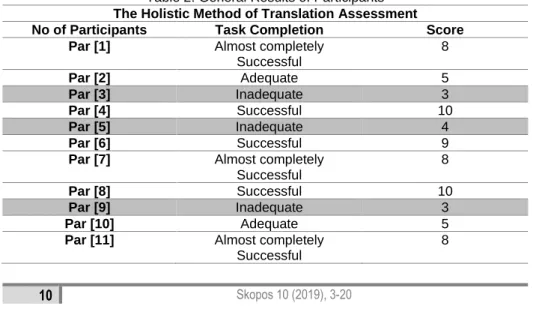
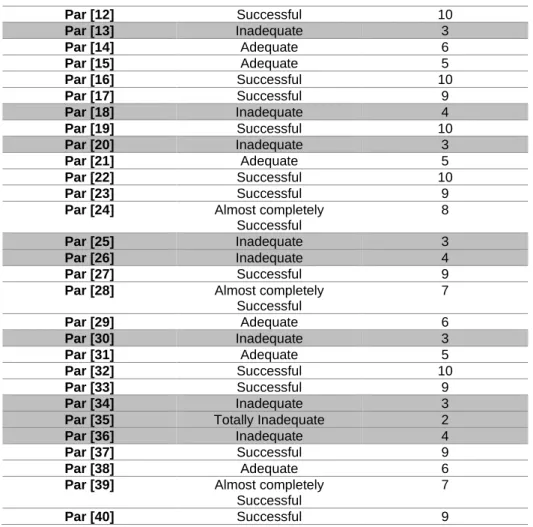
(8) Abkari & Gholamzadeh. Holistic Assessment: Effective or Lenient in Translation Evaluation?. 3.3. The application of Holistic Method of translation assessment In verification of the stated hypothesis, this research paper applied holistic method of translation assessment to correct the exam of Advance Translation (II) participated by forty Translation Studies students at the University of Isfahan. This exam was conducted by a professional translation evaluation expert with 15 years of experience in translation assessment and testing. The process of exam correction based on holistic assessment was systematic. In this respect, the evaluator made use of red lines to identify the mistakes. Furthermore, two levels of mistakes were categorized in this study: (i) minor mistakes with no influence on the general meaning/message of translations and (ii) major/critical (serious) mistakes influential on the general meaning of a sentence. When the correction of translation exam papers was done, based on Waddington’s (2001) holistic scale, the more red lines appeared on the answer sheet were an indication of low level of the participants.. 4. Data analysis and results To reach a higher degree of objectivity, the translation drafts of the students were scored horizontally. The translation instructor advanced on scoring the participants’ drafts by starting with the first question (long statements and one passage). Further, the instructor followed to the second question on the basis of Waddington’s (2001) scale of holistic method of translation assessment. Table 2 indicates the general results provided by the participants: Table 2: General Results of Participants The Holistic Method of Translation Assessment No of Participants Task Completion Score Par [1] Almost completely 8 Successful Par [2] Adequate 5 Par [3] Inadequate 3 Par [4] Successful 10 Par [5] Inadequate 4 Par [6] Successful 9 Par [7] Almost completely 8 Successful Par [8] Successful 10 Par [9] Inadequate 3 Par [10] Adequate 5 Par [11] Almost completely 8 Successful. 10. Skopos 10 (2019), 3-20.
(9) Abkari & Gholamzadeh Par [12] Par [13] Par [14] Par [15] Par [16] Par [17] Par [18] Par [19] Par [20] Par [21] Par [22] Par [23] Par [24] Par [25] Par [26] Par [27] Par [28] Par [29] Par [30] Par [31] Par [32] Par [33] Par [34] Par [35] Par [36] Par [37] Par [38] Par [39] Par [40]. Holistic Assessment: Effective or Lenient in Translation Evaluation? Successful Inadequate Adequate Adequate Successful Successful Inadequate Successful Inadequate Adequate Successful Successful Almost completely Successful Inadequate Inadequate Successful Almost completely Successful Adequate Inadequate Adequate Successful Successful Inadequate Totally Inadequate Inadequate Successful Adequate Almost completely Successful Successful. 10 3 6 5 10 9 4 10 3 5 10 9 8 3 4 9 7 6 3 5 10 9 3 2 4 9 6 7 9. Table 2 illustrated that the application of holistic method of translation assessment generated an extensive number of failure cases (both inadequate and totally inadequate). Amongst others, 12 students were scored below 5. The failed participants needed 3 and 4 more marks to reach the lowest pass mark (30%). The following table (Table 3) indicates the general accumulative results for the participants.. 11. Skopos 10 (2019), 3-20.
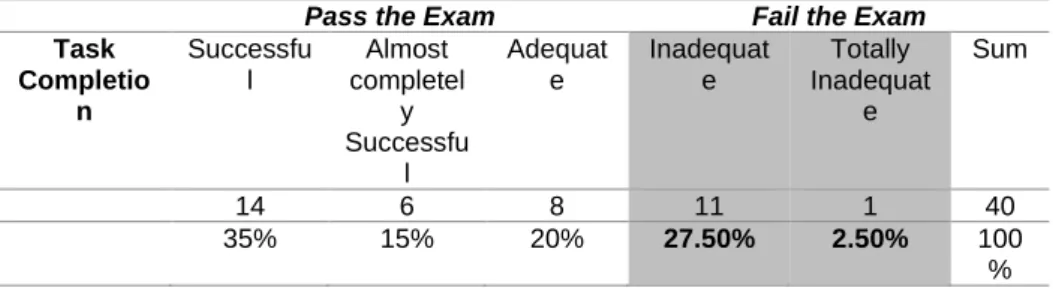
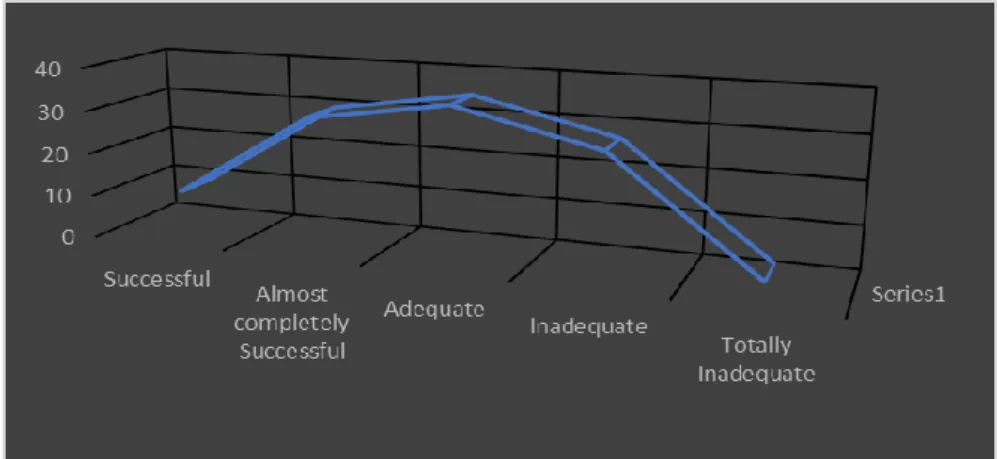
(10) Abkari & Gholamzadeh. Task Completio n. Holistic Assessment: Effective or Lenient in Translation Evaluation?. Table 3: Holistic Accumulative Results Pass the Exam Fail the Exam Successfu Almost Adequat Inadequat Totally l completel e e Inadequat y e Successfu l 14 6 8 11 1 35% 15% 20% 27.50% 2.50%. Sum. 40 100 %. Table 3 indicated that 12 cases (30%) of the total participants failed to reach the pass mark based on Waddington’s holistic scale assessment. Bearing this in mind, the policy of Language faculty of universities take these results (30%) the high percentage of failure cases into account. The policy adopted by the University of Isfahan, for instance, indicates that the failure rate of all participants should not normally exceed (25%). Furthermore, another calculation regarding the direction of translation (L2-L1 and L1-L2) has been conducted to analyze whether direction in translation impacts the results. The following table (Table 4) illustrates the first task assignment (English to Persian) and the second task assignment (Persian-English). It is comprehensible that there is a remarkable difference between translation directionality and the failure rate. It can be discerned that the majority of failure cases occurred in Persian-English translation (L1-L2). In this respect, the scores of 17 participants (42.5%) were below the marks allocated for this question (4 marks); considering that this question was devoted 4 marks in comparison to the 6 marks that was allocated for the first question (EnglishPersian). Thus, the results showed that the English language writing competency was considerably poor among the selected participants. Table 4: The Holistic Results on Translation Directionality Participants Translation Direction toward Translation Direction toward Persian (6 Marks) English (4 Marks) Par [1] 4.9 3.1 Par [2] 3.5 1.5 Par [3] 2.2 0.8 Par [4] 6 4 Par [5] 3.1 0.9 Par [6] 5.1 3.9 Par [7] 4.1 3.9 Par [8] 6 4 Par [9] 3 0 Par [10] 5 0 Par [11] 4.2 3.8. 12. Skopos 10 (2019), 3-20.
(11) Abkari & Gholamzadeh. Holistic Assessment: Effective or Lenient in Translation Evaluation?. Par [12] Par [13] Par [14] Par [15] Par [16] Par [17] Par [18] Par [19] Par [20] Par [21] Par [22] Par [23] Par [24] Par [25] Par [26] Par [27] Par [28] Par [29] Par [30] Par [31] Par [32] Par [33] Par [34] Par [35] Par [36] Par [37] Par [38] Par [39] Par [40] Failure Cases Percentage. 6 1.4 4.7 1.7 6 5.3 3.3 6 1.8 3.4 6 5.7 4.7 2.5 3.2 5.4 4.1 4.4 2.3 2.6 6 5.4 3 1.4 3.8 5.3 2.2 4.8 5.1 9 22.5%. 4 1.6 1.3 3.3 4 3.7 0.7 4 1.2 1.6 4 3.3 3.3 0.5 0.8 3.6 2.9 1.6 0.7 2.4 4 3.6 0 0.6 0.2 3.7 3.8 2.2 3.9 17 42.5%. 5. Discussion As attested by critics, the holistic method of translation assessment is appropriate; however, there can be no claim for its precision and objectivity due to the dependence on the impression (intuition) or appreciation of an evaluator (rater) (Akbari & Segers 2017a, 2017b, 2017c; Kockaert & Segers 2017). For instance, one evaluator might score eight or nine based on his/her personal judgment. With this idea, there are not clear criteria to select one translation as an excellent or poor end product (Kussmaul 1995: 129; Akbari and Segers 2017a:15). At the same time, the proponents of holistic method of translation assessment defend this method by advocating 13. Skopos 10 (2019), 3-20.
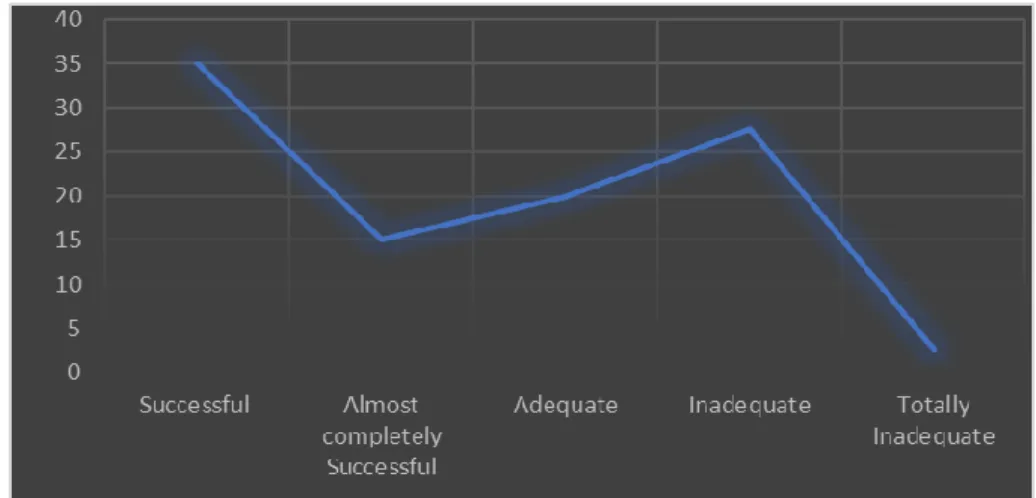
(12) Abkari & Gholamzadeh. Holistic Assessment: Effective or Lenient in Translation Evaluation?. this method to be a logical one. This is due to the fact in holistic method, unlike other methods such as error analysis method, failure cases are attributed in a rational range (one third out of the total participants). This clearly shows that holistic method of translation assessment is not strict enough towards students. Since this method is based upon the raters’ individualistic appreciations or impressions, this method provides the ground for subjectivity in a setting where objectivity is the ultimate aim in translation evaluation. Furthermore, based upon holistic accumulative results (Table 3), this method can be rendered as a loose translation method. This method is in need of other stricter criteria patterns with lower leniency in its own right. According to the results of the participants (Table 3), more than one-third of the total participants (35%) have obtained the successful degree of task completion which obviously delineates the highest holistic marking method for the top group of scorers. These results can be diagrammed in Figure 1:. Fig 1: Holistic Accumulative Results. Thus, since 14 participants (more than one-third of the total participants) obtained the highest scores, it is regarded too much as though the participants can effortlessly get those top marks. By the same token, based on the local policy of the University of Isfahan, the top group of scorers in the logical and appropriate normal cases are anticipated not to exceed ten percent (10%) of the total participants. Therefore, the logical and reasonable diagram of holistic scoring method is supposed to be as illustrated in Figure 2.. 14. Skopos 10 (2019), 3-20.
(13) Abkari & Gholamzadeh. Holistic Assessment: Effective or Lenient in Translation Evaluation?. Fig 2: The Supposed Logical Holistic Results. According to the results of Tables 3 and 4, more than one-third of the participants tried to read their translation drafts like a piece originally written in the receptive (target) language. It is due to the fact that the holistic method of translation assessment urges the evaluators (raters) to take grammatical, lexical, and even spelling errors into account (based upon their own personal judgments). For instance, while one lexical, grammatical, or even spelling error may be considered a minor error by one evaluator, it would be treated as a serious error by another evaluator. This means that evaluators in holistic method of translation assessment are not always in a position of agreement. Therefore, the current method is unjustifiable. On the basis of the exam condition (2 hours), the participants had enough time to check spelling, lexical, and grammatical errors. Additionally, this reinforces the idea that the correction process in holistic method of translation assessment is too lenient to distinguish the top group of scorers from the bottom group of scorers. Holistic method of translation assessment finds spelling errors to be serious ones if they are great in number in a translated text. Furthermore, this method also considers lexical and grammatical errors to be serious errors if they are many in number. By contrast, according to the error analysis method (Waddington 2001), for an inappropriate and unacceptable lexical term, a penalty of 4 marks subtraction is carried out which shows that a participant selected a wrong (false) lexical item or ‘a wrong meaning out of many meanings of a polysemous word’ (Bahameed 2016: 145). In this respect, the penalty which is incurred by the error analysis method is reasonable, since considering such serious or critical errors can negatively impact the entire meaning (message) of the adjoining sentences. Omission 15. Skopos 10 (2019), 3-20.
(14) Abkari & Gholamzadeh. Holistic Assessment: Effective or Lenient in Translation Evaluation?. mistakes (other lexical mistakes) take place when a translation student omit to render a lexical item due to loss of meaning. In this respect, the evaluator feels that the meaning of a translated sentence is incomplete and needs more explanations. Selecting the wrong lexical and omission mistakes intentionally are seriously penalized since these mistakes can negatively affect the whole meaning of the target translation with regard to the error analysis method. Nevertheless, these mistakes can be considered serious mistakes if they are many in number based on holistic method of translation assessment. Furthermore, translation directionality (translating from L2-L1 or L1-L2) is considered to be a noteworthy factor. It has an obvious association with the degree of difficulty or readability of the exam questions. According to the results displayed in Table 4, a majority of mistakes the translation participants committed in the exam questions were those from Persian to English (L1-L2) translation. This supports the idea that translating into one’s mother tongue is quite simple and straightforward.. 6. Conclusion Holistic method of translation assessment is not strict enough and permits the majority of translation students to stand out as top group of scorers (more than one-third of the total participants) with regard to the method scale. Likewise, holistic method of translation assessment is solid and context-sensitive since this method is applied to all participants without distinction. Furthermore, another disadvantage for this method is that it is depended on evaluators’ intuition or impression. This impressionistic-intuitive method is too flexible and therefore hard to measure. However, this impression is trustworthy since the subjectivity of holistic method is limited and the process of correcting the translations is conducted by translation experts. Other disadvantage of holistic method is that this method is not strict enough to distinguish the top scorers as their marks may reach onethird of the total participants. This may have a negative impression on the overall results, causing this method to be considered lenient to the extent that holistic method of translation assessment may be considered to give little chance to analyze individual differences among top group of scorers. Its leniency may be due to the fact that the participants do not take minor lexical, grammatical, and spelling errors into account. As a matter of fact, these errors are too general (broad) and difficult to be measured. The way many minor errors are to be ignored and fulfilled by an evaluator is an issue of discussion about holistic method of translation assessment. The leniency of holistic assessment is negatively echoed in the long run on the translation 16. Skopos 10 (2019), 3-20.
(15) Abkari & Gholamzadeh. Holistic Assessment: Effective or Lenient in Translation Evaluation?. quality assessment and the teaching process is of low quality standard. Thus, applying this translation assessment method is not suitable for academic appraisals. That is to say, the hypothesis regarding the suitability of the holistic method to be applied in classroom setting has not been verified by this paper. In spite of the simplicity of the exam questions, the failure rate was not too little to be ignored. The high failure rate of the participants is a clear indication of poor translation competence of the participants. However, if this research paper applied other translation assessment methods such as the error analysis method, the failure rate might exceed to contain a greater number of participants. References Akbari, A., & Segers, W. (2017a): Translation Difficulty: How to Measure and What to Measure. Lebende Sprachen 62:1, 3-29. Akbari, A., & Segers, W. (2017b): Translation Evaluation Methods and the End-Product: Which One Paves the Way for a More Reliable and Objective Assessment? SKASE JOURNAL OF TRANSLATION AND INTERPRETATION, 11:1, 2-24. Akbari, A., & Segers, W. (2017c): Evaluation of Translation through the Proposal of Error Typology: An Explanatory Attempt Lebende Sprachen, 62:2, 408-430. Bachman, L. F. (1990): Fundamental Considerations in Language Testing: OUP Oxford. Bahameed, A. S. (2016): Applying assessment holistic method to the translation exam in Yemen. Babel, 62:1, 135-149. doi:doi:10.1075/babel.62.1.08bah Eyckmans, J., Anckaert, P., & Segers, W. (2009): "The perks of normreferenced translation evaluation". In C. Angelelli & H. E. Jacobson (Eds.), Testing and Assessment in Translation and Interpreting Studies. Amsterdam: John Benjamins, 73-93. Garant, M. (2009): A case for holistic translation assessment. AFinLA-e: Soveltavan kielitieteen tutkimuksia, 5-17%N 11. Geeraerts, D. (2009): Theories of Lexical Semantics. London: Oxford University Press. Hatim, B., & Mason, I. (1997): The Translator as Communicator: Routledge. Hatim, B. A. (2014): Teaching and Researching Translation: Taylor & Francis. House, J. (1981): A Model for Translation Quality Assessment. Tübingen: Gunter Narr. Kockaert, H., & Segers, W. (2014): Evaluation de la Traduction : La Méthode PIE (Preselected Items Evaluation). Turjuman, 23:2, 232-250. 17. Skopos 10 (2019), 3-20.
(16) Abkari & Gholamzadeh. Holistic Assessment: Effective or Lenient in Translation Evaluation?. Kockaert, H., & Segers, W. (2017): Evaluation of legal translations: PIE method (Preselected Items Evaluation). Journal of Specialized Translation 27, 148-163. Koskinen, K. (2008): Translating Institutions: An Ethnographic Study of EU Translation: St. Jerome Pub. ; Kinderhook, NY : InTrans Publications. Kussmaul, P. (1995): Training the Translator: John Benjamins Publishing Company. Mariana, V., Cox, T., & Melby, A. (2015): The Multidimensional Quality Metrics (MQM) Framework: A New Framework for Translation Quality Assessment. Journal of Specialized Translation 23, 137-161. McAlester, G. (2000): "The Evaluation of Translation into a Foreign Language". In C. Schäffner & B. Adab (Eds.), Developing Translation Competence. Amsterdam: John Benjamins, 229-241. Newmark, P. (1991): About Translation. Clevedon: Multilingual Matters. PACTE. (2002): Exploratory Tests in a Study of Translation Competence. Conference Interpretation and Translation, 4:2, 41-69. PACTE. (2005): Investigating translation competence: conceptual and methodological issues. Meta, 50:2, 609-618. PACTE. (2009): Results of the Validation of the PACTE Translation Competence Model: Acceptability and Decision Making. Across Languages and Cultures, 10:2, 207-230. Séguinot, C. (1990): Interpreting Errors in Translation. Meta, 35:1, 68-73. Snell-Hornby, M. (1988): Translation Studies: An integrated approach: John Benjamins Publishing Company. Stansfield, C. W., Scott, M. L., & Kenyon, D. M. (1992): The Measurement of Translation Ability. The Modern Language Journal, 76:4, 455-467. doi:10.2307/330046 Waddington, C. (2001): Different Methods of Evaluating Student Translations: The Question of Validity. Meta, 46:2, 311-325. Williams, M. (2009): Translation Quality Assessment. Mutatis Mutandis, 2:1, 3-23. Williams, M. (2013): A Holistic-Componential Model for Assessing Translation Student Performance and Competency. Mutatis Mutandis, 6:2, 419-443. Wongranu, P. (2017): Errors in Translation Made by English Major Students: A Study on Types and Causes. Kasetsart Journal of Social Sciences, 38, 117-122. doi:http://dx.doi.org/10.1016/j.kjss.2016.11.003. 18. Skopos 10 (2019), 3-20.
(17) Abkari & Gholamzadeh. Holistic Assessment: Effective or Lenient in Translation Evaluation?. Appendix English to Persian Question 1: Translate the following texts into plain Persian 1. Methought I heard a voice cry sleep no more! Macbeth does murder sleep, the innocent sleep, sleep that knits up the raveled sleave of care. (5 marks) 2. The visual world is a world populated by colored objects. (5 marks) 3. He tries to differentiate those studies that he considers to be clearly sociolinguistics in nature from those that clearly are not. (5 marks) 4. It is analyzed as a clue to a person’s intangible inner being- his ideas, knowledge and feeling. (5 marks) 5. Major was already ensconced on his bed of straw, under a lantern which hung from a beam. (5 marks) I have found the day’s proceedings — and the days spent reading the papers beforehand — to be a fascinating exercise, at various different levels. Fascinating and, I confess, challenging to the point of discomfort. In what follows I shall try to indicate why. I shall also try to indicate what I think the policy implications of the behavioral approach are. To begin with, by way of mild self-defense, I want to draw a distinction between academic economists and our policy counterparts. I think this is an important distinction and often underestimated on both sides. To overstate the contrast a bit, the primary ambition of the academic is to be ‘interesting’; the primary ambition of the policy advisor is (or ought to be) to be ‘right’. (35 Marks). Question 2: Translate the following text into English این کمپین که.بسیاری متخصصین تبلیغات و بازاریابی این کمپین را استاندارد طالیی میخوانند : به یک سوال عمده پاسخ میدهد، توسط گروه تبلیغاتی دویل دین و برنباخ ایجاد شد1960 در سال چگونه میتوان درک مردم را نه تنها نسبت به یک محصول بلکه در مورد گروهی از افراد تغییر داد؟ سال پس از جنگ15 آمریکائیان همواره به سمت خرید ماشینهایی بزرگ گرایش داشتهاند اما حتی پس این تبلیغ فولکس واگن چه.جهانی دوم آنان تمایلی به خرید ماشینهای کوچک آلمانی نشان ندادند شما فکر میکنید من کوچک هستم؟ بله.کرد؟ کاری که کرد دقیقا توقعات مخاطب را هدف قرار داد و این بزرگترین درسی است که میتوان از، آنها هرگز تالشی برای تبدیل به آنچه نبودند نکردند.هستم. 19. Skopos 10 (2019), 3-20.
(18) ?Holistic Assessment: Effective or Lenient in Translation Evaluation. Abkari & Gholamzadeh. این کمپین آموخت .سعی نکنید برای فروش شرکت ،محصول یا خدمات آن را خالف آنچه هست نشان ) (40 marksدهید .مشتریان صداقت را درست به اندازه زیبارویان تبلیغات آبجو دوست دارند.. Skopos 10 (2019), 3-20. 20.
(19)
Figure
+2
Documento similar
In this paper a simple method is described for the evaluation of the multimode network representation of planar waveguide junctions in terms of admittance or impedance
In this contribution, the planning and management of ante-earthquake emergency scenarios have been approached by proposing an improved method for the assessment of
The purpose of this paper is to analyse the effect of positive affect on opportunity evaluation (i.e. novelty assessment and entrepreneurial selection) and to what extent this effect
The variables used to explain the score in the final exam: shift, type of teaching, the weight of the continuous evaluation in the assessment of the subject and the performance of
The type of creativity required in the localisation of video games is one that allows players to immerse themselves in the game experience and the activities linked to beating
“The books to date contain more than one hundred proper names of people (and many place names), nearly all of which, in our opinion, should have been changed in translation,
Silvina Ocampo’s translation of Emily Dickinson is a case in point: the lexical mismatches are so serious that they alter the context of the poem or simply make the
The Dwellers in the Garden of Allah 109... The Dwellers in the Garden of Allah
