
TítuloDesign and development of horizontal airflow biofilters for controlling odour from livestock facilities
6
0
0
Texto completo
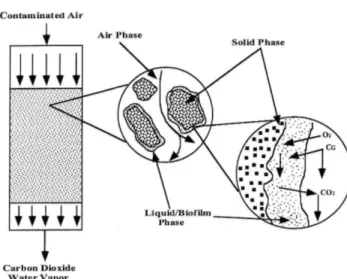
(2) 300. C.S. IMA AND D.D. MANN. Figure 1. The mechanism of a biofilter (Devinny et al., 1999).. The filter medium houses the microorganism and serves as the microbial growth environment (Skladany et al., 1998). The medium provides physical and chemical conditions appropriate for the transfer of contaminants from the air to the liquid phase and the biodegradation of the contaminants in the biofilm layer. As an odorous air stream passes through the biofilter, the contaminants present in the air stream are trapped by the filter medium and oxidized by microoragnisms inhabiting the filter medium. The metabolic by-products of the biological degradation process are primarily carbon dioxide, water, mineral salts, and non-odorous gases (Williams, 1993). Biofiltration is advantageous in several ways. It allows for complete degradation of the odour-causing agents into innocuous substances, thereby producing little or no secondary waste streams requiring a subsequent treatment. It also allows effective pollution control at relatively low capital and operation costs. However, biofiltration technique is only appropriate for treating waste gas streams containing low concentrations of organic compounds (about 1g/m3) or other compounds that are easily degradable. In addition, the filter medium may clog with time. Clogging hinders the passage of air through the filter medium, thereby causing oxygen limitation and reducing the contaminant removal efficiency of the biofilter. 2 AIRFLOW RESISTANCE CHARACTERISTICS IN BIOFILTERS Resistance to airflow through a media develops primarily because of energy loss due to friction and turbulence (Alagusandaram and Jayas, 1990). Hitherto, there is limited published information regarding airflow resistance through biofilter media. However, the available literature suggests that the resistance to airflow through a biofilter media differs in the horizontal and vertical directions. This is possibly due to the orientation of the media particles giving rise to anisotropy. Anisotropic behaviour occurs when nonparticles orient themselves with their major axes lying horizontal when loaded from the top. Since larger, shorter, and straighter air pathways offer less resistance to airflow than smaller, longer, and more crooked air pathways, this orientation creates a situation where more lateral airflow than vertical airflow occurs (Sadaka et al., 2002). Because, in biofilters, the media are usually loaded from the top, it is likely that most pieces of.
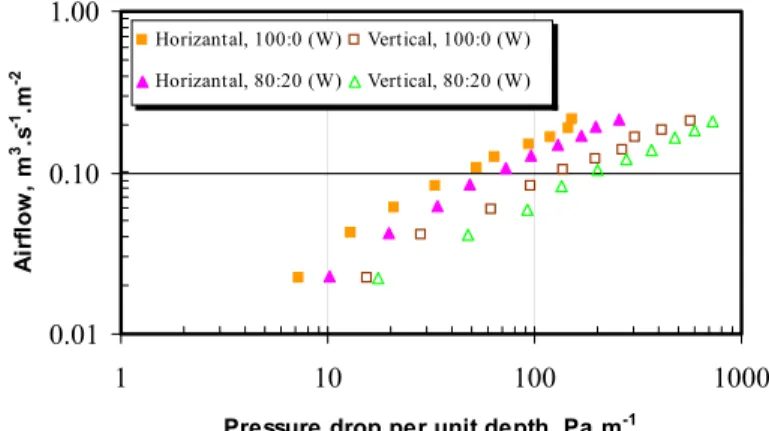
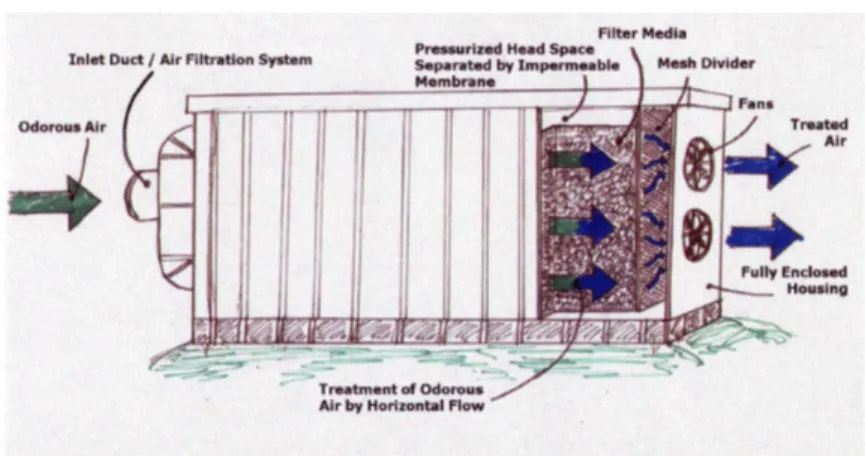
(3) DESIGN AND DEVELOPMENT OF HORIZONTAL AIRFLOW BIOFILTERS FOR CONTROLLING ODOUR …. 301. the media particles, in order to attend equilibrium or stable position, will fall with their axes horizontal, thereby causing anisotropic airflow. Sadaka et al. (2002) studied vertical and horizontal airflow characteristics of wood/compost mixtures and reported that resistance to airflow in the horizontal direction was approximately 0.65 times the resistance to airflow in the vertical direction for media mixtures containing wood chips and compost (Figure 2).. Airflow, m 3.s-1.m -2. 1.00 Horizantal, 100:0 (W). Vertical, 100:0 (W). Horizantal, 80:20 (W). Vertical, 80:20 (W). 0.10. 0.01 1. 10. 100. Pressure drop per unit depth, Pa.m. 1000 -1. Figure 2. Effect of airflow direction on the resistance to airflow for biofilter media (Sadaka et al., 2002).. Even though it has been proved that there is less resistance to airflow in the horizontal direction that vertical direction, biofilters are still being typically designed for vertical air flow. This is because horizontal airflow through any material usually faces the problem of short-circuiting in the head space above the material. That is, air travels above the material rather than through the material. Short-circuiting occurs due to media drying or media settlement. Media drying creates air channels in the media through which untreated gas escape to the top of the bed rather than traveling through the bed. Media settling, on the other hand, create gaps around the perimeter of the biofilter (i.e., between the media and the walls of the biofilter vessel) through which untreated gas escape to the top of the bed. However, the problem of short-circuiting in horizontal biofilters can be minimized by pressurizing the head space of the biofilter vessel (Sadaka et al., 2002; Kumar and Muir, 1986). Short-circuiting will have little or no effect on a vertical airflow system. 3 BIOFILTER DESIGN An Artist’s conceptualization of a horizontal airflow biofilter is shown in Figure 3. The biofilter is conceptualized as a rectangular box filled with filter materials. Odorous air enters from one side of the biofilter and leaves through the other side after passing through the media..
(4) 302. C.S. IMA AND D.D. MANN. Figure 3. Conceptualization of an enclosed, horizontal air flow biofilter (Garlinski and Mann, 2002).. The initial horizontal biofilter (Figure 4a and Figure 4b) was constructed outside a swine unit located in Manitoba. The swine unit has seven ventilation fans and five fan stages. Analysis of experimental data previously collected from the facility shows that the biofilter was very efficient in odour reduction. However, there were much pressure losses caused by the air passageways of the current configuration. One of the major causes of the pressure losses is the orientation of the central plenum. The central plenum was oriented perpendicular to the direction of airflow from the barn. Thus, it was deemed necessary to re-configure the biofilter for subsequent research work.. Figure 4a. Horizontal airflow biofilter (end view).. Figure 4b. Horizontal airflow biofilter (side view).. The current design consists of seven small biofilter units, one for each of the barn ventilation fans (Figure 5). Each unit is 12ft x 10ft x 1.5ft and consists of two equal media chambers separated by a central plenum, which is oriented parallel to the direction of airflow from the barn to reduce pressure losses. Air from each of the seven barn ventilation fans is ducted into the central plenum of a single biofilter unit from where it exits to the atmosphere through the biofilter media in the two chambers..
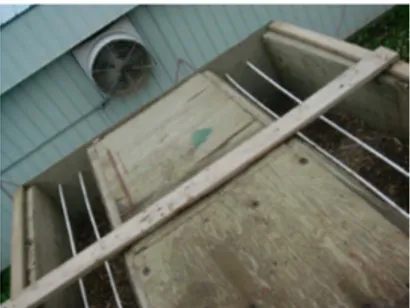
(5) DESIGN AND DEVELOPMENT OF HORIZONTAL AIRFLOW BIOFILTERS FOR CONTROLLING ODOUR …. 303. Figure 5. Current horizontal biofilter design.. The filter media consists of a mixture of woodchips and compost in the ratio of 80:20 by mass. Usually, it is desirable to obtain filter media from a convenient and locally available source. Woodchips and compost is generally considered a readily available material in Manitoba. Five of the seven biofilter units have one of their chambers filled with a mixture of woodchips and compost while the other half have zeolite mixed with woodchips and compost in the ratios of 5, 10, 15, 20, and 25% zeolite by mass. The remaining two units contain only a mixture of woodchips and compost. Table 1 shows the composition of each of the seven biofilter units. Zeolite has been considered necessary for this research because it contains a volcanic mineral called “Clinoptilolite”, which helps in odour control. Clinoptilolite has the ability to attract toxins (odour-causing molecules) due to its high cation exchange capacity. The positive ions of the toxin are attracted to the negative ions of the mineral molecule. Thus, the toxin is removed by adsorption. Consequently, the current biofilter configuration makes it possible to compare the effectiveness of zeolite as a biofilter additive to woodchips and compost. Biofilter Unit 1 2 3 4 5 6 7. Table 1. Composition biofilter units. Media Zeolite (%) North Chamber South Chamber Woodchips and compost 0 0 Woodchips and compost 0 5 Woodchips and compost 0 10 Woodchips and compost 0 15 Woodchips and compost 0 20 Woodchips and compost 0 25 Woodchips and compost 0 0. 4 FUTURE PROJECT The biofilter is an example of agricultural storage facility which is subject to structural failure. Structural failure may be caused by the lateral pressure exerted by the stored material on the walls of the containing vessel (Figure 6). Structural failure may vary from cracking to complete splitting or collapse of the walls. Thus, future project will look into lateral pressures in biofilters. Lateral pressure study will provide useful information for the design of biofilters..
(6) 304. C.S. IMA AND D.D. MANN. Figure 6. The side walls of a biofilter held with a plank. 5 ACKNOWLEDGEMENTS The authors thank the Manitoba Livestock Manure Management Initiative, Manitoba Hydro, and Chemawawin Cree Nation for funding this project. The authors also appreciate Matt McDonald, James Allen, and Kevin for their technical assistance. 6 REFERENCES Alagusundaram, K. and Jayas, D.S. (1990) Airflow resistance of grains and oilseeds. Post Harvest News and Information, 1(4): 279-283. Mann, D.D. and Garlinski, E.M. (2002) Design of a horizontal airflow biofilter. Paper No. CSAE 02-611. Mansonville, QC: CSAE. Kumar, A. and Muir, W.E. (1986) Airflow resistance of wheat and barley affected by airflow direction, filling method and dockage. Trans. ASAE. 29(5): 1423-1426. Sadaka, S., Magura, C.R. and Mann, D.D. (2002) Vertical and horizontal airflow characteristics of wood/compost mixtures. J. Appl. Eng. Agricul. 18(6): 86-92. Skladany, G.J., Deshusses, M.A., Devinny, J.S., Togna, A.P. and Webster, T.S. (1998) Biological systems: biofilters. In (Rafson, H.J., ed.) Odor and VOC Control Handbook, McGraw-Hill, New York, pp. 8.150-8.191. Williams, T.O. (1993) Biofiltration for control of odorous emissions from composting facilities. Proceedings of the 3rd Annual meeting of the Composting Council of Canada, Montreal QC, 23-24 September, pp. 425-442. Zhang, Q., Feddes, J.J.R., Edeogu, I.K., Nyachoti, M., House, J., Small, D., Mann, D.D. and Clark, G. (2002) Odour production, evaluation and control. Project MLMMI 02-HERS 03. Final report submitted to Manitoba Livestock Manure Management Initiative Inc., Winnipeg, MB. October..
(7)
Figure
Documento similar
The wooden slabs are structural elements, generally horizontal, comprising of three layers which transmit the stresses stemming from the usage and self weight on the
Results show that in the actual AFS there were vertical and horizontal externalities because tax base is the same for the State and regional personal income taxation; also,
The experiment was performed to evaluate the behaviour of odorous volatile compounds and odour characteristics from raw knuckle beef steaks during display in
We find that individuals politically aligned to the regional incumbent shift responsibility to the central government upon receiving negative news about the number of contact tracers
A new processing methodology of wind profiler Doppler spectra called UBWPP (Method 2) has been described, addressing the computation of horizontal and vertical wind components,
El objetivo del presente estudio fue realizar un análisis descriptivo sobre valores referenciales de las asimetrías de salto vertical y salto horizontal,
The role of extractives in durability of eight wood species compared to a nondurable control was evaluated in laboratory for resistance to termite attack and decay by brown-rot
The scores (see Table 1 for details) were the BODE (body mass index, airflow obstruction, dyspnea, and severe exac- erbations) [17], updated BODE [16], ADO ( we included in the
