
Diversity and distribution of small terrestrial rodents along a disturbance gradient in montane Costa Rica
8
0
0
Texto completo
(2) 332. REVISTA DE BIOLOGIA TROPICAL. of the present study is to identify key indicator rodent species characteristic for certain levels of disturbance and recovery.. MATERIALS AND METHODS This study was conducted in the Los Santos Forest Reserve near San Gerardo de Dota in the NW part of the Costa Rican Cordillera de Talamanca (9°35'40" N; 83°44'30"). Originally, the watershed area (2000-3200 m altitude) was completely covered with mature, primary Quercus dominated montane cloud forest, but since the 1950s forest conversion for agricultural purposes has led to a landscape mosaic with vegetation patches of different size, structure, composition, level of disturbance and successionaI age (Kappelle and Juárez 1995, Kappelle et al. 1995). In Villa Mills, at a distance of 10 km E ofthe selected forest pIot, the average annual temperature is 1O.9°C and the average annual rainfall is 28 12 mm. A detaiIed description of the study area's physicaI setting and botanicaI aspects can be found in Kappelle (1993, 1996). At the end of the dry season (March-April 1996), using B&W aerial photographs ( 1992, scaIe 1: 15,000) five different habitats were selected aIong a man induced disturbance gradient in the upper montane forest beIt (2200-2800 m a.s.l.). These habitats are, from low to high leveIs of disturbance: (i) 30 to 40 m taH, dense oak dominated 'CIosed Mature Forest' (CMF); (ii) oak dominated 'Open Mature Forest' with a reIatively open, 30 to 35 m high canopy (OMF); (iii) 3 to 7 m high secondary 'SuccessionaI Shrubland' (SSL); (iv) 0.5 to 2 m taIl secondary 'Abandoned Pastureland' (APL); and (v) less than 0.5 m high 'Grazed Pastureland' (GPL); see Table 1. At each habitat site a 0.25 ha pIot (50 x 50 m) was established, with exception of APL where a 0.28 ha plot (37.5 x 75 m) was laid out, since the site's patch dimensions required so.. In all but APL a total of 25 Sherman traps (trap size: 23 x 9 x 8 cm) were pIaced in a 5 x 5 grid with a 12.5 m distance between two neighbouring traps. Similarly, in APL 28 traps were Iocated in a 4 x 7 grid. A standardized capture-recapture method was used to estimate species diversity, distribution and abundance in each habitat type (Leslie et al. 1952). Plots were studied from April to June 1996, covering the transition from the dry to the wet season. Sherman traps were checked ten consecutive days before noon. Only in OMF traps were checked nine days. Bait consisted of a mixture of roUed oats and peanut butter with a touch of vanilla flavour. In the afternoon traps were checked for diurnal catches and bait was renewed for the next trap-night. Traps were covered with litter and/or leaves for camouflage and insuIation. Data on the presence, sex, weight and length of trapped individuals were recorded. Weight was measured using a Pesola pocket scale (max. weight 300 g). Length measurements included the head-body Iength measured from the tip of the nose to the inflection point of the tail, and the tail length measured from the inflection point with the body to the fleshy tip of the tail. In situ species identification was done with the aid of Emmon & Feer's ( 1990) fieId guide, after studying rodent specimens in Costa Rica's national collections. Control specimens were collected and stored at the Museo Nacional. Specimens were ídentified with help of B. Rodríguez (pers. com.) and on basis of field guides (Mora & Moreira 1984, Emmons & Feer 1990). Trapped individuals were marked upon first capture with acrylic paint before being reIeased. Additionally, terrestrial vascular plant inventories were undertaken in each habitat and collected plant specimens stored and identifíed at the Museo Nacional. Species data were grouped and analysed for habitat sites along the disturbance gradient. Richness, abundance, density and capture frequency were assessed and preliminar conclusions drawn..
(3) VAN DER BERGH & KAPPELLE: Diversity of small terrestrial rodents in montane Costa Rica. 333. TABLE 1 General data on physiographic aspects, vegetatíon layering and terrestrial radent populations ojfive different habitat sites in the montane cloud jorest zone oj ¡he upper Río Savegre watershed area, Cordillera de Talamanca, Costa Rica. Habitat site. Closed Mature Forest. Open Mature Forest. Plot size (ha) Altitude (ma.sJ.) Exposition Slope angle Vegetation layering Canopy ¡ayer. 0.25 2750 E 100. 0.25 233 0 SW 33 o. 0.25 2360 W 35 o. 0.28 2780 N 15 o. 0.25 2260 W 50. 40 90 18 70 3 50 0.5 20. 35 80 18 65 3 35 0.5 10. 7 10 3 90 0.5 30. 2 20 0.5 90. 0.4 98. 10 4 92 3 .2 12.8. 9 5 180 10.7 42.8. 10 4 160 11.6 46.4. 10 4 196 8.0 28.6. 10 4 80 5.8 23.2. 1:. - height (m) - cover (%) Subcanopy layer - height (m) - cover (%) Shrub ¡ayer - height (m) - cover (%) Herb layer - height (m) - cover (%). Nr. of trap nights Species richness (or. spp. per plot) Density (or. indiv. per ha) Capture frequency 2 Capture frequency per ha •. 1 2. Grazed Successional Abandoned Shrubland Pastureland Pastureland. AH habitat sites 1.28. 49 7 142* 7.9' 30.8*. Mean values with n 5 habitat sites . Vegetation layering is expressed in maximum height and relative aerial crown cover of each stratum. Capture frequency mean number of captures per trap night. =. =. RESULTS A total of 389 captures corresponded to 185 individuals distributed over 7 species in 2 families. The captured species were: (i) Muridae (Cricetidae): Peromysclls mexicanllS (Mexican Deer Mouse, ratón pata blanca, closely related to P. nlldipes, the Naked-footed Deer Mouse), Scotinomys xerampelinlls (Singing Mouse, ratón cantante), Oryzomys albiglllaris (White-throated Rice Rat, ratón arrocero), Reithrodontomys creper (Chiriquí Harvest Mouse, ratón de las cosechas), and R. cf. sllmichrasti (Sumichrasti's Harvest Mouse, ratón de las cosechas); and, (ii) Heteromyidae: Heteromys oresterus and H. cf. desmarestianlls, being Spiny Pocket Mice (ratas de campo). Table 1 presents some general data on the terrestrial rodent population in the five. habitats. Richness was very similar for all habitat sites, with 4 to 5 species per habitat regardless its position along the disturbance axis. Population density and capture frequency (absolute and per area values), however, were particular1y higher in habitats with interrnediate levels of disturbance, being twice as high in OMF, SSL and APL when compared to both undisturbed CMF and intensively-used GPL. Abundance values differed strongly among species ( Table 2).. DISCUSSION T he varied abundance values were concordant with classical rank-abundance Figs. (Magurran 1988). High abundances (60 75 individuals) were recorded for P. mexicanllS -.
(4) REVISTA DE BIOLOGIA TROPICAL. 334. TABLE 2 Abundance data of seven terrestrial rodent species found in five different habitat sites in the montane cloud forest zone of the upper Río Savegre watershed area, Cordillera de Talamanca, Costa Rica. Abundance data are subdivided per sex. Closed Mature Forest abo capto. Habitat site Abundance. 1. Peromyscus mexicanus. Scotinomys xerampelinus. Oryzomys albigularis. Reithrodontomys creper. R.. cf. sumichrasti. Heteromys oresterus. H. cf. desmarestianus all species. 1 ab.. sex both male female both male female both male female both male female both male female both male female both male female both male female. 19 14 5 3 2. 2. 26 19 7. 3 2 1. 2 J. Successional Abandoned Ope n Grazed Mature Shrubland Pastureland Pastureland Forest abo capt. abo capt. abo capt. abo capt.. AH habitat sites ab. capt.. 21. 75 43 32 61 36 25 15 8 7 15 13 2 11 4 7 6 2 4 2. II. 10 7 4 3 7 4 3 6 6. 4 1 3. 67 33 34 12 8 4 12 8 4 9 9. 17 9 8 20 8 12. 32 22 10. 45 26 19. 44 13. 31. 13 8 5 24 17 7. 26 13 13 29 22 7. 9 7 2 9 3 6. 15 12 3 10 4 6. 55 35 20. 80 51 29. 104 59 45. 40 19 21. 12 6 6 115 48 67. abundance measured as the total number of individuals captured; capt. recaptures. =. and S. xerampelinus, whereas the other three Muridae, O. albigularis, R. creper and R. cf. sumichrasti, appeared to be four to five times less common. Together, P. mexicanus and S. xerampelinus represented 79.4 % of all captures (íncluding recaptured individuals) and 73.5 % of all captured individuals. Both Heteromyidae species, in their tum, seemed to be rather rare in the area ($ 6 indiv.) and appeared to avoid both abandoned and grazed pasturelands (Table 2). P. mexicanus and S. xerampelinus occured at all five sites, although they differed in habitat preference with P. mexicanus appearing with higher numbers in. 5 4 7 5 2 6 3 3. 30 9 21 14 10 4 9 3 6. 2 1. 5 1 4. 20 10 10. 58 23 35. 4 1 3 2 1. 25 17 8. 58 28 30. =. 185 107 78. 207 102 105 102 55 47 23 12 11 24 21 3 15 5 10 6 2 4 12 6 6 389 203 186. total number of captures including. CMF and OMF, and S. xerampelinus showing a higher abundance in SSL and APL. This difference is explained by the fact that the latter, more insectivorous species requires a rather dense vegetation cover at ground level, as its peak in activity is during moming hours (Hooper 1972). The species O. albigularis preferred OMF as well as the edge of GPL bordering mature forest. This observation concides with data earlier presented by Timm et al. ( 1989) for the Braulio Carrillo Park. R. creper and R. cf. sumichrasti were most abundant in APL (Table 2). These observations are concordant with data on habitat.
(5) ...,.• VAN. DERBEl{GH 8I: KA.l'l'�:L,E: Oiv.ersity of.s��tJií!I�dehts iri montall�;eostá Ríe¡¡ . .; " . ' , ' , el,:.} ,. ' ,. .. ". Ni�ar.,g,an"p�ithro4o",totn)1�"; . ' SPeciesi,(1:on�s and Q�hoWay:s,�19'ZO). R. crePilr .was as J Otfapped .0; 0l4f;,¡�ut in lower. ,. ,. .. ". �. p�fere nces , of. ;¡\l>�. wbile. num�rs. Similarly, twoindivid�hls of R. cf.. ; to behayiour, o,r.;popuJatia'h, m*e. et}}1á1ly ,in. �ppearec1. á�l�§'J:�n�,"f�I\1�les. §SL'a�dQpt; (']j'�tile. 2). Whetber. theSe captW'cj �fferellces,betW� �n sexes is due. qp n�mains. ,unkno,VVn. (J.albigulari.s was th� largest. ;,Sumichars,ti occure<l,in" G�L. I:.Q�. �aptyre .... results of H. orester� and H. d.. terrestrial rodent s�cies captur�, beiog over. six times as,heavy and twice as,long as, R. cf. sumichrasti, (Tpble 3). Data on weight and. desmaresti4nlf$ suggest thesespecie�' rarity in 'll1e are�. While H, orestems preferre<l ..mature f()J;pstl'labitats, H. cf. d�smarestianus was o,nly recordOOiIfSst:l1. oresterus may beilJURtified as an indicator species referring to low levels of disturbance.. l),ead-body. and., tail. length. of. captured. ,ind���it)-aeeerilanee-with�in---amnums and ¡:ieer (1990), withexception of ' values recorded for H. cf. desmarestianus. Indjviduals of h t e latter �peared tobe much smallér in this study (mearí weight 24.0 g;. In general, male individuals were more. " ¡��;tl:iead-b04y length8.8 cm)than lbe data. ofien trapped in CMF an<l OMF as wellas. : '-r. TABLE3. Weight�nd,lenglh da,ta'of captiltedindM(luals belongiilg to seven terrestrial rodent species. ' Data are subdividedpir sex and based' on allfivé habitat Sites in the montane cloud forestzone . , the uppe r �(o Savegre watershe4 ; a.: Cédill�ra de Talamanca. Costa Rica , �'. �. ; k\¡-:'. 'f". , •• Wt;ight'�;(g),. , melVi +. male. '. female. botlf. +. '. ". femiiIe. male. .. .'. .male. '�:' , , ' H.cr. desmares,tiip¡1fS '.¡'{i{;: 4r�,. .. .. .,. '\':(e�� both. .. male female. .. �. .. , ,','. (14�,. 22.S + 2.9 22:1 + 3.0 23.0 +'0.0. ". .•. \,\,. . 15:0+' 0.6 S.7 + 0.S. 14:; 9 +�.5. (12) ',: S.6 t O:'1 (01) ¡�¡ ' 9.0+ 1.0 (OS) ( . 7.4 + 0.5. I()J+ .���. (04). 74.S. +. (04). 3.8. ". (03). 7LotO.0. (01). 24.0 + 5.0 29.0+ 0.0. (02) (01) (O�)"". 76,P'+'·3.6. , '�l �,9 0,0 +. ,'. (O�}',;;. ..•. .. +. 13.Ó + 0.9. 17.0f,Q,:". fleshy. (07) (03). .. (01) .. " (01 ). .. of.�. (12). . (05) .. (02.). S.�+Q.Ó. .. (02). (02�. 9. 8.+ t.3 1l.O'+Q,0. catch. (06). (01). , 17.3 +0;3. to thé inflection point of theüiil. · thé body to thé tip tail ... nose. ngth�s méas� as .thé length frOJií the ll!.fl��q'pP;.�t\vith. 16.0 t tl.O. (Ol)'. �14). . ,(OS). (12)'. S:'/ +,O:S S.7 +0,9., S.7+0.S. j3¡g;¡. Oil) . (01) "I-2i&'�'O�8-" ':;'>:(92)" is + 0.3 (1m .,' �IP + 0.0 (1)1):. (23). (14). 13�O+1.0. (03). ' �j:Í�:�dlej\�Nalues �'b��i:'o�,�iI$Ufe�ñi�taken �tl:áCh i��VldUal's'fitst !b0d�¡·leng$i§! meásured lI\l the lengU1 frOríí the tip 'bf tQ(!. 16 ..S + 1.1 13.0,.+ 1.0. (12);. ..... (SS). (35). 5.S+0.!!. OA. 8.5!J':0.0. (42). (l�) (Ó2). '.. ... (32). p.t+2.S f1.�+ 3�4'.. (05) (14) .. 12::7. + O.S. 12..3 +/0:6 5.9 $'(';3 5.9+;0.8. .,, ({)5) , 7;:� * M, um. , 7.1. .(74). ,·(12) (O�7). .... 'U,S+ 1.7 ,. •. '12.3:tQ,6. 12d1o.6. �(35) (42). :. ,�S.O"" 17.1 ;P;;t¡i{(4),. .femide bOth .:.. female' b male. ". '. .,. .. oth. :él l,(24);! ,.,;i( 24). 6.9 +.0.4 ' 6.� �0�5, . 14:S+0.9 : t93.4 + 14.2 . �qll) .9,3.4+ 13.l ¡ ; ;�07j " ; . ',>,14.2 + 1:3 ". hujle '¡;·. .•. .. ''. ••..... 13.2 + U ,14.S+.2.2. .. Tail le*gthI:'3 (crnt melm'+s.d/ (n). ',Head-body feñgth I.Z (cm) . (n) ',' . mean + s.d.. '>�)�i1.��;4.6 ',)t, ($<?)} I\� li.p+0;7';'. ;'. . -;'4) �:;�i�¡f�t 4.4 3.�(; ;r\ ��!�{·(!�;�,: ;�;J�:f�;O;1 .) ·.(�O)< , .U· :r, ) · 4,M� ';:';.,,'", ��[9.·,+J�.2 :'il.:f,'48� . , ,�P: ·� ':P:'4, < ';' ? ,',:)X�7). <. . �0�. 5';11. F, ;(1I). ,. �l. ..
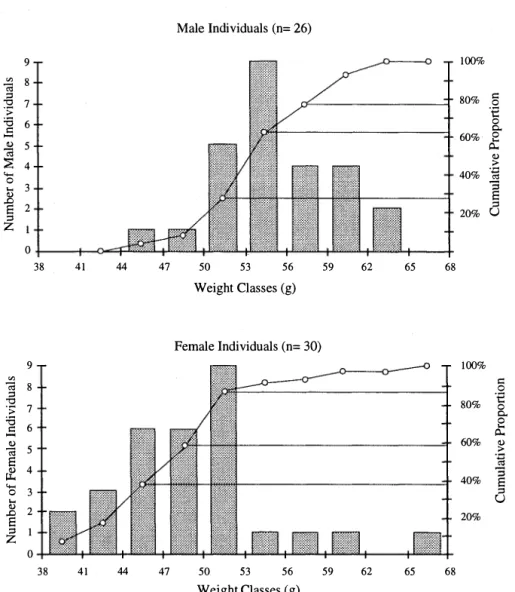
(6) REVISTA DE BIOLOGIA TROPICAL. 336. range given by these authors would suggest (49-103 g;1O.8-14.8 cm). This outcome slresses the difficulties that occurred in the preliminary species identificaríon. The weight distribution for male and female individuals of the most abundant species, P. mexicanus, c1early illustrates within-species weight differences found between sexes in rodents (Fig. 1). Whereas the weight distribution (expressed in J g weight c1asses) for males depicts a normal bell curve, the weight. distribution for female indivíduals is asymmetrical, with an abrupt change at the 53 g weight level. This striking discrepancy may be explainedby the presence of a number of pregnant adults in the 50-53 g weight c1ass. If non-pregnant, these individuals would have been recorded in lower weight c1asses such as the 44-47 and 47-50 g c1asses. Indeed, four heavy adults ( 13 %) out of a total of 32 females were in a certain stage of pregnancy.. Male Individuals (n= 26) 1 00%. 9 '". (ii ::1 "O. 'S:. 8. '6 t:1 ...... 6. ¿ "'" o. 4. � .... <!.l. .o S ::1 Z. 80%. 7. 60%. 5. 40%. 3 2. 20%. t:1 o '€ o o.. o .... Q.. <!.l ;> '.0 ro. "5 S ::1 U. o 38. 41. 44. 47. 50. 53. 56. 59. 62. 65. 68. Weight Classes (g). Female Individuals (n= 30) '". (ii ::1 "O 'S:. '6 t:1 -. <!.l. (ii S � "'" o. .... <!.l. .o S ::1 Z. 9. 1 00%. 8 80%. 7 6. 60%. 5. t:1 o '€ o o.. e Q.. <!.l ;>. .�. 4. 40%. 3 2. "3. S ::1 U. 20%. 1 o 38. 41. 44. 47. 50. 53. 56. 59. 62. 65. 68. Weight Classes (g) Fig, 1. Weight distributíon for maJe and female índividuals of Peromyscus mexicanus in the montane cloud forest zone of the upper Río Savegre watershed area, Cordillera de Talamanca, Costa Rica,.
(7) VAN DER BEROH & KAPPELLE: Diversity oC small terrestrial rodents in montane Costa Rica. This study's results are i n general conSistent with those from two previous studies conducted in the same region (Lanzewizki 199 1; Johnson and Vaughan 1993). Johnson and Vaughan ( 1993) recorded five Myomorph species of which P. mexicanus (P. nudipes, in their study) and S. xerampelinus were the most common. This study revealed seven species of terrestrial Myomorph rodents, indudingO. albigulans ancl H:()resterus as new local records. Both our data and those collected by Johnson and Vaughan ( 1993) indicate the importance of within-habitat microenvironmental heterogeneity for rodent populations in tropical montane cloud forests.. 337. REFERENCES 1994.. Adler, O.H.. Tropical Corest fragmentation and. isolation ptomote asyncbrony among populations oC a frugivorous rodent. J. Anim. Ecol.. 1995. Fruit. Adler,O.H.. 63: 903-911.. and seed exploitation by Central. American spiny rats,Proechimys semispinosus. Stud. Neotrop.Fauna & Environ.. 3 0: 237-244.. L.H. &F. Feer.J990. I'le()tropica1,rainf()rest marnmals, a field guide. Tbe University oC Chicago,. Ernmons,. Chicago.. 1972.. Hooper, E.T.. A synopsis oC tbe rodent genus. Scotinomys. Museum oC Zoology, University oC Michigan. Occas. paper. 665: 1-32. Joboson,W.E. & C. Vaughan.. 1993. Habitat use oC. small. terrestrial rodents in tbe Costa Rican highlands. Rev. Biol. Trop.. ACKNOWLEDGMENTS We are much indebted to F. Bouman and A.M. Cleef for providing scientific support. M.B.v.d.B. was supported by grants of the Hugo de Vries and Van Tienhoven Foundations, the European Science Foundation and Bever Outdoor Sports. M.K. was supported by NWO grant 895. 100.003. T he VZ:Z Association provided Sherman traps. A. Velázquez (UNAM, Mexico) gave helpful advise and practical support. B. Rodríguez (UCR, Costa Rica) identified rodents. The Monge and Chacón farnilies kindly offered field facilities.. 41: 185-191.. Jones, J.K., Ir. & H.H. Oenoways.. 1970.. Harvest mice. (Oenus Reithrodontomys) oC Nigaragua. W. Found. Vert. Zool. Occas. paper Kappelle, M.. 1993.. 2.. Recovery Collowing clearing oC an. upper montane Quercus Corest in Costa Rica. Rev. Biol. Trop. Kappelle,M.. 41: 47-56.. 1996.. Los bosques de roble (Quercus) de la. Cordillera de Ta1amanca, Costa Rica: Biodiversidad, ecología, conservación y desarrollo. Universidad de Amsterdam & Instituto Nacional de Biodiversidad (lNBio). Amsterdam - Santo Domingo de Heredia, Costa Rica Kappelle, M. & M.E. Juárez.. 1995.. Agroecological. zonation along an altitudinal gradient in tbe montane belt oC tbe Los Santos Forest Reserve in Costa Rica Mount. Res. & Deve!.. RESUMEN. 15: 19-37.. Kappelle, M., P.A.F. Kennis & R.A.J. de Vries.. 1995.. Changes in diversity along a successional gradient in a Se estudió la distribución y diversidad de roedores. Costa Rican upper montane Quercus Corest. Biodiv.. 4: 10-34.. terrestres en cinco hábitats perturbados en un área de bos. Cons.. 3 89 cap turas correspondió a 185 individuos (siete especies en 2 Ca-. Lanzewizki,. que montano nuboso en Costa Rica. Un total de. T.. 1991.. Populationsokologische. , milias). La riqueza de especies resultó muy similar para. Untersuchungen an K1einsiiugem in einem Eichen. 4-5 especieslhábitat. La densidad de. Wolkenwald (Quercus spp.) der MontanstuCe Costa. todos los hábitats,con. población y la frecuencia de captura fueron más altas en. Ricas. Tbesis. Phi1ipps-Universitiit,Marburg.. hábitats con niveles intennedios de perturbación; Pe. romyscus mexicanus y Scotinomys xerampelinus fueron cuatro a cinco veces más comunes que otras especies de Muridae. Estas representaron el ras y el. 73.5 %. Heteromyidae.. 79.4 % de todas las captu. de todos los individuos. Se capturo pocos. Leslie,P.H.. 1952. Tbe estimation oC popuIation parameters. from data obtained by means oC tbe capture-recapture method.. 11.. Biometrika. The. estimation. 3 9: 363-88.. oC. total. numbers..
(8) 338. REVISTA D E BIOLOGIA TROPICAL. Magurran, A.E.. 1988.. Ecological diversity and its. measurement. Croom Helm,London.. Timm, R.M., D.E. Wilson, BL Clauson,R.K. Laval & C.S. Vaughan.. 1989. Marnmals. of the La Selva - Braulio. Carrillo Complex,Costa Rica. United States Department Mora,J.M. & 1. Moreira. 1984. Mamíferos de Costa Rica. Universidad Estatal a Distancia,San José,Costa Rica.. of the Interior Fish and Wildlife Service. North American Fauna. 75..
(9)
Figure
Documento similar
It is generally believed the recitation of the seven or the ten reciters of the first, second and third century of Islam are valid and the Muslims are allowed to adopt either of
In the preparation of this report, the Venice Commission has relied on the comments of its rapporteurs; its recently adopted Report on Respect for Democracy, Human Rights and the Rule
The expansionary monetary policy measures have had a negative impact on net interest margins both via the reduction in interest rates and –less powerfully- the flattening of the
Jointly estimate this entry game with several outcome equations (fees/rates, credit limits) for bank accounts, credit cards and lines of credit. Use simulation methods to
In our sample, 2890 deals were issued by less reputable underwriters (i.e. a weighted syndication underwriting reputation share below the share of the 7 th largest underwriter
In the “big picture” perspective of the recent years that we have described in Brazil, Spain, Portugal and Puerto Rico there are some similarities and important differences,
Multiple regression analyses showing the relationship between the number of 10x10 km UTM occupied and the maximum ecological density and habitat breadth of the terrestrial birds
Plotinus draws on Plato’s Symposium (206c4–5) – “procreate in what is beautiful” – 3 in order to affirm that mixed love (which is also a love of beauty) is fecund, although
