
Analysis of student´s challenges and performances in solving integral´s problems
14
0
0
Texto completo
(2) Journal for Educators, Teachers and Trainers, Vol. 9 (1) ISSN 1989 – 9572 http://www.ugr.es/~jett/index.php. Analysis of student´s challenges and performances in solving integral´s problems Análisis de desafíos y desempeños de los estudiantes para resolver problemas integrales Mohammad Darvishzadeh, Islamic Azad University, Iran [email protected] Ahmad Shahvarani-Semnani, Islamic Azad University, Iran [email protected] Hassan Alamolhodaei, Ferdowsi University of Mashhad, Iran [email protected] Mohammad Hassan Behzadi, Islamic Azad University, Iran [email protected]. Abstract: Integral is the base of pure and applied mathematics for all students of science, especially engineering, which some of their lessons are dependent to it directly or indirectly. In fact, Integral is an indisputable concept for solve practical and executive problems of students, so it is important to pay attention to it. On the other hand, experiences of teaching Integral have indicated that most students have weakness in solve Integral problems. Through case study, an exam has been conducted in the form of six problems on six good experienced students in order to study the students' behaviors in coping with the integral problems and also to reach a proposed method for teaching the integral concept, in which each question has in turn two parts. The analysis of their responses and discussion with them have led some light on more details about the integral, how to teach it and also the problems as a result of the teaching method and the problems to which they would encounter, so that by their citation, an appropriate teaching method could be presented in order to maximally conceptualize the integral in students. On the other hand, these studies reveal that in order to solve the integral-related problems, most students first refer to the initial function approach and try to solve the problem by the direct method rather than spending their time learning conceptually and meaningfully. But those students who have used Riemann concept and infinite collection in solve Integral problems were successful in compare to others Resumen: Integral es la base de las matemáticas puras y aplicadas para todos los estudiantes de ciencias, especialmente de ingeniería, de las cuales algunas de sus lecciones dependen directa o indirectamente. De hecho, Integral es un concepto indiscutible para resolver problemas prácticos y ejecutivos de los estudiantes, por lo que es importante prestarle atención. Por otro lado, las experiencias de enseñanza de Integral han indicado que la mayoría de los estudiantes tienen debilidad para resolver problemas de Integral. A través del estudio de caso, se realizó un examen en forma de seis problemas en seis estudiantes con buena experiencia para estudiar las conductas de los estudiantes para enfrentar los problemas integrales y también para alcanzar un método propuesto para enseñar el concepto integral, en el que cada uno La pregunta tiene a su vez dos partes. El análisis de sus respuestas y la discusión con ellos han dado luz sobre más detalles sobre la integral, cómo enseñarla y también sobre los problemas como resultado del método de enseñanza y los problemas con los que se encontrarían, por lo que, según su cita, Se podría presentar un método de enseñanza apropiado para conceptualizar al máximo la integral en los estudiantes. Por otro lado, estos estudios revelan que para resolver los problemas relacionados con la integralidad, la mayoría de los estudiantes primero se refieren al enfoque de la función inicial y tratan de resolver el problema por el método directo, en lugar de pasar el tiempo aprendiendo de manera conceptual y significativa. Pero aquellos estudiantes que han utilizado el concepto de Riemann y la colección infinita para resolver problemas integrales tuvieron éxito en comparación con otros Palabras clave: Integral concept; Initial function concept; Riemann concept; Teaching; Challenge; Performance Keywords: Concepto Integral; Concepto De Función Inicial; Concepto De Riemann; Enseñanza; Desafío; Desempeño. Journal for Educators, Teachers and Trainers JETT, Vol. 9 (1); ISSN: 1989-9572. 165.
(3) 1. Introduction The mathematical concepts, according to Dane et al. (2016), have complex, abstract, and hierarchical levels. In formal education, as Çetin, et al. (2012) indicated, we face the increase in these aforementioned levels of mathematical concepts and also the class level. The concepts of integral, continuity, derivative, and limit, employed in related departments of science; education and engineering faculties, for example, have very hierarchical and abstract forms. We use the concepts, such as accumulation point, neighborhood, etc. to describe the concept of limit, which is considered as the base for other concepts, located at the beginning of the sequence. On the other hand, the research review in this area revealed the learning difficulties of the students in the concepts of integral, continuity, limit, and derivative (Özkaya et al., 2014; Biber & Argün, 2015; Kula & Bukova Güzel 2015; Baki & Çekmez, 2012). For all students and especially university students, the integral and its related concepts are one of the important, fundamental and necessary topics in learning basic mathematics. Integral is indeed the basics of calculus. Therefore, it may be said that if they sufficiently dominate the integral, it means that they have learned its previous topics, including limit and differential well. On the one hand, it is an Irrefutable tool in solving applied problems for university students, especially in the majors of basic sciences and engineering (Dancis, 2001). On the other hand, it may be declared that integral is the entrance to the advanced mathematics which is made based on limit. In fact, other meaning layers of limit are differential and integral (Jones, 2013). Integral is a topic for other higher-level and advanced mathematical subjects for university students. Therefore, to pay careful attention to it is necessary. How it is taught to students and university students, is important, however, it has been not discussed as it should have been. A little research on the first-grade students show the fact that most of them hate integral and know it as somehow their mathematics nightmare in Iran as developing country, but really why? Which factors have led to this problem? We can mention the following points in answer to this question which has drawn from different experiences of teaching over long years in Iran: a) Lack of dominance on the pre-requisite integral subjects in coping with it (weakness in basic and calculation-related subjects), b) Learners' lack of sufficient motivation to learn, c) Ineffective teaching of integral, Incorrect educational system, d) Lack of an applied viewpoint in teachers in teaching integral, e) Changing students and university students' preferences in relation to living principles (Ubuz, 2011). According to the above issues, in recent decades, math-oriented subjects have been especially under attention on the basic mathematics level and relatively many research works have been presented in this regard, especially about limit, differential and – more or less- integral throughout the world -unfortunately except Iran (we know that these three subjects are completely inter-related). Therefore, since in addition to the concept of function, limit, differential and integral concepts are the basics of the basic mathematics of the B.S. degree, they have been especially under attention in recent decades in the world and how students perceive these concepts, has been studied in order to obtain applied results. But to what extent are these results applied, is in turn discussable (Orton, 1983; Thomas & Hong, 1996; Allen, 2001). Remember that students aged around 14-15 become introduced to the concepts of limit and integral, while this age is about 15-16 for entering the integral subject (Orton, 1983). In fact, at the ages 14 to 16, the fundamentals of the student basic mathematics are formed. Of course, after the completion of this course which lasts about two years, some students are able to solve the integral-related problems. Dane et al. (2016) explored on the hierarchical structure of mathematics to check if it had emerged in the minds of the university students or not, with regard to the concepts of derivative, continuity, limit, and integral from the students' viewpoint in the department of mathematics in the faculty of science and letters, and the department of secondary school mathematics teacher training. The findings of his study revealed the inability of the participants in theoretical learning of the integral, continuity, limit, and derivative concepts and their inability to comprehend the hierarchical structures that rest among these concepts.. Journal for Educators, Teachers and Trainers JETT, Vol. 9 (1); ISSN: 1989-9572. 166.
(4) According to these results, we find it necessary to place more activities that lay emphasis on the relationships among the concepts in the actual teaching of the concepts. The fragmentation of the students' thinking structure had been shown by Adi Wibawa et al. (2017) in solving the problems of the application of the definite integral in area. The term "Fragmentation" is used for the storage section in the computers, which is highly correlated with the theoretical structures that occur in the memory section of the human brain. Nearly all the students hold different ways in constructing a problem. Finding the students' thinking process is very interesting. There were two findings in every case of this study, including the fragmentation of the construction pseudo, and the fragmentation of the whole construction. The data in this study was gathered from the in-depth exploration and the full description of the students that their field of study was mathematics education since high school that they studied in the courses on area and the integral. In the Iranian high schools and the first grade at university, integral is presented with approximately three main approaches- initial function, Riemann and infinite rectangles summation (periphery and area)- each of which somehow responds their needs in solving various problems. Of course, each of them has in turn some details paying attention to which is very important. But is it possible to declare that students and university students' understanding of integral is only dependent upon one of the above factors or includes all three? In other words, the main problem is whether the integral may be taught and conceptualized merely with one approach without considering the other two approaches or all three approaches are necessary and inter-related. Of course, this subject is somehow dependent on the teaching purpose too, i.e. as teachers, what we finally expect from students and university students. For instance, if a 2 student learned the integral by the initial function approach, he/she could calculate ∫0 𝑥 𝑑𝑥 easily. However, is he/she able to describe lim𝑛→∞ ∑𝑛𝑖=𝑛 𝑓(𝑥𝑖 )∆𝑥𝑖 , where 𝑓(𝑥𝑖 ) = 𝑥𝑖 ? Is it possible to declare that he/she has learned the integral (Jones, 2013)? In integral conceptualization, each of the above-mentioned approaches has in turn interrogative patterns that must be addressed and conceptualized in a layer-by-layer manner. Now we aim to see if the main approaches of integral teaching have to be learned simultaneously and interrelated or they can be taught separately and merely by concentrating on a single approach. In fact, this study presents the following questions: To what degree have the Iranian students perceived the integral concepts after completing the related lessons? What is the appropriate method of teaching integral on the B.S. level? and Can integral be taught merely with a single approach?. 2. Methodology Since this research follows the responses of the numbers of students in solving integral's problems process and in order to precisely study the above-mentioned subjects, we based our research on the observation and case study of 6 students of who are currently studying the major. Then we have proposed a exam with ten problems at first phase. At second phase, ten problems are studied in terms of content validity by five professors of pure mathematics and mathematics education in the Islamic Azad University of Mashhad. Regard to views and content validity indexes, six questions are accepted finally (see Appendix). Also, all problems have taken from Apostol (1967). The reliability of all six problems are proved on the same samples of students then its reliability is determined that was more than 0.70. Participants were asked to present their responses along with the complete explanation of their responses' details (on the board, in written and oral manners and by declaring whatever passed their minds). It is important to mention that the problems were proposed such that we could differentiate between the computational and the conceptual understanding of students about integral. In addition, all of them were proposed in the form of three approaches presented to the students about integral so that each group could discuss them according to its higher skill in solving a specific type of integral. In addition, we tried to propose problems that would be understandable for all three groups of students. In fact, after being certain that the students had. Journal for Educators, Teachers and Trainers JETT, Vol. 9 (1); ISSN: 1989-9572. 167.
(5) understood them, they were asked to solve and discuss them. The exam was conducted from each group on one day and the next group was postponed to another day. In fact, one session of interview (via the reviewer (one of the authors)) and one exam during three hours on a day for each group executed, of course with regards to time of rest and recovery. Interview has done through questions that proposed by one of the authors about solving integral's problem. First, each group read first problem then interacted and talked together and gave the appropriate answer as much as possible, then were interviewed and began to solve the next question. Each group answered a problem at first and then the interview was conducted about its response, after that they proceeded to the next problem. The time considered for each question was about 30 minutes. All session (almost two months- two sessions for each week) with every group were recorded during the exam and the interview, so they are re-analyzable. The interview was purposeful, i.e. the interviewer presented questions according to their possible responses to get nearer to the purpose of the interview. Composition of the groups is such that they could interact with each other and that problem solving for both groups should be satisfactory. Each session held in presence of 4 students that 2 of them are students participating in the exam and interviews and one interviewer (one of the authors) who are experienced and successful faculty members in the department of mathematics, science and research branch, Islamic Azad University of Tehran. It is important to mention that the students' oral responses to the problems were much longer than what would come, but we tried to convey their meaning as much as possible. All dialogs are recorded by camera. Then discussion and results are analyzed in terms of videos.. 3. Participants Students participating in this research have selected from 40 engineering students who study at Islamic Azad University of Mashhad, such that at first, these students were trained for two semesters in pre- university mathematics and general Math I and II, their training in these lessons based on the proposed exam include all details and preparations. All have participated in two midterm and final exam for each lesson, and after reviewing the results of these exams, and examining their high school education records, 6 students were selected who received score higher than 17 in these exams (Scores in Iran’s universities are calculated from 20). Secondly, every 6 students have good education records in high school. Thirdly, because of the importance of experience in solving the Integral problems, these 6 students have sufficient experience in field of Integral so that their weakness in solve Integral problems cannot be related to their inexperience. These 6 students were divided into three groups, each consisting of two students. For the understanding their responses, researchers have recognized them with names; their names were Negar (NEG), Mahshid (MAH), Negin (NEGG), Mahshad (MAHH), Hooman (HO) and Hirad (HI).. 4. Results Dialogs and results of students' solving are rescored and analyzed by researchers such as; Negar and Mahshid behaved in response the first question: We know that the first question is about the anti-derivative (initial function) and solving the integral with this method is routine with a normal and organized process. When Negar and Mahshid were asked to solve the first 4 4 question, first they transformed the first integral into two parts, i.e.∫2 𝑥𝑑𝑥 and ∫2 2⁄𝑥 2 𝑑𝑥. When they were asked about the reason, by moving her hand over the whole function under the integral and emphasizing on 𝑑𝑥, Negar said that since (𝑥 − 2⁄𝑥 2 )is a differential of 𝑥, and by. Journal for Educators, Teachers and Trainers JETT, Vol. 9 (1); ISSN: 1989-9572. 168.
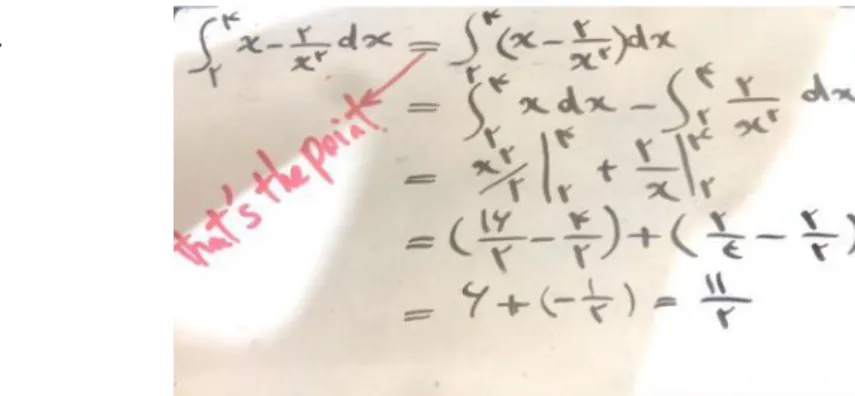
(6) using the differential feature which is broken on summation and subtraction, this is possible to do. She pointed to the lack of parentheses for 𝑥 − 2⁄𝑥 2 and said that this function (while pointing to 𝑥 − 2⁄𝑥 2 ) is a differential of another function. Mahshid said that this integral somehow indicates the initial function and reminds us of it. By pointing to 𝑑𝑥, she said that this initial function is definitely computable via differentiation. But it remains to be seen that relative 2 to which the differentiation should be applied. Mahshid wrote the function 𝑥 ⁄2 + 2⁄𝑥 with the help of Negar. She said that the function in front of the integral may be obtained by differentiation. While Negar and Mahshid were talking, the interviewer noticed that both of them had conducted the whole steps without considering the number 2 and 4 (the integral extremes) and they had referred to them after obtaining the initial function. Negar said that now the integral value may be computed (see figure 1): 4. 4 2 2 𝑑𝑥 = ∫ (𝑥 − 2 ) 𝑑𝑥 2 𝑥 𝑥 2 2 4 4 2 = ∫ 𝑥 𝑑𝑥 − ∫ 2 𝑑𝑥 2 2 𝑥 𝑥2 4 2 4 = | + | 2 2 𝑥 2 16 4 2 2 =( − )+( − ) 2 2 4 2 1 11 = 6 + (− ) = 2 2. ∫ 𝑥−. Figure 1. A sample of handwriting for problem 1 For the second integral, they immediately said that the function 𝑆𝑖𝑛𝑥 may be written for it (without considering the number 2), the integral extremes must be arranged bottom-up (by 𝜋 pointing the integral sign by hand) from low to high values and the positions of and 0 must be 2 exchanged and put behind the negative integral. When the interviewer asked about the reason, 𝜋 Mahshid referred to the concept of integral as an area and said that if the positions of 0 and 2 are not changed, the result value will be negative in which case, there is a paradox. When we asked Negar about the reason of not considering the number 2, she answered that since cos 𝑥 is a differential of another function, a constant number does not affect it. Also, for the second problem, the interviewer asked Negar and Mahshid and we omitted 𝑑𝑥 in the first integral of this question in order to have more discussions. Negar introduced the function 𝑒 𝑥 + 𝐶 for the first integral in this part. When we asked them for an explanation about, Mahshid said that 𝑒 𝑥 + 𝐶 refers to a set of functions and it somehow points to a special function too which is omitted by differentiation. Negar said that the main function may have a constant. She described the integral as an action for finding the anti-derivative of equilibrium. What should be differentiated is within the integral. Mahshid added a 𝑑𝑥 to the end of the integral. In answering why, she had done that, she said that ∫ 𝑒 𝑥 is meaningless in itself and in fact it cannot be considered as a differential or alike. In order to solve 𝑑𝑥, it is necessary to reach the same initial function derivative. She emphasized that 𝑑𝑥 helps us understand how the initial function has been transformed into an integral. Mahshid states that if 摩𝑥 dos not exist, then this relationship can not be understood and acquired by the initial function. On the other hand, since derivatives are taught in the course before integral, the integral may be taught as an antiderivative action. The students' conclusion of integral should not have a separate/united concept, but it should be learned as a reverse action (Anti - derivative). All six students do easily this inference. In solving every problem, they address using this inference of integral, especially for items 𝐼22 and 𝐼23 that require integral solution skills. Since both integrals are limitless, they choose to use this method (see figure 2):. Journal for Educators, Teachers and Trainers JETT, Vol. 9 (1); ISSN: 1989-9572. 169.
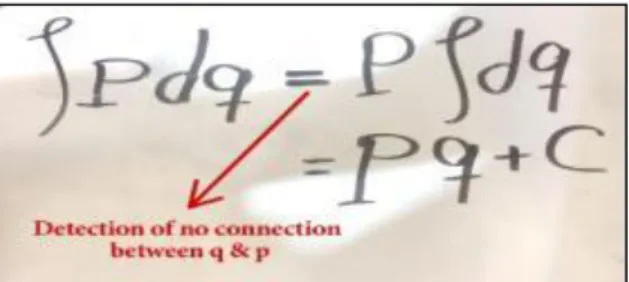
(7) Figure 2. A sample of handwriting for problem 2 In fact, they did not offer a persuasive answer to the question why they did not refer to other methods to solve these two integrals. They just said that this is the best and the easiest method. Now, the interviewer follows the interview based on students’ way of thinking and their perceptions from different problems: "how do you infer the integral's extremes when you conceptualize the integral as an initial function?" The interviewer asked Negar and Mahshid to explain these extremes for 𝐼11 and 𝐼12 . Negar: By emphasizing the point that the solution of the integral 𝐼21 is finished by using 𝑒 𝑥 + 𝐶, for 𝐼12 and 𝐼22 , we obtain the difference between them in the main function (by moving her hand 𝜋 over the integral sign itself). Even in 𝐼12 , has to be substituted with 0. In fact, it may be 2 declared that they just aim to solve the problem, without completely considering its concept. With this inference, there is no complete and precise conceptualization in their minds, while they just learn a complete skill for learning the integral. For instance, we noticed only in Hirad's discussions that he does not look at the number 2 and 4 merely as numbers in 𝐼12 , but he considers them as the values of the main function in 2 and 4 and he obtains their difference simultaneously. When The interviewer asked Hirad and Hooman to discuss with me about how to solve 𝐼11 without using the initial function. Hooman: the integral function may be divided into 𝑓 and 𝑔 functions, where 𝑓(𝑥) = 𝑥 and 4 4 2 𝑔(𝑥) = 2⁄𝑥 2 , i.e. each of ∫2 𝑥 𝑑𝑥 and ∫2 2 𝑑𝑥 gives of an area in the range of 2 and 4, when 𝑥 they are subtracted, the targeted value in the integral may be obtained (he referred to the area between both hypothetical functions drawn by him). Indeed, it may be declared that teaching integral as area has taught them the concept that the integral may be considered as a limited area between these two functions. In fact, we can have this concept the subtraction sign in the problem definition has helped Hirad and Hooman in their explanations, but what would be their answers if the cause was summation? We conduct the discussion about the next problems with Negin and Mahshad. For problem three 𝐼31 , Negin immediately wrote the S + C function on the board and explained that; Negin: When there is nothing in front of the integral, it means that the function under the integral is 1 , therefore we may say that the answer is only the Sfunction whose derivative equals1 . It is clear that again, the first solution that came to her mind was to use the initial function in solving the integral. So we are content that she has not used 𝑥 in the answer. By seeing the definition of the problem, Mahshad declared the answer 𝑥 + 𝑐 loudly at the very beginning. So we can conclude that he has made an inadvertent mistake, not a conceptual one. For 𝐼32 , I talked to Mahshad and he answered: Since there is dq in the integral, it means that our initial function must be based q on, therefore I do not consider p and even I put it out of the integral. Now the answer is like the previous integral (𝐼31 ) and it is done. In fact, again they both solved the integral with the initial function method and just looked at the answer as a general solution, although some layers of thinking about the area may be seen in their comments and they might have answered this question with a combination of both (see figure 3):. Journal for Educators, Teachers and Trainers JETT, Vol. 9 (1); ISSN: 1989-9572. 170.
(8) Figure 3. A sample of handwriting for problem 3 When we turned to the fourth question, discussion with Mahshad and Negin was continued. Mahshad: According to the inference of integral as area, it may be easily said that 𝐼41 and 𝐼42 give us areas, but since 𝑓 is a negative function, i.e. it is under the 𝑥 axis, this area is under the x axis and since the 𝑓 function is defined over the 𝐷 area, it may be assumed that 𝐷 is from a to bon the 𝑥 axis, i.e. the area considered in 𝐼41 is the segment limited to the f function and the 𝑥axis from a to bunder the 𝑥 axis (he drew a picture for this with details on the board). It is found, according to Mahshad and Negar's explanations, that they were able to differentiate the integral determination with the initial function and the area. In this case by showing 𝑎 and 𝑏 on the 𝑥 axis, they refer to the point that when there is an extreme in the integral, these values merely determine a physical boundary for 𝑎 specific area on a plane, not just two mathematical numbers. In fact, this integral in turn determines the figure drawn by Mahshad. This area is only computable via integral. Mashhad's emphasis on 𝑑𝑥 and its relationship with the 𝑥 axis to draw a figure requires more attention. He said he found that the area under consideration must be limited on the 𝑥axis. In his discussion, he said that if 𝑓 is any optional function, then its value may be calculated by using the initial functions (see figure 4):. Figure 4. A sample of handwriting for problem 4 He just used two integral inference methods simultaneously in order to obtain the integral that is very interesting. When Negar was asked about 𝐼42 , after several minutes of hesitation, Mahshad 1 said that it may be declared that 𝐼42 is the same as 𝐼41 , except that it has the index added. 2. 1. Since 𝐼41 give us an area, this the index causes that 𝐼42 makes half of it. Mahshad's answer 2 with Negar's sympathy was a simple, but complete one. When I asked them about their private 1 discussion, Negar said that may be considered as the 𝑓(𝑥) index and 𝐼42 may be assumed as 2. 1. ∫𝐷 2 𝑓(𝑥)𝑑𝑥 . In this case, it may be said that the area under consideration is halved, since 𝑓(𝑥), i.e. its width is halved, while dx is constant, i.e. 𝑥 is still from 𝑎 to 𝑏. This viewpoint may be explained such that Negar proposed a more complete conceptualization of integral as an area compared to Mahshad which would considerably help her in solving more advanced problems. 1. Negar considered and ∫𝐷 𝑓(𝑥)𝑑𝑥 as two separate and unrelated terms and after calculating 2 the latter, she multiplied them, while Mahshad did not consider them separately and considered 1 the integral as a whole. He considered as a part of the f function (see figure 5), experience in 2. Journal for Educators, Teachers and Trainers JETT, Vol. 9 (1); ISSN: 1989-9572. 171.
(9) teaching mathematics has showed that many university students consider ∫𝐷 𝑑𝑥 as content for 𝑏. 𝑏. ∫𝑎 𝑑𝑥 . For example, they consider ∫𝐷 𝑓(𝑥)𝑑𝑥 as a short form of ∫𝑎 𝑓(𝑥)𝑑𝑥.. Figure 5. A sample of handwriting for problem 4 For the fifth problem, we had a discussion with Hooman and Hirad, the two students who had more experience and knowledge about integral. Hirad, according to the figure and that it is similar to no geometrical shape, an integral must be used here (the geometrical inference of integral with area). The vase may be considered as lying on the plane. Now the bottom of the vase that are smooth, are named as a and b. its left and right parts are names as 𝑓(𝑥) 𝑏 and 𝑔(𝑥), respectively. Therefore ∫𝑎 [(𝑓(𝑥) − 𝑔(𝑥)]𝑑𝑥 may be solved to obtain the desired value. Hirad said that we divide this area into smaller rectangles and then add them up (simultaneously he moved his hand from left to right over the hashed part). We subtract the summation of the big rectangles from the small ones and in this way obtain the solution. Hirad pointed to the fact that since there is no rule about 𝑓 and 𝑔, the area must be divided into smaller rectangles and then subtract the summation of each of them. Therefore it may be said that they both have completely understood the integral by area determination, i.e. the summation of infinite rectangles and used them in solving problems. Hooman: in fact, we have cut the hashed segment into smaller rectangles whose width and length are 𝑓− 𝑔 and ∆𝑥, respectively and add them up. During this, however, we lose some parts of the hashed area. Therefore we make ∆𝑥 increasingly smaller until there is no part remained. Hooman used this rectangle to convey the solution and presented his whole comments based on its width and length. Even they pointed to the fact for the beginning and the end of the integral that the bottom of the vase is the initial dividing point of the area, while its top is the end point of the hashed part into smaller rectangles. In fact, the integral extremes show where to start and finish the summation. While the question is solved by both students, we found that they had noticed that they had to consider ∆𝑥 as a very tiny part (they used the term "thin and thinner" rectangle) to obtain the precise value of the area. They filled the existing gaps by making the rectangles increasingly thinner to reach the precise solution. Their inference of integral is related to the area and periphery viewpoint which is different from Riemann summation, although two of the students solved it with Riemann summation (see figure 6):. Figure 6. A sample of handwriting for problem 5. Journal for Educators, Teachers and Trainers JETT, Vol. 9 (1); ISSN: 1989-9572. 172.
(10) For the sixth problem, we refer to my discussion with Hooman and Hirad. They answered the 2 first part easily with a discussion between them and said that ∫0 (2𝑥 − 𝑥 2 )𝑑𝑥 is the solution. -. Hirad: since the hashed area is the area limited to the graph 𝑦 = 2𝑥 − 𝑥 2 and the 𝑥 2 axis in the range of 𝑥 = 0 to 𝑥 = 2, in order to obtain it, it is sufficient to reach ∫0 (2𝑥 − 𝑥 2 )𝑑𝑥. In order to obtain this integral, too, the function conformity form is used to find the solution.. I noticed, by behavioral analysis of Hirad on the board, that during his discussion with Hooman, he emphasized that since it is not similar to any geometrical shape, we must only use the integral to solve it. In fact, here the integral inference as a limited area plays the main role in the students’ thought, although then he emphasized the integral solution obtained by the inference of the initial function. he combination of both inferences leads to the integral solution (see figure 7):. 𝑦 = 2𝑥 − 𝑥 2. 2𝑥 − 𝑥 2 = 0 𝑥 = 0 𝑜𝑟 2 2. ∫ (2𝑥 − 𝑥 2 ) 𝑑𝑥 0. = 𝑥2 −. 𝑥3 2 8 4 | =4− = 3 0 3 3 Figure 7. A sample of handwriting for problem 6. However in solving the last question, i.e. second part, even Hirad and Hooman who are more capable than other students, are not able to answer the question in a correct manner. In fact 51 they cannot present a clear answer for this question. They used for solution of ∫0 𝑑𝑥 . 𝑥 Hooman: according to the previous question, it may be said that here just the function has been 51 changed and to obtain the answer, it is sufficient to enter ∫0 𝑑𝑥 . 𝑥. -. Interviewer said that is it possible to solve this question with previous problem solving method? Hooman: Of course, only the function has been changed.. -. Hirad: He paused a little and confirms Hooman’s answer with suspicion.. -. Interviewer: The lower bound that I used for this integral is zero, which the function 𝑦 = 1/𝑥 not defined on it. They discussed with each other and had no compelling answer to this, and after determined the initial function, they realized their mistake and won’t find any answer to it with mutual discussion.. We notice, by analyzing their answers, that although they had solved problems according to their science in solving routine questions, they make errors for relatively more complicated ones. Of course, these errors were extremely interrogative and so have to be prevented. It may be said that it was not completely and precisely conceptualized in their minds.. 5. Conclusion Calculus is as basic science for almost courses in university. Almost content of calculus in particular, deviation and integral consider as concepts in mathematics of various engineering. Journal for Educators, Teachers and Trainers JETT, Vol. 9 (1); ISSN: 1989-9572. 173.
(11) scopes. Regard to this, researchers have tried that studied challenges and performance of university students in solving integral after teaching, then their responses are analyzed through videos and discourses. During this study, the students were divided into groups of two. By giving enough time, they were asked to answer the problem and discuss their solution to reach an appropriate strategy of problem solving. In addition, choosing the examples and their order must be exactly done so that the conception of integral would be completed in the students' minds layer by layer with more details. The analysis of the students’ answers to the questions includes: In solving integral questions, especially applied ones, most of them use more than one inference of integral during the solution of an integral problem. Since all of the problems are of the mere mathematical type, most of these students emphasize the utilization of the integral inference as an initial function and a combination of it with the integral inference as periphery and area. In order to the subject with more details, it seems necessary to design and implement a test that includes both mathematics and physics (for the applied aspect of integral) so that we could investigate if there would be any change in the type of the students’ approaches in solving applied problems compared to mere ones in using the integral inference. The students who emphasized the Riemann inference or somehow infinite summations in solving problems, had fewer problems in inferring the integrals and presented a more meaningful rational for them. However those who focused more on the inference of integral as an initial function and periphery and area, had more problems. However, definitely the second group would more easily and quickly be able to compute the integral in the implementation stage (the integral computation stage). In fact, the Riemann inference plays the fundamental role in the integral inference, while it is the inference of the initial function and periphery and area in the computation of integral). In some answers of students, the whole three inference approaches of integral may be observed, but choosing the appropriate one in solving problems is different. Students’ problems in solving the integral-related problems could not be often related to the lack of sufficient knowledge and science. Sometimes they have fundamental problems in using their data during the solution of a problem. In fact, it is very important to help them choose the appropriate method. In most Iranian universities, some math books are introduced to teach integral that initiate the integral with its geometrical approach, i.e. its inference with periphery and area and then present the inference of the initial function for solving the integrals obtained with this method and just mention some simple examples about the Riemann integral. In fact, they emphasized the solution and calculation of integral rather than its complete and precise conceptualization. While it may be said that the most fundamental and important inference of integral which leads to its complete conceptualization, is Riemann and of course, the details of how to reach it. Therefore, the necessity of a book with this approach toward integral is found, in fact, a book that presents all three integral approaches together as complementary approaches and would not merely focus on a specific approach of it, since these three inferences of integral are interrelated in the conceptualization of integral. In answering how the integral may be taught and how students can learn it, it may be said that: the fundamental and basic concepts, especially limit and derivative must be recalled about integral and then we have to address the integral concept after ascertaining the students' understanding of these basic concepts. In fact, before teaching the integral in a subjective manner, teachers have to develop its related preliminary and basic concepts and then look for presenting the main subject. In addition, in presenting the integral course, pointing and graph drawing are very useful and solve the interrogative difficulties of students. In fact, visual explanations help integral conceptualization significantly. However entering the subject of integral may be different, but the general belief is that first it is necessary to present the initial function and discuss about the indefinite integral completely and to be sure to present problems which would not be merely solvable with the initial function approach so that the students would have to conceptualize in order to solve the integral rather than formulation. Recommendations are introduced such as; Emphasis on teaching an integral approach such as the initial function leads to the limitation of using integral in this case. In addition, students' understanding of integral could not be completed with a single approach, but the whole three approaches are complementary. Since only six students participated in this test,. Journal for Educators, Teachers and Trainers JETT, Vol. 9 (1); ISSN: 1989-9572. 174.
(12) it may not be declared with certainty that the results are being able general to all students. In addition, it is important to mention that all of those six participants were among good students with high scores, therefore it remains to be seen to what extent could these results be generalized to students with similar profiles, but not all students. It may be said, however, that the main/general viewpoint about integral is obtained. Finally it may be said that these results help teachers provide the appropriate conditions to facilitate the understanding and conceptualization of students by due planning with a complete knowledge about the class. Analysis of answers show that nearly all participants, even those with a higher experience, have a fundamental difficulty with answering the second part of the sixth problem which refers to their weakness in the conceptualization of integral and the fact that they cannot understand that this question is both related to basic subjects including limit and somehow the concept of integral itself. There are also fundamental problems for the fifth question that have to be derived, since there is a serious weakness in students in coping with applied problems. By Experience and analyzing the students' performance in coping with the integral problems shows that, students tend to formulate and learn Integral based on method of teaching mathematics in school and universities of Iran as well as the way of their evaluation. In other words, they want to learn superficially rather than to understand it correctly. In fact, we can say that they have weakness in solving practical problems, while solve routine Integral easily. Much research is still remaining to be conducted about the integral teaching method to reach the desirable result so that students move from the integral interpretation stage to its solution one. Considering other effective items on training, especially teaching integral is very important, e.g. age, sexuality, educational history, family and social conditions, motivation, etc.. 6. References Adi Wibawa, K., Nusantara, T, Subanji., & Parta, N. (2017). Fragmentation of Thinking Structure’s Students to Solving the Problem of Application Definite Integral in Area. International Education Studies, 10(5), 48-60. Allen. D. (2001). Learning integral calculus tee rough non-template. problem solving, XI(2), 147160. Apostol, T.M. (1967). Calculus. Xerox Copporation, Waltham: Massachusetts. Baki, M. & Çekmez, E. (2012). Prospective elementary mathematics teachers’ understandings about the formal definition of limit. Turkish Journal of Computer and Mathematics Education, 3(2), 81-98. Biber, A. Ç., & Argün, Z. (2015). The relations between concept knowledge related to the limits concepts in one and two variables functions of mathematics teachers candidates. Bartin University Journal of Faculty of Education, 4(2), 501-515. Çetin, F.Ö., Dane, A., & Bekdemir, M. (2012). A concept of “accumulation point” and its usage. Necatibey Faculty of Education Electronic Journal of Science and Mathematics Education, 6(2), 217-233. Dane, A., Faruk Çetin, O., Baş, F., & Özturan Sağırlı, M. (2016). A Conceptual and Procedural Research on the Hierarchical Structure of Mathematics Emerging in the Minds of University Students: An Example of Limit-Continuity-Integral-Derivative, International Journal of Higher Education, 5(2), 82- 91. Dancis, J. (2001). Student modeling of physical phenomena as they derive standard integral formulae: One way to reduce proof phobia. PRIMUS, XI (2), 124-146. Kula, S. & Bukova Güzel, E. (2015). Reflections of Mathematics Student Teachers’ Knowledge Related to the Purposes of the Curriculum on Their Limit Teaching. Journal of Theoretical Educational Science, 8(1), 28-49. Jonse, S.R. (2013). Understanding the integral: Students symbolic forms. The journal of mathematical behavior, 32, 122-141. Orton, A. (1983). Student's understanding of integration. Educational studies in mathematics, 14, 1-18. Özkaya, M., Işık, A., & Konyalıoğlu, A. (2014). Proofing and counter-exampling performances of students in the elementary mathematics education department for continuous functions. Middle Eastern & African Journal of Educational Research, 11, 26-42.. Journal for Educators, Teachers and Trainers JETT, Vol. 9 (1); ISSN: 1989-9572. 175.
(13) Thomas, M., & Hong, Y.Y. (1996). The Riemann Integral in Calculus: Student's Processes and Concepts, In P. C. Clarkson (Ed.), Proceeding of the 19th Annual Conference of the Mathematics Education Research Group of Australia, Melbourne, Victoria, Australia. Ubuz, B. (2011). Factors associated with success in a calculus course: An examination of personal variables, International journal of mathematical education in science and technology, 42(1), 1-12.. Journal for Educators, Teachers and Trainers JETT, Vol. 9 (1); ISSN: 1989-9572. 176.
(14) Appendix Integral's Problems. 1. Solve the following integrals:. 4. 𝐼11 ) ∫ 𝑥 − 2⁄𝑥 2 𝑑𝑥 2. 0. 𝐼12 ) ∫ 2 cos 𝑥 𝑑𝑥 𝜋⁄ 2. 2. Look, solve and write the meaning: 𝐼21 ) ∫ 𝑒 𝑥 𝐼22 ) ∫ 𝑥 2 . 𝑒 𝑥 𝑑𝑥 𝐼23 ) ∫ 𝑥𝑒 𝑥 𝑑𝑥 3. Explain the following integrals: 𝐼31 ) ∫ 𝑑𝑠. 𝐼32 ) ∫ 𝜌 𝑑𝑞. 4. Suppose that f is a negative function over the limited domain D. Describe the following integrals: 1 𝐼41 ) ∫ f(x)𝑑𝑥 𝐼42 ) ∫ f(x)𝑑𝑥 2 𝐷 𝐷 5. Calculate the area of the following vase.. 6. Can you calculate the area of the hashed part? If yes, how? If no, explain the reason.. 𝑦 = 2𝑥 − 𝑥 2. (6-1). 𝑦=. 𝑥=4. Journal for Educators, Teachers and Trainers JETT, Vol. 9 (1); ISSN: 1989-9572. 1 𝑥 𝑥=5. (6-2). 177.
(15)
Figure


Documento similar