RENEWABLE ENERGY SYSTEMS AND SMART GRIDS:
PLATFORM TO DEVELOP FINAL YEAR PROJECTS ON
AUTOMATION AND SUPERVISION
Antonio José Calderón Godoy, Isaías González Pérez, Manuel Calderón Godoy
Escuela de Ingenierías Industriales, Universidad de Extremadura, {ajcalde, igonzp, calgodoy}@unex.es
Abstract
Studying Renewable Energy Systems (RES) in engineering degrees is acquiring an increasing importance given the current energetic scenario as well as the expected deployment of intelligent networks for power generation and distribution, the so-called smart grids. In the industrial engineering context, automation and supervision play a vital role, especially for intensifications in Electronics and Automation. Developing a Final Year Project (FYP) constitutes a final stage and a great opportunity for students to achieve skills and knowledge about complementary disciplines. This paper highlights the convenience of applying automation and supervision to renewable energy systems in FYPs of engineering degrees. To this aim, various FYPs successfully completed at the Electrical Engineering, Electronics and Automation Department of the University of Extremadura are presented.
Keywords: Final Year Project, Renewable energy systems, smart grids, hydrogen, automation, supervision.
1
INTRODUCTION
Renewable energies receive an ever-increasing attention due to the need of mitigating the harmful effects of greenhouse gases emissions. In addition, great research efforts are being devoted to systems which combine in an integrated manner different renewable sources jointly with hydrogen since it provides important advantages as energy storage means for mid and long term [9, 16]. These systems become smart when equipped with instrumentation, communication networks and computation core [18], being considered Smart Micro-Grids. Indeed, Smart Grids, the next generation of power grids, emerged as a consequence of the convergence of energy systems and Information and Communication Technologies (ICTs) [6], where the handled data is obtained from remote sensing, control, and monitoring processes [14]. From Smart Grids viewpoint, a Smart Micro-Grid can be defined as a small scale Smart Micro-Grid
which can be autonomous or grid-tied [15]. As pointed in [19], multiple Smart Micro-Grids can form a network with connection to the utility grid, showing a great potential to increase the penetration of renewable energies.
On the other hand, sensing and data acquisition are fundamental in every scientific field [5]. The collected information is used for automation and supervision equipment to achieve automatic operation as well as visualization of the most relevant magnitudes.
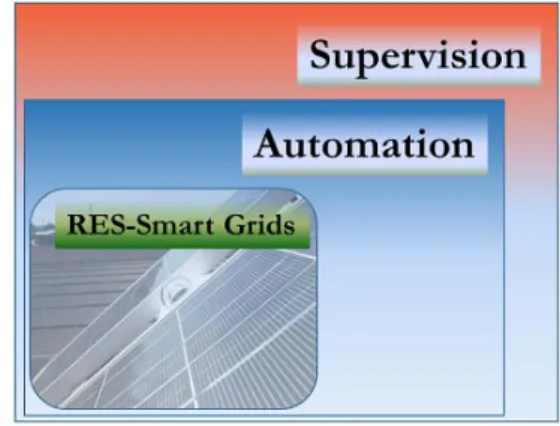
Evidently, Renewable Energy Systems (RES) and Smart Grids also require the application of automation and supervision technologies for optimal, reliable and secure operation [9]. In other words, controllers, sensors, actuators and the required data exchange with players are crucial for a successful performance of smart grids [3]. Figure 1 illustrates in a schematic manner this interplay.
Figure 1: Scheme of the interplay RES-Automation-Supervision
In the context of industrial engineering education, engineers need to be familiarized with technologies involved in the Industry 4.0 paradigm [4, 8]. Well-prepared Industry 4.0 engineers need an interdisciplinary understanding of systems, production processes, automation technology, information technology, and of business processes [17]. Smart grids and renewable energies are, in fact, an important component of the Industry 4.0 [2].
In this sense, in industrial engineering degrees devoted to automation and electronics, RES constitute a relevant field of application of the knowledge and skills related to automation and supervision. This fact gains more importance if the used facilities are experimental, because from an educational perspective, it is mandatory the utilization of experimental systems to apply theoretical concepts and for acquiring practical skills [8]. Even more, professional opportunities can be directly linked to such field.
To complete the degrees, students must develop a Final Year Project (FYP) which delivers a great opportunity for students to achieve skills and knowledge about complementary disciplines.
The aim of this paper is illustrating the convenient combination of RES and automation and supervision disciplines in FYPs of engineering degrees.
The structure of the rest of this contribution is as follows. The second section is devoted to describe some general issues about FYPs and representative FYPs are described in Section 2. Next, the benefits of applying automation and supervision for RES in FYPs are discussed. Finally, the main conclusions of the work are addressed.
2
FYPS ON AUTOMATION AND
SUPERVISION APPLIED TO RES
In this section, firstly, a general contextualization about FYPs and their main features is done. After that, various illustrative FYPs dealing with the application of automation and supervision technologies for RES are presented.2.1 MAIN FEATURES OF FYPS
The implantation of the European Higher Education Area (EHEA) brought the imposition of a FYP for all degrees and masters. This was a novelty for many degrees, but not for those related to engineering, where it was necessary to complete such project since its inception.
Essentially, a FYP consists on developing a project under the supervision of one or more directors. Their goal is to reinforce the knowledge and skills acquired during the degree and/or achieving new complementary ones. In addition, FYPs deliver an opportunity for the student to choose in a high measure the field of developing, enabling the choice of stimulating areas for him/her.
The student can select a topic among the offer of the department or directly agreed with a teacher that will act as director. A project can be directed by a maximum of two directors and at least one of them must have teaching in the degree of the student. All the normative documentation about requirements, terms and so forth can be found in [12] for the industrial engineering degrees of the University of Extremadura.
A FYP lasts 12 credits ECTS (European Credit Transfer and Accumulation System), which are equivalent to 300 hours. In order to pass the FYP, the student must elaborate a project report and conduct a dissertation of around 30-40 minutes. Such a dissertation is divided into public exposition and an argumentation with a tribunal composed by three teachers. This tribunal is responsible of assessing the FYP and the director does not form part of it.
2.2 REPRESENTATIVE FYPS
A number of FYPs have been developed in the topic of this paper, automation and supervision applied to RES, so three of them, considered representative, are briefly described in this subsection.
2.2.1 Automation and supervision of photovoltaic solar tracker
In this project, both the automation of the solar tracking of a large-scale photovoltaic module and its supervision have been approached. It is composed by 56 modules, with a total surface of 80 m2 and a power of 60 kW. Figure 2 shows a photograph of the rear view of such solar tracker.
Figure 2: Rear view of the photovoltaic solar tracker
The programming has been carried out using the software suite TIA Portal V13 of SIEMENS, where STEP7 corresponds to the PLC configuration and WinCC serves to design the supervisory system. To determine the azimuthal position an incremental encoder is used, whereas an inductive sensor is applied to obtain the zenithal position.
The user supervises the condition of the solar tracker via user-friendly screens which include diverse buttons and numerical fields to navigate among them and visualize the variables values. Indeed, the user can modify certain parameters in order to calibrate the system.
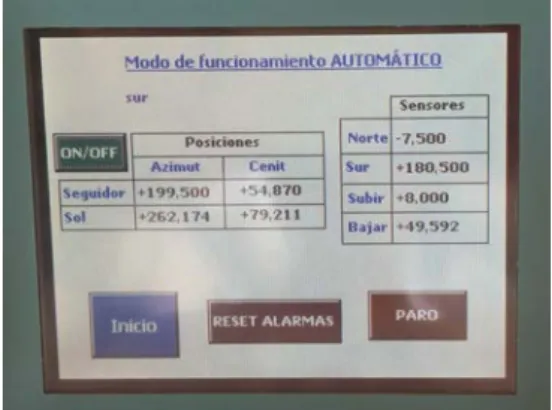
This FYP has been completed by two students, both of the Electronics and Automation Engineering degree. In order to illustrate the successful FYP, Figure 3 shows the aspect of one of the implemented screens. Namely, it corresponds to the automatic operation where some data about the position are displayed. A remarkable point is that the developed FYP achieved a successful operation of the solar tracker.
Figure 3: View of one of the screens of the HMI for the solar tracker
In this FYP, the main scopes that have been trained are automation, supervisory systems, industrial sensors and actuators, as well as renewable energy concepts.
2.2.2 Supervisory system for hybrid Smart Micro-Grid
The design of a supervisory system to monitor the operation of a Smart Micro-Grid which integrates photovoltaic and wind sources with hydrogen generation and consumption is the topic of this project. Such micro-grid requires on the one hand, the visualization of the variables evolution and equipment status, and, on the other hand, the accumulation of such information for further analyses. To this aim, a virtual instrument has been developed with the graphic programming software Laboratory Virtual Instrument Engineering Workbench (LabVIEW) [13] of National Instruments (NI), with worldwide presence and support for thousands of technologies and instruments [1].
The data exchange between the LabVIEW-based SCADA and the PLC (model s7-1500) that governs the actuators and retrieves data from the sensors has been established by means of the Open Platform Communications (OPC) interface. This interface is widely used in both industrial and energy automation [7, 10]. For this purpose, the NI OPC Servers and the Datalogging and Supervisory Control (DSC) module (add-on software for the LabVIEW environment) have been used.
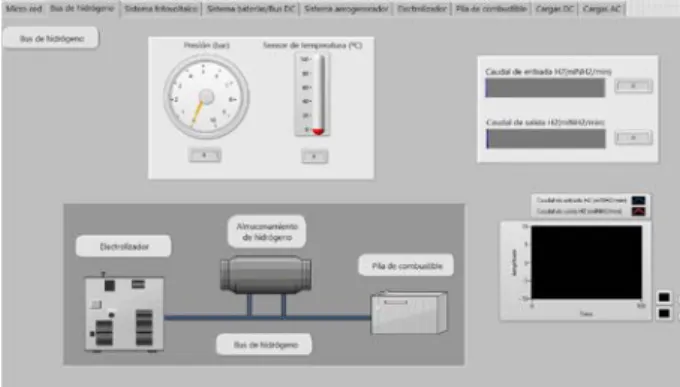
The organization of the supervisory interface has been solved with one screen for a general view of the micro-grid and single screens for each subsystem. The navigation among them is enabled by tab buttons. Schematic representations of the components are used to illustrate them, and different numerical fields indicate the values of the main values of the energetic flows. The main variables that are monitored are voltage, current, temperature, irradiance, wind speed, hydrogen pressure, hydrogen flow, battery state of charge, just to name a few.
Figure 4: Aspect of the screen designed to supervise the hydrogen bus of the Smart Micro-Grid
It must be noted that this project does not cover the deployment of the Smart Micro-Grid neither its automation. It was devoted to design an operative supervisory system as well as the data exchange through the network.
In this FYP, the main scopes that have been covered are the following ones: supervisory systems, industrial communications, interoperability management and smart grids-related concepts.
2.2.2 Characterization system for photovoltaic modules
Testing photovoltaic modules is a paramount task before being used in a RES or as part of maintenance plans during normal operation [11]. Therefore, this FYP was devoted to design and implement an automatic characterization system for photovoltaic modules of different powers using NI LabVIEW.
For a proper characterization of a module, apart from the values of voltage, current and power delivered, other important factors must be taken into account due to their influence. These factors are the solar irradiance incident over the module and its temperature. In the project, these magnitudes are measured by a pyranometer and various temperature probes (placed in different points of the module), integrated in the characterization system. The sensors have been mounted in a Printed Circuit Board (PCB) and assembled in a box for a better handling in the laboratory.
The data acquisition card model NI-USB-6008 is used, whereas the reading and accumulation of the information is made with LabVIEW. A graphical user interface has been designed to display the retrieved data in an illustrative way, by means of both graphical and numerical elements. Ancillary devices that have been used are power sources and electronic loads, as can be observed in Figure 5, where the experimental setup of the FYP is shown.
The designed monitoring interface is seen in Figure 6. Finally, as sample of the obtained results, the current-voltage (I-V) characteristic curves of a photovoltaic module Energreen Solar ES-190-RL for different values of irradiance is shown in Figure 7.
The scopes that have been mainly managed in this project are sensing, instrumentation, data acquisition, supervisory systems and characterization of photovoltaic systems.
Figure 5: Experimental setup of the automatic characterization system
Figure 6: Screen of the monitoring interface for photovoltaic modules
3 DISCUSSION
This section deals with the discussion of diverse aspects of the developed FYPs as well as future guidelines that will be handled in near future.
To begin with, concerning the academic results, the projects have obtained good marks. The achievable mark is between 0 and 10, and all the projects have reached marks above 9.
About the time devoted to their completion, obviously, each project and each student has its own particularities and circumstances. In general, from the viewpoint of the directors, the devoted time has been short taking into account the difficulties associated to experimental facilities. As examples, the projects dealing with the solar tracker and the characterization system lasted 4 months, whereas that devoted to the Smart Micro-Grid required 3 months.
The FYPs have been carried out by students of the Electronics and Automation Engineering, and Electrical Engineering degrees. It has been detected that they lacked knowledge about RES that combine more than one type of energy source. In addition, the concept of smart grids is not introduced in any course of the aforementioned degrees. This issue is very serious from the directors’ point of view given the role that these networks will play in the future energetic scenario.
All students have handled real equipment, which is a valuable aspect when dealing with engineering education. Furthermore, resources really used in industry, both hardware and software, have been managed by students. They do not have used didactic or educational-oriented environments, but realistic tools as close as possible to those they will use in the professional area. For instance, LabVIEW is widely used in academic and industrial environments for instrumentation and monitoring tasks, and the PLC s7-1200 is also profusely applied in industry.
In the professional field of graduates, they must be able to face multiple types of tasks, often finding works in plants or facilities related to renewable energies such as solar thermal plants or design and deployment of grid-connected photovoltaic facilities. Informal interviews with the students have provided positive impressions towards the FYPs. Students commented that they were happy about the management of real systems as well as about the possible professional opportunities in the field of RES and Smart Grids.
Nonetheless, further works are focused on collect the opinions of students regarding the achieved skills as well as their satisfaction with project. In fact, to this aim a survey is being prepared, including Likert scale
questions and open-answers to gather suggestions and opinions. This feedback will contribute to improve the development of the FYPs.
Another guideline is about contacting with students that have reached certain professional trajectory in order to know the domain where it has been developed and its relationship with the topic of their FYP.
New projects are being currently developed, namely about characterization of photovoltaic modules and hydrogen-related equipment using automation devices (PLC, industrial sensors, etc.). Moreover, the design of data acquisition systems based on open-source devices (Arduino, Raspberry Pi, etc.) is also being considered. This type of systems will facilitate monitoring the large amount of magnitudes involved in smart grids.
4 CONCLUSIONS
RES and intelligent power networks, smart grids, contribute to sustainable and responsible development. Moreover, they are a prolific field of application of technologies for sensing, automation and supervision. For such reasons, in this paper the experience gained in the development of engineering FYPs dealing with such a combination has been presented.
The most representative projects have been described, devoted to automate and supervise solar trackers, and to monitor Smart Micro-Grids. This way, the student applies and enhances the knowledge and skills acquired during the degree. In addition, they get familiar with the hardware/software tools required to manage these complex and challenging systems. On the other, it must be noted that the FYPs have been carried out using real facilities, handling well-proven equipment that students will utilize in their future professional development.
Acknowledgments
This work has been supported by the FEDER Funds (Programa Operativo FEDER de Extremadura 2014-2020) through the grant “Ayuda a Grupos de Investigación” (ref. GR18159) of Junta de Extremadura. Moreover, the authors are grateful to the students who developed the projects under their direction.
Resumen en español
SISTEMAS
DE
ENERGÍAS
PLATAFORMA
PARA
importancia creciente dado el escenario energético actual y el despliegue esperado de redes inteligentes para la generación y distribución de energía, las llamadas smart grids. En el contexto de la ingeniería industrial, la automatización y la supervisión desempeñan un papel vital, especialmente para las intensificaciones en electrónica y automatización. El desarrollo de un Proyecto Fin de Carrera (PFC) constituye una etapa final y una gran oportunidad para que los estudiantes adquieran habilidades y conocimientos sobre disciplinas complementarias. Este trabajo destaca la conveniencia de aplicar la automatización y la supervisión a los sistemas de energía renovable en los PFC de los títulos de ingeniería. Para este fin, se presentan varios PFC completados con éxito en el Departamento de Ingeniería Eléctrica, Electrónica y Automática de la Universidad de Extremadura.Palabras clave: Proyectos fin de carrera, sistemas de energías renovables, smart grids, hidrógeno, automatización, supervisión.
References
[1] Arpaia, P., De Matteis, E., Inglese, V., (2015) “Software for measurement automation: A review of the state of the art”, Measurement, vol. 66, pp. 10-25.
[2] Batista, N.C., Melício, R., Mendes, V.M.F., (2017) “Services enabler architecture for smart grid and smart living services providers under industry 4.0”, Energy and Buildings, vol. 141, pp. 16-27.
[3] Batista, N.C., Melício, R., Mendes, V.M.F., (2014) “Layered Smart Grid architecture approach and field tests by ZigBee technology”, Energy Conversion and Management, vol. 88, pp. 49-59.
[4] Calderón, A.J., González, I., (2018) “Integration of Sensor and Actuator Networks and the SCADA System to Promote the Migration of the Legacy Flexible Manufacturing System
towards the Industry 4.0 Concept”, Journal of Sensor and Actuator Networks, vol. 7(2), 23.
[5] Calderón, A.J., González, I., Calderón, M., Segura, F., Andújar, J.M., (2016) “A New, Scalable and Low Cost Multi-Channel Monitoring System for Polymer Electrolyte Fuel Cells”, Sensors, vol. 16(3), 349.
[6] Camarinha-Matos, L.M., (2016) “Collaborative smart grids – A survey on trends”, Renewable and Sustainable Energy Review, vol. 65, pp. 283-294, DOI: 10.1016/j.rser.2016.06.093
[7] González, I., Calderón, A.J. (2018) “A survey on systems integration in the energy automation domain through OPC interface,” Proceedings of the XXXIX Jornadas de Automática, Spain.
[8] González, I., Calderón, A.J., (2018) “Development of Final Projects in Engineering Degrees around an Industry 4.0-Oriented Flexible Manufacturing System: Preliminary Outcomes and Some Initial Considerations”, Education Sciences, vol. 8, 214.
[9] González, I., Calderón, A.J., Andújar, J.M., (2017) “Novel Remote Monitoring Platform for RES-Hydrogen based Smart Microgrid”, Energy Conversion and Management, vol. 148,
pp. 489-505. DOI:
10.1016/j.enconman.2017.06.031.
[10] González, I., Calderón, A.J., Figueiredo, J., Sousa, J.M.C., (2019) “A Literature Survey on Open Platform Communications (OPC) Applied to Advanced Industrial Environments”, Electronics, vol. 8, pp. 510.
[11] Henni, O., Belarbi, M., Haddouche, K., Belarbi, E.H., (2017) “Design and Implementation of a Low-Cost Characterization System for Photovoltaic Solar Panels”, International Journal of Renewable Energy Research, vol. 7, pp. 1586-1594.
[12] https://www.unex.es/conoce-la-uex/centros/eii
[13] http://www.ni.com/labview/
[14] Kabalci, E., (2015) “A smart monitoring infrastructure design for distributed renewable energy systems”, Energy Conversion and Management, vol. 90, pp. 336-346.
V\VWHP´(QHUJ\ &RQYHUVLRQ DQG 0DQDJHPHQW YROSS
>@1DVWDVL % %DVR */ +\GURJHQ WR OLQNKHDWDQGHOHFWULFLW\LQWKHWUDQVLWLRQWRZDUGV IXWXUH6PDUW(QHUJ\6\VWHPV(QHUJ\YRO SS
>@ 6LPRQV6$Ep31HVHU6³/HDUQLQJ LQ WKH $XW)DE ± WKH IXOO\ DXWRPDWHG ,QGXVWULH OHDUQLQJ IDFWRU\ RI WKH 8QLYHUVLW\ RI $SSOLHG 6FLHQFHV 'DUPVWDGW´ 3URFHGLD
0DQXIDFWXULQJYROSS
>@ <DQJ 4 $Q ' <X: 7DQ = <DQJ ; ³7RZDUGV 6WRFKDVWLF 2SWLPL]DWLRQ %DVHG (OHFWULF 9HKLFOH 3HQHWUDWLRQ LQ D 1RYHO $UFKLSHODJR0LFURJULG´6HQVRUVYRO
>@ =KDQJ / *DUL 1 +PXUFLN /9 ³(QHUJ\ PDQDJHPHQW LQ D PLFURJULG ZLWK GLVWULEXWHG HQHUJ\ UHVRXUFHV´ (QHUJ\
&RQYHUVLRQDQG0DQDJHPHQWYROSS
E\ WKH DXWKRUV 6XEPLWWHG IRU SRVVLEOH RSHQ DFFHVV SXEOLFDWLRQ XQGHU WKH WHUPV DQG FRQGLWLRQV RI WKH &UHDWLYH &RPPRQV $WWULEXWLRQ && %<1&6$ OLFHQVH KWWSVFUHDWLYHFRPPRQVRUJOLFHQVHVE\