Accepted Manuscript
Thermodynamics of mixtures with strongly negative deviations from Raoult's law. XV. Permittivities and refractive indices for 1-alkanol + n-hexylamine systems at (293.15– 303.15) K. Application of the Kirkwood-Fröhlich model
Fernando Hevia, Juan Antonio González, Ana Cobos, Isaías García de la Fuente, Cristina Alonso-Tristán
PII: S0378-3812(18)30146-8
DOI: 10.1016/j.fluid.2018.04.007
Reference: FLUID 11802
To appear in: Fluid Phase Equilibria
Received Date: 8 March 2018 Accepted Date: 7 April 2018
Please cite this article as: F. Hevia, J.A. González, A. Cobos, Isaí. García de la Fuente, C. Alonso-Tristán, Thermodynamics of mixtures with strongly negative deviations from Raoult's law. XV. Permittivities and refractive indices for 1-alkanol + n-hexylamine systems at (293.15–303.15) K. Application of the Kirkwood-Fröhlich model, Fluid Phase Equilibria (2018), doi: 10.1016/ j.fluid.2018.04.007.
M
AN
US
CR
IP
T
AC
CE
PT
ED
ACCEPTED MANUSCRIPT
r
D
n
E
r
Kirkwood
Fröhlich
Strong
methanol-HxA
interactions
Dominant
rupture of
interactions
Support
conclusions
E
r
m
,
0
1
T p
S
E
E
K
g
M
AN
US
CR
IP
T
AC
CE
PT
ED
Thermodynamics of mixtures with strongly negative deviations from
Raoult's law. XV. Permittivities and refractive indices for 1-alkanol +
n-hexylamine systems at (293.15-303.15) K. Application of the
Kirkwood-Fröhlich model
Fernando Hevia(1), Juan Antonio González(1)*, Ana Cobos(1), Isaías García de la Fuente(1), Cristina Alonso-Tristán(2)
(1)
G.E.T.E.F., Departamento de Física Aplicada, Facultad de Ciencias, Universidad de Valladolid. Paseo de Belén, 7, 47011 Valladolid, Spain.
(2)
Unidad de Investigación Consolidada UIC-011, JCyL. Departamento de Ingeniería Electromecánica, Escuela Politécnica Superior, Universidad de Burgos. Avda. Cantabria s/n. 09006, Burgos, Spain.
M
AN
US
CR
IP
T
AC
CE
PT
ED
Abstract
Relative permittivities at 1 MHz, εr, and refractive indices at the sodium D-line, nD, are reported at 0.1 MPa and at (293.15-303.15) K for the binary systems 1-alkanol + n-hexylamine (HxA). Also, their corresponding excess functions are calculated and correlated. Positive values of the excess permittivities, εrE, are encountered for the methanol system, whereas the remaining mixtures show negative values. This reveals that interactions between unlike molecules contribute positively to E
r
ε . This contribution is dominant for the methanol mixture,
while those arising from the breaking of interactions between like molecules are prevalent for the remaining mixtures. At φ1(volume fraction) = 0.5, εrE changes in the order: methanol > 1-propanol > 1-butanol > 1-pentanol < 1-heptanol. Similar variation with the chain length of the 1-alkanol is observed for mixtures such as 1-alkanol + heptane, or + cyclohexylamine, and can be explained in terms of the lower and weaker self-association of longer 1-alkanols. The effect of the replacement of HxA by cyclohexylamine, or by aniline, is also shown. Calculations on molar refractions indicate that dispersive interactions in the systems under study increase with the length of the 1-alkanol. The mixtures are studied by means of the application of the Kirkwood-Fröhlich model, and the Kirkwood correlation factors, including the corresponding excess values, are reported.
M
AN
amine systems are characterized by strongly negative excess molar enthalpies ( Em
H ). Thus, at 298.15 K and equimolar composition, E
m However, new interactions between unlike molecules are simultaneously created, which contributes negatively to E
m
H . Therefore, the large and negative E m
H values reveal that the new O-H---N bonds created are stronger than the O-H---O and N-H---N bonds. Thus, the values of the enthalpy of the hydrogen bonds between methanol and amine estimated from the application of the ERAS model [3] are: –42.4 kJ·mol-1 (n-hexylamine) [4]; –45.4 kJ·mol-1 (diethylamine) [5]. The value used, within this model, for the enthalpy of the H bonds between alkanol molecules is higher: –25.1 kJ·mol-1 [3-5]. As a consequence of the strong interactions between unlike molecules, the systems are highly structured. For example, at 298.15 K and x1 = 0.5, –762 J·mol-1 [7, 8]. The existence of strong interactions between unlike molecules in this type of solutions is also supported by large and negative excess molar volumes [4, 9-13] and by solid-liquid equilibria measurements, as the corresponding phase diagrams show that complex formation is an important feature of the systems [14]. Interestingly, the replacement of a linear primary amine by aniline leads to very different HmE/J mol-1 values: –170 (methanol) [15]; 1020 (1-butanol) [16]. This can be explained in terms of a large contribution to HmE from the breaking of the strong dipolar interactions between aniline molecules upon mixing. Note that the upper critical solution temperature of the aniline + heptane system is 343.1 K [17].
M
AN
US
CR
IP
T
AC
CE
PT
ED
formalism [25]. As a continuation, we provide now εr and n measurements over the D
temperature range (293.15-303.15) K for the systems 1-alkanol + HxA. In addition, the data are analyzed in terms of the Kirkwood-Fröhlich model [26-29], which is a useful approach to gain insight into the mixture structure and interactions.
2.
Experimental
2.1 Materials
Information about the purity and source of the pure compounds used along the experiments is collected in Table 1. They were used without further purification. Table 2 contains their εr values at 1 MHz, densities (ρ) and n values at 0.1 MPa and at the working temperatures. D
These results agree well with literature data.
2.2 Apparatus and procedure
Binary mixtures were prepared by mass in small vessels of about 10 cm3 with the aid of an analytical balance Sartorius MSU125p (weighing accuracy 0.01 mg), taking into account the corresponding corrections on buoyancy effects. The standard uncertainty in the final mole fraction is 0.0010. Molar quantities were calculated using the relative atomic mass Table of 2015 issued by the Commission on Isotopic Abundances and Atomic Weights (IUPAC) [30]. In order to minimize the effects of the interaction of the compounds with air components, they were stored with 4 Å molecular sieves (except methanol, because measurements were affected). In addition, the measurement cell (see below) was completely filled with the samples and appropriately closed. Different density measurements of pure compounds, conducted along experiments, showed that this quantity remained unchanged within the experimental uncertainty.
Temperatures were measured with Pt-100 resistances, calibrated according to the ITS-90 scale of temperature, against the triple point of the water and the fusion point of Ga. The standard uncertainty of this quantity is 0.01 K for ρ determinations, and 0.02 K for εr and n D
measurements.
Densities were obtained using a vibrating-tube densimeter and sound analyser Anton Paar DSA 5000, which is automatically thermostated within 0.01 K. The calibration procedure has been described elsewhere [31]. The relative standard uncertainty of the ρ measurements is 0.0012.
A Bellingham+Stanley RFM970 refractometer was used for the n measurements. The D
M
AN
US
CR
IP
T
AC
CE
PT
ED
The refractometer has been calibrated using 2,2,4-trimethylpentane and toluene at (293.15-303.15) K, following the recommendations by Marsh [32]. The standard uncertainty of n is D
0.00008.
The εr measurements were performed with the aid an equipment from Agilent. A 16452A cell, which is a parallel-plate capacitor made of Nickel-plated cobalt (54% Fe, 17% Co, 29% Ni) with a ceramic insulator (alumina, Al2O3), is filled with a sample volume of ≈4.8 cm
3
. The cell is connected by a 16048G test lead to a precision impedance analyser 4294A, and immersed in a thermostatic bath LAUDA RE304, with a temperature stability of 0.02 K. Details about the device configuration and calibration are given elsewhere [33]. The relative standard uncertainty of the εr measurements (i.e. the repeatability) is 0.0001. The total relative standard uncertainty of εr was estimated to be 0.003 from the differences between our data and values available in
the literature, in the range of temperature (288.15–333.15) K, for the following pure liquids:
water, benzene, cyclohexane, hexane, nonane, decane, dimethyl carbonate, diethyl carbonate, methanol, 1-propanol, 1-pentanol, 1-hexanol, 1-heptanol, 1-octanol, 1-nonanol and 1-decanol.
3.
Results
Let us denote by x the mole fraction of component i . The corresponding volume fraction, i
i
φ , is given by φi=x Vi m*i/
(
x V1 m1* +x V2 m2*)
, where V stands for the molar volume of component m*ii . For an ideal mixture at the same temperature and pressure as the mixture under study, the
relative permittivity, εrid, the derivative
(
)
M
AN
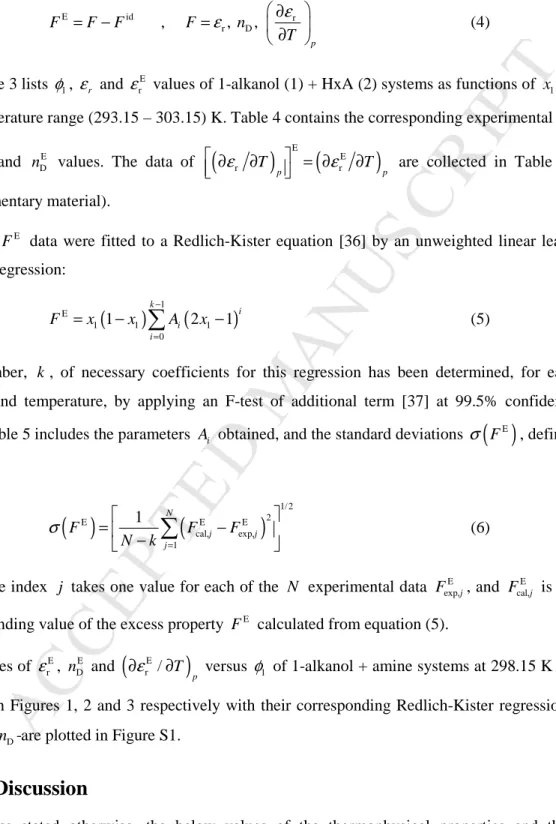
excess functions, FE, are obtained as
E id r
the temperature range (293.15 – 303.15) K. Table 4 contains the corresponding experimental x , 1
1
level. Table 5 includes the parameters Ai obtained, and the standard deviations σ
( )
FE , defined by: corresponding value of the excess property FE calculated from equation (5).Values of εrE, nDE and
(
rE/)
p
T
ε
∂ ∂ versus φ1 of 1-alkanol + amine systems at 298.15 K are
plotted in Figures 1, 2 and 3 respectively with their corresponding Redlich-Kister regressions. Data on nD are plotted in Figure S1.
4.
Discussion
M
AN
US
CR
IP
T
AC
CE
PT
ED
4.1. Excess relative permittivities
The rupture of interactions between molecules of the same species along mixing is associated to a negative contribution to εrE. The creation of new interactions in the mixture forms multimers, whose total dipole moment can be more or less effective –in its impact on the macroscopic dipole moment under the action of an electric field– than in the ideal mixture. In the first case, the contribution to εrE is positive, whereas in the second case it is negative.
1-Alkanol + heptane mixtures show rather large negative values of this quantity (Figure 4): εrE = –1.075 (n = 3), –2.225 (n = 4), –2.525 (n = 5), –2.875 (n = 7), –1.775 (n = 10) [12, 38-40]. These negative values can be attributed to the breaking of 1-alkanol self-association. For methanol, there exists a partial immiscibility region [41]. The εr( )n variation follows the sequence: 1-propanol > 1-butanol > 1-pentanol > 1-heptanol < 1-decanol. It can be explained in terms of the lower and weaker self-association of longer 1-alkanols [19]. This statement also applies for the relative variation of εrE in the mixtures under study (Figures 1 and 4): 1.480 (n = 1), –0.960 (n = 3), –1.424 (n = 4), –1.530 (n = 5), –1.295 (n = 7). These results are higher than those of heptane mixtures. This suggests that the formation of (1-alkanol)-HxA interactions yields a positive contribution to εrE.
4.1.1. Effect of cyclization
Cyclohexylamine (c-HxA) is a cyclic primary amine with a slightly higher permittivity than HxA ( * 4.53
r
ε = [19]). The trend observed in the two series of systems 1-alkanol + heptane and
+ HxA is the same as for 1-alkanol + c-HxA mixtures (Figure 4), for the same reasons: E r
ε =
2.218 (n = 1 [13]), –0.269 (n = 3 [19]), –0.848 (n = 4 [19]), –0.915 (n = 7 [19]) –0.411 (n = 10 [19]). Therefore, cyclization of the amine leads to increased εrEvalues compared to those of
systems with HxA; i.e., multimers formed by unlike molecules contribute more positively to εrE in cyclohexylamine solutions.
4.1.2. Effect of aromaticity
The effect of aromaticity is more dramatic than that of cyclization. In fact, aniline (εr*=7.004 [42]) shows a greater value of the relative permittivity, underlining the importance of aniline-aniline interactions and the polarizability of the aromatic ring. The values of the corresponding excess property are of course negative [42] (Figure 4): –0.775 (n = 1), –1.854 (n = 3), –2.084 (n = 5). In addition, they are lower than those of the mixtures with HxA or c-HxA. This may be explained taking into account that the breaking of the dipolar interactions between aniline molecules contributes more negatively to E
r
M
AN
US
CR
IP
T
AC
CE
PT
ED
4.2. Entropy change with the electric field
r
ε is a collective property and its magnitude in a liquid depends on its structure, the
permanent dipole moment of its molecules and their polarizability. It must be highlighted that it
is also affected by volume effects. In fact, let B
r
denote the macroscopic dipole moment and V the volume. The polarization (macroscopic dipole moment per unit volume) of the liquid,
(ε0 = vacuum permittivity). In order to compare the response of different
liquids to an electric field, it is desirable to work with the molar susceptibility, χm =
(
εr −1 V)
m.This quantity, for a given electric field, is proportional to the macroscopic dipole moment resulting from a fixed amount (1 mol) of molecules. For a linear, isotropic and homogeneous dielectric at constant composition, the molar macroscopic dipole moment Bm is related to χm
and E by:
E through the Schwarz relation (p = pressure):
m m m electric field and a consequent negative variation of the entropy. It can be calculated from linear regressions of χm values in the temperature range (293.15 – 303.15) K. In the following
discussion, we will use the notation m m,p
η for the pure 1-alkanols increase with n (Table 6). It indicates that a high
self-association (in the absence of an electric field) decreases the ability of the electric field to create structure by orientating the dipoles of individual molecules, as the multimers present in the liquid are more stable and the rotational degrees of freedom are more constricted. The lower
* m, p
η values of the amines seems to be due to their lower µ. As HxA and c-HxA have similar
dipole moments (Table 6), the fact that ηm, p* (HxA) < ηm, p* (c-HxA) indicates more freedom of
M
AN
US
CR
IP
T
AC
CE
PT
ED
an extra contribution to the polarizability of the molecules of aniline due to the presence of the aromatic ring.
It is interesting to analyse the ηm,p(φ1) curves for 1-alkanol + HxA systems (Figure 5). The
necessary volumetric properties to compute them have been taken from a previous work [4]. Due to the absence of experimental volumetric data in the whole range of temperature necessary for the complete set of studied systems, we have neglected the contribution from the temperature dependence of the excess molar volume; this approximation does not appreciably affect the ηm,p results, as can be seen by performing the exact calculation for the system
1-butanol + HxA [43]. At low HxA concentrations, ηm,p varies more rapidly when the 1-alkanol is
longer. This shows that, in this region, the difficulty for the electric field to rotate the dipoles decreases more rapidly with concentration when the 1-alkanol self-association is lower and weaker.
4.3. Molar refraction
The refractive index at optical wavelengths is closely related to dispersion forces, since the molar refraction (or molar refractivity), Rm, defined by the Lorentz-Lorenz equation [29, 44]:
m m
(where NA and ε0 stand for Avogadro’s constant and the vacuum permittivity, respectively) is proportional to the mean electronic contribution, αe, to the polarizability, [29]. For the
investigated systems, the values of 3 1 m / cm ·mol
R − at x1 = 0.5 are (Figure S2): 20.5 (n = 1), 25.2 (n = 3), 27.5 (n = 4), 29.8 (n = 5), 34.5 (n = 7). It is clear that dispersive interactions are more important in longer 1-alkanols. We have calculated the corresponding excess values,
E id state, in which dipoles of different components do not interact. The minimum values occur at
1 0.5
x ≈ ; in the same units: –0.37 (n = 1), –0.28 (n ≥ 3). The lower value of the methanol system can be ascribed to a larger number of hydrogen bonds formed by the two species along the mixing process.
4.4. Kirkwood-Fröhlich model
M
AN
permittivity at a high frequency at which only the induced polarizability contributes); (iii) long-range interactions are considered macroscopically by assuming that the outside of the cavity is a
continuous dielectric of permittivity
ε
r ; (iv) short-range interactions are not neglected, and theyare brought on stage by means of the so-called Kirkwood correlation factor, gK, which
provides information of the deviations from randomness of the orientation of a dipole with respect to its neighbours. This is an important parameter, as it provides information about specific interactions in the liquid state. For a mixture, gK can be determined, in the context of a
one-fluid model [26], from macroscopic physical properties according to the expression [26-29]:
Here, kB is Boltzmann’s constant; NA, Avogadro’s constant; ε0, the vacuum permittivity; and
m
V , the molar volume of the liquid at the working temperature, T. For polar compounds,
ε
r∞ is estimated from the relationε
r∞ =1.1nD2 [45].µ
represents the dipole moment of the solution,conducted using smoothed values of E m
Our calculations on gK curves for 1-alkanol + HxA systems can be seen in Figure 6. They support the conclusions extracted from the analysis of ηm,p, indicating that the mixture structure
varies very rapidly with the HxA concentration for n = 3, 4, 5, 7. In contrast, for the methanol system gK changes slowly from φ1>0.6 approximately, and this indicates that HxA is not able to break effectively the methanol self-association at such concentrations. This phenomenon remarks the strong relationship between the magnitude of the rupture of the 1-alkanol self-association by the amine and the dielectric behaviour of the mixtures.
We have also evaluated the excess Kirkwood correlation factors, gKE =gK−gKid, where gKid
M
AN
US
CR
IP
T
AC
CE
PT
ED
formation of strong methanol-HxA interactions, which is consistent with the above analyses. The minima of the E
g (1-heptanol), while the opposite behaviour is encountered for E r
ε .
Thus, according to the Kirkwood-Fröhlich model, the destruction of the correlations of the dipoles is not the only responsible for the εrE minima, but there are other effects involved. For
c-HxA systems, gKE values are higher (Figure 8), indicating that in these mixtures the balance of destruction and creation of correlations is more inclined to the latter than in the case 1-alkanol + HxA. Aniline systems are quite interesting, as gKE(HxA) < gKE(aniline) for the 1-pentanol mixtures (Figure 8). This phenomenon may be related to the higher importance of the rupture of interactions between like molecules in 1-alkanol + aniline solutions, as showed by εrE values
and also HmE (see introduction).
5.
Conclusions
r
ε and nD measurements have been reported for the 1-alkanol + n-hexylamine systems at (293.15-303.15) K. The formation of multimers built by unlike molecules contributes positively to E
r
ε . Such contribution is dominant for the methanol mixture and E r
ε is positive. For the
remaining systems, the dominant contributions arise from the breaking of interactions between like molecules, and εrE values are negative. For a given 1-alkanol, εrE changes in the sequence: cyclohexylamine > n-hexylamine > aniline. The application of the Kirkwood-Fröhlich model confirms these findings. Calculations on Rm show that dispersive interactions in the studied mixtures increase with the length of the 1-alkanol.
Acknowledgements
M
AN
US
CR
IP
T
AC
CE
PT
ED
[2] K. Nakanishi, H. Touhara, N. Watanabe, Studies on Associated Solutions. II. Heat of Mixing of Methanol with Aliphatic Amines, Bull. Chem. Soc. Jpn., 43 (1970) 2671-2676. DOI: 10.1246/bcsj.43.2671.
[3] A. Heintz, A New Theoretical Approach for Predicting Excess Properties of Alkanol/Alkane Mixtures, Ber. Bunsenges. Phys. Chem., 89 (1985) 172-181. DOI: 10.1002/bbpc.19850890217.
[4] S. Villa, N. Riesco, I. Garcı́a de la Fuente, J.A. González, J.C. Cobos, Thermodynamics of mixtures with strongly negative deviations from Raoult’s law. Part 8. Excess molar volumes at 298.15 K for 1-alkanol + isomeric amine (C6H15N) systems: Characterization in terms of the ERAS model, Fluid Phase Equilib., 216 (2004) 123-133. DOI: 10.1016/j.fluid.2003.10.008.
[5] J.A. González, I. García de la Fuente, J.C. Cobos, Thermodynamics of mixtures with strongly negative deviations from Raoult's Law: Part 4. Application of the DISQUAC model to mixtures of 1-alkanols with primary or secondary linear amines. Comparison with Dortmund UNIFAC and ERAS results, Fluid Phase Equilib., 168 (2000) 31-58. DOI: 10.1016/S0378-3812(99)00326-X.
[6] R. Srivastava, B.D. Smith, Total-pressure vapor-liquid equilibrium data for binary systems of diethylamine with acetone, acetonitrile, and methanol, J. Chem. Eng. Data, 30 (1985) 308-313. DOI: 10.1021/je00041a022.
[7] L. Wang, G.C. Benson, B.C.Y. Lu, Excess enthalpies of 1-propanol + hexane + n-decane or n-don-decane at 298.15 K, J. Chem. Eng. Data, 37 (1992) 403-406. DOI: 10.1021/je00008a007.
[8] S.-c. Hwang, R.L. Robinson, Vapor-liquid equilibria at 25 ºC for nine alcohol-hydrocarbon binary systems, J. Chem. Eng. Data, 22 (1977) 319-325. DOI: 10.1021/je60074a025.
[9] S. Villa, N. Riesco, I. Garcı́a de la Fuente, J.A. González, J.C. Cobos, Thermodynamics of mixtures with strongly negative deviations from Raoult’s law: Part 5. Excess molar volumes at 298.15 K for 1-alkanols+dipropylamine systems: characterization in terms of the ERAS model, Fluid Phase Equilib., 190 (2001) 113-125. DOI: 10.1016/S0378-3812(01)00595-7.
M
AN
US
CR
IP
T
AC
CE
PT
ED
of the ERAS model, Fluid Phase Equilib., 198 (2002) 313-329. DOI: 10.1016/S0378-3812(01)00808-1.
[11] L.F. Sanz, J.A. González, I. García De La Fuente, J.C. Cobos, Thermodynamics of mixtures with strongly negative deviations from Raoult's law. XI. Densities, viscosities and refractives indices at (293.15–303.15) K for cyclohexylamine + 1-propanol, or +1-butanol systems, J. Mol. Liq., 172 (2012) 26-33. DOI: 10.1016/j.molliq.2012.05.003.
[12] L.F. Sanz, J.A. González, I. García de la Fuente, J.C. Cobos, Thermodynamics of mixtures with strongly negative deviations from Raoult’s law. XII. Densities, viscosities and refractive indices at T = (293.15 to 303.15) K for (1-heptanol, or 1-decanol + cyclohexylamine) systems. Application of the ERAS model to (1-alkanol + cyclohexylamine) mixtures, J. Chem. Thermodyn., 80 (2015) 161-171. DOI: 10.1016/j.jct.2014.09.005.
[13] L.F. Sanz, J.A. González, I.G. De La Fuente, J.C. Cobos, Thermodynamics of mixtures with strong negative deviations from raoult’s law. XIV. density, permittivity, refractive index and viscosity data for the methanol + cyclohexylamine mixture at (293.15– 303.15) K, Thermochim. Acta, 631 (2016) 18-27. DOI: 10.1016/j.tca.2016.03.002.
[14] U. Domańska, M. Głoskowska, Experimental Solid + Liquid Equilibria and Excess Molar Volume of Alkanol + Octylamine Mixtures. Analysis in Terms of ERAS, DISQUAC, and Modified UNIFAC, J. Chem. Eng. Data, 49 (2004) 101-108. DOI: 10.1021/je0301895.
[15] K. Nakanishi, H. Touhara, Excess molar enthalpies of (methanol + aniline), (methanol + N-methylaniline), and (methanol + N,N-dimethylaniline), J. Chem. Thermodyn., 18 (1986) 657-660. DOI: 10.1016/0021-9614(86)90067-4.
[16] I. Nagata, Excess enthalpies of (aniline + butan-1-ol) and of (aniline + butan-1-ol + benzene) at the temperature 298.15 K, J. Chem. Thermodyn., 25 (1993) 1281-1285. DOI: 10.1006/jcht.1993.1127.
[17] H. Matsuda, K. Ochi, K. Kojima, Determination and Correlation of LLE and SLE Data for the Methanol + Cyclohexane, Aniline + Heptane, and Phenol + Hexane System, J. Chem. Eng. Data, 48 (2003) 184-189. DOI: 10.1021/je020156+.
M
AN
US
CR
IP
T
AC
CE
PT
ED
[19] J.A. González, L.F. Sanz, I. García de la Fuente, J.C. Cobos, Thermodynamics of mixtures with strong negative deviations from Raoult’s law. XIII. Relative permittivities for alkanol + cyclohexylamine) systems, and dielectric study of (1-alkanol + polar) compound (amine, amide or ether) mixtures, J. Chem. Thermodyn., 91 (2015) 267-278. DOI: 10.1016/j.jct.2015.07.032.
[20] J.A. González, I.G. de la Fuente, J.C. Cobos, Thermodynamics of mixtures with strongly negative deviations from Raoult's law. Part 3. Application of the DISQUAC model to mixtures of triethylamine with alkanols. Comparison with Dortmund UNIFAC and ERAS results, Can. J. Chem., 78 (2000) 1272-1284. DOI: 10.1139/v00-114.
[21] J.A. González, I. Mozo, I. García de la Fuente, J.C. Cobos, Thermodynamics of organic mixtures containing amines. IV. Systems with aniline, Can. J. Chem., 83 (2005) 1812-1825. DOI: 10.1139/v05-190.
[22] J.A. González, I. Mozo, I.G.d.l. Fuente, J.C. Cobos, Thermodynamics of organic mixtures containing amines: V. Systems with pyridines, Thermochim. Acta, 441 (2006) 53-68. DOI: 10.1016/j.tca.2005.11.027.
[23] J.A. González, I. Mozo, I.G. de la Fuente, J.C. Cobos, N. Riesco, Thermodynamics of mixtures containing amines: VII. Systems containing dimethyl or trimethylpyridines, Thermochim. Acta, 467 (2008) 30-43. DOI: 10.1016/j.tca.2007.10.011.
[24] J.A. González, I.G. de la Fuente, I. Mozo, J.C. Cobos, N. Riesco, Thermodynamics of Organic Mixtures Containing Amines. VII. Study of Systems Containing Pyridines in Terms of the Kirkwood−Buff Formalism, Ind. Eng. Chem. Res., 47 (2008) 1729-1737. DOI: 10.1021/ie071226e.
[25] J.A. González, J.C. Cobos, I. García de la Fuente, I. Mozo, Thermodynamics of mixtures containing amines. IX. Application of the concentration–concentration structure factor to the study of binary mixtures containing pyridines, Thermochim. Acta, 494 (2009) 54-64. DOI: 10.1016/j.tca.2009.04.017.
[26] J.C.R. Reis, T.P. Iglesias, Kirkwood correlation factors in liquid mixtures from an extended Onsager-Kirkwood-Frohlich equation, Phys. Chem. Chem. Phys., 13 (2011) 10670-10680. DOI: 10.1039/C1CP20142E.
[27] H. Fröhlich, Theory of Dielectrics, Clarendon Press, Oxford, 1958.
[28] C. Moreau, G. Douhéret, Thermodynamic and physical behaviour of water + acetonitrile mixtures. Dielectric properties, J. Chem. Thermodyn., 8 (1976) 403-410. DOI: 10.1016/0021-9614(76)90060-4.
M
AN
US
CR
IP
T
AC
CE
PT
ED
[30] CIAAW, Atomic weights of the elements 2015, ciaaw.org/atomic-weights.htm (accessed 2015).
[31] J.A. González, I. Alonso, I. Mozo, I. García de la Fuente, J.C. Cobos, Thermodynamics of (ketone + amine) mixtures. Part VI. Volumetric and speed of sound data at (293.15, 298.15, and 303.15) K for (2-heptanone + dipropylamine, +dibutylamine, or +triethylamine) systems, J. Chem. Thermodyn., 43 (2011) 1506-1514. DOI: 10.1016/j.jct.2011.05.003.
[32] K.N. Marsh, Recommended reference materials for the realization of physicochemical properties, Blackwell Scientific Publications, Oxford, UK, 1987.
[33] V. Alonso, J.A. González, I. García de la Fuente, J.C. Cobos, Dielectric and refractive index measurements for the systems 1-pentanol + octane, or + dibutyl ether or for dibutyl ether + octane at different temperatures, Thermochim. Acta, 543 (2012) 246-253. DOI: 10.1016/j.tca.2012.05.036.
[34] J.C.R. Reis, T.P. Iglesias, G. Douhéret, M.I. Davis, The permittivity of thermodynamically ideal liquid mixtures and the excess relative permittivity of binary dielectrics, Phys. Chem. Chem. Phys., 11 (2009) 3977-3986. DOI: 10.1039/B820613A.
[35] J.C.R. Reis, I.M.S. Lampreia, Â.F.S. Santos, M.L.C.J. Moita, G. Douhéret, Refractive Index of Liquid Mixtures: Theory and Experiment, ChemPhysChem, 11 (2010) 3722-3733. DOI: 10.1002/cphc.201000566.
[36] O. Redlich, A.T. Kister, Algebraic Representation of Thermodynamic Properties and the Classification of Solutions, Ind. & Eng. Chem., 40 (1948) 345-348. DOI: 10.1021/ie50458a036.
[37] P.R. Bevington, D.K. Robinson, Data Reduction and Error Analysis for the Physical Sciences, McGraw-Hill, New York, 2000.
[38] N.V. Sastry, M.K. Valand, Densities, Speeds of Sound, Viscosities, and Relative Permittivities for 1-Propanol + and 1-Butanol + Heptane at 298.15 K and 308.15 K, J. Chem. Eng. Data, 41 (1996) 1421-1425. DOI: 10.1021/je960135d.
[39] N.V. Sastry, M.K. Valand, Dielectric constants, refractive indexes and polarizations for 1-Alcohol +Heptane mixtures at 298.15 and 308.15 K, Ber. Bunsenges. Phys. Chem., 101 (1997) 243-250. DOI: 10.1002/bbpc.19971010212.
M
AN
US
CR
IP
T
AC
CE
PT
ED
[41] A. Skrzecz, Critical evaluation of solubility data in binary systems formed by methanol with n-hydrocarbons, Thermochim. Acta, 182 (1991) 123-131. DOI: 10.1016/0040-6031(91)87013-M.
[42] V. Alonso, Estudio experimental de propiedades termofísicas de mezclas binarias formadas por 1-alcohol + alcano, + éter lineal o + amina aromática primaria, in: Departamento de Física Aplicada, Facultad de Ciencias, Universidad de Valladolid, 2016.
[43] I.R. Radović, M.L. Kijevčanin, S.P. Šerbanović, B.D. Djordjević, 1-Butanol + hexylamine + n-heptane at temperature range (288.15–323.15 K): Experimental density data, excess molar volumes determination and modeling with cubic EOS, Fluid Phase Equilib., 298 (2010) 117-130. DOI: 10.1016/j.fluid.2010.07.011.
[44] P. Brocos, A. Piñeiro, R. Bravo, A. Amigo, Refractive indices, molar volumes and molar refractions of binary liquid mixtures: concepts and correlations, Phys. Chem. Chem. Phys., 5 (2003) 550-557. DOI: 10.1039/B208765K.
[45] Y. Marcus, The structuredness of solvents, J. Solution Chem., 21 (1992) 1217-1230. DOI: 10.1007/bf00667218.
[46] R.D. Bezman, E.F. Casassa, R.L. Kay, The temperature dependence of the dielectric constants of alkanols, 73–74 (1997) 397-402. DOI: 10.1016/S0167-7322(97)00082-2.
[47] J. Canosa, A. Rodrı́guez, J. Tojo, Binary mixture properties of diethyl ether with alcohols and alkanes from 288.15 K to 298.15 K, Fluid Phase Equilib., 156 (1999) 57-71. DOI: 10.1016/S0378-3812(99)00032-1.
[48] G.J. Janz, R.P.T. Tomkins, Nonaqueus Electrolytes Handbook, Vol. 1, Academic Press, New York, 1972.
[49] S.P. Serbanovic, M.L. Kijevcanin, I.R. Radovic, B.D. Djordjevic, Effect of temperature on the excess molar volumes of some alcohol + aromatic mixtures and modelling by cubic EOS mixing rules, Fluid Phase Equilib., 239 (2006) 69-82. DOI: 10.1016/j.fluid.2005.10.022.
[50] S. Chen, Q. Lei, W. Fang, Density and Refractive Index at 298.15 K and Vapor−Liquid Equilibria at 101.3 kPa for Four Binary Systems of Methanol, n-Propanol, n-Butanol, or Isobutanol with N-Methylpiperazine, J. Chem. Eng. Data, 47 (2002) 811-815. DOI: 10.1021/je010249b.
M
AN
US
CR
IP
T
AC
CE
PT
ED
Propan-1-ol, Butan-1-ol, Pentan-1-ol, Hexan-1-ol, Heptan-1-ol, and Butan-2-ol, J. Chem. Eng. Data, 44 (1999) 216-221. DOI: 10.1021/je9802219.
[52] R. Anwar Naushad, S. Yasmeen, Volumetric, compressibility and viscosity studies of binary mixtures of [EMIM][NTf2] with ethylacetate/methanol at (298.15–323.15) K, J. Mol. Liq., 224, Part A (2016) 189-200. DOI: 10.1016/j.molliq.2016.09.077.
[53] S.M. Pereira, T.P. Iglesias, J.L. Legido, L. Rodrı́guez, J. Vijande, Changes of refractive index on mixing for the binary mixtures {xCH3OH+(1−x)
CH3OCH2(CH2OCH2)3CH2OCH3} and
{xCH3OH+(1−x)CH3OCH2(CH2OCH2)nCH2OCH3} (n=3–9) at temperatures from 293.15 K to 333.15 K, J. Chem. Thermodyn., 30 (1998) 1279-1287. DOI: 10.1006/jcht.1998.0395.
[54] A. Rodríguez, J. Canosa, J. Tojo, Density, Refractive Index, and Speed of Sound of Binary Mixtures (Diethyl Carbonate + Alcohols) at Several Temperatures, J. Chem. Eng. Data, 46 (2001) 1506-1515. DOI: 10.1021/je010148d.
[55] A.P. Gregory, R.N. Clarke, Traceable measurements of the static permittivity of dielectric reference liquids over the temperature range 5–50 °C, Meas. Sci. Technol., 16 (2005) 1506. DOI: 10.1088/0957-0233/16/7/013.
[56] M.J. Fontao, M. Iglesias, Effect of Temperature on the Refractive Index of Aliphatic Hydroxilic Mixtures (C2–C3), Int. J. Thermophys., 23 (2002) 513-527. DOI: 10.1023/A:1015113604024.
[57] J.L. Hales, J.H. Ellender, Liquid densities from 293 to 490 K of nine aliphatic alcohols, J. Chem. Thermodyn., 8 (1976) 1177-1184. DOI: 10.1016/0021-9614(76)90126-9.
[58] N.G. Tsierkezos, I.E. Molinou, A.C. Filippou, Thermodynamic Properties of Binary Mixtures of Cyclohexanone with n-Alkanols (C1–C5) at 293.15 K, J. Solution Chem., 34 (2005) 1371-1386. DOI: 10.1007/s10953-005-8508-9.
[59] C. Yang, H. Lai, Z. Liu, P. Ma, Density and Viscosity of Binary Mixtures of Diethyl Carbonate with Alcohols at (293.15 to 363.15) K and Predictive Results by UNIFAC-VISCO Group Contribution Method, J. Chem. Eng. Data, 51 (2006) 1345-1351. DOI: 10.1021/je0600808.
M
AN
US
CR
IP
T
AC
CE
PT
ED
[61] B. Giner, A. Villares, M.C. López, F.M. Royo, C. Lafuente, Refractive indices and molar refractions for isomeric chlorobutanes with isomeric butanols, Phys. Chem. Liq., 43 (2005) 13-23. DOI: 10.1080/0031910042000303518.
[62] E. Jiménez, M. Cabanas, L. Segade, S. Garcı́a-Garabal, H. Casas, Excess volume, changes of refractive index and surface tension of binary 1,2-ethanediol + 1-propanol or 1-butanol mixtures at several temperatures, Fluid Phase Equilib., 180 (2001) 151-164. DOI: 10.1016/S0378-3812(00)00519-7.
[63] G.A. Iglesias-Silva, A. Guzmán-López, G. Pérez-Durán, M. Ramos-Estrada, Densities and Viscosities for Binary Liquid Mixtures of n-Undecane + 1-Propanol, + 1-Butanol, + 1-Pentanol, and + 1-Hexanol from 283.15 to 363.15 K at 0.1 MPa, J. Chem. Eng. Data, 61 (2016) 2682-2699. DOI: 10.1021/acs.jced.6b00121.
[64] T.P. Iglesias, J.L. Legido, S.M. Pereira, B. de Cominges, M.I. Paz Andrade, Relative permittivities and refractive indices on mixing for (n-hexane + 1-pentanol, or 1-hexanol, or 1-heptanol ) atT = 298.15 K, J. Chem. Thermodyn., 32 (2000) 923-930. DOI: 10.1006/jcht.2000.0661.
[65] M.N.M. Al-Hayan, Densities, excess molar volumes, and refractive indices of 1,1,2,2-tetrachloroethane and 1-alkanols binary mixtures, J. Chem. Thermodyn., 38 (2006) 427-433. DOI: 10.1016/j.jct.2005.06.015.
[66] S.P. Patil, A.S. Chaudhari, M.P. Lokhande, M.K. Lande, A.G. Shankarwar, S.N. Helambe, B.R. Arbad, S.C. Mehrotra, Dielectric Measurements of Aniline and Alcohol Mixtures at 283, 293, 303, and 313 K Using the Time Domain Technique, J. Chem. Eng. Data, 44 (1999) 875-878. DOI: 10.1021/je980250j.
[67] Á. Piñeiro, P. Brocos, A. Amigo, M. Pintos, R. Bravo, Refractive Indexes of Binary Mixtures of Tetrahydrofuran with 1-Alkanols at 25°C and Temperature Dependence of n and ρ for the Pure Liquids, J. Solution Chem., 31 (2002) 369-380. DOI: 10.1023/A:1015807331250.
[68] J.J. Cano-Gómez, G.A. Iglesias-Silva, E.O. Castrejón-González, M. Ramos-Estrada, K.R. Hall, Density and Viscosity of Binary Liquid Mixtures of Ethanol + 1-Hexanol and Ethanol + 1-Heptanol from (293.15 to 328.15) K at 0.1 MPa, J. Chem. Eng. Data, 60 (2015) 1945-1955. DOI: 10.1021/je501133u.
M
AN
US
CR
IP
T
AC
CE
PT
ED
[70] C. Wohlfahrt, Static Dielectric Constants of Pure Liquids and Binary Liquid Mixtures. Landolt-Börnstein - Group IV Physical Chemistry Vol. 6, Springer Berlin Heidelberg, Berlin, 1991.
[71] S. Otín, J. Fernández, J.M. Embid, I. Velasco, C.G. Losa, Thermodynamic and Dielectric Properties of Binary Polar + Non-Polar Mixtures I. Static Dielectric Constants and Excess Molar Enthalpies of n-Alkylamine + n-Dodecane Systems, Ber. Bunsenges. Phys. Chem., 90 (1986) 1179-1183. DOI: 10.1002/bbpc.19860901212.
[72] C. Wohlfahrt, Optical Constants. Refractive Indices of Pure Liquids and Binary Liquid Mixtures. Landolt-Börnstein - Group III Condensed Matter Vol. 47, Springer Berlin Heidelberg, Berlin, 2008.
[73] Y. Miyake, A. Baylaucq, F. Plantier, D. Bessières, H. Ushiki, C. Boned, High-pressure (up to 140 MPa) density and derivative properties of some (pentyl-, hexyl-, and heptyl-) amines between (293.15 and 353.15) K, J. Chem. Thermodyn., 40 (2008) 836-845. DOI: 10.1016/j.jct.2008.01.006.
[74] P. Góralski, M. Wasiak, A. Bald, Heat Capacities, Speeds of Sound, and Isothermal Compressibilities of Some n-Amines and Tri-n-amines at 298.15 K, J. Chem. Eng. Data, 47 (2002) 83-86. DOI: 10.1021/je010206v.
[75] M. El-Hefnawy, K. Sameshima, T. Matsushita, R. Tanaka, Apparent Dipole Moments of 1-Alkanols in Cyclohexane and n-Heptane, and Excess Molar Volumes of (1-Alkanol + Cyclohexane or n-Heptane) at 298.15 K, J. Solution Chem., 34 (2005) 43-69. DOI: 10.1007/s10953-005-2072-1.
[76] A.L. McClellan, Tables of Experimental Dipole Moments, Vols. 1,2,3, Rahara Enterprises, El Cerrito, US, 1974.
[77] D.R. Lide, CRC Handbook of Chemistry and Physics, 90th Edition, CRC Press/Taylor and Francis, Boca Raton, FL, 2010.
M
AN
US
CR
IP
T
AC
CE
PT
ED
Table 1
Sample description.
Chemical name CAS
Number Source
Purification
method Purity a
methanol 67-56-1 Sigma-Aldrich none 99.99% 1-propanol 71-23-8 Sigma-Aldrich none 99.84% 1-butanol 71-36-3 Sigma-Aldrich none 99.86% 1-pentanol 71-41-0 Sigma-Aldrich none 99.9% 1-heptanol 111-70-6 Sigma-Aldrich none 99.8%
n-hexylamine (HxA) 111-26-2 Aldrich none 99.9%
a
M
AN
pure compounds at temperature T and pressure p = 0.1 MPa. aM
AN
Volume fractions of 1-alkanol, φ1, relative permittivities, εr,and excess relative permittivities,
M
AN
US
CR
IP
T
AC
CE
PT
ED
0.4991 0.5154 6.671 – 1.444
1-heptanol (1) + HxA (2) ; T/K = 298.15
0.0000 0.0000 3.903 0.6036 0.6188 7.224 – 1.382 0.0503 0.0534 4.133 – 0.176 0.7001 0.7133 7.981 – 1.344 0.0950 0.1006 4.339 – 0.329 0.8007 0.8107 8.951 – 1.114 0.1606 0.1694 4.644 – 0.547 0.8524 0.8603 9.521 – 0.921 0.2073 0.2180 4.882 – 0.678 0.8904 0.8965 9.983 – 0.734 0.3067 0.3205 5.392 – 0.947 0.9402 0.9437 10.642 – 0.434 0.4038 0.4193 5.934 – 1.156 1.0000 1.0000 11.504
0.4991 0.5151 6.508 – 1.310
1-heptanol (1) + HxA (2) ; T/K = 303.15
0.0000 0.0000 3.848 0.6036 0.6185 7.035 – 1.245 0.0503 0.0534 4.070 – 0.161 0.7001 0.7131 7.746 – 1.212 0.0950 0.1005 4.271 – 0.297 0.8007 0.8105 8.651 – 1.005 0.1606 0.1692 4.567 – 0.493 0.8524 0.8601 9.177 – 0.834 0.2073 0.2178 4.796 – 0.613 0.8904 0.8964 9.607 – 0.665 0.3067 0.3202 5.291 – 0.852 0.9402 0.9436 10.222 – 0.388 0.4038 0.4190 5.811 – 1.040 1.0000 1.0000 11.014
0.4991 0.5147 6.358 – 1.178
a
The standard uncertainties are: u T
( )
=0.02K; u p( )
=1kPa; u( )
ν =20 Hz; u x( )
1 =0.0010;( )
1 0.004M
AN
Volume fractions of 1-alkanol, φ1, refractive indices, nD, and excess refractive indices, E D
n , of 1-alkanol (1) + HxA (2) mixtures as functions of the mole fraction of the 1-alkanol, x1, at temperature T and pressure p = 0.1 MPa. a
M
AN
US
CR
IP
T
AC
CE
PT
ED
0.3044 0.3184 1.42310 306 0.9472 0.9504 1.42464 70 0.4059 0.4217 1.42423 355 1.0000 1.0000 1.42425
0.5044 0.5207 1.42503 374
1-heptanol (1) + HxA (2) ; T/K = 298.15
0.0000 0.0000 1.41563 0.6020 0.6172 1.42331 353 0.0560 0.0595 1.41674 71 0.7029 0.7161 1.42351 306 0.1018 0.1078 1.41761 125 0.7979 0.8080 1.42339 233 0.1463 0.1545 1.41840 173 0.8534 0.8612 1.42320 178 0.2047 0.2153 1.41937 229 0.8986 0.9043 1.42299 128 0.3044 0.3181 1.42080 303 0.9472 0.9503 1.42271 69 0.4059 0.4214 1.42197 350 1.0000 1.0000 1.42235
0.5044 0.5204 1.42280 367
1-heptanol (1) + HxA (2) ; T/K = 303.15
0.0000 0.0000 1.41321 0.6020 0.6169 1.42116 347 0.0560 0.0594 1.41434 70 0.7029 0.7158 1.42142 301 0.1018 0.1077 1.41523 124 0.7979 0.8078 1.42136 228 0.1463 0.1543 1.41604 171 0.8534 0.8611 1.42120 174 0.2047 0.2151 1.41703 226 0.8986 0.9042 1.42103 125 0.3044 0.3178 1.41853 301 0.9472 0.9502 1.42079 68 0.4059 0.4211 1.41974 347 1.0000 1.0000 1.42047
0.5044 0.5200 1.42062 363
a
The standard uncertainties are: u T
( )
=0.02K; u p( )
=1kPa; u x( )
1 =0.0008; u( )
φ1 =0.004,( )
Du n = 0.00008. The combined expanded uncertainty (0.95 level of confidence) is
( )
Erc D 0.0002
M
AN
temperature T and pressure p = 0.1 MPa for 1-alkanol (1) + HxA (2) systems by equation (5).M
AN
US
CR
IP
T
AC
CE
PT
ED
Table 6
Intrinsic dipole moment, µ, and molar dielectric properties of pure liquids at p = 0.1 MPa: * m
χ ,
molar dielectric susceptibility; *
(
*)
m,p m T p
η = − ∂χ ∂ .
Compound µ/ D
* m
χ /cm3·mol-1 ηm, p* /cm
3
·mol-1·K-1
T = 293.15 K T = 298.15 K T = 303.15 K T = 298.15 K
methanol 1.664 [75] 1318 1287 1256 6.2
1-propanol 1.629 [75] 1507 1462 1419 8.8 1-butanol 1.614 [75] 1574 1521 1472 10.2 1-pentanol 1.598 [75] 1591 1533 1478 11.3 1-heptanol 1.583 [75] 1557 1491 1427 13.0 1-decanol 1.566 [75] 1413 a
1342 a 1277 a 13.6 a
HxA 1.3 [76] 392 387 381 1.1
c-HxA 1.26 [77] 418 a
409 a 401 a 1.7 a aniline 1.51 [40] 558 b
548 b 538 b 2.0 b
a
Calculated from data of ref. [19].
b
M
AN
US
CR
IP
T
AC
CE
PT
ED
0
0.2
0.4
0.6
0.8
1
?
1
-2
-1
0
1
2
e
r
E
Figure 1
Excess relative permittivities, E r
ε , of 1-alkanol (1) + HxA (2) systems at 0.1 MPa, 298.15 K and
M
AN
US
CR
IP
T
AC
CE
PT
ED
0 0.2 0.4 0.6 0.8 1
?
1-0.02 -0.01 0 0.01 0.02 0.03
(?
e
r
E
/?
T
)
p/
K
-1
Figure 2
M
AN
US
CR
IP
T
AC
CE
PT
ED
0 0.2 0.4 0.6 0.8 1
?
10 200 400 600 800
1
0
5
·
n
D
E
Figure 3
Excess refractive index, E D
M
AN
US
CR
IP
T
AC
CE
PT
ED
0
2
4
6
8
10
12
n
-4
-2
0
2
4
e
r
E
(?
1
=
0
.5
)
Figure 4
M
AN
US
CR
IP
T
AC
CE
PT
ED
0
0.2
0.4
0.6
0.8
1
?
1
0
4
8
12
16
?
m
,p
/
c
m
3
·m
o
l
-1
·K
-1
(1) (3)
(4) (5) (7)
Figure 5
m m,p
p
T
χ η = −∂
∂
of 1-alkanol (1) + HxA (2) systems at 0.1 MPa, 298.15 K and 1 MHz.
M
AN
US
CR
IP
T
AC
CE
PT
ED
0
0.2
0.4
0.6
0.8
1
?
10.5
1
1.5
2
2.5
3
3.5
g
K(1)
(3) (4)
(5) (7)
Figure 6
M
AN
US
CR
IP
T
AC
CE
PT
ED
0 0.2 0.4 0.6 0.8 1
?
1-0.6 -0.4 -0.2 0 0.2
g
K
E
(1)
(3)
(4)
(5)
(7)
Figure 7
M
AN
US
CR
IP
T
AC
CE
PT
ED
0 2 4 6 8 10 12
n
-0.6-0.4 -0.2 0 0.2 0.4
g
K
E
(?
1
=
0
.5
)
Figure 8
M
AN
US
CR
IP
T
AC
CE
PT
ED
Highlights
• εr, nD and their excess functions are reported at (293.15-303.15) K for 1-alkanol+HxA.
• 1-alkanol-HxA interactions contribute positively to E r
ε , being dominant for methanol.
• E
r ( 1 0.5)
ε φ = changes in the order: methanol > propanol > butanol > pentanol <
1-heptanol.
• For a given 1-alkanol, ε φrE( 1=0.5) varies in the order: aniline < HxA <
cyclohexylamine.