FACULTAD de FILOSOFÍA Y LETRAS
DEPARTAMENTO de FILOLOGÍA INGLESA
Grado en Estudios Ingleses
TRABAJO DE FIN DE GRADO
Persuasive Language in Tourism Webpages: Official
Webpages of Los Angeles, Seattle and Washington
Silvia Nerea Sastre Ferreira
Tutor: Leonor Pérez Ruiz
ABSTRACT
Tourist promotional material has developed from paper tourist guides into digital promotional material, taking advantage of the benefits of the Internet. The appearance of tourism official webpages has changed the style of writing whose aim is to persuade tourists. In this way, this work is a corpus-based study of the most frequent persuasive strategies used by the tourism official webpages of Los Angeles, Seattle and Washington. The results were extracted with the program AntConc 3.2.4w and the analysis will focus on adjectives, neologisms, ego-targeting, interrogative sentences and the imperative mood.
Persuasive Language, Tourism Official Webpages, Corpus-based Study, English for Specific Purposes.
El material de promoción turística ha evolucionado de las guías turísticas en papel al formato digital aprovechando las ventajas que ofrece Internet. La aparición de las páginas web oficiales de turismo ha cambiado el estilo de la escritura cuyo objetivo es persuadir a los turistas. De esta manera, este trabajo es un estudio basado en un corpus de las estrategias persuasivas utilizadas más frecuentemente por las páginas web oficiales de turismo de Los Angeles, Seattle y Washington. Los resultados se han obtenido con el programa AntConc 3.2.4w y el análisis se centrará en los adjetivos, los neologismos, el ego-targeting, las oraciones interrogativas y el imperativo.
LIST OF ACRONYMS
DPM Digital Promotional Material
KWIC Key Word In Context
PTG Paper Tourist Guide
TOW Tourism Official Webpage
CONTENTS
INTRODUCTION 3
PART I: THEORETICAL FRAMEWORK 5
I.1. Promotional material in tourism 5
I.1.1. Digital promotional material 5
I.2. The language of tourism promotional material 6
I.2.1. Defining persuasion 7
I.2.2. Features of persuasive messages in tourism promotional material 7
I.2.3. Persuasion strategies in tourism promotional material 8
PART II: METHODOLOGY 11
II.1. Description of the corpus 11
II.2. Corpus exploitation tools 14
PART III: EMPIRICAL RESEARCH 16
III.1. Data analysis and results 17
III.1.1. Persuasion strategies to create a constant positive language 17
III.1.2. Persuasion strategies to address directly to the visitor 20
CONCLUSION 24
WORKS CITED 27
INTRODUCTION
We decided to address the present study due to our interest in the use of persuasive
language in tourism promotional material (TPM); specifically, we have worked with the
digital promotional material (DPM) in tourism official webpages (TOWs). We have
focused our study in these online promotional resources because of their increasing
development in tourism and also because of the consequences that we believe the use of
persuasive strategies has in clients when looking for a destination. TOWs take advantage of
persuasive language in order to promote their city or state. They make use of different
persuasion strategies to fulfill their ultimate aim, which is to seduce and encourage tourists
to choose the places they are being publicized as their final destination.
There are two reasons why we have decided to analyze specifically texts of TOWs:
1. Firstly, we have noticed that the vast majority of studies made about TPM were
based on paper tourist guides (PTGs). Moreover, although it is true that in the last ten
years some studies have been carried out on webpages (Kerbrat-Orecchioni 2004;
Antelmi, Held and Santulli 2007; Maci 2007) they do not broach the subject proposed
in this work.
2. Secondly, we believed that the use of persuasion in institutional webpages is more
objective than in those of private companies. The latter adapt their language to their
main target which is not only to attract visitors but also to obtain economic benefits;
and as a result, these digital sources are less impartial and persuasion acquires a more
subjective sense.
On that account, in this dissertation we are analyzing the language used in the
institutional webpages of Los Angeles, Seattle and Washington created by governments or
Taking these considerations into account, in regards to the objectives of this paper,
our general purpose is to analyze the persuasive language in these three American
institutional webpages. To achieve this, we have to meet the following specific purposes:
- To study the impact of persuasive language in TPM with the change from PTGs to
DPM.
- To understand the use of persuasiveness and to identify the features of persuasive
messages in TPM.
- To identify the most recurrent persuasion strategies employed in TPM to meet that
purpose.
- To develop a corpus-based study of the most frequent linguistic methods used by
the TOWs under consideration.
Dealing with the structure, our paper is organized in three parts. The first part of our
study consists of a theoretical review of the promotional material in tourism, and the
language used in it. Then we will present the methodology used for our empirical study in
which we have described the corpus that we have compiled and we have explained the tools
of the program AntConc 3.2.4w, that have helped us to make the exploitation and analysis
of our corpus. The third part of our work covers the analysis of the results obtained. This
analysis has been divided in two sections which are the strategies used to create a constant
positive language: adjectives and neologisms, and the procedures applied to address
directly to the visitor: ego-targeting, interrogative sentences and the imperative mood.
Finally, we have presented our conclusions in terms of the theoretical, methodological and
PART I: THEORETICAL FRAMEWORK
The final purpose of this study is to analyze the most frequent persuasive strategies
used by the institutions of Los Angeles, Seattle and Washington in their TOWs.
Nonetheless, to achieve this objective, we have first carried out an analysis of the existing
literature dealing with this or with related issues in order to design our system of analysis.
Once this done we have been able to identify and study persuasiveness in the discourse of
the institutional webpages.
I.1. Promotional material in tourism
Promotional material in tourism has always been conceived as the advertising of destinations through paper tourist guides or brochures. Nowadays, the revolution of the Internet has opened up its boundaries adding to it the promotion of tourism through the Web. As a consequence of this development, the language used in the TPM has also changed; therefore, in the following section we will study the evolution of persuasive language from PTGs to DPM.
I.1.1. Digital promotional material
We live in an era of maximum development of communication and information
technology; accordingly, the documents that have until recently been or still are in paper
have been digitalized. Tourist texts are not an exception of this digitalization; and although
local authorities continue investing in promotional material in paper format, they have also
taken advantage of the huge possibilities offered by the Internet technology, creating TOWs
to promote their destinations. As Pierini states: “the tourism industry is a global enterprise
that has captured the relevance of the Web as a new mass medium for contacting potential
receivers all over the world and promoting tourist products both in domestic and
It is true that the immediacy and visual potential of the World Wide Web are great
benefits for governments who have the necessity to communicate to the widest possible
range of tourists and to attract them to visit their destinations. However, we hypothesize
that the decisive element to cause an attractive effect in their audience is, in fact, the clever
use of persuasiveness that they make. As Nigro says, to motivate people, language needs to
present the tourist destination as a novelty, as a change of routine (47-48). The language
used should convince the tourist to visit places that he or she has evoked thanks to these
texts which presented the city or the country as an attractive destination.
In this way, considering the accomplishment of attracting visitors, the spread of the
Internet has had a strong impact in the world of tourism and particularly in its language.
PTGs use an essentially referential language and they adopt descriptive techniques to
present information that promotes a destination. In the case of DPM, the repercussion of
language goes beyond the informative function enhancing the element of persuasiveness. In
the online platform, the referential function is reinforced linguistically to provide objective
information about a place. Calvi notes that the irruption of communication through the
network has created new alternatives in the experiences of recipients, as DPM combines the
strength of the promotional ads and PTGs, with the flexibility and interactivity of the media
(Los Géneros Discursivos 20). In essence, the network has given a new boost to the
dissemination of TPM, turning it into useful information which makes emphasis in its
promotional character to increase the promotion of the tourist attraction (Navarro 199).
I.2. The language of tourism promotional material
To achieve our purpose of understanding the use of persuasiveness and identifying
the features of persuasive messages in TPM, in this section of the paper we will start by
explaining the meaning of persuasion, to then apply this definition to our general theme of
analysis which is the use of persuasive messages in TPM. The last step will be to make a
more detailed study, focusing on our specific aim which is to identify the most recurrent
I.2.1. Defining persuasion
Persuasion is defined by the Oxford English Dictionary as “the addressing of
arguments or appeals to a person in order to induce cooperation, submission, or
agreement”; in other words, persuasion is the “manipulation designed to produce action in
others” (Lerbinger 3). Moreover, Aristotle defined rhetoric as “an ability, in each particular
case, to see the available means of persuasion” (Kennedy 37). Therefore, we can deduce
strengthening the existing beliefs and behaviors of those who already agree, the beliefs and
behaviors of persuaders included” (5).
I.2.2. Features of persuasive messages in tourism promotional material
According to Fischer a tourist text is every text addressed to an audience that informs
about the qualities of the place and suggests the reader to visit it (Fischer, par. 1).
Obviously, in the language of tourism, the methods employed to encourage tourists to visit
the destinations advertised acquire a vital relevance. That is to say, tourism discourse is a
combination of transmission of information and persuasiveness. In this way, Dann
describes the language of tourism as a language that controls society (79). He thoroughly
details this idea of the discourse of tourism being an instrument of social control by saying
that:
In the act of controlling people, travel texts present us the benefits of a product or service; and furthermore, they motivate us to purchase it, creating a necessity in the visitors. Thus, the tourist language presents events manipulated by the tourism industry to satisfy a touristic demand based on the real or created needs of the tourists. Lafant says that there is a necessity of touristic experiences, and the tourist industry has to master this demand (qtd. in Dann 75). In this way, the tourist discourse, whose principal aim is to exercise some influence on the recipient of the message, emerges as a consequence of the presence of a necessity or interest (Corral 19). As a result of this, the suitable communication of information becomes as important as the effect that it causes in its audience because, by controlling people, writers meet their goal of encouraging potential tourists to become actual tourists; and they achieve this by means of a persuasive communication developed in their TPM.
To reach this paramount role of language, persuasive messages must gather a series
of characteristics that Lewis summarized in 1898 in the AIDA model, acronym that stands
for attention, interest, desire and action. Although this classification was made for
marketing communication, we have considered that it could be applied to tourist discourse
too as the message expressed in tourist texts also has an advertising incentive. For this
reason the language of persuasion should firstly attempt to capture the attention of the
reader. To cause interest, the theme has to be developed in depth accompanied by the
benefits of the immediate action. Moreover, the message also has to have a supporting
evidence to motivate the individual to have the desire to buy the product or the service.
Finally, the message has to use the corresponding procedures to motivate the reader to take
the desired action. Indeed, the language of tourism in TPM should use those four elements
as its ultimate purpose is to seduce and persuade visitors.
I.2.3. Persuasion strategies in tourism promotional material
In order to persuade, the language of tourism applies diverse linguistic techniques
most relevant methods employed in TPM in order to encourage visitors to choose these
places as their travel destinations.
There are two types of persuasive strategies: one group which aims at creating a
positive language and the other which involves the prospective client in the reading of the
texts in order to create a communicative familiarity. Each of them uses different linguistic
techniques that we will explain in more detail.
On the one hand, TPM tries to emphasize the qualities of a destination creating an
embellishing language which predisposes the receiver to be moved (Corral 38). The
language of tourism uses real events and transforms them in an aesthetic depiction of
reality. Dann says that “reality and authenticity itself were covertly staged as tourism
became increasingly institutionalized and commercialized. What the tourist believed was
the real thing . . . one that had been manipulated by the tourism establishment” (8). This is
the reason why it is important that the TPM keeps the authenticity perspective, due to the
fact that the tourism industry is adapting reality in positive terms. In this way, even the
information is elevated to a privileged status, the rhetoric of tourism must contain true
events.
In order to achieve this purpose of creating a positive language without losing its
authenticity, the most recurrent linguistic technique employed in TPM is the use of positive
and superlative adjectives which describe a product or service filling the information with
emotion and beauty. Another method used in these webpages in order to portray those
meaningful experiences to the client is the use of key words like ‘excitement’, ‘dream’ or
‘escape’ accompanied by similes or metaphors which give poeticism to the language.
Neologisms were similarly a recurrent alternative to create this sensation of traveling to an
exotic place. The use of terms from other languages is a habitual phenomenon in the tourist
discourse in order to encourage tourists to discover different sensations. Dann, talking
specifically about gastronomy, maintains that “this variant of ‘languaging’ serves to
of its use since “there is a tendency to over-use foreign words, particularly French and
Italian expressions, without further explanation” (Ibid).
On the other hand, supplementary strategies of persuasion applied in TPM are those
linguistic procedures which directly involve the reader and establish a user-friendly
communication. The language of TPM is in fact a monologue in which there is only
one-way communication and the public cannot answer back except by refusing to read the texts
(Dann 64). However, the senders of the messages use linguistic strategies to hide this
unilateral nature of the tourist texts and to create the illusion of an interactive dimension in
which the reader is involved. In this way, the receiver perceives the message as if there was
a two-way communication instead of a monologue in which the sender writes and the
receiver reads.
This interpersonal function is managed by means of different persuasive strategies.
Alcaraz refers to the fact that persuasion focuses on the receiver in a subjective way, and
this is done through the use of ‘you’ and sending the message directly to the potential
customer (130). This use of ‘you’ and ‘we’ is called ego-targeting and it creates a
conversational discourse because by being involved the tourist perceives the message as
something personalized and addressed to him or to her exclusively. “There are just two
parties involved – “we” and “you”. The dialogue assumes the form of an intimate
conversation as if “you” were the only person in the world receiving VIP treatment and personalize service” (Dann 187). According to Williamson, by recognizing that we are
being addressed by the advertisement we become singled out from the crowd; we become
spectator and consumer as part of the product (50-51). In her words: “We constitute a
totemic set of one, we find our identity as part of a group the rest of which does not exist.
We are appellated as already in a group of one… We give the product meaning by our own individuality” (Ibid).
This singling out of the individualism is often achieved by means of interrogative
interlocutors are created, together with the imperative discourse, which maintains
communication links with the reader. This is done thanks to the use of this verbal mood that
gives the visitors instructions and invites them to participate in the activities that the city or
the states offers. Dann argues that “underlying all these linguistic strategies is the
supposition that a strong ethos of individualism prevails in society itself – that by
purchasing the product I will become a bit more myself, someone special, and realizing my
unique potential” (186).
PART II: METHODOLOGY
In this part of the dissertation, we have followed the method proposed by Anthony’s
A critical look at software tools in corpus linguistics where he stresses the importance of
differentiating between the data and the tools when analyzing a corpus. This distinction is
important since “a corpus by itself can do nothing at all, being nothing more than a store of used language” (Hunston 20) and because “the essence of the corpus as against the text is
that you do not observe it directly; instead you use tools of indirect observation, like query
languages, concordances, collocations, parsers, and aligners…” (Sinclair 189). In this way,
in the following section we will describe on the one hand the corpus that we have compiled
together with the criteria that we have followed for the selection of the texts that make it
up; and on the other hand, we will explain how we have used the tool AntConc 3.2.4w to
analyze our corpus.
II.1. Description of the corpus
This study consists in an analysis of persuasion based on a corpus extracted from
the institutional webpages of Los Angeles, Seattle and Washington. Despite many experts
(Sinclair 1991 and Laviosa 2013 among others) have elaborated a definition of corpus, each
of them has emphasized different aspects of it; and as a result, some of the interpretations
by Sánchez is the most suitable because it includes some of the characteristics to which we
have given prominence in our work such as representativeness, size and language.
Conjunto de datos lingüísticos (pertenecientes al uso oral o escrito de la lengua, o a ambos), sistematizado según determinados criterios, suficientemente extenso en amplitud y profundidad de manera que sean representativos del total del uso lingüístico o de alguno de sus ámbitos, y dispuestos de tal modo que puedan ser procesados mediante ordenador con fines de descripción o análisis. (Sánchez 13)
Following this definition, in this section of our study we will describe our corpus by
means of its representativeness, size and language, together with other two characteristics
that we have also considered important which are the date of publication and the sender and
receiver.
First of all, in order to compile a corpus, we have collected data in electronic format
taking into account its representativeness of the language variety under consideration. In
this way, due to the fact that “a corpus constitutes a standard reference for the language
variety that it represents” (McEnery and Wilson 32), the corpus that we have used to do the
analysis is characteristic of the tourist language. This representativeness is an important
characteristic because we intend to make certain hypotheses based on the results obtained.
Therefore our corpus has to be characteristic enough to provide a reliable analysis and to
extract valid conclusions. In addition, the corpus is taken as evidence for the linguistic
description of the language in use, because according to Marzá a corpus “uses an empiricist
method consisting of the construction of knowledge through experience” (50). In this way,
we will undertake an explanatory study from which we will observe and describe real
examples of the use of the popular discourse in promotional material with the intention of
persuading.
As for the size, the corpus has to be large enough to be illustrative of the language
that will be studied. There is not one fixed size for a corpus to be considered appropriate,
collect millions of words” (31). In the language of tourism the issues covered should not be
many to maintain a high level of attention of the audience (Calvi, Lengua y Comunicación
25). Consequently, the texts are direct and brief and their extension is shorter than in other
subjects. Having these considerations into account, we have considered that in the case of
promotional material in tourism, it is adequate to work with a corpus size of between
50,000 and 100,000 words (tokens). As a result, our overall corpus size is of 68,000 tokens,
being the number of words extracted from each source provided in the table below.
S
OURCEST
OKENSLos Angeles 40,438
Seattle 19,559
Washington 8,391
Total number of tokens 68,338
Table 1: Sources and size of our corpus
The fact that the number of tokens in the three sources of our corpus is not equal is
due to the fact that the institutional webpage of Los Angeles gives more information about
its destination than the other two. Furthermore, we have decided not to include some texts
that we considered less relevant for our analysis as, for example, those of the webpage of
Seattle which refer to the news of the city and have the style of a newspaper article; and
those of the webpage of Washington which publicize hotels and restaurants.
To continue with the characteristics of our corpus, meaningful importance also has
the decision of the variety of language used in the texts, because they have to share
linguistic attributes in order to achieve this representativeness. We have collected data in
electronic format from three different institutional webpages of the United States. Being
those our sources, we have created a monolingual corpus with the body and title of different
In addition to these three characteristics included in the corpus definition of
Sánchez, since our corpus has been collect ad hoc, we have added two other aspects that
texts have to encompass to be part of our corpus. These are to share the same date of
publication as well as sender and receiver.
Regarding the date of publication, our corpus is designed to study language
synchronically, and the data compiled was taken from publications from 2014 and 2013.
The reason for this is that tourist texts may sometimes be temporary and become out of date
in a very short time due to competition and diversification of the market.
From the point of view of the sender and receiver, we are going to analyze
persuasion in promotional material of official webpages, so the texts are written by
governments or local authorities and they are addressed to non-experts.
II.2. Corpus exploitation tools
Corpora have become larger over the years and hence linguistic data require
specialized software tools to analyze them. Linguistic corpora make use of computers to
analyze the documents using automatic and interactive techniques (Biber et al.). Our corpus
has been analyzed by means of the concordance software program AntConc 3.2.4w
developed by Laurence Anthony. It includes a suite of programs created in order to observe
data and display it in different formats. We have worked with the applications Word List
and Concord.
We have used the function Word List to create a list of terms ordered by the number
of times that a word type appears in a text; that is to say, they were ordered by their
frequency in the corpus. Before obtaining the frequency list with which we will finally
work, we have added a stoplist. It is an enumeration of mainly functional words
(prepositions, conjunctions, adverbs) and some lexical ones (forms of common verbs such
those that are very frequent and that we do not want to include in our final wordlist (see
Table 2). This process has helped us to obtain an enumeration of terms from which we have
selected manually the adjectives which appear at least eight times in our corpus.
WORDLIST ADDING A STOPLIST WORDLIST WITHOUT A STOPLIST
R
ANKT
ERMF
REQUENCYR
ANKT
ERMF
REQUENCYTable 2: Top ten words in our corpus with and without stoplist
The Concordance application has been crucial in this work because it allows us to
study the context of some keywords whose usage in promotional material discourse to
persuade or to create a positive language will be analyzed later. This tool provides us Key
Word In Context (KWIC) concordance lines (see Figure 1) in which the keyword is set in
the center of the screen surrounded by a number of words on both sides of the line.
Therefore, through a concordance list provided by the Concord Tool, we have been able to
observe words that usually co-occur around key terms. These sets of word combinations are
called collocations and they are so necessary because our keywords are pragmatic units that
acquire meaning in a context. The words that we will analyze may not have relevant
significance on their own. However if we observe them in their context and we analyze
Figure 1: KWIC Concordance View from AntConc 3.2.4w
In this way, the functions Word List and Concordance included in the program
AntConc 3.2.4w are useful tools that will allow us to exploit our corpus in an easy way; and
as a result, we will be able to analyze efficiently the results obtained from our data,
achieving in this way the purposes that we have established in this dissertation.
PART III: EMPIRICAL RESEARCH
On account of the methodology explained in the previous section, in this third part
of our study, we carry out an analysis of the results of the most common persuasion
strategies employed by the institutional webpages of Los Angeles, Seattle and Washington
in order to encourage visitors to choose these places as their travel destination. To do so, we
performing an empirical approach because in our corpus-based analysis we will analyze
patterns of language use in real texts (Biber et al. 4).
III.1. Data analysis and results
As we have explained in the theoretical review, there is a broad variety of
persuasion strategies used in digital promotional material. However, due to the limitation of
space in this study we will just focus our attention in analyzing the most relevant methods
of persuasion employed by the official webpages of our study. Given the purpose of this
study, two specific matters will be addressed in this section:
1. The techniques used to create a constant positive language:
Within this section we have included the use of adjectives and the use of
neologisms.
2. The procedures used to address the message directly to the visitor:
This part reviews the usage of ego-targeting, interrogative sentences and the
imperative mood.
III.1.1. Persuasion strategies to create a constant positive language
With the goal of highlighting a product or tourist service and call the attention of the
visitors, the DPM of the TOWs selected for the study reinvents reality in positive terms by
making use of positive vocabulary with the aim of transmitting optimism, joy and
wellbeing. We have noticed that they achieve this by using an adjectival system and
neologisms whose objective is to present the beauty, attractiveness or uniqueness of the
tourism product. For this reason, in what follows we will analyze the most frequently used
Adjectives play a prominent role in the tourist discourse since they describe the
qualities of the destinations. In this way, they can influence the attitude of the reader, being
that the reason why we have taken them under consideration in our analysis of persuasion
techniques.
Some authors (Lee, 1994 and Ferris, 1993 among others) have classified adjectives
semantically, syntactically or functionally using different criteria. However, in our study we
have not followed any of these categorizations because our aim is not to identify the types
of adjectives used by governments, but to demonstrate that actually the use of adjectives is
a frequent persuasion strategy in TOWs. In the absence of the necessity of a categorization
we have generated a wordlist in AntConc 3.2.4w to which we have added our stoplist. Once
we have done this, we have carried out two procedures. First, we have manually extracted
the 1,000 most frequent adjectives in our corpus (not including words originally pertaining
to other syntactic categories as for example past participles); and second, we have ordered
them in terms of their frequency in our corpus (see appendix).
Indeed, as we can see in the numbers of the table of the appendix, the use of
positive adjectives is a recurrent method that the local authorities of Los Angeles, Seattle
and Washington have made use of to highlight the qualities of their destinations.
Furthermore, in that account, as they want to publicize their state or city, it makes sense
that two of the most frequent adjectives are ‘national’ and ‘American’. On the contrary, in
the gastronomy discourse, in addition to the adjectives describing the flavor and texture of
the food, official webpages wish to emphasize their multicultural dishes and this is the
reason why there are in the table other adjectives that refer to the place of origin (e.g.
‘Asian’, ‘Indian’, ‘Japanese’.)
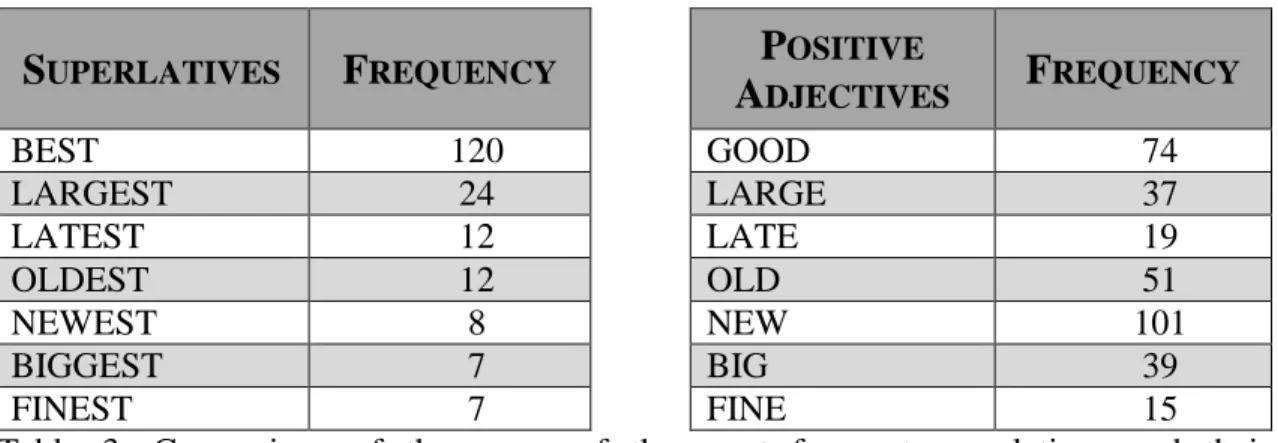
Besides, dealing also with this category, the governments of the official webpages
of our study use as well the superlative of some adjectives in order to give a higher
decide to visit these destinations. Some of the most recurrent superlatives are included in
As we can see, all the superlatives have a lower usage rate than their corresponding
positive adjectives, with the exception of the most frequent one, in which the superlative
‘best’ is almost twice as frequent as ‘good’. The explanation that we can give to that fact is
that many destinations can be good, but there is only one that can be the best. In this way,
since the messages of official webpages wish to portray their state or city as a better place
than the others, they use more the superlative ‘best’ in order to persuade tourists to choose
them instead of the others.
Moving into the other procedure employed to create a constant positive language, it
has attracted our attention the fact that these specific institutional webpages use some
neologisms to create the impression of refinement. We have found that in our corpus
neologisms were used more in gastrolingo1. Some examples are the French words ‘crème’
which is used seven times in the gastronomy texts taken from the webpage of Los Angeles;
and ‘décor’ which appears ten times in Los Angeles and Seattle official webpages. There
are other neologisms taken from the Spanish language that they have also used in their
gastronomy related texts, such as ‘tortilla’ or ‘salsa’, but we have highlighted the French
words because, as opposed to the Spanish ones, they have an equivalent in English. Thus,
1
even though their frequency may not seem meaningful in comparison to other words, we
have made reference to it because the use of neologisms is not indispensable in these cases
and therefore they use the French words as a persuasive strategy.
III.1.2. Persuasion strategies to address directly to the visitor
Supplementary strategies of persuasion applied in the tourism webpages of Los
Angeles, Seattle and Washington are those linguistic procedures which directly involve the
reader and establish a communicative familiarity. In this case, we have noticed that this
interpersonal function of the discourse is managed in these official webpages by means of
the use of ego-targeting, interrogative sentences and the imperative mood. Consequently,
these three strategies will be analyzed in this part of our study by identifying different
examples in our corpus.
Ego-targeting is a persuasion strategy used by these governments of the United
States to create a conversational style in their promotional material. In order to analyze it,
we have looked for the pronoun ‘you’ in the wordlist of our corpus by extracting it with the
program AntConc (see Table 4); and with the Concordance tool, we have quoted some
examples of the use of the determiner ‘your’ within the context of our corpus. As we stated
earlier in our methodology section, pronouns and articles are some of the words that we
have included in our stoplist; but due to the fact that the determiner ‘your’ and the pronoun
‘you’ need to be analyzed for the reasons previously given, in this particular case, we have
6 1109 IN
On the one hand, as we can see in table 4, the word ‘you’ is the sixteenth most used
word in our corpus, appearing 330 times in the texts that we have compiled; moreover, it is
the most used pronoun in our corpus. As a result of this, we can conclude that our TOWs
use the pronoun ‘you’ to make the tourist who is reading the DPM feel as if he or she is the
only person to which the message is addressed.
On the other hand, the word ‘your’ (with a frequency of 112) is used in sentences
that induce the readers directly to experiment the sensations that the destinations offer to
them. We can see it being used as an strategy of persuasion in the following sentences
extracted from our corpus:
- You’ll try your best not to eating the warm and chewy shaobing (sesame bread) […]
- […]Seattle is your destination for festivals.
- Make sure your voice is on-key for the Monday-night Showtunes Sing-a-Long […]
Continuing with the strategies used to direct the message to the tourist, we will go
on with the analysis of the imperatives in our set of texts. To carry out our analysis of the
imperative mood we have extracted the verbs from the list of words that AntConc gives us
once we add a stoplist. After this step, we have realized that their frequency is not a reliable
were in fact infinitives. Then, we have looked for the imperatives in context with the
Concordance function. In this way, we have decided to evidence the use of this persuasive
strategy quoting some sentences that include the imperatives most frequently used in these
institutional webpages:
- Visit the more-than-100-year-old Union Station to find out why its beautiful architecture
and special events make it more than just a train station.
- Experience the serenity of the monuments at sunrise.
- Find friendly faces and a half-price menu […]
- Enjoy extended gallery hours and exhibit openings, along with refreshments and great
people watching […]
- Explore the streets bordering the park and enjoy stately homes built when city
forefathers envisioned Seattle as the capitol of Washington State.
- Discover Northwest African American culture at the Northwest African American
Museum.
- Feel the city's soul power at one of DC's many nightspots.
In these sentences we see that the local authorities that write this promotional
material use the imperative to maintain the communication links with the reader, and to
give the visitors instructions, inviting them to participate in the activities that their city or
state offers them. Furthermore, we have observed that, especially the Washington webpage,
makes an ample use of the imperative (see Image 2) because they include lists of things to
do by their visitors. Therefore, by using imperatives, this institution invites tourists to take
part in their attractions and give them the opportunity to follow the steps suggested in the
Image 2: Screenshot of imperative usage in the Washington webpage [AntConc 3.2.4w]
Finally, the last persuasive strategy intended to focus on the receiver, that we will
study, is the use of interrogative sentences. These sentences are intended to create a closer
relationship between the sender and the receiver of the message.
To achieve this purpose, since we have our corpus in docx format, instead of using
the program AntConc 3.2.4w, we have used the search tool in Microsoft Word and we have
keyed in the interrogative symbol. This way we have been able to find all the interrogative
sentences included in our corpus. As a result, once we have studied them we can conclude
that the officials make use of them with two aims. The first one is to get the attention of the
tourists, usually in headlines. The most frequent questions of this type are ‘Did you know?’
and ‘What will you find?’ The second reason why the institutional webpages make use of
They have the solution to the possible problems that the tourists could have, so instead of
just presenting this information, they formulate the questions to highlight the fact that they
can solve any problem that could arise to their customers. Therefore, they write the
questions in advance, to answer them immediately after their formulation, being the
following some of the examples taken from our corpus:
- Sounds far? It’s really just a couple minutes from the heart of Downtown Los Angeles,
on the other side of the river. You can even take the Metro there, destination Mariachi
Plaza.
- Don’t want to stray from your workout routine? Join DC Front Runners, a running,
walking and social club that meets at 9:30 a.m. on Saturdays at 23rd and P Streets for a
brisk walk, or 10 a.m. for a fun run followed by socializing.
- Need to check your email or confirm a hotel stay while you're out? You're in luck – the
courtyard has free Wi-Fi.
This is a good method to make the addressee feel understood and to avoid them feel bad,
when making questions that may seem too obvious; and it is also a proper alternative to
present their information in a user-friendly language which is another clever approach to
persuade tourists.
CONCLUSION
Our general purpose in this work was to study the persuasive language in the
official webpages of Los Angeles, Seattle and Washington; but as we stated in the
introduction, to achieve this objective, we have established other more specific purposes.
Hence, in this final part of our study, we will present our conclusions divided in three parts:
firstly, the aims that we have met in the theoretical approach; secondly the ones reached in
Starting with the theoretical framework, in this first part of the study we have
concluded that although the persuasive element is present in PTGs, the rise of the Internet
has brought with it new capacities to enhance this persuasiveness; and consequently, the
officials have taken advantage of the benefits of the World Wide Web using different
persuasive strategies when writing their DPM. In addition, we could determine that in order
to meet this purpose, their persuasive messages may fulfil the four elements summarized in
Lewis AIDA model: attention, interest, desire and action. Finally, after our literary review,
we conclude that these messages make also use of persuasive strategies which can be
divided into those that create a constant positive language and those that address directly to
the visitor.
With reference to the methodology, by means of our corpus we have been able to
analyze the real use of the persuasive strategies in the two senses just stated. In this way,
the software program AntConc 3.2.4w has provided us with Word List and Concordance
tools which have helped us to fulfil the purposes of the experimental part of our study. On
the one hand, the Word List program has allowed us to analyze the frequency and
distribution of the adjectives, superlatives, the pronoun ‘you’ and the determiner ‘your’.
On the other hand, the Concordance program has been effective to study the ego-targeting
strategy and to observe the imperatives in context.
In regards to the empirical part, and as a result of the conclusions obtained in the
other two parts of the study, we have come to the conclusion that the official webpages of
Los Angeles, Seattle and Washington make use of specific linguistic elements in order to
persuade tourists. On the one hand, in order to achieve their purpose of creating a positive
impression, they use positive and superlative adjectives to describe and highlight the
qualities of their destinations, together with French neologisms especially in gastrolingo to
give the impression of elegance. On the other hand, to maintain the communicative links
with the reader, they use the second person singular and the imperative mood to address the
tourists directly. They also often include rhetorical questions with the intention of involving
To sum up, we can imply from the conclusions we have just presented, that in our
study we have been able to verify the fact that persuasion is a powerful component in the
tourist language of DPM from TOWs. In fact, this strategy helps to meet the purpose of
seducing, encouraging and attracting visitors to the Web’s destination.
Finally, as one of our reasons for carrying out this corpus-based analysis was the
fact that we considered that the study of DPM is not very extensive, we hope that our work
WORKS CITED
Alcaraz, Enrique. l Ingl s rofesional y cad mico. Madrid: Alianza, 2000. Print.
Antelmi, Donella, Held Gudrun, and Francesca Santulli. Pragmatica Della Comunicazione
Turistica. Roma: Editori Riuniti, 2007. Print.
Baker, Paul. Using Corpora in Discourse Analysis. London: Continuum, 2006. Print.
Biber, Douglas, Susan Conrad, and Randi Reppen. Corpus Linguistics: Investigating
Language Structure and Use. Cambridge: Cambridge UP, 1998. Print.
Calvi, Maria Vittoria. Lengua y Comunicaci n en el spa ol del Turismo. Madrid: Arco
Libros, 2006. Print.
---. “Los Géneros Discursivos en la Lengua del Turismo: Una Propuesta de Clasificación.”
Diss. Università degli Studi di Milano, 2010.
Corral, Luis S nchez. Ret rica y Sinta is de la ublicidad Itinerarios de la ersuasi n.
Córdoba: Universidad De Córdoba, 1991. Print.
Dann, Graham. The Language of Tourism: A Sociolinguistic Perspective. Wallingford,
Oxon, UK: CAB International, 1996. Print.
Marzá, Nuria Edo. “The Communicative Theory of Terminology (CTT) applied to the
development of a corpus-based specialized dictionary of the ceramics industry”. Diss.
Universitat Jaume I, 2008.
Ferris, D. Connor. The Meaning of Syntax: A Study in the Adjectives of English. London:
Longman, 1993. Print.
Fischer, Martin. “Sprachgefühl und Welterfahrung -La traducción inversa de textos
Intercultura en la enseñanza del español como lengua extranjera. 2/2000. Espéculo.
19 May 2014. <http://www.ucm.es/info/especulo/ele/alcala.html>.
Gibson, Jane W., and Richard M. Hodgetts. Business Communication: Skills and
Strategies. New York: Harper & Row, 1990. Print.
Halmari, Helena, and Tuija Virtanen. Persuasion across Genres: A Linguistic Approach.
Amsterdam: John Benjamins Pub., 2005. Print.
Hunston, Susan. Corpora in Applied Linguistics. Cambridge: Cambridge University Press,
2002. Print.
Kerbrat-Orecchioni, Catherine. “Suivez le guide! Les modalités de l’invitation au voyage
dans les guides touristiques: l’exemple de l’«île d’Aphrodite»” in Fabienne Baider,
Marcel Burger and Dionysis Goutsos (eds.). La communication touristique.
Approches discursives de l’identit et de l’alterit . Paris: L’Harmattan, 2004.
133-150.
Kennedy, George A. Aristotle: On Rhetoric: A Theory of Civic Discourse. New York:
Oxford UP, 2007. Print.
Laviosa, Sara. “Corpora and the translator.” In Somers, H. (ed). Computers and
Translation a Translator’s Guide. Ámsterdam/Filadelfia: John Benjamins, 2003.
Print.
Lee, Sun-Muk. ntersuchungen ur alen Des d ektivs in Der Deutschen
Gegenwartssprache Die orphosyntaktische nd Logisch-semantische estimmung
Der rg n ungen um d ektiv. Frankfurt Am Main: P. Lang, 1994. Print.
Lerbinger, Otto. Designs for Persuasive Communication. Englewood Cliffs, NJ:
Maci, Stefania Maria. “Virtual Touring: The Web-Language of Tourism”. Linguistica e
Filologia. Bergamo, 2007. 25: 41-65.
McEnery, Tony, and Andrew Wilson. Corpus Linguistics: An Introduction. Edinburgh:
Edinburgh UP, 2001. Print.
Navarro, Carmen. La Comunicación Especializada. Peter Lang, 2008. Print.
Nigro, Giovanna. Il Linguaggio Specialistico del Turismo: Aspetti Storici, Teorici e
Traduttivi. Roma: Aracne, 2006. Print.
"Persuasion". Oxford English Dictionary. 2014. Oxford English Dictionary Online. 20 May
2014. <http://www.oed.com/>.
Pierini, Patrizia. “Adjectives in tourism English on the web: a corpus-based study.”
CÍRCULO de Lingüística Aplicada a la Comunicación CLAC 40. Universidad
Complutense de Madrid 2009: 93-116
Roloff, Michael E., and Gerald R. Miller. Persuasion: New Directions in Theory and
Research. Beverly Hills: Sage Publications, 1980. Print.
Sánchez, Aquilino. “Investigación y análisis mediante corpus lingüísticos: el poder de
atracción de las palabras”. In Fernández, Purificación and Bravo, José María (eds).
Pathways of Translation Studies. Valladolid: Universidad de Valladolid, 2001.
11-46.
Sinclair, John McH. Corpus, Concordance, Collocation: Describing English Language.
Oxford: Oxford University Press, 1991. Print.
---. Trust the text: Language, corpus and discourse. London: Routledge, 2004. Print.
Williamson, Judith. Decoding Advertisements: Ideology and Meaning in Advertising.