To my supervisor, Jesús Manuel Alegre, for guiding me on the steps to follow in this difficult research line, for trusting in my ability to carry out this work, for always wanting to undertake new projects and, especially, for his friendship and good humour.
To Iván Cuesta for his absolute dedication, his wise advices, his help in this research and for making daily work really gratifying.
To the University of Burgos and, in particular, to the Area of Continuum Mechanics where the work environment has been the best that one could imagine for this pre-doctoral stage. To Emilio Martinez-Pañeda, for his help in the numerical part of this thesis, but, above all, for expanding my vision on hydrogen diffusion phenomena, embrittlement, and plasticity. To Zhiliang Zhang, for giving me the opportunity to be part of his Nanomechanical Lab during three months and for guiding me in my research. To all the NTNU's colleagues and friends in Trondheim, especially to Haiyang for his help and dedication.
To colleagues I have met at conferences, for awakening my interest in material modelling from the most diverse approaches, and for all their contributions.
To the financial support from the Ministry of Economy and Competitiveness of Spain through grant MAT2014-58738-C3 To the Junta of Castile and Leon through project BU053U16 and pre-doctoral grant EDU/1006/2015.
To my friends, for encouraging me to do this work, for cheering me up in the worst moments and for making all of these years a really exciting stage of my life.
This thesis presents and discusses hydrogen diffusion modelling as a first step in predicting and mitigating hydrogen-assisted fracture. Hydrogen embrittlement is a common phenomenon that degrades metals and alloys, and related failures are usual in industry. However, the relationship between hydrogen and the transition from ductile to brittle modes of fracture is not entirely clear. Even though mechanism operating at nano and microscales are not yet completely understood, it has been proved that embrittlement is proportional to hydrogen concentration within a metal. Therefore, the present work has the objective of establishing, validating, implementing and analysing a consistent numerical model for hydrogen diffusion, in a Continuum Mechanics framework by means of a Finite Element software.
Diffusion phenomena are reviewed and particularised on hydrogen transport in metals. In particular, a “two-level” model, considering trapping effects explicitly, is chosen in order to simulate hydrogen diffusion near a crack tip. Strain and stress fields present in a crack or notch are connected with hydrogen diffusion; additionally, hydrogen promotes a local softening, a dilatation and a reduction in cohesive energy so a coupled behaviour between diffusion, elasto-plasticity and damage must be considered.
Contents ... vii
List of Figures ... xi
List of Tables ... xv
Nomenclature ... 17
Chapter 1 Introduction ... 21
1.1 Motivation ... 21
1.2 Research objectives ... 24
1.3 Document structure ... 26
Chapter 2 Review on hydrogen diffusion modelling ... 29
2.1 Introduction ... 29
2.2 Multiscale approach ... 31
2.3 Diffusion phenomena ... 33
2.3.1 Einstein equation for brownian motion ... 34
2.3.2 Diffusion as a random walk ... 34
2.3.3 Landscape of potential energies ... 35
2.3.4 Transition rate ... 40
2.3.5 Driving force and flux ... 43
2.4 Interstitial Solid Solutions ... 45
2.4.1 Chemical potential ... 46
2.4.2 Chemical activity ... 51
2.4.3 Equilibrium between sites ... 51
2.4.4 Stress state ... 52
2.5 Two-level continuum model ... 53
2.5.1 Interstitial flux ... 54
2.5.2 Chemical potential ... 55
2.5.3 Mass balance ... 55
2.5.4 Trapping influence ... 56
2.6 Coupled diffusion ... 65
3.1 Introduction ... 69
3.2 Implemented diffusion equations ... 73
3.2.1 Flux between trapping sites ... 73
3.2.2 Mass balance: general governing equation ... 75
3.2.3 Simplified governing equation ... 75
3.2.4 Oriani’s equilibrium ... 76
3.2.5 Plastic strain influence ... 77
3.3 Boundary conditions ... 77
3.4 Coupled diffusion ... 79
3.4.1 Hydrogen induced softening ... 79
3.4.2 Hydrogen induced dilatation ... 80
3.5 Informed cohesive model ... 80
3.5.1 Traction – Separation Law ... 80
3.5.2 Hydrogen influence ... 83
3.5.3 Triaxiality influence ... 84
3.6 Implementation in ABAQUS through user subroutines ... 85
3.6.1 Diffusion equations ... 86
3.6.2 Coupling equations ... 88
3.6.3 Boundary conditions ... 90
3.6.4 Multi-trapping effects ... 90
3.6.5 Kinetic equations ... 91
3.6.6 Cohesive element behaviour ... 92
3.7 Validation of subroutines for diffusion ... 92
3.7.1 Parameters ... 93
3.7.2 Geometry and boundary conditions ... 94
3.7.3 Results ... 97
Chapter 4 Numerical simulation of hydrogen diffusion near a crack tip ... 101
4.1 Introduction ... 101
4.2 Materials and geometry ... 103
4.3 Simulation of coupled effects ... 103
4.3.1 Dilatation... 104
4.3.2 Hardening/Softening ... 106
4.4 Flux between trapping sites ... 107
4.7.2 Non-equilibrium ... 124
4.8 Conclusions ... 129
Chapter 5 Simulation of hydrogen and triaxiality effects in notched specimens ... 131
5.1 Introduction ... 131
5.2 Materials and procedures ... 132
5.3 Hydrogen diffusion model ... 134
5.4 Results and discussion ... 138
5.5 Conclusions ... 145
Chapter 6 Application to a pressure vessel considering cyclic loading ... 147
6.1 Introduction ... 147
6.2 Hydrogen diffusion model ... 148
6.3 Modelling ... 148
6.3.1 Material characterization ... 148
6.3.2 Diffusion parameters ... 149
6.3.3 Thickness design ... 150
6.3.4 Vessel ... 152
6.3.5 Cyclic load ... 152
6.4 Results and discussion ... 152
6.5 Conclusions ... 159
Chapter 7 Assessment of residual stress effects in a pressure vessel ... 161
7.1 Introduction ... 161
7.2 Hydrogen diffusion model ... 163
7.2.1 Parameters and boundary concentration ... 163
7.2.2 Hydrogen trapping ... 165
7.3 Vessel modelling ... 166
7.3.1 Vessel without defects ... 168
7.3.2 Notched vessel ... 171
7.4 Results and discussion ... 172
7.5 Conclusions ... 181
Chapter 8 Conclusions and future work ... 183
8.1 Conclusions ... 183
8.1.1 Hydrogen diffusion near a crack tip ... 184
8.1.2 Hydrogen Assisted Fracture modelling ... 185
Figure 2-1. Multiscale approaches (blue) and its respective computational methods (brown). Boxes on the left correspond to a continuum scale while boxes on the right are related to the atomic scale. ... 32 Figure 2-2. Potential energy of a metal lattice along a certain x direction ... 37 Figure 2-3. Potential energy distribution and degeneracy of the well points in different configurations (R Kirchheim, 1982). ... 38 Figure 2-4. Hop between two different sites A y B. ... 42 Figure 2-5. Comparison between different expressions for found in literature. ... 60 Figure 3-1. Diagram of the modelling approach and relationship between the physical phenomena and the numerical problem. ... 70 Figure 3-2. Continuum and cohesive element responses. ... 81 Figure 3-3. Coupling scheme between diffusion and elasto-plastic response. ... 89 Figure 3-4 Boundary layer geometry with symmetry boundary condition and far-field displacements. ... 96 Figure 3-5 Mesh detail in a crack tip with initial radios of /2 and hydrogen concentration
kJ/mol. Comparison between equilibrium and kinetic formulations. ... 113 Figure 4-8. Hydrogen concentration in trapping sites after 0.13 and 1.3 seconds for = 60 kJ/mol. Comparison between equilibrium and kinetic formulations. ... 113 Figure 4-9. Hydrogen concentration in lattice sites after 0.13 and 1.3 seconds for = 20 kJ/mol. Comparison between equilibrium and kinetic formulations. ... 114 Figure 4-10. Hydrogen concentration in trapping sites after 0.13 and 1.3 seconds for = 20 kJ/mol. Comparison between equilibrium and kinetic formulations. ... 114 Figure 4-11. Binding energy influence on hydrogen concentration in lattice sites after 1.3 seconds. ... 115 Figure 4-12. Hydrogen concentration in lattice sites after 0.13 and 1.3 seconds for = 60 kJ/mol. Comparison between equilibrium and kinetic formulations for initially empty traps ( , 0 0). ... 116 Figure 4-13. Influence of vibration frequencies on hydrogen concentration in lattice sites after 0.13 and 1.3 seconds for = 40 kJ/mol. ... 117 Figure 4-14 Influence of vibration frequencies on hydrogen concentration in trapping sites after 0.13 and 1.3 seconds for = 40 kJ/mol. ... 118 Figure 4-15. Hydrogen concentration in lattice sites after 0.13 and 1.3 seconds. Comparison between the single-trap model (with = 60 kJ/mol) and multi-trap model (with = 30 kJ/mol and = 60 kJ/mol). ... 119 Figure 4-16. Hydrogen concentration in trapping sites after 1.3 seconds. Comparison between the single-trap model with = 60 kJ/mol) and multi-trap model (with = 30 kJ/mol and
Figure 4-26. Hydrogen concentration in lattice sites after 0.13 and 1.3 seconds. Comparison between multi-traps models with equilibrium and non-equilibrium considerations with =
60 kJ/mol and = 30 kJ/mol. ... 127
Figure 4-27. Hydrogen concentration in trapping sites after 0.13 and 1.3 seconds. Comparison between multi-traps models with equilibrium and non-equilibrium considerations with = 60 kJ/mol and = 30 kJ/mol. ... 127
Figure 4-28. Hydrogen concentration in lattice sites after 0.13 and 1.3 seconds. Comparison between multi-traps models with equilibrium and non-equilibrium considerations with = = 45 kJ/mol. ... 128
Figure 4-29. Hydrogen concentration in trapping sites after 0.13 and 1.3 seconds. Comparison between multi-traps models with equilibrium and non-equilibrium considerations with = = 45 kJ/mol. . ... 128
Figure 5-1. NRB dimensions. ... 134
Figure 5-2. Scheme of the two-step simulation: firstly a mechanical and diffusion coupled analysis is performed and then an informed CZM analysis. ... 138
Figure 5-3. Hydrostatic pressure at the beginning of load for r = 0.25 mm. (note thatp h) ... 139
Figure 5-4. Equivalent stress at the beginning of load for r = 0.25 mm. ... 140
Figure 5-5. Triaxiality and coverage distribution in the notch root section with increasing load for = 0.25 mm. ... 140
Figure 5-6. Notch radius effect on maximum triaxiality and hydrogen coverage. ... 141
Figure 5-7. Stress-strain curve for different notch radii without cohesive elements. ... 142
Figure 5-8. Stress-strain curve for different notch radii with cohesive elements ... 143
Figure 5-9. Stress-strain curve for = 0.25 mm: triaxiality , and coverage influence. ... 144
Figure 5-10. Stress-strain curve for = 0.25 mm: influence. ... 144
Figure 6-1. Hydrogen distribution and in the symmetry axis. ... 153
Figure 6-2. Hydrogen distribution in lattice sites near the notch tip. ... 154
Figure 6-3. at crack tip boundary (dashed red line) and maximum (solid blue line) for = 1.0 ... 155
Figure 6-4. at crack tip boundary (dashed red line) and maximum (solid blue line) for = 0.714 and = 300 s ... 156
Figure 6-5. at crack tip boundary (dashed red line) and maximum (solid blue line) for = 0.5 and = 300 s ... 157
Figure 6-6. at crack tip boundary (dashed red line) and maximum (solid blue line) for = 0.5 and = 30 s ... 158
Figure 7-3. Hydrostatic stress along the vessel thickness depending on the autofrettage pressure. Dashed lines represent residual stress and solid lines represent the hoop stress
during the service life. ... 171
Figure 7-4. Geometry and hydrostatic stress during service for = 140 MPa. Detail shows notch geometry and mesh for = 0.5 mm. Note that here compressive stresses are positive (i.e. ) ... 172
Figure 7-5. Lattice hydrogen concentration and total hydrogen concentration near the notch root for: (a) = 0.1 mm and = 30 kJ/mol; (b) = 0.1 mm and = 60 kJ/mol; (c) = 0.9 mm and = 30 kJ/mol; (d) = 0.9 mm and = 60 kJ/mol. ... 174
Figure 7-6. response surface for = 30 kJ/mol. ... 180
Figure 7-7. response surface for = 45 kJ/mol. ... 180
Table 2-1. Binding energies (or detrapping activation energies in brackets) for different types
of trapping sites. References collected by Song, 2014. ... 64
Table 3-1. Chronological compilation of works modelling hydrogen diffusion near a crack tip using a Modified Boundary Layer approach and considering trapping sites in diffusion equations. ... 72
Table 3-2. Analogy between variables in heat transfer and diffusion. ... 87
Table 3-3. Elasto-plastic and diffusion parameters (from reference (Sofronis & McMeeking, 1989)). ... 93
Table 3-4. Maximum displacements in the far field contour, correspondent to a load of = 89.2 MPa√m. ... 95
Table 4-1. Coupling parameters. ... 104
Table 5-1. AISI 4130 steel: mechanical parameters. ... 133
Table 5-2. AISI 4130 steel: hydrogen related parameters (San Marchi & Somerday, 2008). ... 133
Table 6-1. Allowable composition range (wt%) for AISI 4130 steel (San Marchi & Somerday) ... 149
Table 6-2. Mechanical parameters for AISI 4130 steel. ... 149
Table 6-3. Diffusion parameters for AISI 4130 steel. ... 150
Table 6-4. Minimum thickness required considering different approaches. ... 152
Table 7-1. Diffusion parameters for AISI 4130 steel. ... 164
Table 7-2. Mechanical parameters for AISI 4130 steel. ... 166
Table 7-3. Variable parameter range in the interval [-1, 1]. ... 175
Table 7-4. Design of experiments performed for = 30 kJ/mol. ... 176
Table 7-5. Design of experiments performed for = 45 kJ/mol. ... 177
Table 7-6. Design of experiments performed for = 60 kJ/mol. ... 178
diffusivity, diffusion coefficient
diffusivity in the ideal lattice without defects effective diffusivity
mobility coefficient temperature
hydrogen concentration (hydrogen per unit volume)
hydrogen concentration in i –sites (hydrogen per unit volume) hydrogen concentration in trapping sites of i-type
hydrogen concentration in the boundary
equilibrium hydrogen concentration at a given fugacity or pressure hydrogen concentration (in hydrogen atoms per metal atoms) geometrical factor for random diffusion
energy of a potential well
energy of a potential well in a perfect lattice energy of a potential well in a defect
degeneracy of energy states
activation energy (for diffusivity or hop frequency) hop distance or lattice constant
Γ→ hop frequency of hydrogen atoms from sites i to sites j
Ω→ frequency of hop attempt form sites i to sites j
vibration frequency of hydrogen atom in sites i
number of sites where a hydrogen atom might be located (per volume unit) number of i-sites where a hydrogen atom might be located (per volume unit)
number of lattice sites (per volume unit) number of trapping sites (per volume unit)
number of trapping sites of i-type (per volume unit) binding energy of a defect (potential well)
equilibrium constant for trapping sites
flux vector of i-component (or hydrogen located in i-sites) thermodynamic force vector
Onsager coefficients for i-component and j-force. drift velocity (drifted diffusion)
chemical potential
chemical potential of i-component (or hydrogen located in i-sites) chemical potential of i-component in the standard state
chemical potential in the boundary fugacity of gaseous hydrogen
hydrogen pressure in the standard state
hydrogen occupancy (fraction of sites occupied by hydrogen) hydrogen coverage (occupancy of surface sites)
hydrogen occupancy in i-sites partial molar volume
Cauchy stress tensor hydrostatic stress
dislocation density
Young’s modulus (elastic modulus)
Poisson coefficient
yield stress (before plastic straining)
yield stress (including hardening/softening)
parameter considering hydrogen-induced softening or hardening component ij in the deformation rate tensor
hydrogen-induced dilatational true strain
hydrogen-induced volumetric engineering strain
∆ volume change for each introduced hydrogen atom
Ω mean volume of a metal atom dilatational parameter (∆ /Ω)
hydrogen solubility
Ψ potential function defining a Traction – Separation Law
Δ normal separation between element faces
Δ tangential separation between element faces critical separation for the normal mode critical separation for the tangential mode
traction in the normal direction traction in the tangential direction critical traction for the normal mode critical traction for the tangential mode
fracture energy for the normal mode fracture energy for the tangential mode
shape parameter for the normal Traction –Separation Law characteristic length of cohesive elements
working pressure in a vessel outer radius of a vessel inner radius of a vessel outer radius of a vessel
∗, ∗, ∗ elastic hoop, radial and axial stress
, , hoop, radial and axial stress distribution
SUBSCRIPTS
lattice or interstitial sites
In this Chapter, the problem of hydrogen-metal interaction is exposed in its context and some examples of application are shown. Once the problem has been motivated, research objectives are enlisted and the document structure is summarised.
1.1
Motivation
Hydrogen embrittlement is a common phenomenon which degrades metals (Barnoush, 2011; Bernstein, 1970; Delafosse & Magnin, 2001; Gangloff & Somerday, 2012; Hirth, 1980; Lynch, 2007; Oriani, 1978). A reduction in mechanical properties of metals and alloys occurs due to the inclusion of hydrogen as an impurity.
cadmium plated head cap screws during service and attributed them to hydrogen embrittlement (Tanner, 1992).
Welding processes may also introduce significant amounts of hydrogen and promote failure (Moon, Lee, Kim, Kim, & Kim, 2003). Hydrogen is supplied by materials in the electrode coating, in the flux or in the shielding gas, as well as by the moist environment (Dayal & Parvathavarthini). This hydrogen insertion added to the usual presence of residual stresses in the weld frequently causes Hydrogen Assisted Cracking (Pardal et al., 2013).
In recent decades, since hydrogen has been proposed as a promising energy carrier, the interest in the interaction between hydrogen and diverse types of materials for hydrogen storage has increased. Several methods of storing hydrogen have been proposed (Zhou, 2005): liquid hydrogen at cryogenic temperatures, by physisorption, as a metal hydride and in gaseous state at high pressures, e.g. at 35 up to 75 MPa (Zheng et al., 2012). The last is the least expensive and consist in storing H2 in pressure vessels made of alloys or composite materials. However, although H2 containers have been built for more than a century, embrittlement of the used alloys still is a problem. The explosion of some iron bottles storing gaseous hydrogen in an airship in 1894 (Boellinghaus, Holtappels, Mair, & Grunewald, 2014) might be regarded as one of the first failure cases of hydrogen containers documented.
Currently, selection of suitable components for hydrogen service simply discriminates between especially susceptible alloys (high strength steels, and nickel alloys) and alloys hardly affected (austenitic stainless steels and aluminium alloys), as the Standard ANSI/CSA CHMC 1-2014 defines (Moriconi, Hénaff, & Halm, 2014). Such distinction has an empirical basis but lacks a consistent microstructural and physical explanation.
there since the aluminium liner is expected to minimise hydrogen diffusion. However, vessels without aluminium or austenitic steel liner, e.g. Type I tanks made of high strength steels, do not keep hydrogen from diffusing along the whole thickness and embrittlement might occur. Hydrogen in solid solution interacts with the crystal lattice, thereby modifying the mechanical properties of the metal or alloy. Furthermore, the interaction of hydrogen with lattice defects, such as vacancies, dislocations, grain boundaries or inclusions, also plays a crucial role. Progress must be made towards a greater understanding of these phenomena comprising various scales with the objective of predicting and preventing the failure of industrial components subjected to hydrogen embrittlement. Therefore, also the assessment of hydrogen embrittlement must move towards a physical-based numerical modelling of the metal-hydrogen system.
Even if the embrittlement phenomenon involves fracture at low strains, surface morphologies usually show small dimples (Beachem, 1972; Birnbaum & Sofronis, 1994). Thus, even though fracture looks brittle from a macroscopic point of view, a significant plastic process is happening in the crack tip (Oriani & Josephic, 1974). There is agreement about the hydrogen induced dislocation mobility (Birnbaum & Sofronis, 1994), which, in the end, causes strain localization and failures that seem brittle at a higher scale. Moreover, from atomistic calculations, it has been shown that hydrogen reduces the cohesive energy as it weakens the metallic bonding (Jiang & Carter, 2004). However, it is not clear which one is predominant in each specific situation or if there are more mechanisms involved (Lynch, 2007). Thus, hydrogen embrittlement modelling is a challenging matter due to numerical issues as well as uncertainties in the micro-mechanisms operating.
Since hydrogen atom diffuses rapidly due to its small size, time-scale and the possibility of delayed effects are crucial in the interaction between metallic lattice and the inserted hydrogen atom. The number of hydrogen atoms in a region will be directly related to the local response of the metal; then, hydrogen concentration is usually the variable sought when embrittlement wants to be predicted or prevented.
defects, affecting thus hydrogen diffusion, while, at the same time, hydrogen is influencing dislocation movement and metallic bonding. Coupled effects are critical in fracture because stress concentrators might promote hydrogen accumulation. Therefore, hydrogen diffusion near a crack tip must be simulated and, with this objective, robust numerical models must be established and verified.
1.2
Research objectives
The framework for this thesis is the simulation of hydrogen embrittlement processes. However, due to the complexity of these phenomena, only the initial phase in embrittlement modelling will be studied: hydrogen transport within metals. Nevertheless, a coupled response of the material and cohesive models modified by hydrogen concentration will also be introduced. Therefore, the main goal of the work will be the numerical modelling of hydrogen diffusion.
Finding a balance between physically-based models (which have many parameters difficult to find empirically) and phenomenological models (which, in contrast, are not based in the real mechanisms) is also an objective sought.
As a more practical aspect of this thesis, the established models will be finally applied in the simulation of hydrogen diffusion in vessels. The objective is not to design a real deposit but to demonstrate how the particularities of the stress state present in a vessel affect hydrogen diffusion and its accumulation around stress concentrators. The relationship between internal pressure in the vessel, stress state, and hydrogen entry phenomena is also intended to be clarified.
The specific objectives of this thesis are:
Contextualising hydrogen embrittlement as an important issue in material modelling and highlighting its importance for fracture prevention.
o Microstructural defects as trapping sites. Consideration of hydrogen different sites in the mass balance.
o Hydrogen hops between different sites giving a kinetic formulation for trapping phenomena
o Thermodynamic equilibrium between trapped hydrogen and hydrogen located in interstitial sites.
o Stress state influence and hydrogen accumulation in tensile regions.
o Relationship between plastic deformation and crystallographic defects.
o Boundary conditions, emerging from the adsorption/absorption processes occurring at the metal surface.
Presenting a numerical strategy for the implementation of diffusion models in a Finite Element code, including:
o Analogy between hydrogen diffusion and heat transfer. This strategy can be extended to other phenomena like thermal softening or thermal-induced dilatation.
o Modelling in ABAQUS by means of the available user subroutines (in brackets) modifying:
Balance equations, considering the possible trapping sites (UMATHT).
Hydrogen fluxes, including drift terms depending on the hydrostatic stress gradient (UMATHT).
State variables: plastic strain, hydrostatic stress, etc. (USDFLD).
Boundary conditions: non-uniform and stress dependent (DISP).
Hardening/softening (UHARD).
Hydrogen-induced dilatation (UEXPAN)
o Modification of Cohesive Zone Models, specifically of Traction-Separation Law, by hydrogen concentration and local triaxiality using:
A two-step simulation (diffusion + crack propagation)
Numerical simulation of hydrogen embrittlement in notched tensile specimens of a high strength steel
o Analysis of hydrogen and triaxiality influence on damage initiation
o Discussion on the Traction-Separation Law capability of simulating the shift from ductile to brittle failure.
Numerical simulation of hydrogen diffusion through a vessel wall of a high strength steel
o Analysis of diffusion near a stress concentrator
o Simulation of cyclic loads and its effects on hydrogen diffusion
o Assessment of residual stress influence on hydrogen concentration at equilibrium
Beyond the numerical study and simulations, a primary, even though more abstract, goal will be to describe the uncertainties and knowledge gaps present in research on hydrogen diffusion and embrittlement. The aim is to clarify the future challenges in this field, to emphasize the need for a multidisciplinary study and to delimitate the possibilities of the current models.
1.3
Document structure
Following this introductory chapter, the dissertation structure is:
Chapter 2. Review on hydrogen diffusion modelling In this chapter, diffusion fundamentals are exposed in a didactic way, reviewing the main equations modelling this phenomenon in various scales: from the atomic perspectives to the continuum equations in which FEM codes are based. The vast part of this Chapter is extracted from the paper “A review on diffusion modelling in hydrogen related failures” published in the journal Engineering Failure Analysis.
Chapter 3. Implementation of hydrogen diffusion and embrittlement modelling.
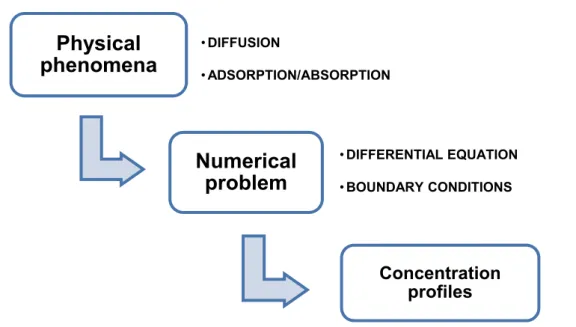
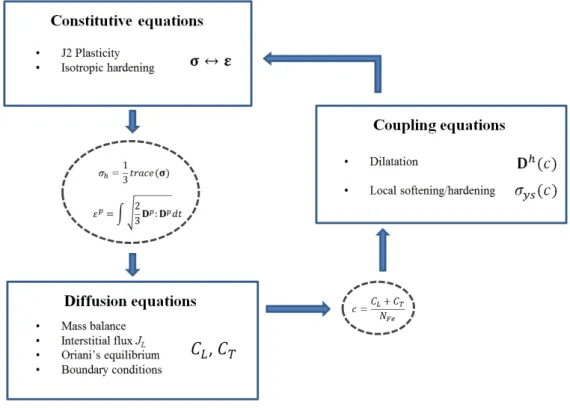
diffusion in metals, specifically steels, are shown. Hydrogen concentrations are treated separately depending on the sites in which they are located (lattice or trapping sites). A critical review of the milestones in this research field is carried out. After that, a consistent model is presented, which is used afterwards in the diffusion simulations made in Chapter 4 to Chapter 7. In Section 3.5. a methodology aiming at modelling fracture with cohesive elements is presented, in which hydrogen content and local triaxiality influence the fracture process. Section 3.6. includes the details for the numerical implementation by means of user subroutines in the commercial FE code ABAQUS. Finally, diffusion model implementation is validated with some results from literature.
Chapter 4. Numerical simulation of hydrogen diffusion near a crack tip. In this chapter, the main objective of the dissertation thesis is partially covered: the simulation and analysis of hydrogen diffusion near a crack tip. With this purpose, the previously presented model variants, e.g. realistic boundary conditions or multi-trapping effects, are evaluated and a parametric study is made. This Chapter is based on the research paper “Coupled hydrogen diffusion simulation using a heat transfer analogy” published in the journal International Journal of Mechanical Sciences.
Chapter 5. Simulation of hydrogen and triaxiality effects in notched specimens. This Chapter is dedicated to simulating hydrogen-assisted fracture of notched specimens employing the informed-cohesive model presented in Section 3.5 after finding hydrogen local concentrations considering equilibrium. This Chapter is based on the research paper “Numerical simulation of hydrogen embrittlement and local triaxiality effects in notched specimens” published in the journal Theoretical and Applied Fracture Mechanics.
conference paper “Hydrogen transport modelling near a crack tip in a pressurized tank” published in the journal Procedia Engineering.
Chapter 7. Assessment of residual stress effects in a pressure vessel. Hydrogen diffusion is analysed near a notch in a pressure vessel storing H2, which has been subjected to an autofrettage process. Relationship between hydrogen concentration, compressive residual stress and plastic strain is evaluated. This simulation represents an industrial application of the presented numerical methodology. This Chapter is based on the research paper “A methodology for the numerical assessment of autofrettage influence on hydrogen content near a notch in a 4130 steel pressure vessel” published in the journal Theoretical and Applied Fracture Mechanics.
modelling
In this Chapter, the need of hydrogen diffusion modelling is highlighted as a first step in the numerical characterisation and prevention of hydrogen embrittlement. Interstitial solid state diffusion can be described as a random phenomenon, however there will be also some drift forces biasing this behaviour so a modification in Fick’s laws is needed. The potential energy landscape of the metal lattice characterises the influence of imposed fields and microstructural defects in transport kinetics. Thus, considering the chemical potential as a driving force, the physical basis of diffusion will be translated into continuum equations. Finally, the two-level models that take into account lattice and trapping sites for hydrogen will be reviewed in this Chapter.
2.1
Introduction
Usually, the interaction of metal-hydrogen is divided into two parts: transport phenomena (absorption and diffusion) and damage mechanisms. Both phenomena are related, but in this Chapter only the mathematical models that try to establish constitutive equations of diffusion are reviewed. The ultimate aim of diffusion modelling is to obtain concentration profiles to predict where and how the fracture will begin or where the more severe damage will occur. In any case, a consistent theory of diffusion and the influence of the stress-strain fields on it will not only produce more accurate concentration profiles, but it will result in a better understanding of the damage micro-mechanisms.
Later, mass transport is physically explained and the interstitial diffusion mechanism is explained as a random motion at the atomic level.
Next, the importance of characterising the energy landscape of the metal lattice is shown and what the factors are that influence the energy state of an inserted hydrogen atom. Spatial variations in such free potential energy are discussed as a driving force. This leads to defining and characterizing the chemical potential as a continuum function. In order to consider all the effects in a single driving force, one must know how the chemical potential changes with the variation of concentration and stress state. These functions can be found using thermodynamic properties and statistical physics. Chemical equilibrium or, alternatively, kinetic relationships between components or between sites are also discussed. Then, through appropriate simplifications, the physical concepts exposed are related to the continuous diffusion models that are most commonly used in finite element simulations. These are models that consider only two types of sites for hydrogen: interstitial sites and microstructural traps.
2.2
Multiscale approach
In materials science there is often, unfortunately, a gap between the different approaches modelling the same fact; nevertheless, in recent years the need of a multiscale approach in modelling has been emphasised (Horstemeyer, 2010; Risto, 2002). Diffusion and hydrogen embrittlement are not exceptions.
Regarding the hydrogen transport, diffusion has usually been a phenomenological science based on the laws of Fick and Arrhenius. Because both classical theories and quantum physics agree in these behaviours, researchers can find unprofitable to follow a quantum approach (A. M. Stoneham, 1978).
However, due to the nature of the metals, quantum physics and solid state physics have become increasingly important in the field of metallurgy and in the prediction of properties of such materials. In addition, with regard to hydrogen diffusion, quantum effects are not always negligible because the small size and mass of the hydrogen atom causes that it cannot be treated as a classical particle (Paxton, 2014).
For example, a quantum phenomenon that can alter the prognosis made by classical physics in terms of mass transport is tunnelling (A. Stoneham, 1972a, 1972b; K. Yu & Klinger, 1974). Diffusion in this case is not thermally activated and thus an Arrhenius-based approach would be wrong.
At the atomic level, metallic bonding properties vary due to the insertion of hydrogen. Besides, at microscopic scale, the interaction of hydrogen with certain defects such as dislocations must be also considered.
In this sense, the presumed absence of a single mechanism to explain hydrogen embrittlement is remarkable: models that may seem contradictory at the continuum level, such as decohesion (HEDE) versus localized plasticity (HELP) should be explained at the microscopic or even atomic level.
hydrogen. In the context of transport phenomena, due to the random walk nature of diffusion, the Monte Carlo method is usually applied (R. Kirchheim, 1987; R. Kirchheim & Stolz, 1987).
The present review consists in the following conceptual scheme: an understanding of the diffusion phenomenon as a random jump at atomic level that, due to the interstitial solution properties, is translated into driving forces associated with macroscopic thermodynamic magnitudes. This means that, although the review aims at putting the focus on the modelling of continuous, previously the basics of diffusion will be presented in connection with solid state physics (Figure 2-1). It is also shown how statistical mechanics serve as a bridge between the two scales.
It is noteworthy that not only the interstitial transport must be described; hydrogen entry at surfaces plays a key role. When adsorption/absorption occurs in aqueous media, an electrochemical approach should be considered. Thus, in many processes of interest in the degradation of metals by hydrogen, electrochemistry is an indispensable science (Beck, Bockris, McBreen, & Nanis, 1966; Bockris & Subramanyan, 1971; Liu, Atrens, Shi, Verbeken, & Atrens, 2014).
2.3
Diffusion phenomena
2.3.1
Einstein equation for brownian motion
In his work on Brownian movement (Einstein, 1906), Albert Einstein presented a kinetic theory explaining the randomness in the motion of particles in suspension observed by Robert Brown. A relation between the diffusion coefficient , the temperature and the fluid viscosity is found: it is called Stokes-Einstein relation. More generically, a mobility coefficient is defined that in the case of Brownian motion would depend on the viscosity and particle size:
(2.1)
Such generic equation is called Einstein-Smoluchowski relation. Although supposedly Brownian motion only refers to fluids, an analogy with crystalline solids can be made since diffusion has also the random walk as a basis (Schubert, 2005).
However, the causes of this random motion are different: classical Brownian motion is produced by collisions of pollen particles with fluid molecules whereas interstitial solid diffusion is caused by the vibrations of the interstitial impurity and its random jump to a neighbour site.
2.3.2
Diffusion as a random walk
In order to prove the randomness of diffusion, it is supposed a certain hydrogen mass deposited at 0 in a unidimensional path. Initially, it is assumed that each hydrogen atom has the same opportunities to make a jump to the left than to the right. The atoms that make many more steps towards one side than towards the other side will move away very much from the origin. However, most of atoms make approximately the same number of hops to the right than to the left. This leads to the hypothesis that the distribution will approach, as the number of steps increases, to a normal distribution. The randomness leading to such distribution is what is known as Gaussian White Noise. In fact, the differential equation that represents Fick's second law can be easily solved (Crank, 1979) obtaining:
,
It is proved that , / approaches a normal distribution centred in the origin, i.e. with a mean value of 0, and with a variance of 2 2 . Therefore Fick's law is compatible
with a random movement. Actually, the diffusion equations are a particularization of the Fokker-Planck equation governing the evolution of a stochastic event such as Brownian motion (Altenberger, 1978) or, in this case, the interstitial solid diffusion. Drift forces are also included in the Fokker-Planck equation (Tsallis & Bukman, 1996).This deviation is discussed in section 3.5.
It is important to highlight, that the standard deviation depends on time: the more time elapses the distribution will be "extended". Knowing the properties of a normal distribution,
2 is the expected value of the square of the distance to the mean. Therefore, on average, the
square of the displacement of an atom is expected to be (Einstein, 1906):
2 2 (2.3)
The expression is only valid for the one-dimensional diffusion. Generically, instead of a factor of 2, a coefficient that takes into account the geometry can be included. For instance, for the three-dimensional case, 6.
While the movement of a single particle in a given time may thus be described with the concept of random motion, it is not possible to tell in which direction it will move in that time (Crank, 1979). However, considering no longer a particle but a large set of particles distributed in a region, random motion will result statistically in a net flux from regions of high concentration to regions of low concentration; this fact occurs simply because there are more molecules in the area of high concentration.
2.3.3
Landscape of potential energies
As a result of the interatomic attractions generated by the metal lattice, sites where hydrogen tends to stay correspond to areas of low potential energy. Interatomic potentials are usually treated as a two-body problem; however, an impurity in a metal crystal is a many-body problem. In order to solve this difficulty, there are different approaches that derive analytic potentials from semi-empirical quantum-mechanics arguments.
Among them there is the Embedded Atom Method (EAM) developed by Daw and Baskes that allows to find the interatomic potential and to characterize the influence of defects and impurities in metals (Daw & Baskes, 1983; Daw & Baskes, 1984).
Some works (X. Zhang, Peng, & Lu, 2010; Zhao & Lu, 2011) perform a multiscale modelling considering two regions: an interior zone where Quantum Mechanics (QM) calculations are done including Density Functional Theory (DFT) and an outer region where Molecular Mechanics (MM)calculations are performed with the EAM. An interaction energy must be included in order to couple the two scales (QM/MM). This procedure is a tool for obtaining preference sites and energy distributions.
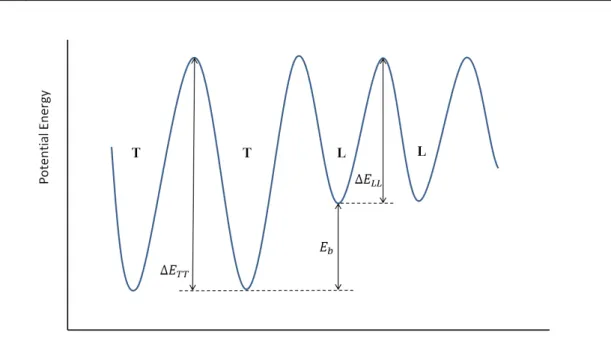
Thus, analysing the diffusion in certain orientation , the potential trace will have some well points where the hydrogen atom can be placed and saddle points to be overcome in the hop between neighbour sites.
In order to characterize the energy levels associated with different type of traps, there are different experimental techniques: one of the most used is Thermal Desorption Spectroscopy (TDS) (M Nagumo, Takai, & Okuda, 1999; Takai, Yamauchi, Nakamura, & Nagumo, 1998) in which trapping energies are closely related to the temperature at which the rate of desorbed hydrogen is greater. Isothermal methods such as electrochemical permeation might also be used to find the energies associated with traps if a number of tests at different temperatures are made (Oudriss, Creus, Bouhattate, Conforto, et al., 2012).
Such techniques have their limitations and with them it is challenging to obtain accurate values of binding energies for each type of trap because in the same specimen simultaneous effects of different traps occur (Maroef, Olson, Eberhart, & Edwards, 2002). Besides, by a well potential it is only possible to characterize the ideal vacancies or substitutional impurities. Most of the real traps have instead an associated distribution of energy wells and saddle points. Therefore, comparison of the experimental values with atomistic calculations (e.g. semiempirical potential in the above-mentioned EAM) will be crucial for better energy characterization of the traps in each specific situation.
Energy distributions has been can be calculated by the EAM for different systems, e.g. for hydrogen in body-centered-cubic iron (Wen, Xu, Fukuyama, & Yokogawa, 2001). In that work of Wen et al., calculated binding energies of dislocations and vacancies are in agreement with experimental values.
Grain boundaries (GB) are particularly complex because they not only act as trapping sites but they constitute accelerated diffusion paths or short-circuits (A Barnoush, 2011). However, knowledge and energy characterization of both phenomena are still limited.
Furthermore, the influence of hydrogen on grain boundary decohesion plays a fundamental role in intergranular fracture modelling (Alvaro, Thue Jensen, Kheradmand, Løvvik, & Olden, 2015).
2.3.4
Transition rate
Considering the metal lattice as a discrete space of sites, each jump is the step of a random walk with a length equal to the distance between two adjacent well points. In addition, the frequency of jump, i.e. the transition rate, will be the inverse magnitude of the time elapsed in a single step: 1/ . Starting from here, it is possible to reach numeric expressions of the diffusion coefficient.
2.3.4.1
Hop between equal sites
When all sites are equal, i.e. matrix without defects or one-level system, and there is no interaction between interstitial hydrogen atoms because the concentration is very low and all neighbour sites are empty, a single jumping frequency can be defined by means of an Arrhenius law. The exponential term indicates the probability of thermal energy exceeding the diffusion barrier; in other words, a thermally-activated jump with is considered:
exp (2.5)
The pre-exponential factor depends on the vibration frequency of the hydrogen atom, sometimes taken as the Debye frequency within the metal lattice and hence a quantum problem that is not reviewed here. This fact is related with tunnelling or delocalization. Therefore, deviation from the expected dependence of diffusion coefficient occurs at low temperatures (Hirth, 1980). Wimmer et al. obtain temperature-dependent diffusion coefficients in nickel from ab initio computations considering all vibrational terms (Wimmer et al., 2008). The pre-exponential factor is also greatly isotope dependent (Schaumann, Völki, & Alefeld, 1970).
empirical values of the diffusion coefficient. However, there exist elastic models able to calculate the diffusion barrier assuming a lattice elastic expansion (Ferro, 1957). However, with ε equal to the interatomic distance :
1
exp (2.6)
An Arrhenius type expression is obtained for :
exp (2.7)
2.3.4.2
Hop between different sites
More generically, following Toribio and Kharin’s work (Toribio & Kharin, 2015), it must be assumed that the jump occurs between different sites and even that the neighbour sites may already be occupied. The kinetics of mass exchange between two adjacent places, for instance A and B, can be described by the frequency Γ→ in which the hop from A to B occurs:
Γ→ Ω → (2.8)
It is equal to the frequency Ω → in which the jump is attempted, multiplied by the
probability that the jump is effective . The first term depends on the vibration frequency of the particle in A and the activation energy → acting as a barrier between A and B:
2.3.5
Driving force and flux
In classical physics, a force is any magnitude capable of modifying the momentum of a particle or system. Knowing that in the fluids there is an analogy between the Transport Phenomena (Bird, Stewart, & Lightfoot, 2007), i.e. momentum transfer, heat transfer and mass transfer, a force will also represent any agent capable of modifying the amount of energy or matter.
Momentum transfer has as driving force in a fluid the velocity gradient, which constitutes Newton's law relating the shear stress with such gradient and through the a coefficient called viscosity.
Analogically, there is the Fourier's law for heat transfer and Fick's law for mass diffusion. Focusing on diffusion, Fick's law assumes that the flux of particles of a component is proportional to the concentration gradient . This proportionality allows defining the diffusivity or diffusion coefficient with units of type m2/s. The negative sign indicates that transport is produced from high to low concentrations:
(2.11)
Exchange of matter will happen until thermodynamic equilibrium is reached. This equilibrium is characterized by the absence of variations in different thermodynamic quantities. This condition does not always mean an absence of concentration gradients (Gorban, Sargsyan, & Wahab, 2011). Onsager uses this fact to include the diffusion in the context of non-equilibrium thermodynamics (Onsager, 1931a, 1931b):
(2.12)
Where the component suffers a flux due to the different driving forces (each one defined as a vector). The matrix contains the corresponding coefficients. Moreover, each driving force defines a scalar potential in the classical form:
In other words, the thermodynamic equilibrium may be defined as the absence of gradients on the potential of these forces. Usually, the driving forces are caused by variations in chemical potential of the components, in temperature T, in pressure P, and in other external potentials. For example, transport due to temperature gradients is called Soret effect or thermophoresis; osmosis is explained by the pressure gradient; or if the external potential is due to electrostatic forces, the expression obtained is the Nernst-Planck equation.
When several of these processes occur at the same time, in order to consider a less complex approach, it is taken into account that all driving forces can be reduced into gradients of chemical potential (Wijmans & Baker, 1995). Thus, a flux of particles of component will be created:
(2.14)
When there is a multicomponent solution, the terms are designated as cross coefficients because they weight the influence of a component in the transport of the other. A different approach consist in establishing that hydrogen flux is equal to the contribution of all the jumps (Γ→ ) passing through a particular surface. Using Fourier series, flux vector can be expressed at a given point (Toribio & Kharin, 2015). This approach is more physical-based, but it is mathematically more complex than the phenomenological Onsager expression.
As noted, Fick's laws have a random distribution as numerical solution. This occurs when the only driving force is the concentration gradient. However, when the jump is not completely random, diffusion deviates from Fick's first law. This deviation can be described by a drift flux that is equal to the concentration multiplied by a quantity called drift velocity , which is always associated with a driving force. It is assumed that there is only one component and thereby the subscript is removed:
(2.15)
Following Teorell’s formula, a relation between the velocity and the driving force is obtained through the associated mobility defined above.
(2.17)
Although drift velocity and drift flux were initially defined for drag forces occurring in fluids due to advection, i.e., due to the bulk transport of the media, it is also applicable in rigid solids considering other phenomena that cause deviation of random motion. In addition, this double flux term also serves to explain the Kirkendall effect (Danielewski & Wierzba, 2010). Nevertheless, the approach based on the equation 14 allows to include both random effects and the deviation from them in the chemical potential as the only driving force. In this case, the flux is:
(2.18)
where the mobility is considered as expressed before. It could be shown how, for dilute solutions, substituting the value of the chemical potential as a function of concentration
Fick's first law is finally obtained.
2.4
Interstitial Solid Solutions
For the purpose of modelling the continuum, it must be found an accurate function of the chemical potential . Then, a flux tending to equalize the chemical potentials until equilibrium is established.
2.4.1
Chemical potential
As noted, hydrogen atoms tend to stay in places of low potential free energy. From fundamental thermodynamic relations the chemical potential is defined as a molar free energy. Considering the Helmholtz free energy:
, ,
(2.19)
But the most common conditions in engineering are those of constant pressure and temperature. In that case the Gibbs free energy is used:
, ,
(2.20)
As seen in section 3.3, the potential energy landscape characterizes diffusion at the atomic level. Making the necessary corrections, microscopic properties of the lattice should be translated into macroscopic features (thermodynamic potentials). The tool that bridges the gap between both scales is provided by statistical mechanics.
Alternatively, through an atomic approach, Venturini et al. (Venturini, Wang, Romero, Ariza, & Ortiz, 2014) define a particle chemical potential that may vary from particle to particle, thus it is not a uniform field. In such a case, driving forces and linear kinetics are considered discrete.
2.4.1.1
Statistical Mechanics
Entropy can be divided into a configurational part , dependent on the "order" of the particles, and a non-configurational part . Configurational entropy follows Boltzmann law depending on the number of possible microstates :
ln (2.21)
Possible microstates are calculated by means of combinatory as a function of the number of particles and the number of possible sites :
!
! ! (2.22)
Using, as it is usually done in statistical physics, Stirling's approximation, and an expression for the chemical potential is obtained (Fukai, 2006). Defining a dimensionless concentration called occupancy / :
ln
1 (2.23)
If only the configurational entropy is considered, the model is called quasi-regular solution (Lumsden, 1952; Lupis & Elliott, 1967; R. B. McLellan, 1972). In this case, 0 is the
molar enthalpy.
The next step is to take into account the interaction energy between pairs of atoms (Guggenheim & McGlashan, 1951): solute-site (H-S), solute-solute (H-H) and site-site (S-S). The total energy is the sum over all possible pairs. In that term the coordination number of interstitial sites is also included, depending on the type of cell (R. B. McLellan, 1972). Because there is an energetic degeneracy dependent on the configuration of the sites, the canonical ensemble is used, whose partition function is:
where the summation is made over each of the possible configurations and is the degeneracy of each one. From this partition function, it can be found the Helmholtz free energy :
ln (2.25)
There are two possibilities to calculate the partition function: zeroth order or first order treatment. In the first case it is considered that the atoms are randomly distributed in the interstitial sites so the sum of all states is replaced by a single degenerate state (Alex & McLellan, 1970).
Actually, each interstitial solute atom restricts to a number of neighbour sites to be occupied. It is what is called quasi-chemical or first-order treatment (R. B. McLellan & Dunn, 1969). In this approach, therefore, the entropy is not completely random. Now it is not possible to suppose a single degenerate state and the expression for degeneracy will be much more complex.
In both cases, however, there is a term independent on occupancy, ; another term associated with the number of possible microstates and finally a more or less extensive sequence of terms that depend on configuration , on occupancy and on the interaction energy between hydrogen atoms :
ln
1 , , (2.26)
2.4.1.2
Fermi-Dirac distribution
Hydrogen in a metal lattice follows Fermi-Dirac statistics because each energy state can be occupied only by an atom and therefore an analogy with the Pauli exclusion principle can be established. The probability that the level is occupied by a hydrogen atom corresponds to the Fermi-Dirac distribution:
1
1 exp (2.27)
Equivalence between the chemical potential and the Fermi energy is assumed, although this is physically arguably [68]. The total occupancy will be:
(2.28)
Where is the degeneracy of the energy state , i.e. the density of site energies (DOSE) (Reiner Kirchheim, 1988). For an interstitial solid solution, being the total number of sites of type , degeneracy means the normalized number of such sites:
∑ (2.29)
If the energy levels are very close, occupancy and degeneracy can be expressed in a continuous manner:
1 exp (2.30)
Degeneracy has a different expression depending on whether one considers the perfect crystal, with certain defects or completely amorphous. There will be considered only extreme cases.
In the former case, a lattice without defects represents a completely degenerate state in which the distribution of sites follows the Dirac delta function (Reiner Kirchheim, 1988). The potential well is constant and equal to 0.
(2.31)
Solving the corresponding integral (substituting eq. 31 in 30) and isolating the chemical potential, a similar expression is obtained where the term 0 is equivalent to the energy of a
potential well in the ideal matrix, 0.
ln
1 (2.32)
For the latter case, the amorphous state, it is almost impossible to know the real distribution of defects and therefore the energy states distribution. Nevertheless, the amorphous state can be characterized as a deviation from the perfect crystal, i.e. with a mean value of 0,
following a normal distribution. Kirchheim (Reiner Kirchheim, 1988) makes some simplifications in order to solve the integral and obtains for high temperatures and low concentrations:
4 ln (2.33)
This expression tends to that of an ideal dilute solution ideal. The less irregular the crystal is (less deviation 2 from perfect lattice) the more ideal behaviour will have.
2.4.1.3
Corrections
system includes not only the lattice energy generated by the interatomic forces; vibrational and thermal effects must also be taken into account (Anderson, 1989).
Therefore, when theoretical calculations of the chemical potential are compared with experimental results, two corrections should be introduced. The first correction is made by a phonon term or zero-point energy (Hao et al., 2012; Jiang & Carter, 2004). The second one is a correction due to the thermal electronic excitations (Christensen et al., 1990).
2.4.2
Chemical activity
Chemical activity can be defined through the chemical potential:
ln (2.34)
In this expression the chemical potential in a reference state 0 corresponds to that of an
activity equal to unity. Taking into consideration the forms of the chemical potential previously found, Henry’s law and ideal behaviour are satisfied only for a dilute solution, i.e.
≪ 1.
Interaction effects between hydrogen atoms, non-configurational entropy excess and corrections by zero point energy and thermal excitations will be neglected hereinafter. And therefore, the chemical potential of a component (disregarding the stress state) will be:
0 ln
1 (2.35)
2.4.3
Equilibrium between sites
As said in sections 3.3 and 3.4, there are various kinds of sites that can be seen as two different species. An exchange of matter between them, characterized by its energy relationship, is established. In a physicochemical approach, reaction between the hydrogen atoms ( ) and the empty sites ( ) of each state is assumed and therefore a law of mass action can be used (R Kirchheim, 1982)
When the reaction, that is, the exchange between A and B reaches equilibrium, a constant can be defined. Concentrations of empty and filled sites are here expressed in terms of the number of particles and the number of each type of site :
(2.37)
Expressed in terms of occupancy, / , Oriani’s equilibrium (R. A. Oriani, 1970) equation is obtained:
1 1 (2.38)
The value of the equilibrium constant follows an Arrhenius law. This can be proved because in equilibrium between both species, their chemical potentials are equal. Therefore, with equations (35) and (38) and imposing :
exp
0 0
(2.39)
The difference between the potential in the standard state of both species can be seen as the enthalpy of formation of a reaction. In the context of diffusion affected by microstructural traps, this enthalpy is called the binding energy between the two sites: 0 0. As mentioned above, binding energy is used in this research work to characterise crystal defects with positive values; that means: 0 and exp / .
2.4.4
Stress state
In a lattice subjected to a traction stress state, the sites will be wider and hence the chemical potential will be lower. In different thermodynamic studies on stressed solids (A. G. McLellan, 1970) it has been found:
0 (2.40)
This means that the energy of interaction of hydrogen atoms with the stress field only depends on the diagonal terms of the stress tensor, 13 11 22 33 and on the
hydrogen partial molar volume .
Here, only spherical distortion is considered. However, depending on the type of lattice there will be a greater or lesser anisotropy that causes non-symmetrical distortion (Hirth, 1980). In this case, the distortion is tetragonal and the off-diagonal stress terms are also important (T.-Y. Zhang & Hack, 1999).
Interaction energy can also be calculated for a dislocation stress field interacting with an hydrogen atoms atmosphere (Robertson, 2001; Sofronis & Birnbaum, 1995). This approach is fundamental in localized plasticity theories.
2.5
Two-level continuum model
Another simplification is to consider that all the saddle points have the same energy for the entire crystal. Therefore, a single activation energy is considered for interstitial diffusion . Furthermore, this diffusivity is considered independent of concentration.
For convenience, hereinafter the more usual nomenclature in bibliography will be used. Energies are usually expressed per mol so the universal constant R is included. In addition, the occupation in each kind of site represents the relationship between the hydrogen concentration and the concentration of this type of site.
2.5.1
Interstitial flux
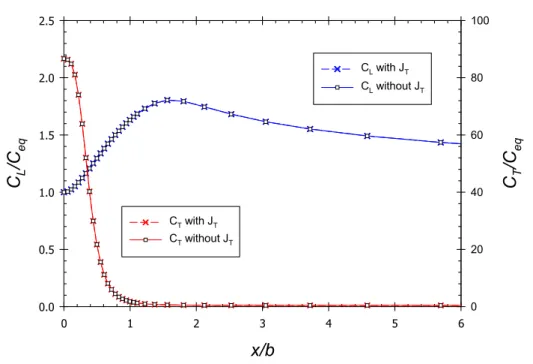
It is assumed, by definition, that traps are isolated from each other (Di Leo & Anand, 2013). Thus 0 and only the interstitial flux is considered. Another interpretation (Toribio & Kharin, 2015) consists of neglecting flux between traps only if the jump between the two places is unlikely: when there are few traps or when excessive energy is required; in this case need not be considered isolated traps. Anyway, taking the interstitial flux (18), the total hydrogen flux is:
(2.41)
This means that only interstitial diffusion is considered and the trapping influence is taken into account as a reaction between the two species.
2.5.2
Chemical potential
Despite being the chemical potential gradient which governs diffusion, equations are traditionally expressed in terms of a more familiar physical variable: concentration. The simplification made here is to consider a dilute solution, i.e., low occupancy: ≪ 1. Thus, with (35) and (49) the chemical potential is:
0 ln (2.42)
Substituting equation (41) into (42) and operating, flux is obtained as a concentration function:
(2.43)
It can be observed how, analogically to (15), (16) and (17), a random term and a drift flux have been obtained. The drift force is here the hydrostatic stress gradient.
2.5.3
Mass balance
Mass conservation implies that the variation of hydrogen concentration in the total volume must be equal to the flux through the surface containing it. Numerically:
0 (2.44)
Substituting (43) in (44) and using the divergence theorem, this balance represents a modified form of the second Fick’s law.
0 (2.45)
kinetics of exchange between interstitial sites and traps. All models reviewed are isothermal, i.e., there are no temporal or spatial temperature variations.
2.5.4
Trapping in
f
luence
Depending on the considered relationship between traps and interstices, a different numerical expansion of / is obtained.
2.5.4.1
Effective diffusivity
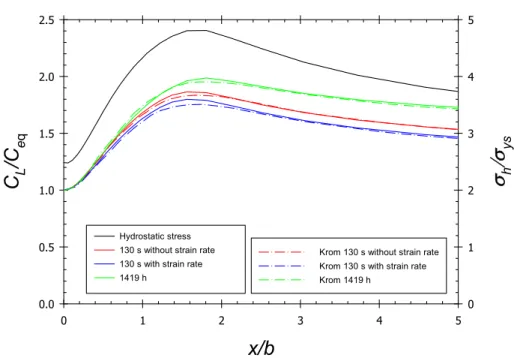
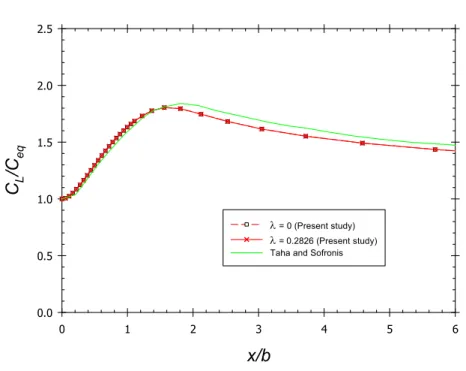
One of the first attempts, if not the first, to develop a finite element simulation of a two-level diffusion was made by Sofronis and McMeeking (Sofronis & McMeeking, 1989). The general transport equation (45) can be rewritten:
1 0 (2.46)
It is possible to define an effective diffusion coefficient representing the delay in diffusion produced by trapping:
1
1 / (2.47)
Finally, the general equation used by Sofronis and McMeeking has the form:
(2.48)
In their work, Oriani’s equilibrium is assumed. Deriving from (38) and with ≪ 1:
1 (2.49)
The concept underlying the permeation test is simple: evaluating the time that hydrogen takes to diffuse through a thin layer of metal. With this purpose, (Devanathan et al., 1963) proposed an set of two cells: a charging cell in which hydrogen is produced and absorbed in the entry surface of the thin metallic specimen and an oxidation cell in which hydrogen atoms that have reached the exit side of the membrane are oxidised. Hydrogen flux on the exit side might be recorded since it is proportional to the oxidation current density. This test is standardised by the ISO 17081:2014 Method of measurement of hydrogen permeation and determination of hydrogen uptake and transport in metals by an electrochemical technique. The output flux rises after the first atoms reach the exit surface and stabilises at a certain time. The final flux is called steady state flux .
Parameters are obtained by numerical fitting techniques; an analytical expression of the permeation transient flux must be then analysed. In order to obtain these equations, some simplifications are considered. In addition, a proper selection of boundary conditions must be made to reflect the real permeation behaviour. Boundary conditions are the mathematical translation of the physical phenomena implied in hydrogen uptake, i.e. during adsorption and absorption processes. Permeation tests are usually carried out by electrochemical means. As it is mentioned in the previous section, a realistic generalised boundary condition is not usually taken into account in the electrochemical permeation. Nevertheless, hydrogen absorption in a gaseous H2 environment can be more easily modelled using Sievert’s law.
2.5.4.2
Plastic strain influence
From the previous model, Krom et al. (A. Krom, R. Koers, & A. Bakker, 1999) consider the plastic strain rate. Applying the chain rule, an additional term is included:
(2.50)
Oriani’s equilibrium is again assumed obtaining:
The number of traps is not a characteristic value of the matrix and is very difficult to determine because of the large variety of microstructural defects that can be included under this category. However, various investigations have shown that the trap population is associated with dislocation density and depends on the level of plastic strain.
Despite the usual employment of expressions relating with , it should be noted that this is an important simplification: the number of traps depends not only on dislocations as there will be other types of traps: grain boundaries, vacancies, inclusions, etc.
Number of trapping sites NT could depend on many microstructural factors: grain size
(Oudriss, Creus, Bouhattate, Conforto, et al., 2012), grain boundary misorientation (Oudriss, Creus, Bouhattate, Savall, et al., 2012), density of inclusions , etc. But the importance of hydrogen diffusion in a crack tip has led to many authors to relate NT with the equivalent plastic strain . From a crystallographic point of view, an individual trap might be assumed for each atomic plane intersected by a dislocation. Sofronis et al. (Sofronis, Liang, & Aravas, 2001) calculate the number of traps from the dislocation density (m/m3), and the lattice parameter a (m):
√2 (2.52)
For the dislocation density, those authors use an empirical expression of :
, 0.5
10 , 0.5 (2.53)
(2.54)
where is associated with dislocation storage, and with dislocation annihilation by recovery. Actually, depend on rate, but assuming that it is also constant and solving the differential equation (2.57(2.57), the following relationship is obtained:
exp 1
2 (2.55)
Here, according to Horstemeyer et al. , only includes the Statistically Stored Dislocations (SSD). If Geometrically Necessary Dislocations (GND) are to be introduced, grain boundary effects (Oudriss, Creus, Bouhattate, Conforto, et al., 2012) and Strain Gradient Plasticity (SGP) (Martínez-Pañeda, del Busto, Niordson, & Betegón, 2016; Martínez-Pañeda & Niordson, 2016) should be discussed.
Oudriss et al. (Oudriss, Creus, Bouhattate, Conforto, et al., 2012) have found that decreases with grain size in polycrystalline nickel. As a first approximation they assumed that
is due to geometrically necessary dislocations (GND), because the density of GND decreased as the grain size increased. But the difference between experimental and calculated indicates that vacancies played a crucial role in trapping.
Dislocations are not immobile defects and, additionally, an hydrogen enhanced mobility has been found, establishing the HELP theory. From the previously defined transport model, Dadfarnia et al. (Mohsen Dadfarnia, Martin, Nagao, Sofronis, & Robertson, 2015) have implemented the mobility of dislocations by means of a drift term consisting of an hydrogen flux associated with mobile dislocations. This term includes dislocation mobility in transport models but does not consider how this mobility is enhanced by hydrogen. Moreover, Zhang et al. (X. Zhang et al., 2010) found by way of quantum and molecular mechanics simulations that dislocations and stacking faults can promote the so-called “pipe diffusion” creating short-circuits for hydrogen.
the effective diffusivity it is possible to fit an empirical relationship (Dietzel, Pfuff, & Juilfs, 2006; Juilfs, 2002; A. J. Kumnick & H. H. Johnson, 1980).
A commonly used result is the obtained by Kumnick and Johnson (A. J. Kumnick & H. H. Johnson, 1980) by permeation tests in alpha iron with different levels of equivalent plastic strain. Their results are fitted into the following expression (Sofronis & McMeeking, 1989):
log 23.26 2.33 exp 5.5 (2.56)
p
0.0 0.1 0.2 0.3 0.4 0.5
NT
(sit
es/
m
3 )
1e+19 1e+20 1e+21 1e+22 1e+23 1e+24 1e+25 1e+26
Kumnick and Johnson, 1980 Sofronis et al., 2001 Juilfs, 2002
Figure 2-5. Comparison between different expressions for found in literature.