Treatment of gas phase styrene in a biofilter
under steady-state conditions
ELDON R. RENE, MARÍA C. VEIGAAND CHRISTIAN KENNES Faculty of Sciences, Chemical Engineering Laboratory,
University of La Coruña, 15071 – La Coruña, Spain
347 ABSTRACT
Preliminary studies on the performance of a laboratory scale perlite biofilter inoculated with a mixed culture taken from petrochemical refinery sludge was evaluated for gas phase styrene removal under various operating conditions. Initially, the biofilter was acclimatized for 53 days at constant loading rates (40-60 g/m3.h), wherein the performance gradually improved with fluctuations in the removal profiles. Experiments were carried out by subjecting the biofilter to different flow rates (150, 300 l/h) and concentrations (0.5 – 5 g/m3), that corresponds to inlet loading rates between 60 – 200 g/m3.h. The results from this study show100% styrene removal with a maximum elimination capacity of 190 g/m3.h.
1 INTRODUCTION
Biodegradation is a promising alternative for the mineralization of volatile organic compounds (VOCs). The most widely used biological processes for waste gas treatment are bioscrubbing, trickling biofilters and biofilter. The simplicity in the operation of biofilters has resulted in its emergence as a more practical treatment option (Kennes and Veiga, 2001). Biofilters have also proven to be effective in treating large volumes of VOCs at relatively high concentrations (Kennes et al., 1996; Mohammad et al., 2007). A complex phenomenological step consisting of adsorption, absorption, diffusion and biodegradation takes place in a biofilter where the pollutant is converted to non-toxic end products (Devinny et al., 1999). Furthermore, the removal and oxidation rates of these hazardous contaminants depend principally on the biodegradability, reactivity and largely on the solubility of the pollutant in the liquid layer of the biofilm. Biofiltration studies have been tested with different packing materials and with a wide variety of pollutants having different degradation rates. Typical examples are biofilters packed with perlite as inert carrier material that have been used to treat styrene or alkylbenzene vapours (Kennes et al., 1996; Cox et al., 1997; Paca et al., 2001; Veiga and Kennes, 2001).
For styrene removal in biofilters, individual or mixed species of bacteria have generally been used according to literature. Pseudomonas sp. represents the most common group of isolates capable of styrene degradation and has been shown to produce styrene mono-oxygenase, which plays a major role in styrene degradation (O’Leary et al., 2002). Jang et al (2004) used Pseudomonas sp in a biofilter packed with peat and ceramic beads to treat styrene vapours and was able to show a maximum elimination capacity (EC) of 170 g/m3.h. Similarly, a mixed culture biofilter packed with perlite showed maximum EC of 145 g styrene/m3.h (Weigner et al., 2001). Ryu et al. (2004) used a polyurethane foam biofilter inoculated with activated sludge and achieved EC ranging between 580~635 g/m3.h at a space velocity (SV) of 50~200 per hour.
These experimental studies have proved biofiltration as an efficient waste gas treatment process and a reliable technology for the control of off gases containing styrene. This paper present the performance of a perlite based mixed culture biofilter treating styrene vapours at different concentrations and flow rates.
2 MATERIALS AND METHODS
2.1 MICROBIALSEED
2.2 BIOFILTER
The biofilter was made of glass having a diameter (ID) of 10 cm and 70 cm in height. The packing in the biofilter consisted of sieved perlite beads (4-6 mm). A perforated plate at the bottom provided the support for the packing while another plate at the top acted as a distributor for gas flow and mineral salt media addition. Gas sampling ports sealed with rubber septa were provided at equal intervals along the biofilter height.
2.3 EXPERIMENTAL
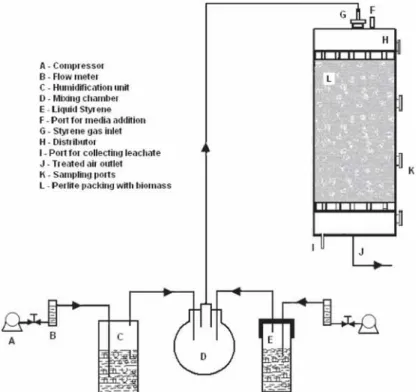
A schematic of the experimental setup is given in Figure 1. Humidified styrene vapors at constant flow and concentration, controlled through valves were passed through the bed in a down flow mode. The bed moisture was maintained constant by periodic addition of fresh mineral salt medium (Kennes et al., 1996) from the top. Experiments were carried out by varying the flow rates of the styrene vapors and humidified air independently to get different initial concentrations and residence times in the biofilter. Gas samples were collected from different ports and analyzed for residual styrene and CO2 concentration.
2.4 ANALYTICALMETHODS
Styrene concentration in gas samples were measured by gas chromatography on an HP 5890 gas chromatograph, using a 50 m TRACER column and a FID detector. The flow rates were 30 ml/min for H2 and 300 ml/min for air. Helium was used as the carrier gas at a flow rate of 2 ml/min. The temperatures at the GC injection, oven and detection ports were 150, 150 and 150°C respectively. CO2 was analyzed with a HP 5890 gas chromatograph equipped with a TCD detector. The injection and oven temperatures were 90 and 25 oC respectively, with the TCD set at 100 oC. Biomass concentration, as g of dry biomass/ g of perlite was measured according to the procedure outlined by Mohammad et al. (2007).
3 RESULTS AND DISCUSSIONS
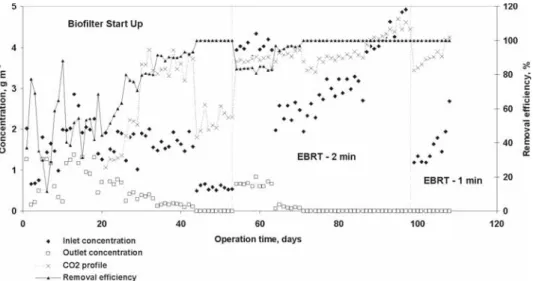
The performance of the biofilter was evaluated in terms of two parameters, the removal efficiency (RE, %) and the elimination capacity of the filter bed (EC, g/m3.h). The biofilter was initially acclimatized to styrene vapours by passing low concentrations and low gas flow rates (150 LPH) for 53 days to obtain sufficient biomass concentration in the filter bed. The biofilter was run under these conditions to achieve stable and high removal efficiencies. During the operation, the relative humidity of the air stream was maintained at around 95%.
reported in literature using biofilters for handling styrene vapours, which could be due to the dominant presence of fungi as shown in Figure 2. Indeed, it has been reported that fungal dominant biofilters would allow reaching a better performance than usual for hydrophobic VOCs (Kennes and Veiga, 2004).
Figure 2. SEM images of different biomass on the surface of perlite.
Figure 4. Effect of inlet loading rate on the elimination capacity of biofilter.
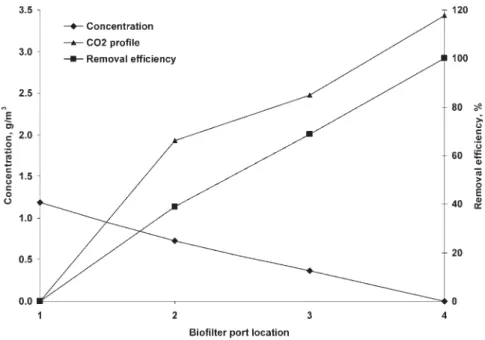
For better understanding the styrene elimination mechanism within the reactor, the concentration profile at different heights was measured at a constant loading rate. The results indicate that styrene removal is more efficient in the higher part (Port 2) than in the lower section of the filter bed. Nearly 40% of styrene was removed in the first section followed by 30% respectively in the other two sections (Figure 5). This may be due to a higher concentration of microbial populations and higher moisture content in the upper section of the filter bed.
In any biofiltration process, the volatile organic compounds are aerobically degraded to water, carbon dioxide, and biomass. Hence it is important to monitor the profile of CO2 in gas phase, at the inlet and outlet of the biofilter. These profiles are also shown in Figure 5, when the inlet loading rate was 84 g/m3.h. Complete mineralization was confirmed from these CO2 profiles measured along the biofilter height.
Figure 6. Temperature and biomass dry weight profile along the biofilter height (Day 99: Inlet loading rate – 84 g/m3.h, Removal efficiency – 100%).
4 CONCLUSIONS
The results from this preliminary study show that the removal of styrene vapours from off gas emissions can be performed with high efficiencies by means of a biofilter. A petrochemical sludge provides easily adaptable microbial strains capable of degrading VOCs. Removal efficiencies as high as 100% were achieved under the present operational conditions at inlet loads varying between 60 – 190 g/m3.h, reaching a high maximum EC of 190 g/m3.h, which could be due to the dominant presence of fungi.
5 ACKNOWLEDGEMENTS
The present research was funded by the Spanish Ministry of Education and Science (Project No: CTM2004-00427/TECNO) and through European FEDER funds. The post doctoral research of E.R.R was funded by the same Ministry.
REFERENCES
Cox, H.H.J., Moerman, R.E., van Baalen, S., van Heiningen, W.N.M., Doddema, H.J. and Harder, W. (1997) Performance of styrene degrading biofilter containing the yeast Exophiala jeanselmei. Biotechnol. Bioeng. 53: 259-266.
Devinny, J.S., Deshusses, M.A. and Webster, T.S. (1999) Biofiltration for air pollution control. Lewis Publisher, Boca Raton.
Fielder, R.J. and Lowing, R. (1981) Toxicity Review 1: Styrene. Health and Safety Executive, London.
Jang, J.H., Hirai, M. and Shoda, M. (2004) Styrene degradation by Pseudomonas sp. SR-5 in biofilters with organic and inorganic packing materials. Appl. Microbiol. Biotechnol. 65(3): 349-355.
Jorio, H., Bibeau, L. and Heitz, M. (2000) Biofiltration of air contaminated by styrene: effect of nitrogen supply, gas flow rate and inlet concentration. Environ. Sci. Technol. 34: 1764-1771.
Kennes, C., Cox, H.H.J., Doddema, H.J. and Harder, W. (1996) Design and performance of biofilters for the removal of alkylbenzene vapours. J. Chem. Technol. Biotechnol. 66: 300-304.
Kennes, C. and Veiga, M.C. (2001) Conventional Biofilters, In: Bioreactors for waste gas treatment, (Eds: Kennes, C., Veiga, M.C), Kluwer Academic Publishers, Dordrecht, The Netherlands, 47-98.
Mohammad, B.T., Veiga, M.C. and Kennes, C. (2007) Mesophilic and thermophilic biotreatment of BTEX polluted air in reactors. Biotechnol Bioeng. 97: 1423-1438.
O’Leary, N.D., O’Connor, K.E. and Dobson, A.D.W. (2002) Biochemistry, genetics and physiology of microbial styrene degradation. FEMS Microbiol. Rev. 26: 403-417.
Paca, J., Koutsky, B., Maryska, M. and Halecky, M. (2001) Styrene degradation along the bed height of perlite biofilter. J. Chem. Technol. Biotechnol. 76: 873-878.
Ryu, H.W., Kim, J., Cho, K-S., Jung, D.J. and Lee, T.H. (2004) Biological treatment of air contaminated with styrene. In: Proceedings of the Better Air Quality Conference, CAI-Asia, Agra, India.
Veiga, M.C. and Kennes, C. (2001) Parameters affecting performance and modelling of biofilters treating alkylbenzene polluted air. Appl. Microbiol. Biotechnol. 55: 254-258.