DNLM-MA-P: A Parallelization of the
Deceived Non Local Means Filter with
Moving Average and Symmetric Weighting
Sa´ul Calder´on
∗, Jorge Castro
†,Manuel Zumbado
‡ ∗‡Pattern Recognition and Machine Learning GroupSchool of Computing, Costa Rica Institute of Technology
†‡Advanced Computing Laboratory, Costa Rica National High Technology Center
∗[email protected], †[email protected],‡[email protected].
Abstract—This paper presents a novel computational optimization of the deceived non local means filter using moving average and symmetric weighting. The proposed optimization is compared with different approaches that reduce the computational cost of the deceived non local means filter. Furthermore, the impact of parallelizing different optimization approaches is assessed by eval-uating the execution time and scalability in Xeon Phi KNL architecture. The proposed optimization for the sequential implementation achieved a 90x speedup, while its parallelized implementation yielded a speedup of up to 1662x.
Index Terms—Non Local Means filter, Image Pro-cessing, Parallelization, Optimization, Xeon Phi Knights Landing.
I. INTRODUCTION
Image and signal denoising refers to suppressing partially or completely irrelevant energy from a sig-nal, as images are affected by many noise sources like sensor sensibility or imperfections in the capture and communication processes. It is a well addressed problem in literature, with vast number of techniques proposed [1]. Noisy input images decrease the per-formance of common image processing tasks such as segmentation, object tracking and classification [2]– [4]. Thus, it becomes an important issue to incorporate denoising and enhancement techniques as a prepro-cessing stage, to increase performance of latter steps. Furthermore, the usage of a preprocessing stage has improved the model precision of popular Convolu-tional Neural Network (CNN) based approaches for image processing related tasks [5], [6]. CNN models build feature extractors upon training data, in spite of classical hand-crafted feature extraction approaches, which leads to the intuition that CNN methods are more robust to noisy training data than hand-crafted approaches. However, previously reported results [5], [6] suggest that CNN based methods are also sig-nificantly sensitive to noisy data, which leads to the
need of implementing preprocessing approaches for data denoising and relevant information enhancement. Nevertheless, implementing complex and powerful image preprocessing approaches for enhancing the overall precision of different image based pattern recognition tasks comes at the price of increasing the need of computational resources. This encourages the implementation of increasingly efficient computational optimizations of popular preprocessing techniques.
We implement and compare different optimizations of Deceived Non Local Means (DNLM) filter [7], which performs both image enhancement and denois-ing, using the popular edge preserving Non Local Means (NLM) kernel designed for image denoising [8]. DNLM brute force implementation presents a high computational cost, which has been addressed previ-ously [9], but still is not suitable for preprocessing large data sets. For example in the case of the auto-matic segmentation of cell activity videos, researchers need to analyze hundreds of thousands of images [2]. Also, preprocessing large datasets for CNN models is useful as recent work reveals [6]. For those reasons, we focus on techniques to reduce DNLM computa-tional cost, and moreover, we explore its paralleliza-tion to further reduce its execuparalleliza-tion time. We evaluate the parallelization of the original brute force DNLM implementation and two computational optimizations of the filter on Xeon Phi Knights Landing (KNL) architecture. Both optimizations of DNLM filter and its original version are parallelized using thread level par-allelism (OpenMP) and data level parpar-allelism (vector-ization). We measured the speedup of the parallelized filters against its sequential version.
performed experiments and its results are detailed in Section IV. Finally, we present the conclusions and future work in Section V.
II. BACKGROUND
A. DNLM Description
DNLM performs both image denoising and the enhancement of contrast and edges. This filter is a particularization of the Deceived Weighted Averaging Framework (DeWAFF), as it uses NLM kernel to filter an imageFUSMenhanced with any Unsharped Masking
(USM) technique, but using the original imageU for the kernel weighting. This is done to avoid the often resulting ringing artifacts in USM approaches. For instance, image FUSM can be calculated as a simple
linear combination FUSM = U + λL, with L the negative laplacian approximation, andλthe sharpening gain.
DNLM filter is formally expressed as:
Y(U, p) = P
m∈ΩψNLM(U, p, m)FUSM
P
m∈Ω ψNLM(U, p, m)
, (1)
wherepis a specific pixel andΩthe current search window of|Ω|=S pixels around pixelp.
DNLM uses the non local means weighting function [8], which measures per pixel neighborhood dissimi-larity. The weighting function of NLM filter is defined as:
ψNLM(U, p, m) =exp −
−
→η(ω, m)− −→η(ω, p)
2
h
!
, (2)
with −→η(ω, m) being the vectorized neighborhood of |ω|=W pixels for the pixel m within U, and hthe parameter for controlling filter smoothing. NLM kernel showed superior denoising and enhancement results when compared with other kernels as the bilateral filter [2].
B. Optimization approaches for NLM and DNLM fil-ters
Many sequential optimizations have been proposed to reduce the time complexity of NLM filter which, for its brute force implementation, is ofO(N ×S×W) for gray-scale images, where N, S, and W are the number of pixels in the image, search window, and neighborhood window, respectively. Some of these optimizations are based on approximations of NLM filter [10] or modifications that improve its results [11]–[16], however we discarded both categories in this paper, as we aim to first preserve similar behavior of DNLM filter.
In this section we focus on exploring computational optimizations of NLM filter, to port them to DNLM
(a) Original image (b) DNLM-MA output
Figure 1. Output of DNLM filter with a window size of21×21, a neighborhood size of7×7,h= 5, andλ= 15. The input sample is an X-Ray image for an automatic patient age assessment approach based on CNN with DNLM filter as a preprocessing stage [6].
filter. One technique within this category uses inte-gral images and the Fast Fourier Transform (FFT) to compute the distance between different neighborhoods, reducing the time complexity of the filter toO(N×S) [17], [18]. The distance computation has also been optimized exploiting the weight symmetry between pixels, using a moving average, and reordering the filter loops, reducing the computation time to O(N ×S) [19]. Later, a similar approach was proposed using a separable convolution to implement the moving aver-age filter [20], leading to a similar time complexity reduction. Also, an optimization based on the Sum of Invariant Lines (SIL) yields a time complexity of O(N× S×√W)[21].
Since DNLM filter requires the decoupling of the weighted image and the filtered image we focus on the optimizations that meet that requirement and best reduce the time complexity of the algorithm. Those optimizations are the proposed by Wang [17] and Condat [20]. The optimization proposed by Goossens [19] is very similar to the proposed by Condat, but the latter is more suitable to parallelize since it implements the moving average as a separable convolution, remov-ing data dependencies and leadremov-ing to a computational complexity of O(N ×S ×√W). The optimization proposed by Wang has already been partially imple-mented without symmetry assumption for DNLM filter, achieving a speedup of up to ten times [9]. In this work we implement the optimization proposed by Condat for NLM to optimize DNLM filter.
C. Previous parallelization approaches for non local means filter
parallelization of the filter was done using multiple threads to process 3D medical images in a server with eight Xeon processors [22]. Later, a Single In-struction Multiple Data (SIMD) architecture was used to parallelize the filter in a server with eight Dual-Core AMD Opteron processors [23]. Also, GPU im-plementations of the filter have been proposed based on Goossens’ optimization on DirectX [24] and Condat’s optimization on CUDA platform [25], [26], where the first and the latter work reported higher speedup than previous CPU implementations. A slightly higher speedup to the one obtained by Marques and Pardo [24] was achieved parallelizing the filter with MPI in a distributed memory system with 1024 cores [27]. A more complex implementation of an improved NLM filter on hybrid parallel architectures, combined MPI with P-threads and MPI with CUDA to achieve a high speedup [28]. Finally, two implementations of the filter on Intel Xeon Phi platforms were proposed using OpenMP [29], [30] and OpenCL [29].
Although the speedup obtained on GPU platforms is usually higher than the ones obtained on Intel Xeon Phi platforms, the latter platform provides a more flexible and simple programming style that is very suitable for developing parallel image processing algorithms prototypes, since it uses the x86 instruction set [30].
Table I
PREVIOUS PARALLEL IMPLEMENTATION METHODS FORNLM
FILTER. ONLY THE MAXIMUM SPEEDUP WITH RESPECT TO THE SEQUENTIAL-UNOPTIMIZED VERSION OF THE FILTER IS SHOWN.
Implementation Platform Parallel tool
Speedup
Coupe et al. [22]
8 Intel Xeon CPU Threading library
8 Intel Xeon CPU MPI and PThreads
Intel Xeon Phi OpenMP 32×
III. PROPOSED METHOD: ACCELERATINGDNLM FILTER
We propose and develop both parallel and vec-torized versions of two computational optimizations for DNLM filter, namely IIFFT and DNLM-MA. Moreover, the proposed implementations take advantage of the Xeon Phi KNL platform features. Vectorization is successfully achieved by using Intel Performance Primitives (IPP) with AVX-512 support for almost all pixel operations.
The optimized DNLM-MA filter is based on the Moving Average (MA) and symmetry approach pro-posed by Condat [20]. Following the formal definition of DNLM filter, a pixelycan be expressed in terms of the displacement from pixelxasy=x+ ∆, within a search window ofs pixels. For instance, for a search window of5×5, with s= 25 pixels,∆ can take the values ∆ = 0, ∆ = 1, ∆ = 2, and in general goes up to∆ =S/2. Thus, the weighting function of NLM accomplishes symmetry as:
ψNLM(U, x, x+ ∆) =ψNLM(U, y, y−∆) . (3)
The weights are computed by swapping the loops, as it iterates for each displacement∆, instead of iterating over all of the pixelsU. For each iteration, the squared difference is computed for the entire image as:
D∆(x) = (U(x)−U(x+ ∆))
◦2
, (4)
where the squared power is a pixel wise operation following the Hadamard notation.
Then, a convolution of the resultD∆with a moving
average kernel of sizeW is performed by:
E∆(x) =D∆(x)∗G , (5)
withGan unary matrix with the neighborhood dimen-sions.
Thus, the weight function of DNLM-MA is given by the element-wise exponential function, also written with the Hadamard notation as:
ψ∆= exp◦
DNLM-MA filter response for each iteration is given by the pixel wise product of the weights in ψ∆ and
FUSM as:
Y∆=ψ∆◦FUSM . (7)
accu-mulating the weights for all the displacements ∆ in matrixψDNLM-MA as:
ψDNLM-MA=
q
X
∆=0
ψ∆ (8)
then, sum up all its elements to fulfill c = ΣiψDNLM-MA(i). To attain the filter output, partial filter responses calculated in equation (7) are accumulated, normalized byc, as:
YDNLM-MA=
q
X
i=0
c−1Y∆ . (9)
The parallelized DNLM-MA is done with the con-current computation of each ∆ iteration. However, since the search window sizeS is not large enough to provide enough parallelism for outer loop paralleliza-tion, we opt to parallelize the computation of (4) to (7) to take advantage of the many-core architecture.
It is important to highlight that the weight com-putation in DNLM-MA performs operations over all the image for each iteration, corresponding to each displacement ∆, in spite to DNLM-IIFFT and brute force implementations. This leads us to the intuition that DNLM-MA filter has higher memory bandwidth requirements than DNLM-IIFFT and DNLM filters. Thus, the scaling of DNLM-MA version might not be as good as other DNLM implementations.
IV. EVALUATION
A. Experimental setup
All the tests were performed in an Intel Xeon Phi platform which includes architectural optimiza-tion features suitable for high performance computing purposes. One of its main highlights is the incorpo-ration of a 16GB on-chip high bandwidth memory, which allows several memory layout configurations, providing enough bandwidth and good timing to help hide the main memory latency [31]. It also features 64 cores with simultaneous multi threading up to 256 threads, organized in a mesh grid of 32 tiles. Each tile comprises two cores and 1MByte of shared L2 cache. Each core contains two vector processing units with latest AVX-512 instruction set support, allowing a peak computation of 64 single precision or 32 double precision operations per cycle [31]. To perform the experiments we used a default gray scale input of 1024×1024 pixels, a search window size of S = 21×21, and a neighborhood window size ofW = 7×7. All the reported results correspond to the average of 10 executions or replicas for each evaluated program. To execute each parallel implementation of the filter, we choose as default the number of threads that minimizes its runtime using the default parameters values forS, W, and image size N. Thus, DNLM-P was executed
using 256 threads, DNLM-IIFFT-P with 128 threads, and DNLM-MA-P with 32 threads. It is important to highlight that all parallel and sequential implementa-tions of DNLM filter used IPP directives that were automatically vectorized for KNL architecture.
B. Experiments and Results
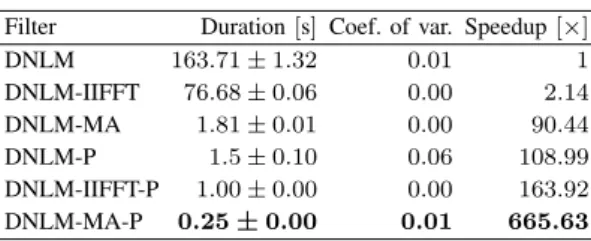
Table II shows a comparison of the runtime for each implemented version of DNLM filter. It reveals that DNLM-MA outperforms by88.30× the DNLM-IIFFT implementation. The coefficient of variation for all measured runtime is equal or less than 0.06. Also, DNLM-MA-P implementation is the fastest paralleliza-tion, achieving a 665.63× speedup over the unop-timized sequential DNLM filter. However, DNLM-IIFFT-P and DNLM-P obtain speedups higher than 100×compared to the unoptimized sequential DNLM filter. Table II also reveals that DNLM-MA-P obtains a lower speedup (7×) than DNLM-IIFFT-P (77×) and DNLM-P (109×) with respect to its sequential version.
Table II
AVERAGE RUNTIME AND SPEEDUP OF ALLDNLMFILTER IMPLEMENTATIONS.
Filter Duration[s] Coef. of var. Speedup[×]
DNLM 163.71±1.32 0.01 1
DNLM-IIFFT 76.68±0.06 0.00 2.14 DNLM-MA 1.81±0.01 0.00 90.44 DNLM-P 1.5±0.10 0.06 108.99 DNLM-IIFFT-P 1.00±0.00 0.00 163.92 DNLM-MA-P 0.25±0.00 0.01 665.63
Table III
AVERAGE RUNTIME OFDNLMANDDNLM-MA-PFILTERS USING DIFFERENT IMAGE SIZES.
Image size DNLM[s] DNLM-MA-P[s] Speedup[×] 256×256 10.26±0.02 0.05±0.00 206.95 512×512 40.95±0.35 0.11±0.00 377.70 1024×1024 163.18±0.03 0.25±0.01 662.27 2048×2048 654.15±5.64 0.90±0.01 728.66 4096×4096 2621.96±23.00 3.45±0.01 759.42 8192×8192 10539.96±3.09 33.10±0.61 318.38
Table IV
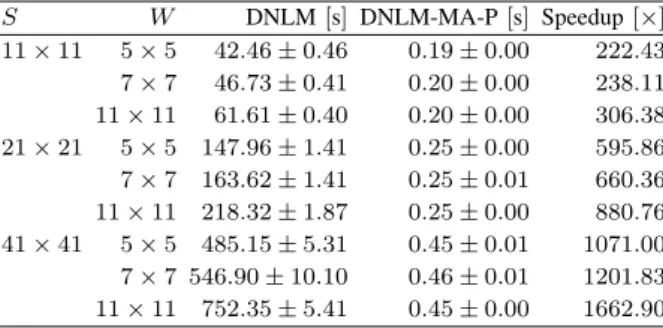
AVERAGE RUNTIME OFDNLMANDDNLM-MA-PFILTERS USING DIFFERENT SEARCH WINDOW SIZESsAND
NEIGHBORHOOD WINDOW SIZESω.
S W DNLM[s]DNLM-MA-P[s]Speedup[×] 11×11 5×5 42.46±0.46 0.19±0.00 222.43 7×7 46.73±0.41 0.20±0.00 238.11 11×11 61.61±0.40 0.20±0.00 306.38 21×21 5×5 147.96±1.41 0.25±0.00 595.86 7×7 163.62±1.41 0.25±0.01 660.36 11×11 218.32±1.87 0.25±0.00 880.76 41×41 5×5 485.15±5.31 0.45±0.01 1071.00 7×7 546.90±10.10 0.46±0.01 1201.83 11×11 752.35±5.41 0.45±0.00 1662.90
The effect of varying the number of threads on the parallel implementations of DNLM filter is shown in Fig 2. DNLM-MA-P filter achieves its lowest execution time of 0.25 s using only 32 threads. When more threads are added the execution time is progressively higher, due to memory bound behavior of DNLM-MA-P, as previously suggested in section III. However, independently of the number of threads, DNLM-MA-P implementation is always faster than DNLM-DNLM-MA-P and DNLM-IIFFT-P. On the other hand, DNLM-IIFFT-P implementation achieves its lowest execution time of 1 s when using 128 threads. If we increase the number of threads to 256, the execution time increases to 1.63 s. Although DNLM-P is the slowest one for almost all the number of threads tested, it scales the best when the number of threads increases. Using 256 threads, DNLM-P is faster than DNLM-IIFFT-P and performs similar to DNLM-MA-P version.
The efficiency of each parallel implementation of DNLM filter is shown in Fig. 3. When the number of threads increases, the efficiency of DNLM-MA-P filter rapidly decreases, being only 0.006 when using 256 threads. On the other hand, the efficiency of DNLM-P and DNLM-IIFFT-P decreases more slowly. However, when using more than 64 threads, which is actually the number of physical cores of the KNL, the efficiency drops faster for both implementations. For DNLM-IIFFT-P filter the efficiency goes from 0.86, when using 64 threads, to0.18when using 256 threads. For DNLM-P it goes from0.93, when using 64 threads, to
0.44when using 256 threads.
50 100 150 200 250 100
101 102
Number of threads
Duration
(s)
DNLM DNLM-IIFFT-P
DNLM-MA-P
Figure 2. Effect of varying the number of threads on each parallel implementation of DNLM filter.
50 100 150 200 250 0
0.2 0.4 0.6 0.8 1
Number of threads
Ef
ficienc
y
DNLM-P DNLM-IIFFT-P
DNLM-MA-P
Figure 3. Efficiency of the parallel implementation for each DNLM filter version, from 1 to 256 threads.
V. CONCLUSIONS AND FUTURE WORK
segmentation and tracking, would take 11 hours. This result could be further enhanced by using multi-node parallelism with MPI. Our approach overcomes the speedup reported in Table I for other Xeon Phi im-plementations, possibly due to effective vectorization and the improvement of KNL in contrast with previous Xeon Phi architecture.
Furthermore, the computational efficiency of DNLM-MA-P allows its usage as a preprocessing stage in CNN architectures to improve the performance of different image based pattern recognition tasks. As previously addressed, recently in [6] authors found an impressive increase of a CNN model precision for age estimation using X-ray images using DNLM filter as a preprocessing step. An efficient implementation of DNLM makes its usage practical as a preprocessing stage in a CNN model, implementing parameter calibration to be performed during the CNN model training.
VI. ACKNOWLEDGEMENTS
This research was partially supported by a machine allocation on Kabr´e supercomputer at the Costa Rica National High Technology Center.
REFERENCES
[1] P. Jain and V. Tyagi, “A survey of edge-preserving image denoising methods,” Information Systems Frontiers, vol. 18, no. 1, pp. 159–170, 2016.
[2] S. Calder´on, D. Moya, J. C. Cruz, and J. M. Valverde, “A first glance on the enhancement of digital cell activity videos from glioblastoma cells with nuclear staining,” inCentral American and Panama Convention (CONCAPAN XXXVI), 2016 IEEE 36th. IEEE, 2016, pp. 1–6.
[3] A. S´aenz, S. Calder´on, J. Castro, R. Mora, and F. Siles, “Deceived bilateral filter for improving the automatic cell segmentation and tracking in the nf-kb pathway without nu-clear staining,” inVI Latin American Congress on Biomedical Engineering CLAIB 2014, Paran´a, Argentina 29, 30 & 31 October 2014. Springer, 2015, pp. 345–348.
[4] R. Chac´on-Quesada, S. Calder´on-Ram´ırez, and F. Siles, “Im-proving the temporal segmentation in digital videos using the deceived bilateral filter,” in Central American and Panama Convention (CONCAPAN XXXVI), 2016 IEEE 36th. IEEE, 2016, pp. 1–6.
[5] S. Dodge and L. Karam, “Understanding how image quality affects deep neural networks,” inQuality of Multimedia Ex-perience (QoMEX), 2016 Eighth International Conference on. IEEE, 2016, pp. 1–6.
[6] S. Calderon, F. Fallas, M. Zumbado, P. N. Tyrrell, H. Stark, Z. Emersic, B. Meden, and M. Solis, “Assessing the impact of the deceived non local means filter as a preprocessing stage in a convolutional neural network based approach for age estimation using digital hand x-ray images,” inInternational Conference on Image Processing 2018, in press. IEEE. [7] S. Calder´on, A. S´aenz, R. Mora, F. Siles, I. Orozco, and
M. Buemi, “Dewaff: A novel image abstraction approach to improve the performance of a cell tracking system,” in
Bioinspired Intelligence (IWOBI), 2015 4th International Work Conference on. IEEE, 2015, pp. 81–88.
[8] A. Buades, B. Coll, and J.-M. Morel, “Neighborhood filters and pdes,”Numerische Mathematik, vol. 105, no. 1, pp. 1–34, 2006.
[9] S. C. Ram´ırez and M. Z. Corrales, “Dnlm-iifft: An implementa-tion of the deceived non local means filter using integral images and the fast fourier transform for a reduced computational cost,” in Iberoamerican Congress on Pattern Recognition. Springer, 2017, pp. 127–134.
[10] M. Mahmoudi and G. Sapiro, “Fast image and video denoising via nonlocal means of similar neighborhoods,” IEEE signal processing letters, vol. 12, no. 12, pp. 839–842, 2005. [11] A. Pardo, “Non Local Means Image Filtering Using
Cluster-ing,” inProgress in Pattern Recognition, Image Analysis, Com-puter Vision, and Applications, M. Mendoza and S. Velast´ın, Eds. Cham: Springer International Publishing, 2018, pp. 483– 490.
[12] A. Dauwe, B. Goossens, H. Q. Luong, and W. Philips, “A fast non-local image denoising algorithm,” in Image Processing: Algorithms and Systems VI, vol. 6812. International Society for Optics and Photonics, 2008, p. 681210.
[13] P. Chatterjee and P. Milanfar, “A generalization of non-local means via kernel regression,” inComputational Imaging VI, vol. 6814. International Society for Optics and Photonics, 2008, p. 68140P.
[14] Z. Ji, Q. Chen, Q.-S. Sun, and D.-S. Xia, “A moment-based nonlocal-means algorithm for image denoising,” Information Processing Letters, vol. 109, no. 23-24, pp. 1238–1244, 2009. [15] T. Thaipanich, B. T. Oh, P.-H. Wu, and C.-C. J. Kuo, “Adaptive nonlocal means algorithm for image denoising,” inConsumer Electronics (ICCE), 2010 Digest of Technical Papers Interna-tional Conference on. IEEE, 2010, pp. 417–418.
[16] C. Karam and K. Hirakawa, “Monte-carlo acceleration of bilateral filter and non-local means,” IEEE Transactions on Image Processing, vol. 27, no. 3, pp. 1462–1474, 2018. [17] J. Wang, Y. Guo, Y. Ying, Y. Liu, and Q. Peng, “Fast
non-local algorithm for image denoising,” in Image Processing, 2006 IEEE International Conference on. IEEE, 2006, pp. 1429–1432.
[18] Y.-L. Liu, J. Wang, X. Chen, Y.-W. Guo, and Q.-S. Peng, “A robust and fast non-local means algorithm for image denois-ing,”Journal of Computer Science and Technology, vol. 23, no. 2, pp. 270–279, 2008.
[19] B. Goossens, H. Luong, A. Pizurica, and W. Philips, “An im-proved non-local denoising algorithm,” in2008 International Workshop on Local and Non-Local Approximation in Image Processing (LNLA 2008), 2008, pp. 143–156.
[20] L. Condat, “A simple trick to speed up and improve the non-local means,” 2010.
[21] J. Froment, “Parameter-free fast pixelwise non-local means denoising,”Image Processing On Line, vol. 4, pp. 300–326, 2014.
[22] P. Coup´e, P. Yger, and C. Barillot, “Fast non local means denoising for 3d mr images,” inInternational Conference on Medical Image Computing and Computer-Assisted Interven-tion. Springer, 2006, pp. 33–40.
[23] J. Darbon, A. Cunha, T. F. Chan, S. Osher, and G. J. Jensen, “Fast nonlocal filtering applied to electron cryomicroscopy,” in
Biomedical Imaging: From Nano to Macro, 2008. ISBI 2008. 5th IEEE International Symposium on. IEEE, 2008, pp. 1331– 1334.
[24] A. M´arques and A. Pardo, “Implementation of non local means filter in gpus,” inIberoamerican Congress on Pattern Recognition. Springer, 2013, pp. 407–414.
[25] X. Mingliang, L. Pei, L. Mingyuan, F. Hao, Z. Hongling, Z. Bing, L. Yusong, and Z. Liwei, “Medical image denoising by parallel non-local means,” Neurocomputing, vol. 195, pp. 117–122, 2016.
[26] B. Goossens, H. Luong, J. Aelterman, A. Piˇzurica, and W. Philips, “A gpu-accelerated real-time nlmeans algorithm for denoising color video sequences,” in International Con-ference on Advanced Concepts for Intelligent Vision Systems. Springer, 2010, pp. 46–57.
[28] T.-A. Nguyen, A. Nakib, and H.-N. Nguyen, “Medical image denoising via optimal implementation of non-local means on hybrid parallel architecture,”Computer methods and programs in biomedicine, vol. 129, pp. 29–39, 2016.
[29] H. Zhu, Y. Wu, P. Li, D. Wang, W. Shi, P. Zhang, and L. Jiao, “A parallel non-local means denoising algorithm implementa-tion with openmp and opencl on intel xeon phi coprocessor,”
Journal of Computational Science, vol. 17, pp. 591–598, 2016. [30] F. Huang, B. Lan, J. Tao, Y. Chen, X. Tan, J. Feng, and Y. Ma, “A parallel nonlocal means algorithm for remote sensing image denoising on an intel xeon phi platform,”IEEE Access, vol. 5, pp. 8559–8567, 2017.