UNIVERSIDAD ANDRÉS BELLO Facultad de Educación y Ciencias Sociales
Pedagogía en Inglés
PRE-SERVICE UNAB EFL TEACHERS’ BELIEFS ABOUT VOCABULARY INSTRUCTION
Seminario para optar al título de Profesor de Inglés para la enseñanza básica y media y al Grado Académico de Licenciado en Educación
Geraldine Castro Ignacio Gamboa Alexa Mansilla Boris Saavedra
2
ACKNOWLEDGEMENTS
Geraldine Castro.
I would like to dedicate this section to thank all the people that supported me during this long, beautiful, but not easy process. First, I would thank my parents Ines Segovia and Victor Castro for the endless support and encouragement they gave to me throughout the entire program and of course for giving me the opportunity of becoming a professional. To my Brother and sisters that always encourage me to continue in this process. Without their support and love, I would not have been able to make it to this part. Second, I would like to acknowledge Miss Carol Gomez for her great work as a teacher and mentor— thank you miss for all your help, support, and your infinite patience until the end. Without your guidance this work would not have been possible, we are all grateful to you!—I would also like to thank my friends and coworkers in this project since it was wonderful and a pleasure working with you guys Alexa, Boris, and Ignacio you made this experience very special. Even though we faced different situations in this process we made it finally to this part. Love you guys! Finally, I would like to thank all my friends with which I spent and shared beautiful moments there in Hakuna, especially to mis Amores Alexa, Alexandra, Vania and Cota for all your support, Friendship, and love. Thank you, girls, for being there when I needed you the most and make this experience the most wonderful one.
Ignacio Gamboa.
3
4
Alexa Mansilla.
To be honest, it is not easy to find the exact words to show my gratitude to all the people that supported me throughout this important and challenging process. Undoubtedly, my family has been the most important mainstay to me in the pursuit of this project, and during all these years. The unconditional love, support, sacrifice and understanding from my mother, grandmother, and brother were essential for me when I needed it the most. Secondly, I would especially like to thank Miss Carol Gómez for her guidance, she has taught and guided me much more than I could ever give her credit for. This work would not have been possible without your help, support, and great patience. I would also like to mention my friends and partners; Ignacio, Geraldine, and Boris. Even though the difficulties we faced, your good attitude and positivism were essential to keep working and to accomplish this project, I will definitely miss spending time with you. Finally, I cannot finish these lines without mentioning my Tridente Ofensivo; Constanza Ferraro and Alexandra Fonseca. Thank you for your love, encouragement, friendship, and most important, for being part of my life.
Boris Saavedra.
5
6 2. Chapter II: Literature Review………..……… 2.1 Teacher Cognition………..……… 2.2 Teacher Beliefs………... 2.2.1 Teacher beliefs in language teaching……….. 2.2.2 Teacher beliefs of vocabulary instruction……… 2.3 Vocabulary Instruction………...……… 2.3.1 Explicit Vocabulary Instruction……….. 2.3.2 Implicit Vocabulary Instruction……….. 2.3.3 Explicit Over Implicit Vocabulary Instruction……...………... 2.4 Vocabulary Instruction Methods………...………... 2.4.1 The Grammar-translation Method………... 2.4.2 The Natural Approach……… 2.4.3 The Audio – Lingual Method………. 2.4.4 The Total Physical Response Method………... 2.4.5 Communicative Language Teaching………... 2.4.6 Task Based Language Teaching………. 2.5 Vocabulary Instruction Techniques……….
2.5.1 Using Pictures……….
7 4.4 Questionnaire Results Section 3 Qualitative Analysis….………… 4.5 Interview Results……… 4.5.1 Beliefs about vocabulary instruction……… 4.5.2 Effectiveness of strategies and methods to teach
vocabulary……… 4.5.3 The influence of previous experiences in vocabulary
instruction………. 5. Chapter V: Discussion………..
5.1 UNAB EFL Pre-service teachers’ beliefs about vocabulary
instruction……… 5.2 Pre-service teachers’ beliefs regarding the effectiveness of
strategies and methods to teach vocabulary……….……… 5.3 The influence of pre-service teachers’ previous experiences in
8
1. Appendix I: Questionnaires………...………….. 2. Appendix II: Interview Transcriptions………...………. List of Tables, Figures and Graphs
1. Figure 1 Adapted from Borg (2003), Teacher Cognition……… 2. Figure 2 Explanatory Design (Creswell, 2012)……… 3. Figure 3 Explanatory Design Adapted from Creswell (2012)………… 4. Figure 4 Coding………. 5. Table 1. Questionnaires Results in section 1………... 6. Table 2. Questionnaires Results in section 2………... 7. Graph 1. Pre-service teachers’ answers about their vocabulary
instruction at the university……….. 8. Table 3. Answers from the participants in section 3……… 9. Graph 2. Pre-service teachers’ answers about their vocabulary
instruction at the university……….. 10. Table 4. Answers from the participants in section 4……… 11. Table 5. Beliefs about vocabulary instruction……….. 12. Table 6. Effectiveness of strategies and methods to teach
vocabulary……….. 13. Table 7. Previous experiences influence in vocabulary instruction…..
65-68 69-91
16 33 34 39 40 42
44 46
46 48 50
9
ABSTRACT
10
RESUMEN
11
CHAPTER I: INTRODUCTION
English language teaching and learning involve different areas such as phonetics, grammar, reading, listening, speaking, writing (the four skills) and vocabulary. Nevertheless, in our practicum instances at school, as part of our teaching preparation, we have discovered that only some of these areas are given real attention, probably because they are observable skills and can be easily assessed. These emphasized or concrete skills are usually speaking, writing or grammar; and vocabulary for example, is not given the enough attention knowing the implications it may have in the development of a second language (L2). Hence, it is worth highlighting the essential role that vocabulary instruction plays in acquiring a second language and the detrimental effect that the lack of vocabulary can have in developing the other skills in the language. Hence, starting from the premise that vocabulary is responsible for allowing successful communication due to the fact that “a limited vocabulary in a second language impedes successful communication (...), it can be claimed that vocabulary instruction is essential for language learning. In addition to this, a good lexical repertoire is “needed to communicate ideas and express the speaker's meaning, which is the reason why it is important to learn vocabulary” (Alqahtani, 2015, p.5).
The Chilean National Guidelines for primary and secondary education
(Bases Curriculares) propose a very complete description of how vocabulary
should ideally be taught at the different stages of English as a Foreign Language Teaching (EFL), depending on the learners’ developmental stage in
their academic process. However, in order for pre-service teachers to meet the
expectations regarding the national guidelines they must understand different
aspects referring to vocabulary instruction and what it involves, such as the
difference between explicit and implicit teaching. Not only this, but as the
guidelines propose, what is adequate for each learner in relation to their
knowledge and competences in the foreign language.
12
the contrary, while starter levels build their base in terms of vocabulary, higher levels receive a more implicit instruction, due to their previous process in lower levels in which they were supposed to build their vocabulary bank. In spite of the fact that the National Guidelines represent a model for teachers to master and apply inside classrooms, there is not a way to verify that what these guidelines suggest is being implemented to the very letter. From our own experience as students and pre-service teachers—which is an important point we should bear in mind--we consider that there is a lack of preparation in terms of which are the adequate ways to instruct vocabulary. Consequently, the lack of preparation does not allow teachers to implement methods and strategies as they should (considering learners’ age, level, context, etc.). Besides the national regulations, many previous authors have researched vocabulary instruction, as Hiebert and Kamil (2005) state “vocabulary instruction is not just
one of several important aspects of reading, it is a gift of words, a gift that one gives generously to others” (p.112). In the same line, vocabulary instruction has been identified by several researchers, as an exceptionally relevant area
of language learning. Bearing in mind the relevance of vocabulary, this study aims to determine participants’ beliefs regarding vocabulary instruction, the
effectiveness of methods and techniques when teaching vocabulary, and how
their previous experiences influenced their beliefs in the same topic. Alongside
with the detailed explanation and analysis carried out by means of the study,
significant information for a better understanding will be presented in the next
13
CHAPTER II: LITERATURE REVIEW
In this chapter, we will approach a series of concepts that are crucial for the understanding of pre-service teachers’ beliefs regarding vocabulary instruction, and we will provide a state of the art in relation to the literature associated with our research topic.
What we understand by teacher beliefs falls under a much broader construct that researchers have identified as teacher cognition, which includes three cognitive dimensions such as (i) what teachers know, (ii) what teachers think, (iii) what teachers believe, and finally (iv) what they do. This will be a recurrent topic throughout our research due to the fact that this study attempts to explore different beliefs pre-service teachers from UNAB have on vocabulary instruction.
The understanding of these different postures will then allow us to make a relationship with the national guidelines regarding vocabulary. However, as previously mentioned, since this study aims to explore pre-service teachers’ beliefs, the focus will be on the third aspect, ‘what teachers believe’ regarding vocabulary instruction.
2.1 Teacher Cognition
14
is built by “a wide range of interacting and often conflicting factors” (Borg, 2003, p. 91).
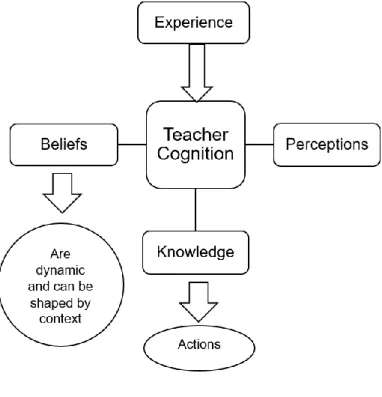
Based on the above mentioned, it may be inferred that the study of language teacher cognition is broad; as cognition itself embraces several other constructs; such as beliefs, perceptions, knowledge, teaching and learning experiences, attitudes, assumptions, among many others. In fact, Borg (2003) organizes the concept of teacher cognition into three main variations of the construct (knowledge, perceptions, and beliefs), which he claims do not necessarily match what teachers do (classroom practices). As illustrated in this quote:
Studies of teacher cognition are taken here as those which examine what second and foreign language teachers, at any stage of their careers, think, know, or believe in relation to various aspects of their work […], and which, additionally but not necessarily, also entail the study of actual classroom (both proactive and interactive decision-making) and of the relationships between cognitions and these practices. (Borg, 2003, p. 86)
15
2.2 Teacher Beliefs
Beliefs play a major role when referring to teachers’ decisions and behaviors inside the classrooms. As previously mentioned in the introduction chapter, the current study has as a main objective to explore pre-service teachers’ beliefs in terms of vocabulary instruction. Thus, it is fundamental to provide a clear view regarding what beliefs are, as well as their relation with language teaching, and the way beliefs influence vocabulary instruction inside the classrooms. As explained by Borg (2001) “a belief is a mental state which has as its content a proposition that is accepted as true by the individual holding it, although the individual may recognize that alternative beliefs may be held by others” (p.186). In other words, people can have different beliefs on the same matter and be aware of that discordance.
Undoubtedly, beliefs are fundamental for many aspects of life, mainly when individuals shape their world, and their own perceptions about outer stimulus. Hence, beliefs are influenced by individuals’ experiences, and personal judgments. In fact, Gao and Ma (2011) stated that beliefs, which had been originally established as static, are now considered as dynamic features that are continuously changing and can be modified or shaped by the context. For instance, a teacher’s belief will vary -depending on several aspects-, and so will change his/her performance in the classroom.
16
Figure 1. Adapted from Borg (2003), Teacher Cognition.
The role of beliefs has been studied in several areas of research, and still has the leadership in recent studies since it provides researchers with relevant information for the development of their theories. Therefore, since the purpose of our study is to explore pre-service teachers’ beliefs, and their effects on participants’ actions inside the classrooms, the focus on the concept ‘belief’ will be primarily associated to language teaching for the rest of the study.
2.2.1. Teacher beliefs in language teaching.
17
classroom is a consequence of what he/she has experienced before as a student. Indeed, Johnson (1994) mentioned that “pre-service ESL teachers’ beliefs may be based largely on images from their formal language learning experiences, and in all likelihood, will represent their dominant model of action during the practicum teaching experience” (p. 450).
Therefore, what Johnson states is that all previous encounters throughout our educational processes, all the teaching models we are exposed to, and all influences in our teaching methodologies shape our beliefs. Additionally, along the same line Richards, Gallo and Renandya (2001) suggested that past experiences with previous teachers would probably affect future teachers’ beliefs, making every educational encounter a potential belief-forming situation (Richards, Gallo & Renandya, 2001). Moreover, teachers who have clearly established thoughts on teaching can reflect this upon their instructional strategies and methods they apply during classes. Actually, there is a variety of strategies and methods regarding teachers’ beliefs which reflect the different perspectives that teachers may have while teaching in a particular way (Díaz, Alarcón & Ortiz, 2013).
Hence, all teachers have their own beliefs creating a diversity of ideas, methods and teaching styles that influence the teaching process. For instance, teachers bring their experience, knowledge and values into the classroom and they also encourage students to well develop their language skills and attitudes (Díaz, Martínez, Roa & Sanhueza, 2010). However, there are contents that may seem dull and repetitive for students, even when having teachers with several methods and techniques to influence positively the classroom environment and to improve students’ willingness to work and their performances. Unfortunately, vocabulary tends to fit within these contents.
18
2.2.2 Teacher beliefs of vocabulary instruction
Regarding beliefs on vocabulary instruction, there are many misconceptions and myths. As mentioned by Rossiter, Abbott and Kushnir (2016), the context for vocabulary in this case is because the interest in the topic of L2 vocabulary has only recently sprouted in the last two to three decades. When it comes to vocabulary instruction, teaching learning strategies for the acquisition of new words has been found to be important, though there is a debate whether to use class time to teach these resources or not. In terms of vocabulary instruction, general disinformation causes a “widespread dissatisfaction with their prior vocabulary learning experiences, both pre-service and in-pre-service language teachers need to work out better ways to help their students learn vocabulary more efficiently in class” (Gao & Ma, 2011, p. 24).
19
even if the first approach he/she decided to use was the preferable according to his/her beliefs. Another instance to catch students’ acceptance could be teaching a selection of words that seem to be acquired by the students, so that the perception of the students after the teaching process can be beneficial towards the vocabulary instruction.
2.3 Vocabulary Instruction
Vocabulary is fundamental due to the fact that it encompasses all the words that we must know in order to express our ideas, communicate effectively, produce the language, and to develop all the necessary skills that learners must accomplish. As well as Sturza (2009) states, “the knowledge of a word not only implies a definition, but also how that word fits into the world” (p. 570). In other words, vocabulary is not only a skill that provides learners with concepts, it also gives them the chance to understand the world by acquiring these concepts in a contextualized manner in order for them to use the words meaningfully, and in all the dimensions that language learning involves. Since vocabulary is a major component when learning a language, the focus on how teachers are teaching vocabulary in EFL contexts must be established.
It is inferable that there is a need for more vocabulary instruction in all grades; however, this instruction should be adequate for learners’ age, and contexts. Therefore, the preparation that in-service teachers had previously received, and their own beliefs regarding vocabulary instruction, will tremendously affect the decisions the teachers take when choosing among the different methods and techniques whilst teaching vocabulary inside a classroom. For instance, if a teacher during his/her high school years learnt vocabulary in an explicit manner, the techniques and methods that the teacher will use to teach vocabulary will probably take the same path.
20
can understand new words and relate meanings, in order for them to build their vocabulary bank so they will be able to reach deeper levels of word knowledge, and to recognize the strategies that aid their independent vocabulary acquisition.
As exposed, there exist several methods that teachers use to instruct vocabulary. For the aims of our study, two different manners to instruct vocabulary were selected, studied, and compared. The approaches that were selected were; explicit and implicit vocabulary instruction.
2.3.1 Explicit vocabulary instruction
Taking into consideration the importance that vocabulary has when expressing ideas, it is the first branch of language that young EFL learners are dominantly exposed to. In order to teach vocabulary, explicit instruction has to go hand in hand with its counterpart, Implicit instruction, because, as cited by Young-Davy (2014) “explicit vocabulary learning vs. implicit vocabulary learning issue is not a dichotomy, but rather a continuum”(p.26). Thus, neglecting one approach is not recommended, since both approaches complement each other achieving optimal learning and retention conditions. Nevertheless, for an effective use of both instructional approaches, these should be used strategically and coherently in order to first achieve word recognition and then exposure. Following this line of thought, explicit vocabulary instruction is the first step to teaching lexical items. This way, the first thing we ensure is word recognition by matching words with their meanings; ambiguity is neutralized when teaching new vocabulary items explicitly.
21
practice with feedback until independent mastery has been achieved” (p.1). Thus, explicit vocabulary instruction could be understood as a set of procedures inside the classroom where learners are presented new vocabulary items, and are exposed to the way that they are spelled, their grammatical function, their meanings, and examples of usage within a sentence or context.
Explicit vocabulary instruction is fundamental for beginner EFL learners. In order to understand any language we must first be familiar with its lexis. In fact, research suggests that a person with a lexicon below 2000-3000 high-frequency words might struggle when trying to infer words from context, and from that point on 90% of everyday input is comprehensible (Mirzaii, 2012). Therefore, due to the complexity of inferring new vocabulary items from context, explicit vocabulary teaching is the most effective way to achieve the recognition of these 2000-3000 high-frequency vocabulary items. For these reasons, the Chilean national guidelines stress the importance of significant explicit vocabulary instruction for young EFL learners.
2.3.2 Implicit vocabulary instruction
Having known the fact that explicit vocabulary teaching is more effective than implicit vocabulary teaching, it becomes more feasible to show facts and characteristics about implicit instruction that can actually improve the vocabulary acquisition in certain students. In this sense, we can state that implicit vocabulary instruction is a slow process for elementary and even high school EFL students since they have a lack of knowledge in the target language, thus students may struggle when deciding the meanings of unknown words. Besides, Sokmen (2006) states that “exposure to a word in a variety of contexts is extremely important to understanding the depth of the word's meaning” (p.152), which means that it is fundamental for the students to know the meanings of the words they are asked to use, so that they are able to understand with what they are working when using the words given by the teachers.
22
frustrated when using this implicit approach because of their lack of knowledge at the moment of trying to guess words correctly. Besides, students with low management of the foreign language are likely to commit mistakes when guessing words and it is complicated for them to undo the damage done by incorrect guessing in such context. As a matter of fact, Haynes and Baker (1993) affirmed that even when students are trained to use flexible reading strategies to guess words in context, their comprehension may still be low due to insufficient vocabulary knowledge.
Hence, there are two important aspects in this matter. First, implicit vocabulary instruction is worthy to be applied in students with high proficiency in the language because they have the knowledge enough to manage this approach to have a fruitful outcome. Second, it is fundamental for teachers to be cautious when using implicit techniques with initial students due to the fact that even when students seem to be ready for difficult challenges, the outcomes will probably be negative and frustrating.
2.3.3 Explicit over implicit vocabulary instruction
23
know that both approaches are different but at the same time they complement each other to achieve maximum learning and retention conditions for students.
When talking about vocabulary instruction it is necessary to take into consideration the fact that the instruction from the teacher needs to be the most accurate for students’ context to ensure they will become more competent when using the language effectively. The main step to develop a better vocabulary bank is based on the correct instruction from the teacher in order to maximize students’ academic development. One of the best approaches to do so is using explicit vocabulary instruction since this approach is, as stated by Archer and Hughes (2011) “a structured, systematic, and effective methodology for teaching academic skills” (p. 1). In fact, the use of explicit vocabulary instruction is the most recommended due to the fact it is easier for EFL students to build they vocabulary bank when they belong to starter levels of English.
Thus, the fact that explicit vocabulary is structured and systematic makes students from starter levels of English acquire a bigger quantity of words increasing they vocabulary bank easily and quickly. As mentioned by Larsson (2014) “learners who are taught vocabulary explicitly in activities in a classroom acquire a larger vocabulary than those who only learn vocabulary implicitly” (p. 6). In addition to that, for higher levels of English the instruction can be explicit, but at the same time implicit due to that at this stage learners have a vast vocabulary bank to understand words from context. Furthermore, we need to add that explicit vocabulary instruction is the main approach to use and the most effective at the moment of learning new words, and then implicit vocabulary can be used to complement the explicit instruction.
24
Finally, it is necessary to acknowledge the importance of the national guidelines (Bases Curriculares, 2012) for vocabulary instruction in Chile, which state that the process of learning vocabulary will not happen in a passive way yet, this vocabulary must be intentionally taught through the four skills. This means that vocabulary instruction must be explicit and intentional at least for elementary levels in our country. For this matter we need to understand that explicit vocabulary instruction plays a critical role in developing and improving vocabulary skills for all learners from very young ages. Besides, when it comes to teach vocabulary there is not only one way of doing so, and there are several factors that interferes in teachers’ decisions when planning which is the most accurate method to instruct vocabulary.
2.4 Vocabulary Instruction Methods
For decades teachers have come up with different and more effective ways of teaching vocabulary to students. Some of these methods have become very popular and are focused on different types of students, depending on their level of English and their learning styles. As stated by Richards and Rodgers, (2014) “method is the level at which theory is put into practice and at which choices are made about the particular skill to be taught, the content to be taught, and the order in which the content will be presented” (p. 21). Not only is there one correct method, but the usage of only one method is not recommended to achieve the full potential of pedagogical strategies. As stated by Taylor (2015), “linguists have demonstrated that there is not one single best method for everyone in all contexts, and that no one teaching method is inherently superior to the others” (blog.tjtaylor.net). Instead, experts have recommended a series of methods and strategies which suit different purposes and classroom styles. This variety of techniques and methods can lead learners into a successful learning process, but when students face the opposite, the learning process may fail and it will probably decrease its success. As illustrated in this quote:
25
or other of the intelligences.Those with strengths in interpersonal intelligence who are expected to work in a solitary fashion; those who have kinaesthetic strengths and aptitudes and are not ‘allowed’ to work practically or to move around;and those with intrapersonal strengths and preferences who are required to operate as a part of a group working collaboratively to solve a problem are just three examples of the ways in which an ignorance of – or disregard for – individual intelligence, in Gardner’s terms, can lead to disadvantage” (Pritchard, 2009, p. 59).
Every method has its own advantages and disadvantages, therefore each of the methods is more effective depending on different factors, for example: learner age, learning styles, learners’ current level of the target language, and stages of the lesson.
The methods used to teach vocabulary should be chosen depending on students’ needs and teachers must adapt their preferences according to that. Here are some of the most commonly used methods.
2.4.1.The grammar-translation method.
26
2.4.2. The natural approach.
“The Natural Approach is designed to develop basic communication skills—both oral and written—“. (Krashen & Terrell, 1983, p.67). This means, that the Natural Approach is mainly based on the use of the language for communication purposes rather than being focused on teaching only academic learning skills. Moreover, an important characteristic of the current method is that it does not appeal to the usage of the native language while teaching the L2. Consequently, the development of this method requires a strict target language atmosphere, which means that discussions, interventions or any activity that the teacher decides to implement inside the classroom in order to teach the language, must be focused on the use of the target language itself. Hence, as explained by Krashen and Terrell (1983) the main goals of this method is its usefulness when students apply the target language in real situations, for example, if students understand what a native speaker is trying to communicate orally, or if students are able to write a paragraph and being understood even though the possible grammar mistakes that they may have produced. In this method vocabulary is very important since students are exposed to a huge number of words in order to understand the target language that is used in every class making it easier for the students to use it in real situations.
2.4.3. The audio-lingual method.
27
on mastering the target language by repeating and memorizing. A concrete example of this method is the memorization of dialogues, since students may reinforce proper intonation, pronunciation, rhythm, and they will be exposed to different utterances (opinions, greetings, likes/dislikes, etc.) of the target language. In the audio-lingual method, Vocabulary plays a very important role since students are required to repeat the word they are learning in order to give it more practice to learn new words unconsciously.
2.4.4. The total physical response method.
As it name suggests, the Total Physical Response (TPR) is a method to teach the target language by using physical movements to reply to verbal input. The main purpose of the TPR is generating a connection in the brain among the production of vocabulary, and the action itself. It may be inferred, that it is more convenient the implementation of the TPR method when teaching vocabulary related to actions. As mentioned by Schunk (1990), the TPR “involves active participation of students who learn new actions words by acting and imitating as the teacher says...this facilitates more rapid comprehension and better retention of vocabulary” (p. 113). One of the most frequent activities according to the TPR method that teachers use in classes is “Simon says”, considering that the teacher gives students a command, and the word must be understood in order to accomplish the action. It has been proved that by carrying out TPR activities, teachers may reduce stress and inhibitions from students when producing the language.
2.4.5. Communicative language teaching.
28
apply the CLT method inside classrooms may be developing activities which are focused on producing real and meaningful information, such as practicing question forms by asking personal information among students. Additionally, if teachers are interested on applying the CLT method, they must plan learners-oriented classes, and it is more convenient the use of authentic material. CLT lays emphasis on developing the communicative competence, for that reason vocabulary plays an important role due to all the words related to real situation the students learn and use through this method.
2.4.6. Task-based language teaching.
The task based method allows teachers to take all those activities that must be taught, such as the activities the national guidelines suggest, to a ludic and more meaningful activity for the students. In addition, this method allows educators to lead their classes with a complete domain of the time due to the fact that task based lessons are ordered easily by following its three phases, which are pre-task, during task, and post-task. As explained by Hyltenstam and Pienneman (1985) “By ‘task’ is meant the hundred and one things people do in everyday life, at work, at play, and in between” (p.89). In other words, these authors refer to the meaningfulness and advantages of using this method, which allows students to analyze and organize their knowledge when working in the class. Moreover, students have the possibility to represent their acquaintanceship as they believe is more suitable. For task-based language teaching, vocabulary is used through dynamic activities where the development of new words is very important at the pre-task phase where students develop a set of words according to the main topic making the learning of new target words more interesting and fun for students.
2.5Vocabulary Instruction Techniques
29
students' vocabulary development.” (Sanusi, 2009, p.1). Thus, the importance of choosing the most accurate techniques to implement inside the classrooms has a great significance since it refers to what teachers do or should do with the objective of helping students learn vocabulary.
Accordingly, the teaching strategies that teachers employ rely in factors as time availability, students’ needs, students’ learning styles, and the content itself. Hence, the current section of our investigation provides with some of the most known and frequent techniques for teaching vocabulary.
2.5.1.Using pictures.
Using this technique to teach vocabulary is a good option since the use of pictures, illustrations in books, flashcards, and visual aids can be more meaningful. As Phillips (2016) states, “...pairing vocabulary with pictures is helpful in learning word meaning…” (p.6), which means that images can be related to their meaning and it is easy for students to relate them and be memorize through visualization.
2.5.2.Using objects.
The use of this technique to teach vocabulary involves the use of realia, visual aids, and objects around the classroom. This way of teaching vocabulary can be very helpful for students to remember new words in order to make the learning experience more memorable for the students. In addition, Paredes, Paredes and Rojas (2008) mentioned that “realia is considered as real objects, which are used to aid in practicing a new language, as a way to present meaningful examples from the real world” (p. 24). In other words, the use of objects to teach new target language can be useful for learners to memorize the vocabulary through visualization of objects.
2.5.3.Using mime expressions and gestures.
30
energy and create fruitful achievement and communication skills in the students’ learning process.
“Young children do not come to the language classroom empty-handed. They bring with them an already well-established set of instincts, skills and characteristics which will help them to learn another language. We need to identify those and make the most of them”. (Susan Halliwell, 1992, p. 3).
Better said, Halliwell means that as students are totally able to learn a second language by using different techniques, it is the task of the teachers to find out students’ best abilities, and therefore, it is fundamental not to underestimate students’ abilities, and apply these non-verbal techniques in order to know students’ necessities better.
2.5.4.Contrast.
One technique that teachers use inside classrooms, is contrasting concepts. As mentioned by Jean and Letcher (n.d.) Compare and contrast “help students make connections between their background knowledge and experiences and the new content they are learning” (http://www.readingrockets.org). Some words can be easily introduced to learners, by teaching opposites. For example, if we are teaching adjectives, we can work with the word “big” contrasted with the word “small”. Consequently, it may be inferred that learners will expand their vocabulary when learning new words’ antonyms.
2.5.5. Translation.
31
“The act of translating is a holistic activity, which immediately compels the learners to pay more attention to the SL/FL text, which encourages their awareness of form and meaning in context and improves their reading and writing skills in SL/FL.” (p. 740)
This means that translation may work as a fruitful technique when teachers want students to improve certain skills in the second language such as reading or writing. In addition, it considers students’ attention span so that students can effectively retain and learn new vocabulary in a class.
2.5.6.Eliciting.
This technique involves a variety of procedures where the teacher makes the students provide information instead of giving it to them. Thus, Eliciting is defined by Richards and Schmith (2002) as “Techniques or procedures which a teacher uses to get learners to actively produce speech or writing” (178). This means that the teacher asks students to come up with vocabulary, language form, and rules in order to brainstorm about a topic at the beginning of the lesson. Moreover the teacher can elicit memories, ideas, feelings, situations, and meaning, in order to motivate students to learn the target language.
2.5.7. Drawing.
32
2.6 The Current Study
After going through the themes that were previously exposed for the creation of the literature review and for the purpose of the present study, and in order to achieve the general objective which is “to explore UNAB EFL pre-service teachers’ beliefs about vocabulary instruction”, and to accomplish with our specific objectives that are;
i) “To determine the beliefs that pre-service teachers hold regarding the effectiveness of strategies and methods to teach vocabulary”, and
ii) “To understand how pre-service teachers’ previous experiences influence their beliefs of vocabulary instruction”,
We aim to answer the following research questions that emerged during this process:
1. What are UNAB EFL pre-service teachers’ beliefs about vocabulary instruction?
2. What beliefs do pre-service teachers hold regarding the effectiveness of strategies and methods to teach vocabulary?
3. How do pre-service teachers’ previous experiences influence their beliefs about vocabulary instruction?
In order to achieve the research objectives, and to answer the research questions that arose through our investigation, the following methodology and procedures were used.
CHAPTER III: METHODOLOGY
33
3.1 Research Design
For the purposes of the study, we decided to conduct a mixed-methods research design in order to accomplish a clearer view on the aspects we studied. It is fundamental for us to provide complete answers for our research questions, that is the main reason why we combined both approaches, and our instruments were designed aiming to collect qualitative and quantitative data. As well stated by Creswell (2012), “the basic assumption is that the uses of both quantitative and qualitative methods, in combination, provide a better understanding of the research problem and questions than either method by itself.” (p.535).
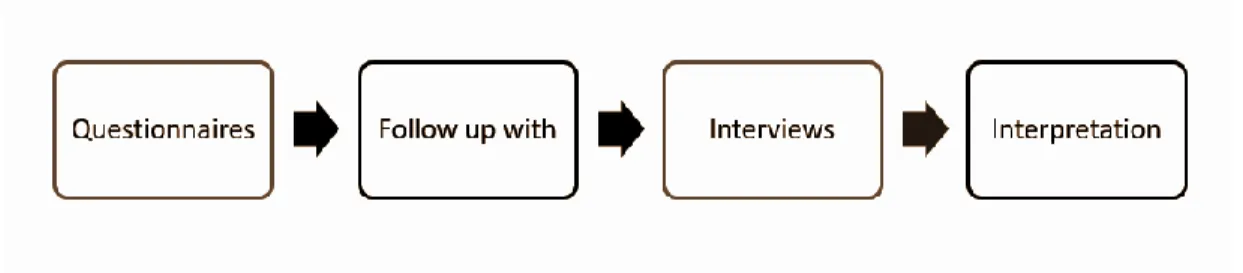
The type of mixed-methods study we conducted follows an explanatory design, and its main objective was to collect data sequentially in two phases. Firstly, quantitative data was collected in order to give researchers a general view about the research problem that was stated. Secondly, the collection of qualitative data was necessary to support and elaborate deeply on the aspects that were evidenced in the first phase.
3.1.1 Explanatory design
Figure 2. Explanatory Design (Creswell, 2012)
34
Figure 3. Explanatory Design adapted from (Creswell, 2012)
3.2 Context of the Study
The present study was focused on pre-service teachers from UNAB who are currently studying their third year. As exposed, due to the fact that we consider there is a gap in terms of the preparation that programs provide for future teachers about vocabulary instruction, we believe it was appropriate and meaningful to conduct a study with participants from our same context. Additionally, we must mention that participants were selected by non-probability sampling which according to Creswell (2012) means that they were convenient, available, and embodied the characteristics we needed in order to answer the questions that our study attempts to elucidate.
3.3 Participants
35
practicum phase which involved interacting solely with high school students giving them a glimpse of the entire school level spectrum. Furthermore, there were more requirements for these third-year. Accordingly, they had to have passed at least 5 English language courses, every one more advanced than the last. These students, in order to have advanced into the practicum stage of the program had to pass previous “Integración Laboral” courses and to have advanced to their second methodology course, “Methodology II”.
In the beginning, the ideal sample was thought out to be fellow fourth year students who were also carrying out their thesis, due to the fact that they had at least one more year of experience inside classrooms as teachers. What made this part of the population unavailable was the fact that they would have been biased from the first thesis progress report meeting, making them unsuitable for our study. Third year students have the undisputed advantage of already having completed their first practicum, and another factor that made them more suitable than the younger generations of the program was the intermediate-advanced level of English that these students possessed when carrying out this study.
Finally, we made sure that all the participants were willing to participate in our research study. Also, their identity has been kept in total anonymity, and so have the results we obtained from them, which were used only for the professional purposes of this study.
3.4 Procedures
36
The first concrete step for data collection involved developing a questionnaire for our participants mentioning all of the guarantees that they will have at the moment of actual participation and post-task guarantees as well ensuring absolute anonymity and the right to withdraw from the study at any desired moment, as well as the destruction of the recorded information once we make use of it. This questionnaire was elaborated because of its usefulness for the aims of our study due to the fact that, as Lois & Gavin (2010) stated “ questionnaires are usually viewed as a more objective research tool that can produce generalisable results because of large sample sizes” (p.2). As mentioned, the questionnaires’ goal is to know the tendency of pre-service UNAB EFL teachers’ beliefs, which is why the questionnaires are the most suitable instruments to use in our study. The purpose and possible contributions of our study, and why it is imperative to count with participants’ collaboration is also mentioned in the first pages. Having this document completed we continued the process and asked for the necessary permissions in the educational establishment, Universidad Nacional Andrés Bello, in order to carry out the study with third year students that had the adequate profile to make our study valid. This particular step consisted of solely asking a teacher for permission to use her “Methodology III” module in order for our sample to complete the consent forms in the document, read the information and ultimately complete the Likert-scale questionnaire section used as our first instrument for data collection.
37
questionnaire, was delivered to each and every one of them with satisfaction. The participants completed the questionnaires and we moved on to the next stage of the study. The first data analysis took place organizing the information we had collected segmenting it into useful strips of information.
Having the first data analysis taken place, the next stage of our explanatory study began. The first questionnaire served the purpose of a general data collection focused specifically on pre-service teacher beliefs, then from the results obtained we randomly selected our second group of participants. The reason why interviews were the second instrument we decided to implement was that, as exposed by Alshenqeeti (2014) “interviewing is a powerful way of getting insights into interviewee's perceptions, it can go hand in hand with other methods” (p. 43). In other words, the meaningfulness that comes along with the application of interviews, was essential to support the answers that were obtained from the first instrument. Before applying the interviews, the corresponding permissions were delivered to the participants we selected, also, they were able to collaborate on their own personal time at any specific location where the information could be successfully extracted. The second instrument designed consisted of an oral interview--as above mentioned--where they were surveyed satisfactorily leading to a complete collection of all the important data necessary to analyze for our study. Once all of the necessary information was extracted, we commenced our final data analysis stage to extract all of the relevant information contained in the survey. Then, all of the data was successfully recorded in our study.
3.5 Data Analysis
3.5.1. Questionnaires.
38
found more effective. The level of agreement and effectivity was on a scale of one to five, one being totally disagree or highly ineffective and five being totally agree and highly effective. Given that these first two items were recorded in such a numerical manner on the questionnaire, the transcription onto an Excel document was accurate and precise. Using excel we managed to extract several aspects of the data including averages, mode, highest and lowest result, median and standard deviation. Having this done, data was put on different graphs which ensured a clear illustration of different tendencies in participant beliefs. Knowing these tendencies we were able to transform the data into results.
3.5.2. Interviews and transcriptions.
Since we decided to conduct a mixed method design in order to accomplish a clearer view on the aspects we studied. We apply a set of questions as an interview (see appendix section) to four participants that already answer the questionnaires for the first part of the study. These interviews were apply due to the fact that it was fundamental to complement and support with concrete and detailed information the data that emerged. It is important to mention that the interviews were recorded with the participants’ permission to continue with the following step that is transcription.
Once the four interviews were conducted, the next step to analyze the data is to transcribe all the information taken from the interviews. In other words, we had to “transform the recordings into a textual form” (Dörnyei, 2007, p. 246). It is important to mention that all the words or expression made by the participants or the researchers were never omitted or change during the transcription process. Once the transcriptions where made we organize the data in order to start the coding process.
3.5.3. Coding.
39
(see figure 4 below) in order to have a better understanding, to complement and support with concrete and detailed information from the data that emerged in this phase of the study.
Figure 4 coding.
Once we had the pre- set codes, we analyzed the data retrieved from the interview according to the codes we selected to get the information we needed to answer the research questions and to have a better understanding of the answers we got from the questionnaires. After the analysis of the data was finished, we obtained relevant results explained in the following section.
CHAPTER IV: RESULTS
The results that the Excel transcription illustrated suggested that it would be more suitable to record two different sets of statistics. One set of statistics became known as the global tendency where the level of agreement and efficacy was recorded for each participant and then an overall average with all of the participants. At the same time the mean (M), highest and lowest average, median and standard deviation (SD) were recorded for this set of results. This was done the same for item one and item two (see appendix). The second set of statistics became known as the statement averages. The statement averages simply average every participants answer for each individual question in order to see tendencies in the results. Therefore, the same statistical procedure was used for this set, overall average, highest and lowest average, mode, median and standard deviation. Then, both sets were graphed to illustrate the results.
Coding Vocabulary instruction
40
4.1 Questionnaire Results: Section 1
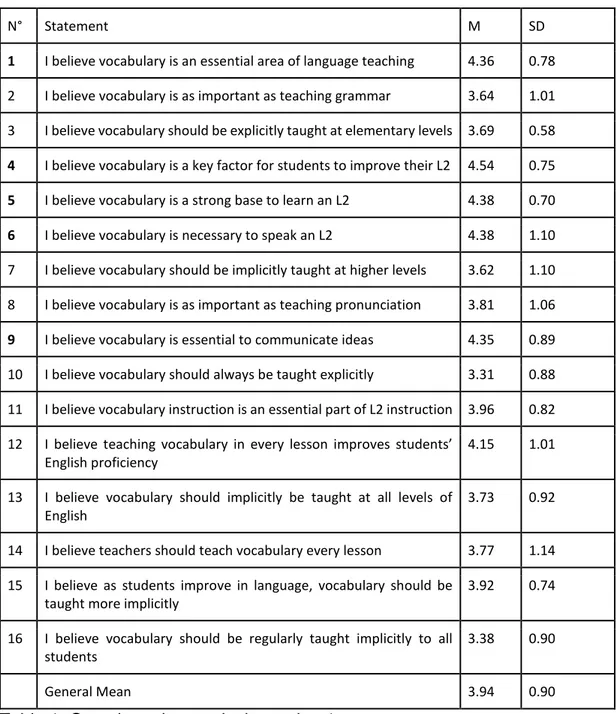
N° Statement M SD
1 I believe vocabulary is an essential area of language teaching 4.36 0.78
2 I believe vocabulary is as important as teaching grammar 3.64 1.01
3 I believe vocabulary should be explicitly taught at elementary levels 3.69 0.58
4 I believe vocabulary is a key factor for students to improve their L2 4.54 0.75
5 I believe vocabulary is a strong base to learn an L2 4.38 0.70
6 I believe vocabulary is necessary to speak an L2 4.38 1.10
7 I believe vocabulary should be implicitly taught at higher levels 3.62 1.10
8 I believe vocabulary is as important as teaching pronunciation 3.81 1.06
9 I believe vocabulary is essential to communicate ideas 4.35 0.89
10 I believe vocabulary should always be taught explicitly 3.31 0.88
11 I believe vocabulary instruction is an essential part of L2 instruction 3.96 0.82
12 I believe teaching vocabulary in every lesson improves students’ English proficiency
4.15 1.01
13 I believe vocabulary should implicitly be taught at all levels of English
3.73 0.92
14 I believe teachers should teach vocabulary every lesson 3.77 1.14
15 I believe as students improve in language, vocabulary should be taught more implicitly
3.92 0.74
16 I believe vocabulary should be regularly taught implicitly to all students
3.38 0.90
General Mean 3.94 0.90
Table 1. Questionnaire results in section 1
41
Referring to the results obtained from the measures of central tendency called mean, statements 4, 5, 6, 1, 9, and 12 were selected. The statements previously mentioned, revealed a mean higher than 4, which according to the Likert scale designed for the first section of the questionnaire, is between the higher levels of agreement—agree and totally agree—.
For instance, the majority of participants in the statement 4 (mean: 4.54) believe that vocabulary is essential for the students’ second language improvement. Likewise, the statement 5 (mean: 4.38) exposed a considerable level of agreement among participants when responding that they believed vocabulary is a strong base to learn a second language. In the same line, a significant number of participants in the statement 12 (mean: 4.15) believe that teaching vocabulary in every lesson improves students’ English proficiency. Additionally, in the statement 1 (mean: 4.36) an important fraction of participants think that vocabulary is an essential area of language teaching. Furthermore, the statement 6 (mean: 4.38) evidenced that participants agreed with the belief concerning to the idea that vocabulary is necessary to speak the second language. Correspondingly, in the statement 9 (mean: 4.35), participants agreed on the thought that vocabulary is essential to communicate ideas. As mentioned, the statements previously described showed the higher levels of agreement, however, none of the rest of the statements were under 3 that is to say there is not a significant disagreement among participants’ beliefs.
4.2 Questionnaire Results: Section 2
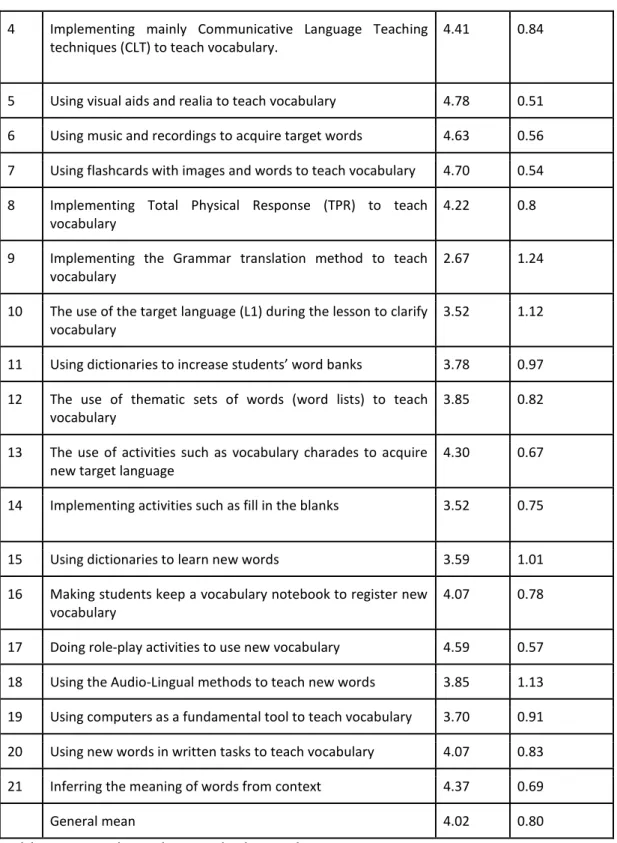
N° Statements M SD
1 Considering students’ needs and preferences to select the best methods or technique to teach vocabulary
4.70 0.54
2 Using one vocabulary teaching method/technique instead of a combination of two or more
2.52 0.94
3 Having in mind factors such as students’ age and level of English when teaching vocabulary
42
4 Implementing mainly Communicative Language Teaching techniques (CLT) to teach vocabulary.
4.41 0.84
5 Using visual aids and realia to teach vocabulary 4.78 0.51
6 Using music and recordings to acquire target words 4.63 0.56
7 Using flashcards with images and words to teach vocabulary 4.70 0.54
8 Implementing Total Physical Response (TPR) to teach vocabulary
4.22 0.8
9 Implementing the Grammar translation method to teach vocabulary
2.67 1.24
10 The use of the target language (L1) during the lesson to clarify vocabulary
3.52 1.12
11 Using dictionaries to increase students’ word banks 3.78 0.97
12 The use of thematic sets of words (word lists) to teach vocabulary
3.85 0.82
13 The use of activities such as vocabulary charades to acquire new target language
4.30 0.67
14 Implementing activities such as fill in the blanks 3.52 0.75
15 Using dictionaries to learn new words 3.59 1.01
16 Making students keep a vocabulary notebook to register new vocabulary
4.07 0.78
17 Doing role-play activities to use new vocabulary 4.59 0.57
18 Using the Audio-Lingual methods to teach new words 3.85 1.13
19 Using computers as a fundamental tool to teach vocabulary 3.70 0.91
20 Using new words in written tasks to teach vocabulary 4.07 0.83
21 Inferring the meaning of words from context 4.37 0.69
General mean 4.02 0.80
Table 2. Questionnaire results in section 2
43
teaching vocabulary. The table provides mean scores and the standard deviation from the responses participants provided in each statement. In table 2 we can see that the statements 2 and 9 got a negative answer from the participants, however the standard deviation from those two questions is close to 1, which means that there was disagreement among the participants regarding statements 2 and 9. In addition, we can see that the statements with more agreement among participants were the statements 1, 3, 4, 5, 6, 7, 8, 13, 16, 17, 20, and 21 which were all related to a student-focus teaching process and a wide variety of techniques and styles to teach different students in a better way according to different intelligences.
4.3 Questionnaire Results: Section 3
44
Graph 1. Pre-services teachers’ answers about their vocabulary instruction at the university.
As it is observable in Graph 1—which shows the most frequent vocabulary instruction techniques and methods to which participants were exposed to during their education at school—the Grammar Translation method was the most repeated answer that participants replied when referring to vocabulary instruction methods and techniques employed by their school teachers. Furthermore, techniques such as using images and listening were, after the grammar translation method, the most recurring techniques that participants mentioned when specifying about their vocabulary instruction while being a school student.
In order to explain in a clearer way the results we obtained from participants, a table below is presented with some responses that they provided in the third section of the questionnaires.
Techniques Answers from the participants
Grammar Translation - “It was taught through grammar translation method only”
45
oriented (verb to be and transcriptions)”
- “… We translated vocabulary from Spanish to English.” - “… The school I attended to focused only on the
grammar translation approach…”
- “… English classes were mostly focused on grammatical aspects, as well as translation.”
- “… Most of it was taught using grammar translation and drilling.”
- “…Writing the word on the board and then proceed to write its meaning in Spanish.”
- “My teacher at school taught vocabulary through grammar translation.”
- “My teacher would write both the word and its translation on the board and make us repeat it 10 times” - “… writing the new words on your notebooks alongside
the description or definition”
- “I was taught vocabulary with visual aids and flash cards” - “… mainly a visual type of learning since my teachers
used a lot of pictures”
- “… Teacher of English used song, videos and music…” - “I learned English from songs and movies”
Word list - “… We had a notebook with different new words each
week…”
- “My teacher asked me to have a notebook where I should write the new words…”
- “We made vocabulary lists…”
Listening - “Listening to podcast from the English text”
- “They taught me vocabulary with listening” - “Teacher of English used song, videos and music…” - “I learned English from songs and movies”
Repeating - “They all taught me vocabulary with repeating activities” - “… teachers used choral drills”
- “… Most of it was taught using grammar translation and drilling.”
- “My teacher would write both the word and its translation on the board and make us repeat it 10 times” - “… vocabulary was taught to me by grammar drills”
Dictionary - “By looking for the meanings in the dictionary”
- “My teachers taught vocabulary by using dictionaries.” - “I remember using dictionaries lot...”
46
- “We had to look for the meaning of the new words in the dictionary”
Table 3. Answers from the participants in section 3.
4.4 Questionnaire Results Section 3 Qualitative Analysis
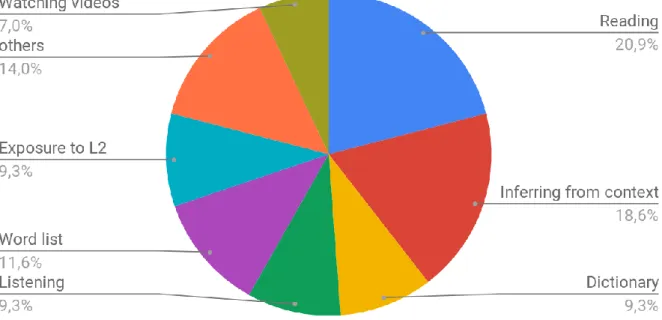
As mentioned above, sections 1 and 2 from the questionnaires were presented in tables with their correspondent means and standard deviations. Nonetheless, the answers of the section 3 were presented in graphs since we applied the technique of coding to see which answers were the most repeated among the participants. In the next graph, the answers retrieved from question 2 of the questionnaires third part, which refers to the way in which participants were taught vocabulary at the English Teaching Program at UNAB, are exhibited.
Graph 2. Pre-services teachers’ answers about their vocabulary instruction at the university.
47
about the use of reading tasks since it was the most recurrent response obtained by the participants. Nevertheless, inferring from context was also repeatedly stated as a method that university teachers applied for the instruction of vocabulary. The table below shows in more detail the answers given by the participants about the vocabulary instruction methods that university teachers employed in their lessons. As the graph 1 shows, “Reading” was the most repeated option among the participants with 20.9% of the total. The second option most repeated was “Inferring from context” with 18.6% of the total.
Techniques Answers from the participants
Listening - “Different ways of learning vocabulary such as listening”
- “Listening activities”
- “Listening to an audio and then have a discussion about it”
- “Mainly by listening and reading”
Word list - “On the one hand we have made lists of vocabulary”
Dictionary - “Looking for the meanings of words we didn’t know”
- “I register new vocabulary, use dictionaries, ...” - “we look them up online”
- “I´ve learned vocabulary by looking up the words in the dictionary...”
Reading - “Reading texts”
- “Different ways of learning such as reading” - “Reading activities”
- “We were taught mainly through readings...” - “Mainly by Listening and reading”
- “Mostly through reading books...”
- “On the other hand, we are asked to read, summarize, write...”
- “Using flashcards and reading texts inferring the meaning of the words.”
- “We were taught mainly through reading tasks...”
Inferring from context - “The programme has taught me vocabulary by understanding the words from a context”
48
- “... in some cases I infer the meaning of words according to the context”
- “Using the context to clarify the meaning and talking a lot.”
- “My teachers taught me using synonyms and I also learned the meaning of words from context”
- “At UNAB we usually have to infer the meaning from context”
- “In context, making sentences with them”
- “... but it is also pretty common to learn by context” - “Using flashcards and reading texts inferring the
meaning of the words.”
Exposure to L2 - “I was taught vocabulary by being constantly exposed to the second language”
- “... Every unit was designed to implement different set of words that were contextualized throughout the whole semester”
- “The units come with certain vocabulary words, we mostly used them in speaking classes”
- “I was taught vocabulary using it in context. Also, teachers used different methods or strategies in order to learn better. Furthermore, teachers use some global units in which we have to get new vocabulary that is used in real situations or contexts”
Watching videos - “Watching videos”
- “Activities such as watching a video”
- “And watch videos so it is impossible to avoid learning vocabulary”
Table 4. Answers from the participants in section 4.
4.5 Interview Results
49 3.69).This, is backed up with the evidence retrieved from the interviews were participants eeh... entrenándolo por decirlo constantemente se puede llegar a veces hay que ayudar un poco más a los niños a entender que esas son la palabras y el uso…”
vocabulary should be implicitly taught at higher levels
In the questionnaire we can see a tendency towards implicit vocabulary instruction for higher levels (mean: 3.62).This, is backed up with the evidence retrieved from the interviews were participants mentioned después ya que sea de manera más eeh… abstracta” aprendiendo porque hay palabras que la profesora no las incluye como parte del vocabulario pero que uno igual lo aprende y se vuelve parte de tu vocabulario”
vocabulary should always be taught explicitly
The questionnaire yielded a tendency towards explicit vocabulary instruction as a current way of teaching (mean: 3.31).This, is backed up with the
50
evidence retrieved from the interviews were participants mentioned the following.
“ separar las palabras nuevas, como por clusters, como por no eeh… no como por adjetivos, sustantivos y verbos, sino por, por, situaciones en las que tú podrías usar esa palabra. Yo creo que estrategias como esa with the evidence retrieved from the interviews were participants mentioned this.
“...estoy de acuerdo con que sea así porque de repente es mejor empezar a formar una base y después ya que sea de manera más eeh… abstracta…”
“...Si queremos que realmente aprenda eeh siempre hay que partir de una base que si es muy bajo se usar, entonces ya una vez dado eso después pueden empezar a experimentar más…”
Table 5. Beliefs about vocabulary instruction.
4.5.2. Effectiveness of strategies and methods to teach vocabulary.
Strategies’ Effectiveness Description Evidence
It is essential to consider
questionnaire, defined a clear agreement towards statements contexto real o interesante para el alumno.”
51 hacíamos durante los trece años en nuestra…”
questionnaire, defined a clear agreement towards statements respuesta y eeh… la fila que ganaba se… se ganaba unos cupcakes.” 3.85).This, is backed up with the evidence retrieved from the interviews were participants sientan como conectados con... entonces luego de hacer esa actividad no se mostrar videos canciones y todo y dar un tiempo para enfocarse en el vocabulario de cada actividad”
“Para niños eeh canciones”
52
divirtiéndose aprenden vocabulario igual.”
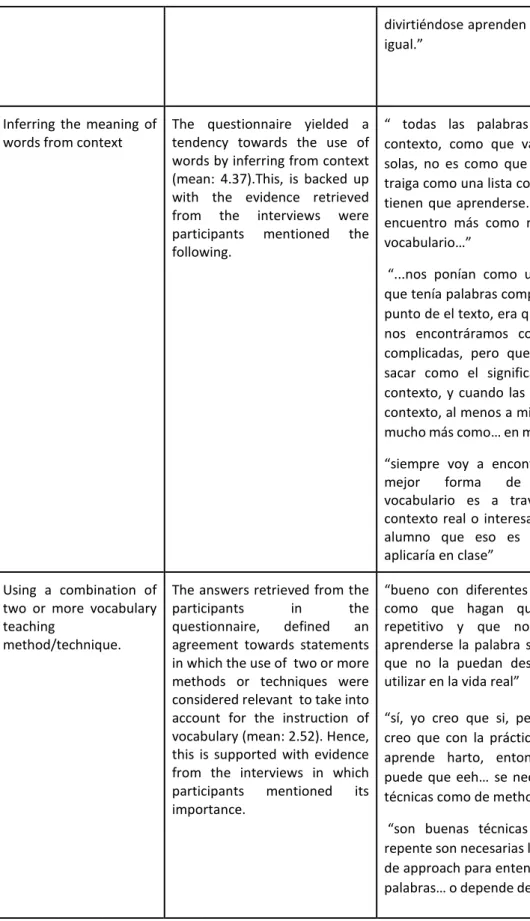
Inferring the meaning of words from context
The questionnaire yielded a tendency towards the use of words by inferring from context (mean: 4.37).This, is backed up with the evidence retrieved from the interviews were traiga como una lista como, ya esto tienen que aprenderse… así que lo encuentro más como relevante el vocabulario…”
“...nos ponían como un texto en que tenía palabras complicadas y el punto de el texto, era que nosotros nos encontráramos con palabras complicadas, pero que las podías sacar como el significado por el contexto, y cuando las sacai por el contexto, al menos a mi, me quedó mucho más como… en mi memoria”
“siempre voy a encontrar que la mejor forma de aprender vocabulario es a través de un contexto real o interesante para el alumno que eso es lo que yo considered relevant to take into account for the instruction of
“bueno con diferentes estrategias como que hagan que no sea repetitivo y que no sea sólo aprenderse la palabra sin contexto que no la puedan después saber utilizar en la vida real”
“sí, yo creo que si, pero también creo que con la práctica uno igual aprende harto, entonces quizás puede que eeh… se necesiten más técnicas como de methodology,”
“son buenas técnicas y que de repente son necesarias las dos tipos de approach para entender bien las palabras… o depende del contexto “
53
4.5.3. The influence of previous experiences in vocabulary instruction.
Previous experiences Description Evidence
Previous experience can have a big impact on students’ beliefs.
All the answers given in the questionnaires are related to vocabulary instruction experience for the instruction of vocabulary. Hence, this is supported with evidence from the interviews in which innovadoras y que en el fondo nos enseñaron ehh… como los
métodos en ehh en
metodología para enseñar como con Krashen ehh… con el input hypothesis, el participants were ask about different methodologies and ser profesor de inglés era para cambiar la forma en que yo aprendí inglés, porque de verdad fue súper fome, era súper desmotivante y no creo que a mis alumnos les gustaría que yo hiciera las clases así.”