UNIVERSIDAD ANDRES BELLO Facultad de Educación
Pedagogía en Inglés
THE RELATIONSHIP BETWEEN STUDENTS AND TEACHERS’ USE OF LANGUAGE LEARNING STRATEGIES AT UNIVERSITY LEVEL.
Seminario para optar al título de Profesor de Inglés para la Enseñanza Básica y Media y al grado académico de Licenciado en Educación.
Autores:
Constanza Javiera Bünzli Padilla Elizabeth Daniela Ahumada Urrutia
Profesor guía:
Daniela Paz Bascuñán Quezada
ACKNOWLEDGEMENTS
First, I would like to thank my family, who is always there when I need them. With their help and support, I could overcome this difficult and messy chapter of my life.
Furthermore, thanks to my mother who makes my life easier by helping me with all the things that I needed. Second, the knowledge that I received from Mr. Magaña and Miss Miriam that helped me to maintain interesting conversations regarding World Culture with my friends and family. Also for all the help that I receive from them regarding grammar and techniques of speech that improved my speaking skill in both languages, English and Spanish. Third, thanks to Elizabeth (Eli) who was the best partner I could ask for to work with me on this project. Fourth, thanks to my boyfriend Niccolo, who always supports me, helps me with good pieces of advice, love me even when I am in a bad mood, and feed me with a lot of pizza and chocolates. Finally, thanks to Miss Daniela, who guide us and calm us down when we were running out of time or nervous. (Constanza Bünzli)
I would like to thank my family, friends, and boyfriend for their unconditional support during this long path that comes to an end by the submission of this study. Without their words of wisdom and encouragement, this project would have never been finalized.
Also, I want to thank my teammate Constanza for her arrival to this project and for her commitment to it.
4.3.2. Participants………22
LIST OF TABLES
Table 1: Oxford’s 1990 LLS Classification…….………..………...15
Table 2: Occurrence of LLS observed ordered by category……….29
Table 3: Occurrence of LLS used by students ordered by category………...31
LIST OF FIGURES Figure 1: Occurrence of LLS by category through the three session………..33
LIST OF APPENDICES Appendix A ………....50
Appendix B………..………..……….56
Appendix C………..………..……….62
Appendix D………..………..……….67
Appendix E……….72
Abstract
This case study aims to explore the field of LLS in Chile, specifically in the English language learning area. The purposes of this research are: to identify which LLS were fostered by the teacher through class tasks, discover which LLS were used by the students and know if there is a relation between fostered LLS by the teacher and used LLS by the students.
The participants who collaborated with this research were a group of students from the second year of a TEFL program in a private Chilean university, and their teacher from the grammar module of an English Language course. A quantitative approach was chosen because it provided hard data, that is, results showed frequency of fostering and use of LLS, which allowed the investigators to objectively compare the results. In order to obtain the results, the employed instruments were: an adapted version of the Strategy Inventory for Language Learning (SILL) created by Rebecca Oxford (1990), which was applied to the teacher by observing him during three lessons, and a questionnaire created in function of the SILL - which was answered by the students. The findings evidenced the existence of a relation between some of the LLS fostered by the teacher and the ones used by the students, these were cognitive and metacognitive strategies. However, in other categories of LLS, such as in compensation strategies, there was not any relation whatsoever. Also, not all strategies were observed in both groups. The last step of the investigation showed that LLS are fostered and used with different priorities, its results revealed that some LLS were the 30% of the total number of categories while others obtained 0%.
Resumen
Chapter 1. Introduction 1.1.Motivation of the Study
As we are future teachers of English, what motivated us to carry out a study about Language Learning Strategies (LLS) was its relevance in the pedagogical area. The motivation of the study comes from our personal experience as students and from our practicums as pre-service teachers since we found difficult to match the learning strategies used by us and the ones used or preferred by our students. Furthermore, the limited information and research about this topic in Chile encouraged us to investigate more about the LLS used in Chilean classrooms. Likewise, our study intends to provide more knowledge in this pedagogical area, which can help the students to learn in a more effective way and for the teachers, to provide the necessary tools to improve their lessons.
1.2.Research Purpose
The main purpose of the study is to determine if the English language lessons match with the LLS used by the students. It is believed that there are some incongruences regarding the strategies fostered by the teacher and the ones used by the students. In order to achieve the main purpose, other two purposes arose. They are: to identify which LLS are fostered by the teacher through different class tasks and to discover which LLS are used by the students. This is important since teachers need to know what strategies to use when planning their lessons if they want to catch the attention of the students and make their lessons more dynamic.
1.3.Relevance of the Study
topic to different areas of English language learning in Chile. Also, knowing about the LLS used by students could be considered important for teachers, for example, when planning lessons.
Chapter 2. Literature Review
In this section, some authors have been cited to bring definitions regarding the diverse terms used in this study. Likewise, the context will set the previous knowledge gathered by the authors. This research will also show the results from other contexts, which will provide the investigators with the theoretical background to support this research. In that way, certain knowledge on the subject can be obtained.
2.1. Language Learning Strategies (LLS)
As stated by Ellis (1994), the way a second or foreign language is learned has been a subject of research since around the end of the 1960s, one area of these studies is covered by research on LLS. They have been defined by different authors, such as Oxford in 1990, as “specific actions taken by the learner to make learning easier, faster, more enjoyable, more-self-directed, more effective, and more transferable to new situations”. Likewise, these actions have been classified into six categories, which are: memory, cognitive, compensation, metacognitive, affective and social. Later, in 2002, LLS were described by Cohen and Dörnyei as “the conscious or semi-conscious thoughts and behaviors used by learners with the explicit goal of improving their knowledge and understanding of a target language” (pp. 170-192). In other words, LLS help learners of a second or foreign language to improve their learning process, whether they are aware of it or not. The definitions given by the authors have been found to be similar despite a difference of 13 years between one publication and the other. In this way, a congruence in the meanings of LLS has been shown. To sum up, this group of actions or behaviors help the students to learn a new language in a more personalized way.
language, since it is a lingua franca that, as Seidlhofer (2011) stated, “has emerged as a way of referring to communication in English between speakers with different first languages”. This means that English unites different cultures because it is a tool used to communicate with others. This makes English learning very useful nowadays because it helps people to communicate with others around the globe.
In Chile, not many studies about LLS focused on English have been published. For this reason, it was considered necessary and useful to explore this field in order to provide further information about the fostering and use of LLS in Chile.
The focus of this study is to determine if the lesson match with students’ LLS and use of LLS for English learning because it is appropriate for the interests of teachers and students as well. Furthermore, it can be studied by future teachers of English in order to expand their knowledge. Also, it can be applied in classrooms and teaching instances. 2.2. Language Learning Strategy Models
The field of LLS has been explored by different investigators through the years. Some authors suggested similar classifications and descriptions of them. In the next lines, perspective from some researchers is provided. Finally, the model in which this study was based on is presented.
2.2.1. O'Malley's (1985) classification of Language Learning Strategies
O'Malley (1985) classified LLS into three main subcategories; metacognitive, cognitive, and socio-affective strategies.
planning, self-monitoring, delayed production, self-evaluation” (pp.557-584). Metacognitive strategies require a set of steps which are organized in order to have a successful development from the student.
Cognitive strategies, in contrast with metacognitive, are restrained to specific learning tasks that are influenced by direct manipulation of the learning material. According to O’Malley (1985), some examples of the most important cognitive strategies are repetition, resourcing, translation, grouping, note taking, deduction, recombination, imagery, auditory representation, keyword, contextualization, elaboration, transfer, and inferencing.
Finally, socio-affective strategies refer to the interaction with others, for example, when asking for clarification to maintain and interact in a conversation.
2.2.2. Rubin’s (1987) classification of Language Learning Strategies
In 1987, a distinction in LLS was made by Rubin: they were divided into direct and indirect strategies. It has been stated by the author that there are three types of strategies that contribute to language learning. These are learning, communication, and social strategies.
Learning strategies have been divided into cognitive and metacognitive. Examples of cognitive strategies are clarification, guessing, deductive reasoning, practice, memorization, and monitoring. While metacognitive strategies include: planning, prioritizing, setting goals and self-management.
Social strategies were classified by Rubin and Wenden (1987) as the activities through which learners are exposed to situations that allowed them to apply and practice their knowledge. From this, they obtained exposure to the target language.
2.2.3. Stern's (1992) classification of Language Learning Strategies
In 1992, LLS were divided into five categories by Stern; management and planning strategies, cognitive strategies, communicative - experiential strategies, interpersonal strategies, and affective strategies.
Management and planning strategies refer to the learner’s intention to control his own learning. This means that the teacher will only act as a supervisor guiding the progress of the students. While the students will decide their own goals, the methodology to use, evaluate their own achievement and will decide how to work.
Cognitive strategies are the steps that the students will use to solve problems while learning. Some of these steps are, as Rubin had stated before, clarification, guessing, practice, and memorization.
Communicative-experiential strategies are used by students to maintain a fluid conversation by avoiding interruptions. Some of the used techniques are gesturing, asking for repetition, and explanation.
Interpersonal strategies are similar to management and planning strategies because the students will keep record of their progress and pay attention to their own development and performance.
when the students learn how to control their emotional problems, they could overcome the difficulties by transforming them into a positive situation of learning.
2.2.4. Oxford’s (1990) classification of Language Learning Strategies
In 1990, LLS were classified by Oxford based on Rubin’s work, these were divided into two categories: direct and indirect strategies. In order to present them in an organized and structured way, a definition of each is provided. The first three categories correspond to direct LLS, the following three categories correspond to indirect LLS.
Table 1: Oxford’s 1990 LLS Classification.
DIRECT STRATEGIES
i) Memory Strategies: Ways of remembering and retrieving new information, such as creating mental linkages, applying images and sounds, and reviewing well.
ii) Cognitive Strategies: Used for understanding and producing the language, such as practicing, sending and receiving messages, analyzing and reasoning, and creating a structure for input and output. These strategies are the only ones that have been found to affect performance for a group of proficient learners.
iii) Compensation Strategies: Used for utilizing the language despite a possible lack of knowledge, such as guessing intelligently (i.e. taking into account the context) and overcoming limitations in speaking and writing (i.e. being able to paraphrase).
INDIRECT STRATEGIES
the learning, arranging and planning, and evaluating the learning. These strategies require a certain level of self-awareness to be used.
ii) Affective Strategies: Used to regulate emotions, and meant to provide stability and security in difficult situations. They include lowering the anxiety, words of encouragement, and taking the learner’s emotional temperature.
iii) Social Strategies: Used for learning with others. Contexts are different, but given the prevalence of school-like learning environments, these strategies are clearly sound. These include asking questions, cooperating with others, and empathizing with others.
Based on the table, it was observed that LLS were grouped into six categories that, at the same time are divided into direct and indirect. It has been possible to observe some concepts in other definitions of LLS provided by different authors. The presented categories are similar to the ones used by the other three researchers. From this, it can be inferred that Oxford-based her work on the basis granted by the pioneers in this topic.
2.3. Strategy Inventory for Language Learning (SILL)
items of metacognitive strategies, 6 items of affective strategies and 6 items of social strategies. Each of these items referred to actions employed when learning English.
According to Oxford (1990), the SILL is a structured survey designed to be answered by subjects based on a 5-point Likert scale when 5 is always, 4 frequently, 3 occasionally, 2 rarely and 1 never or almost never. Its objective is to identify and pinpoint specific strategies that are or might be used by students when learning English as a second or foreign language.
2.4. Research on Language Learning Strategies.
LLS have been studied before in different contexts and from different perspectives. Some of those studies were described throughout this section.
Research on LLS was conducted by Zareva and Fomina (2013) in a linguistics program, in which they identified the categories of LLS used by Russian pre-service teachers of EFL. In this research, two groups were taken as samples. The first group was composed of students entering the program. The second group was composed of students finishing the program. The groups completed the SILL by themselves, in order to collect data about their preferences and uses. Results from both groups were compared to measure which LLS were more frequently used.
Regarding the frequency of use of LLS in both samples, metacognitive strategies were found to be used with a higher frequency than the rest. In contrast, affective strategies were found lower in the frequency of use. The findings of the study showed that the Russian students of the TEFL program tended to maintain their LLS preferences of use.
analyzed and the participants were classified into unsuccessful and successful students. Considering that the range of possible grades for Mexican students goes from 0 to 100, the subjects called successful were those with grades from 91 above. The checklist contained 50 items measuring the six groups of strategies defined above.
Results from Del Ángel and Gallardo concluded that the most used LLS by academically successful students were metacognitive strategies; meanwhile, compensation strategies were the most used by unsuccessful students.
In the United Kingdom, Liu (2012) conducted a study in 18 universities, colleges, and schools, using the SILL focused on Chinese language learning. Participants were divided into heritage and non-heritage Mandarin Chinese learners. A background questionnaire with 16 questions and a Strategies questionnaire were applied. Results showed that, on the one hand, heritage Chinese students used social, compensation, and affective LLS more often when learning Mandarin Chinese. On the other hand, non-heritage Chinese students used cognitive, metacognitive and social LLS more frequently.
Chapter 3. Research Questions
Based on the previous sections, three questions have emerged, which are expected to expand our study.
1) Which LLS are fostered by the teacher through different class tasks of second-year students of English Pedagogy from a Chilean private university, and how?
2) Which LLS are used by second-year students from an English program in a Chilean private university?
3) To what extent do the lessons match the LLS used by the students?
Chapter 4. Methodology
In this section, we present the different aspects addressed in the study while exploring the research questions previously stated. Some of those aspects are: approach, context, instruments, procedures, data analysis, and finally validity and reliability of the study. These are explained throughout this chapter.
4.1. Tradition
We chose to observe the behavior of a group. Therefore, a case study was chosen as the tradition to work. According to Creswell (2013), a case study studies real-life and contemporary cases over time, using different sources of information. Likewise, our decision was supported by the instruments that we used for the data collection, which were observations and recordings. As Yin (1994) established, from direct and participant observations, as well as records and documentation, quantitative data come largely. We decided to complete a SILL checklist focused on the teacher while observing him, we also recorded the lessons. In addition, we applied a questionnaire to the students. Through these instruments we gathered enough data for our study.
4.2. Approach
instrument was specifically made to be compared with the adapted version of the SILL used in this study.
4.3. Context
The observations took place in a Chilean private university. The classroom we observed had forty chairs with tablet arms, a data projector and one desktop computer on the teacher’s table. The lightning was adequate and, in general, it was a comfortable classroom because the students and the teacher had enough space to move freely. The modules observed were taught on Fridays from 12:10 to 13:50 and they corresponded to regular grammar sessions, that is, there was content instruction given by the teacher and activities done by the students. The module observed is part of a bigger subject called English Language 4.
4.3.1. University
We chose a Chilean private university because of its availability. Also, we were able to conduct this study thanks to its personnel’s and students’ disposition. It can be considered new since the subjects of the study were future teachers of English by the time the study took place, and research about the relation between fostered LLS by the teacher and used LLS by the students has not been published in our country.
4.3.2. Participants
disposition allowed us to carry out this study. The ages of the participants fluctuate between 18 and 30 years, in the class, there were 11 females and 7 males, and their level of English was B1 according to the CEFR.
4.4. Procedures
In the following section, we proceed to describe the steps that were followed to collect data for this study.
4.4.1. Permissions
As the participants were adults, it was not necessary to request for their parents’ permission to observe and record them during the lessons. Instead, the participants signed a consent form. Likewise, permissions from their teacher and the headmaster of the program were granted. The permissions explained the procedures as well as the advantages of being part of our investigation (see appendix B).
4.4.2. Data Collection Method
instrument was created based on the questions from the SILL in order to compare the results later. We decided to use a questionnaire because it provided the possibility to compare its results directly to those of the observations. The questionnaire was taken at the beginning of the last lesson observed because of time constraints, however, this did not affect the results because it took the only ten minutes to be completed by the students. Dörnyei (2003) states that questionnaires are more efficient for the researchers regarding the time, effort, and financial resources. In the next subsections; we explain how data were collected, the instruments used and how they were applied.
4.4.2.1. Observations and recordings
We observed three lessons in order to develop an understanding of the LLS fostered by the teacher, and to assess the reliability of our observations. Being present in more than one session provided us with more background for further analysis. The observations were recorded in order to be watched later and to see if something was missing in the checklists. In the next lines, a brief description of each session is presented.
The second lesson started with a review of the content of the former lesson. We observed the lesson while completing the SILL checklist, the recordings took place using the same devices employed in the first session.
In the final session, the questionnaire was given to the participants at the beginning of the lesson, they completed it individually. We observed while completing the SILL checklist, the recordings took place using the same devices employed in the previous sessions. The class included a summary and practice of the content since the participants were going to have a test in the following class.
4.4.2.2. SILL
In order to measure the frequency of use of LLS, in 1989, Rebecca Oxford developed an inventory –in the form of a checklist—called the Strategy Inventory for Language Learning (SILL), which throughout the years has been through modifications, and which most current version is the seventh, developed in 2011.
According to Oxford (1990), the SILL is a structured survey designed to be answered by subjects based on a 5-point Likert scale from “never or almost never” to “always or almost always”. Its objective is to identify specific strategies which are used by students when learning English as a second or foreign language. As stated before, an adapted version was applied in this research.
We completed the SILL while observing the lessons and we used the recordings of the sessions to analyze the data in more depth. The main aim of this was to understand which strategies were fostered by the teacher.
We created the questionnaire to be answered by marking with an X for YES or NO. These questions were specifically chosen and adapted to be compared with the results of the SILL that was applied in the same class. As Creswell (2011) mentioned, “the advantage of this type of questioning is that your predetermined closed-ended responses can net useful information to support theories and concepts in the literature” (p.219). The aim of the questionnaire was to obtain hard data in relation to the use of LLS by students. Later, these results were compared with those obtained from the observations in order to see if there was any relation between the LLS fostered by the teacher and the ones used by the students. 4.5. Data Analysis
In order to organize and process the collected data, we followed a number of steps which are further explained in this section.
4.5.1. Observations, recordings and SILL analysis
First, we watched the recordings and read our notes about the observations. The SILL checklist was completed while the lessons took place individually, they included 6 boxes to include the number of times each strategy was fostered (See appendix E). In the SILL, the strategies were classified by category (memory, cognitive, compensation, metacognitive, affective and social). The next step was to count the number of times each strategy was fostered. Finally, we joined our results and created a chart in an excel document with the obtained data, which ranked the LLS from the most to the least fostered.
4.5.2. Questionnaire analysis
document, as we did with the SILL’s results, to rank the numbers and know which LLS were the most and least used by the students (See appendix F).
4.6. Validity/Reliability
Chapter 5. Results and Analysis
As stated before, LLS and their use in English learning have been researched around the globe yet in our country they have not been explored in much depth. In this chapter, results, and analysis of the gathered data regarding the relation between fostered LLS by a teacher and used LLS by second-year university students will be presented.
As mentioned in the previous chapter, the approach of this study is quantitative and the instruments used as a source of information were three: observations, adapted SILL, displayed. First, fostered LLS by the teacher in numbers of occurrence are shown, followed by the number of positive answers to the use of LLS from students. Finally, the possibility of a relation between both (fostered and used LLS) is explored.
5.1.1 Observation results
4 course did not give place to foster all the items listed in the SILL. For example; item 4 stipulates the use of rhymes when learning new English words, but students have had at least three semesters of English language, in which students have supposedly learnt the necessary grammar rules and have acquired enough vocabulary to take the course. According to what was mentioned before, this strategy is not supposed to be necessary at this stage.
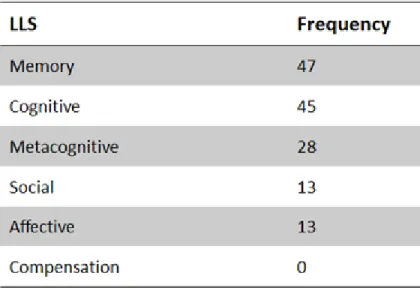
In order to present the results of the application of the SILL (see index 5), the times each item was observed were counted and grouped into the different types of LLS. Then, the categories were ordered from the most to the least fostered by the teacher. In this subsection, the number of occurrence for each category of LLS is presented, showing the number of times an LLS was fostered. In the next section results of both instruments will be balanced by transforming them into percentages.
Table 2: Occurrence of LLS observed ordered by category
English words by grouping them into synonyms, antonyms, nouns, and verbs. Given the fact that the observed module corresponds to grammar, it can be considered natural that this category was the most fostered by the teacher because the items refer to establishing connections between previous knowledge of vocabulary and grammar. The second most fostered LLS were cognitive (45 times). Such LLS include saying or writing new English words several times, using English words in different ways and trying to find patterns in English, among others. These LLS also refer to acquire concepts and analyzing words grammatically, which could justify their fostering given the nature of the course. The next category is metacognitive with 28 repetitions, in this category, the most fostered strategy was asking the students to learn from their mistakes to improve later, which shows encouragement of autonomy from the teacher to the students. Finally, compensation were the least fostered LLS with zero occurrences during the three lessons. These LLS include guessing the meaning of words or using gestures when the students were not able to say what they meant: it is inferred that fostering of these LLS was not observed during the lessons because of the students’ level of English. Again, it can be affirmed that students were likely to have acquired these strategies during earlier English language courses.
5.1.2 Questionnaire results
environment of the lesson. They paid attention when the teacher talked, the lesson seemed to be enjoyed since they laughed repeatedly along with the teacher when pertinent.
Results are shown in a descendant order starting with the highest number of occurrences. In the next section, results are shown in percentages in order to compare them with the SILL.
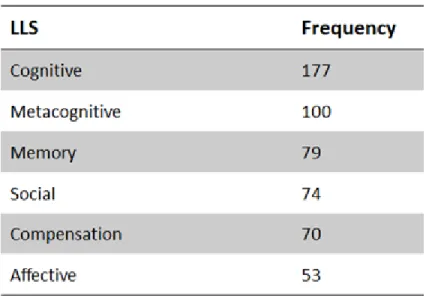
Table 3: Occurrence of LLS used by students ordered by category
According to Table 3, students’ use of cognitive strategies is significantly higher than the rest of them (177 positive answers among 18 students), that is, students tend to practice English sounds, among others. These strategies, according to Oxford (1990), affect the level of proficiency from a group of proficient learners. From this, it can be inferred that these LLS are more frequently used by the participants because, as stated before, proficient learners use these strategies and the group observed should be proficient since they have passed three English language courses before being a part of English language 4.
since they have been studying English at a professional level for at least three semesters before English language 4, which should provide them with it self-awareness about their learning process. The next three LLS -memory, social and compensation- were used with a similar frequency and finally. Affective strategies such as writing down feelings in a journal regarding learning English are the least used. This could be because, according to our experience in practicum, affective strategies are not fostered in general as much as cognitive or memory strategies, which means that it might not be very natural for the learners to acquire them.
5.2. A Contrast Among the Three Sessions
In order to compare both results, graphics were created. After data were gathered, results in numbers were transformed into percentages in order to make comparisons between the eighteen questionnaires and the SILL checklist valid; after percentages were obtained, graphics were created.
Results showed that the most fostered LLS by the teacher were memory (32%) followed by cognitive LLS (31%) while the least fostered LLS were compensation (0%).
Figure 1: Occurrence of LLS by category through the three sessions.
situations were seen during the lessons because, as observed, they understood the language during classes; their doubts were related to grammar structures instead of the meaning of words.
5.3 Contrast between LLS research in Chile with LLS investigations in other contexts In order to contrast these results with other similar studies, investigations described in the literature review chapter were used. In the case of Zareva and Fomina’s (2013), metacognitive strategies were found to be the most used among Russian students from first and final year of a TEFL program. This result was seen in both groups, which showed consistency in LLS use through the career.
In México, Del Ángel and Gallardo’s (2014) research showed similar results: metacognitive strategies were the most used by successful Mexican students. Both studies from Russia and Mexico share some preferences of LLS use, which could suggest certain similarities among students from such countries.
Chapter 6. Discussion
In this chapter, the previously presented research questions are explicitly answered based on the analysis made on the entire investigation.
The first question, which referred to the fostered LLS by the teacher through different class tasks, revealed that the most fostered LLS were memory strategies with a 32%. These strategies were encouraged by, as stated by Oxford (1990), asking the students indirectly to think of relationships between what they already knew and new things they learned in English, which means that while teaching the new content, the teacher asked questions about the previous lessons that allowed students to establish such relationships. As an example of this, during the first observed lesson, the teacher asked the students to complete an exercise using the new knowledge acquired during the lesson, and to connect it with the knowledge they acquired during the previous lessons. This indicates that the teacher encouraged the students to create relations in their minds in order to connect the new contents with the previous learning. Also, the teacher indirectly asked the students to review the lessons by constantly asking questions about previous classes. For example, the teacher made the students remember a part of the last class by using a similar example that he had used in the previous lesson. He used that example because he noticed a positive reaction from the students, he wrote: “Mr. John who was a nice guy, is dead”. Reactions from the students towards this were completely positive since they looked relaxed, receptive to the class, and they participated actively during the session.
module the only spoken language was English, the items mentioned before were fostered naturally. In addition, students were asked to use English words in different ways when they had to speak to their classmates or to their teacher, and whenever they were asked to write sentences with structures. Finally, fostering of cognitive strategies was showed by making students start new conversations in English every time they had to do pair or group activities. This was observed when the teacher asked the students to work in pairs discussing and answering some questions about a video seen in that class.
Metacognitive strategies followed with a 19%. This strategy was fostered mainly by letting the students notice their mistakes and correcting them when they could, as Oxford (1990) suggested in the description of these LLS. This was constantly noticed during the three observed lessons. It could be seen when the teacher checked an exercise with the class: the lesson was focused on noun and adverb clauses. As students gave their examples, the teacher checked them on the board with the class. After a student gave the sentence, the teacher asked the rest if it was well created or not, and why. After a sentence was told the teacher said: “I would say that this would not be either a noun clause or an adverb clause because it is not a clause… why?” Few seconds after, several students started making sounds as a way of showing they have realized what the mistake was. Finally, they corrected the sentence on the board as a class.
description this type of fostering is likely to be seen in school-like learning environments. Also, when students forgot a concept or a part of previous contents, they knew they could ask questions aloud and the teacher would answer them, this was also possible because the environment of the classroom was pleasant for them and since they knew each other it was easier to speak freely.
Then, affective strategies followed with a 9%. They were fostered, as said by Oxford (1990) when students were encouraged to speak even when they did not know how to express themselves accurately in the target language. For this, the teacher did not correct minor mistakes in grammar or pronunciation, it is presumed he did it to prevent students from feeling ashamed. During the lessons, the good and relaxing atmosphere created by the teacher helped the students to be more talkative and to participate even though they could make mistakes. This was demonstrated whenever the teacher presented a sentence that, besides the main purpose which was to analyze it, made the students laugh because the teacher made a funny commentary about it. Also, every time the teacher made a joke the students were able to lower their anxiety if they were nervous since there was a friendly atmosphere.
Finally, fostering of compensation strategies was not observed during the lessons, this could be because at that stage, students were supposed to have acquired a level of English that does not require these strategies to be fostered. Taking this into consideration, it can be interpreted that these strategies should be established in learners rather than fostered by the teacher.
cognitive. These strategies obtained almost the same percentage of use among the students with 32% and fostering by the teacher with 31%. This could be because, as described by Oxford (1990), they are used for understanding and producing the language. As mentioned before, the module observed corresponded to grammar instruction, which could explain the relation between fostered and used cognitive strategies since grammar has a direct relation to the understanding and production of the target language. Activities such as reading, writing, analyzing sentences, and practicing the language by interacting with the rest of the class, are examples that have relation to this type of LLS. Students specifically used, in addition to the previously mentioned, watching television and listening to music in English. This could be justified by observing the context in which they were immersed, in Chile, there is plenty of English input that comes from movies and music.
With a notorious difference of percentage of use, the LLS that followed were metacognitive with an 18%, this was rather low in contrast with the results from the SILL. According to an article published by the website Inclusive Schools Network (2014), “Metacognitive strategies refer to methods used to help students understand the way they learn; in other words, it means processes designed for students to 'think' about their 'thinking'.” The students affirmed that they paid attention when someone spoke in English, which means that they gather information from English speakers. In this way, students could know what to use to replicate a similar conversation.
After memory strategies, the LLS that followed were social with a 13%. According to Oxford (1990), the social strategy is the interaction between learners to improve their language learning. The students expressed through the questionnaire, that when they did not understand something, they asked questions for clarification in English. This means that there was interaction among the students when they are not clear about something by asking questions to clarify their doubts.
Unlike in the case of fostered LLS, in which compensation strategies were excluded, students showed to use all of them. As mentioned before, Oxford (1990) described that compensation strategies refer to the capacity of students to use the language despite the possible lack of knowledge of it. This could explain why students did use these strategies even if they were not fostered during the grammar lessons. According to the questionnaire, when the students had problems thinking of an English word, they tended to use a word or phrase that meant the same. This means that the students, even though they might have had problems expressing themselves in English, were capable of using the language to express what they wanted to say by replacing the words.
regarding the target language. It is believed that these strategies are of great importance considering how emotions affect human behavior, therefore their correct use could benefit the performance of the language in general.
Finally, the third question meant to explore to what extent the lessons prepared by the teacher matched the LLS used by the students. Results showed that there was a relationship between some LLS as in the case of cognitive strategies. This was the most important finding when exploring the correspondence between the lessons and the LLS used by the students. This relation could be explained by the nature of cognitive strategies. As mentioned before, the teacher and the students had to use them in order to understand and produce the language. The fostering and use of these strategies were understood as part of the grammar module and they were observed during the lessons. There were more LLS that shared a relation between their fostering and use during the lessons; the use of metacognitive strategies also relates to the teachers’ fostering of them, from which could be inferred that the teacher indirectly encouraged the use of these LLS, by giving instructions that led students to plan and organize the contents in their heads. For example, when the teacher told the students about a test taking place soon, the students had to arrange in their minds their schedules to study, also, by studying they organized the contents in their minds. The last LLS that shared a relation between fostering and use were affective strategies. These strategies might be less recurrent because they are opposite to cognitive and metacognitive strategies, affective LLS do not include strategies that refer to contents, and instead, their focus is on self-regulating emotions.
Chapter 7. Conclusion
Once the study was applied, reflection on its results was carried out by both investigators. From this, thoughts and conclusions arose. In this chapter, different aspects of the final stages of the dissertation were explored. The next subsections refer to the limitations found during the investigation, further research that could be carried out based on the topic, and possible implications for pedagogy in our context.
This study has helped us to explore the relationship that exists between the LLS encouraged by the teacher of a second-year class in a private Chilean university, and the ones used by students from such class. It is prudent to state that the findings of the research confirmed a relation among three LLS. This information could be useful for language teachers given the fact that they are in charge of encouraging students, directly or indirectly, to use LLS when learning English. It may be possible that fostered LLS affect the efficiency of learners as they acquire them; based on this, teachers could develop self-awareness about the strategies they apply since it may help them to manage the fostered LLS and, at the same time, optimize the learning process.
Since this study was conducted in a specific context, it was not adequate to generalize the results in any other class in Chile because every class has its unique features. Moreover, more studies regarding this topic should be carried out through the country. Due to the fact that its exploration may be helpful to understand the learning process better. 7.1. Limitations
the authorities of the school and the students’ parents were required, which was not possible given the time needed to gather these documents. For the sake of time, the focus had to be changed for higher education participants since at university, students were found to be adults, therefore they were able to decide whether to participate or not and permission from their parents was not necessary. Also, working with a university class allowed the investigators to set the observations dates directly with the teacher in charge of the module and to adjust these days according to the requirements of the lessons.
Another limitation that emerged was the number of lessons observed. Initially, four lessons were expected to be observed, but it was necessary to decrease this number due to the focus of the lessons. For example, some contemplated dates had evaluations or presentations set, which did not count as valid observations because, for the purposes of the study, the content instruction was essential during the lessons.
Overall, limitations found in this investigation were minor and they could be solved by making slight modifications to the structure of the research.
7.2. Further research
fostered in order to improve the learning process. On the other hand, studies on LLS focused on the high school could be easier to develop given the fact that older students have more tools to report their actions and answering questionnaires by themselves. Based on these results, activities could be oriented to the used LLS to investigate possible changes in students’ results when studying English as a second language.
At higher education levels, this could be applied to universities or institutes from different contexts. Results might also be compared with the present study in order to explore the possible relations among them. Studies on this might use mixed methods and include -qualitative instruments such as interviews or focus groups to obtain more complete answers from the participants.
Action research could make modifications to in-class activities, and study if tasks made in function of LLS used by the students, were prone to lead to any improvement in the learning process.
Overall, studies that employ instruments adapted from the SILL, could create an adaptation based on the Chilean reality and on what it is seen in Chilean classrooms. In that way, the instrument would be more contextualized.
Finally, researchers could observe which specific strategies are fostered by teachers or used by students in combination with others. It was observed during this research that the teacher tended to combine more than one type of strategy by activity, such as memory with cognitive strategies. This could make the investigation and their results more specific.
7.3. Pedagogical implications.
teachers and students could be beneficial for both. It can be inferred that if teachers became aware of the LLS they foster, these could be conscientiously chosen. In that way, taking into account the relations found between fostered and used LLS, students might start using strategies that improve their learning process. For example, Affective strategies were not found to be encouraged or used very often. Nevertheless, they relate to moderating the learner’s emotions such as anxiety. If affective strategies were more fostered and used, it could be possible to benefit from them. Affective strategies could also be explored in other fields, given the fact that self-regulating emotions might help in other areas of learning.
References
Cohen, A.D. & Dörnyei, Z. (2002). Focus on the language learner: Motivation, styles and strategies. In N. Schmitt (Ed.), An introduction to applied linguistics (pp. 170-192). London: Arnold.
Creswell, J.W. (2003). Research Design: Qualitative, Quantitative, and Mixed Methods Approaches (2nd ed.). Thousand Oaks, CA: Sage Publications.
Creswell, J. W. (2011). Educational Research. Planning, Conducting, and Evaluating Quantitative and Qualitative Research (5th ed.). Pearson Education.
Creswell, J. W. (2013). Qualitative Inquiry and Research Design: Choosing Among Five Approaches. Thousand Oaks, CA: Sage
Del Ángel, M. C., & Gallardo, K. E. (2014). Language Learning Strategies and Academic Success: a Mexican Perspective. 13(2), 703-713.
Dörnyei. Z. (2003). Questionnaires in Second Language Research: Construction, Administration, and Processing. Lawrence Erlbaum Associates, Publishers.
Ellis, R. (1994). The Study of Second Language Acquisition. UK: Oxford University Press. Inclusive Schools Network. (2014). Metacognitive Strategies. Retrieved on November 17,
Liu, Y. (2012). Motivation and Its Relationship with Learning Strategy. Taiwan:
Conference paper for the 2 nd International Conference on Chinese as a Second Language Research.
Oxford, R. (1990). Language learning strategies: What every teacher should know. Boston: Heinle & Heinle.
O'Malley, J. Michael, Chamot, Anna U., Stewner-Manzanares, Gloria, Russo, Rocco P., and L. Kupper. (1985). Learning Strategy Applications with Students of English as a Second Language: In TESOL Quarterly, 19, 557-584.
Park, G. (2011). The Validation Process of the SILL: A Confirmatory Factor Analysis(4th ed., Vol. 4). Korea. Canadian Center of Science and Education
Polit, D.F. & Beck, C.T. (2012). Nursing research: Generating and Assessing Evidence for Nursing Practice. Philadelphia: Lippincott, Williams & Wilkins.
Seidlhofer (2005). English as a lingua franca. ELT. Oxford: Oxford University Press. Stern, H.H. (1992). Issues and Options in Language Teaching. Oxford: OUP.
Yin, R. K. (1994). Case study research: Design and methods (2nd ed.). Newbury Park, CA: Sage Publications.
Rubin, J. & Wenden, A. (1987). Learner Strategies in Language Learning. New Jersey: Prentice Hall.
Appendices
This form of the STRATEGY INVENTORY FOR LANGUAGE LEARNING (SILL) is for students of English as a second or foreign language. On the separate worksheet, write the response ( l, 2, 3, 4 or 5) that tells HOW TRUE OF YOU THE STATEMENT IS.
l. Never or almost never true of me 2. Usually not true of me
3. Somewhat true of me 4. Usually true of me
5. Always or almost always true of me
NEVER OR ALMOST NEVER TRUE OF ME means that the statement is very rarely true of you.
USUALLY NOT TRUE OF ME means that the statement is true less than half the time. SOMEWHAT TRUE OF ME means that the statement is true of you about half the time. USUALLY TRUE OF ME means that the statement is true more than half the time. ALWAYS OR ALMOST ALWAYS TRUE OF ME means that the statement is true of you almost always.
items. Work as quickly as you can without being careless. This usually takes about 20-30 minutes to complete. If you have any questions, let the teacher know immediately.
EXAMPLE
I actively seek out opportunities to talk with native speakers in English.
On this page, put an "X" in the blank underneath the statement that best describes what you actually do in regard to English now. Do not make any marks on the Worksheet yet. Always or Almost Always True of me _____ 1
Never or Almost Never _____ 2
Generally Not True of Me _____ 3
Somewhat True of Me _____ 4
Generally True of Me _____ 5
If you have answered the question above, you have just completed the example item. Now wait for the teacher to give you the signal to go on to the other items. When you answer the questions, work carefully but quickly. Mark the rest of your answers on the Worksheet, starting with item 1.
Strategy Inventory for Language Learning Version 7.0 (ESL/EFL)
© R. Oxford, 1989 l. Never or almost never true of me 2. Usually not true of me
3. Somewhat true of me 4. Usually true of me
Part A
1. I think of relationships between what I already know and new things I learn in English. 2. I use new English words in a sentence so I can remember them.
3. I connect the sound of a new English word and an image or picture of the word to help remember the word.
4. I remember a new English word by making a mental picture of a situation in which the word might be used.
5. I use rhymes to remember new English words. 6. I use flashcards to remember new English words. 7. I physically act out new English words.
8. I review English lessons often.
9. I remember new English words or phrases by remembering their location on the page, on the board, or on a street sign.
Part B 10. I say or write new English words several times. 11. I try to talk like native English speakers.
12. I practice the sounds of English.
13. I use the English words I know in different ways. l. Never or almost never true of me 2. Usually not true of me
3. Somewhat true of me 4. Usually true of me
14. I start conversations in English.
15. I watch English language TV shows spoken in English or go to movies spoken in English.
16. I read for pleasure in English.
17. I write notes, messages, letters, or reports in English.
18. I first skim an English passage (read over the passage quickly) then go back and read carefully.
19. I look for words in my own language that are similar to new words in English. 20. I try to find patterns in English.
21. I find the meaning of an English word by dividing it into parts that I understand. 22. I try not to translate word-for-word.
23. I make summaries of information that I hear or read in English. Part C
24. To understand unfamiliar English words, I make guesses.
25. When I can' t think of a word during a conversation in English, I use gestures. 26. I make up new words if I do not know the right ones in English.
27. I read English without looking up every new word.
28. I try to guess what the other person will say next in English.
29. If I can' t think of an English word, I use a word or phrase that means the same thing. l. Never or almost never true of me
5. Always or almost always true of me (Write answers on Worksheet)
Part D 30. I try to find as many ways as I can to use my English.
31. I notice my English mistakes and use that information to help me do better. 32. I pay attention when someone is speaking English.
33. I try to find out how to be a better learner of English.
34. I plan my schedule so I will have enough time to study English. 35. I look for people I can talk to in English.
36. I look for opportunities to read as much as possible in English. 37. I have clear goals for improving my English skills.
38. I think about my progress in learning English. Part E 39. I try to relax whenever I feel afraid of using English.
40. I encourage myself to speak English even when I am afraid of making a mistake. 4l. I give myself a reward or treat when I do well in English.
42. I notice if I am tense or nervous when I am studying or using English. 43. I write down my feelings in a language learning diary.
44. I talk to someone else about how I feel when I am learning English. l. Never or almost never true of me
5. Always or almost always true of me (Write answers on Worksheet)
Part F
45. If I do not understand something in English, I ask the other person to slow down or say it again.
46. I ask English speakers to correct me when I talk. 47. I practice English with other students.
48. I ask for help from English speakers. 49. I ask questions in English.
Hoja de información para los participantes
Titulo del proyecto: The relationship between students and teachers' use of Language Learning Strategies at university level.
Investigadores:
Constanza Javiera Bünzli Padilla - [email protected]
Elizabeth Daniela Ahumada Urrutia - [email protected]
Supervisor: Daniela Paz Bascuñán Quezada - [email protected]
Queridos participantes
Nos gustaría invitarlos a formar parte de nuestra investigación que es parte de nuestro título de grado de la Universidad Nacional Andrés Bello. Por favor, tome su tiempo de leer cuidadosamente la siguiente información antes de que tome la decisión de formar o no parte de nuestra investigación. Cualquier consulta deberá ser realizada antes de confirmar su participación.
¿Cuál es el propósito de nuestro estudio?
¿Qué implica nuestro estudio?
Nuestro estudio incluirá un cuestionario, donde los participantes responderán una serie de preguntas destinadas a medir su uso de ciertas estrategias de aprendizaje de una segunda lengua. También se realizará una observación durante el periodo de clases, en el cual los tres investigadores observarán las estrategias de aprendizaje impulsadas por el profesor. Ambos procesos se llevarán a cabo en persona, serán grabados con audio y video en las instalaciones de la universidad y con los tres investigadores presentes.
¿Por qué he sido invitado?
Nos hemos acercado a usted porque cumple con los requisitos del tipo de participante que nos interesa estudiar. Los requisitos son estar cursando segundo año de Pedagogía Inglés y estar actualmente asistiendo a la Universidad Nacional Andrés Bello, la cual es objeto de nuestro estudio. Estaríamos muy agradecidos si estuviera de acuerdo en participar en nuestro estudio.
¿Qué pasará si formo parte de esta investigación?
Si decide formar parte de nuestro estudio, esto involucraría lo siguiente: usted responderá una serie de preguntas diseñadas para medir sus métodos de estudio y las estrategias de aprendizaje de lenguaje que usa para aprender inglés. Extractos tomados del cuestionario podrían ser usados en nuestra defensa de tesis, manteniendo su anonimato.
Participar en nuestra investigación le permitirá reflexionar sobre sus propias experiencias como usuario del idioma inglés y como estudiante del grado que está llevando a cabo en Chile.
¿Cuáles son los posibles riesgos o desventajas al tomar parte de esta investigación? No existen desventajas significativas si decide formar parte de nuestra investigación.
¿Qué pasará si decido no formar parte de esta investigación?
Si decide no formar parte de este estudio, tendremos la obligación de buscar a otro grupo de estudiantes que cumpla con los requisitos descritos anteriormente.
¿Se mantendrá confidencial mi participación en esta investigación?
Cualquier información que pudiera identificarle, como nombres y características personales, no será revelada en la tesis, cualquier publicación que se pueda escribir, presentaciones académicas en las que pueda participar y otros tipos de usos educativos y/o académicos. No se revelara su nombre en el estudio y se borrarán todos los datos de nuestras computadoras.
Qué pasará con los resultados de la investigación?
Los resultados del estudio serán usados para propósitos académicos solamente. Esto incluirá nuestra tesis, posiblemente también en otras publicaciones (tales como artículos académicos), presentaciones académicas y para otros posibles usos educacionales y/o académicos.
Si tienes alguna pregunta, inquietud o no te encuentras satisfecho con algún aspecto relacionado a tu participación en este estudio, por favor no dudes en contactarnos o a nuestra supervisora Daniela Bascuñán ([email protected])
Para mayor información:
Constanza Javiera Bünzli Padilla - [email protected] +56 9 5525 8559
Elizabeth Daniela Ahumada Urrutia - [email protected] +56 9 4910 0444
Gracias por considerar tu participación en este proyecto.
Appendix C:
Strategy Checklist Y/N N°
Memory
1. Students are asked to think of relationships between what they already know and new things they learn in English.
2. Students are asked to use new English words in a sentence so they can remember them.
3. Students are asked to remember a new English word by making a mental picture of a situation in which the word might be used.
4. Students are asked to use rhymes to remember new English words. (e.g. I see a “cat” on a “mat”)
5. Students are asked to use flashcards to remember new English words.
6. Students are asked to physically act out new English words (e.g., when they learn the word “headache”, they act like they have a headache)
7. Students are asked to review English lessons often.
8. Students are asked to remember new English words or phrases by remembering their location on the page, on the board, or on a street sign.
9. Students are asked to memorize new English words by grouping them into synonyms, antonyms, nouns and verbs.
Cognitive
10. Students are asked to say or write new English words several times.
12. Students are asked to practice the sounds of English.
13. Students are asked to use the English words they know in different ways.
14. In English class, students are asked to start conversations in English.
15. Students are asked to watch TV shows and movies spoken in English or listen to English radio programs.
16. Students are asked to read for pleasure in English.
17. Students are asked to write notes, messages, letters, or reports in English partially.
18. Students are asked to first skim an English passage (read over the passage quickly) then go back and read carefully.
19. Students are asked to look for similarities and contrasts between English and Spanish.
20. Students are asked to try to find patterns in English.
21. Students are asked to find the meaning of an English word by dividing it into parts that they understand.
22. Students are asked to try not to translate word-for-word.
23. Students are asked to make summaries of information that they hear or read in English.
Compensation
24. To understand unfamiliar English words, students are asked to make guesses.
26. Students are asked to make up new words if they do not know the right ones in English.
27. Students are asked to read English without looking up every new word.
28. Students are asked to try to guess what the other person will say next in English.
29. If students can' t think of an English word, they are asked to use a word or phrase that means the same thing.
Metacognitive
30. Students are encouraged to try to find as many ways as they can to use their English.
31. Students are asked to notice their English mistakes and use that information to help them do better.
32. Students are asked to pay attention when someone is speaking English.
33. Students are encouraged to try to find out how to be a better and more effective learner of English.
34. Students are encouraged to plan their schedule so they will have enough time to study English.
35. Students are encouraged to look for people they can talk to in English.
36. Students are encouraged to look for opportunities to read as much as possible in English.
37. Students are encouraged to have clear goals for improving their English skills.
Affective
39. Students are encouraged to try to relax whenever they feel afraid of using English.
40. Students’ self-encouragement to speak English even when they are afraid of making a mistake, is promoted by the teacher.
4l. Students are encouraged to reward themselves when they do well in English.
42. Students are asked to notice if they are tense or nervous when they are studying or using English.
43. Students are asked to write down their feelings in a language learning diary.
44. Students are encouraged to talk to someone else about how they feel when they are learning English.
Social
45. If students do not understand something in English, they are encouraged to ask the other person to slow down or say it again.
46. Students are encouraged to ask English speakers to correct them when they talk.
47. Students are asked to practice English with other students.
48. Students are encouraged to ask for help from English speakers.
49. Students are encouraged to ask questions for clarification in English.
50. Students are encouraged to try to learn about the culture of English speakers.
Appendix D:
Cuestionario
I. En el siguiente cuestionario deberá marcar con una equis (X) según corresponda a su respuesta.
Preguntas Sí No
1. ¿Estableces relaciones entre lo que sabes y cosas nuevas que aprendes?
2. ¿Utilizas palabras nuevas en oraciones para poder recordarlas?
3. ¿Recuerdas palabras nuevas creando imágenes mentales de situaciones en las que se puedan utilizar?
4. ¿Usas rimas para recordar palabras nuevas? por ejemplo: I see a “cat” on a “mat”
5. ¿Utilizas tarjetas con imágenes para recordar palabras nuevas?
6. ¿Actúas palabras nuevas para aprenderlas? ¿Como por ejemplo, actuar como si tuvieras un dolor de cabeza cuando aprendes la palabra “headache”?
7. ¿Repasas las clases?
8. ¿Aprendes palabras nuevas o frases recordando su ubicación en la página, la pizarra o en un letrero?
10.¿Escribes las palabras nuevas repetidas veces?
11. ¿Intentas hablar como un hablante nativo?
12. ¿Practicas los sonidos del inglés?
13. ¿Utilizas las palabras en inglés que conoces de diferentes maneras?
14. ¿Entablas conversaciones en inglés?
15. ¿Ves televisión, películas o escuchas música en inglés?
16. ¿Lees en inglés por entretención?
17. ¿Escribes notas, mensajes, cartas o informes parcialmente en inglés?
18. ¿Ojeas un texto en inglés antes de leerlo cuidadosamente?
19. ¿Buscas similitudes y diferencias entre inglés y español?
20. ¿Intentas encontrar patrones en inglés?
21. ¿Encuentras el significado de las palabras dividiéndolas?por ejemplo: dis-agree
22. ¿Intentas evitar traducir palabra por palabra?
23. ¿Haces resúmenes de información que oyes o lees en inglés?
24. ¿Intentas adivinar el significado de palabras desconocidas?
conversación?
26. ¿Inventas palabras nuevas si no sabes la palabra en inglés?
27. ¿Lees en inglés sin buscar el significado de cada palabra que no conozcas?
28. ¿Intentas adivinar lo que la otra persona dirá en inglés en los próximos segundos?
29. Cuando no puedes pensar en la palabra precisa para decir algo, ¿Utilizas otra palabra o frase que signifique lo mismo?
30. ¿Intentas encontrar la mayor cantidad de maneras posibles para utilizar tu inglés?
31. ¿Utilizas tus errores en inglés como información para mejorarlo?
32. ¿Prestas atención cuando escuchas a alguien hablando en inglés?
33. ¿Buscas maneras para ser más rápido y lograr retener más contenidos al momento de aprender inglés?
34. ¿Planificas tu horario para tener tiempo suficiente para estudiar inglés?
35. ¿Buscas personas para hablar con ellas en inglés?
36. ¿Buscas oportunidades para leer lo más que puedas en inglés?