Strategies and good practice for sustainable and liveable cities of tomorrow
Isabela Velázquez, Carlos Verdaguer, Ernst Lung, Uwe Schubert, Franz Skala
(Isabela Velázquez, Grupo de Estudios y Alternativas GEA 21, Address, [email protected]) (Carlos Verdaguer, Grupo de Estudios y Alternativas GEA 21, Address, [email protected])
(Dipl.-Ing. Ernst Lung, Institute for Ecological Urban Development, A-1200 Wien, Gerhardusgasse 26, [email protected]) (Prof. Dr. Uwe Schubert, Institute for Ecological Urban Development, A-1200 Wien, Gerhardusgasse 26,
(Franz Skala, Institute for Ecological Urban Development, A-1200 Wien, Gerhardusgasse 26, [email protected])
1 ABSTRACT
This contribution deals with the question, what makes cities sustainable and integrative, and suggests an approach for "liveable cities of tomorrow" designed to sustain mobility.
The liveable city of tomorrow needs to meet both ecological and social requirements in an integrative approach. To design urban patterns appropriate for “sustainable mobility” based on a concept of mobility defined as the number of accessible destinations (different to that for “fossil mobility” defined as the ability to cover distances) is a key element of such an approach. Considering the limited reserves of fossil fuels and the long lifetime of the built structure, mobility needs to rely on modes independent of fossil fuels (public transport and pedestrians) to make it sustainable and the urban pattern needs to be developed appropriately for these modes.
Crucial for the success of public transport is the location of buildings within the catchment area of stops. An attractive urban environment for pedestrians is characterised by short distances in a compact settlement with appropriate/qualified urban density and mixed land use as well as by attractive public space. This, complemented by an integrative urban development on the quarter level including neighbourhood management with a broad spectrum of activity areas (social infrastructure, integration of diverse social and ethnic groups, health promotion, community living, etc.), results in increased liveability.
The role of information technology in this context is to support a sustainable use of the built structures by organisational instruments.
Sustainable and liveable communities offer many benefits for health, safety and well-being of their inhabitants.
2 INTRODUCTION
What makes cities sustainable, integrative and liveable ?
The liveable city of tomorrow needs to meet both ecological and social requirements in an integrative approach. This includes sustainable solutions in urban design and transport, energy and water utilisation, creating a balance of natural, rural and urban environment as well as solutions for a socially integrative development.
To design urban patterns appropriate for “sustainable mobility” is a key element for this new approach. In this context mobility is defined as the number of accessible destinations within the shortest possible time while covering the shortest possible distance (different to “fossil mobility” defined as the ability to cover increasing distances). Considering the limited reserves of fossil fuels and the long lifetime of urban structure and transport infrastructure, mobility needs to overcome the dependence of fossil fuels and rely more on public transport, cyclists and pedestrians, to make it sustainable and the urban pattern needs to be developed appropriately for these modes.
3 URBAN PATTERNS APPROPRIATE FOR SUSTAINABLE MOBILITY
The structure of small settlements (quarters of a city, villages, small towns) should be orientated towards walking and cycling; the location of these small settlements within a larger city, region or metropolitan area towards public transport. To identify the appropriate patterns for sustainable mobility requires answers to the following questions:
What makes an urban pattern attractive for pedestrians ?
A compact city of short distances, achieved by:
• Mixed land use, characterised by a well balanced ratio of residential and business use. Location of necessary facilities, particularly for everyday needs, in a central area to create short distances from all parts of the quarter, allowing combined trips
• Limitation of the total area for a quarter, roughly defined by a 300 m radius around the centre. An attractive public space characterised by:
• A net of streets and squares with buildings showing varied facades and good architecture in an attractive urban landscape.
• Open space elements including street furniture, integrated green and water elements (trees, grassland, ponds, creeks, fountains), active fronts and views.
• Limitation of automobile traffic and parking to only absolutely indispensable trips within the quarter.
• Save pathways for everybody (especially children and elderly), barrier free for prams, wheel-chairs and shopping trolleys
• Bioclimatic comfort (shadow, breeze, vegetation, wind barriers)
• Seamless weather protection for pedestrians (arcades, etc.), particularly in the central area, especially in regions with severe weather conditions.
What makes an urban pattern appropriate for public transport ?
The selection of suitable sites for new construction respectively for a new settlement or infill to achieve:
• a linear polycentric development along an axis (with attractive destinations at both ends)
• a decentralised concentration in walking distance around stops (stations), locating buildings within the catchment area
Following this location principle is essential for the efficiency and economical sustainability of local public transport systems. These should preferably be based on tram lines (light rail) using modern, reduced noise low-floor trams, thus an attractive mean of local transport, as opposed to a regular train which tends to separate the two sides and be noisier.
Rail oriented urban development can come in different forms:
• Extension (and filling in) of existing quarters around public transport stops already in use
• Development of new quarters around new stops of already existing lines
• Development (and filling in) of new quarters along settlement axes and construction of new lines Such quarters may be referred to as parts of a “Tram-City”.
Main supra-regional roads with heavy car traffic are not suitable for the location of sites for future development because of the great negative impacts (noise, separation) and thus they are not suitable for a public transport route, where future development should be concentrated.
Settlement specific important requirements are
• a balanced ratio of dwellings and working places in such neighbourhoods around stops to achieve a more even distribution of passengers in both directions
• concentrating parking lots at the edge of such neighbourhoods resulting mostly in longer distances from dwellings than the public transport stop
Urban development towards such patterns is promoted in the USA as Transit Oriented Development e.g. by New Urbanism (http://www.cnu.org/) and the Center for Transit-Oriented Development (http://www.reconnectingamerica.org/html/TOD/).
It is essential to make the development of the transportation and the settlement system compatible by co-ordinating the extension of local transportation systems and the extension of a settlement.
To provide access also to destinations distant from the tram axis requires an integrated system of public transport (a network of regional and local bus, minibus and demand responsive transport with coordinated timetables complementing rail lines).
4 EFFICIENT ENERGY AND WATER UTILISATION
Another important share of energy consumption connected with the built structure is caused by room heating and cooling. Its magnitude depends on construction mode aiming at minimising energy losses, maximising solar gains and preventing overheating, being also promoted by appropriate urban patterns.
So, what makes an urban pattern appropriate for energy efficiency?
• Mainly South orientation of facades to allow passive solar energy use in solar architecture as well as solar water heating and electricity production, distances between buildings planned to avoid shadowing as far as possible
• Location and orientation of particular buildings and/or planting of forests as wind barriers or breeze corridors to reduce heat loss in the cold season or increase comfort in the hot season
• Qualified density decreasing lengths of utility lines (for district heating, gas, electricity) A combination of further solutions contributes to a sustainable energy supply, e.g.:
• high insulation standards (low energy houses, passive-houses) and compact design (low surface-to-volume ratio) for reducing energy losses of buildings
• devices for controlling solar irradiation to protect buildings against overheating (e.g. cornices, projections, shades, blinds) for avoiding cooling demand
• using biomass and/or heat recovery for room heating/cooling as well as wind engines and/or biomass co-generation plants for local electricity supply
Crucial for sustainable handling of water is storm water management using rain water retention and infiltration measures to maintain the natural water balance and relieve the waste water treatment plants (green roofs, infiltration swales and hollows, trench drain infiltration, retention ponds, minimising sealing by use of permeable surfaces) taking into account natural flow rates. Additionally, collected rainwater for use in toilets, gardening, etc. as well as water saving devices used in baths, toilets, kitchens, etc. can reduce the demand for drinking water.
5 SOCIALLY INTEGRATIVE DEVELOPMENT
The question concerning the social life of the inhabitants in their neighbourhood is:
What is the contribution of the urban pattern towards social integration?
• Social diversity and integration (mixed population structure with respect to income, age, cultural background) by providing a balanced variety of dwelling types for different population groups (e.g. singles, families, seniors) and ownership models (owner-occupied flats and rented apartments, including subsidised / social housing)
• Good accessibility of social services (child care, care for the elderly and other persons in need of support) and health care services (general practitioner, pharmacy etc.) within walking distances (from public transport stops) for most people.
• Promotion of gender and generation equity by taking special needs into account (furthering autonomy) The German project "Socially Integrative City" (Soziale Stadt) (http://www.sozialestadt.de/en/programm/) within the programme "Experimenteller Wohnungs- und Städtebau" (ExWoSt) includes good examples of socially-oriented activities for an integrative urban quarter development:
Neighbourhood management is a key tool for organising quarter development, pooling municipal resources. Fundamental prerequisites for its success are onsite offices, qualified personnel (communication and organisational skills) and personnel continuity to establish trust.
An integrated action plan is intended to offer solutions for complex problems, including comprehensive, integrative concepts based on citywide micro-spatial analyses, control mechanisms and detailed implementation proposals. This action plan proved to initiate dialogue between the stakeholders and improve their cooperation.
The Spanish Strategic Programme Llei de Barris is a similar approach, which co-finances integrative projects in difficult neighbourhoods in Catalunya to develop plans for a sustainable renewal of these quarters in a participative process. From 2004, more than 95 quarters have been improved. (more information about Llei de Barris: http://www10.gencat.net/ptop/AppJava/cat/arees/ciutat/barris/index.jsp).
6 CONDITIONS FOR LIVEABLE SETTLEMENTS
The sustainable urban pattern, especially attractive public spaces, complemented by a socially integrative urban development on the quarter level, results in increased liveability.
What else makes a settlement liveable ?
- an attractive landscape with access to natural and agricultural green areas (forests, meadows and fields) in short walking distance from each point of the settlement
- Integration of green (nature, gardens, courtyards) and surfaces of water (creek, biotopes) within the settlement to improve bioclimatic comfort
- Respecting human scale and striving for urbanity, taking over compact historic settlement patterns
- Renovation and revitalisation of historic buildings on a site of new development as a point of identification
- Keeping the internal area to a great extent free from interference of private cars resulting in reduced pollution and increased safety of pedestrians, especially seniors and handicapped
7 ELEMENTS OF A SUSTAINABLE AND LIVEABLE CITY
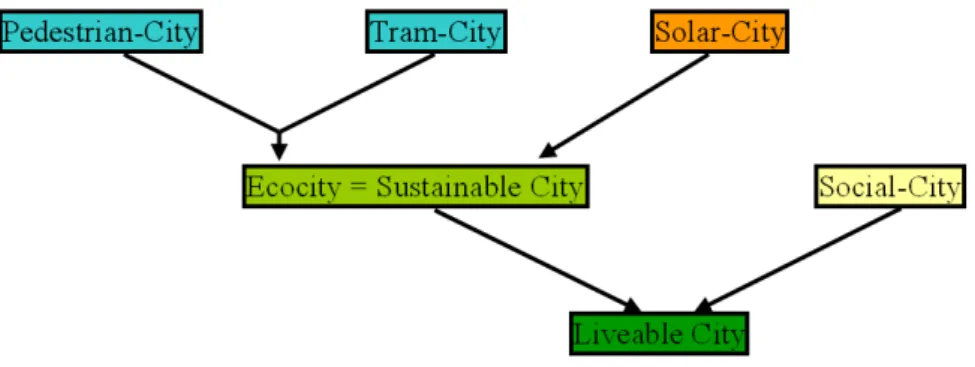
The main elements of a “Sustainable City” are the “Pedestrian-City” (City of short distances) and the “Tram-City” (Transit Oriented Development) to enable ecology compatible transport, sustaining mobility, and the “Solar-City” to bring about energy efficiency, sustaining comfortable living in buildings.
These structural elements constitute a basis, which needs to be complemented by the “Social City” promoting good human relations to achieve finally a “Liveable City”, creating well-being for all inhabitants
Fig. 1: Elements of a Sustainable and Liveable City
8 THE ROLE OF INFORMATION TECHNOLOGY IN A SUSTAINABLE COMMUNITY
The role of information technology in this context is to support a sustainable use of the built structures by organisational instruments e.g.
- for facility management to minimise energy consumption (control devices and sensors for heating, protection against the sun, use of solar energy and ventilation)
- for neighbourhood-communication and management, using the internet
Additionally IT enables tele-working from home or from tele-centres providing professional grade network access, phone system and other services in residential areas to reduce travel distances.
All these aspects are investigated in the programme Connected Urban Development (CUD), initiated by the company Cisco (http://www.connectedurbandevelopment.org/).
9 BENEFITS
Sustainable and liveable communities offer many benefits for health, safety and well-being of their inhabitants:
• reduced air and noise pollution and a lower risk of injuries by traffic accidents
• more space for people in an attractive, quiet, safe and wholesome environment (car-free streets and squares, a great variety of green areas), promoting a slower-paced, more relaxed, wholesome and thus more sustainable lifestyle
• promotion of more personal interaction with neighbours, resulting in the presence of more people in public areas, thus creating a greater sense of community and possibly lower crime rates
• an attractive and safe environment for children (to play safely outdoors and walk on their own) as well as for the mobility of senior citizens and the handicapped
• favourable conditions for non-drivers (who are disadvantaged by car-dependent transport and land use patterns), increasing their mobility and accessibility options
10 STEPS TOWARDS A SUSTAINABLE AND LIVEABLE CITY – EXAMPLES
10.1
Ecological Model Quarter Vauban in Freiburg, Germany
(implemented project, start 1998 – nearly completed 2007)
Municipality Freiburg: about 200.000 inhabitants
Vauban: about 5000 inhabitants in an area of about 42 ha
for more information see: http://www.vauban.de/info/abstract.h tml
Aerial view of Vauban 2006
Source: City of Freiburg, http://www.freiburg.de/servlet/PB/sh ow/1169077/Vauban%20Luftbild%2 02006.jpg
Fig. 2: Aerial view of Vauban 2006
Vauban is an acknowledged example for large projects with an integrated approach, including ecological solutions for most relevant sectors (mixed use structure, transport, energy, social aspects etc.) and especially for the participation process, which involved future inhabitants in the “Forum Vauban”.
10.2
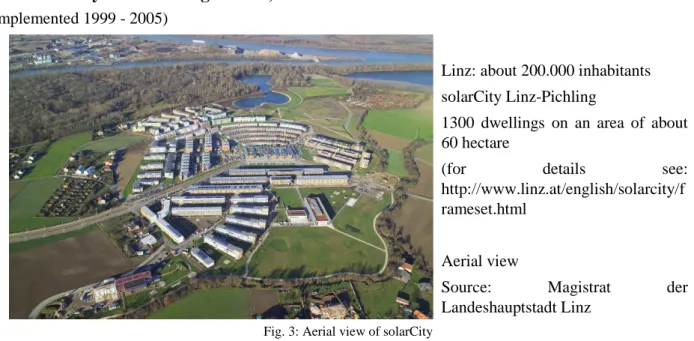
solarCity Linz-Pichling in Linz, Austria
(implemented 1999 - 2005)
Linz: about 200.000 inhabitants
solarCity Linz-Pichling
1300 dwellings on an area of about 60 hectare
(for details see:
http://www.linz.at/english/solarcity/f rameset.html
Aerial view
Source: Magistrat der Landeshauptstadt Linz
Fig. 3: Aerial view of solarCity
The city extension necessary, accomplished on the Southern fringe of the city’s area in the form of a model project for the use of solar energy (“solarCity”), brought about also an extension of the tram network. Passing through Ebelsberg, an area dedicated for new construction, a new tram line was built to the solarCity. It merges with an existing line and runs in paralell to the terminus in the North of Linz. Ebelsberg and the solarCity are connected this way with the main train station, the city centre, the university as well as other sections of town. Running three tram lines in parallel in the core of the city makes short intervals of less than 5 minutes (between 8 a.m and 6 p.m.) possible.
10.3
Ecocity Bad Ischl, Austria (concept)
The concept was developed within the EU-project ECOCITY (Urban Development towards Appropriate Structures for Sustainable Transport).
Municipality Bad Ischl: about 14 000 inhabitants
Ecocity neighbourhood: planned for about 2000 inhabitants
Mixed use in the neighbourhood
1, 2: hotel, gastronomy
3, 4: shops (passage), services
5, 7: kindergarten, school
6 : cultural centre
8, 9: business yard, logistic centre
Source: Project Ecocity
Supported by the EU in the 5th Framework Programme
http://www.ecocityprojects.net/
Fig. 4: Mixed use in the neighbourhood
new compact sub-centre for the municipality was designed within a radius of 300 m around the stop of a planned public transport line in the centre.
Attractive multi-storeyed residential and commercial buildings with appropriate height (maximum 4, minimum 2 storeys) to achieve an appropriate urban density and the location of facilities, necessary for a balanced mixed use in a central area create short distances from all parts of the sub-centre and allow easy trip chaining.
The map of the neighbourhood shows an example for the location of the necessary facilities for different purposes feasible for its size (places of work, shops, etc.)
10.4
The social interaction process in the quarter of Trinitat Nova/Barcelona
This case study looked at a renewal project on the north-eastern outskirts of Barcelona. A total of 891 social housing units in decline are being demolished and replaced by 1,045 new ones in several phases. The process, initiated through a participative community plan, has been driven by the (bottom up) initiative of the local people, who encouraged the administrative bodies involved (city and regional government) to include innovative sustainability criteria in the project, resulting in a Masterplan for an eco-neighbourhood. Sectoral sustainability studies were undertaken within the ECOCITY project (Eco-neighbourhood Trinitat Nov).
The most outstanding output is the participative and collaborative approach to seeking solutions to the complex problem of renovating social housing in old neighbourhoods. An integrated project is being implemented, which is a known reference for a collaborative transformation of a stigmatised neighbourhood into an interesting urban model for a new approach to the renovation of social housing quarters. Trinitat Nova is now a good quality neighbourhood with good public transport connections, interesting city life, commerce and new buildings with good standard. Its community building process has been a model for the ‘Llei de Barris’ Programme.
11 CONCLUSION
Good accessibility of necessary facilities by high-quality, environmentally compatible transport links (direct, barrier-free pedestrian and cycle routes and attractive public transport routes) in an appropriate urban pattern of short distances is the basic requirement for sustaining high mobility of people in a future of decreasing fossil fuel availability.
A rethinking of settlement policies, orientating development on theoretically agreed spatial planning principles presented in this paper and thus preventing sprawl is important to attain the goal of sustainable and liveable cities.
These provide a better quality of life for almost all inhabitants, promoting a more sustainable and equitable lifestyle, while contributing to climate protection by saving energy and thus decreasing the consumption of limited fossil fuels and other resources.
12 REFERENCES
DITTMAR, Hank, OHLAND, Gloria (eds.): The New Transit Town, Best Practices in Transit-Oriented Development, Island Press, 2004
(http://books.google.at/books?id=4USDi8bjFZwC&dq=The+New+Transit+Town&printsec=frontcover&source=bl&ot s=dh4_J35Ui1&sig=FSfUnaOxHpBzCWPDsrAUA9uyGhc&hl=de&ei=adi3SaaNAtWa_gbX7tW9Cw&sa=X&oi=boo k_result&resnum=4&ct=result#PPA5,M1)
GAFFRON, Philine, HUISMANS, Gé, SKALA, Franz (eds.): ECOCITY Book I ‘A better place to live’. Hamburg, Utrecht, Vienna, 2005
GAFFRON, Philine, HUISMANS, Gé, SKALA, Franz (eds.): ECOCITY Book II, ‘How to make it happen’. Hamburg, Utrecht, Vienna, 2008 (Spanish: Manual para el diseño de Ecociudades – Proyecto Ecocity,
http://www.sepes.es/Inicio/Contenidos/MostrarInformacion?ruta=jornada_ecociudades&I=0)
German Institute of Urban Affairs: Socially Integrative City Strategies, Implementation of the joint programme of the German federal government and the Länder: "Districts with Special Development Needs - the Socially Integrative City." - Experiences and Prospects. Berlin, 2003 (http://www.sozialestadt.de/en/veroeffentlichungen/endbericht/)
Translated from: Soziale Stadt - Strategien für die Soziale Stadt, Erfahrungen und Perspektiven – Umsetzung des Bund-Länder-Programms „Stadtteile mit besonderem Entwicklungsbedarf – die soziale Stadt", Deutsches Institut für Urbanistik
NOBIS, Claudia, Deutsches Zentrum für Luft- und Raumfahrt e.V., Institut für Verkehrsforschung: Bewohnerbefragung Vauban, Bericht im Rahmen des Projektes „Umsetzungsbegleitung des Verkehrskonzeptes im Stadtteil Freiburg-Vauban“. Berlin, 2003
SCHRIEFL, Ernst, SCHUBERT, Uwe, SKALA, Franz, STÖGLEHNER, Gernot: Urban Development for Carbon Neutral Mobility, SCUPAD 2008: Carbon Neutral Society: From Vision to Reality, Salzburg, 2008