Environments
Borja Bordel1∗, Marina P´erez-Jim´enez2, and Diego S´anchez-de-Rivera1
1Department of Telematics Systems Engineering. Universidad Polit´ecnica de Madrid, Spain
[email protected], [email protected] 2Department of Physical Electronics. Universidad Polit´ecnica de Madrid, Spain
Abstract
Enhanced Living Environments consider the recognition of the Activities of Daily Living (ADLs) being performed by users as first step in the aid plans. Some works proved the information about the objects with which a person interacts robustly characterizes the ADL’s identity. However, designing aid plans based on these raw data is a very complicated task, as an expert in both technology and occupational sciences is required. In addition, the plans produced by these experts are not platform-independent, to be closely linked to the hardware characteristics. Therefore, the aim of this paper is to design a two-phase solution capable of acquiring data from users, and of extracting informa-tion about the ADL being performed to trigger the execuinforma-tion of the proper aid plans. This soluinforma-tion disengages the technological and occupational domains, so that aid plans could be applied to any environment. Moreover, an experimental validation is conducted in order to validate the proposed technology as a valid solution for ADL recognition.
Keywords: HCI, ELEs, ADL, Enhanced Living Environments, Cyber-Physical Systems, Activities of Daily Living
1
Introduction
Helping assisted people to maintain an independent lifestyle is nowadays one of the most important research challenges. In this field, most remarkable solutions are based on seamless integration of Infor-mation and Communication Technologies (ICT) within context-aware homes with the aim of construct-ing Enhanced Livconstruct-ing Environments (ELEs). Works such as [18] demonstrate the importance of these solutions.
Nevertheless, the design and implementation of these systems is a complex and multidisciplinary ac-tivity which deals with very different aspects which rarely can be addressed by only one person. Despite of this fact, most proposed ELEs are monolithic solutions where there is no division between the differ-ent scidiffer-entific domains (such as the occupational sciences or electronics). Thus, works about ELEs use to show the necessity of data interpreters being specialist in both technological and occupational sciences [38]. Furthermore, such interpreters (as well as all models, patterns, etc. created by them) can only be used in some particular ELE platforms, as data format depends strongly on the underlying hardware and all the know-how created cannot be easily exported to other systems [13].
Among all the steps that compose the aid processes in ELEs, perhaps the most critical is the recogni-tion of the activity the users are performing [28], vital for triggering the proper aid plan in each situarecogni-tion [18]. In context-aware homes (the base of ELEs) the most common activities are Activities of Daily
IT CoNvergence PRActice (INPRA), volume: 4, number: 4 (December 2016), pp. 18-31
Living (ADL) [15]. Some authors proved that the sequence of objects with which a person interacts char-acterizes the ADL being performed [30, 10]. Other authors, however, demonstrated implicit information (such as the hand gestures or emotions) is necessary to recognize ADL adequately [7, 9]. The utilization of computing elements to register this information is a challenge [23], as recently it has been proved that the introduction of computing elements in residences can lead stress in users and consequently modify the normal ADL execution and reduce the user quality-of-experience (QoE) [13].
Therefore, the objective of this paper is to describe a new a solution to be integrated in ELEs, being able to recognize ADLs automatically. We argue the use of Cyber-Physical Systems paradigm and ref-erence architecture [24] allow the different abstraction levels of ELEs to become independent and, then, allow us to separate the different expert domains (becoming the aid plans platform-independent).
The authors, besides, built a prototype and carried out an experimental validation in order to validate the proposed solution as a valid technology for DL recognition. In particular, more than 85% of ADL are perfectly deducted using our proposal.
The rest of the paper is organized as follows: Section 2 introduces the state of the art in ADL recog-nition systems. Section 3 analyzes the requirements ELE scenarios, presents the functional architecture of the proposal and the implementation of the first prototype based on it. Section 4 provides an exper-imental validation of the solution. Finally, Sections 5 and 6 explain some results of this experexper-imental validation and the conclusions of our work.
2
State of the Art
Activity recognition systems are made of two different parts: the monitoring subsystem and the recogni-tion subsystem [36]. On the one hand, the monitoring subsystem acquires data from users such as users’ location or the objects they touch. On the other hand, the recognition subsystem processes the acquired data and decides which is the ADL being performed.
Five main types of monitoring technologies can be identified [29]: passive infrared (PIR) motion sensors, body-worn sensors, pressure sensors, video monitoring and sound capturing. Deployments based on PIR motion sensors [25] consist of a set of sensors which detect user’s position in the house. The position, as well as the time he remains in the same location, is used to recognize the ADL being executed. Body-worn sensors approach is based on different types of wearable sensors, such as accelerometers [3] or [33], with which users are provided and whose outcomes are evaluated during the activity. Other systems deploy several binary pressure sensors (they get active when touched) in home elements and places [17] and use the activation sequence of sensors to recognize the ADL being performed. Video monitoring is probably the most studied technology. With this name we refer to all technologies based on deploying cameras on the user’s residence and using the recorded video to recognize the executed ADL [31, 26]. Finally, sound capturing systems consist of a set of microphones deployed in the house, allowing activity recognition by means of the audio analysis [21]. With respect to video monitoring, audio capturing presents fewer problems from the point of view of privacy.
In general, video monitoring and body-worn sensors are the most used technologies. They present less ambiguity and less noise level than the others, and often allow obtaining systems with more preci-sion.
Very recently, activity recognition systems which do not present the monitoring subsystem have appeared [39]. However, their practical use is not clear and the obtained results are not as good as expected.
are expressed as the sequence of the data it is expected to receive from monitoring subsystem when executing a certain ADL. Thus, the process of recognition can be understood as finding the modelM= {m1,m2, . . . ,mn}that best explains the sequence of observationsO={o1,o2, . . . ,ok}.
Some works [30] propose algorithms based on dynamic Bayesian networks which model the se-quence of objects with which a person interacts. Other authors [37] propose algorithms which work with temporal probabilistic models (like naive Bayes or hidden Markov) and sensor readings. In some cases, researches try to recognize concurrent ADLs [40] and analyze the activity duration. Algorithms based on the analysis of the time a sensor is active [41] are also possible. Finally, solutions consisting of semantic technologies and ontology-based approaches have been also proposed [19].
In the ideal case, recognition subsystem would be independent of the monitoring subsystem. How-ever, in all cases [25, 37], they are designed together as the recognition algorithm depends strongly on the data offered by the monitoring subsystem. Achieving this independence between monitoring subsystem (which belongs to the technological domain) and recognition subsystem (which belong to occupational sciences domain) is the goal of the proposed solution.
3
Proposal: Toolkit for ADL Inference
ELEs require precise information about the users’ situation in order to execute the most appropriate aid plan in each moment. Therefore, activity recognition is an increasingly important functionality to be implemented in enhanced living systems. This section analyzes ELEs and the requirements to be met to enable precise information acquisition and ADL recognition. After describing the requirements of ELEs, we present the proposed solution and the design and implementation of a first functional prototype.
3.1 Motivation Scenario: Requirements
ADL recognition solutions present some important requirements which have been studied many times [14] (unobtrusiveness and flexibility are the most mentioned topics). Moreover, several prototypes and instruments in order to obtain information from users and perform ADL inference have been described [34, 4]. In this section, and taking into account these previous descriptions, some additional requirements (introduced by the specific needs of ELEs) are expressed:
• REQ#1: ADL descriptions should be tolerant to the different possible performing ways.
• REQ#2: The underlying hardware of ubiquitous computing system in ELEs should be tolerant to high levels of noise, light, vibration, etc.
• REQ#3: ADL recognition system should incorporate instruments to create ADL models with min-imum human effort.
• REQ#4: Data acquisition should be transparent to users, in order to not negatively affect their daily lives.
• REQ#5: The system should evaluate not only the identity of the ADL being performed, but also the quality of the execution. For example, in scenarios related to people with cognitive disorders in first stage aid plans depend strongly on the advance of the dementia.
3.2 Solution Architecture
proposed in June 2015 by the National Institute of Standards and Technology (NIST) [24] stands out among other architectural proposals to be more general and to be considered the standard for CPS com-mercial products [4].
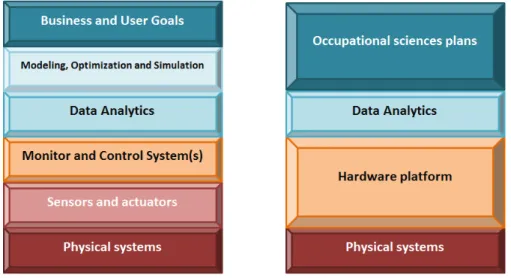
NIST’s Architecture shown in Figure 1 a describes a whole system (in this case, a complete ELE). Then, for our purpose, it is possible to make a simplification (see Figure 1 b). The problem of ADL recognition is basically a problem about data analytics [10, 20], thus, in general, the details about the superior and inferior levels are not important. In particular, the solutions used to control sensors and actuators do not affect the proposed system [1], so that “Sensors and actuators” and “Monitor and control system” levels can be merged into a single level (“Hardware platform”), of which it is only interesting the format and nature of the generated data. On the other hand, the subdivision of aid plans into objectives (“user goals” level) and methodologies (“Modeling, optimization and simulation” level) does not modify the following considerations, so that the two top levels can be reduced to a single level (“Occupational sciences plans”) that concentrates all the elements belonging to the occupational sciences.
The resulting architecture is made of the following layers:
Figure 1: (a) Reference CPS architecture (NIST). (b) Reference architecture in our proposal
• Physical systems: It includes all elements in the ELE belonging to a regular residence. Furniture, kitchen and home appliances, grooming items. . . even the users belong to this layer.
• Hardware platform: It includes the electronic elements, processing devices and, in general, the entire ICT infrastructure deployed in the residence to monitor the users’ behavior.
• Data Analytics: The inclusion of this layer is the novelty of this work. As can be seen in Figure 1 b, it uncouples the hardware layer (technological domain) and the occupational sciences models (obviously, occupational sciences domain). In this layer data from hardware platform is processed for pattern recognition and information extraction. At this level, it is evaluated the correlation between high-level models and the data generated by the hardware platform.
• Occupational sciences plans: It includes the aid plans and activities models created by the occu-pational sciences experts, using their own description languages, data format and, in general, their domain knowledge.
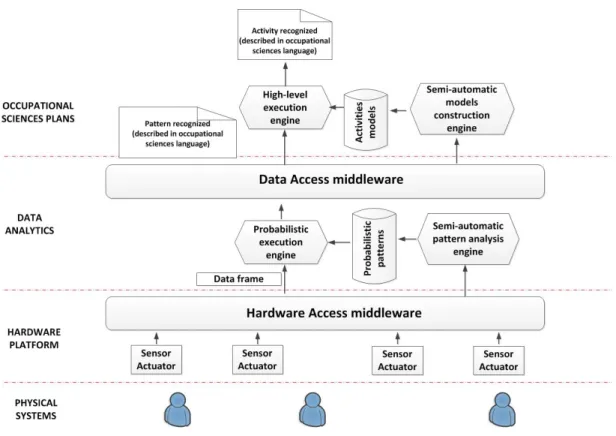
Figure 2: Functional architecture of the proposed technology
Users perform their usual activities of daily living. While executing the ADLs, they cause that sensors deployed along the residence generate data, which are transmitted in the form of frames through the appropriatehardware access middleware. Any type of middleware is valid, although considering it has to communicate two groups of devices made of various entities, Publication/Subscription paradigm [22] is probably the most adequate.
Two different operation modes can be distinguished in the proposal: training mode and recognition mode. In training mode, data frames from hardware platform are directed to aSemi-automatic pattern
analysis engine, which studies the received data using machine-learning algorithms [12]. This engine
will construct the data patterns associated with the atomic tasks defined in occupational sciences [2] to describe ADLs. Users are asked to execute each one of the atomic tasks, and for each one the engine will build at least one pattern which will be stored in aprobabilistic pattern repositorywith the atomic task that represents. In recognition mode, data frames fromhardware platformare directed to aprobabilistic
execution engine, which evaluates which of the stored patterns in the repository corresponds to the
re-ceived data. In this evaluation, any of the algorithms described in Section 2 can be used. The output of this engine is a description of the recognized pattern, indicating the atomic task which has been identified using the terminology of occupational sciences [2].
The information about the recognized atomic task is transmitted through aData access middleware, for which the same considerations made for theHardware access middlewareare valid.
In training mode, information about the recognized atomic task is directed to aSemi-automatic
mod-els construction engine, which will build the complete ADL models by means of the analysis of the
information received. The ADL models (understood as a collection of atomic tasks, as in the occupa-tional sciences [2]) will be stored in anactivities models repository. Once completely trained theData
Analytics components, users are asked to execute the entire ADLs in order to calculate the ADLs models.
engine, which evaluates which of the stored models in the repository corresponds to the received data. In this evaluation, any of the algorithms described in Section 2 can be used. The output of this engine is a description of the recognized ADL, using the terminology of occupational sciences.
The use of probabilistic models and algorithms (both in Data analytics and Occupational sciences plans levels), as well as the fact that models and patterns are calculated in a training period involving users, allow us to fulfil the REQ#1 introduced in Section 3.1. Also, this training period allows creating automatically ADL models, so REQ#3 is also addressed.
The introduction of two recognition processes presents various advantages. First, the technological domain and the occupational sciences domain become independent. With this configuration, occupa-tional sciences experts can design aid plans without knowing the details about the hardware platform. For example, experts can design an aid plan including an action after executing a certain atomic task, without knowing the particular datum or event which determines the end of the task.
In a more particular example, one of the simplest ADLs is “preparing a simple drink” [30]. The shortest definition of this ADL, as a collection of atomic task, could be: (1) taking the soda bottle that is on the table, (2) filling the glass which is on the table with soda and (3) leaving the bottle on the table again [27]. In scenarios involving people with dementia, it is really important to avoid accidental poisonings, so it is valuable to alert users and caregivers (if any) when they select the wrong bottle. Such notification, in our proposal, can be planned and modified by experts in occupational sciences without having to know which hardware event indicates the bottle selection at technological level. Moreover, hardware platform can be modified without having to reprogram the aid plan.
It must be noted that, as atomic tasks are indivisible in the occupational sciences theory, it has no sense to consider actions while one of them is being executed.
Second, in works which do not consider that ADLs can be described as a collection of atomic task (such as “take a glass” or “press a button”), recognition algorithms must address together all the sources of randomness in ADLs execution. Basically [3] they include sensors errors, noise and interferences in the medium and the variations in human behavior. In our solution, we separate these sources in two groups: effects due to hardware (solved in Data Analytics level) and due to the intervention of users (solved in Occupational sciences plans level). In that way, each problem’s part can be addressed separately by the proper domain experts. These politics partially cover REQ#2.
Finally, the accuracy of the resulting system may be greater than in the one from previous proposals [30]. The execution of atomic tasks has less ambiguity than the execution of complete ADLs, so the success rate of the probabilistic engine tends to be high. Later, once the atomic tasks are properly recognized, the algorithms to recognize ADLs also increase their success rate since they have more information, as they perfectly know the atomic tasks that have been executed.
3.3 Implementation
In this section, we design and build a first prototype in order to validate its usability as functional part of ELEs.
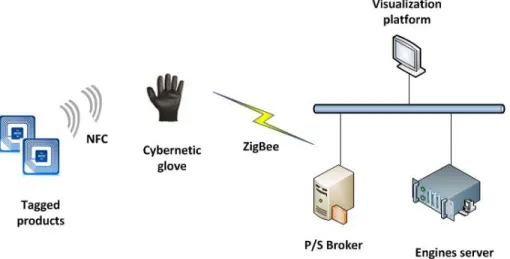
First, we must consider the requirements the prototype should fulfill. In the functional architecture design, we solved in a general way REQ#1 and REQ#3. It is also partially covered REQ#2. However, it remains unsolved three requirements (REQ#4, REQ#5 and the rest of REQ#2) which cannot be addressed in the functional architecture, as they depend on the hardware platform and the particular implementation done. Figure 3 shows the physical architecture of the proposed prototype.
Various elements can be distinguished in Figure 3:
Figure 3: Proposed physical architecture
object (as described, for example in [33]). With this election, REQ#2 is fulfilled. NFC technology is extremely tolerant to noise, vibrations, manipulation, etc. much more than any other technology (such as PIR motion sensors). Tags should be place in the proper way, in order to respect REQ#4.
• Cybernetic glove: Users will be provided with a cybernetic glove including a NFC reader and various accelerometers. In that way, both information sources for ADL inferring are monitored: explicit (the objects with which users interact [30, 10]) and implicit (the hand gestures done dur-ing the activities execution [7, 9]). The use of accelerometers, besides, allows obtaindur-ing a mea-sure of the quality of ADLs execution [33] (which addresses REQ#5, although this kind of al-gorithms is not the objective of this article). As most involved objects in ADLs execution are hand-manipulated, creating a cybernetic glove is the most reasonable solution in order to obtain correct readings from NFC tags. However, if there were users with special needs or it was wanted to recognize other type of activities, any other NFC-based wearable device could be integrated. Finally, the glove should be designed in order to respect REQ#4. Moreover, the glove will use a Publication/Subscription middleware based on ZigBee technology, in order to transmit the data frames [32].
• P/S Broker: This element allows the spatial and temporal decoupling between publishers and subscribers. However, as this element belongs to the networking and communications plane and was not the focus of this work, it is omitted in the rest of the article (an in-depth discussion about this subject can be found in articles, such as [11]).
• Engines server: This server executes in different processes the four engines identified in the func-tional architecture (see Figure 2). This server also contains the two repositories (patterns and models) described above. The communication between the different components was based on sockets.
• Visualization platform: On this platform the results of the ADL recognition process will be shown (using the terminology of occupational sciences).
the hand) and a synthetic textile support, whose properties do not significantly affect the magnetic field generated by the NFC module [34]. The integration of the electronic circuit into the glove is greatly important, as it must be designed to fulfil REQ#4.
The engines server is composed of four different Java programs, connected among them through sockets. The Semi-automatic pattern analysis engine executes a pattern recognition algorithm called “Nonparametric clustering”, which allows detecting patterns without having any previous knowledge. A complete description of the algorithm can be found in [12]. Later, considering the type of monitoring technology included in the prototype, the most appropriate algorithm to be executed in theprobabilistic
execution engineis a temporal probabilistic model as described in [37]. Both, accelerometers and RFID
reader information is combined as explained in [35].
In occupational sciences, there is not a unique uniform description language, so one of the usually used must be chosen to be included in the prototype. Basically there are two proposals: the American one [2, 5] (made by the American Occupational Therapy Association) and the European one [8] (encouraged European network of Occupational Therapy). Because the European project normalizes terminology, not only in English but also in Spanish and German, among others languages, we decided to use their proposal [8]. So, the output of theprobabilistic execution engineand thehigh-level execution enginewill be expressed following those recommendations.
Finally, thehigh-level execution enginewill execute an algorithm based on Bayesian networks, equal to described in [30]. In this work, it can be found also an algorithm to construct the Bayesian networks, which will be implemented in theSemi-automatic models construction engine.
The visualization platform is composed of a Java GUI where the result of the recognition process is shown.
4
Experimental Validation
An experiment was designed in order to validate the proposed solution as a valid technology for ADL recognition in ELEs. In particular, the experimental validation consisted of two different experiments.
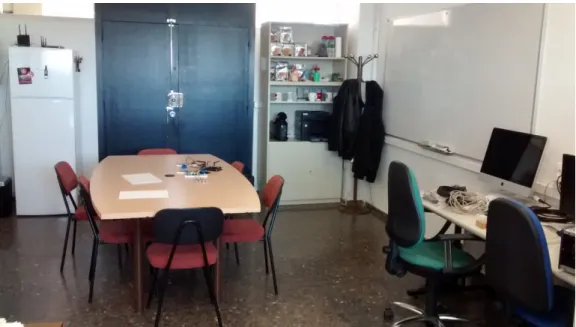
In the first experiment, the rate of ADL correctly detected is evaluated. The proposed technology is deployed in a laboratory of the Technical University of Madrid, where a house-like scenario is created (see Figure 4). A traditional solution based on PIR sensors was also implemented in a similar space [25]. Eighteen people (18) were involved in the experiment. Nine people (9) performed activities in the space where our solution was available. The other people (nine) worked in the space where the PIR-based system was implemented.
A description about the activities to be performed in the different spaces was provided to participants. Table 1 shows the list of panned ADLs.
Information about the inferred activities by both deployed systems was collected and compared with the created plans. In order to do that, the Engines server was programmed to create a log file. Finally, the rate of successfully deducted ADL was calculated.
In the second experiment, the user satisfaction is evaluated by means of a survey. People using both ADL recognition systems were asked, once finished the first experiment, to fulfill a survey about their satisfaction in respect to the experience. Results are processed using statistical software in order to compare the obtained responses.
5
Results and Discussion
Figure 4: House-like space at the Technical University of Madrid
Activity Evaluation form
Transfer Moves in and out of bed and/or in and out of chair
Feeding Gets food from plait or equivalent into mouth
Going to toilet
Gets on and off toilet Arranging clothes
Bathing Sponge bath
Tub bath Shower
Dressing Gets clothes from closets and drawers Puts on clothes
Table 1: List of planned ADLs
inferred ADLs around 74%, while in the proposed technology is around 85%. This improvement is due to the proposed separation between variation due to hardware and due to humans, which allow introduc-ing a double verification phase. Moreover, many ADLs are performed usintroduc-ing hands, so if these extremities and their movements are controlled, more precise results are obtained (in PIR-based solutions only body movements are monitored).
However, this improvement is not homogeneous. Figure 6 presents the results of the first experiment, disaggregated per ADL.
As can be seen, activities performed, mainly, using the hands are easily detected by means of the proposed technology. Nevertheless, if the ADL implies body movements (as in transfer ADL), PIR-based technologies are more adequate and success rate is higher.
In respect to the second experiment, Figure 7 shows the results of the satisfaction survey.
Figure 5: Aggregated results of the first experiment
Figure 6: Disaggregated results of the first experiment
Figure 7: Results of the second experiment
6
Conclusions
Enhanced living environments (ELEs) are rapidly becoming in one of the most profitable research fields. Seamless integrations of Information and Communication Technologies (ICT) within context-aware homes are usually the technological base over which ELEs are built. In this field, ADLs recognition is one of the most critical and widely studied activities. However, most proposed systems are monolithic solutions where there is no division between the different scientific domains, making difficult and costly their maintenance and modification. Our technology pretends to address this problem by means of a functional architecture based on Cyber-Physical paradigm and reference architecture.
In our solution, technological domain and occupational sciences domain become independent, which enables the deployment of systems only attended by expert caregivers or occupational therapists (without the intervention of hardware technicians).
We provided also two experimental validations with real users. These experiments showed that the proposed technology improves the overall rate of success; especially in ADL performed suing the hands (compared to traditional PIR-based approaches). Moreover, despite the use of a cybernetic glove, the user satisfaction level in both technologies is equivalent.
Acknowledgments
The research leading to these results has received funding from the Ministry of Economy and Compet-itiveness through SEMOLA project (TEC2015-68284-R) and from the Autonomous Region of Madrid through MOSI-AGIL-CM project (grant P2013/ICE-3019, co-funded by EU Structural Funds FSE and FEDER). Borja Bordel has received funding from the Ministry of Education through the FPU program (grant number FPU15/03977)
References
[1] R. Alcarria, T. Robles, A. Morales, and E. Cede˜no. Resolving coordination challenges in distributed mobile service executions. International Journal of Web and Grid Services, 10(2/3):168, 2014.
[2] American Occupational Therapy Association. Occupational Therapy Practice Framework: domain and pro-cess. The American journal of occupational therapy : official publication of the American Occupational Therapy Association, 56(6):609–39, 2002.
[3] O. Banos, M. Damas, H. Pomares, A. Prieto, and I. Rojas. Daily living activity recognition based on statistical feature quality group selection.Expert Systems with Applications, 39(9):8013–8021, jul 2012.
[4] B. Bordel S´anchez, R. Alcarria, D. Mart´ın, and T. Robles. TF4SM: A Framework for Developing Traceability Solutions in Small Manufacturing Companies.Sensors, 15(12):29478–29510, nov 2015.
[5] M. J. Borst and D. L. Nelson. Use of uniform terminology by occupational therapists. The American journal of occupational therapy : official publication of the American Occupational Therapy Association, 47(7):611– 8, jul 1993.
[6] D. J. Cook and S. K. Das.Smart environments : technologies, protocols, and applications. John Wiley, 2005. [7] R. Cowie, E. Douglas-Cowie, N. Tsapatsoulis, G. Votsis, S. Kollias, W. Fellenz, and J. Taylor. Emotion
recognition in human-computer interaction.IEEE Signal Processing Magazine, 18(1):32–80, 2001.
[8] ENOTHE Project (Occupational Therapy Terminology). Available online: http://enothe.eu/, last viewed May 2017.
[9] G. Fischer. User Modeling in Human–Computer Interaction. User Modeling and User-Adapted Interaction, 11(1/2):65–86, 2001.
[10] K. Fishkin, M. Philipose, and A. Rea. Hands-On RFID: Wireless Wearables for Detecting Use of Objects. In
[11] G. Fortino, A. Guerrieri, and W. Russo. Agent-oriented smart objects development. InProceedings of the 2012 IEEE 16th International Conference on Computer Supported Cooperative Work in Design (CSCWD), pages 907–912. IEEE, may 2012.
[12] K. Fukunaga. Introduction to Statistical Pattern Recognition (2Nd Ed.). Academic Press Professional, Inc., San Diego, CA, USA, 1990.
[13] A. Grguric, A. M. M. Gil, D. Huljenic, Z. Car, and V. Podobnik. A Survey on User Interaction Mechanisms for Enhanced Living Environments. InICT Innovations 2015, pages 131–141. Springer, Cham, 2016. [14] M. P. Jimenez, B. B. S´anchez, and R. P. A. Garrido. T4ai: A system for monitoring people based on improved
wearable devices.Research Briefs on Information & Communication Technology Evolution (ReBICTE), 2:1– 16, 2016.
[15] S. Katz, A. B. Ford, R. W. Moskowitz, B. A. Jackson, and M. W. Jaffe. Studies of Illness in the Aged. The Index of ADL: A Standardized Measure of Biological and Psychosocial Function. JAMA, 185:914–9, sep 1963.
[16] E. Lee and E. A. The Past, Present and Future of Cyber-Physical Systems: A Focus on Models. Sensors, 15(3):4837–4869, feb 2015.
[17] J. Lester, T. Choudhury, and G. Borriello. A Practical Approach to Recognizing Physical Activities. In
Lecture Notes in Computer Science, pages 1–16. Springer, Berlin, Heidelberg, 2006.
[18] S. Loshkovska and S. Koceski. ICT innovations 2015: emerging technologies for better living. Springer International Publishing, 2015.
[19] H. Maki, H. Ogawa, S. Matsuoka, Y. Yonezawa, and W. M. Caldwell. A daily living activity remote moni-toring system for solitary elderly people. In2011 Annual International Conference of the IEEE Engineering in Medicine and Biology Society, pages 5608–5611. IEEE, aug 2011.
[20] D. Mart´ın, J. G. Guzm´an, J. Urbano, and J. Llorens. Patterns as objects to manage knowledge in software development organizations. Knowledge Management Research & Practice, 10(3):252–274, sep 2012. [21] D. Maunder, J. Epps, E. Ambikairajah, and B. Celler. Robust sounds of activities of daily living
classifi-cation in two-channel audio-based telemonitoring. International journal of telemedicine and applications, 2013:696813, 2013.
[22] A. Morales, R. Alcarria, D. Martin, and T. Robles. Enhancing Evacuation Plans with a Situation Awareness System Based on End-User Knowledge Provision.Sensors, 14(6):11153–11178, jun 2014.
[23] L. Muguira, J. I. Vazquez, A. Arruti, J. R. de Garibay, I. Mendia, and S. Renteria. RFIDGlove: A Wearable RFID Reader. In2009 IEEE International Conference on e-Business Engineering, pages 475–480. IEEE, 2009.
[24] National Institute of Standards and Technology. CPS Public Working Group Presentation. Available on-line: http://www.nist.gov/el/upload/CPS-PWG-Kickoff-Webinar-Presentation-FINAL.PDF, last viewed May 2017.
[25] T. Nef, P. Urwyler, M. B¨uchler, I. Tarnanas, R. Stucki, D. Cazzoli, R. M¨uri, and U. Mosimann. Evaluation of Three State-of-the-Art Classifiers for Recognition of Activities of Daily Living from Smart Home Ambient Data.Sensors, 15(5):11725–11740, may 2015.
[26] B. Ni, G. Wang, and P. Moulin.RGBD-HuDaAct: A Color-Depth Video Database for Human Daily Activity Recognition, pages 193–208. Springer London, London, 2013.
[27] C. D. Nugent, Xin Hong, J. Hallberg, D. Finlay, and K. Synnes. Assessing the impact of individual sensor reliability within smart living environments. In2008 IEEE International Conference on Automation Science and Engineering, pages 685–690. IEEE, aug 2008.
[28] F. J. Ord´o˜nez, P. de Toledo, and A. Sanchis. Activity recognition using hybrid generative/discriminative models on home environments using binary sensors.Sensors, 13(5):5460–5477, 2013.
[29] K. K. B. Peetoom, M. A. S. Lexis, M. Joore, C. D. Dirksen, and L. P. De Witte. Literature review on moni-toring technologies and their outcomes in independently living elderly people.Disability and Rehabilitation: Assistive Technology, 10(4):271–294, jul 2015.
[31] H. Pirsiavash and D. Ramanan. Detecting activities of daily living in first-person camera views. InComputer Vision and Pattern Recognition (CVPR), 2012 IEEE Conference on. IEEE, 2012.
[32] D. S´anchez-de Rivera, D. Mart´ın, R. Alcarria, B. Bordel, and T. Robles. Towards a Wireless and Low-Power Infrastructure for Representing Information Based on E-Paper Displays.Sustainability, 9(1):76, jan 2017. [33] A. Schmidt, H.-W. Gellersen, and C. Merz. Enabling implicit human computer interaction: a wearable
RFID-tag reader. InDigest of Papers. Fourth International Symposium on Wearable Computers, pages 193–194. IEEE Comput. Soc, 2000.
[34] B. B. S´anchez, D. S. de Rivera, and ´Alvaro S´anchez-Picot. Building unobtrusive wearable devices: an ergonomic cybernetic glove.Journal of Internet Services and Information Security (JISIS), 6(2):37–52, May 2016.
[35] M. Stikic, T. Huynh, K. Van Laerhoven, and B. Schiele. ADL recognition based on the combination of RFID and accelerometer sensing. In2008 Second International Conference on Pervasive Computing Technologies for Healthcare, pages 258–263. IEEE, jan 2008.
[36] H. Takechi, A. Kokuryu, T. Kubota, and H. Yamada. Relative Preservation of Advanced Activities in Daily Living among Patients with Mild-to-Moderate Dementia in the Community and Overview of Support Pro-vided by Family Caregivers.International Journal of Alzheimer’s Disease, 2012:1–7, 2012.
[37] T. L. M. van Kasteren, G. Englebienne, and B. J. A. Kr¨ose. An activity monitoring system for elderly care using generative and discriminative models.Personal and Ubiquitous Computing, 14(6):489–498, sep 2010. [38] L. Vuegen, B. Van Den Broeck, P. Karsmakers, H. Van Hamme, and B. Vanrumste. Monitoring activities of daily living using Wireless Acoustic Sensor Networks in clean and noisy conditions. In2015 37th Annual International Conference of the IEEE Engineering in Medicine and Biology Society (EMBC), volume 2015, pages 4966–4969. IEEE, aug 2015.
[39] J. Wang, J. Bauer, M. Becker, P. Bente, L. Dasenbrock, K. Elbers, A. Hein, M. Kohlmann, G. Kolb, C. Lammel-Polchau, M. Marschollek, M. Meis, H. Remmers, H. M. zu Schwabedissen, M. Schulze, E.-E. Steen, R. Haux, and K.-H. Wolf. A novel approach for discovering human behavior patterns using unsuper-vised methods.Zeitschrift f¨ur Gerontologie und Geriatrie, 47(8):648–660, dec 2014.
[40] S. Zhang, S. McClean, B. Scotney, P. Chaurasia, and C. Nugent. Using duration to learn activities of daily living in a smart home environment. InProceedings of the 4th International ICST Conference on Pervasive Computing Technologies for Healthcare. IEEE, 2010.
[41] H. Zheng, H. Wang, and N. Black. Human Activity Detection in Smart Home Environment with Self-Adaptive Neural Networks. In2008 IEEE International Conference on Networking, Sensing and Control, pages 1505–1510. IEEE, apr 2008.
Author Biography
Borja Bordel received the B.S. degree in telecommunication engineering in 2012 and the M.S. telecommunication engineering in 2014, both from Technical University of Madrid. He is currently pursuing the Ph.D. degree in telematics engineering at Telecommunication Engineering School, UPM. His research interests include Cyber-Physical Systems, Wireless Sensor Networks, Radio Access Technologies, Commu-nication Protocols and Complex Systems.
Marina P´erez-Jim´enez received the B.S. degree in telecommunication engineering in 2011 and the M.S. telecommunication engineering in 2014, both from Technical University of Madrid. He is currently pursuing the Ph.D. degree in physical electron-ics at Telecommunication Engineering School, UPM. His research interests include magnetic sensors, microprocessors, underwater communications, aerospace technol-ogy and communications based on magnetic induction.