How much energy will your NGN consume? A model for
energy consumption in next generation access networks:
The case of Spain
Rafael Coomonte , Claudio Feijóo , Sergio Ramos , José-Luis Gómez-Barroso
A B S T R A C T
The contribution to global energy consumption of the information and communications technology (ICT) sector has increased considerably in the last decade, along with its growing relevance to the overall economy. This trend will continue due to the seemingly ever greater use of these technologies, with broadband data traffic generated by the usage of telecommunication networks as a primary component. In fact, in response to user demand, the telecommunications industry is initiating the deployment of next generation networks (NGNs). However, energy consumption is mostly absent from the debate on these deployments, in spite of the potential impact on both expenses and sustainability. [n addition, consumers are unaware of the energy impact of their choices in ultra-broadband services. This paper focuses on forecasting energy consumption in the access part of NGNs by modelling the combined effect of the deployment of two different ultra-broadband technologies (FTTH-GPON and LTE), the evolution of traffic per user, and the energy consumption in each of the networks and user devices. Conclusions are presented on the levels of energy consumption, their cost and the impact of different network design parameters. The effect of technological developments, techno-economic and policy decisions on energy consumption is highlighted. On the consumer side, practical figures and comparisons across technologies are provided. Although the paper focuses on Spain, the analysis can be extended to similar countries.
1. Introduction
Do the same "green" rules apply in any market segment? The answer, obviously, is no. First, real or perceived environmental impacts differ across industries; any consistency in consumption behaviour is difficult to measure. The same green consumer will not use the same information sources or decision-making criteria, consider the same options, or focus on the same industry actors for products in different sectors (McDonald, Oates, Thyne, Alevizou, & McMorland, 2009).
Few studies related to these matters have been conducted in the telecommunications field. Ropke (2012) highlights that "although the integration of ICT in everyday life has considerable environmental impacts, this concern has played a very minor role in the research community studying people's use of ICT". One limited exception is the study by Ali, Rehman, Yilmaz, Nazir, and Ali (2010) of the cellular industry of Pakistan, which did not report any relationship between awareness of corporate social responsibility activities and consumer purchase intentions. Broadening the scope to any utility, the issue of green electricity tariffs has been subject to increasing analysis. Potential adopters are found to have higher incomes, be better informed with respect to energy matters, show concern for the environment, and believe that individual actions can make a difference in environmental degradation (Diaz-Rainey & Ashton, 2011). However, Ozaki (2011) found that consumers sympathetic to environmental issues do not necessarily adopt green electricity, which may be due to the lack of strong social norms and personal relevance, the inconvenience of switching, uncertainty about the quality of green electricity and the lack of accurate information. Information is a recurring factor in these analyses, and it is indeed an important issue. In an experiment conducted by Stall-Meadows and Hebert (2011), when participants were informed about the energy efficiency, sustainability and associated costs of several lighting types, their preferences towards adopting higher-priced sustainable lighting grew considerably. The information technologies sector, which is similar to the telecommunications sector, has also been the subject of considerable activity in the definition of paths and guidelines for adoption of more sustainable practices (Murugesan, 2008), although again, there is a scarcity of quantitative references on the consumer perspective.
The above discussion shows that although environmental matters are far from being a hot topic in today's telecommunications markets, appropriately marketed "green strategies" may nonetheless be productive. For a medium-to long-term time horizon, this assertion could be reaffirmed, assuming that concerns about global, social and environmental well-being will increase. In this scenario, the role of consumers in the development of product innovation will be reinforced. The distribution of consumer preferences with regards to quality, price, and the environmental impact of consumption will determine whether newer, more environmentally benign paradigms are developed and are beneficial (Ropke, 2012) and whether these new paradigms will replace older, environmentally harmful technology paradigms (Windrum, Ciarli, & Birchenhall, 2009). Moreover, large multinational corporations (as are many telecommunications operators) are regarded as playing a specific role in sustainable development—that they are part of the problem as well as the solution is increasingly recognised (Kolk & van Tulder, 2010).
In spite of the evidence of these trends, the impact of energy consumption of next generation networks (NGNs) seems mostly absent from the analysis of their deployment and usage. In particular, the potential of upcoming ultra-broadband networks to make a significant contribution to reducing the carbon footprint of the ICT sector has been anticipated (ITU, 2008a) but never thoroughly examined, in spite of many authors predicting that broadband may become the most important public utility in the 21st-century economy (Melody, 2007; Ropke, 2012) and calling for research on this topic (Murugesan, 2008). In this regard, broadband has several main effects on energy consumption: its wider adoption would raise energy consumption but, at the same time, could positively change, in terms of energy, the processes of production, transport and consumption in many sectors—smart buildings, smart grids, smart transportation systems—while having mostly unknown systemic effects related to medium- or long-term adaptations of behaviour and economic structures that follow the services provided through broadband infrastructures (Ropke, 2012).
Although it is not the purpose of this paper to prove the contribution of NGNs to energy efficiency and sustainability, it is argued that it could be a potentially positive move for an operator to bring these issues to the forefront and increase efforts to achieve higher energy efficiency in its network operations. Active and informed customers may reward them with their loyalty, which has been shown to be stronger when customers believe that firms behave ethically (Valenzuela, Mulki, & Jaramillo, 2010). In addition, it would attract those customers who not only consider functionality and price but also search for products that reflect their self-image and values. Of course, last but not least, given the impact of energy consumption on operators' operating expenses, as shown in this paper, energy savings would contribute considerably to profitability.
model. It is also worth mentioning that there is also an increasing number of technical papers aimed at very specific aspects of energy efficiency during network operation: for instance, Ajmone Marsan and Meo (2011) on energy saving when sharing wireless infrastructures, or López Vizcaíno, Ye, and Tafur Monroy (2012) on modulation techniques in fibre-based networks. The overall purpose of this paper is to increase awareness of the energy and sustainability choices involved in ultra-broadband technology usage. To achieve this purpose, this paper presents a baseline for present and future energy consumption of FTTH-GPON and LTE as two main types of access networks, including the devices used in conjunction with the networks, and a simple sensitivity analysis with respect to selected design parameters. The paper models, in the baseline, the evolution over time of three primary forces: the consumption profiles of the diverse active devices involved in the network architecture, the users' data traffic patterns as they affect the network design and deployment, and the penetration and deployment of NGNs within the socio-economic scenario presented—that of Spain.
This paper only considers the access part of network and the operative part of its full life cycle. There are good reasons to constrain the analysis to these two dimensions. With respect to the access choice, the devices in this part of the network are estimated to consume, on average, 5 times less energy than the devices in the transport part, and almost 9 times less than the devices in the core network (Bolla, Bruschi, Davoli, & Cucchietti, 2011). However, the number of devices in the access part of the network represents 94% of the total number of devices in the full network. Combined these two factors suggest that approximately 70% of total consumption takes place in the access network and that the remaining 30% is distributed in the core and transport layers (Shi, Chowdhury, & Mukherjee, 2013). As a consequence, the analysis of the access part of the network appears more relevant. In addition, it is in the access part where the differences among technologies are significant, whereas the transport and core parts of networks are increasingly similar or shared between technologies. The operative part of the network life cycle is where energy is consumed to provide telecom services; thus, it is more relevant to the decisions of operators and users, and it accounts for the largest part of a network's environmental impact (Scharnhorst, Hilty, &Jolliet, 2006). In fact, according to available studies, more than 50% of the total environmental impact of a network is associated with the operative part of the network's life cycle (Malmodin, Oliv, & Bergmark, 2001).
After this introduction on the rationale and objective of this study, this paper is structured into the following sections. The next section describes the proposed model for the energy consumption of the two types of access networks considered: fibre-based and wireless. It closes with a longer subsection providing a middle-term projection—a baseline—of energy consumption for both. Section 3 presents and discusses the results obtained. The final section of the paper offers some conclusions and implications drawn from the analysis of the results.
2. Energy consumption calculations and baseline model
The assessment of energy consumption begins with the selection of the technologies and architectures for the access portion of the network. These, together with coverage and quality objectives, determine the number and type of active devices—that is, those consuming energy—in the network. In this section, the energy-related variables and the energy prices, as well as their reference values, are discussed. The network design parameters are considered in a separate sub-section. Once all the elements in the procedure have been introduced, the next sub-section presents a detailed description of the full calculation procedure, explaining the influence of each parameter. Then a short description of the specific demographic case of Spain completes the energy consumption calculation process is provided. In addition, a model for the calculation of the energy consumption of user devices is presented, as it is considered separately from network energy consumption, for reasons explained above. The final sub-section ends with a baseline model for energy consumption of NGNs in the 2020 horizon, where the evolution over time of the variables described in the calculation process is considered in detail.
2.1. Choice of NGN technologies
The baseline calculations consider two technologies: FFTH for fixed deployments and LTE terrestrial wireless technology for the deployment of 4G mobile networks.
FTTH technology uses optical fibre to connect subscribers at their premises with two-way transmission speeds of up to 100 Mbps (Kramer, De Andrade, Roy, & Chowdhury, 2012). Continuing improvements in fibre-optic equipment are focused on increasing these speeds without replacing the deployed fibre, creating a "future proof NGN technology (Fibre to the Home Council Europe, 2012). The particular type of FTTH analysed here is the Gigabit Passive Optical Network (GPON). This technology was developed by the ITU-T in the G.984 series of Recommendations (ITU, 2008b). It represents the reference technology for point to multi-point deployments, providing a maximum rate of 2.5 Gbps of bandwidth downstream and 1.25 Gbps upstream, shared at most by 64 users (ITU, 2008b). The FTTH market went from 11 million connected homes at the end of 2006 to approximately 86 million at the end of 2011—this represents 5% of all households worldwide and 14% of the total fixed broadband market (IDATE, 2012), of which 22% were GPON connections. Asia dominates this market with roughly 70% of the total market share, with the remaining 30% split equally between the Americas and the Europe, Middle East and Africa (EMEA) region (Reading, 2011). Currently, the transition from copper to fibre access networks is well underway and will result in the replacement of most copper access networks over the next two decades.
standard aimed at fulfilling—and eventually surpassing—the International Mobile Telecommunications-Advanced (IMT-Advanced) technical and operational requirements for 4G technologies specified by the ITU (ITU-R, 2008). In fact, the figures for LTE deployment worldwide prove the key role of this technology in the evolution of mobile telecommunication networks. After the pioneering system was launched by TeliaSonera in 2009 in Stockholm, the deployment of LTE networks has grown rapidly. As of March 2013, there were 156 commercial LTE networks deployed in 67 countries—figures that are forecast to increase to 244 networks in 87 countries by the end of 2013 (GSA, 2013). The total number of subscribers reached 70 million by the end of the fourth quarter of 2012. More than half of these are Verizon network subscribers in the US. In addition, more than 660 LTE-enabled user devices are available (more than two and a half times the figure in January 2012), confirming that manufacturers are gradually embracing the migration from 3G to 4G.
2.2. Network architecture and active devices
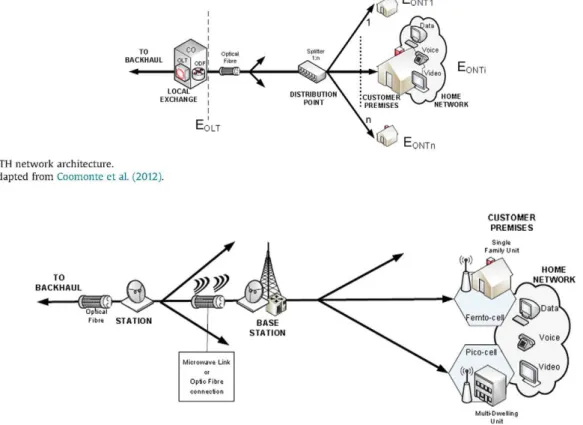
The network architectures presented in Figs. 1 and 2 derive from deployment models used in previous studies to assess the costs in the rollout process of NGA networks (Coomonte et al., 2012; Feijóo, Gómez-Barroso, & Ramos, 2011). The FTTH architecture is congruent with technical models of fixed fibre-based access networks (Kramer et al., 2012) and main fibre cost-related studies (Analysys Mason, 2008, 2009). The architecture for the mobile network is based on the evolved UMTS Terrestrial Radio Access Network (e-UTRAN) (3GGPP, 2012; Dahlman et al., 2006). In the case of LTE, it has been assumed that major changes with significant impact will not happen in the current cellular commercial architecture within the time period considered in this paper (up to 2020) in spite of promising proposals on mesh networks and software-defined radio (Raychaudhuri & Mandayam, 2012).
These architectures will be used for both the energy consumption and cost calculations, thus becoming a common framework for comparisons of the energy consumption costs with regard to operating expenses, network design, and deployment strategies.
The main elements in the access part of the fibre architecture are explained. First, the connection with the transport layer is accomplished through a local exchange office in which the energy consumption takes place at the Optical Line Termination (OLT) device. The other primary energy consumption within the network occurs at the customer interface via Customer Premises Equipment (CPE), which utilises an Optical Network Termination (ONT). In the GPON architecture, one or more distribution points are placed in between these two extremes, splitting the signal and dispersing it among subscribers. These splitters, as passive devices, do not contribute to the energy consumption of the network, but their
Fig. 1. FTTH network architecture.
Source: adapted from Coomonte et al. (2012).
CUSTOMER PREMISES
Molu-DweDIng Unit Fig. 2. 4G Mobile network architecture.
number does affect the signal power level transmitted to and from the customer premises. Therefore, the energy consumed at the active devices (OLTand CPE) is typically higher than in other FTTH architectures such as Point to Point (PtP) (Keymile, 2011). In the case of 4G networks, the active deployed devices consist of the base stations, the equipment to fill coverage gaps, and the equipment to interface with users devices. Base stations are the building blocks of any terrestrial wireless deployment, and the footprint of the network is composed of the coverage area of each base station. From an engineering perspective, the network deployment coincides with the selection of the most appropriate location of base stations, given the objectives of coverage and quality of communications (Andrews, Claussen, Dohler, Rangan, & Reed, 2012; Schindler, Sadhir, Robbins, Guo, & Paradis, 2011). In general, additional equipment is needed to fill coverage gaps due to the existence of physical obstacles to the radio waves emanating from the base stations. This typically occurs in urban areas. There are different types of equipment used depending on the size of the coverage gap—picocells have a coverage radius of hundreds of metres and femtocells tens of metres (Andrews et al., 2012; Ghosh et al., 2012). It is also the objective of both types of equipment to achieve or improve indoor coverage. In this paper, we will not distinguish between the two types of equipment and the number of them required, as the deployment of the network will be simply a function of the number of buildings in the area and not their size. As an additional simplification, base stations and pico-/femtocells are considered here as the equipment required for the connection of all types of user devices; not only handsets but also tablets, personal computers or connected television sets are not considered as such. Wi-Fi traffic off-loading from mobile networks into fixed networks is also considered as explained in the sections below.
2.3. Energy consumption of active devices in the network
For each of the active devices in the network, it is necessary to establish an energy profile. These behavioural functions determine the different levels of consumption for the devices according to the workload of the network. The profiles in this paper are defined in accordance to the values proposed in EC (2011) guidelines, the latest available, and which also suggest representative tiers for the next three years. It is worth noting that these values are merely recommendations for broadband equipment manufacturers and that actual consumption data will depart somewhat from these figures; however, they can be considered a representative depiction of the situation.
These profiles are shown in Fig. 3. The base station pattern is defined by consumption levels of 100% (high), 50% (medium) and 10% (low or idle) load states, while the profiles of pico-/femtocells, OLT and ONT are only defined at the 100% (high) and 10% (low or idle) load states. The low (or idle) state does not coincide with a switched-off power consumption level, as operations other than pure data transmission (for example, cooling) are necessary at all times. Due to this, these devices can never be shut down, even in cases of no transmission, as the reactivation process is not immediate, thereby affecting their real-time performance (Frenger, Moberg, Malmodin, Jading, & Godor, 2011).
There are three main and mutually compatible ways of increasing the energy efficiency of networks with respect to active devices. The first is an architecture design aimed at reducing energy requirements. However, this is seldom undertaken, as network architectures are usually designed to fulfil specific coverage and service provision goals (Cuomo, Cianfrani, Polverini, & Mangione, 2012). The second set of possible enhancements takes place at the system and network levels, in the definition of new functions, network management mechanisms and algorithms for dynamic resource management. These features are typically implemented at the software level and potentially upgraded and introduced into the network over the lifetime of several hardware generations. These potential improvements can be achieved, for instance, by using techniques to manage discontinuous transmission time slots during device operation (Frenger et al., 2011) or by analysing the network requirements and training the network to respond dynamically, putting specific sections to sleep (Cuomo et al., 2012; Shi et al., 2013). The third and most likely option is implemented at the device level, using the most up-to-date energy-efficient equipment either for new deployment or for replacement of existing equipment once the hardware amortisation has taken place. Technically, to achieve higher efficiency, the energy consumption profiles are
Low load state
Medium load state
100%
50%
100% 100%
50%
Usage level (%)
Fig. 3. Power consumption profiles for base stations (a) and pico-/femtocells, ONTs and OLTs (b). Based on the model from (Frenger et al., 2011) 50%
modified by lowering the level of power consumption at the 100% load state (maximum power consumption in absolute terms) or by adjusting the relative variation of the other states with respect to the maximum level of consumption. In this paper, both possibilities are combined in the suggested evolution for these patterns—see Section 2.1.
In the analysis presented in this paper, only the last approach is considered in the baseline, as it is by far the most common procedure. Therefore, the most energy-efficient devices are included in the network deployment on a yearly basis. The devices already deployed are only replaced for more efficient ones after five years, which is the period assumed for device amortisation. The only exception takes place from 2017 onwards on mobile networks, where variations on the key design features of the network require a general replacement with new devices. This is explained later on. In the sensitivity analysis, alternative scenarios departing from the baseline are considered for possible improvements in management of networks as well as other roadmaps for achieving energy efficiency in network devices.
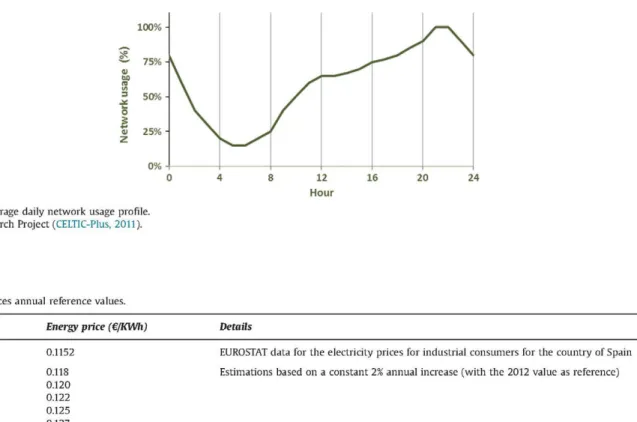
In any case, the actual energy consumption of the active devices at any given time depends on the data traffic workload (level of usage) of the network. The data traffic pattern in fibre networks has been analysed by Shi et al. (2013); suggesting, for example, that an hourly basis is enough to build a reasonable model for dynamic resource allocation. To avoid the difficulties of a dynamic model, a simpler approach reduces the problem to the consideration of an average hour-by-hour daily traffic evolution. A pattern of average daily usage of a network is presented in Fig. 4. This pattern was developed within the March Project (CELTIC-Plus, 2011) and is considered representative of the typical daily pattern, encompassing the variations across the different zones where the network is deployed as well as along different time frames of the year (days of the week, months, seasons, etc.). The combination of this pattern with the energy profile already presented permits the determination of the average energy consumed every hour throughout the day by the active devices and thus the daily average and total yearly consumptions.
2.4. Energy prices
For cost calculations, the price of the energy was obtained from EUROSTAT data on the electricity prices for industrial consumers in Spain. The price for 2012 was 0.1152 €/KWh. Forecasts of energy prices suggest an increase of 50% by 2030 compared to 2005 levels (EC, 2009, 2010b). This projected increase corresponds to an average annual increase of 2% at constant prices. The complete evolution in the energy prices used for reference is shown in Table 1.
Fig. 4. Average daily network usage profile.
Source: March Project (CELTIC-Plus, 2011).
Table 1
Energy prices annual reference values.
Year Energy price (€/KWh) Details
2012 0.1152
2013 2014 2015 2016 2017 2018 2019 2020
0.118 0.120 0.122 0.125 0.127 0.130 0.132 0.135
EUROSTAT data for the electricity prices for industrial consumers for the country of Spain
25. Network design parameters
According to the typical engineering design approach (Forsgren & Prytz, 2006), the key network parameters are data traffic per user, quality of service, the (expected) penetration of each broadband technology, data throughput (data capacity) of local exchanges and base stations, and for mobile technologies the frequency of operation and the amount of spectrum bandwidth allocated to the operator. The sizing of the network depends on all of these parameters and, therefore, so does the energy consumption of the network. Each of these parameters is briefly discussed below, leaving the calculation process to be addressed in the following sub-section.
Data traffic has undoubtedly experienced significant increases in recent years, with global figures up to 43 Exabytes (EB) per month in 2012 and a forecasted compounded annual growth rate (CAGR) of 29% for the period 2011-2016, reaching 110 EB/month in 2016 (CISCO, 2012a). Mobile traffic is expected to grow at rates of over 50% until 2020, increasing from 1.3 EB/month in 2012 to approximately 40 EB/month in 2020 (Jefferies, 2011). Mobile traffic off-loaded via Wi-Fi was 9 EB per month in 2012 and is expected to grow to 18 EB per month at a CAGR of 21% (CISCO, 2012a). These figures show how users are changing their habits with regard to broadband, particularly with respect to their increasing usage of data-intensive applications such as social networks, cloud computing and various video services and applications. However, while these figures provide an aggregated average of user behaviour, they do not provide information about their concrete demands at (peak) data rates for specific services and applications. From a technical perspective, GPON technology is expected to be able to provide peak data rates of up to 2.5 Gbps, while expected LTE peak data rates range up to 150 Mbps. These two figures seem well above current prospects of (peak) user behaviour, whatever the combination of advanced services and applications they choose, and they are also well above main policy objectives set in the range of 100 Mbps for 2020 (EC, 2010a).
In between average and peak data rates, the amount of time a given data rate is guaranteed for users—or the number of users than can be served simultaneously at a given data rate—is specified by the quality of service (QoS). In fact, QoS is arguably the design parameter that most affects the deployment of a network and, therefore, its energy consumption. While OoS levels are currently considered to be low, especially in mobile networks (Ixia, 2011; Vadada, 2010), it is expected that the evolution in the demand of higher speeds will be in accordance with an increase in the standards of QoS offered to users. In this paper, the starting point for the guaranteed data rate per subscriber is established initially at 30 Mbps in fixed networks and 1 Mbps in mobile networks. These are reference values for each technology that cover the current needs for more demanding data applications (Jukan & Mambretti, 2012; Radio, Ying, Tatipamula, & Madisetti, 2012).
Broadband penetration determines both the total number of potential subscribers and, along with the demographic scenario and the network deployment strategy, the number of them located in each area. The fixed broadband penetration in January 2012 was 81.1% of the premises, on average, in the EU (EC, 2012). Of this value, only 7.2% of the lines provide speeds of 30 Mbps or above. A typical target for the prospective market saturation level of fixed broadband technology is set at 80% penetration in premises (Analysys Mason, 2008). Regarding mobile technologies, while the level of adoption of mobile services in general is over 100% in most developed countries, the specific penetration of mobile broadband (3G and beyond) is still relatively low: 43% in January 2012 (EC, 2012). Most market prospects assign 4G figures approaching 80% of the population by 2020 (Jefferies, 2011). Once the number of potential subscribers is determined, an operator can follow different strategies for the deployment of the network, essentially using different combinations for the number of users in different areas to achieve an overall target. In general, as deployment costs per user are inversely related to population density (Tselekounis, Maniadakis, & Varoutas, 2012), the most rational strategy for the operator to follow would be to start the deployment in those areas with higher population densities. However, this is not always the case, primarily as a consequence of diverse types of regulatory conditions.
The data throughput of a FTTH-GPON local exchange is dependent on the number of OLT cards and the splitting ratio in the GPON architecture. In this paper, a conservative scheme of two levels of splitting - 8 x 8- has been preferred (Analysys Mason, 2008; Bock et al., 2008). This implies that each feeder fibre from the local exchange serves 64 customers supplying a maximum data rate per user of 30 Mbps downstream and 19.5 Mbps upstream. Higher data rates require the replacement of OLT cards and splitters to work with 10 Gbps feeder fibres, the next step in GPON technology. In extreme rural areas a lower splitting ratio has been used as indicated in Table 2 due to the reduced number of potential subscribers.
In the case of mobile networks, frequencies allocated to the operator impact both the coverage and maximum throughput (the total data capacity) of each base station—the lower the frequency of operation, the greater the coverage, and the higher is the bandwidth, the higher is the throughput of the base station. Base station coverage is delimited by the lesser of two factors. The first is the share of the maximum throughput among the users while complying with QoS
Table 2
FTTH-GPON network sizing.
Zone I II III IV V VI VII VIII IX X
Number of users per access area 16,384 16,384 16,384 16,384 16,384 16,384 4096 2048 512 256 Minimum number of fibres at the exchange 256 256 256 256 256 256 64 32 8 8
requisites. This limitation varies inversely with population density. The second derives from signal transmission losses. Beyond a certain distance, the signal is compromised with excessive errors. A typical maximum coverage radius at mobile communications lower frequencies ranges up to 50 km (Astely et al., 2009; Furuskar, Jing, Blomgren, & Skillermark, 2011). However, this value diminishes to just a few km in areas of high building clustering or complex terrain, where the combination of diffraction and multipath interference significantly increases signal losses and errors. In any case, for mobile broadband the first limiting factor occurs usually in high (urban) and medium (suburban) population density zones, while the latter is typical of low population density zones (rural). As a consequence of the above, lower frequencies of operation (such as those resulting from the digital dividend) do not increase network coverage if the limiting factor is QoS.
The data throughput of a mobile base station depends, in addition to the bandwidth allocated to the operator, on the spectral efficiency level and on vendor-dependent parameters, such as the number of sectors and the number of channels for data transmission. Bandwidth allocation is subject to regulatory constraints due to the scarcity of the spectrum in more convenient frequency bands. In LTE technology, a typical value for this parameter is currently 20 MHz (IDATE, 2012), although higher values will be required to satisfy the increasing demands of users as discussed in the next section. The spectral efficiency determines the capacity of using each unit of frequency available in the allocated bandwidth to transmit at a specific data rate. It is measured in bits per second per Hertz. A typical peak value for this parameter in LTE is 15 bps/Hz (IDATE, 2012), achieved close to base stations. As the paper assumes a very dense cellular network it is used as a reference value. The number of channels and sectors refers to the configuration on base stations. A typical LTE configuration features 3 sectors (each covering a 120° angle) and a 2 x 2 MIMO1 (the one used in this model) or a 4 x 4 MIMO (Deruyck,
Tanghe, Joseph, & Martens, 2011) channel configuration. Considering the above parameters, a baseline base station could manage a total data throughput of up to 1800 Mbps.
2.6. Demographic scenario
The baseline is placed in the specific demographic framework of Spain (see Table 3 for details). Aside from the direct relevance of the case for Spain as a European example of NGN deployment, it is interesting to note that data for Spain is relatively similar to the "Euroland" scenario (Forge, Blackman, & Bohlin, 2005), thus enabling its easy extension for similar countries.
The demographic framework classifies each of more than 8000 municipalities into 10 different geographical zones based on their population density. While other studies (Analysys Mason, 2009; Forge et al., 2005; Gómez-Barroso and Robles-Rovalo, 2008; Jeanjean, 2010) typically divide the territory into 3 to 8 zones, this division into 10 zones allows for more accurate estimations in the "grey" areas with intermediate population densities, a key aspect of NGN deployment ( Gómez-Barroso & Feijóo, 2010). However, and despite the increased granularity, this approach delivers little information on building clustering. Information on which part of a municipality is densely built and which has only scattered buildings allows for a more precise characterisation of suburban and rural areas. This is a key element for the proper dimensioning of networks, as base stations and local exchanges need to be located in a denser pattern in those places where buildings are also more densely placed. Therefore, to improve the approach, each density zone is further divided into two different sub-geotypes. In particular, a zone is classified into the "a" geotype if over 80% of its surface is covered with buildings. Otherwise, it is classified into the "b" geotype. Therefore, each zone has a share of "a" and "b" geotypes, except for the IX and X density zones that only contain the "b" type, as a result of their rural nature. This results in a total of 18 zones. Note that in fixed networks, the local exchanges in "b" geotypes require longer fibres to reach customers, and in rural areas, they use a reduced number of OLT cards and splitters with regard to a regular situation. For mobile networks, the share of "a" geotypes in each zone defines the number of femtocells required to complete the coverage of base stations. Additionally, due to the terrain in rural areas in Spain, a maximum coverage radius of 10 km is assigned for a base station in those areas when there is no other limiting factor.
2.7. Calculation process
The calculation process is designed from the bottom up following the traditional engineering design approach (Forsgren & Prytz, 2006), and consists of two main parts. The first determines the size—the footprint—of the basic coverage unit for each technology (the local exchange access area for fixed networks and cell for mobile networks) and the number needed in the different zones that compose the demographic scenario. In the second part, the per-hour average, daily average and yearly energy consumption of the access network are determined by applying the energy profiles of the active devices combined with the network usage. The process is explained in detail below.
Starting with mobile networks, calculation begins with the size of the cell, in terms of both the area covered and the maximum number of subscribers. The latter (see Eq. (1)) is calculated from the relationship between the total data throughput per base station and the specified QoS. This maximum number of subscribers is then compared with the size of
Table 3
Spanish d e m o g r a p h i c data.
Source: INE (Spanish Statistics Institute) d e m o g r a p h i c database.
Zone I II III IV V VI VII VIII IX X Total
Density {inhabitants per > 10,000 10-5000 5-3000 3-1000 1000- 500-100 100-50 50-10 10-5 < 5 square km) 500
Number of 17 28 46 175 209 946 745 2705 1444 1797 8112 municipalities
Share of total 5.79% 13.48% 8.20% 18.39% 10.73% 2 4 . 2 3 % 7.65% 9.43% 1.43% 0.67% 100% population (%)
Geotype A share (%) 85% 63% 70% 38% 21% 31% 56% 43% 0% 0% Geotype B share (%) 15% 37% 30% 62% 79% 69% 44% 57% 100% 100%
Number of users 2,707,360 6,300,119 3,832,203 8,596,709 5,016,333 11,326,891 3,574,008 4,406,394 668,735 317,055 46,745,807 Number of premises 963,482 2,090,404 1,185,622 2,575,576 1,446,293 3190.138 1,061,590 1,453,938 258,753 134,524 14,360,318 Number of buildings 150,991 349,457 292,268 1,009,798 796,835 2,511,879 1,195,232 2,089,301 515,673 373,573 9,285,007 Ratio users per building 21.70 21.81 15.87 10.30 7.62 5.46 3.62 2.55 1.57 1.03
I * user-building)
Table 4
4G n e t w o r k sizing.
Zone
Number of cells
Number of users per cell (n„s(.rc(.íí) Area of the cell
Radius of the cell Number of areas per zone Number of users per area N u m b e r of cells per access area
I 7376 360 0.05 0.13 160 16384 46.10 fl 17,185 360 0.15 0.22 373 16384 46.07 III 10,487 360 0.24 0.27 227 16384 46.20 IV 23,542 360 0.59 0.43 508 16384 46.34 V 13,870 360 1.41 0.67 297 16384 46.70 VI 31,765 360 4.56 1.21 670 16384 47.41 VII 10,884 360 14.28 2.13 845 4096 12.88 VIII 15,202 360 36.71 3.42 2083 2048 7.30 IX 3973 223 64.36 4.53 1265 512 3.14 X 4218 106 60.42 4.39 1199 256 3.52 Total 42,105 7627
the municipality. If it is lower, then the size of the cell is calculated as the size of the area covering that number of subscribers, given the population density of the zone under consideration. The number of cells in the municipality is rounded up to the nearest integer to cater to the remaining fraction of users not covered (the worst-case design). In contrast, if the maximum number of subscribers is greater than the population of the municipality, the maximum number of subscribers will be limited by the population of the municipality, and the cell size is the maximum range of coverage at the frequency of operation. If the range of the cell is smaller than the size of the municipality, then the location of premises in the municipality is used to check the required number of cells. If the range of the cell is greater than the size of the municipality and there are no geographic obstacles (a rare situation in Spain), then the population of the neighbouring municipality is also considered for cell coverage. Although this simplified process may slightly over-estimate the number of base stations required, it also reflects the reality concerning licences for base station sites, which are usually granted at the municipal level. It is, therefore, considered a reasonable depiction of a real deployment situation for mobile networks. Table 4 presents the resulting number of potential subscribers per base station across the different demographic zones. The number of femtocells per cell is also obtained at this stage from the percentage of urban buildings with respect to the total number of premises in the average municipality in the zone.
Total data throughput BW x Spectral efficiency x nsec tors x nantennas
n"sers = QoSldamJal^)e7user)=^ Q_oS ( '
For fixed networks, the calculation process is equivalent, using the local exchange access area instead of the cell area. The starting point is the number of potential subscribers covered by a local exchange. As the location of local exchanges are re-used from legacy networks, this value is already set, as indicated in Table 2. The same comparisons as above with the population size of the municipality are considered. In the case of mobile networks, an access area is also calculated. The reason for adding this intermediate stage in the calculations for the deployment of a 4G network is derived from our interest in establishing a common framework for comparisons between mobile and fibre-based technologies with respect to the access part of the network. The base station topology is denser than that of local exchanges (their fibre-based "counterpart"), such that, to effectively reach subscribers, it is necessary to lay a certain amount of fibre (Fig. 2) from where an equivalent local exchange would be located. Therefore, using this fictitious "access area" permits the calculation of the additional fibre (the "middle mile") that must be deployed to reach the base stations in a 4G network. Thus, the inclusion of this value in the cost and energy calculations of the mobile access network creates a framework that is more comparable with fixed technologies.
option was chosen for the baseline: the deployment starts in the highest-density zone and moves into subsequent zones until the coverage objective is achieved. The simple rationale behind this approach consists of decreasing the costs of deployment per potential subscriber as much as possible, as in this industry profitability is based on the average return per user. The deployment strategies used and their target levels of coverage are detailed in Table 5.
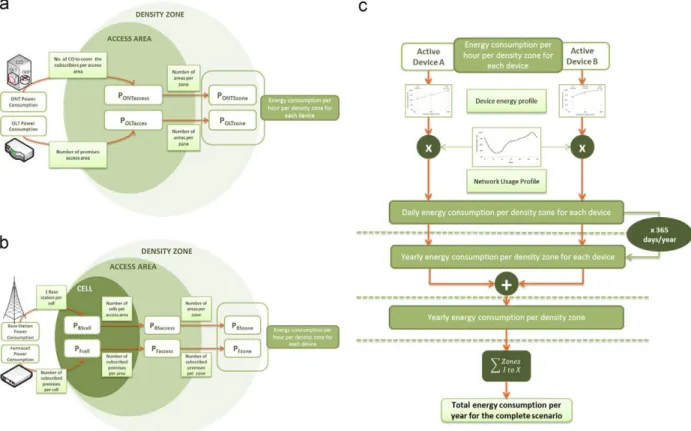
The second part of the calculation process considers the power required by the active devices in the network. The maximum energy reference levels of OLT, ONT and pico-/femtocells are constant. However, in the case of base stations, this level varies with the number of subscribers and, therefore, changes across zones. The combination of the energy profile of the devices with the network daily usage pattern allows for obtaining the percentage of power consumption regarding the maximum of each device for every hour of the day and its aggregation in the annual consumption. The process for the calculation of hourly, daily and annual energy consumption is illustrated in Fig. 5. Therefore, the energy consumption calculations for mobile and fixed networks show their primary differences in the first part of the process (Fig. 5a and b). The second stage of the procedure (Fig. 5c) is common for both types of networks, with the exception of using the appropriate device energy profile in each case.
2.8. User devices energy consumption
User devices are not strictly part of the access network. However, energy calculations from the consumer perspective would not be complete without their consideration. The analysis of the energy consumption of user devices differs from the compilation of the user device market in Spain, as presented in Table 6. The distribution of the devices across the demographic scenario was assumed to be proportional to the population and premises distribution.
Two basic operational modes are defined for user devices: continuous power consumption during usage and an idle state with energy consumption only while recharging the device. Therefore, Eq. (2) is used for the consumption per device.
device = v^usage x Pusage) ' {^recharge x Precharge x ^recharge) \¿)
where tusage and pUSage respectively are the average daily times of usage of the device in hours and the power in watts per hour consumed by the device, and trecharge, preCharge and nrecharge are respectively the times in hours required to completely recharge the device, the power consumed in watts per hour while performing this process and the number of average recharges per day. See Table 7 for the values of each parameter in 2011.
For energy consumption comparison purposes, laptops, computers and other devices are considered to belong to fixed networks, while tablets and smartphones are considered to belong to mobile access networks. The off-loading of mobile data traffic via Wi-Fi is considered to assign part of the consumption of mobile devices to fixed networks. Forecasts from the industry are used for off-loading traffic (CISCO, 2012a). The energy consumed in the router group is shared in proportion to the ratio of fixed and off-loaded mobile traffic to pure mobile data traffic (CISCO, 2012b).
2.9. Model for the evolution of the energy consumption baseline
Energy consumption of NGNs in the 2020 horizon depends on the evolution of some of the variables described in the previous section. In particular, this paper considers the evolution of technologies, user demands and devices (the combination of which is reflected in data traffic), the evolution of energy prices, the effects of the deployment progress of the networks and the increasing energy efficiency of devices. In the following paragraphs the evolution over time of each of these parameters is considered in detail.
Beginning with data traffic, an increment of guaranteed speeds is considered, in accordance with the increasing prevalence of broadband-intensive applications such as video, cloud computing, videogames, and, in the mobile domain, M2M and augmented reality. The objective figures for 2020 are set at 100 Mbps for fixed networks and 5 Mbps for mobile networks, in conjunction with policy (EC, 2010a) and current industrial perspectives (Jukan & Mambretti, 2012; Radio et al., 2012). In particular, in fixed networks, the guaranteed data rate is assumed to increase from 30 Mbps to 50 Mbps by 2016 and to 100 Mbps by 2020. In mobile networks, a more nuanced evolution is assumed to take place, from 1 Mbps to 2 Mbps in 2013, to 3 Mbps by 2015, and to 5 Mbps by 2017. The corresponding CAGR of the guaranteed data rate for the period 2011-2020 for fixed networks is 13%, while for mobile networks it is 17%. Both figures are rather more conservative than the forecasts of aggregated data traffic growth presented in the previous section.
For mobile networks the achievement of these objectives requires a shift in two key design factors: spectral efficiency and allocated spectrum. Expecting a similar evolution from 3.5G to 4G technologies (Lluch, 2012) a shift from 15 to 20 bps/Hz is proposed for spectral efficiency. Regarding allocated spectrum to operators, a move from the initial 20 MHz to 40 MHz is also proposed. Both network design enhancements are assumed to take place in the year 2017. This is in line with expectations in the availability of new spectrum set out in EU and US policies. In the case of fixed networks, the objectives set in the baseline would require to change the OLTs to increase the capacity provided by the feeder optic fibres in 2020.
Table 5
User allocation strategies determined for the different zones and population of each of them according to the Spanish demographic scenario.
Density zone I II
Population in the zone according to demographic data 2,707,360 6,300,119 (inhabitants)
HI W V
3,832,203 8,596,709 5,016,333
VI
11,326,891
VII VIII IX X
3,574,008 4,406,394 668,735 317,055
Total
46,745,807
Coverage strategy selected for the model {Strategy H)
Deployment and filling sequence Fixed networks Target coverage (% of premises)
2012 No. of inhabitants per zone 2020 No. of inhabitants per zone Mobile Target coverage (% of population) networks 2012 No. of inhabitants per zone
2020 No. of inhabitants per zone
Strategy variation (Strategy L)
Deployment and filling sequence Fixed networks Target coverage (% of premises)
2012 No. of inhabitants per zone 2020 No. of inhabitants per zone Mobile Target coverage (% of population) networks 2012 No. of inhabitants per zone
2020 No. of inhabitants per zone
Following this strategy, operators would first deploy networks in higher density zones and when the each density zone reaches its maximum target coverage next one is started to be covered
1 2 3 4 5 6 7 8
100% 100% 90% 80% 76% 70% 50% 50%
171,323 - - - -
-1,083,918 2,351,705 963,318 2,092,656 1,265,506 2,791,370 125% 125% 110% 110% 95% 95% 3,384,200 7,560,143 4,215,423 9,456,380 200,051
-3,384,200 7,875,149 4,215,423 9,456,380 4,765,516 10,760,546 3,037,907 3,525,115 434,678 174,882 47,629,797
This strategy variation proposes to first deploy the network in lower density zones, according to the filling order stated in the next cell
10 90%
1,127,939 1,544,809 291,097 85% 80%
9 40%
-291,097 65%
-10 40%
-142,851 65%
-76.10% 171.323 13,655,168 101.96% 248,16,233
9
90% 65%
7
65% 70%
5 70%
1,075,430 2,351,705 963,318 110% 110% 100%
2,092,656 1,265,506 2,91,370 95% 100% 100%
4 85%
-1,127,939 105%
3 85%
-1,544,809 105%
1 90% 171.323 291,097 105%
2 90%
-151,340 100%
DENSITY ZONE
ACCESS AREA
DENSITY Z O N E
ACCESS A R E A
Daily energy consumption per density zone for each device
—t™
i
Yearly energy consumption per density zone for each device
Yearly energy consumption per density zone
TO y e
T o t a l e n e r g y c o n s u m p t i o n p e r
year for the complete scenario
Fig. 5. Calculation process stages: (a) fixed network average hourly energy consumption, (b) mobile network average hourly energy consumption, and (c) daily average, yearly and global scenario energy consumption calculation
Table 6
Spanish user device market, 2011. Source: Telefónica (2012).
Device market in 2012
Laptops Computers
Other devices (video games consoles, smart TV, etc.)
Smartphones Tablets Router
Total
Number of units (millions)
22.92 22.57 10.14
24.84 4.81 10.52
88.27
Penetration of the device population (%)
49 48
22
38
10
23
189
among Number of devices per premise
1.28 1.26 0.57
0.99 0.27 0.59
4.92
Table 7
Power consumption and usage features of user devices in 2011.
Source: Obtained from specifications of manufacturers and vendors of devices.
User devices consumption features 2011
Laptops Computers
Other devices (video games consoles, smart TV,...) Smartphones
Tablets Router
tusage \"1 5 3 1
-24
p
1 usage
60
120 150
-11(Wh) ¿recharge 2
-1 5
-(h) 'recharge 25
-5 10-(Wh) "recharge (per day)
0.4
-1 0.25-preferred due to its easy interpretation. Therefore, for fixed and mobile technologies, their penetration is expressed as M
Table 8
Results of the forecast for the evolution of fixed and mobile technologies in Spain for 2020.
Technology Year 2012 2020
FTTH-GPON Fixed BB penetration (lines per premises) 68.27% 79.08% FTTH penetration (over total Fixed BB) 1.47% 98.12% FTTH penetration (per 100 inhabitants) 0.99% 30.34% Number of FTTH lines (millions) 0.46 14.18
LTE Mobile penetration (subscribers per 100 inhabitants) 121.06% 128.47% LTE penetration (over total mobile penetration) 40.71% 79.80% LTE penetration (per 100 inhabitants) 49.28% 102.51% Number of mobile BB lines (millions) 23.54 47.74
Table 9
Forecast of user devices for year 2020.
Device market in 2020
Laptops Computers
Other devices (video games consoles, smart TV, etc.)
Smartphones Tablets Router
Number of units (millions)
34.60 35.13 15.55
47.63 12.72 13.76
Penetration of the device population (%)
74 75 33
102 27 29
among Number of devices per premise
1.97 1.96 0.87
2.65 0.71 0.77
Total 159.40 341 8.88
In this equation, M defines the market saturation level, T0 is the year when 50% of the saturation level is reached, and a defines the rate of growth of the curve. The final market saturation levels have been already set in the section above in both fixed and mobile technologies in 2020, and T0 and a are obtained by fitting the data about actual Spanish market values for each market (see 2009-2012 figures in Table 12 in Appendix), as explained in the following.
In the case of fixed networks, the forecast uses two estimations: first, the evolution of the market saturation level starting from the current penetration of fixed broadband lines, and then secondly, the share of FTTH technologies in the broadband market. The combination of both estimations results in the evolution of FTTH lines until 2020. Mobile penetration assessment follows a similar pattern. In the first stage, the evolution of the total number of mobile subscribers is estimated, and in the second stage, the number of smartphones with broadband capabilities is estimated with regard to the total number of subscribers. The results of the forecast are summarised in Table 8 (and detailed in the 2013-2020 figures of Table 12 in Appendix).
The evolution of user demand is synergic with changes in the user devices market. In fact, according to forecasts (CISCO, 2012b; Jefferies, 2011), the increase in data traffic, especially in the mobile domain, is driven by the increase in the number of wireless devices that provide access to broadband services. Thus, for 2016, there is the likelihood of data traffic from wireless devices (61%) exceeding wired device traffic (39%), while in 2011, wired devices accounted for 55% of all traffic.
Currently in Spain, each inhabitant has on average nearly two different devices to access the network, and there are nearly five devices per premise (see Table 6). This figure places Spain at the same level that the world average (CISCO, 2012b). Without the appearance of a new technology/device (as experienced in recent years with the entry of tablets into the market), the number of devices is not expected to dramatically increase. For fixed access devices (computers, laptops and others), the increase in penetration is assumed to be gradually lower due to the migration towards wireless devices and the virtualization of a relevant part of the services delivered by these types of devices (Gartner, 2012). Mobile devices will grow according to the forecast of the S-shaped growth explained above. The same logic is followed to establish the number of tablets, as the other main source of data traffic for 4G networks, apart from the off-loading to fixed networks. The number of router devices relates to the evolution of the penetration of FTTH technology (see above). Following these assumptions Table 9 summarises the projection of the number of user devices for the year 2020 (see the detailed projections for the complete period 2012-2020 in Table 13 in Appendix).
Table 10
Power consumption and usage features of user devices for 2020. Source: Own estimations based on EC (2011).
Laptops Computers
Other devices (video games consoles, smart TV,...) Smartphones
Tablets Router
7 2 2
-24
45 100 125
-20
1
-1 2.5
-User devices consumption features 2020 fusage (") Pusage (Wh) tyechayge (h) Preotarge (Wh) n„,ci,argl, (per day)
20 0.33
4 0.5
8 0.2
comparisons between the two extreme deployment possibilities and is used in the sensitivity analysis that is discussed later. In either case, at the end of 2020, the deployments are meant to be completed regardless of the selected strategy; the differences lie in the energy consumption path.
The evolution of energy consumption in network devices extrapolates existing guidelines for the short term (EC, 2011; ETSI, 2009), where the improvement in energy efficiency performance translates into a modification of the energy profile. In this sense, the change affects both the maximum energy consumed and the percentage of this value consumed at each load state. Base stations are proposed to reduce 25% their energy consumption in 2014 as compared to 2011. Assuming the same trend, and also assuming that the base value for 2011 should be increased to consider the use of base stations that make use of higher bandwidth and spectral efficiency, the value of energy consumption in 2017 is set at 900 Wh. The other energy states are defined at 58% for the 50% workload and at 29% for the 10% load. Pico-/femtocells will also follow the trend proposed in the guidelines (EC, 2011), and will consume 4 Wh at their maximum work-cycle, using 77% of this level at the 10% load state. Regarding fixed networks, ONTs will consume 4.3 Wh at maximum workload and 3.4 Wh at the 10% state. At the local exchange, each interface will consume 8 Wh and the OLTs will consume 3.8 Wh plus the cooling requirements, established at 60% of the device consumption (Cucchietti, 2009).
With respect to user devices, energy management features will improve their energy profiles (Bojic, Podobnik, & Petric, 2012; CISCO, 2012b; Frenger et al., 2011). The only exception will be routers, as they will manage larger amounts of data, increasing the energy consumed. It has also been considered that the increasing usage of wireless devices will reduce time devoted to other user devices, thus decreasing their total energy consumption (Brandewinder, 2008). The proposed values for the 2020 scenario are shown in Table 10.
3. Results and discussion
This section introduces the baseline results for energy consumption and costs. First, the evolution of the energy consumption of each of the access network technologies considered is illustrated. Then, a number of comparisons are made between technologies and between the energy consumed by the network itself and the user devices. Finally, the results of a simple sensitivity analysis of the modification of the main network design parameters are presented. The sensitivity analysis includes a brief discussion of the influence of the deployment strategy of operators on energy consumption.
Fig. 6 displays the energy consumption baseline of each access network, according to the design parameters discussed in the previous two sections. FTTH departs from a low energy consumption of about 28 Gw/year in 2011, consistent with its limited market penetration, and grows according to the s-shaped deployment curve until a mature stage is reached at energy consumption of approximately 745 Gw/year. LTE also departs from a modest energy consumption of 43 Gw/year, but grows more rapidly, due to the rapid adoption of 4G, and peaks in 2016 at 718 Gw/year. From that year onwards, three conflicting forces affect the energy consumption baseline for LTE: the improvements in technology—such as an increase in spectral efficiency and the greater availability of bandwidth—substitution of older technology for more energy-efficient devices, and the continuation of 4G adoption. In 2020, "mature" energy consumption of 638 Gw/year is reached.
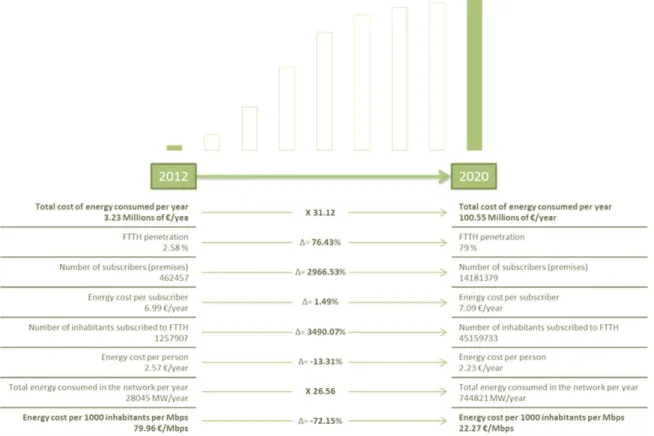
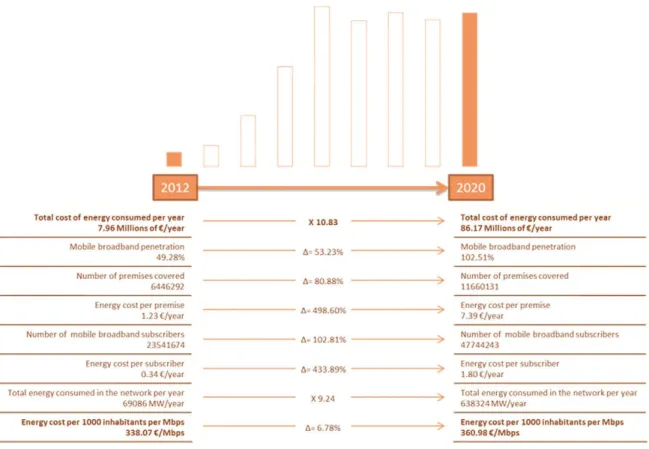
Figs. 7 and 8 summarise and compare the baseline results for both types of NGNs, contrasting the situation in 2012 with that of 2020 and introducing the costs of energy consumption. Beginning with FTTH-GPON, the most interesting result is the significant increase in energy consumption within the network and its associated cost. This is to be expected, as the technology has barely commenced the rollout phase. The situation is rather distinct for mobile broadband. Here, the total energy consumption and its costs increase considerably, but in a much more modest proportion. This is essentially due to the fact that the network supporting mobile broadband was already partially deployed in 2012. If the costs per premise (subscriber) or per person are considered, it is also noteworthy how they decrease for FTTH-GPON, despite the increase in energy prices. The reason for this is that in fixed networks, energy consumption by user devices depends on the number of subscribers served by the network and evolves with this number. In the case of mobile broadband, the evolution of the energy consumption per subscriber is the opposite of that for FTTH-GPON: the cost of energy per subscriber almost quadruples over the period considered, as the network has to scale up to cater to more subscribers and more intense usage, both of which increase the number of base stations and pico-/femtocells and their workload.
800,000 •
700,000 •
600,000 •
500,000 •
400,000 •
300,000 •
200,000 •
100,000
-III
Ml
.Ml
.MM
Mill
^ T L L L L L
-2011 2012 2013 2014 2015 2016 2017 2018 2019 2020
Fig. 6. E n e r g y c o n s u m p t i o n profiles ( M W / y e a r ) for t h e access n e t w o r k c o n s u m p t i o n
2011 2012 2013 2014 2015 2016 2017 2018 2019 2020
a l o n g t h e 2 0 1 1 - 2 0 2 0 p e r i o d for (a) FTTH-GPON a n d (b) LTE.
Total cost of energy consumed per year 3.23 Millions of C/yea
FTTH penetration 2.58% Number of subscribers (premises) 462457 Energy cost per subscriber 6.99 C/year Number of inhabitants subscribed to FTTH 1257907
Energy cost per person 2.57 C/year Total energy consumed in the network per year 28045 MW/year Energy cost per 1000 inhabitants per Mbps 79.96 t/Mbps
I
- fl= 2966.53%
A= 1.49%
-- A= 3490.07%
¿=13.31%
-X 26.56
A 72.15%
-Total cost of energy consumed per year 100.55Millions of C/year
FTTH penetration
Number of subscribers{premises) 14181379
.. Energy cost per subscriber 7.09 C/year
Number of inhabitants subscribed to FTTH
Energy cost per person 2.23 C/year
Total energy consumed in the network per year 744821 MW/year
Energycost per 1000 inhabitants per Mbps 22.27 C/Mbps
Fig. 7. Baseline results—energy consumption and costs—for FTTH-GPON in 2012 and 2020.
be completely different without considering improvements in spectral efficiency and an increase in the spectrum bandwidth allocated to mobile operators. Without these improvements, the cost of energy consumption for the LTE network in 2020 would be €205.8 million, more than two times the cost of the energy consumed in the mobile broadband baseline scenario. Finally, a completely different perspective is obtained when the amount of broadband provided by the two different technologies is included. In this case, the energy cost per Mbps is approximately sixteen times less in FTTH than it is for mobile broadband technologies in 2020.
n
Total cost of energy consumed per year 7 . 9 6 M i l l l o n s o f t / y e a r Mobile broadband penetration 49.28% Number of premises covered 6446292 Energy cost per premise
1.23€/year Number of mobile broadband subscribers 23541674 Energy cost per subscriber 0.34 €/year Total energy consumed in the network per year 69086 MW/year Energy cost per 1000 inhabitants per M b p s 338.07 C/Mbps
X 10.83 A= 53.23% A= 80.88% A= 498.60% A= 1 0 2 . 8 1 % A= 433.89%
X 9 . 2 4 £>= 6.78%
Total cost of energy consumed per year 8 6 . 1 7 M i l l i o n s o f t / y e a r
Mobile broadband penetration 1 0 2 . 5 1 %
Number of premises covered 11660131
Energy cost per premise 7.39€/year
Number of mobile broadband subscribers 47744243
Energy cost per subscriber 1.80€/year
Total energy consumed in the network per year 638324 MW/year
Energy cost per 1000 inhabitants per M b p s 360.98 C/Mbps
Fig. 8. Baseline results—energy consumption and costs—for LTE in 2012 and 2020.
2011 2012 2013 2014 2015 2016 2017 201$ 2019 2020 2011 2012 2013 2014 7015 2016 2017 2018 2019 2020
Fig. 9. Percentage of annual energy cost compared to operating expenses in the period 2011-2020 in (a) FTTH-GPON and (b) mobile broadband.
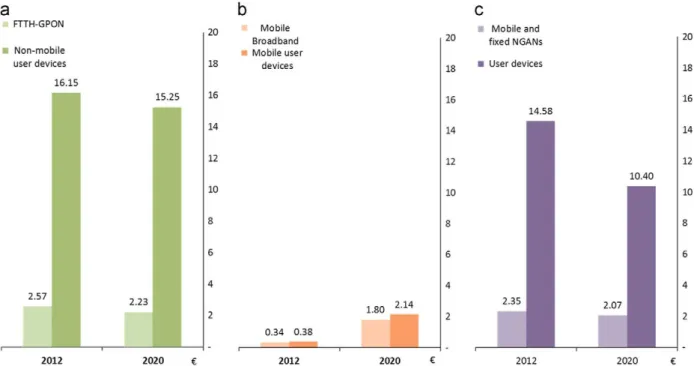
Fig. 10 compares the baseline results of the costs of energy consumption within the NGNs with those of user devices. When comparing network consumption and user devices, there are again important differences between fixed and mobile technologies. User devices typically attached to fixed broadband networks are projected to consume almost seven times more energy than the network itself in 2020. In the mobile broadband case, the network and device energy consumption levels and cost levels are projected to be closer, both at the start of the analysis period in 2012, when devices consumption cost is 11% higher, and in year 2020, when it is 18% higher. The total aggregated usage of fixed and mobile networks with respect to the breakdown of traffic between the two types of networks—Wi-Fi offloading considered—is depicted in Fig. 9c. While the cost of energy consumed by NGNs was 5.17 times lower than that consumed by user devices in 2012, this ratio is projected to decrease slightly, to 4.95, by 2020, indicating in both cases the predominance of energy consumption (and cost) associated with user devices. It is also worth noting that while routers are responsible for about 10% of fixed user device consumption, this proportion increases to 70% in the case of mobile user devices via traffic off-loading.
Non-mobile user devices
Millions of €
Mobile Broadband
Mobile user devices
Mobile and fixed NGANs
2020 Millions of 2012 C
2020 Millions o f
Fig. 10. Cost of energy consumption (M€) in 2012 and 2020 in (a) FTTH-GPON vs. non-mobile devices (b) mobile broadband vs. mobile devices and (c) fixed
and mobile NGNs vs. user devices.
FTTH-GPON Non-mobile user devices
16.15
15.25
20
18
14
12
10
2012 2020
Mobile Broadband Mobile user
devices
0.34 0.38
20
18
Mobile and fixed NGANs • User devices
16
14
12
10
14.58
Fig. 11. Cost of energy consumption per subscriber (€) in 2012 and 2020 in (a) FTTH-GPON vs. non
and (c) fixed and mobile NGNs vs. user devices.
2012 2020 €
mobile devices, (b) mobile broadband vs. mobile devices
The final part of this section presents the results of a simple analysis of the changes in energy consumption and cost due to different modifications of the baseline assumptions, creating alternative scenarios. The comparisons are presented in Table 11 for the total energy consumption costs over the full 2012-2020 period.
The analysis shows that for each 1% annual increase in energy prices, the overall cost of the energy consumed increases by approximately 5% compared to the baseline. In terms of operating expenses, each 1% annual increase in energy costs increases the weight of energy consumption in the overall operating expenses of fixed networks by 0.2% and by 0.4% in the case of mobile networks, as the latter are more sensitive to energy consumption.
Table 11
Variations from the baseline for total energy consumption costs for 2012-2020 in access networks for alternative assumptions.
Alternative assumption Variation of energy
cost from baseline (%)
FTTH-GPON
-10% - 5 % 0% (Baseline) 5% 11% 0% (Baseline) 4% 0% (Baseline) 9% 23% 9% -11% 0.4% -0.0% _ --0.4% -1.4% -1.3% 0% (Baseline) -1.3% -LTE -10% - 5 % 0% (Baseline) 5% 11% 0% (Baseline) 40% 0% (Baseline) 11% 51% 12% -11% _ --17% -30% _ -_ -52% 17% 0% (Baseline) -10% -17% 17% 0% (Baseline) -11% -14%
Costs of energy
Deployment strategy
Device energy enhancements
Market penetration limit
Guaranteed data rates (Q_oS)
Access area footprint (in no. of subscribers)
improvements in GPON technology (from 2017 onwards)
BW allocated (from 2017 onwards)
Spectral efficiency (max.) (from 2017 onwards)
improvements in management systems of mobile communications
Remain constant Increase 1% annually Increase 2% annually
Increase 3% annually Increase 4% annually
From high to low density
From low to high density
According to guidelines
Half the goal of guidelines No enhancements at all
+ 10% -10%
Reaching 100 Mbps in fixed networks in 2017
Not reaching 100 Mbps in 2020 (staying at 50 Mbps in fixed networks from 2016 onwards)
Staying at 3 Mbps in mobile networks from 2015 onwards Staying at 2 Mbps in mobile networks from 2013 onwards
+200% + 100% + 50%
10 Gb/s fibre feeders
40 Gb/s fibre feeders
No additional spectrum 10 MHz additional spectrum 20 MHz additional spectrum
30 MHz additional spectrum 40 MHz additional spectrum
15 b/s/Hz 20 b/s/Hz
Switching off 1 in 4 base stations by night Switching off 1 in 3 base stations by night
strategies over the full analysis period would be 40%. This difference shows that, while in both strategies the deployment is near completion at the end of the period, the profile of energy expenditure is very different as it progresses towards the final stage.
Improvements in the energy efficiency of network devices is another area of particular interest. Not achieving the goals set in the guidelines (and their extrapolation for the baseline) would increase the costs of energy consumption by 23% for fixed NGNs and by 51% for mobile ones, demonstrating again the greater sensitivity of the latter to energy consumption. Even if the guidelines are only partially met and it takes twice as long to reach the goals originally specified, energy efficiency improvements still yield considerable advantages, as the costs would only increase 9% for FTTH-GPON and 11% for mobile broadband.
The effect of variations on the penetration in the market in 2020 is almost proportional to the 10% margin for both technologies.