BRAIN COMPUTER INTERFACE.
Application of an adaptive bi-stage classifier based on RBF-HMM.
Jos´e Luis Mart´ınez P´erez, Antonio Barrientos Cruz
Grupo de Rob´otica y Cibern´etica, Universidad Polit´ecnica de Madrid, C/Jos´e Gutierrez Abascal 2, Madrid, Espa˜na [email protected], [email protected]
Keywords: Electroencephalography. Brain Computer Interface. Linear Discriminant Analysis. Spectral Analysis. Biomedical signal detection. Pattern recognition.
Abstract: Brain Computer Interface is an emerging technology that allows new output paths to communicate the user’s intentions without the use of normal output paths, such as muscles or nerves. In order to obtain their objective, BCI devices make use of classifiers which translate inputs from the user’s brain signals into commands for external devices. This paper describes an adaptive bi-stage classifier. The first stage is based on Radial Basis Function neural networks, which provides sequences of pre-assignations to the second stage, that it is based on three different Hidden Markov Models, each one trained with pre-assignation sequences from the cognitive activities between classifying. The segment of EEG signal is assigned to the HMM with the highest probability of generating the pre-assignation sequence.
The algorithm is tested with real samples of electroencephalografic signal, from five healthy volunteers using the cross-validation method. The results allow to conclude that it is possible to implement this algorithm in an on-line BCI device. The results also shown the huge dependency of the percentage of the correct classification from the user and the setup parameters of the classifier.
1
Introduction.
Since that Dr. Hans Berger discovered the elec-trical nature of the brain, it has been considered the possibility to communicate persons with external de-vices only through the use of the brain waves (Vidal, 1973).
Brain Computer Interface technology (Wolpaw, J.R.; et al., 2000) is aimed at communicating with persons using external computerized devices via the electroencephalographic signal as the primary com-mand source (Birbaumer, N; et al., 2000); in the first international meeting for BCI technology it was esta-blished that BCI“must not depend on the brain’s nor-mal output pathways of peripheral nerves and mus-cles”(Wolpaw, J. R.; et al., 2002). The primary uses of this technology are to benefit persons with block-ing diseases, such as: Amiotrophic Lateral Sclerosis (ALS), brainstem stroke, or cerebral palsy; or persons whom have suffered some kind of traumatic accident like for example paraplegic (E. Donchin and K. M. Spencer and R. Wijesinghe, 2000). In order to control an external device using thoughts, it is necessary to associate some mental patterns to device commands. Therefore, an algorithm that detects, acquires, filters,
and classifies the electroencephalographic signal is required (Kostov, A.; Polak, M., 2000) (Pfurtscheller et al., 2000b). Actually different types of classifica-tions can be established for BCI technology, from the physiologic point of view BCI devices can be clas-sified in exogenous and endogenous. The devices in the first group provide some kind of stimuli to the user and they analyze the user’s responds to them, exam-ples of this class are devices based on visual evoked potential or P300 (E. Donchin and K. M. Spencer and R. Wijesinghe, 2000). On the contrary, the endoge-nous devices does not depend on the user’s respond to external stimuli, they base their operation in the detec-tion and recognidetec-tion of brain-wave patterns controlled autonomously by the user, examples of this class are devices based on the desynchronization and synchro-nization of µandβ rhythms (Wolpaw, J. R.; et al., 2002), (Pfurtscheller et al., 2000a), (Pineda, J.A. et al., 2003).
Figure 1: Block diagram of a BCI device.
stage is computed the generation probability of the in-put sequence by three different Hidden Markov Mod-els, each one had been previously trained with data sequences from the different cognitive activities be-tween classifying.
The content of this paper is as follows:
• Section 2 describes the experimental procedure, the cognitive activities or mental tasks, and the equipment to develop the experiment.
• Section 3 presents the proposed two-stage classi-fier and describes the algorithms employed in it for training and operation.
• Section 4 presents the results obtained from each volunteer.
• Section 5 analyzes the previous results.
• And finally section 6 is devoted to making conclu-sions.
2
Experimental procedure.
The tests described below were carried out on five healthy male subjects, one of whom had been trained before but the other four of whom were novices in the use of the system.
In order to facilitate the mental concentration ne-cessary for the proposed activities, the experiments
were carried out in a room with a low noise level and under controlled environmental conditions. For instance, all electronic equipment external to the ex-periment and unrelated to the subject were switched off in order to avoid electromagnetic artifacts. The experiments were carry out between 10:00 a.m. and 14:00 p.m. The subjects were directed to sit down 50 cm from the screen of the acquisition system monitor, and with their hands in a visible position. The super-visor of the experiment ensured the correct enactment of this process.
2.1 Flow of activities in the
experimental process.
The experimental process is shown in Figure 2.
Figure 2: Diagram of the experiment carried out.
System devices test. The correct battery level and correct state of the electrodes were checked.
System assembly. Device connections: superfi-cial electrodes (Grass Au-Cu), battery, bio-amplifier (g.BSamp by g.tec), acquisition signal card (PCI-MIO-16/E-4 by National Instrument), computer.
System test. The correct operation of the whole system was verified. To minimize noise from the electrical network the Notch filter (50Hz) of the bio-amplifier was switched on.
Subject preparation for the experiment.
Electrodes were applied to the subject’s head. Electrode impedance≤4KOhms.
Experiment setup. The experiment supervisor set up the number of replicationsNrep=10, and the
quan-tity of different mental activities. The duration of each trial wast =7s, and the acquisition frequency was
fs =384Hz. The system suggested that the subject
think about the proposed mental activity. A short re-laxation period was allowed at the end of each trial; between replications the relax time ist=7s.
2.2 Electrode Position.
Electrodes were placed in the central zone of the skull, next to C3 and C4 (Penny, W. D.; et al., 2000), and two pairs of electrodes were placed in front of and behind the Rolandic sulcus. This zone has the highest discriminatory power and receives signals from mo-tor and sensory areas of the brain (Birbaumer, N; et al., 2000) (Neuper, C.; et al., 2001). A reference elec-trode was placed on the right mastoid and two more electrodes were placed near the corners of the eyes to register blinking.
Figure 3: Electrode placement.
2.3 Description of Cognitive Activities.
The experiment supervisor asked the subject to figure out the following mental activities; tasks that were used to differentiate between cerebral patterns (Ne-uper, C.; et al., 2001):
Activity A. Mathematical task.Recursive subtraction of a prime number, i.e. 7, from a large quantity, i.e. 3.000.000.
Activity B. Movement task. The subject imagines moving their limbs or hands, but without actually do-ing so. It is movement imagery.
Activity C. Relax.The subject relaxes.
3
Description of the classifier.
3.1 Introduction.
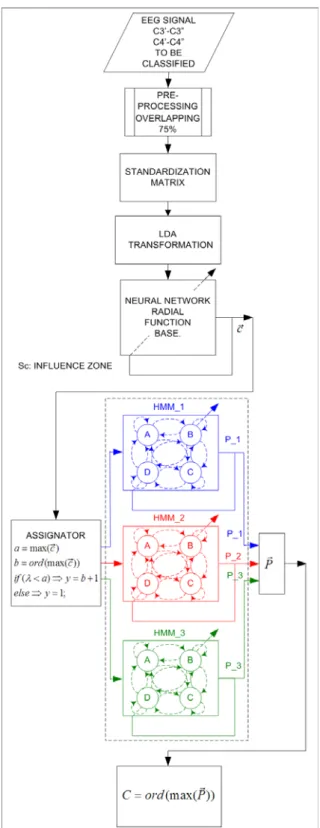
In Figure 4 is shown the block diagram of the algo-rithm for the proposed classifier.
In it can be appreciated how the classification of the considered segment of the EEG signal is obtained after the evaluation of the probability generation of the pre-assignation sequence provided by three Hid-den Markov Models.
There are as many Hidden Markov Models as cog-nitive activities to be considered for the classification, each model is trained with pre-assignation sequences of data of the cognitive activity associated to it.
Figure 4: Block diagram of the classifier.
3.2 Preprocessing.
On Figure 5 is depicted the operations associated to the preprocessing phase.
Figure 5: Block diagram for the preprocessing phase.
In a first step the EEG signal coming from both electroencephalographic channels C3’-C3” and C4’-C4” are sampled and quantified atfs=384Hz.
In the next step the samples are bundled in pack-age of Nw=128 samples, it is equivalent to Tw =
1/3s. Each group of samples is normalized, in order to obtain homogenous groups of transformed samples with zero mean value and unity as standard deviation.
x"i=xi−µ
σ (1)
This transformation does not affect the frequency properties of the signal, but allows the comparison of groups of samples in the same session or between ses-sions, it avoids that changes in the impedance of the electrodes or skin conductivity affect the next proce-dures.
After this the samples are processed by a pass band Butterworth filter of order n=6, with lower and higher frequencies of f1=4Hzand f2=40Hz
(Proakis and Manolakis, 1997); frequencies outside this band are not common in sane conscious users.
In the next step the filtered samples are convoluted with a Tukey’s window of lengthN=128, this ate-nuates the leakage effect associated to the package procedure, see Figure 6. Previous studies allow to conclude that the convolution of the signal with this kind of window increase the discrimination capabil-ity that the one obtained with other kind of windows as for example: rectangular, triangular, Blackman’s, Hamming’s, Hanning’s or Kaiser’s (Martinez, J.L.; Barrientos, A., 2006).
Figure 6: Frequency leakage effect.
After the convolution, the Fast Fourier Transform, eq.2, is applied in order to obtain the spectral power estimation, eq.3; the obtained frequency resolution is in eq.4.
X(k) =
N
∑
j=1x(j)wN(j−1)(k−1); wN=e−
2πi N (2)
P(k) =X(k) 2
N (3)
∆f = fs Nw
=384
128=3Hz (4)
Table 1: Feature vector.
Index Denomination. Frequency (Hz).
1 θ. 6 - 8
2 α1. 9 - 11
3 α2. 12 - 14
4 β1. 15 - 20
5 β2. 21 - 29
6 β3. 30 - 38
phase, it instructs the classifier to discard that group of samples.
A group of samples is considered with artifacts if one sample differs more than three standard de-viations from the previous one.
3.3 Training of the neural network.
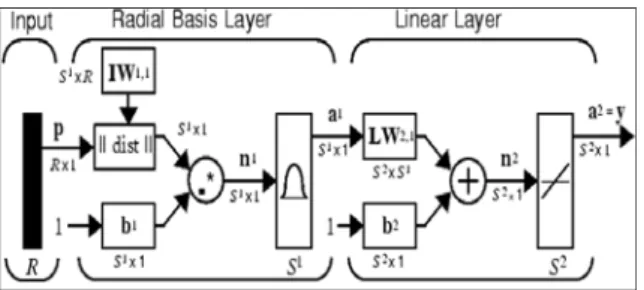
The considered neural network is the type of Radial Function Basis. This type of neural network is charac-terized by the learning of the position of the samples in the training set and by the interpolation capability between them (Ripley, 2000).
In Figure 7 is represented the architecture of this type of neural network.
Figure 7: Architecture of the RBF neural network.
From previous studies it has been concluded that this type of neural network behaves better than other types of neural networks, as for example Multi-Layer Perceptrons or Probabilistic Neural Networks (Mar-tinez, J.L.; Barrientos, A., 2008).
The activation function is:
radbas(x) =e−x2; x= (!w−!p)∗Sc (5)
In where!wandScare respectively the weights and
influence zone constant of each neuron, and!pis the position of the considered sample.
During the learning phase the neurons of the hid-den layer learn the position of the samples of the learning set,!w; during the test phase when a new sam-ple!pis presented, it is computed the distance between the sample and the learned positions, the nearest neu-rons to the sample will proportionate higher activation values than the rest of the neurons.
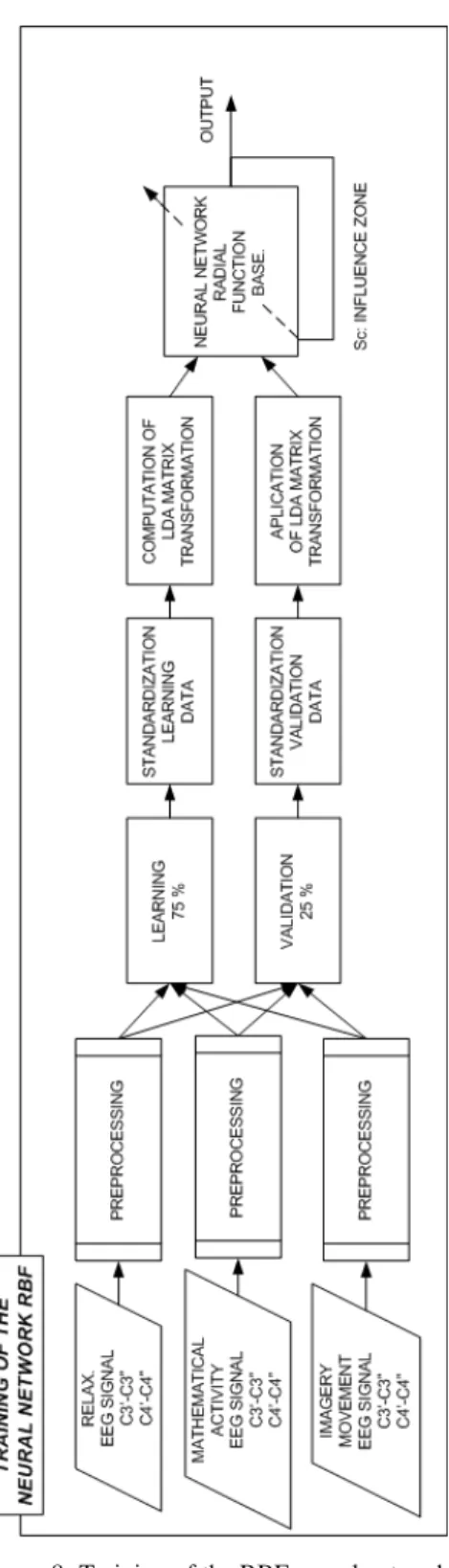
For the learning process are considered vectors of features from the EEG signal, acquired when the user
was performing one of the different cognitive activi-ties considered for the classification. The learning set is composed by the 75% of all the sample set, and the other 25% is considered for validation. After the de-termination of the learning and validation sets, the in-put vectors to the neural network are normalized, and with LDA technique is reduced their dimensionality projecting the original input vectors in the direction of the highest discrimination capability (Martinez, J.L.; Barrientos, A., 2007).
In order to minimize the over-learning effect, the RBF learning process allows a dynamic growth of the number of neurons in the hidden layer. In the out-put layer are considered as many linear neurons as cognitive activities between discriminate. Finally in the assignation block on Figures 4, it is weighted the output vector of the neural network and it assigns the input vector to the activity with highest output value provided it is higher than a thresholdλ, on the con-trary if the value is lower thanλ, the input vector is labeled as unclassified.
On operation, once the neuronal network has been trained, when a new vector is presented the cogni-tive activity, with samples nearer to it, will provide a higher activation level, and the corresponding out-put will have a higher value than the others cognitive activities.
3.4 Description of Hidden Markov
Models.
A Hidden Markov Model is a double stochastic sta-tistical model, it consists of a Markov process with unknown and non-observable parameters, and a ob-served model which parameters depend stochastically from the hidden states. A stochastic process is called a Markovian process if the future does not depend from the past, only from the known present; considering the stochastic variableq(t−1)the transition probability in the instanttis defined asP(qt=σt|qt−1=σt−1). A
Markov chain is formally defined with the pair(Q,A), whereQ={1,2, ...,N}are the possible estates of the chain and A= [ai j] is the transition matrix of the model, with the constrains:
0≤ai j≤1; 1≤i,j≤N (6) N
∑
j=1ai j=1; 1≤i≤N (7)
The transition and emission probabilities depends from the actual estate and no from the former estates.
P(qt= j|qt−1=i,qt−2=k, ...) = (8)
Figure 8: Training of the RBF neural network.
Formally a discrete HMM of first grade is defined by the 5-tuple:λ={Z,Q,A,B,π}, in where:
• Z={V1,V2, ...,VM}is the alphabet or discrete set
ofMsymbols.
• Q={1,2, ...,N}is the set of N finite estates.
• A= [ai j]is the transition matrix of the model.
• B= (bj(Qt))NxM is the matrix of emission
sym-bols, also known as observation matrix.
• π= (π1,π2, ...,πN)is the prior probability vector
of the initial estate.
The parameters of a HMM are λ ={A,B,π}. There are three types of canonic problems associated to HMM (Rabiner, 1989)(Rabiner and Juang, 1986):
1. Given the parameters of the model, obtain the probability of a particular output sequence. This problem is solved through a forward-backwards algorithm.
2. Given the parameters of the model, find the most probable sequence of hidden estates, that could generate the given output sequence. This problem is solved through the use of Viterbi algorithm. 3. Given an output sequence, find the parameters of
the HMM. This problem is solved through the use of Baum-Welch algorithm.
The HMM have been applied specially in speech recognition an generally in the recognition of tempo-ral sequences, hand written, gestures, and bioinfor-matics (Rabiner and Juang, 1986).
3.5 Training of the Hidden Markov
Models.
The HMM’s are trained with sequences of pre-assignations coming from the EEG samples, as it is shown in the Figure 9.
For each cognitive activity a particular HMM, with the following characteristics, is trained:
• Number of hidden estates: 4.
• Number of different observable objects: 4 In the training phase, chains of nine pre-assignations were used. In a previous experiment with synthetic samples, it was concluded that for the proposed architecture of Hidden Markov Models the highest percentage of correct classifications were ob-tained with chains of nine elements.
After the training or solution of the third canonic problem, the probability matrices of state transitions and observation matrices are determined. The Viterbi algorithm is used in order to determine the probability that a model generates the proposed sequence.
4
Results.
Figure 9: Training of the HMM.
4.1 Evaluation of the learning
capability.
With a subset of 75% of the all EEG samples the al-gorithm was trained with differentλ andSc values:
λ= 0.55 0.65 0.8
Sc= 0.5 0.95
These values have been fixed after a seek in wide with the samples of the first volunteer.
After the learning, the same samples were pro-cessed with the trained algorithm, and a comparison between the results obtained with the algorithm and the ones employed for the learning was done, in all cases a 100% of correct classification has been ob-tained.
4.2 Evaluation of the generalization
capability.
After the good results obtained from the learning phase, a cross-validation methodology is used to es-timate the generalization capability. From the whole ten sessions, nine are used for learning and one is used for validation, the process is repeated ten times chang-ing each time the session used for validation.
In the following tables are shown the results ob-tained for each volunteer, considering theλ andSc
parameters.
For each combination, the process is replicated three times. In the upper row it is shown the num-ber of correct classifications. In the lower row it is shown the percentage of improvement against a naive classifier.
Sc=0.5 Sc=0.95 Sc=0.5 Sc=0.95
λ=0.65 λ=0.55 λ=0.55 λ=0.80
94 103 103 94 81 87 93 92 87 86 97 81 +4 +14 +14 +4 -10 -3 +3 +2 -3 -4 +8 -10
Table 2: Volunteer: Al01.
Sc=0.5 Sc=0.95 Sc=0.5 Sc=0.95
λ=0.65 λ=0.55 λ=0.55 λ=0.80
103 97 92 118 109 118 97 87 86 117 106 110 +14 +8 +2 +31 +21 +31 +8 -3 -4 +30 +18 +22
Table 3: Volunteer: Ro01.
Sc=0.5 Sc=0.95 Sc=0.5 Sc=0.95
λ=0.65 λ=0.55 λ=0.55 λ=0.80
106 97 110 87 90 107 99 106 107 98 108 99 +18 +8 +22 -3 0 +19 +10 +18 +19 +9 +20 +10
Table 4: Volunteer: Ja01.
Sc=0.5 Sc=0.95 Sc=0.5 Sc=0.95
λ=0.65 λ=0.55 λ=0.55 λ=0.80
109 102 104 83 92 92 106 91 110 86 87 92 +21 +13 +15 -8 +2 +2 +18 +1 +22 -4 -3 +2
Table 5: Volunteer: Da01.
Sc=0.5 Sc=0.95 Sc=0.5 Sc=0.95
λ=0.65 λ=0.55 λ=0.55 λ=0.80
106 97 110 87 90 107 99 106 107 91 76 99 +18 +8 +22 -3 0 +19 +10 +18 +19 +1 -15 +10
Table 6: Volunteer: Ra01.
Sc=0.5 Sc=0.95 Sc=0.5 Sc=0.95
λ=0.65 λ=0.55 λ=0.55 λ=0.80
102 102 98 102 107 114 103 105 96 116 99 98 +13 +13 +9 +13 +19 +26 +14 +16 +6 +29 +10 +9
Table 7: Volunteer: Ra02.
5
Discussion.
From the results of the proposed classification al-gorithm, it is observed that:
• From the analysis of the results of the replicas it has been detected that the variability in the percentage of correct classifications is caused by the HMM’s, both in the learning and validation phases. The sequences of pre-assignations pro-vided by the neural network were stable, but the generation probabilities of the HMM’s changed in each replica. In the learning phase the HMM’s probabilities allowed a perfect classification, but they were not maintained in the cross validation phase; for this stage a lower percentage of correct classification was obtained, as it is summarized in the tables 2 to 7. But until in this case, almost in all replicas, the cross-validation test results were better than the ones hoped from a naive classifier.
• The values of correct classifications depend highly from the user. There has not been identi-fied a pair ofλandScvalues which proportionate
the highest percentage of correct classification for all users. The discrepancy in the results between RA1 and RA2 is explained by the user’s learning process, session RA1 is previous to RA2.
6
Conclusions.
The information inside the pre-assignation se-quences improves the classification capability, there-fore the Hidden Markov Model technique is useful for the extraction and use of this information in an On-line BCI device.
The scattering of the maximum values, of the cor-rect classifications obtained from the cross-validation tests, shows that the combination ofλandSc
param-eters are highly dependent on the user, for this reason a BCI device based in this kind of algorithm should have a setup stage, that allows to initialize correctly these parameters.
On the other hand, the algorithm behaves better than a naive algorithm, but it is not as good as it should be taking into account the good results ob-tained during the learning phase. The size of the learning data set is critical in the results obtained dur-ing the validation phase. With a bigger learndur-ing data set the validation results will improve, because of the minimization of the overlearning.
In future applications the algorithm presented in this paper will be used as kernel for an on-line classi-fier embedded in a BCI device. The on-line use of this device will allow to assess how the different kinds of user’s feedbacks modify the classification capability.
REFERENCES
Birbaumer, N; et al. (2000). The thought translation de-vice (TTD) for completely paralyzed patients. IEEE TRANS. ON REH. ENG., 8(2):190–193.
E. Donchin and K. M. Spencer and R. Wijesinghe (2000). The mental prosthesis: assessing the speed of a p300-based brain-computer interface. IEEE Transactions on Rehabilitation Engineering, 8(2):174–179. Kostov, A.; Polak, M. (2000). Parallel man-machine
training in development of EEG-based cursor control.
IEEE TRANS. ON REH. ENG., 8(2):203–205. Martinez, J.L.; Barrientos, A. (2006). The windowing
Ef-fect in Cerebral Pattern Classification. An Application to BCI Technology. IASTED Biomedical Engineering BioMED 2006, pages 1186–1191.
Martinez, J.L.; Barrientos, A. (2007). Linear Discriminant Analysis on Brain Computer Interface.2007 IEEE. In-ternational Symposium on Intelligent Signal Process-ing. Conference Proceedings Book., pages 859–864. Martinez, J.L.; Barrientos, A. (2008). Brain computer
inter-face. comparison of neural networks classifiers. Pro-ceedings of the BIODEVICES International Confer-ence on Biomedical Electronics and Devices., 1(1):3– 10.
Neuper, C.; et al. (2001). Motor Imagery and Direct Brain-Computer Communication. Proceedings of the IEEE, 89(7):1123–1134.
Penny, W. D.; et al. (2000). EEG-based communication: A pattern recognition approach.IEEE TRANS. ON REH. ENG., 8(2):214–215.
Pfurtscheller et al. (2000a). Brain oscillations control hand orthosis in a tetraplegic. Neuroscience Letters, 1(292):211–214.
Pfurtscheller et al. (2000b). Current trends in Graz brain-computer interface (BCI) research.IEEE TRANS. ON REH. ENG., 8(2):216–219.
Pineda, J.A. et al. (2003). Learning to Control Brain Rhythms: Making a Brain-Computer Interface Pos-sible.IEEE TRANS. ON REH. ENG., 11(2):181–184. Proakis, J. G. and Manolakis, D. G. (1997). Tratamiento
digital de se˜nales : [principios, algoritmos y aplica-ciones]. Prentice-Hall, Madrid.
Rabiner, L. R. (1989). A tutorial on hidden markov models and selected applications in speech recognition. Rabiner, L. R. and Juang, B. H. (1986). An introduction to
hidden markov models.
Ripley, B. (2000). Pattern Recognition and Neural Net-works. Cambridge University Press, London, 2nd edi-tion.
Vidal, J. J. (1973). Toward direct brain-computer commu-nication.
Wolpaw, J. R.; et al. (2002). Brain-Computer interface for communication and control. Clinical Neurophysiol-ogy, 113:767–791.
Wolpaw, J.R.; et al. (2000). Brain-Computer Interface Tech-nology: A Review of the First International Meeting.