Sustainability in Forest Management Revisited Using
Multi-Criteria Decision-Making Techniques
Marta Ezquerro 1,*r Marta Pardos 2 and Luis Diaz-Balteiro 1
1 Universidad Politecnica de Madrid, E.T.S. de Ingenieria de Montes, Forestal y del Medio Natural, Ciudad
Universitaria, 28040 Madrid, Spain
2 Department of Forest Dynamics and Management, INIA-CIFOR, Ctra. La Coruna Km 7.5, 28040 Madrid,
Spain
* Correspondence: [email protected]; Tel.: +34-913-365-563
Abstract: Since its origins, the idea of sustainability has always been linked to forest management. However, nowadays, sustainable forest management has usually been approached by defining a set of criteria and indicators. This paper aims to address sustainability in forest management including a set of criteria encompassing the most common decisions: whether the stands are even or uneven-aged, and the optimal silviculture that should be applied in each stand. For this purpose, a lexicographic goal programming model with two priority levels has been defined, into which six different criteria are integrated. Each criterion corresponds to a particular pillar (economic, technical, or environmental). Furthermore, also incorporated into the model are the preferences of diverse stakeholders, both for the criteria considered in the analysis and for the most suitable silvicultural alternatives to be applied in each stand. This methodology has been applied to a case study in Spain, and the results show much more attractive solutions than the current forest management planning, allowing the obtainment of multi-aged systems that could be favourable for other ecosystem services.
Keywords: goal programming; interactive methods; forest planning; Green-Tree Retention
1. Introduction
The concept of sustainability in a forestry perspective has a development history that dates over 300 years back in time [1], without the author himself having supplied any definition of this term [2]. In some respects, this idea at that time was the first conservation principle ever formulated [3]. In recent decades, it has spread in an exceptional manner to other areas [4]. To some authors, the sustainability concept is currently belonging to the field of social ethics [5]. Nowadays, it continues to be a forceful message with a wide representation in diverse disciplines [6]. In synthesis, von Carlowitz's premise promoted the concept of not exhausting resources in order to bequeath them to future generations, safeguarding finite natural resources for future generations [7].
On the basis of the literature consulted, it has been verified that the definition of sustainable forest management was usually of a static nature. That is to say, the studies in question contained only one measurement of the indicators, without taking into account their temporal evolution, in spite of this component being included in the definition of the word sustainability [16]. However, only in some studies has it been proposed to measure a set of criteria over the entire planning horizon covering forest management in a certain case study [17-19]. Given the extensive length of rotations in many forest systems, it is necessary to have a set of indicators available whose values are known in each period or, at least, are quantifiable at the end of the planning horizon.
Given the multidimensional nature intrinsic to the concept of sustainability, and as has been mentioned previously, the need to apply multifunctional management requires the use of Multi-Criteria Decision-Making (MCDM) techniques. These methodologies have been widely employed to solve typical forest management problems [20-22]. Moreover, multicriteria methods have been applied prolifically to tackle aspects related to sustainability [23-26], even dealing with aggregation problems and dynamic sustainability indicators [27]. These methodologies are also recommendable for integrating different ecosystem services into the decision-making process [28-30]. Finally, it is fitting to insist that these methods permit the solution of the emergent problem of how to aggregate the indicators on which the idea of sustainability is based [31].
Bearing in mind that sustainability is difficult to define in precise terms [32,33], the main objective of this study is to present a flexible model, based on multicriteria techniques. These kinds of models permit the redefinition of sustainability in a forest system, not at one specific moment, but through the evolution of the indicators considered throughout the planning horizon. This new view of sustainability should address the multifunctionality of forest systems, which implies defining a diverse set of criteria and indicators, choosing the best silvicultural alternative for each stand, and enabling the stakeholders involved to have their opinion integrated into it. It should be emphasized that some authors have affirmed that the rigidity of the concept of a normal forest does not ensure the idea of sustainability in force today [34], which would justify using the approach proposed here in order to adapt this notion to the present-day context. Finally, in the following Sections, we will introduce terms like "criterion", "objective", "indicator" and "index". In order to avoid misinterpretations, and following [35], under an MCDM umbrella, criteria are the objectives or goals to be considered relevant for a certain decision-making situation. However, if applicable, we have considered a hierarchy between criteria and indicators. Indicators are parameters or sub-criteria which can be measured, and which correspond to a particular criterion. Besides, some sustainability measurements can be defined as a synthetic, aggregate, or composite index, and the value achieved by this index is a proxy of the respective sustainability goodness.
2. Theoretical Background
2.1. Framework
The stages of the model proposed are condensed in Figure 1 A. The first step involves defining both the sustainability indicators selected for the planning horizon chosen, and the different silvicultural alternatives put forward. Applying both the indicators and the silvicultural alternatives to the case study, precise information is made available for the formulation of a strategic forest planning model. If each criterion considered is optimized separately, the pay-off matrix can be set up and the degree of conflict between the different criteria verified [35]. If no solution is supplied by the pay-off matrix, coming from the optimization of a single criterion is acceptable. The following step is to construct an MCDM model, integrating the opinions of the stakeholders (DMs) on some aspects. In that way, compromise solutions that could be accepted by the decision-maker will be obtained.
that can solve continuous-type problems will be apt. This circumstance implies that those techniques that aim to choose the best solution out of a finite set of alternatives would not be valid for this case. From the MCDM techniques that fulfil the above condition, goal programming has been selected. This methodology adds flexibility to forest management models [37], and it has been used quite frequently to tackle this type of problem [31]. The basics of goal programming can be seen in [38-40].
Among the variants of this technique typically employed [39], we chose Lexicographic Goal Programming (LGP), also known as Non-Archimedean or pre-emptive goal programming [41]. The selection of this technique is justified because it allows the decision-making centre to show an order of preference for each of the goals defined. In addition, the idea of defining sustainability by means of a conceptual hierarchy [42] fits the LGP notion perfectly. This hierarchy manifests itself in the definition of different levels of priority to which each goal is attached. This means that the preferences are initially assigned to each goal following an established order, and that the achievement of a goal situated at a certain level of priority is infinitely preferred to the fulfilment of one located at a lower priority level. In short, this type of modelling implies accepting that there are no finite trade-offs among the goals placed at one priority level with respect to goals placed at lower ones [35]. Consequently, the results obtained for the goals situated at lower priority levels cannot worsen those of the goals at higher priority levels [43]. The mathematical formulation can be seen in Appendix B. Once the goals are defined [44], the variant of the weighted goal programmed is selected to solve the problem at each priority level [45], this being the most common option when electing this goal programming variant [46].
With the methodology shown in Appendix B, a model is obtained which permits the evaluation of the different criteria or indicators considered for defining sustainability over the defined time period, in the context of strategic forest planning [9]. The preferences introduced into the model will only take into account the opinion of the stakeholders and exclude intergenerational justice components from the analysis [47]. In addition, only criteria for which values can be obtained throughout the entire planning horizon are considered [31]. That is to say, if the evolution over time of a certain criterion cannot be modelled, it is not included in the analysis. Further, it is assumed that the silvicultural alternatives that can be applied in each of the stands are known with certainty. The model proposed is totally deterministic, and the introduction of elements of risk and/or uncertainty is not considered [48-50]. Finally, although, in previous work, diverse climate change scenarios have been analyzed in the same case study [51,52], the latter will not be included in this work, although the results for some ecosystem services like carbon sequestration could be altered according to the different scenarios contemplated [53].
The next step is to design a strategic forest planning model (see Appendix B). In order to assess the degree of conflict between the criteria considered, a pay-off matrix was developed starting from the results of the strategic forest planning model. This is a usual step in the application of multicriteria techniques in forest management problems [54,55]. The pay-off matrix is a square matrix, whose dimension coincides with the number of objectives considered. This matrix is obtained by optimizing the six objectives separately and computing the values of the criteria for each of the corresponding optimal solutions, thus having a dimension equal to the number of objectives that exist [35]. The main diagonal includes the optimum values that each objective can reach, known as the ideal point. By definition, this vector in the objective space is infeasible, but plays a decisive role as a point of reference [56]. Other cells of the matrix contain the anti-ideal (nadir) points, which would be the worst results obtained for each of the objectives. Concerning the criteria considered, it is appropriate to clarify that VOL, NPV, IM and C are criteria belonging to the type "the more, the better", while NF and G are criteria belonging to the type "the less, the better", following the term used in [35].
2.2. Theory Review
based on a few basic principles in accordance with the type of forest management practiced at the time, which was centered on the "normal forest" or "normality" concept [60], established at the end of the 18th century by German foresters [61]. In fact, it was characterized by being a mono-objective management, focused only on timber production, usually in regular stands, in which one or a few main species prevailed [62], and to which a silviculture with a fixed rotation was applied [63]. In addition, a single decision-maker made the corresponding decisions with the aim of perpetuating the idea of a fully-regulated forest [57,64]. Finally, as a result, and unlike what happens nowadays [65], restrictions to final harvest were very lenient.
The concept of sustainability has been modified and updated due, among other reasons, to the changes in the role played by forests in society [66,67]. Besides that, the demand for goods and services coming from forest systems has been continuously increasing [68], meaning that, today, forest management is much more polyhedral (or multi-faceted, according to [69]) than it was three centuries ago, and includes other ecosystem services not contemplated in the original idea of sustainability, such as in the case of biodiversity [70]. Indeed, some authors have recently gone beyond the theory of von Carlowitz and defined forests as a "multifunctional bioeconomic system" [71]. Thus, numerous authors maintain that the new paradigms associated with sustainability should promote multifunctionality in forest management [72]. At the same time, the idea of sustainability in forest management has been linked to that of resilience [73]. In this regard, although the expression "sustainable" has for many years been on a par with forest management [74], nowadays it has been assumed that the latter should achieve certain goals with respect to economic, social and environmental pillars and, also, balancing present and future demands [75]. Some authors even propose the concept of "ecologically sustainable forest management" to give prominence to a type of forest management that perpetuates ecosystem integrity [76].
The way forest management has evolved has required the reformulation of the original sustainability concept [1] into the idea of a "regulated forest" (the organization of a forest property to provide a sustained yield of timber products forms [57]), by integrating the abovementioned pillars, but taking into account that, on some occasions, the trade-offs between different criteria are not fully known [77]. That is w h y sustainability should not be defined by only focusing on the conception of its being concentrated on "sustained yield", one of the objectives most sought after in forest management [78], or on other similar concepts [47]. Namely, this idea should be generalized starting from a case in which not all the forest should be associated with the idea of even-aged stands into which different silvicultural alternatives are established [63]; other ecosystem services are integrated, as well as timber production; and the preferences of the different stakeholders in the decision-making process are included. In effect, a multi-aged structure in forest stands is associated with the idea of long-term sustainability [79], incorporating multiple uses into different stands even with variable rotations [32]. Lastly, the inclusion of different silvicultural alternatives in the analysis is basically justified for two reasons. First, because different forest management strategies promote biodiversity [80], and, second, because silviculture as a science has to respond to the demands of society and not only concentrate on timber production [81].
3. Materials and Methods
3.1. Case Study
The case study corresponds to Valsain forest, which is in the Central Mountain Range of Spain. The forest area covers about 7206 ha and mainly composed of pure Scots pine (Pinus sylvestris L.) stands, although there are other species less represented in the area such as Quercus pyrenaica L. and
Ilex aquifolium L. The first management plan was developed in 1889, and the main objective was timber
into a shelterwood group system [52]. Nowadays, other aspects such as biodiversity conservation are of great importance. Thus, there are several endangered species in the area, like the black vulture
(Aegypius monachus (Linnaeus, 1766)). The number of nests of this species is around 131, and harvest
limitations have been introduced in order to protect them. In short, around each nest, a restricted area without management of 3.14 ha has been established as a buffer protection. Finally, there are several protection features in this forest, such as the declaration of the Sierra de Guadarrama National Park in 2013, where commercial cuttings have been forbidden, and which affects 3326 ha.
3.2. Silvicultural Alternatives
In order to deal with this complexity, seven silvicultural strategies have been proposed to maintain the adaptability of forests to different conditions [81], and to provide different ecosystem services. The set of possible treatments considers the nature of the stands forming the case study, and all of them have been discussed and approved by the forest manager. A priori, the seven treatments (see Figure IB and Appendix A, Table Al) could be applied to every stand.
Sustainability in forest planning 1A
Define sustainability indicators
(valid along planning horizon) I,, I2,..-In
Proposed silvicultural alternatives (in each stand) Si, S2,....Sn
Strategic Forest Planning (100 years)
Pay-Off Matrix
MCDM Model
(Lexicographic Goal Programming
Model)
Solution
Interaction with DM's
Define sustainability criteria (valid along
the planning horizon) Proposed silvicultural alternatives (in each stand)
Ideal Management (ha)
Harvest volume
<mJ)
Represents the idea of a normal forest based on three indicators (final cuts similar in each period, final inventory, and regulation), that, suitably normalised, fulfil this aggregated a n d dimensionless criterion.
Represents the extent of the area on which the appropriate silviculture is applied in accordance with the objective sought in each management unit, following the preferences declared by the decision-maker.
Represents a measurement of inequality. The idea of including this index lies in promoting the existence of an uneven-aged stands trend as a conservation measure.
Difference between the estimated of gains a n d losses of carbon d u e to the growth of trees and the emissions p r o d u c e d after t h e final cuttings over the planning horizon.
Volume harvested under the different silvicultural treatments proposed over the
planning horizon.
Economic criterion derived from t h e timber cuttings
Silvicultural alternative* Business as usual 1 Business as usual 2
HE
Green Tree Retention 1 Green Tree Retention 2 Treatment for National
Park No Management
Acronym BAUl
BAU2
GS
GTR1
GTR2
TNP
NM
*more information in Appendix A (Table A l )
IB
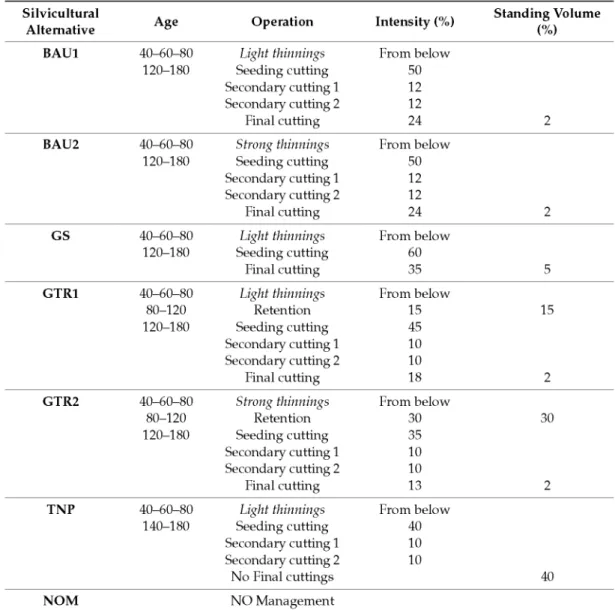
The first alternative is based on a shelterwood group system. The treatment spans 40 years, cutting every ten years, and it would be the "business as usual" alternative (BAU). After the final cut, 2% of the stand volume remains as dispersed trees for at least one rotation. In order to model this alternative, we have considered the schedule and cutting intensity traditionally used in Valsain forest [82]. BAU has been divided into two new alternatives: BAU1, embracing light thinning, and a more intensive option with strong thinning (BAU2). The third alternative, called Group selection (GS), consists of 2 cuttings with medium patch sizes of 1 hectare. After final cutting, 5% of the stand volume remains as residual trees.
Another two silvicultural alternatives are based on the idea of Green Tree Retention (GTR). Two GTR alternatives with different retention percentages are proposed, before applying BAU1 or BAU2. In short, either 15% of the volume is maintained in an aggregated way as mature forest patches (GTR1), or 30% of it (GTR2). These figures are similar to those proposed for this species in Spain [83]. These patches could simulate the protection buffers discussed above for the protection of the black vulture species.
For the area now included in the National Park, we have proposed an alternative (TNP) similar to BAU, but with a main difference: the final cut is excluded, due to prohibitions in all Spanish National Parks. Moreover, in this case, the rotation has been increased (up to 140 years) in relation to the other treatments, as a conservation measure [84]. Finally, a no management alternative (NOM) has been incorporated in order to facilitate the possibility of creating mature forest stands in the future, given that these stands are allowed to grow naturally, thus forming reserve areas.
3.3. Criteria Considered
As mentioned above, the criteria to be introduced should evaluate sustainability based on the multifunctionality intrinsic to forest systems. First, two technical criteria have been defined. The first of these corresponds to a synthetic index that encompasses the classic idea of a normal forest (NF). In short, this criterion embraces tree indicators: one associated with the notion of even-flow policy, another with the idea of regulation or regulated forest [57], and, finally, a third one related to a suitable ending forest inventory, which ensures the perpetuation of the forest. In order to aggregate the above indicators under the normal forest concept, the procedure used in [85] was followed. In addition, a criterion called Ideal Management (IM) has been introduced. It can be quantified by the amount of area (in hectares) to which the silviculture suitable for each stand, according to the criterion optimized in each case, is applied. Therefore, calculating this criterion consists of minimizing the deviations of the silviculture used, compared to that which would be preferred in terms of the characteristics of the stands and in accordance with the preferences reflected by a decision-maker.
On another side, two environmental criteria have been defined. The first one refers to the possibility that, at the end of the planning horizon, there is a multi-aged forest. To enable a comparison of the degree of irregularity between different prescriptions, the Gini index (G) was employed. The latter is frequently used to measure the degree of inequality in different variables, generally with economic data, although applications in many fields have been described [86]. It supplies values in the interval [0 1] and has been defined in such a way that values close to 0 imply the existence of multi-aged stands, whereas values close to 1 ensure an even-aged structure. The second environmental criterion considered was the carbon balance (C), defined as the difference between the estimated gains and losses of carbon due to the growth of trees and their removal (default method, following [87]) throughout the planning horizon. This criterion will be computed in physical units (tons of carbon).
is appropriate to clarify that VOL, NPV, IM and C are criteria belonging to the type "the more, the better", while NF and G are criteria belonging to the type "the less, the better", following the terms used in [35]. Figure IB shows the six criteria considered with their acronyms, meanings, and the units in which they are expressed.
3.4. Multi-Criteria Model
When analyzing the solutions shown in the Pay-off matrix, if no solution is preferable, it is necessary to look for a satisficing compromise solution, making the harvest scheduling more sustainable. As we have said before, the technique chosen was Lexicographic Goal Programming (LGP), the second most used GP variant in forest management applications [88].
The first issue to decide in this type of model is how to select the number of priority levels that one wants to establish. Starting from the premise that it should be a limited number and that there should not be as many priorities as the number of criteria [89], in this case, two priority levels have been fixed. In the first one, three goals most directly related to silvicultural aspects have been included, while in the second, NF, IM and G are considered. Namely, given that there are no finite trade-offs among goals placed at the two priority levels [88], it is assumed to be a priority to achieve the goals at the first level before optimizing the criteria situated at the second priority level [90]. The target for each goal was established at 70% with respect to the ideal value obtained in the pay-off matrix. This percentage has been employed in the literature [91], and its use avoids the drawback of not obtaining optimal alternatives if the targets are closer to ideal values [92]. Finally, the complete model can be found in Appendix B, and for its resolution the software LINGO 13.0 [93] has been used.
3.5. Interactive Process
In this study, we interacted with two decision-makers (DM1 and DM2). First, as mentioned above (Equations (A2) and (A3)), it was considered appropriate to introduce preferential weights for each of the six goals contemplated in the analysis. For this purpose, the interaction was with the forest manager (DM1), and his opinion was asked on the six criteria using a survey based on pairwise comparisons, with Saaty's verbal scale [94] (see Appendix A, Table A3). This way of obtaining the decision-maker's preferences is recommended for integrating them into GP models [95]. These pairwise comparisons are typically used in the forest context [96].
On another side, and with the aim of obtaining the IM criterion, the engineer in charge of carrying out the last forest management planning (DM2) was contacted. Taking into account the silvicultural alternatives considered (see Appendix A, Table Al) the objective was to establish the suitability of each one for being applied to each stand. For this purpose, the 288 stands in the forest have been grouped into seven categories generated as a combination of a series of factors: production, protection, National Park, districts with nests or the presence of mixed stands. Once the categories were defined, in a first contact with DM2, we selected a set of 2-3 preferred alternatives for each stand. Later, after a second interaction with the same expert, some weights were obtained to weight the different silvicultural alternatives for their suitability, attending to the characteristics and nature of the stand in which they were found (see Appendix A, Table A2). To obtain the weights assigned to each silvicultural alternative in each stand, the same procedure as that employed with DM1 was used (see Appendix A, Table A3).
4. Results
occupied when each criterion is optimized by each of the silvicultural treatments described, as well as the average rotation.
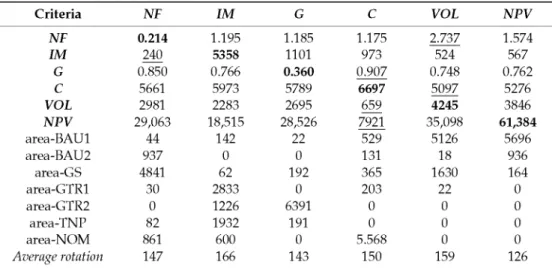
Table 1. Pay-off m a t r i x (ideal v a l u e s in b o l d ; anti-ideal v a l u e s u n d e r l i n e d ) .
Criteria NF IM G C VOL NPV area-BAUl area-BAU2 area-GS area-GTRl area-GTR2 area-TNP area-NOM Average rotation NF 0.214 240 0.850 5661 2981 29,063 44 937 4841 30 0 82 861 147 IM 1.195 5358 0.766 5973 2283 18,515 142 0 62 2833 1226 1932 600 166 G 1.185 1101 0.360 5789 2695 28,526 22 0 192 0 6391 191 0 143 C 1.175 973 0.907 6697 659 7921 529 131 365 203 0 0 5.568 150 VOL 2.737 524 0.748 5097 4245 35,098 5126 18 1630 22 0 0 0 159 NPV 1.57 A 567 0.762 5276 3846 61,384 5696 936 164 0 0 0 0 126
NF: Normal Forest structure, IM: Ideal management (ha), G: Gini index, C: Carbon balance (103 tC), VOL: Harvest
volume (103 m3), NPV: Net Present Value (103 €). area-BAUl: area under BAU1 treatment (ha), area-BAU2: Area
under BAU2 treatment (ha), area-GS: Area under GS treatment (ha), area-GTRl: Area under GTR1 treatment (ha), area-GTR2: Area under GTR2 treatment (ha), area-TNP: Area under TNP treatment (ha), area-NOM: Area under NOM treatment (ha). Average rotation (years).
The results given in this table show the ideal and anti-ideal values reached by the criteria, according to the optimized criterion (per columns). First, it can be seen that some objectives do not reach ideal values (NF, IM, G). Then, the level of conflict existing between the different criteria, mainly between
NF and IM, and between C and G, can be observed, as well as the fact that the results are fairly similar
in relation to carbon balance, because the percentage for this criterion varies the least compared to the rest. In synthesis, it can be noted that there is no solution corresponding to the optimization of a single criteria that appears to be sufficiently attractive. In short, the results of this pay-off matrix justify the setting up of an MCDM model in order to achieve solutions that are more balanced from the point of view of sustainability.
However, before revealing the results of those models, the result of the first interaction with DM1 to obtain the preferential weights associated with the criteria is shown (Table 2). Note that the sum of the weights for each priority level is equal to 1. Finally, Appendix A (Table A2) contains the weights obtained throughout the second interactive process with DM2 for the seven categories, in which the stands and the silvicultural alternatives associated with them have been grouped.
Table 2. Preferential weights associated with the criteria after DM1 interaction.
Criteria NF IM G C VOL NPV Priority 1 2
Level Preferential Weights
0.078 0.435 0.487 0.467 0.067 0.467
NF: Normal Forest structure, IM: Ideal management (ha), G: Gini index, C: Carbon balance (tC), VOL: Harvest
volume (m3), NPV: Net Present Value (€).
solution (Ui), whereas the values of the three criteria included in U2 improve in comparison with those obtained in U\. Further, to facilitate comparisons, the same auxiliary rows have been included. In general, it can also be seen that the areas assigned to each silvicultural alternative are notably modified when moving from U\ to IZ2.
Table 3. Results obtained in the resolution of m o d e l LGP ( i n b o l d t h e results for the six goals considered).
Criteria
NF IM G C VOL NPV
area-BAUl area-BAU2 area-GS area-GTRl area-GTR2 area-TNP area-NOM
Average rotation
Ui 0.56 3750 0.67 5599 2735 27,294
384 150 1148 1776 758 2100
480
150
U2
0.56 3750 0.67 5605 3120 42,969
1667 547
52 2332
789 924 484
136
NF: Normal Forest structure, IM: Ideal management (ha), G: Gini index, C: Carbon balance (103 tC), VOL: Harvest volume (103 m3), NPV: Net Present Value (103 €). area-BAUl: area under BAU1 treatment (ha), area-BAU2: Area under BAU2 treatment (ha), area-GS: Area under GS treatment (ha), area-GTRl: Area under GTR1 treatment (ha), area-GTR2: Area under GTR2 treatment (ha), area-TNP: Area under TNP treatment (ha), area-NOM: Area under NOM treatment (ha). Average rotation (years).
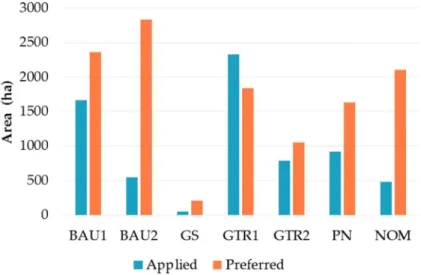
In the auxiliary rows in Table 3, the area selected by the model for each silvicultural alternative is indicated. Also, this solution of the LGP model can be compared with the value proposed by the DM2 (the area pointed out as being the one preferred for applying each silviculture), information which is available on Appendix A (Table A2). In Figure 2 the difference (in surface) between both areas (applied or selected by the model and preferred) can be noted. However, it should be taken into account that the area preferred exceeds the value of the total forest area, because, for each stand, a set of 2-3 possible silvicultural treatments were proposed.
3000
2500
_ 2000 re -E
« 1500
k
< 1000
5 0 0
0
B A U 1 B A U 2 GS GTR1 GTR2 P N N O M • A p p l i e d Preferred
Figure 2. Relation b e t w e e n t h e silviculture a p p l i e d in t h e forest a n d t h e d e v i a t i o n of w h e n it w o u l d b e
5. Discussion
The method here proposed for evaluating sustainability in forest management has the advantage of following the evolution of the criteria over the planning horizon [19], but it could also be adapted when including spatial constraints [97]. In that case, it could be suitable to design a model simultaneously integrating strategic and tactical planning [98]. Furthermore, the methodology proposed could be extended to incorporate the preferences of a group of stakeholders for addressing sustainability [99,100]. Some authors suggest compiling the forest managers' preferences on silvicultural aspects in a goal programming model [101], although the way these individual preferences would be aggregated is still an open question [102]. Finally, although the inclusion of dynamic aspects could trigger highly specific models, limiting their transference to others [103], we do not believe that this could happen in the proposal presented in this study due to its potential adaptation to other works, with other criteria and indicators.
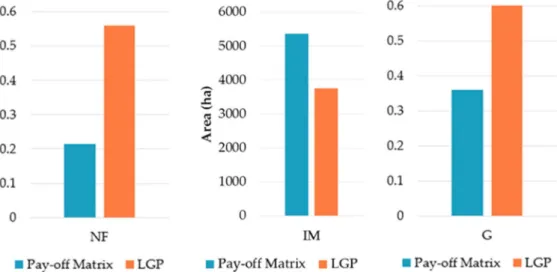
The results presented in Table 3 allow us to observe the differences in relation to the values achieved for the indicators situated at the first priority level, at forest level. Thus, Figure 3 shows how the values of the criteria NF, IM and G obtained in the pay-off matrix are modified (Table 1), with respect to those obtained in the solution of the LGP model (Table 3).
0.6 6000
0.5 5000
0.4 4000
0.3 g 3000 0.3
0.2 K I < 2000 0.2
0.1 1000 0.1 0.6
0.3
0.4
NF IM G
• Pay-off Matrix • LGP • Pay-off Matrix • LGP • Pay-off Matrix BLGP
Figure 3. Comparison between the results of the pay-off matrix and those obtained in the LGP model,
for the criteria NF, IM and G.
From a sustainability perspective, it has been implicitly assumed up to now that the criteria selected functioned within weak sustainability parameters [31]. Namely, a certain degree of compensation between the different indicators was presumed, although the LGP method implies that there is no finite trade-off between the different indicators of the different criteria considered [89]. However, in the literature, aggregated sustainability indexes based on multicriteria techniques including premises associated with strong sustainability can be found; i.e., it is found that there cannot be compensation between the criteria [104], nor can a certain degree of compensation between criteria even be chosen [105,106].
The methodology proposed here is open to incorporating other silvicultural alternatives. In our case study, GS has been proposed in order to favor the development of multi-aged stands [79], and GTR has been suggested in order to maintain multiple forest values [76], including biodiversity conservation [107], and, especially, to promote silvicultural treatments compatible with the protection of wildlife species [108]. The percentages of mature forest chosen here are those most frequently used in the literature [109,110]. Another silvicultural alternative (TNP) embraces the prohibition of final cuts (this forbiddance is mandatory in all Spanish National Parks). Maintaining this type of protected area is highly beneficial for certain species, and this justifies not employing a conventional silvicultural alternative [111].
On another side, and as mentioned above, other criteria could be integrated into the model, if considered to be appropriate. For example, we are aware that, unlike other studies [112,113], no criterion expressly linked to the social pillar of sustainability has been proposed. Although one study made in the same case study [114] did suggest two recreation indicators, it has not been possible to transfer this idea to our analysis. Along these lines, some studies point to an underrepresentation of social type indicators as being common [103].
Again, and aside from the significance of the Gini coefficient proposed here, which has been applied as an indicator of forest structural heterogeneity [115,116], we have attempted to define our own biodiversity criterion [117] that could be integrated into the LGP model. In fact, one of the objectives in the case study [118] is focussed on the conservation of the black vulture, an umbrella species [119], which is catalogued as "near threatened" at the global level [120]. For this reason, we pursue the possibility that, at the end of the planning horizon, there is a multi-aged forest. The inclusion of this criterion (Gini coefficient) under an environmental pillar is justified when the forest managers aim to promote the existence of uneven-aged stands as a biodiversity conservation measure [63,79].
However, it has not been possible to model the evolution of this species over 100 years, due to the lack of information available for predicting these values, so it has not been included in the analysis. Furthermore, it would have been necessary to determine the impact of the different silvicultural alternatives on the vulture populations, because it has been demonstrated that they have an influence on some requirements of the nesting of this species [121]. The lack of consideration of this criterion illustrates the difficulty in finding criteria compatible with the information assembly over the planning horizon, in spite of the availability of suitable methodologies for their possible integration into the model proposed. However, some studies have been developed under the goal programming technique successfully integrating aspects related to biodiversity [122,123]. Lastly, the methodology proposed here can also be extended, incorporating other silvicultural alternatives centred on other ecosystem services different from timber production [124].
case, the solutions notably vary with respect to the area that each silvicultural treatment has to cover, and this also happens in other studies [126].
In addition to incorporating new sustainability criteria, one aspect of the methodology proposed here that should be highlighted lies in the combination of flexibility and complexity that can be incorporated, for example, in terms of the silvicultural alternatives considered. The advantage of this flexibility is indispensable for tackling typical contemporary challenges in forest management [127,128]. Since there is no single specific definition of the idea of complexity in silviculture [129], some authors affirm that the impact of certain forest practices on forest system dynamics can compromise their sustainability [81]. Thus, the consideration of diverse silvicultural alternatives for approaching different criteria would lead to what some authors already call "complex adaptive systems" [130]. Lastly, this methodology can be applied at different levels (spatial or temporal) at which it is desired to carry out the planning and silviculture [128], contributing to the flexibility of the proposed methodology.
6. Conclusions
In this study, a flexible methodology was proposed to address sustainability in forest management. It includes the possibility of incorporating different criteria, or even synthetic indicators, multiple silvicultural alternatives for each stand and the preferential weights of different stakeholders. The solutions of these multi-criteria models allow the decision-maker to select, in terms of sustainability, the optimal silvicultural alternative for each stand along the planning horizon, the degree of multi-aged forest proposed and the fulfilment of the normal forest ideal.
The results obtained in the case study show different solutions from the ideal values shown in the pay-off matrix, with those supplied by the LGP model being much more attractive. Moreover, it can be seen how the areas devoted to each silvicultural alternative are notably modified in each of the solutions obtained. Finally, the flexibility of the model leads us to believe that this methodology could easily be extended to other case studies and planning levels, both temporal and spatial.
Author Contributions: M.E. carried out all the research, wrote the manuscript and performed the modelling issues. M.E wrote the manuscript, focusing on silvicultural alternatives. L.D.-B. coordinated the study and wrote the manuscript, focusing on sustainability topics.
Funding: This work was funded by the Ministry of Economy and Competitiveness of Spain under project AGL2015-68657-R. Additionally, this research was partially financed by the European Union's H2020 research and innovation programme under the Marie Sklodowska-Curie grant agreement No. 691149-SuFoRun.
Acknowledgments: The authors thank Javier Dones, Marisol Redondo and Marta Pihuela (Valsain forest staff) for their continuous support. The authors deeply appreciate the comments and suggestions raised by Carlos Romero. Thanks are also given to Patricia Riquelme (Sierra de Guadarrama National Park) and Miguel Cabrera, and to Diana Badder for editing the English. Additionally, this manuscript has been proofread by PRS and MDPI. Thanks are given to the Editor and the reviewers for their helpful comments and criticisms, which have greatly improved the presentation and accuracy of the paper.
Appendix A
Table A l . Set of p o s s i b l e silvicultural a l t e r n a t i v e s to b e a p p l i e d in t h e case study.
Silvicultural Alternative BAUl BAU2 GS GTRl GTR2 TNP NOM Age 40-60-80 120-180 40-60-80 120-180 40-60-80 120-180 40-60-80 80-120 120-180 40-60-80 80-120 120-180 40-60-80 140-180 Operation Light thinnings Seeding cutting Secondary cutting 1 Secondary cutting 2
Final cutting
Strong thinnings
Seeding cutting Secondary cutting 1 Secondary cutting 2
Final cutting Light thinnings Seeding cutting Final cutting Light thinnings Retention Seeding cutting Secondary cutting 1 Secondary cutting 2
Final cutting
Strong thinnings
Retention Seeding cutting Secondary cutting 1 Secondary cutting 2
Final cutting
Light thinnings
Seeding cutting Secondary cutting 1 Secondary cutting 2 No Final cuttings
NO Management Intensity (%) From below 50 12 12 24 From below 50 12 12 24 From below 60 35 From below 15 45 10 10 18 From below 30 35 10 10 13 From below 40 10 10 Standing Volume (%) 2 2 5 15 2 30 2 40
Table A2. Weights for the set of possible silvicultural treatments (7) in each category (7).
Categories Definition Set of
Alternatives Weights
Productive stands
BAUl BAU2 GTRl
0.188 0.081 0.731
Under protection stands
Mixed stands
Mixed stands with nests
Mixed stands in the National Park (NP)
Stands with nests
NOM TNP
GS NOM
GS GTRl GTR2
GS TNP NOM
GTRl GTR2
0.9 0.1
0.875 0.125
0.055 0.173 0.772
0.149 0.785 0.066
0.25 0.75
Stands with nests in the National Park (NP)
GTR2 TNP NOM
0.149 0.785 0.066
BAUl: Business As Usual 1, BAU2: Business As Usual 2, GS: Group Selection, GTRl: Green-Tree Retentionl, GTR2: Green-Tree Retention2, TNP: Treatment for the National Park, NOM: NO Management.
Table A3. Scale of relative importance [94].
Intensity of Importance
1 3 5 7 9 2, 4, 6, 8
Definition
Equal importance Moderate importance Strong importance Demonstrated importance Extreme importance Intermediate values
Appendix B
Appendix B.l. Lexicographic Goal Programming Formulation
being
LexMin = [U]_, U2,---, Uv]
J=1
(Al)
(A2)
Uv = \Yd(aq-nq+Pq-Pq)\ (A3)
subject to:
fq{x)+nq-pq = tq (A4)
to the goals (Equation (A4)) situated at those priority levels, tq is the target level for the Cjth goal, w? and
Pq are the negative and positive deviations from the target value of the qth goal. aq = -^- is used if nq is
unwanted, otherwise is used a? = 0, $q = -^- if it is unwanted, otherwise fa = 0. The parameters Wq
and Rq are the weights reflecting preferential and normalising purposes attached to the achievement of the qth goal.
Appendix B.2. Strategic Planning
Following Figure 1A, a strategic forest planning model was designed with a planning horizon of 100 years, divided into 10-year periods, which is a typical timeframe in models with slow-growing species, especially with Scots pine [118]. In short, a timber harvest scheduling model following Model I methodology [121] was built. Initially, Model I requires the definition of the decision variables or prescriptions, which need to encompass all possible management regimes to be considered, taking into account the rotation length and the silvicultural alternatives put into the model, which will remain unaltered throughout the planning horizon [33]. This strategic planning model was fed with the information available in the last forest management plan [82]. In addition, the abovementioned silvicultural alternatives were included in this general model, and we fixed an interval for rotations of between 120 and 180 years. The lowest limit corresponds to the current rotation length for Scots pine in the Sierra de Guadarrama [52], while the upper limit was established at 180 years in order to provide mature forest habitats, which are essential for the survival of several endangered species [84,131]. On the other hand, it is convenient to clarify that, in addition to the endogenous restrictions two exogenous restrictions have been introduced: a minimum harvest area for each silvicultural treatment, and a minimum commercial volume from final cuttings (TNP not included) per period. Finally, considering the rotation length and the 288 stands defined in Valsain Forest, a set of 11,148 prescriptions was generated.
Appendix B.3. Definition of Model Inputs
Constants
T is the length of the planning horizon. t is the time period.
L = T/t is the number of periods into which the planning horizon is divided. ts is the time span that defines the final age class.
S = T/ts is the number of final age classes, taking into account the range of years in which
regeneration can occur.
B is the total forest area. B( is the area in stand i.
b^AUi is the minimum harvest area when XBAUI prescriptions are selected.
bsAU2 is the minimum harvest area when XBAU2 prescriptions are selected.
bos is the minimum harvest area when xGS prescriptions are selected.
bcTR1 is the minimum harvest area when XGTR1 prescriptions are selected.
bcTR2 is the minimum harvest area when XQTR2 prescriptions are selected. Hm;n is the minimum volume harvested per period.
mAge and MAge are the minimum and maximum harvest ages during the planning
horizon, respectively.
Viji is the volume harvested per hectare in stand i, prescription j at period /. Flz is the initial forest inventory on z site index.
BVN is the Black Vulture Nest protection area.
CFo is the initial investment and CFf is the cash-flow per year.
r is the discount rate.
y is the parameter that expresses the density of wood in tons per m3 (0.5) and the percentage of
Index Sets
i is the number of stands.
j is the number of prescriptions, defining a complete treatment schedule for each stand, following
the Model I structure (Johnson and Scheurman, 1977).
k is the number of initial age classes.
/ is the index of periods. z is the site index.
v is the number of priority levels.
Variables
Xij is the area harvested at prescription j in stand i.
XBAUt is the area harvested by BAU\ at prescription j in stand i.
XBAU2 is the area harvested by BAU2 at prescription j in stand i. XQS is the area harvested by GS at prescription j in stand i. XGTRX is the area harvested by GTR\ at prescription j in stand i.
XGTR2 is the area harvested by GTR2 at prescription j in stand i.
XTNP is the area harvested by TNP at prescription j in stand i.
%NOM is the area selected for NOM at prescription j in stand i.
UXi is a binary variable to force decision variable X; to take either a zero value or a value greater
than, or equal to, the minimum harvest area designated by parameters bsAUir bsAU2r bcs, bcTR1 and
bcTR2 •
As is the area belonging to s final age class s at the ending period.
Fi, is the ending forest inventory from site index z.
SVij is the total standing volume at prescription j in stand i.
P is the cumulative percentage of the number of trees per hectare for each stand i. Q is the cumulative percentage of volume.
CCij is the carbon capture at prescription j in stand i.
ECij are the carbon emissions produced by cuttings at prescription j in stand i.
Rq is the normalized vector (as the difference between ideal and anti-ideal values) for each
criterion q.
Appendix B.4. Definition ofLGP Model
Criteria
NF is the normal forest as an aggregated normalized function of the even flow harvest volume
per period (Hi), the forest ending inventory for each site class (Fz) and the area control for each age
class (As).
IM is the ideal management to be applied in each stand i. G is the gini index as an inequaluty measure.
VOL is the volume harvested at the end of the planning horizon. NPV is the Net Present Value at the end of the planning horizon.
C is the carbon balance at the end of the planning horizon.
Achievement function
LexMIN= [UlrU2,-Uo,)
^={—•
( % ? ) + " ™ W ) + ° > G { ^ ) + — •
(m+™
NPV• m)+w
c. ($}
(1) Normal Forest (NF)
(2) Ideal Management (IM)
(3) Gini index (G)
(4) Carbon balance (C)
(5) Harvest volume (VOL)
(6) Net Present Value (NPV)
NF + n-NF - p-NF = NF*
IM + nIM - VIM = IM*
G + nG-pG = G*
C + nc-pc = C*
VOL + nVOL ~ PVOL = VOL*
NPV + nNPV - pNPV = NPV*
The following constraints were introduced into the LGP model. First, endogenous ones were introduced to ensure that the area chosen by the model cannot exceed the available area in each stand. Second, a minimum harvest area was proposed for each treatment, since, as the treatments propose cutting sequences at several periods (2-4), a minimum area necessary for the intervention (5 ha for BAUl and BAU2, and 10 ha for GTRl and GTR2) for each of them, was considered. In the case of GS, this minimum area refers to the size of the gaps in which the thinnings are applied. Finally, for TPN and NOM, no amount of minimum area was imposed for their application. The last constraint ensures a minimum harvested volume per period, according to the current forest management plan and the timber harvested in past years.
Subject to:
(7) Area accounting
+ %BAU2 + XGS + XGTRt + *GTR2 + XTNP + ^NOM Vj, /
/
L Xij = Bt
;'=i
%ij =
LB,
Vi /
Vi,j
L xBAUi
-;'=i = B
(8) Auxiliary variables domain
UX( £ {0,1}
(9) Minimum harvest area per treatment
XBAUt-hAUt -UXi^OVi,)
XBAUt = 0 Vf, /; %BAUt < i>BAUt XBAU2-hAU2-UXi>0Vi,i
XBAU2 = 0 Vf, / ; %BAU2 < i>BAU2
xGs - bGs -uxi>0 Vf, /
xGS =0Vf,/; xGS <bGS
XGTRt - bGTRt -UXi>0 Vf, /
XGTR2 - bGTR2 -uxi>0 Vi, j XGTR2 = 0 Vi,j; xGTR2 < bGTRl
(10) M i n i m u m and m a x i m u m harvest age
%ij = 0 Vi, j ; k < mAge
%ij = 0 Vi, /; k > MAge
(11) M i n i m u m harvested v o l u m e per period
H!>Hmin, Z = 1 , . . . , L - 1
(12) N o n - n e g a t i v i t y constraints
Xij>0,Vi,j
XBAU2 > 0,XBAU2 > 0,XGS > 0,XGTRt > 0,XGTR2 > 0,XTNP > C U N O M > 0
nvoi, KNPV, « N F , nIM, nc, nG>0
PV0L,PNPV,PNF,PIM,PC,PC ^ 0
References
1. von Carlowitz, H. Sylvicultura Oeconomica Oder Hauflwirthliche Nachricht und Naturgemiiflige Anweisung zur
Wilden Baum-Zucht; Johann Friedrich Braun (2 Bande): Leipzig, Germany, 1713.
2. Grober, U. The discovery of sustainability: The genealogy of a term. In Theories of Sustainable Development; Enders, J.C., Remig, M., Eds.; Routledge: Abingdon, UK, 2015; pp. 6-15.
3. Robin, L. A history of global ideas about environmental justice. In Natural Resources and Environmental Justice.
Australian Perspectives; Lukasiewicz, A., Dovers, S., Robin, L., McKay, J., Schilizzi, S., Graham, S., Eds.; CSIRO
Publishing: Clayton South, Australia, 2017; pp. 13-25.
4. Bettencourt, L.; Kaur, J. Evolution and structure of sustainability science. Proc. Natl. Acad. Sci. USA 2011,
108,19540-19545. [CrossRef] [PubMed]
5. Schuler, A. Sustainability and biodiversity- forest historical notes on two main concerns of environmental utilization. In Assessment of Biodiversity for Improved Forest Planning; Bachmann, P., Kohl, M., Paivinen, R., Eds.; Springer Science: Dordrecht, The Netherlands, 1998; pp. 353-360.
6. Caradonna, J.L. Routledge Handbook of the History of Sustainability; Routledge: Abingdon, UK, 2018; 443p. 7. Zenner, E.K. The Ongoing Story of Silviculture on Our Natural Public Forestlands. /. For. 2014,112, 611-616.
[CrossRef]
8. Raison, R.J.; Brown, A.; Flinn, D. Criteria and Indicators for Sustainable Forest Management; CABI Publishing: Wallingford, UK, 2001; 427p.
9. Spies, J.; Devisscher, T; Bulkan, J.; Tansey, J.; Griess, V. Value-oriented criteria, indicators and targets for conservation and production: A multi-party approach to forest management planning. Biol. Conserv. 2019,
230,151-168. [CrossRef]
10. Grainger, A. Forest sustainability indicator systems as procedural policy tools in global environmental governance. Glob. Environ. Chang.-Hum. Policy Dimens. 2012, 22,147-160. [CrossRef]
11. Linser, S.; Wolfslehner, B.; Asmar, F.; Bridge, S.R.J.; Gritten, D.; Guadalupe, V; Jafari, M.; Johnson, S.; Laclau, P.; Robertson, G. 25 Years of Criteria and Indicators for Sustainable Forest Management: Why Some Intergovernmental C&I Processes Flourished While Others Faded. Forests 2018, 9, 515. [CrossRef]
12. Diaz-Balteiro, L.; Alfranca, O.; Bertomeu, M.; Ezquerro, M.; Gimenez, J.C.; Gonzalez-Pachon, J.; Romero, C. Using quantitative techniques to evaluate and explain the sustainability of forest plantations. Can. ]. For. Res.
2016, 46,1157-1166. [CrossRef]
14. Rametsteiner, E.; Simula, M. Forest Certification—An Instrument to Promote Sustainable Forest Management? /. Environ. Manag. 2003, 67, 87-98. [CrossRef]
15. Diaz-Balteiro, L.; Talon, S.G. Certifying Forests to Achieve Sustainability in Industrial Plantations: Opinions of Stakeholders in Spain. Forests 2017, 8, 502. [CrossRef]
16. Helms, J.A. The Dictionary of Forestry; Society of American Foresters: Bethesda, MD, USA, 1998; 203p. 17. Briceno-Elizondo, E.; lager, D.; Lexer, M.J.; Garcia-Gonzalo, J.; Peltola, H.; Kellomaki, S. Multi-criteria
evaluation of multi-purpose stand treatment programmes for Finnish boreal forests under changing climate.
Ecol. Ind. 2008, 8, 26-45. [CrossRef]
18. Nelson, E.; Mendoza, G.; Regetz, J.; Polasky, S.; Tallis, H.; Cameron, D.; Chan, K.M.; Daily, G.C.; Goldstein, J.; Kareiva, P.M.; et al. Modeling multiple ecosystem services, biodiversity conservation, commodity production, and tradeoffs at landscape scales. Front. Ecol. Environ. 2009,7,4-11. [CrossRef]
19. Monkkonen, M.; Juutinen, A.; Mazziotta, A.; Miettinen, K.; Podkopaev, D.; Reunanen, P.; Salminen, H.; Tikkanen, O.-P Spatially dynamic forest management to sustain biodiversity and economic returns. /. Environ.
Manag. 2014,134, 80-89. [CrossRef] [PubMed]
20. Martins, H.; Borges, J.G. Addressing collaborative planning methods and tools in forest management.
For. Ecol. Manag. 2007,248,117-118. [CrossRef]
21. Diaz-Balteiro, L.; Romero, C. Making forestry decisions with multiple criteria: A review and an assessment.
For. Ecol. Manag. 2008,255,3222-3241. [CrossRef]
22. Uhde, B.; Hahn, W.A.; Griess, V.; Knoke, T. Hybrid MCDA methods to integrate multiple ecosystem services in forest management planning: A critical review. /. Environ. Manag. 2015,56, 373-388. [CrossRef] [PubMed]
23. Cinelli, M.; Coles, S.R.; Kirwan, K. Analysis of the potentials of multi criteria decision analysis methods to conduct sustainability assessment. Ecol. Ind. 2014, 46,138-148. [CrossRef]
24. Lozano-Oyola, M.; Blancas Peral, F; Lozano, M.; Caballero, R. Sustainable tourism indicators as planning tools in cultural destinations. Ecol. Ind. 2012,18, 659-675. [CrossRef]
25. Diaz-Balteiro, L.; Gonzalez-Pachon, J.; Romero, C. Measuring systems sustainability with multi-criteria methods: A critical review. Eur. }. Oper. Res. 2017, 258, 607-616. [CrossRef]
26. Stojcic, M.; Zavadskas, E.K.; Pamucar, D.; Stevic, Z.; Mardani, A. Application of MCDM Methods in Sustainability Engineering: A Literature Review 2008-2018. Symmetry 2019,11,350. [CrossRef]
27. Perez, E; Molinos-Senante, M.; Gomez, T.; Caballero, R.; Sala-Garrido, R. Dynamic goal programming synthetic indicator: An application for water companies sustainability assessment. Urban Water ]. 2018,15, 592-600. [CrossRef]
28. Langer, A.; Irauschek, E; Perez, S.; Pardos, M.; Zlatanov, T.; Ohman, K.; Nordstrom, E.-M.; Lexer, M. Value-based ecosystem service trade-offs in multi-objective management in European mountain forests.
Ecosyst. Serv. 2017, 26, 245-257. [CrossRef]
29. Blattert, C ; Lemm, R.; Thees, O.; Hansen, J.; Lexer, M.; Hanewinkel, M. Segregated versus integrated biodiversity conservation: Value-based ecosystem service assessment under varying forest management strategies in a Swiss case study. Ecol. Ind. 2018, 95, 751-764. [CrossRef]
30. Miiller, A.; Knoke, T.; Olschewski, R. Can Existing Estimates for Ecosystem Service Values Inform Forest Management? Forests 2019,10,132. [CrossRef]
31. Diaz-Balteiro, L.; Belavenutti, P.; Ezquerro, M.; Gonzalez-Pachon, J.; Nobre Ribeiro, S.; Romero, C. Measuring the sustainability of a natural system by using multi-criteria distance function methods: Some critical issues. /. Environ. Manag. 2018, 214,197-203. [CrossRef] [PubMed]
32. Toman, M.A.; Ashton, M.S. Sustainable forest ecosystems and management: A review article. For. Sci. 1996,
42, 366-377.
33. Davis, L.S.; Johnson, K.M.; Bettinger, P.; Howard, T.E. Forest Management, 4th ed.; McGraw-Hill: New York, NY, USA, 2001; 816p.
34. Morgenstern, E.K. The origin and early application of the principle of sustainable forest management.
For. Chron. 2007, 83, 485-489. [CrossRef]
35. Romero, C ; Rehman, T. Multiple Criteria Analysis for Agricultural Decisions, 2nd ed.; Elsevier: Amsterdam, The Netherlands, 2003; 186p.
36. Zopounidis, C ; Pardalos, P.M. Handbook of Multicriteria Analysis; Springer: Berlin, Germany, 2010; 455p. 37. Buongiorno, J.; Gilles, J.K. Decision Methods for Forest Resource Management; Academic Press: San Diego, CA,
38. Ignizio, J.; Romero, C. Goal Programming. In Encyclopedia of Information Systems; Four Volume Set; Bidgoli, H., Ed.; Academic Press: San Diego, CA, USA, 2002; pp. 489-500.
39. Jones, D.; Tamiz, M. Practical Goal Programming; Springer: New York, NY, USA, 2010; 170p.
40. Jones, D.; Romero, C. Advances and New Orientations in Goal Programming. In New Perspectives in
Multiple Criteria Decision Making, Multiple Criteria Decision Making; Doumpos, M., Rui Figueira, J., Greco, S.,
Zopounidis, C., Eds.; Springer: Cham, Switzerland, 2019; pp. 231-246.
41. Ignizio, J.P; Romero, C. Goal Programming. Encycl. Inf. Syst. 2003,2,489-500. [CrossRef]
42. Fischer, J.; Manning, A.; Steffen, W.; Rose, D.B.; Daniell, K.; Felton, A.; Garnett, S.; Gilna, B.; Heinsohn, R.; Lindenmayer, D.; et al. Mind the sustainability gap. Trends Ecol. Evol. 2007,22, 621-624. [CrossRef]
43. Zeleny, M. Multiple Criteria Decision Making; McGraw-Hill: New York, NY, USA, 1982; 563p.
44. Romero, C. A general structure of achievement function for a goal programming model. Eur. } . Oper. Res. 2004,153, 675-686. [CrossRef]
45. Benitez-Fernandez, A.; Ruiz, F. A Meta-Goal Programming Approach to Cardinal Preferences Aggregation in Multicriteria Problems. Omega 2019, in press. [CrossRef]
46. Caballero, R.; Nunez, T.; Ruiz, F. Goal Programming: Realistic targets for the near future. /. Multi-Criteria
Decis. Anal. 2009,16, 79-110. [CrossRef]
47. Hahn, A.; Knoke, T. Sustainable development and sustainable forestry: Analogies, differences, and the role of flexibility. Eur. }. For. Res. 2010,129, 787-801. [CrossRef]
48. von Detten, R. Sustainability as a guideline for strategic planning? The problem of long-term forest management in the face of uncertainty. Eur. }. For. Res. 2011,130, 451-465. [CrossRef]
49. Hahn, A.; Hartl, E; Irland, L.; Kohler, C ; Moshammer, R.; Knoke, T. Financially optimized management planning under risk aversion results in even-flow sustained timber yield. For. Policy Econ. 2014, 42, 30-41.
[CrossRef]
50. Pasalodos-Tato, M.; Makinen, A.; Garcia-Gonzalo, J.M.; Borges, J.G.; Lamas, T.; Eriksson, L.O. Assessing uncertainty and risk in forest planning and decision support systems: Review of classical methods and introduction of innovative approaches. For. Syst. 2013,22, 282-303. [CrossRef]
51. Mina, M.; Bugmann, H.; Cordonnier, T.; Irauschek, E; Klopcic, M.; Pardos, M.; Cailleret, M. Future ecosystem services from European mountain forests under climate change. /. Appl. Ecol. 2017,54, 3 8 9 ^ 0 1 . [CrossRef]
52. Pardos, M.; Perez, S.; Calama, R.; Alonso, R.; Lexer, J.M. Ecosystem service provision, management systems and climate change in Valsain forest, Central Spain. Reg. Environ. Chang. 2017,17,17-32. [CrossRef]
53. Baskent, E. Exploring the effects of climate change mitigation scenarios on timber, water, biodiversity and carbon values: A case study in Pozanti planning unit, Turkey. /. Environ. Manag. 2019, 238, 420-433.
[CrossRef]
54. Hernandez, M.; Gomez, T; Molina, J.; Leon, M.A.; Caballero, R. Efficiency in forest management: A multiobjective harvest scheduling model. J.For. Econ. 2014,20,236-251. [CrossRef]
55. Xavier, A.M.; Costa Freitas, M.B.; Fragoso, R. Management of Mediterranean forests—A compromise programming approach considering different stakeholders and different objectives. For. Policy Econ. 2015,57, 38-46. [CrossRef]
56. Diaz-Balteiro, L.; Martell, D.; Romero, C ; Weintraub, A. The optimal rotation of a flammable forest stand when both carbon sequestration and timber are valued: A multi-criteria approach. Nat. Hazards 2014, 72, 375-387. [CrossRef]
57. Franklin, J.E; Johnson, K.N.; Johnson, D.L. Ecological Forest Management; Waveland Press: Long Grove, IL, USA, 2018; 646p.
58. Schraml, U.; Detten, R.V. Forestry or "the art of flying blind". Sustainability in an era of global change. In Sustainable Forest Management in a Changing World. A European Perspective; Spathelf, P., Ed.; Springer: Dordrecht, The Netherlands, 2010; pp. 217-238.
59. Hauhs, M.; Langel, H. Sustainability in Forestry: Theory and a historical case study. In Sustainable
Forest Management; von Gadow, K., Pukkala, T., Tome, M., Eds.; Kluwer Academic Publishers: Dordrecht,
The Netherlands, 2000; pp. 69-98.
60. Johnston, D.R.; Grayson, A.J.; Bradley, R.T. Forest Planning; Faber and Faber Limited: London, UK, 1967; 541p.
62. Ciancio, O.; Nocentini, S. Biodiversity conservation and systemic silviculture: Concepts and applications.
Plant Biosyst.—Int. }. Deal. Asp. Plant Biol. 2011,145,411-418. [CrossRef]
63. Puettmann, K.J.; Wilson, S.M.; Baker, S.C.; Donoso, P.J.; Drossier, L.; Amente, G.; Harvey, B.D.; Knoke, T.; Lu, Y.; Nocentini, S.; et al. Silvicultural alternatives to conventional even-aged forest management—What limits global adoption? For. Ecosyst. 2015,2, 8. [CrossRef]
64. Kangas, A.; Kurttila, M.; Hujala, T.; Eyvindson, K.; Kangas, J. Decision Support for Forest Management, 2nd ed.; Springer: Berlin, Germany, 2015; 307p.
65. Kaspar, J.; Marusak, R.; Hlavaty, R. A Forest Planning Approach with Respect to the Creation of Overmature Reserved Areas in Managed Forests. Forests 2015, 6, 328-343. [CrossRef]
66. Wiersum, K.F. 200 years of sustainability in forestry: Lessons from history. Environ. Manag. 1995,19, 321-329.
[CrossRef]
67. Rytteri, T.; Peltola, T.; Leskinen, L.A. Co-production of forestry science and society: Evolving interpretations of economic sustainability in Finnish forestry textbooks. /. For. Econ. 2016, 24, 21-36. [CrossRef]
68. Pretzsch, PL; Knoke, T. Forest management planning in mixed-species forests. In Mixed-Species Forests.
Ecology and Management; Pretzsch, H., Forrester, D.I., Bauhus, J., Eds.; Springer: Berlin, Germany, 2017;
pp. 503-544.
69. Parrot, L.; Kange, H. An introduction to complexity science. In Managing Forests as Complexity Adaptive
Systems; Messier, C , Puettmann, K.J., Coates, D., Eds.; Routledge: Abingdon, UK, 2014; pp. 17-32.
70. Eyvindson, K; Repo, A.; Monkkonen, M. Mitigating forest biodiversity and ecosystem service losses in the era of bio-based economy. For. Policy Econ. 2018, 92,119-127. [CrossRef]
71. Langenberger, G.; Lippe, M. Forestry. In Bioeconomy: Shaping the Transition to a Sustainable, Biobased Economy; Lewandowski, I., Ed.; Springer: Cham, Germany, 2018; pp. 124—141.
72. Shannon, M.A.; Buttoud, G.; Paivinen, R. Science is Endogenous to Sustainable Forestry—Implications for Scientists and Policymakers. In Sustainable Forestry: From Monitoring and Modelling to Knowledge Management
and Policy Science; Reynolds, K.M., Thompson, A.J., Kohl, M., Shannon, M.A., Ray, D., Reynolls, K , Eds.;
CABI: Wallingford, UK, 2007; pp. 1-13.
73. Rist, L.; Moen, J. Sustainability in forest management and a new role for resilience thinking. For. Ecol. Manag.
2013, 310, 416^27. [CrossRef]
74. Bettinger, P.; Boston, K ; Siry J.P; Grebner, D. Forest Management and Planning, 2nd ed.; Academic Press: San Diego, CA, USA, 2017; 362p.
75. Higman, S.; Mayers, J.; Bass, S.; Judd, N.; Nussbaum, R. The Sustainable Forestry Handbook, 2nd ed.; Earthscan: London, UK, 2005; 332p.
76. Lindenmayer, D.B.; Franklin, J.F.; Lohmus, A.; Baker, S.C.; Bauhus, J.; Beese, W.; Brodie, A.; Kiehl, B.; Kouki, J.; Pastur, G.M.; et al. A major shift to the retention approach for forestry can help resolve some global forest sustainability issues. Conserv. Lett. 2012,5,421-431. [CrossRef]
77. Mori, A.S.; Lertzman, K.P; Gustafsson, L. Biodiversity and ecosystem services in forest ecosystems: A
research agenda for applied forest ecology. /. Appl. Ecol. 2017, 54,12-27. [CrossRef]
78. Nordstrom, E.-M.; Nieuwenhuis, M.; Baskent, E.; Biber, P.; Black, K ; Borges, J.; Bugalho, M.; Corradini, G.; Corrigan, E.; Eriksson, L.; et al. Forest decision support systems for the analysis of ecosystem services provisioning at the landscape scale under global climate and market change scenarios. Eur. J. For. Res. 2019, 1-21. [CrossRef]
79. O'Hara, K.L. Multiaged Silviculture. Managing for Complex Forest Stand Structures; Oxford University Press: Oxford, UK, 2014; 213p.
80. Augustynczik, L.D.A.; Asbeck, T.; Basile, M.; Bauhus, J.; Storch, I.; Mikusihski, G.; Yousefpour, R.; Hanewinkel, M. Diversification of forest management regimes secures tree microhabitats and bird abundance under climate change. Sci. Total Environ. 2018,650,2717-2730. [CrossRef] [PubMed]
81. Puettmann, K.J.; Coates, K.D.; Messier, C. A Critique of Silviculture: Managing for Complexity; Island Press: Washington, DC, USA, 2009; 188p.
82. Cabrera, M. Proyecto de 7a Revision de la Ordenacion del Monte Numero 2 del Catdlogo de los de Utilidad Publica de la Provincia de Segovia "Pinar" de Valsain; Organismo Autonomo Parques nacionales, Ministerio de Medio
Ambiente: Madrid, Spain, 2010; 365p.