RESOURCE ALLOCATION IN GMD AND SVD-BASED MIMO
SYSTEM
Andreas Ahrens
1, Francisco Cano-Broncano
2and C´esar Benavente-Peces
21Hochschule Wismar, University of Technology, Business and Design, Philipp-M¨uller-Straße 14, 23966 Wismar, Germany 2Universidad Polit´ecnica de Madrid, Ctra. Valencia. km. 7, 28031 Madrid, Spain
[email protected], [email protected]
Keywords: Multiple-Input Multiple-Output System, Singular-Value Decomposition, Geometric Mean Decomposition, Bit Allocation, Power Allocation, Antennas Correlation, Wireless Transmission, Tomlinson-Harashima Precoding.
Abstract: Singular-value decomposition (SVD)-based multiple-input multiple output (MIMO) systems, where the whole MIMO channel is decomposed into a number of unequally weighted single-input single-output (SISO) chan-nels, have attracted a lot of attention in the wireless community. The unequal weighting of the SISO channels has led to intensive research on bit- and power allocation even in MIMO channel situation with poor scattering conditions identified as the antennas correlation effect. In this situation, the unequal weighting of the SISO channels becomes even much stronger. In comparison to the SVD-assisted MIMO transmission, geometric mean decomposition (GMD)-based MIMO systems are able to compensate the drawback of weighted SISO channels when using SVD, where the decomposition result is nearly independent of the antennas correlation effect. The remaining interferences after the GMD-based signal processing can be easily removed by using dirty paper precoding as demonstrated in this work. Our results show that GMD-based MIMO transmission has the potential to significantly simplify the bit and power loading processes and outperforms the SVD-based MIMO transmission as long as the same QAM-constellation size is used on all equally-weighted SISO chan-nels.
1
INTRODUCTION
The strategy of placing multiple antennas at the trans-mitter and receiver sides, well-known as multiple-input multiple-output (MIMO) system, improves the performance of wireless systems by the use of the spa-tial characteristics of the channel (Zheng, 2003; Yang et al., 2011). MIMO systems have become the subject of intensive research over the past 20 years as MIMO is able to support higher data rates and shows a higher reliability than single-input single-output (SISO) sys-tems (Jiang et al., 2008).
Singular-value decomposition (SVD) is well-established in MIMO signal processing where the whole MIMO channel is transferred into a number of weighted SISO channels. The unequal weight-ing of the SISO channels has led to intensive re-search to reduce the complexity of the required bit-and power-allocation techniques (Zanella bit-and Chiani, 2012; Cano-Broncano et al., 2014) in rich and poor scattering conditions.
However, due to poor scattering conditions the
un-equal weighting of the SISO channels is strongly af-fected by the antennas correlation effect (Benavente-Peces et al., 2013; Chiani et al., 2003; Abdi and Kaveh, 2002; Loyka and Tsoulos, 2002; Shiu et al., 1998), which makes the process of bit- and power-allocation more challenging.
The novelty of our contribution is that we demon-strate the benefits of amalgamating a suitable choice of activated MIMO layers and number of bits per sub-carrier along with the appropriate allocation of the transmit power under the constraint of a given fixed data throughput. Here, optimal and suboptimal bit-and power-loading in both SVD- bit-and GMD-based MIMO transmission systems with and without an-tenna correlation are elaborated. Assuming a fixed data rate, which is required in many applications (e.g., real time video applications), a two stage optimiza-tion process is proposed. Firstly, the allocaoptimiza-tion of bits to the number of SISO channels is optimized and secondly, the allocation of the available total trans-mit power is studied when minimizing the overall bit-error rate (BER) at a fixed data rate. Whereas optimal power allocation techniques are highly com-plex, suboptimal solutions offer a good compromise between complexity and performance lost compared with optimal solutions. Our results show that GMD-based MIMO transmission has the potential to signif-icantly simplify the process of bit and power loading both in correlated and uncorrelated MIMO systems and outperforms SVD-based MIMO transmission as long as the same QAM-constellation size is used on all equally weighted SISO channels.
The remaining part of this paper is structured as follows: Section 2 introduces the MIMO system model and the signal processing techniques used in this work. In section 3 the well-know quality criteria is briefly reviewed and applied to our problem. The proposed resource allocation solutions are discussed in section 4, while the associated performance results are presented and interpreted in section 5. Finally, section 6 provides some concluding remarks.
2
MIMO SYSTEM MODEL
A frequency non-selective MIMO communication link with nTantennas in transmission and nRin recep-tion can be described as
u=H·c+n , (1)
where u corresponds to the(nR×1)received data vector, H is the(nR×nT) channel matrix, c is the (nT×1)transmitted data vector and n is the(nR×1) Additive White Gaussian Noise (AWGN) vector. Fur-thermore, it is assumed that the coefficients of the channel matrix H are independent and identically Rayleigh distributed with equal variance and that the number of transmit antennas equals the number of re-ceive antennas nT=nR.
In MIMO systems, inter-antennas interferences appear due to the increased number of antennas and the consequent multipath signals. These interfer-ences are described by the off-diagonal elements of the channel matrix H. In order to avoid the inter-antenna interferences, appropriate signal processing techniques are required. The Singular Value Decom-position (SVD) is used to transform the MIMO chan-nel into independent layers. Given the chanchan-nel matrix
H, the application of the SVD to H allows
express-ing it as H =S·V·DH, where the (nR×nR) ma-trix S and the (nT×nT)matrix DH are unitary ma-trices, and V is a real-valued diagonal matrix con-taining the positive square roots of the eigenvalues of the matrix HHH sorted in descending order, and(·)H denotes the Hermitian transpose. Assuming perfect channel state information (PCSI) is available at both the transmit and receive sides, the application of pre-and post-processing decomposes the MIMO channel into multiple independent SISO layers with different gains given by the singular values in V, consequently, the overall transmission relationship results in
y=SH·u=SH(H·c+n) =SH(H·D·x+n) (2)
which leads to
y=V·x+w , (3)
where x is the(nT×1)pre-processed transmit data vector, y is the (nR×1)post-processed receive data vector and the (nR×1)post-processed noise vector is given by w=SH·n. The number of independent
SISO layers is limited by min(nR,nT).
On the other hand, GMD decomposes the channel matrix into
H=Q·Σ·PH , (4)
where the(nR×nR)matrix Q and the(nT×nT) matrix P are composed of orthogonal columns, and
Σ is a real upper triangular matrix where the off-diagonal elements represent the remaining interfer-ences and all the elements in the main diagonal take the same value which is the geometric mean of the positive square roots of the eigenvalues of the matrix
HHH given by
rii= L
∏
i=1q
ξ(i) !1/L
, (5)
where the parameters pξ(i) > 0 (for i = 1,2, . . . ,L)are the singular values of H and L defines the number of activated MIMO layers.
0 0.5 1 1.5 2 2.5
0 0.5 1 1.5 2 2.5
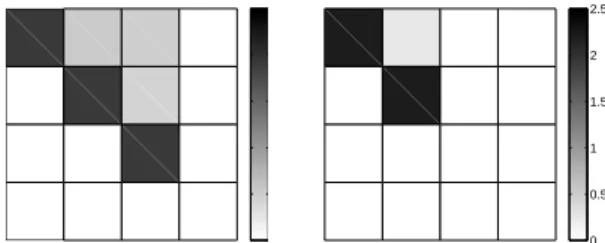
Figure 1: Graphical representation of the matrix V (left) and the matrixΣ(right)
0 0.5 1 1.5 2 2.5
0 0.5 1 1.5 2 2.5
Figure 2: Graphical representation of the matrixΣwith L= 3 (left) and L=2 activated layers (right)
into multiple SISO channels and the transmission sys-tem results in
y=QH·u=QH(H·c+n) =QH(H·P·x+n) , (6)
and can be represented as
y=Σ·x+w (7)
where x is the(nT×1)pre-processed transmit data vector, y is the(nR×1)post-processed data vector at the receiver side and w=QH·n is the(nR×1) post-processed noise vector.
The required signal processing in both SVD- and GMD-based MIMO transmission systems modifies neither the transmit power nor the noise levels since the pre- and post-processing matrices are unitary.
Fig. 1 compares the distribution of the singular values of the matrix V and the geometric mean of the singular values of the matrixΣ. The analysis of Fig. 1 highlights the unequal weighting in the SVD-based MIMO system (left) and the equal weighting as well as the remaining inter-antennas interferences in the GMD-based MIMO system (right). Fig. 2 shows a representation of the matrixΣfor a different number of activated layers.
The proximity between the antennas introduces correlation effect which drops the MIMO system per-formance. Transmit-side antennas correlation de-scribes the similitude between the paths correspond-ing to a pair of antennas (at the transmitter side) with respect to a reference antenna (at the receiver side).
0 0.1 0.2 0.3 0.4 0.5
0 0.005 0.01 0.015 0.02
uncorrelated correlated
p
d
f
→
ϑ →
Figure 3: PDF of the ratioϑbetween the smallest and the largest singular value for uncorrelated (dotted line) as well as correlated (solid line) frequency non-selective (4×4) MIMO channel
The antennas’ correlation affects the singular values distribution and increases the probability of having predominant layers. The appearance of predominant weak and strong layers with small and large singular values respectively increases the BER.
To analyse the correlation effect, the ratio ϑ between the smallest and the largest singular val-ues seems to be an unique indicator of the unequal weighting of the MIMO layers. Fig. 3 shows the prob-ability density function (PDF) of theϑ for uncorre-lated and correuncorre-lated frequency non-selective(4×4) MIMO systems. Fig. 3 illustrates how the ratio be-tween the singular values increases (i.e the unequal weighting) as the correlation does. This means that the ratio between the largest and the smallest singu-lar value increases, and then, the probability of hav-ing predominant layers increases. In consequence, the probability of having weak layers with layer poor behaviour increases and transmit-to-receive antenna paths become similar affecting the channel behaviour by decreasing the channel capacity and increasing the overall BER in the wireless communication link. As a result, the use of resource allocation techniques seems an appropriate solution to optimize the layer behaviour since no power should be allocated to the MIMO layer having the smallest singular values be-cause of the overall performance would be deterio-rated.
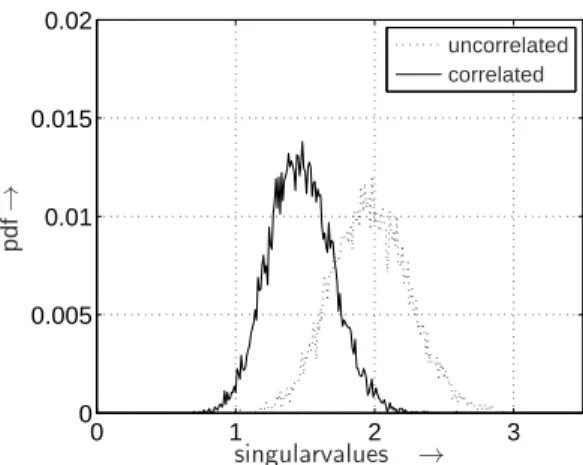
Fig. 4 shows a comparison between the PDF of the geometric mean of the singular values of the matrix
0 1 2 3 0
0.005 0.01 0.015 0.02
uncorrelated correlated
p
d
f
→
singularvalues →
Figure 4: PDF of the geometric mean of the singular values of the matrixΣwithout correlation (dotted line) and with correlation (solid line) when using L = 3 activated layers
compared to the uncorrelated ones. As an example, analysing the PDF curves for a fixedϑ=2, the prob-ability of the geometric mean of the singular values in the uncorrelated GMD-based MIMO channel takes 10 times (approximately) larger than in the correlated one. This means that increasing the correlation, the probability of having larger values decreases and con-sequently, the MIMO performance drops. Further comparisons between the BER performance of the SVD-based and the GMD-based MIMO systems are accomplished in following sections.
3
QUALITY CRITERIA
The quality criteria considered for end-to-end wireless communication system performance is given in terms of the bit-error-rate (BER), which quantifies the reliability of the entire wireless system from input to output.
In order to optimize the overall channel perfor-mance the argument of the complementary error func-tion, also known as signal-to-noise ratio (SNR), is maximized as an alternative to minimizing the BER. The SNR per quadrature component is defined by
ρ=(UA) 2
(UR)2 , (8)
where UAis the half vertical eye opening and UR2 is the noise power per quadrature component taken at the detector input. The relationship between the signal-to-noise ratio ρ and the bit-error probability evaluated for AWGN channels and M-ary Quadrature Amplitude Modulation (QAM) is given by
xℓ,k yℓ,k
wℓ,k p
ξℓ,k
Figure 5: System model per MIMO layerℓand transmitted data block k after SVD pre- and post-processing
Pb= 2 log2(M)·
1−√1
M
·erfc
rρ
2
. (9)
The application of the SVD pre- and post-processing leads to an unequally weighted SISO channel (see Fig. 5) with different eye openings per activated MIMO layerℓand per transmitted symbol block k according to
UA(ℓ,k)=qξℓ,k·Usℓ , (10)
where Usℓdenotes the half-level transmit amplitude assuming Mℓ-ary QAM andpξℓ,krepresents the
pos-itive square roots of the eigenvalues of the matrix
HHH. Considering QAM constellations, the
aver-age transmit power per MIMO layer Psℓmay be ex-pressed as
Psℓ= 2 3 U
2
sℓ(Mℓ−1) . (11) By taking L≤min(nT,nR)MIMO activated lay-ers into account, the overall transmit power results in
Ps= L
∑
ℓ=1
Psℓ . (12)
where Psis the total available power at the trans-mit side. The layer-specific bit-error probability at the time slot k is obtained by combining (8), (9), and (10) resulting in
Pb(ℓ,k)= 2 log2(Mℓ)
1−√1
Mℓ
erfc U (ℓ,k) A
√ 2UR
!
.
(13) The aggregate bit-error probability at the time slot k, taking L activated MIMO-layers into account, re-sults in
Pb(k)= L 1
∑
ν=1
log2(Mν) L
∑
ℓ=1
log2(Mℓ)Pb(ℓ,k) . (14)
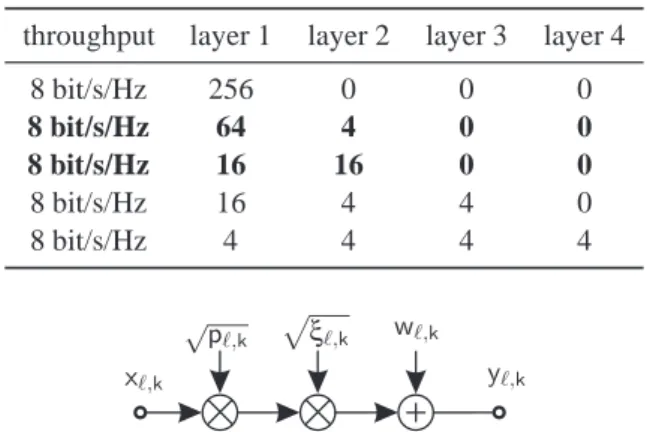
Table 1: Investigated QAM transmission modes assuming nR=nT=4
throughput layer 1 layer 2 layer 3 layer 4
8 bit/s/Hz 256 0 0 0
8 bit/s/Hz 64 4 0 0
8 bit/s/Hz 16 16 0 0
8 bit/s/Hz 16 4 4 0
8 bit/s/Hz 4 4 4 4
xℓ,k yℓ,k
wℓ,k p
ξℓ,k √p
ℓ,k
Figure 6: Resulting layer-specific system model including MIMO-layer PA
power loading provides helpful strategies to improve the overall performance. The bit error probability at a given time k is influenced by both the chosen QAM constellation and the layer-specific weighting factors. In particular, the layer-specific weighting factors in-fluence the overall performance.
4
RESOURCE ALLOCATION
Resource allocation strategies allow the optimiza-tion of the MIMO channel overall performance. Hence, the BER can be minimized under the con-straints of a fixed data rate and a limited avail-able transmit power. Regarding the channel qual-ity, the BER performance is affected by both the layer-specific weighting factorspξℓ,kand the
QAM-constellation size Mℓ. Assuming a fixed data rate, regardless of the channel quality, Table 1 highlights the resulting layer-specific QAM constellations for a fixed spectral efficiency of 8 bit/s/Hz. Following the allocation of bits per layer, power allocation (PA) can be added to optimize the overall BER. The layer-specific power allocation weights √pℓ,k adjust the
half-vertical eye opening per symbol block as follows (see Fig. 6)
UA PA(ℓ,k)=√pℓ,k·
q
ξℓ,k·Usℓ . (15) This results in the layer-specific transmit power per symbol block k
Ps PA(ℓ,k)=pℓ,k·Psℓ , (16) where Psℓdenotes the allocated power per MIMO layer without PA e. g. Psℓ=Ps/L. Therein the param-eter L describes the number of activated MIMO
lay-Table 2: Investigated channel profiles for studying the effect of optimum power allocation
Profile layer 1 layer 2 layer 3 layer 4
CM-1 1,7500 0,8750 0,4375 0,2188 CM-2 1,9000 0,6333 0,2111 0,0704
ers. Taking all activated MIMO layers L into account, being L≤min(nT,nR), the overall transmit power per symbol block k is obtained as
Ps PA(k) = L
∑
ℓ=1
Ps PA(ℓ,k) . (17)
With (15) the layer-specific bit-error probability at the time k changed to
Pb PA(ℓ,k)= 2 log2(Mℓ)
1−√1
Mℓ
erfc U (ℓ,k) A PA
√ 2UR
!
.
(18) In order to find the optimal set of PA parameters minimizing the overall BER, i. e.,√pℓ,k, the Lagrange
multiplier method is used. The cost function for this method J(p1,k,p2,k, . . . ,pL,k)may be expressed as
J(· · ·) = 1 L
∑
ν=1
log2(Mν) L
∑
ℓ=1
log2(Mℓ)Pb(ℓ,k)+λ·B ,
(19) whereλdenotes the Lagrange multiplier. The pa-rameter B in (19) describes the boundary condition to meet the overall transmit power constraints
B =
L
∑
ℓ=1
Psℓ−Ps PA(ℓ,k)
=0 (20)
= L
∑
ℓ=1
Psℓ(1−pℓ,k) =0 . (21)
Assuming Psℓ=Ps/L, the boundary condition re-sults in
B=Ps L
L
∑
ℓ=1
(1−pℓ,k) =0 . (22)
Given (22), the transmit power coefficients have to fulfill the following equation ∑Lℓ=1pℓ,k =
L. Differentiating the Lagrangian cost function J(p1,k,p2,k, . . . ,pL,k)with respect to the pℓ,k and
the fixed channel profiles shown in Table 2 are inves-tigated. For comparison reasons, the channel profile CM-1 describes a MIMO channel with a low degree of correlation (ϑ=0,125) whereas the channel CM-2 introduces a higher degree of antennas’ correlation (ϑ=0,037). In this case the unequal weighting of the layers becomes stronger compared to the channel profile CM-1.
Since the optimal PA solution is notably computa-tionally complex to implement, a suboptimal solution which concentrates on the argument of the comple-mentary error function is investigated. In this particu-lar case the signal-to-noise ratio
ρ(ℓ,k) PA =
UA PA(ℓ,k)2
U2 R
(23)
is assumed to be equal for all activated MIMO layers per data block k,i. e.,ρ(PAℓ,k) =constant ℓ = 1,2, . . . ,L.
Assuming that the transmit power coefficient per layer is uniformly distributed, the power to be allo-cated to each activated MIMO layerℓand transmitted data block k can be simplified as follows:
pℓ,k=
(Mℓ−1)
ξℓ,k ·
L
L ∑ ν=1
(Mν−1) ξν,k
. (24)
Hence, for each symbol the same half vertical eye opening of (15) can be guaranteed (ℓ=1, . . . ,L), i. e.,
UA PA(ℓ,k) =constant ℓ=1,2, . . . ,L . (25)
Considering an identical noise power at the de-tector’s input, the above-mentioned equal quality sce-nario is encountered.
The BER curves for channel profiles CM-1 and CM-2 are shown in Fig. 7 and Fig. 8. In order to use the MIMO channel in an optimized way not all the MIMO layers should be necessarily activated. Fur-thermore, PA in combination with an appropriate se-lection of number of activated MIMO layers guaran-tees the best BER performance when transmitting at a fixed data rate of with spectral efficiency 8 bit/s/Hz.
In Fig. 9 the obtained BER curves with the opti-mal PA based on the Lagrange multiplier method are shown considering the above mentioned equal qual-ity criteria. As demonstrated by computer simulations the loss in the overall BER with the equal quality cri-teria is quite acceptable when using the optimized bit loading.
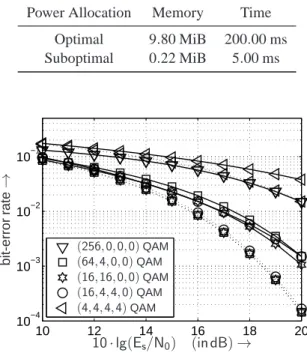
Table 3 compares the memory usage and CPU time required to execute the optimal and suboptimal solutions with a processor AMD A4−5300 APU at 3.40Ghz. It turned out that the proposed suboptimal
Table 3: Investigated PA methods for comparing the computational load assuming a (4×4) MIMO system at 10 log10(Es/N0) =20 dB
Power Allocation Memory Time
Optimal 9.80 MiB 200.00 ms Suboptimal 0.22 MiB 5.00 ms
10 12 14 16 18 20
10−4 10−3 10−2 10−1
10·lg(Es/N0) (in dB)→
b
it
-e
rr
o
r
ra
te
→
(256,0,0,0)QAM
(64,4,0,0)QAM
(16,16,0,0)QAM
(16,4,4,0)QAM
(4,4,4,4)QAM
Figure 7: BER with optimal PA (dotted line) and without PA (solid line) when using the transmission modes introduced in Table 1 and transmitting 8 bit/s/Hz over channel CM-1
equal-SNR PA technique presents a lower complexity and computational load than the optimal one.
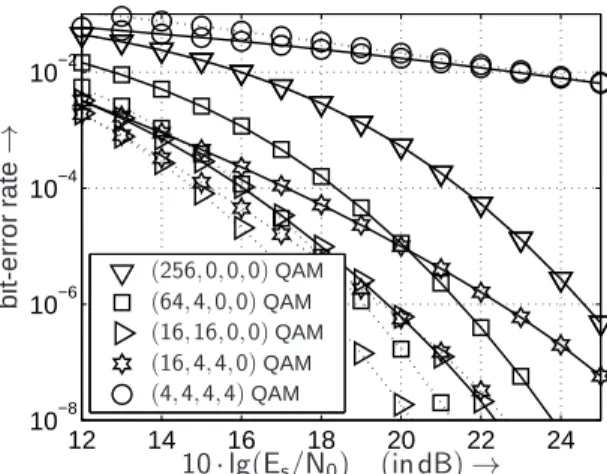
Fig. 10 shows a comparison of the BER curves among the QAM transmission modes listed in Ta-ble 1 with and without PA when transmitting 8 bit/s/Hz over uncorrelated frequency non-selective MIMO channels. It can be seen that not all MIMO layers should be activated in correlated as well as in uncorrelated MIMO channels to minimize the overall BER while transmitting at a fixed date rate.
5
RESULTS
In this section the computer simulation results concerning the analysis of the SVD-based and the GMD-based MIMO systems are shown. These re-sults highlight the bit- and power-allocation strategies which obtain the best performance. Furthermore, the best results are compared when using the SVD-based and GMD-based systems.
10 12 14 16 18 20 10−4
10−3 10−2 10−1
10·lg(Es/N0) (in dB)→
b
it
-e
rr
o
r
ra
te
→
(256,0,0,0)QAM
(64,4,0,0)QAM
(16,16,0,0)QAM
(16,4,4,0)QAM
(4,4,4,4)QAM
Figure 8: BER with optimal PA (dotted line) and without PA (solid line) when using the transmission modes introduced in Table 1 and transmitting 8 bit/s/Hz over channel CM-2
10 12 14 16 18 20
10−3 10−2 10−1
10·lg(Es/N0) (in dB)→
b
it
-e
rr
o
r
ra
te
→
(16,16,0,0)QAM
(16,4,4,0)QAM
Figure 9: BER with optimal PA (dotted line), equal-SNR PA (dashed line) and without PA (solid line) when using the transmission modes introduced in Table 1 and transmitting 8 bit/s/Hz over channel CM-2
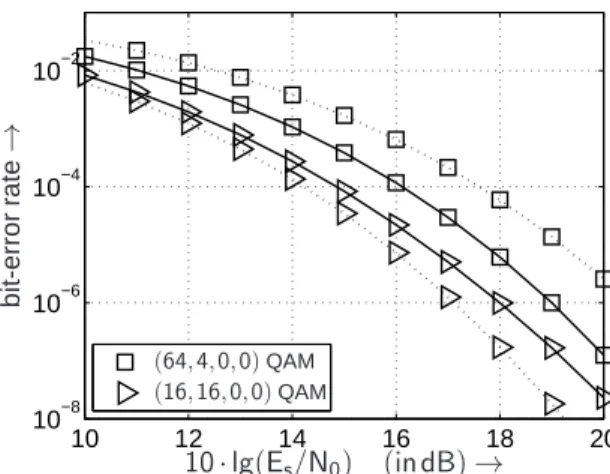
Fig. 11 shows the BER curves of the SVD-based MIMO system and remarks the poor performance ob-tained in the presence of correlation. When transmit-ting the same QAM constellation through the best two layers, the channel affected by antennas’ correlation performs much worse than the uncorrelated. On the other hand, when transmitting unequal QAM constel-lations through the two activated layers, the channel affected by antennas correlation performs worse than the uncorrelated, but the performance difference is not as notably as the case with equal QAM constellations. This means that bit-allocation is specially useful in MIMO channels affected by antennas’ correlation.
Fig. 12 shows the BER performance of the GMD-based (4×4) MIMO system (assuming perfect re-maining interference cancellation) compared to the
12 14 16 18 20 22 24
10−8 10−6 10−4 10−2
10·lg(Es/N0) (in dB)→
b
it
-e
rr
o
r
ra
te
→
(256,0,0,0)QAM (64,4,0,0)QAM (16,16,0,0)QAM (16,4,4,0)QAM (4,4,4,4)QAM
Figure 10: BER with PA (dotted line) and without PA (solid line) when using the transmission modes introduced in Table 1 and transmitting 8 bit/s/Hz over uncorrelated fre-quency non-selective MIMO channels
SVD-based(4×4)MIMO system, both for frequency non-selective channels. Fig. 13 extends that analy-sis to the case in which the channels are affected by antennas correlation. The analysis of Fig. 12 high-lights that when unequal QAM modes are used on the two activated layers (consider the transmission mode analysed), the SVD-based system presents a superior performance than the GMD-based. This is due to the unequal performance of the two layers in the SVD-based MIMO system.
On the other hand, when transmitting equal QAM modes through the two activated layers, the GMD-based MIMO system shows the best results, as both layers present the same performance. These conclu-sions are reinforced by the results in Fig. 13 for cor-related channels. In this case, as the performance of the two activated layers is much more different in the SVD-based MIMO system, the use of unequal QAM modes along the activated layers becomes more im-portant to obtain a better performance. In this case the SVD-based system shows a superior performance than the GMD-based. Nevertheless, the results high-light that the use of equal QAM modes along the acti-vated layers is much more appropriate for the GMD-based MIMO system. Then, GMD-GMD-based MIMO sys-tems do not require bit allocation strategies to obtain the best performance. Nevertheless, SVD-based sys-tems require bit allocation to improve the channel per-formance.
cor-10 12 14 16 18 20 10−8
10−6 10−4 10−2
10·lg(Es/N0) (in dB)→
b
it
-e
rr
o
r
ra
te
→
(64,4,0,0)QAM (16,16,0,0)QAM
Figure 11: BER performance with SVD processing and equal-SNR PA when using the transmission modes intro-duced in Table 1 and transmitting 8 bit/s/Hz over frequency non-selective(4×4) MIMO channels without correlation (solid line) and with correlation (dotted line)
responds to the(nT×1)transmitted vector followed by a modulo reduction which suppresses the power enhancement. Assuming perfect channel state infor-mation is available at the transmitter side, Htis given
by
Ht=Σ−diag(Σ)·I , (26)
whereΣcorresponds with a real upper triangular matrix, diag(·)are the main diagonal elements and I is the identity matrix. The modulo operator (Fig. 14) constraints the real and imaginary part of the trans-mit symbols into the boundary constellation of width of the modulo operator. This modulo is defined by modulo(∆·q) =modulo(2·Us·q), where∆is the dis-tance between two adjacent symbols, Us denotes the half-level transmit amplitude and q=√M, being M the modulation index in every active MIMO layer.
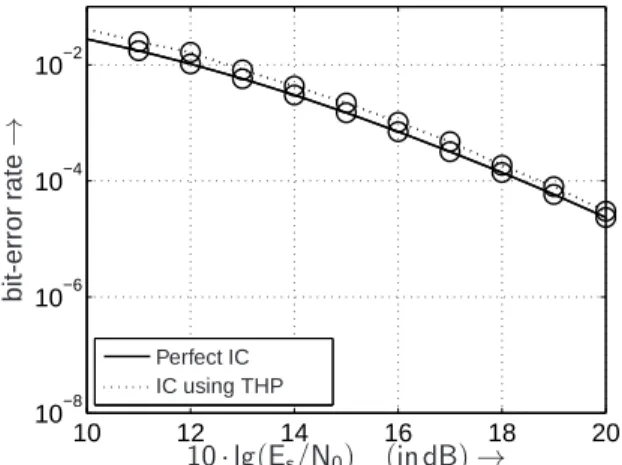
In Fig. 15 a comparison between perfect inter-ference cancellation technique and THP interinter-ference cancellation for a(4,4,4,4)QAM transmission mode is shown. The results reveal that the GMD-based MIMO system performance with THP is close to those obtained when perfect interference cancellation is assumed. The losses are about 0.5 dB compared to the perfect cancellation. In consequence the THP seems to be an appropriate strategy to eliminate the GMD-based system remaining interference with little computational complexity overhead.
10 12 14 16 18 20
10−8 10−6 10−4 10−2
10·lg(Es/N0) (in dB)→
b
it
-e
rr
o
r
ra
te
→
(64,4,0,0)QAM (16,16,0,0)QAM
Figure 12: BER curves with GMD processing (dotted line) assuming perfect interference cancellation compared to BER curves with SVD (solid line) when using the trans-mission modes introduced in the legend with equal-SNR PA and transmitting 8 bit/s/Hz over frequency non-selective (4×4)MIMO channels without antenna correlation
10 12 14 16 18 20
10−8 10−6 10−4 10−2
10·lg(Es/N0) (in dB)→
b
it
-e
rr
o
r
ra
te
→
(64,4,0,0)QAM (16,16,0,0)QAM
Figure 13: BER curves with GMD technique (dotted line) assuming perfect interference cancellation compared to BER curves with SVD (solid line) when using the trans-mission modes introduced in the legend with equal-SNR PA and transmitting 8 bit/s/Hz over frequency non-selective (4×4)MIMO channels with antenna correlation
6
CONCLUSION
-modulo
Ht
z−1
x c
Figure 14: Tomlinson-Harashima precoding model in the transmission side for MIMO systems
10 12 14 16 18 20
10−8 10−6 10−4 10−2
10·lg(Es/N0) (in dB)→
b
it
-e
rr
o
r
ra
te
→
Perfect IC IC using THP
Figure 15: BER comparison between Perfect Interfer-ence Cancellation and InterferInterfer-ence Cancellation using THP when using the transmission mode(4,4,4,4)and transmit-ting 8 bit/s/Hz over uncorrelated frequency non-selective GMD-based MIMO channels
performance losses.
A relevant challenge and achievement of this in-vestigation is the introduction of the GMD signal pro-cessing to improve the MIMO channel performance. The analysis focusses on both uncorrelated and corre-lated(4×4)MIMO channels and the results are com-pared with those obtained when using the SVD signal processing, combined with bit- and power-allocation techniques.
GMD-based MIMO systems show remaining inter-antennas interferences. Hence, some additional signal processing techniques must be applied to re-move it. The THP has demonstrated to be an appro-priate technique to remove the interferences with low losses compared to the perfect interference elimina-tion case.
According to the obtained results the combination of GMD-based MIMO systems with the THP shows a noteworthy BER performance improvement com-pared to the SVD-based MIMO system. First, assum-ing the remainassum-ing inter-antennas interferences have been completely removed, the GMD-based MIMO system shows equal quality SISO channels (layers)
and, in consequence, bit- and power-allocation tech-niques are not required as they do not improve the channel performance. Conversely, the performance drops. This conclusion applies to both antennas un-correlated and un-correlated channels. The SVD-based MIMO channel requires the application of bit- and power- allocation techniques to improve the perfor-mance, as it presents unequal quality layers. Second, when bit allocation is applied to both the SVD-based and GMD-based MIMO systems, as shown in our work, the SVD-based one presents a superior perfor-mance, because in the GMD-based system the advan-tage of having equal quality layers is not taken when transmitting data with different QAM constellation sizes. Finally, the obtained results demonstrate that the GMD-based MIMO system with remaining inter-antennas interference cancellation by using the THP shows a superior performance than the SVD-based system without requiring bit- and power-allocation techniques, which notably reduces the computational complexity and overhead.
REFERENCES
Abdi, A. and Kaveh, M. (2002). A Space-time Correlation Model for Multielement Antenna Systems in Mobile Fading Channels. IEEE Journal on Selected Areas in Communications, 20:550–560.
Benavente-Peces, C., Cano-Broncano, F., Ahrens, A., Ortega-Gonzalez, F., and Pardo, J. (2013). Analysis of Singular Values PDF and CCDF on Receiver-Side An-tennas Correlated MIMO Channels. Electronics Let-ters, 49, Issue: 9:625–627.
Cano-Broncano, F., Ahrens, A., and Benavente-Peces, C. (Lisboa, (Portugal), 7-9 January 2014). Iterative Bit- and Power Allocation in Correlated MIMO Sys-tems. In International Conference on Pervasive and Embedded Computing and Communication Systems (PECCS).
Chiani, M., Win, M., and Zanella, A. (2003). On the Capac-ity of Spatially Correlated MIMO Rayleigh-Fading Channels. IEEE Transactions on Information Theory, 49:2363–2371.
Jiang, Y., Hager, W., and Jian, L. (2008). The Generalized Triangular Decomposition. Mathematics of Computa-tion, 77:1037–1056.
Jiang, Y., Li, J., and Hager, W. (2005). Joint Transceiver Design for MIMO Communications Using Geometric Mean Decomposition. IEEE Transactions on Signal Processing, 53:3791–3803.
Loyka, S. and Tsoulos, G. (2002). Estimating MIMO Sys-tem Performance using the Correlation Matrix Ap-proach. IEEE Communications Letters, 6:19 – 21. Shiu, D.-S., G.J, F., Gans, M., and Kahn, J. (1998). Fading
multi-element Antenna Systems. In Universal Personal Communications.
Yang, P., Xiao, Y., Yu, Y., and Li, S. (2011). Adaptive Spatial Modulation for Wireless MIMO Transmission Systems. IEEE Communications Letters, 15:602–604. Zanella, A. and Chiani, M. (2012). Reduced Complexity Power Allocation Strategies for MIMO Systems with Singular Value Decomposition. IEEE Transactions on Vehicular Technology, 61:4031–4041.