Kinematic analysis of small-scale faults and its
applica-tion to the study of an extensional depocentre,
Neuquén basin, west-central Argentina
F. B
ECHIS1, 2*ANDL. G
IAMBIAGI11CONICET - Instituto Argentino de Nivología, Glaciología y Ciencias Ambientales (IANIGLA), CCT Mendoza, CC 330,
CP 5500, Mendoza, Argentina.
2Laboratorio de Modelado Geológico, Facultad de Ciencias Exactas y Naturales, Universidad de Buenos Aires, Pabellón 2,
Ciudad Universitaria, CP 1428, Buenos Aires, Argentina.
*e-mail: [email protected]
Abstract: In this contribution we present a case study where valuable structural information on the extensional architecture of the Atuel depocentre (Neuquén basin) is obtained from kinematic analysis of small-scale normal faulting. The area was subsequently inverted during the Andean uplift, conceal-ing most of the previous rift episode. We integrated the results of the kinematic analysis of minor faults with data from inferred major normal faults. We found a wide dispersion of the results obtained by the inversion method of fault-slip data, suggesting that the observed fault patterns reflect local deforma-tions instead of responding to the regional stress field.
Keywords:rift basin, Andes, fault-slip data, transtension, oblique rifting, reactivation.
The kinematic study of small-scale faults can be crucial for the recognition of previous tectonic events in areas that have undergone several defor-mation stages. Major faults related to previous deformation are often reactivated or covered dur-ing subsequent tectonics, makdur-ing difficult their recognition and study. On the other hand, small-scale faults often escape subsequent reactivation and are generally abundant and well exposed (Schlische et al., 1996; Homberg et al., 2002). Moreover, strain or stress inversion methods car-ried out with slip data from small-scale faults can give important information about the kinematics and/or dynamics of previous tectonic stages (Carey and Brunier, 1974; Angelier, 1984; Marrett and Allmendinger, 1990).
Methodology
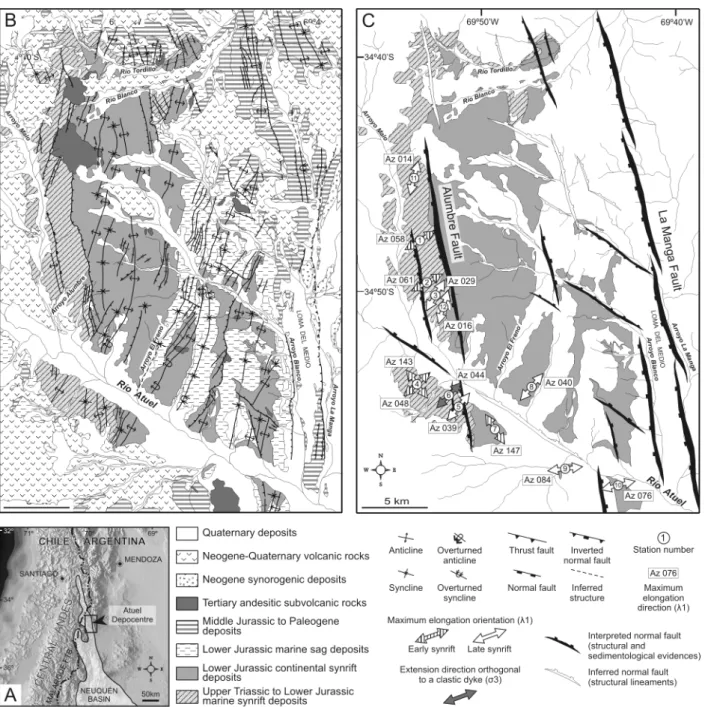
In order to recognize the main normal faults that were active during the Mesozoic rifting, we carried out a detailed mapping of the Cenozoic compressive struc-tures, based on our field observations and subsurface data (Fig. 1B). We integrated our structural analysis with previous sedimentological and stratigraphic studies (Lanés, 2005, 2007), constraining the
loca-tion, orientation and timing of the main normal faults (Fig. 1C).
We identified in the field more than 300 small-scale nor-mal faults with displacements ranging from a few cen-timetres to several meters, widely distributed in a number of localities within the study area (Fig. 1C). We measured values of strike, dip, and amount and sense of displace-ment (from kinematic indicators). We dated the strata
where the normal faulting was observed following the biostratigraphic scheme of Riccardi et al. (1991). After restoring the data to their original position (pre-Andean folding) we processed the fault-slip data using the R.W. Allmendinger’s FaultKinWin program in order to obtain the orientation of the main axes of the strain ellipsoid (λ1,
λ2 andλ3) for each location. We used the method based on Bingham distribution statistics (Marrett and Allmendinger, 1990), comparing the obtained values and evaluating possible regional, local and temporal changes. Finally, we integrated the results of small-scale fault-slip analysis with timing and orientation of the previously identified major normal faults.
Results
The extensional structure of the Atuel depocentre is characterized by the presence of the NNW-trending La Manga and Alumbre major faults, evidenced by the distribution of the synrift deposits in outcrops and from subsurface data (Fig. 1C, Giambiagi et al., 2005, 2008). These faults limited two major half-grabens, controlling the main subsidence of the basin and the distribution of sedimentary environments during the synrift phase (Fig. 1C). Inside the half-grabens, we interpreted a bimodal distribution of nor-mal faults with NNW and WNW trends (Fig. 1C).
During the Andean deformation, some of these faults were reactivated as inverse or accommodation faults, while in other cases they had a passive role evidenced by the bending of compressive structures.
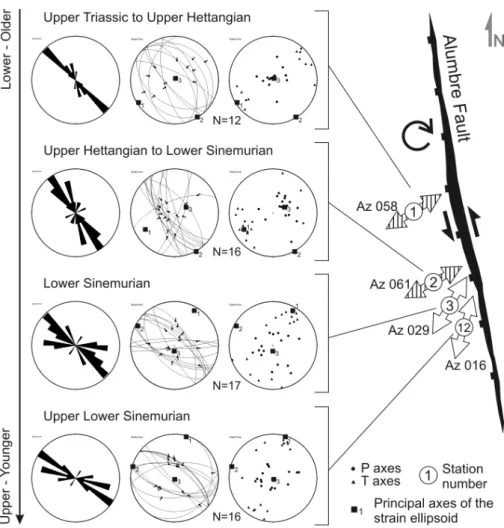
We found a wide range of orientations for the small-scale normal faults, ranging from WNW to NE (Figs. 2 and 3). In all cases the intermediate and major axes of the strain ellipsoid (λ2 andλ1) show a nearly horizontal position after the strain inver-sion, indicating an extensional tectonic regime. WNW- to NNE-trending faults show a dispersion of the maximum elongation directions (λ1) from NNE to ENE directions, with a NE mean value of Az 055º (Figs. 2 and 3). On the other hand, in two
localities we measured NE-oriented normal faults that indicate a NW-directed extension (Fig. 2). As these stations are located near the hinge of two major NE-trending Andean anticlines (Fig. 1), we interpret these structures as faults possibly related to bending of strata during Cenozoic compression-al folding.
The obliquity between the main NNW rift trend, marked by the orientation of the La Manga and Alumbre major normal faults, and the calculated mean elongation direction (Az 055º) suggests that the Atuel depocentre acted as an oblique rift. The orientation of the principal faults is similar to the orientation of Permian-Triassic shear zones (Japas and Kleiman, 2004), indicating that they could have formed as the result of normal or oblique-normal slip reactivation of previous discrete structures. These reactivated struc-tures localized great part of the strain during the rift-ing stage. We estimated a regional extension oriented in a NNE direction, with possible refraction of the elongation to a NE direction inside the rifted area respect to the regional motion (Teyssier et al., 1995).
Close to the Alumbre fault we observed a variation of the elongation direction (λ1) from ENE to NNE, from older to younger deposits, respectively (Fig. 3). We evaluated a possible change in the regional extension direction form ENE to NNE during the opening of the depocentre, but we dis-carded it because in the eastern sector we
ed an ENE elongation direction affecting the late synrift deposits (Figs. 1C and 2). An angular unconformity present between stations 2 and 3 near the Alumbre fault suggests that the extension direction had a NNE to NE orientation, and that local clockwise rotation could have occurred in the hanging-wall of the fault. This constitutes an inde-pendent evidence for our proposal of an oblique left-lateral movement for the Alumbre fault, as a reactivated discrete structure under NNE to NE extension.
On the other hand, we observed a spatial variation from NE extension directions in the western sector of the Atuel depocentre, to ENE directions in the south-eastern sector (Fig. 2). One possible explanation for this variation is to infer a local perturbation of the stress field near the La Manga major fault. Other pos-sibility is to attribute these changes to strain variations related to the oblique stretching of the rift basin. Normal faulting sub-parallel to the rift is likely to occur near its borders, and faults sub-orthogonal to the regional extension direction are generally more common towards the centre of the extended area, as was observed in analogue models of oblique rifting (McClay and White, 1995). If this is the case the La Manga fault probably had a predominantly normal slip, at least during the late synrift, in contrast with the oblique slip inferred for the Alumbre fault.
Discussion
Major faults are formed by finite or accumulative strain, and they can be the result of reactivation of previous anisotropies or can undergo a progressive syntectonic rotation along their activity history. They usually control the location of rift basins and their main depocentres, being one of the main factors that affect the distribution of depositional environments. On the other hand, small-scale normal faults could be considered as representing instantaneous strain. As was previously noted (Homberg et al., 2002) and as we showed here, they can be very useful in areas that underwent subsequent deformation episodes, where major faults have been reactivated or obscured by newly formed structures.
An important matter of discussion is the question whether to consider fault slip data in terms of kine-matic (strain) or dynamic (stress) terms (Marrett and Allmendinger, 1990; Twiss and Unruh, 1998). Are the small-scale normal faults of our case study (the Atuel depocentre) reflecting accommodation of strain in the hanging-wall of major faults or are they reflecting local perturbations of the stress field? We postulate that it is difficult to infer the regional stress field from our data because they show a wide disper-sion of the results obtained by the inverdisper-sion method. The heterogeneity of our results seems to favour the hypothesis that the fault patterns are reflecting local deformations instead of responding to the regional stress field, in agreement with the proposal present-ed by Gapais et al.(2000).
Conclusions
In this contribution we presented an integrated multi-scale faulting analysis for the study of an extensional basin, the Atuel depocentre of the Neuquén basin. This sub-basin has a main NNW orientation con-trolled by two major normal faults, La Manga and Alumbre. We interpreted them as reactivated discrete structures with normal and oblique normal-sinistral movement, respectively. We carried out a detailed kinematic analysis of the small-scale faulting data, obtaining NNE to ENE elongation directions for the synrift stage. The obliquity between the main rift trend and the calculated elongation directions from the fault-slip analysis suggests that the Atuel depocen-tre acted as an oblique rift. We conclude that slip-data obtained from small faults inside the studied oblique rift are best interpreted in terms of strain than stress.
Acknowledgements
We would like to thank Victor García, Julieta Suriano, José Mescua, Maisa Tunik, Carla Terrizzano, Marilin Peñalva, Gabriela Da Poian and Sergio Orts for their valuable help in the field. We are specially thanked to Silvia Lanés and Ernesto Cristallini for many fruitful discussions and comments. We also thank Drs. S. Damborenea, M. Manceñido and A. Riccardi, who carried out the biostratigraphic studies at the Universidad Nacional de la Plata.
References
ANGELIER, J. (1984): Tectonic analysis of fault slip data sets. J. Geophys. Res., 89, B7: 5835-5848.
CAREY, E. and BRUNIER, B. (1974): Analyse théorique et numérique
d´un modèle mécanique élémentaire appliqué à l´étude d´une population de failles. C. R. Acad Sci., Paris, 279, 11: 891-894.
GAPAIS, D., COBBOLD, P. R., BOURGEOIS, O., ROUBY, D. andDE
URREIZTIETA, M. (2000): Tectonic significance of fault-slip data.
J. Struct. Geol., 22: 881-888.
GIAMBIAGI, L., BECHIS, F., GARCÍA, V. and CLARK, A. (2008): Temporal and spatial relationship between thick- and thin-skinned deformation in the thrust front of the Malargüe fold and thrust belt, Southern Central Andes. Tectonophysics, 459: 123-139.
HOMBERG, C., BERGERAT, F., PHILIPPE, Y., LACOMBE, O. and ANGELIER, J. (2002): Structural inheritance and Cenozoic stress fields in the Jura fold-and-thust belt (France). Tectonophysics, 357: 137-158.
JAPAS, M. S. and KLEIMAN, L. E. (2004): El ciclo Choiyoi en el bloque de San Rafael (Mendoza): de la orogénesis tardía a la relajación mecáni-ca. Rev. As. Geol. Argent., Serie D, 7: 89-100.
LANÉS, S. (2005): Late Triassic to Early Jurassic sedimentation in
northern Neuquén Basin, Argentina: Tectonosedimentary evolu-tion of the first transgression. Geol. Acta, 3, 2: 81-106.
LANÉS, S. (2007): Depósitos fluviales de la Formación El Freno en el valle del Atuel, sur de Mendoza: datos preliminares. 3º Simposio Argentino Jurásico, Abstracts: 49.
MARRETT, R. and ALLMENDINGER, R. W. (1990): Kinematic analysis of fault-slip data. J. Struct. Geol., 12, 8: 973-986.
MCCLAY, K. R. and WHITE, M. J. (1995): Analogue modelling of
orthogonal and oblique rifting. Mar. Petrol. Geol., 12: 147-151.
RICCARDI, A., DAMBORENEA, S., MANCEÑIDO, M. O. and BALLENT, S. C. (1991): Hettangian and Sinemurian (Lower Jurassic) biostratigraphy of Argentina. J. S. Am. Earth Sci., 4, 3: 159-170.
SCHLISCHER. W., YOUNG, S. S., ACKERMANN, R. V., and GUPTA,
A. (1996): Geometry and scaling relations of a population of very small rift-related normal faults. Geology, 24, 8: 683-686.
TEYSSIER, C., TIKOFF, B. and MARKLEY, M. (1995): Oblique plate motion and continental tectonics. Geology, 23, 5: 447-450.
TWISS, R. J. and UNRUH, J. R. (1998): Analysis of fault slip