Conceptualisations of the construct of addiction have changed over the last 30 years. At the centre of these changes is the idea that drug addiction is defi ned not so much by continuous ingestion as by the repetition of a behavioural pattern that is similarly applicable to other types of behaviours (Sussman, Lisha, & Griffi ths, 2011). In accord with line of reasoning, the new nosology set out in the Diagnostic and Statistical Manual of Mental Disorders (DSM-V, American Psychiatric Association, 2010) will include addiction to behaviours. Although the DSM-V will solely include gambling as a behavioural addiction, this new way of thinking about addiction diagnoses demands research into other forms of excessive behaviour that also can be addictive in this sense, such as physical exercise.
To date, research on this topic has identifi ed similarities between exercise addiction and drug addiction (Davis, 2000; Sussman
et al., 2011). In other words, exercise addiction is manifested by a strong desire to exercise—so strong that it becomes an uncontrolled behaviour expressed through physiological symptoms (e.g., tolerance, withdrawal) or psychological symptoms (e.g., anxiety, depression) (Chapman & DeCastro, 1990; Hausenblas & Symons-Downs, 2002a, 2002b). In general, exercise addiction is considered to be a process that leads an individual to repeat the activity despite the obstacles or diffi culties that may follow from it, such as failing to meet professional and family commitments, injuries or medical contraindications (Hamer & Karageorghis, 2007). Exercise addiction has also been referred to as obligatory exercise, compulsive exercise, guided exercise, excessive exercise, abusive exercise and exercise dependence (Davis, 2000; Hausenblas & Symon-Downs, 2002a; Johnston, Reilly, & Kremer, 2011; Pasman & Thompson, 1988). Nevertheless, in this article, the term exercise addiction will be used to conform to the new DSM-V classifi cation.
Prevalence estimates of exercise addiction in the population vary considerably from 2% to approximately 40% (Griffi ths, Szabo, & Terry, 2005; Lejoyeux, Avril, Richoux, Embouazza, & Nivoli, 2008; Symons-Downs, Hausenblas, & Nigg, 2004; Szabo,
Spanish adaptation and validation of the Exercise Addiction Inventory (EAI)
Álvaro Sicilia
1, Antonio Alías-García
1, Roberto Ferriz
1and Juan Antonio Moreno-Murcia
21 Universidad de Almería and 2 Universidad Miguel Hernández de Elche
Abstract
Resumen
Background: The purpose of this study was to validate the Addiction Exercise Inventory (EAI) in the Spanish context. Method: Five hundred and eighty-four university students participated in the study, completing a questionnaire that assessed exercise addiction, exercise frequency and intensity. Results: The results supported the factor structure of the EAI model. An alpha value of .70 and high level of temporal stability (ICC = .92) were obtained. The structure of the model was invariant across gender. A group of 87 students (14.9%) obtained a total score equal to or higher than 24 in the EAI and were classifi ed as being at risk of exercise addiction. Students exercising more than three days per week at high intensity obtained higher scores in exercise addiction than students exercising at low-medium intensity, regardless of their frequency. Conclusions: The
fi ndings of this study showed the reliability and validity of the EAI in a Spanish context, providing a practical instrument that allows screening for exercise addiction.
Keywords: Addiction, exercise, validation, psychometric properties.
Adaptación y validación al español del Inventario de Adicción al Ejercicio (EAI).Antecedentes: el objetivo de este estudio fue validar al contexto español el Inventario de Adicción al Ejercicio (EAI). Método: quinientos ochenta y cuatro estudiantes universitarios participaron en el estudio, completando un cuestionario que evaluaba la adicción al ejercicio físico, la frecuencia y la intensidad de práctica física. Resultados: los resultados apoyaron la validez factorial del modelo del EAI. Se obtuvo un valor alfa de Cronbach igual a .70 y un nivel elevado de estabilidad temporal (ICC = .92). La estructura del modelo se mostró invariante respecto al género. Ochenta y siete estudiantes (14,9%) obtuvieron una puntuación total de 24 o más en el EAI, siendo clasifi cados como en riesgo de adicción. Los estudiantes que informaron realizar ejercicio con una frecuencia de más de tres días a la semana y una intensidad alta puntuaron más alto en adicción al ejercicio que los estudiantes que informaron realizar ejercicio con una intensidad baja-media, independientemente de su frecuencia de práctica semanal. Conclusiones: los resultados proporcionan evidencias para la
fi abilidad y validez del EAI en el contexto español, lo que permite contar con un instrumento práctico y fácil de utilizar que posibilita realizar un tamizaje de la adicción al ejercicio.
Palabras clave: adicción, ejercicio físico, validación, propiedades psicométricas.
Received: January 16, 2013 • Accepted: May 17, 2013 Corresponding author: Álvaro Sicilia-Camacho
Facultad de Ciencias de la Educación, Enfermería y Fisioterapia Universidad de Almería
& Griffi ths, 2007). The variation in these estimates may attributable to differences in the populations targeted for each study; they also may be due to the variety of defi nitions and tools used to measure the construct. For example, Veale (1987, 1995) has even proposed a conceptual difference between primary and secondary exercise addictions in order to differentiate primary addiction from other types of disorders, such as eating disorders, that may underlie excessive physical exercise. According to this distinction, whereas exercise is an end in and of itself in the case of primary exercise addiction, it is used as a means to achieve other ends (e.g., to lose weight) in the case of secondary exercise addiction.
To date, a variety of tools have been developed to measure exercise addiction. The fi rst instruments to be developed were one-dimensional measurements, such as the Commitment to Running Scale (Carmack & Martens, 1979) and the Negative Addiction Scale (Hailey & Bailey, 1982). These early measurements essentially operationalised the relationship between exercise and addiction by means of the manner by which the exercise is performed (e.g., frequency, duration, intensity), biomedical symptoms (e.g., tolerance, abstinence) or psychological symptoms (e.g., giving priority to exercise as opposed to social or professional commitments). However, these one-dimensional measurements only evaluated limited aspects of the addiction and did not provide a comprehensive evaluation of the construct (Hausenblas & Symnons-Downs, 2002a).
More recently, multidimensional models have been developed that liken exercise addiction to substance addiction and, consequently, exercise addiction has been defi ned as a set of varied symptoms (Freimuth, Moniz, & Kim, 2011; Hausenblas & Symons-Downs, 2002b). For example, Ogden, Veale, and Summers (1997) developed the Exercise Dependence Questionnaire (EDQ) based on the clinical criteria of substance dependence established in the DSM-IV (American Psychiatric Association, 1994). Still, only three subscales (i.e., interference with social and professional life, withdrawal and stereotyped behaviour) of the eight included in the EDQ correspond to the criteria presented in the DSM-IV, whereas some items in the remaining subscales evaluate attitudes towards and social aspects of exercise more than actual symptoms of the addiction (Hausenblas & Symons-Downs, 2002a).
Years later, Hausenblas and Symons-Downs developed the Exercise Dependence Scale (EDS; Hausenblas & Symons-Downs, 2002b, 2002c; Symons-Downs et al., 2004), which was the fi rst instrument to conceptualise and operationalise exercise addiction completely within the framework of the seven symptoms defi ned in the DSM-V (i.e., withdrawal, continuance, tolerance, lack of control, reduction other activities, time , and intention effects). The EDS has since undergone revision (Symon-Downs et al., 2004), and the last version contains a total of 21 items (3 for each subscale), with responses scored on six-point Likert scales. Scores on this instrument permit differentiation of the respondents into three groups: a) those at risk of addiction (i.e., those who score 5-6 on the scale for at least three of the seven criteria); b) those considered symptomatic (i.e., those scoring 3 or 4 on the scale for at least three criteria or those scoring 5-6 combined with scores of 3-4 for three criteria, without fulfi lling the conditions of the group at risk of addiction); and c) those regarded as asymptomatic (i.e., those scoring 1-2 on the scale for at least three criteria, without fulfi lling the conditions of the non-addicted symptomatic group).
Although the EDS enjoys a solid theoretical foundation by operationalising dependence symptoms according to DSM-IV
criteria, it is hardly practical for use in the daily work of sports doctors, occupational physiotherapists instructors and sport trainers on account of the time-intensiveness of its administration and the diffi culties of calculating a score to identify individuals at risk of addiction. In an attempt to address these limitations, Terry, Szabo, and Griffi ths (2004) examined the instrument’s psychometric properties and developed the Exercise Addiction Inventory (EAI), an abbreviated, practical instrument for measuring exercise addiction.
The EAI is an instrument based more on the theory of addiction to behaviours than on criteria perceived as important by the researcher (e.g., the EDQ) or criteria for substance dependence (e.g., the EDS). Consequently, it is better aligned with the new classifi cation system provided by the DSM-V. In the EAI, the symptoms of exercise addiction are expressed through the six components of behaviour addiction defi ned by Griffi ths (1996): a) salience—the degree to which physical exercise becomes the most important activity and dominates the other facets of an individual’s life; b) mood modifi cation—the subjective experience reported as a consequence of doing exercise; c) tolerance—the tendency towards increasing the amount of exercise practised in order to experience the desired effects; d) withdrawal—the unpleasant feeling or physical experience caused by interrupting or drastically reducing exercise; e) confl ict—the tension that may arise as a consequence of the exercise addiction between the individual and those closest to him or her (interpersonal confl ict) or within the person (intrapsychic confl ict) due to the activity itself; and f) relapse—the tendency to repeat the same (or exaggerated) exercise patterns after a certain time without doing the activity or after withdrawal from the activity due to injury. Each one of these six items included in the instrument refl ects a component of addiction. Moreover, the EAI, which uses a summed score of all items on a fi ve-point Likert scale, is a categorisation tool that can distinguish between persons who are at risk of exercise addiction (i.e., scores of 24 or more), those who show some symptoms (i.e., scores between 13 and 23) and those who do not show symptoms of addiction (i.e., scores between 0 and 12).
Using a sample of 200 university students, Terry et al. (2004) analysed the psychometric validity of the EAI by observing its high correlation with other tools measuring the same construct, such as the Obligatory Exercise Questionnaire (OEQ; Pasman & Thompson, 1988) (r = .80) and the EDS (r = .81). This supports the idea that the EAI identifi es the same construct measured by previous instruments despite using different theoretical bases for their defi nitions. Furthermore, the reliability of the instrument has been demonstrated in an independent sample of 79 students who engaged in physical exercise (Griffi ths et al., 2005).
Hailey & Bailey, 1982; Kjelsas, Augestad, & Götestam, 2003; Pierce, McGowan, & Lynn, 1993). However, some authors have indicated that research should consider the intensity with which exercise is performed in addition to its frequency and duration (Allegre, Therme, & Griffi ths, 2007; Sicilia & González-Cutre, 2011). Indeed, an individual who only exercises six hours per week may be experiencing more exercise addiction than a person who engages in 10 or more hours of exercise, if the former’s exercise intensity is greater. Thus, research should clarify the relationship between exercise addiction and a combination of various factors (e.g., the frequency and intensity of the exercise) that would better account for the forms and habits of physical activity. Based on previous studies, it was hypothesised that the participants who reported doing physical exercise with greater frequency and intensity would score higher on measures of exercise addiction.
Method
Participants
Five hundred and eighty-four students belonging to three Spanish universities (378 men and 206 women), aged 18 to 55 (M = 22.13; SD = 3.93), participated in this study. Four hundred and thirty-seven were students of Physical Education and Sport Sciences, whereas 147 were studying other disciplines, such as business administration and management, psycho-pedagogy, psychology and labour relations. All participants reported doing exercise in their free time.
Measurements
Inventario de Adicción al Ejercicio (EAI. The Spanish version of the Exercise Addiction Inventory (Terry et al., 2004)was used. This instrument has six items, (e.g., “when I don’t do exercise, I feel guilty”). The scale was preceded by the following question: “To what degree do you agree with the following statements?” Participants were instructed to respond on a Likert scale ranging from 1 (Completely disagree) to 5 (Completely agree), with higher scores indicating greater risk of exercise addiction. The instrument has established cut-off scores to classify respondents with regard to their levels of exercise addiction. Specifi cally, individuals reporting global scores of 24 points or more are classifi ed as being at risk of addiction. Scores from 13 to 23 defi ne an individual as being symptomatic whereas scores from 0 to 12 are considered to refl ect an asymptomatic condition.
Frequency and intensity of physical exercise. To collect information about the frequency with which students engaged in physical exercise, students reported the number of days per week they routinely exercised during their free time for at least 15 minutes. Similarly, participants indicated if the intensity of their physical exercise was low, medium or high according to their subjective evaluation. Following the proposal put forth by Godin and Shephard (1985), low intensity exercise was defi ned as activities requiring minimum effort (e.g., yoga, golf, archery, walking); medium intensity exercise was defi ned as activities requiring greater energy than that needed for daily activities but not leading to exhaustion (e.g., fast walking, relaxed swimming, volleyball, badminton, dancing, tennis); and high intensity exercise was defi ned as activities quickly increasing heart rate (e.g., running, vigorous swimming, squash, judo).
Procedure
First, the scale was translated using the backward translation strategy (Hambleton & Patsula, 1998). During this process, the original scale was translated to Spanish by a group of translators and subsequently, another group of translators translated it back to the original language. The accuracy of the translation was judged according to the degree of coincidence with the original version. The version obtained was analyzed by three experts (Lynn, 1986) in physical activity, so the items were guaranteed to be well designed to measure the construct that was meant to be measured and to retain the original meaning.
Once the scale had been translated teachers and students were contacted in order to request their collaboration in this research. The scale was administered emphasising that the responses were anonymous and there were no right or wrong responses. During the administration of the scale, any doubts arising during the process about the meaning of the items were clarifi ed. Participants needed approximately 12 minutes to complete the scale.
Data analysis
An initial analysis of the psychometric properties of the EAI was performed to determine its validity and reliability for a Spanish population. To meet this objective, a descriptive analysis, an inter-item correlation analysis and a confi rmatory factor analysis were performed along with tests of internal consistency (by means of the Cronbach’s alpha coeffi cient) and factor invariance with regard to gender. Additionally, in order to evaluate the temporal stability of the scale, a test-retest comparison was performed on an independent sample. Finally, an analysis of variance was performed for the purpose of examining the relationship between exercise addiction and the frequency and intensity of physical exercise. The statistical packages SPSS 19.0 and AMOS 19.0 were used to analyse the data.
Because the data were normally univariate and multivariate distributed (Mardia’s coeffi cient = -.335), the method of maximum verisimilitude (Byrne, 2001) was used in the confi rmatory factor analysis. Additionally, in order to accept or reject the model, a combination of various fi t indices were used: χ2/df, the CFI (Comparative Fit Index), the TLI (Tucker-Lewis Index), the IFI (Incremental Fit Index), the RMSEA (Root Mean Square Error of Approximation) with its 90% confi dence interval and the SRMR (Standardised Root Mean Square Residual). In general, non-signifi cant values for χ2, values of less than 3 for χ2/df, values equal to or more than .95 for the CFI, the TLI and the IFI, values equal to or less than .06 for the RMSEA and values equal to or less than .08 for the SRMR were considered indicative of a model that fi t the data adequately (Hu & Bentler, 1999; Schermelleh-Engel, Moosbrugger, & Müller, 2003).
Results
Descriptive statistics and analysis of inter-item correlations
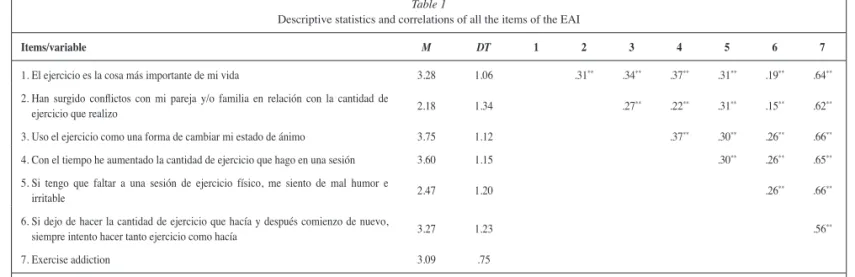
and the global measurement of exercise addiction were signifi cant in all cases, ranging between r = .54 and r = .67.
Students classifi ed as being at risk for exercise addiction (i.e., total score of 24 or more on the EAI) comprised 14.9% (n = 87) of the sample. Of the remainder, 75.3% (n = 440) of the students had scores between 12 and 23 and were classifi ed as belonging to the symptomatic group, and 9.8% (n = 57) who received scores between 0 and 12 were classifi ed as asymptomatic.
Confi rmatory factor analysis
The fi t indices evaluating the adequacy of the measurement model given the data were satisfactory: χ2 (12, N = 584) = 19.18, p < .05; χ2/df = 2.13; CFI = .98, TLI = .96, IFI = .98, RMSEA = .044, 90% CI [.015, .72], SRMR = .029. As illustrated in Figure 1, the factorial loadings of the items ranged from .41 to .59 and were statistically signifi cant (p<.001).
Analyses of internal consistency and temporal stability
To determine the reliability of the scale, an analysis of internal consistency and temporal stability were performed. The analysis
of internal consistency yielded a Cronbach’s alpha of .70 for the EAI. To analyse the temporal stability of the scale, an independent sample of 42 university students aged 20 to 31 (M = 25.5; SD = .92) was used. The scale was administered twice, with an interval of 4 weeks between the fi rst and second measurement. To calculate temporal stability, the intra-class correlation coeffi cient (ICC) was obtained for the scale. The averages from the EAI were 3.09 (SD = .80) and 3.00 (SD = .61), with an ICC of .92, CI [.85 , .96].
Analysis of invariance between genders
To determine whether the structure of the EAI was invariant between two independent subsamples, one of men and another of women, a multigroup analysis was conducted. The results showed that the four models compared had good fi t indices (Table 2). No signifi cant differences were found between the unconstrained model (Model 1) and the models with invariant measurement weights (Model 2), invariant structural covariances (Model 3), and invariant measurement residuals (Model 4); consequently, invariance of the measurement model between genders was supported (Byrne, Shavelson, & Muthén, 1989; Marsh, 1993).
Differential analysis according to the intensity and frequency of practise
Because few participants reported doing physical exercise at low intensities (n = 56), it was decided to collapse the fi rst two categories of this variable into one group. Likewise, the students were classifi ed into two groups with respect to their frequency of exercise: three days was adopted as the recommended frequency threshold (Haskell et al., 2007) for differentiating between a medium-low level and a high level of physical activity. Following from these decisions, an examination of the infl uences of exercise frequency and intensity on EAI scores was accomplished using four groups (i.e., the two groups of exercise intensity by the two groups of exercise frequency). The fi rst group was composed of 238 students who reported engaging in physical exercise at medium-low intensities three days or fewer per week (IntLM/ FrLM). The second group was composed of 170 students who reported exercising at medium-low intensity more than three days Table 1
Descriptive statistics and correlations of all the items of the EAI
Items/variable M DT 1 2 3 4 5 6 7
1. El ejercicio es la cosa más importante de mi vida 3.28 1.06 .31** .34** .37** .31** .19** .64**
2. Han surgido confl ictos con mi pareja y/o familia en relación con la cantidad de
ejercicio que realizo 2.18 1.34 .27
** .22** .31** .15** .62**
3. Uso el ejercicio como una forma de cambiar mi estado de ánimo 3.75 1.12 .37** .30** .26** .66**
4. Con el tiempo he aumentado la cantidad de ejercicio que hago en una sesión 3.60 1.15 .30** .26** .65**
5. Si tengo que faltar a una sesión de ejercicio físico, me siento de mal humor e
irritable 2.47 1.20 .26
** .66**
6. Si dejo de hacer la cantidad de ejercicio que hacía y después comienzo de nuevo,
siempre intento hacer tanto ejercicio como hacía 3.27 1.23 .56
**
7. Exercise addiction 3.09 .75
** p < .01. Note: The scale items have not been translated, as this is the Spanish version of the EAI that was originally published in English
Exercise addiction
Item 1
Item 2
Item 3
Item 4
Item 5
Item 6
.34
.22
.35
.35
.30
.16 .59
.47
.59
.59
.55
.41
per week (IntLM/FrH). The third group, composed of 37 students, reported engaging in physical activity at high intensity three or more days per week (IntH/FrLM). The last group was made up of 134 students who physically exercised at high intensity more than three days per week (IntH/FrH).
The ANOVA performed on the frequency and intensity of exercise (see Table 3) revealed signifi cant differences in exercise addiction from one group to another. Tukey tests for multiple comparisons showed signifi cant differences in exercise addiction among all the groups except between the groups IntLM/FrH and IntH/FrLM (p = .324) and between the groups IntH/FrLM and IntH/ FrH (p =.580). Students who claimed to exercise at high intensity and high frequency reported higher exercise addiction scores than the group of students who reported exercising at medium-low intensity, regardless of their frequency of practise. Thus, the participants’ reported exercise intensity was more strongly related to exercise addiction than was exercise frequency.
Discussion
The goals of this study were to examine the factor validity, internal consistency, temporal stability and external validity of the EAI. The results demonstrated that the EAI is a valid and reliable instrument for evaluating exercise addiction in Spain. It is simple to administer, and its scoring procedure differentiates between individuals at risk of exercise addiction, individuals who present some symptoms and those who show no symptoms of addiction.
The results supported the factor validity of the EAI model. All items correlated signifi cantly with the global measurement of exercise addiction. The confi rmatory factor analysis produced acceptable fi t indices for the model and adequate internal consistency and temporal stability, with values of .70 or higher (Nunnally & Bernstein, 1995).
In the present study, the EAI identifi ed 87 students (14.9%) at risk of exercise addiction, which lies within the limits of addiction prevalence established for the EAI. Indeed, as Terry et al. (2004) have noted, scores of greater than 24 on the EAI usually represent individuals “with scores in the top 15% of the total scale score” (p. 493). Nevertheless, it should be noted that the prevalence of
exercise addiction reported in other studies vary considerably (Griffi ths et al., 2005; Lejoyeux et al., 2008; Symons-Downs et al., 2004; Szabo & Griffi ths, 2007), which may be due to the use of different instruments. In fact, as Sicilia and González-Cutre (2011) have indicated, the EDS classifi es participants into different exercise addiction groups according to the summed averages its subscales, but there is no cut-off score for the global value of the scale as there is for the EAI. This means that group classifi cation using the EDS is more complex and that there is the possibility of confronting discrepancies when comparing its results with the EAI. More studies are needed to estimate exercise addiction prevalence in various populations using the EAI.
The multi-group analysis showed that the structure of the EAI was invariant to gender. This result is important because it allows for the comparison of measurements between men and women in future studies. In fact, recent research has reported that differences in exercise addiction by gender do not appear to be entirely clear and seem to be affected by variations in how factors are defi ned and the instruments used to measure those (González-Cutre & Sicilia, 2012). However, future research should also examine the invariance of the EAI with respect to other variables in which clear differences have previously been established. For example, invariance by age was not analysed in this study because the sample of students varied little in age. However, research has shown that exercise addiction is inversely related to age (Allegre et al., 2007; Furst & Germone, 1993; Szabo, Frenkl, & Caputo, 1997). It would, therefore, be of interest for future research to examine the invariance of the EAI among age groups, while taking into account the theoretical division that defi nes different developmental stages: adolescents, young people, adults and the elderly.
This study found evidence of external validity by analysing the relationships between exercise addiction and the frequency and intensity of physical exercise. The analysis of variance showed that students who reported doing exercise at a frequency greater than three days a week at high intensity scored higher on exercise addiction than those who reported doing exercise with low-medium intensity, regardless of the frequency of the weekly exercise. These results are consistent with previous research, which has shown a clear association between exercise addiction symptoms and the
Table 2
Multi-Group invariance analysis across gender
Models χ2 gl χ2/gl Δχ2 Δgl CFI TLI IFI SRMR RMSEA (IC 90%)
Model 1 36.93 18 2.05 – – .96 .93 .96 .028 .043 (.022-.062)
Model 2 42.17 23 1.83 5.23 5 .96 .95 .96 .032 .038 (.019-.056)
Model 3 43.74 24 1.82 6.80 6 .96 .95 .96 .034 .038 (.019-.055)
Model 4 46.65 30 1.55 9.72 12 .96 .96 .96 .034 .031 (.011-.047)
Table 3
Analysis of variance of exercise addiction by intensity and practice frequency
IntLM/FrLM IntLM/FrH IntH/FrLM IntH/FrH
F (3-575) η2 parcial
M DT M DT M DT M DT
Exercise addiction 2.84 .66 3.08 .74 3.30 .63 3.47 .73 24.14*** .11
amount of time engaged in physical exercise (Adams et al., 2003; Chapman & De Castro, 1990; Furst & Germone, 1993; Hailey & Bailey, 1982; Kjelsas et al., 2003; Pierce et al., 1993; Sicilia & González-Cutre, 2011). Nevertheless, the results of the present research suggest that the intensity with which physical exercise is pursued is more strongly associated with exercise addiction than is the frequency of the exercise. These results support the need to consider not only frequency and duration of physical exercise but also other variables of exercise, such as intensity, when evaluating risk for exercise addiction.
Although the results of this study provide a psychometric support for the EAI, some limitations should be noted. First, the participant sample used in the study did not represent the entire student population, which complicates generalisation of the fi ndings to other students and groups. Second, although the relationship between addiction and the combination of frequency and intensity of physical exercise was analysed in the study, the data were self-reported. Moreover, it may be of interest to prevention and treatment efforts to recognise contextual characteristics associated with exercise addiction besides frequency and intensity of physical exercise. For instance, recent research has come to suggest that individuals who participate in activities supervised by a monitor tend to present fewer exercise addiction symptoms than those who exercise on their own (González-Cutre & Sicilia, 2012). At any rate, this issue should be better clarifi ed in future research. Finally, disorders comorbid to exercise addiction were not identifi ed. For
example, eating disorders most commonly tend to accompany exercise addiction (Freimuth at al., 2011) and at least could partially explain the percentage of participants in this study classifi ed as being at risk of addiction. Thus, future studies could use a measure to detect eating disorders after identifying the group of individuals at risk of exercise addiction in order to distinguish between individuals at primary and secondary exercise addiction (Veale, 1987, 1995).
In conclusion, although it would be advisable to validate this instrument with different samples, initial results presented in this study suggest that the EAI can be a valid and reliable measurement for evaluating exercise addiction in the Spanish context. The instrument is simple and fast to administer, reports results similar to those of lengthier scales and allows for the differentiation among individuals at risk of exercise addiction, those with some symptoms and those with no symptoms. Due to these characteristics, the EAI appears to be a very appropriate instrument for professionals such as therapists, doctors and instructors, who often are the initial treatment providers of individuals who are injured while exercising and who may present symptoms of exercise addiction. Although these professionals are not trained in psychometrics, the cut-off points established for the EAI could allow them to decide rapidly and easily if these individuals need to be referred to receive further consultation in order to prevent future injuries. Therefore, the availability of an instrument like the EAI in the Spanish context represents a signifi cant contribution not only to the literature on exercise addiction but also to applied practise.
References
Adams, J., Miller, T.W., & Kraus, R.F. (2003). Exercise dependence: Diagnostic and therapeutic issues for patients in psychotherapy. Journal of Contemporary Psychotherapy, 33, 93-107.
Allegre, B., Therme, P., & Griffi ths, M. (2007). Individual factors and the context of physical activity in exercise dependence: A prospective study of ‘Ultra-marathoners’. International Journal of Mental Health and Addiction, 5, 233-243.
American Psychiatric Association (1994). Diagnostic and statistical manual of mental disorders (4th ed.). Washington DC: (APA). American Psychiatric Association (2010). DSM-5 Development. Avalaible
in: http://www.dsm5.org/Pages/Default.aspx (Archived by WebCite® at http://www.webcitation.org/6G7dXoCev).
Byrne, B.M. (2001). Structural equations modeling with Amos: Basic concepts, application, and programming. Mahwah, NJ: Erlbaum. Byrne, B.M., Shavelson, R.J., & Muthén, B. (1989). Testing for the
equivalence of factor covariance and means structures: The issue of partial measurement invariance. Psychological Bulletin, 105, 456-466. Carmack, M.A., & Martens, R. (1979). Measuring commitment to running:
A survey of runners’ attitudes and mental states. Journal of Sport Psychology, 1, 25-42.
Chapman, C.L., & De Castro, J.M. (1990). Running addiction: Measurement and associated psychological characteristics. Journal of Sports Medicine and Physical Fitness, 30, 283-290.
Davis, C. (2000). Exercise abuse. International Journal of Sport Psychology, 31, 278-289.
Freimuth, M., Moniz, S., & Kim, S.R. (2011). Clarifying exercise addiction: Differential diagnosis, co-occurring disorders, and phases of addiction. International Journal of Environmental Research and Public Health, 8, 4069-4081.
Furst, D.M., & Germone, K. (1993). Negative addiction in male and female runners and exercisers. Perceptual and Motor Skills, 77, 192-194. Godin, G., & Shephard, R.J. (1985). A simple method to assess exercise
behavior in the community. Canadian Journal of Applied Sport Science, 10, 141-146.
González-Cutre, D., & Sicilia, A. (2012). Dependencia del ejercicio físico en usuarios españoles de centros de acondicionamiento físico (fi tness): diferencias según el sexo, la edad y las actividades practicadas [Exercise dependence in Spanish users of fi tness centres: Differences according to gender, age and practiced activities]. Behavioral Psychology/Psicología Conductual, 20, 349-364.
Griffi ths, M.D. (1996). Behavioural addiction: An issue for everybody? Journal of Workplace Learning, 8(3), 19-25.
Griffi ths, M.D., Szabo, A., & Terry, A. (2005). The exercise addiction inventory: A quick and easy screening tool for health practitioners. British Journal of Sports Medicine, 39(6): e30. Available in: http:// www.bjsportmed.com/cgi/content/full/39/6/e30 (Archived by WebCite® at http://www.webcitation.org/6G7dn2prw).
Hailey, B.J., & Bailey, L.A. (1982). Negative addiction in runners: A quantiative approach. Journal of Sport Behavior, 5, 150-154.
Hamer, M., & Karageorghis, C.I. (2007). Psychobiological mechanisms of exercise dependence. Sports Medicine, 37, 477-484.
Hausenblas, H.A., & Symons-Downs, D. (2002a). How much is too much? The development and validation of the Exercise Dependence Scale. Psychology and Health, 17, 387-404.
Hausenblas, H.A., & Symons-Downs, D. (2002b). Exercise dependence: A systematic review. Psychology of Sport and Exercise, 3, 89-123. Hausenblas, H.A., & Symons-Downs, D. (2002c). Exercise Dependence
Scale-21 Manual. Gainesville, FL: Florida University.
Hambleton, R.K., & Patsula, L. (1998). Adapting tests for use in multiple languages and cultures. Social Indicators Research, 45, 153-171. Haskell, W.L., Lee, I.M., Pate, R.R., Powell, K.E., Blair, S.N., Franklin,
B.A., et al. (2007). Physical activity and public health: Updated recommendation for adults from the American College of Sports Medicine and the American Heart Association. Medicine and Science in Sports and Exercise, 39, 1423-1434.
Johnston, O., Reilly, J., & Kremer, J. (2011). Excessive exercise: From quantitative categorisation to a qualitative continuum approach. European Eating Disorders Review, 19, 237-248.
Kjelsas, E., Augestad, L.B., & Götestam, K.G. (2003). Exercise dependence in physically active women. The European Journal of Psychiatry, 17, 145-155.
Lejoyeux, M., Avril, M., Richoux, C., Embouazza, H., & Nivoli, F. (2008). Prevalence of exercise dependence and other behavioral addictions among clients of a Parisian fi tness room. Comprehensive Psychiatry, 49, 353-358.
Lynn, M. (1986). Determination and quantifi cation of content validity. Nursing Research, 35, 382-385.
Marsh, H.W. (1993). The multidimensional structure of physical fi tness: Invariance over gender and age. Research Quartely for Exercise and Sport, 64, 256-273.
Nunnally, J.C., & Bernstein, I.J. (1995). Teoría psicométrica. Madrid: McGraw-Hill.
Ogden, J., Veale, D., & Summers, Z. (1997). The development and validation of the Exercise Dependence Questionnaire. Addiction Research, 5, 343-356.
Pasman, L., & Thompson, J.K. (1988). Body image and eating disturbance in obligatory runners, obligatory weightlifters and sedentary individuals. International Journal of Eating Disorders, 7, 759-769.
Pierce, E.F., McGowan, R.W., & Lynn, T.D. (1993). Exercise dependence in relation to competitive orientation of runners. Journal of Sports Medicine and Physical Fitness, 33, 189-193.
Schermelleh-Engel, K., Moosbrugger, H., & Müller, H. (2003). Evaluating the Fit of Structural Equation Models: Tests of Signifi cance and Descriptive Goodness-of-Fit Measures. Methods of Psychological Research Online, 8(2), 23-74.
Sicilia, A., & González-Cutre, D. (2011). Dependence and physical exercise: Spanish validation of the Exercise Dependence Scale-Revised (EDS-R). The Spanish Journal of Psychology 14, 421-431.
Sussman, S., Leventhal, A., Bluthenthal, R.N., Freimuth, M., Forster, M., & Ames, S.L. (2011). A framework for the specifi city of addictions. International Journal of Environmental Research and Public Health, 8, 3399-3415.
Sussman, S., Lisha, N., & Griffi ths, M. (2011). Prevalence of the addictions: A problem of the majority or the minority? Evaluation & the Health Professions, 34, 3-56.
Symons-Downs, D., Hausenblas, H.A., & Nigg, C.R. (2004). Factorial validity and psychometric examination of the Exercise Dependence Scale-Revised. Measurement in Physical Education and Exercise Science, 8, 183-201.
Szabo, A., Frenkl, R., & Caputo, A. (1997). Relationship between addiction to running, commitment to running, and deprivation from running: A study on the internet. European Yearbook of Sport Psychology, 1, 130-147.
Szabo, A., & Griffi ths, M. (2007). Exercise addiction in British sport sciences students. International Journal of Mental Health and Addiction, 5, 25-28.
Terry, A., Szabo, A., & Griffths, M. (2004). The exercise addiction inventory: A new brief screening tool. Addiction Research and Theory, 12, 489-499.
Veale, D.M.W. (1987). Exercise dependence. British Journal of Addiction, 82, 735-740.