A Unified Hardware/Software Monitoring
Method for Reconfigurable Computing
Architectures using PAPI
Leonardo Suriano
∗, Daniel Madro˜nal
†, Alfonso Rodr´ıguez
∗, Eduardo Ju´arez
†, C´esar Sanz
†and Eduardo de la Torre
∗ ∗Centro de Electr´onica Industrial (CEI), Universidad Polit´ecnica de Madrid†Research Center on Software Technologies and Multimedia Systems (CITSEM), Universidad Polit´ecnica de Madrid
Email:{leonardo.suriano, daniel.madronal, alfonso.rodriguezm, eduardo.juarez, cesar.sanz, eduardo.delatorre}@upm.es
Abstract—In this work, a standard and unified method for monitoring hardware accelerators in Reconfigurable Computing Architectures is proposed, based on a standard software moni-toring interface.
The open source Performance Application Programming In-terface (PAPI) library is commonly used in the field of High Performance Computing and aims at providing event information directly extracted from a set of Performance Monitor Counters. Important events such as data and instruction cache misses, hardware interrupts, etc. are collected to analyze and profile ap-plications to pinpoint the contingent bottlenecks. In other words, it serves as a ”Hardware Abstraction layer” for applications running in the user-space.
In this paper, its use is extended by proposing a method to target custom Performance Hardware Registers on accelerators built upon an FPGA. Furthermore, portability and standardiza-tion are discussed and the overhead associated with PAPI use is evaluated. Two hardware examples are proposed to evaluate this approach: a simple counter and an infrastructure for hardware accelerators called ARTICo3.
Index Terms—Monitoring Hardware, Performance API, PAPI, PAPIFY, ARTICo3, Hardware Abstraction
I. INTRODUCTION AND MOTIVATION
Nowadays, the world is in the era of Internet of Things (IoT) and Cyber-Physical Systems (CPSs) [1]: everybody is connected to everything. Likewise, the new generation of computer systems should be (1) portable, (2) wearable, (3) offer the highest computing power using the lesser energy possible [2] and (4) include a specific set of sensors according to the specific application. Consequently, sensing, processing, communication and energy consumption are now considered key features of such devices [3].
For this reason, during the past years, ultra-low power micro-controllers have been massively used. Nevertheless, there is still a great research interest in this direction: in 2018, Intel has proposed a complete IoT system prototype [4] featuring an ultra-low power SoC in a 14nm tri-gate CMOS technology.
However, as demonstrated in [5], new architectures, using hardware-based solutions (i.e., FPGAs in this particular case), can (1) reduce the application execution time and (2) minimize the energy consumption of the system. Furthermore, including an FPGA in a Multi-Processor System on Chip (MPSoC)
Computing Architectures
Instruction-driven
Architecture ASICs
GPPs DSPs ASIPs FPGAs CGRAs
Performance and Power Consumption
Flexibility
Reconfigurable Architectures
Hybrid Reconfigurable SoCs
Fig. 1. Computing architecture: comparison [6].
ensures a level of flexibility and adaptivity unreachable with a custom Application Specific Integrated Circuit (ASIC): sur-rounding the CPUs with programmable logic supports the modification of the CPS functionalities during its lifetime according to each specific situation.
For these reasons and taking into account the analysis of Reconfigurable System on Chip in [6] (2018), it is clear that, as shown in Fig 1, ”Hybrid Reconfigurable SoCs” (hereafter called Heterogeneous MPSoCs) have a fair trade-off between performance and power consumption in one side versus flexi-bility in the other side. Hence, they will play a central role in the evolution of the CPS.
Likewise, the main challenge when using this kind of Re-configurable Computer Architecture is to give an easy access to the device hardware resources to users that are not familiar with the underlying concepts [11]. The tasks of hardware-abstractionandresource-access-standardizationare usually carried out by an Operating System (OS). This issue has been addressed by different research groups and different solutions have been proposed: a Run-Time System Manager
(RTMS) [12] by Technical University of Crete; SPREAD [13], a Streaming-Based Partially Reconfigurable Architecture and Programming Model proposed by Wang et al.; FUSE [14], a
Front-end USEr frameworkdeveloped in Canada at the Simon Fraser University are some of the latest frameworks and OS extensions that target reconfigurable platforms.
Another challenge to cope with in a CPS environment is the
self-adaptivity, i.e., the ability to change the system behavior and to reconfigureitself based on both a set of environment inputs and the system status [15]. Consequently, including
self-awarenessin a CPS allows the automatic selection of an optimal configuration in terms of internal system parameters such as energy-consumption or performance [16]. In this context, Rajkumar et al. in [17] defines CPSs as ”physical and engineered systems whose operations are monitored, coordinated, controlled and integrated by a computing and communication core”.
The aforementioned frameworks and OS extensions intro-duce a custom solution to manage generic hardware. Thus, these systems lack of unified interface to access both SW and HW performance information when a heterogeneous architec-ture is employed, as in the case of the next generation of CPS. In this line, a commonly used High Performance Computing (HPC) open-source library called Performance Application Programming Interface (PAPI) [18] provides unified method to access hardware performance information through a set of Performance Monitoring Counters (PMCs). Additionally, an extended version of this library called PAPIFY [19] simplifies the use of PAPI with an extra abstraction layer, which unifies the processing element (PE) monitoring configuration.
In this paper, a PAPI component to include FPGA monitor-ing for the available PEs (and also for an hardware architecture called ARTICo3) is developed and tested. With this solution, the existing OS-based Resource HW/SW Managers will have performance information available through a standard well-known library to monitor both software and hardware re-sources. To evaluate this new approach, two use cases (i.e. two hardware examples) are proposed and tested and monitoring overhead is evaluated.
The rest of the paper is structured as follows: an analysis of the role of PAPI is discussed in Section II. An overview of the tools, the device and the hardware components is given in Section III; in Section IV, the technical details of the custom-hardware/PAPI/PAPIFY integration are reported and, after a brief description of the examples implemented in Section V, the results are present and discussed in Section VI. Finally, in the conclusion, the main achievements and the motivation beyond the work are depicted.
II. BACKGROUND ANDSTATE OF THEART
In this section, the role of PAPI is analyzed when targeting heterogeneous devices and platforms that include also an FPGA. Its use is investigated and the differences with the work here proposed are highlighted. Moreover, the importance of monitoring Hardware Performance Counters is discussed and another approach (similar to the one presented in this paper) is examined.
The Performance API (commonly called PAPI library) has provided, for more than a decade, low-level cross-platform access to hardware performance counters on the most modern CPUs and GPUs and its use was extended, also, to measure and report power and energy values. In fact, in [20], the author describes, in detail, the types of energy and power readings available thanks to the extended use of PAPI. The paper is a great example on how the use of a standard existing library can bring benefits when designing an application: in addition to the CPU performance counters, GPU counters and many other advanced PAPI features natively supported, new energy and power ”Events” can be evaluated with no extra effort. In this respect the work proposed in this paper should be considered: through the use of the same API, new devices can be targeted including the use of generic hardware accelerators (not still taken into account from Weaver et al. in [20]).
Likewise, in [21], the use of PAPI to monitor energy and power is discussed. In that work, the effort of McCraw et al. is to extend the use of PAPI to support power monitoring capabilities for various platforms and, specifically, for the Intel Xeon Phi and Blue Gene/Q. Also, the integration of PAPI in PARSEC (a data-flow task-based runtime [22]) is discussed but, here, compatibility with hardware accelerators is not proved and, neither, discussed.
An example on how to monitor hardware registers on the programmable logic of an FPGA is present in [23]: SnoopP
was introduced as a non-intrusive and real time profiling tool for soft-core processors and its use was proven with a Mi-croBlaze on a Xilinx Virtex II FPGA. Anyway, a compatibility with otherhard-processorsis here not shown. It means that, when using heterogeneous platform that includes, for instance, ARM processors, other profiling tools need to be used in addition to SnoopP.
Besides, the importance of Hardware Monitors is high-lighted, also, in [24]. In this paper, the authors present the so called Hardware Performance Monitoring Infrastructure
(HwPMI): a set of hardware monitors (hardware cores) to be inserted in a general HDL design and, also, a set of software tools to manage them. The purpose is to profile a hardware design. The use of custom hardware counters for monitoring other kind of Events (different from the ones they already have included in the HwPMI) is not described. Also, the set of functions to retrieve data from the hardware needs to be integrated in the particular developed application.
Interface (known as OMPT) for supporting and targeting accelerators. OMPT was first introduced in [26] as ”an ap-plication programming interface (API) to support construction of portable, efficient, and vendor-neutral performance tools” and it ”enables performance tools to gather useful performance information from applications with low overhead”. With the extension, the authors target also FPGAs and not only ho-mogeneous/heterogeneous platforms, allowing insightful anal-ysis by retrieving detailed performance information about the execution of the accelerated tasks. The use of the library is restricted to applications OpenMP-compliant.
Differently, in this paper, the method proposed uses PAPI, which is an abstraction layer commonly employed to interface hardware performance counters of CPUs, GPUs, network or memory controllers [27], but also of power and temperature monitors, as it is previously discussed in this section. Its use is not restricted to any particular application and it is employed by many profiling toolkits that will be discussed in Section III.
III. MATERIAL ANDMETHODS
In this section the technologies employed are described: (1) the target platform, (2) the PAPI library and its PAPIFY
extension and, (3) the ARTICo3 hardware architecture.
A. The device: UltraScale+ / Heterogeneous platforms
In order to demonstrate the method proposed, an Ultra-Scale+ chip developed by Xilinx is selected as the target platform. In Fig 2 the main components are highlighted: this device is equipped with a quad-core ARMRCortex-A53,
with a dual-core Cortex-R5 real-time processor, a Mali-400 MP2 Graphics Processing Unit (GPU) and, also, with a 16nm FinFET+ programmable logic. The Programmable Logic (PL) hosts a set of System Logic Cells, Block Memory, UltraRAM, DSP and many other resources and here, thanks to the use of Vivado, we can build HW accelerators for boosting SW applications. For a detailed description of the device and for a complete list of SW and HW documentation, please, refer to [28].
Additionally, for the purpose of the paper, an OS GNU/Linux-based is developed to run on the quad-core and to manage the transaction between the user-space and the hardware. Also, the examples proposed were tested on the Pynq Board featuring a Zynq XC7Z020 chip.
B. The open source library: PAPI library and PAPIFY exten-sion
The Performance Application Programming Interface (PAPI) library focuses on providing a standard API to easily access hardware monitoring information. Although this library can be used as a standalone tool for system analysis, it is also usually employed as a middleware in profiling, tracing and sampling toolkits like Vampir [29], HPCToolKit [30] and Score-P [31].
This API is divided into two layers: first, a platform-independent layer that provides an unified hardware monitor-ing interface; secondly, a lower, platform-dependent layer to
Compar
ison Logic
Compar
ison Logic
Real-time Processing Unit
B
B B
Compar
ison Logic
Platform Managment Unit Processing System
A53
Mali-GPU
R5
Compar
ison Logic
Configuration Memory
PCAP
ICAP Programmable Logic
Hardware
Accelerators
Fig. 2. A simplified block diagram of the Ultrascale+ MPSoC.
deal with the specific characteristics of the platform, which is transparent for the user. Additionally, in [19], a new abstraction layer called PAPIFY is added on top of the other ones. This extra layer focuses on easing the configuration process and the usage of PAPI library when several PAPI components, which are usually associated to different types of PEs, are defined in the same architecture.
In order to use PAPIFY, a set of functions has been included within theeventLiblibrary. In this context, the performance in-formation can be accessed at runtime by including three stages in the application code: (1) a configuration step where config-ure papify()transparently initializes both the PAPI component and the events to be monitored and associates them to the specific PE; (2)event start() andevent start papify timing()
trigger the monitoring of both events and timing, respectively; (3) event stop() and event stop papify timing() finish the monitoring and store the results.
C. The hardware architecture: ARTICo3
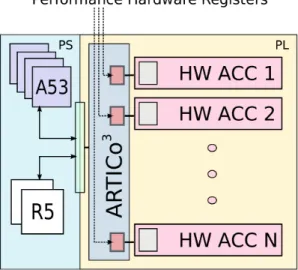
In one of the examples proposed, the ARTICo3
A53
R5
R5
HW ACC 1
HW ACC 2
HW ACC N
Performance Hardware Registers
Fig. 3. Stylized view of the whole system with the ARTICo3 hardware
architecture.
IV. INTERFACINGHWWITHPAPIANDPAPIFY
In this section, the proposed method is discussed and explained step by step using a naive example. On the other hand, a brief description of the hardware used is necessary to fully understand the procedure.
A. Targeting Physical Addresses from the User-space
A simple 32-bits counter was created in VHDL and nestled in an AXI4-lite compliant wrapper (it permits to communicate with the standard bus protocol of the quad-core in the PS). Fig 4 shows that the hardware component includes four slave registers where, in order to start/stop the counting and retrieve the data, AXI4-lite transactions are required. In red, the useful bits of the slave registers are highlighted while the white ones are unused (they exist for a full compatibility of the AXI4-lite protocol).
AXI4-LITE WRAPPER
slv_reg0slv_reg1
slv_reg2
slv_reg3
start_stop_s
reset_s
counter32bit_reg
clk reset
Fig. 4. Schematic view of the 32 bit counter interface with PAPI.
In order to quantify the overhead due to the use of PAPI and PAPIFY, a register access time test is required at this point,
where no additionally libraries are involved.
Differently from the approach in [14] where Linux Device Drivers were developed every time new
accelerators/HW-registers were created, Fig 5 depicts a block diagram ex-plaining the procedure to access Physical Addresses from the User-space. Specifically, the steps to manage HW components are: (1) direct mapping of user-space virtual addresses to HW accelerators physical addresses using mmap()[34]; (2) command/data writing into HW accelerators using virtual addresses obtained withmmap().
User Space
Kernel
Hardware
System Calls
Kernel Drivers mmap(...)
Physical Addresses
Fig. 5. The use ofmmap()for managing physical addresses.
B. Component in PAPI
PAPI provides a long list of Components [35] that gives the possibility of reading PMCs of the most important archi-tectures: ARM CPUs, Intel CPUs, AMD CPUs but also on NVIDIA GPUs, InfiniBand, etc.
However, when new hardware accelerators are designed, the necessity of developing a new component arises [27]. Likewise, the essential functionalities of the basic FPGA hardware together with their corresponding PAPI functions are the following ones:
PAPI_start(Ev) // writes the bit 0 of slv_reg0
PAPI_stop(Ev) // writes the bit 0 of slv_reg0
PAPI_reset(Ev) // writes the bit 0 of slv_reg1
PAPI_read(Ev) // reads the whole slv_reg3
whereEvargument of the functions stands for Event.
C. Connecting HW with PAPI and PAPIFY
Profiling an application using PAPI can be a tough task and, as explained in IV, PAPIFYaims at easing this process. Specif-ically, the whole PAPI configuration setup is now transparent and the setting/monitoring/collecting-data can be summarized in three instructions. Fig 6 depicts the schema of the approach.
In short, the steps to follow are:
1) to create hardware counters (PMCs) on the pro-grammable logic. Every counter will be in charge of counting ”Events”. The designer is, so, completely free to monitor signal and transaction useful in his own design;
SW component Monitors
HW component Monitors
eventLib
Library
Application
configure(PE,monitors) / start_monitoring() / stop_monitoring()
Fig. 6. PAPIFY usage.
3) to create a PAPI component corresponding to the PMCs. The PAPI library will manage internally and autonomously the access to the hardware resources. The use of PAPIFY is optional and aims at easing PAPI usage. By including this new abstraction layer, the configura-tion step is simplified from tens of funcconfigura-tion calls to only one (configure papify()), independently of the number of events.
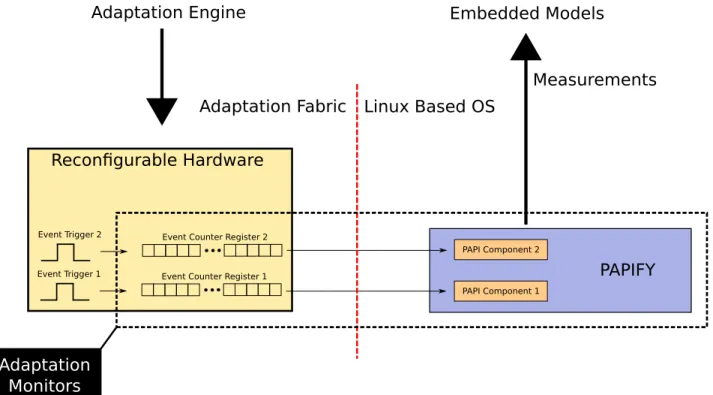
To sum up, in the Fig 7, a schematic overview of the entire system with the hardware-software connection is given. The
Adaptation Engineis in charge of reconfigure the hardware if and when necessary on the Adaptation Fabric(that is a Zynq Ultrascale+ in our example). The Linux-Based OS running in the device is in charge of retrieving data by using PAPI and PAPIFY. The measurements are, so, available to other profiling SW in charge to model and evaluate the behavior of the system.
V. EXAMPLESIMPLEMENTED
In order to quantify the overhead due to the use of extra abstraction layers, test-applications were created: severalread
operations were sequentially performed using three methods: 1) a pointer to virtual memory to directly access hardware
registers thanks to the use of mmap() described in Section IV;
//...
gettimeofday(&t0, NULL); for(i=0;i<N_readings;i++){
output_vector[i] = *ptr_to_hw; }
gettimeofday(&tf, NULL);
//...
2) PAPI_read(EventSet): the standard PAPI function created for the designed hardware;
//...
gettimeofday(&t0, NULL); for(i=0;i<N_readings;i++){
PAPI_read( EventSet, values);
}
gettimeofday(&tf, NULL);
//...
3) event_read(papify_actions_Read): the PA
-PIFYfunction;
//...
gettimeofday(&t0, NULL); for(i=0;i<N_readings;i++){
event_read(papify_actions_Read, 0); }
gettimeofday(&tf, NULL);
//...
In the case of ARTICo3 architecture, two PMCs were designed in VHDL:
1) error counters;
2) latency of execution (time window between the start
signal and the end of the hardware execution).
Also, the ARTICo3architecture is accompanied by a Run-time
support: a set of software functions to manage the underlying hardware. Two new function has been included to have access to the PMCs:
1) hw_get_pmc_errors(SLOT); 2) hw_get_pmc_cycles(SLOT);
where SLOT is the number of the specific hardware accel-erator. Similarly, three methods were used to evaluate the overhead (here the snippet code only for one of the two registers is reported: the method is equivalent in the two cases):
1) the lowest functions of the Run-time to have access to the hardware registers;
//...
gettimeofday(&t0, NULL); for(i=0;i<N_readings;i++){
output_value = hw_get_pmc_cycles(0); }
gettimeofday(&tf, NULL);
//...
2) PAPI_read(EventSet): the PAPI function created for the designed hardware; here the code snippet is exactly the same (the benefits of the abstraction andcode reuse are clear). The main difference with the previous example is in the PAPI configuration code.
3) event_read(papify_actions_Read): the equivalent PAPIFY instruction; again the code snippet is missing due to the exact correspondence with the previous one. In this case, the configuration code is missing and hidden by PAPIFY. The advantage of the
Abstractionis, again, highlighted.
VI. RESULTS
Recon gurable Hardware
Event Counter Register 1 Event Trigger 1
Event Counter Register 2 Event Trigger 2
PAPI Component 2
PAPI Component 1
PAPIFY
Adaptation Fabric
Linux Based OS
Embedded Models
Adaptation Engine
Measurements
Adaptation
Monitors
Fig. 7. Schematic of the connections between the PMCs and the PAPI component
A. Results report
In table I, the elapsed times with different number of repetition of the for loop are shown. In this way it is possible to prove the accuracy of the measurement: in fact, it was noted that, with less than one hundred repetitions, the
read transactions are so fast that the precision of the function
gettimeofday()is not enough.
TABLE I
32-BITCOUNTERACCESSING USINGDIFFERENTFUNCTIONS
Measurements
HW Function Reps Time (ms)
Counter 32 bits
low level
1000 0.211 10000 2.101 100000 21.100
PAPI
1000 0.361 10000 3.644 100000 36.154
PAPIFY
1000 0.3710 10000 3.7260 100000 37.647
The overheads are computed dividing the average of the elapsed time per access in table I by the low level access time and are reported in the following table:
TABLE II
OVERHEAD ESTIMATION FORCOUNTER32BITS
Function Access Time (ns) Overhead
HW_pointer 221 x 1
PAPI_read(EventSet) 361 x 1,71
event_read(papify_actions) 371 x 1,77
The same procedure has been repeated for the ARTICo3
architecture and the table III and table IV summarize the results:
TABLE III
TIME NECESSARY FOR READING VALUES FROMARTICO3USING DIFFERENT FUNCTIONS
Measurements
HW Function Reps Time (ms)
ARTICo3
low level
1000 0.242 10000 2.428 100000 24.244
PAPI
1000 0.495 10000 4.130 100000 41.086
PAPIFY
1000 0.475 10000 4.247 100000 42.104
TABLE IV
OVERHEAD ESTIMATION FOR THEARTICO3ARCHITECTURE
Function Access Time (ns) Overhead
hw_get_pmc_cycles(SLOT); 242 x 1
PAPI_read(EventSet) 413 x 1,70
event_read(papify_actions) 424 x 1,75
B. Results discussion
PAPIFY guarantees potential compatibility with SW profiling tools.
Moreover, it is important to note the difference between TABLE I and TABLE III where the absolute values of timing access are reported: using the ARTICo3 runtime function for
retrieving data from the registers adds a little overhead more. The reason lies in the hardware pointer-calls: they are not performed directly by the PAPI-Component but it delegates
the task to the ARTICo3’s functions.
VII. CONCLUSIONS
In this paper, a unified and standard strategy to interface Hardware Performance Registers is proposed. The Perfor-mance API is extended to Reconfigurable Computing Ar-chitectures targeting, also, hardware accelerators. Using a standard open-source library (to monitor what is happening in the Hardware Accelerators located in the FPGA) ensures a potential compatibility with a myriad of SW profiling tools such as Vampir [29], HPCToolKit [30] and Score-P [31]. Also, as discussed in section I, many research groups have proposed frameworks and OS extensions to manage SW and HW PEs in heterogeneous platforms. The aim of the work proposed in this paper is to give a common profiling instrument for these Heterogeneous MPSoCs. This furtherAbstraction Layeris also important in self-aware CPSs where a runtime manager needs to reconfigure the system based on the platform monitoring information (as well as all the inputs from the external physical world).
Specifically, a detailed description on the steps to include the HW monitoring as a PAPI component is given by using a naive VHDL module. Additionally, the method is tested using the ARTICO3hardware architecture running on the Zynq Ultrascale+ MPSoC device developed by Xilinx.
As a result, it is shown that the overhead associated to the use of PAPI needs to be taken into account. Finally, the additional overhead of PAPIFY is negligible, so its use is encouraged to ease the utilization of PAPI in terms of code simplicity and intuitiveness.
ACKNOWLEDGMENT
This work has received funding from the EU Commissions H2020 Program under grant agreement No 732105.
Leonardo Suriano and Daniel Madro˜nal hold predoctoral contracts under RR01/2015 (Programa Propio) by Universidad Politecnica de Madrid.
The authors would like to thank the Spanish Ministry of Education, Culture and Sport for its support under the FPU grant program.
REFERENCES
[1] F. Garibaldo and E. Rebecchi, “Cyber-physical system,” 2018. [2] S. Vinco, L. Bottaccioli, E. Patti, A. Acquaviva, and M. Poncino, “A
compact pv panel model for cyber-physical systems in smart cities,” 2018.
[3] M. Alioto, E. S´anchez-Sinencio, and A. Sangiovanni-Vincentelli, “Guest editorial special issue on circuits and systems for the internet of things—from sensing to sensemaking,”IEEE Transactions on Circuits and Systems I: Regular Papers, vol. 64, no. 9, pp. 2221–2225, 2017.
[4] T. Karnik, D. Kurian, P. Aseron, R. Dorrance, E. Alpman, A. Nicoara, R. Popov, L. Azarenkov, M. Moiseev, L. Zhaoet al., “A cm-scale self-powered intelligent and secure iot edge mote featuring an ultra-low-power soc in 14nm tri-gate cmos,” inSolid-State Circuits Conference-(ISSCC), 2018 IEEE International. IEEE, 2018, pp. 46–48. [5] J. Valverde, A. Otero, M. Lopez, J. Portilla, E. De La Torre, and
T. Riesgo, “Using sram based fpgas for power-aware high performance wireless sensor networks,”Sensors, vol. 12, no. 3, pp. 2667–2692, 2012. [6] H. K. Nguyen and T. X. Tran, “A survey on reconfigurable
system-on-chips,”REV Journal on Electronics and Communications, 2018. [7] P. J. Edavoor, S. Raveendran, and A. D. Rahulkar, “Implementation
of adaptive image compression algorithm using varying bit-length daubechies wavelet coefficient with three-level encryption on zynq 7000,” inEmbedded Computing and System Design (ISED), 2017 7th International Symposium on. IEEE, 2017, pp. 1–6.
[8] E. Setiawan, M. M. Latin, V. A. Mardiana, and T. Adiono, “Imple-mentation of baseband transmitter design based on qpsk modulation on zynq-7000 all-programmable system-on-chip,” inElectronics and Smart Devices (ISESD), 2017 International Symposium on. IEEE, 2017, pp. 138–143.
[9] T. Xue, J. Zhu, G. Gong, L. Wei, Y. Luo, and J. Li, “The design and data-throughput performance of readout module based on zynq soc,” IEEE Transactions on Nuclear Science, vol. PP, no. 99, pp. 1–1, 2018. [10] L. Suriano, A. Rodriguez, K. Desnos, M. Pelcat, and E. de la Torre, “Analysis of a heterogeneous multi-core, multi-hw-accelerator-based system designed using preesm and sdsoc,” in Reconfigurable Communication-centric Systems-on-Chip (ReCoSoC), 2017 12th Inter-national Symposium on. IEEE, 2017, pp. 1–7.
[11] M. Eckert, D. Meyer, J. Haase, and B. Klauer, “Operating system concepts for reconfigurable computing: review and survey,”International Journal of Reconfigurable Computing, vol. 2016, 2016.
[12] G. Charitopoulos, I. Koidis, K. Papadimitriou, and D. Pnevmatikatos, “Hardware task scheduling for partially reconfigurable fpgas,” in Inter-national Symposium on Applied Reconfigurable Computing. Springer, 2015, pp. 487–498.
[13] Y. Wang, X. Zhou, L. Wang, J. Yan, W. Luk, C. Peng, and J. Tong, “Spread: A streaming-based partially reconfigurable architecture and programming model,”IEEE Transactions on Very Large Scale Integra-tion (VLSI) Systems, vol. 21, no. 12, pp. 2179–2192, 2013.
[14] A. Ismail and L. Shannon, “Fuse: Front-end user framework for o/s abstraction of hardware accelerators,” inField-Programmable Custom Computing Machines (FCCM), 2011 IEEE 19th Annual International Symposium on. IEEE, 2011, pp. 170–177.
[15] J. Otto, B. Vogel-Heuser, and O. Niggemann, “Automatic parameter estimation for reusable software components of modular and recon-figurable cyber-physical production systems in the domain of discrete manufacturing,”IEEE Transactions on Industrial Informatics, vol. 14, no. 1, pp. 275–282, 2018.
[16] J. Preden, “Generating situation awareness in cyber-physical systems: Creation and exchange of situational information,” in 2014 Interna-tional Conference on Hardware/Software Codesign and System Synthesis (CODES+ISSS), Oct 2014, pp. 1–3.
[17] R. R. Rajkumar, I. Lee, L. Sha, and J. Stankovic, “Cyber-physical systems: the next computing revolution,” in Proceedings of the 47th design automation conference. ACM, 2010, pp. 731–736.
[18] D. Terpstra, H. Jagode, H. You, and J. Dongarra, “Collecting perfor-mance data with papi-c,” in Tools for High Performance Computing 2009. Springer, 2010, pp. 157–173.
[19] D. Madro˜nal, A. Morvan, R. Lazcano, R. Salvador, K. Desnos, E. Juarez, and C. Sanz, “Automatic instrumentation of dataflow applications using papi,” inCF ’18: Computing Frontiers Conference. ACM, 2018. [20] V. M. Weaver, M. Johnson, K. Kasichayanula, J. Ralph, P. Luszczek,
D. Terpstra, and S. Moore, “Measuring energy and power with papi,” in Parallel Processing Workshops (ICPPW), 2012 41st International Conference on. IEEE, 2012, pp. 262–268.
[21] H. McCraw, J. Ralph, A. Danalis, and J. Dongarra, “Power moni-toring with papi for extreme scale architectures and dataflow-based programming models,” inCluster Computing (CLUSTER), 2014 IEEE International Conference on. IEEE, 2014, pp. 385–391.
[23] L. Shannon and P. Chow, “Using reconfigurability to achieve real-time profiling for hardware/software codesign,” inProceedings of the 2004 ACM/SIGDA 12th international symposium on Field programmable gate arrays. ACM, 2004, pp. 190–199.
[24] A. G. Schmidt, N. Steiner, M. French, and R. Sass, “Hwpmi: an ex-tensible performance monitoring infrastructure for improving hardware design and productivity on fpgas,”International Journal of Reconfig-urable Computing, vol. 2012, p. 2, 2012.
[25] M. Wagner, G. Llort, A. Filgueras, D. Jim´enez-Gonz´alez, H. Servat, X. Teruel, E. Mercadal, C. ´Alvarez, J. Gim´enez, X. Martorell et al., “Monitoring heterogeneous applications with the openmp tools inter-face,” inTools for High Performance Computing 2016. Springer, 2017, pp. 41–57.
[26] A. E. Eichenberger, J. Mellor-Crummey, M. Schulz, M. Wong, N. Copty, R. Dietrich, X. Liu, E. Loh, and D. Lorenz, “Ompt: An openmp tools application programming interface for performance analysis,” in International Workshop on OpenMP. Springer, 2013, pp. 171–185. [27] “Papi-c component developer’s manual,” http://icl.cs.utk.edu/projects/
papi/wiki/PAPIC:Component Developers Manual, 2018, [Online]. [28] Xilinx, “Zynq ultrascale+ device technical reference manual, ug1085,”
Dec 2017.
[29] A. Kn¨upfer, H. Brunst, J. Doleschal, M. Jurenz, M. Lieber, H. Mickler, M. S. M¨uller, and W. E. Nagel, “The vampir performance analysis tool-set,”Tools for High Performance Computing, pp. 139–155, 2008. [30] L. Adhianto, S. Banerjee, M. Fagan, M. Krentel, G. Marin, J.
Mellor-Crummey, and N. R. Tallent, “Hpctoolkit: Tools for performance anal-ysis of optimized parallel programs,”Concurrency and Computation: Practice and Experience, vol. 22, no. 6, pp. 685–701, 2010.
[31] M. Schl¨utter, B. Mohr, L. Morin, P. Philippen, and M. Geimer, “Profiling hybrid hmpp applications with score-p on heterogeneous hardware,” in International Conference on Parallel Computing, no. FZJ-2014-01861. J¨ulich Supercomputing Center, 2014.
[32] A. Rodrıguez, J. Valverde, and E. de la Torre, “Design of opencl-compatible multithreaded hardware accelerators with dynamic support for embedded fpgas,” inReConFigurable Computing and FPGAs (Re-ConFig), 2015 International Conference on. IEEE, 2015, pp. 1–7. [33] J. Valverde, A. Rodriguez, J. Camarero, A. Otero, J. Portilla, E. de la
Torre, and T. Riesgo, “A dynamically adaptable bus architecture for trading-off among performance, consumption and dependability in cyber-physical systems,” inField Programmable Logic and Applications (FPL), 2014 24th International Conference on. IEEE, 2014, pp. 1–4. [34] “Linux programmer’s manual,” http://man7.org/linux/man-pages/man2/
mmap.2.html, 2018, [Online].
![Fig. 1. Computing architecture: comparison [6].](https://thumb-us.123doks.com/thumbv2/123dok_es/6817289.834789/1.918.474.842.344.610/fig-computing-architecture-comparison.webp)