VOCABULARY FOR THE TEST SABER 11 - ENGLISH IN THE I.E.M. CIUDAD EBEN EZER OF FUSAGASUGÁ
A RESEARCH PROJECT PRESENTED TO
THE PROGRAM OF B.A. IN TEACHING ENGLISH AS A FOREIGN LANGUAGE SCHOOL OF EDUCATION
UNIVERSIDAD NACIONAL ABIERTA Y A DISTANCIA COLOMBIA
IN PARTIAL FULFILLMENT
OF THE REQUIREMENTS FOR THE DEGREE OF LICENCIADO EN INGLÉS COMO LENGUA EXTRANJERA
BY
CARLOS EDUARDO ZAMBRANO VARGAS
GRADUATION JUNE, 2020
EDUCATIONAL ANALYTICAL SUMMARY
Text Title Evaluation of the influence of
M-Learning on strengthening vocabulary for the Test Saber 11 - English in the I.E.M. Ciudad Eben Ezer De Fusagasugá.
Name and Surname of the Author Carlos Eduardo Zambrano Vargas
Publication Year 2020
Summary of the text:
This applied grade project; seeks to demonstrate the effect of the implementation of online activities as an approach to the M-Learning pedagogical strategy, with students from one of the tenth grades (10-01) of the Municipal Educational Institution Ciudad Eben Ezer of Fusagasugá. Through the implementation of educational and digital practice activities on mobile devices, in which students interact with various contents that enrich their English learning experience.
The activities have a vocabulary acquisition approach to improve reading comprehension.
It seeks to demonstrate that students participating in this learning process will enhance the necessary skills to face the test "Saber 11".
Keywords M-Learning – Test Saber 11 –
English – School education – Mobile phones Problem addressed by the text:
through their school life to face with property this evaluation, indispensable to access to the higher education in Colombia.
Objectives of the text: General Objective
Determine how the M_Learning teaching strategy, a form of learning focused on the use of mobile devices in the classroom, promotes the development of English skills that are assessed in the test Saber 11 in 10th grade students of the I.E.M. Eben Ezer city of
Fusagasugá.
Specific Objectives
• Identify the English language skills, which the Saber 11 ° test evaluates, in the
students of the I.E.M City Eben Ezer de Fusagasugá from the results obtained in previous year, the mock Icfes Test, and the processes reported by the teacher.
• Design and apply the corresponding actions to the M_Learning pedagogical strategy, considering the results of the characterization of the students and the skills assessed by the Saber 11 test.
• Determine the effectiveness of the M_Learning pedagogical strategy in the development of the skills assessed by the Saber 11 test.
Hypothesis raised by the author:
The greater the articulation between the teaching of English with the use of mobile devices for educational purposes, the more effective the students' learning will be.
Main thesis of the author:
Arguments presented by the author:
The new generations of apprentices are interested in digital learning and they find it interesting and familiar to use the mobile phone in their daily lives.
Therefore, it is essential that teachers adapt to the educational evolution and put them at the forefront in the management and application of pedagogical strategies that bring themselves closer to students.
Faced with this interesting and challenging situation, an excellent alternative is to teach learners to use the cell phone as a powerful learning tool, which facilitates classroom
interaction and provides them with educational resources at all times and places.
English teachers should encourage the use of technological tools in the classroom to get closer to their students, otherwise their teaching work will be obsolete and boring.
Nowadays; those English teachers who are not prepared and willing to use technological elements in their classes will not have interesting and effective educational processes.
Conclusions of the text:
It was demonstrated through the obtained results of the research, that M-Learning teaching method is effective.
The M-Learning method facilitates the teaching process because many pages and educational activities are found in the network to learn or practice.
Name and surname of who
developed this RAE Carlos Eduardo Zambrano Vargas Date this RAE was developed 09/03/2020
ABSTRACT
Not having a broad vocabulary to understand English texts is one of the most common problems that Colombian students face when they take the knowledge test Saber 11. For
eleventh grade students it is a challenge largely due to a lack of motivation and engagement with the current education system. This situation is caused by various factors, such as the lack of effective classroom strategies that optimize the learning process, and the lack of interest of young learners to expand their lexicon and understanding of the structure of the texts that are implemented in the test.
This research based on previous investigation on the "Evaluation of the influence of activities and applications developed through mobile devices in the strengthening of vocabulary for the English test Saber 11", carried out by UNAD teachers, Diana Mireya Cuellar and José Orlando Pachón in 2018; seeks to demonstrate the effect of implementing online activities on digital platforms as an approach to the M-Learning pedagogical strategy and motivate tenth grade students of the Municipal Educational Institution Ciudad Eben Ezer de Fusagasugá. Through the implementation of mobile devices, with modern and more engaging activities, interactions between the teacher and the students will strengthen and improve.
RESUMEN
No tener un vocabulario amplio para comprender textos en Inglés es uno de los problemas más comunes que enfrentan los estudiantes colombianos cuando presentan la prueba de
conocimiento saber 11. para los estudiantes de undécimo grado es un desafío en gran medida debido a la falta de motivación y compromiso con el actual sistema educativo. esta situación es causada por varios factores, como la falta de estrategias efectivas en el aula que optimicen el proceso de aprendizaje y la falta de interés de los jóvenes por ampliar su léxico y la comprensión de la estructura de los textos que se implementan en la prueba.
Esta investigación, basada en la estudio previo sobre la "Evaluación de la influencia de actividades y aplicaciones desarrolladas a través de los dispositivos móviles en el fortalecimiento del vocabulario para las pruebas saber 11 de Inglés", realizada por los profesores de la UNAD, Diana Mireya Cuellar y Orlando Pachón en el año 2018; busca demostrar el efecto de la implementación de actividades en línea en plataformas digitales como enfoque de la estrategia pedagógica m-Learning y motivar a los estudiantes de décimo grado de la institución educativa municipal ciudad Eben Ezer de Fusagasugá mediante el uso de dispositivos móviles, con actividades modernas y más atractivas, que seguramente fortalecerán y mejorarán las interacciones entre el profesor y los estudiantes.
ACKNOWLEDGMENTS
TABLE OF CONTENTS
EDUCATIONAL ANALYTIC SUMMARY...……….…………2
ABSTRACT……….…………6
RESUMEN ……….……….7
ACKNOWLEDGMENTS………...8
LIST OF TABLES………..……….……….……….11
LIST OF FIGURES ……….…….12
INTRODUCTION ……….13
Significance of the Study ………...……….……14
Statement of the Problem ………...…...……....…..15
Objectives………...16
General Objective……….……….16
Specific Objectives...17
LITERATURE REVIEW...17
Test Saber 11...17
Reading Comprehension………...……...………..………19
Vocabulary Learning………...………..…….20
M-Learning………...………..……21
Mobile devices ………...………...…..24
Language competition………...………..…………25
The Common European Framework of Reference for Languages (CEFR)...26
The Colombian National Bilingual Program...27
Competent teachers in technology management...29
Information and communication technologies (ICT)...30
State of the art………...………..…31
METHODOLOGY...35
RESULTS...50
DISCUSSION...62
CONCLUSION...63
REFERENCES...65
APPENDIX A: FIELD DIARY OF THE DEVELOPMENT OF THE ACTIVITIES IN THE I.E.M CIUDAD EBEN EZER DE FUSAGASUGÁ...68
APPENDIX B: PHOTOGRAPHIC EVIDENCE OF THE DEVELOPMENT OF THE ACTIVITIES IN THE I.E.M CIUDAD EBEN EZER DE FUSAGASUGÁ...73
LIST OF TABLES
LIST OF FIGURES
Figure 1. Shield and anthem of ciudad Eben Ezer school……….…..…….………….38
Figure 2. Evidence of the developed activities in PPT format during the research application with the tenth-grade students of the I.E.M Ciudad Eben Ezer of Fusagasugá...44
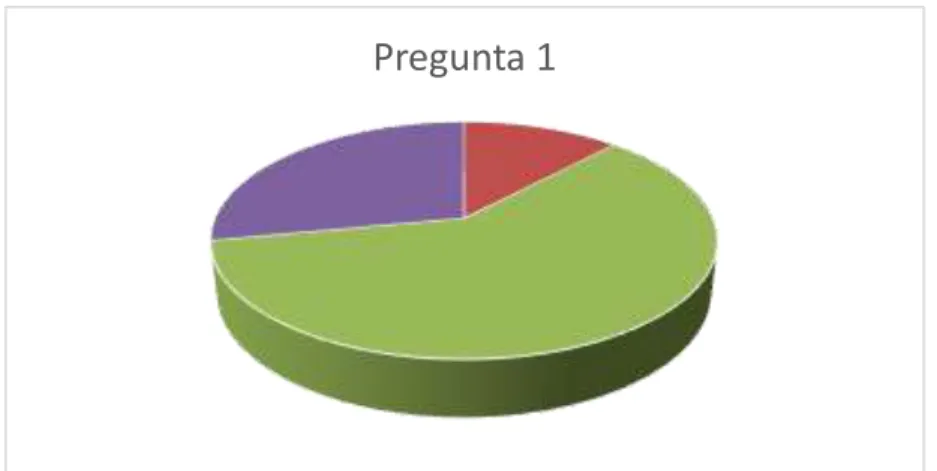
Figure 3. Statistic Graphic initial survey - 1st question………...…………...51
Figure 4. Statistic Graphic initial survey – 2nd question………...……….…...52
Figure 5. Statistic Graphic initial survey – 3rd question……….……...…………...52
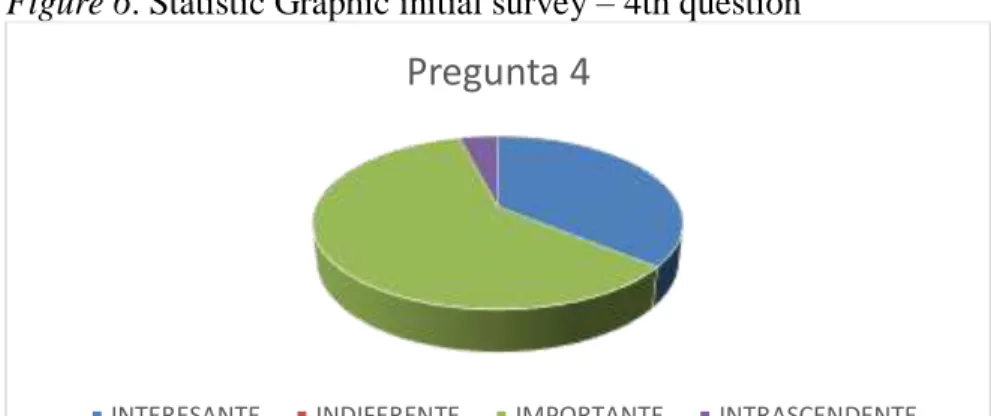
Figure 6. Statistic Graphic initial survey – 4th question………..……...…………...53
Figure 7. Statistic Graphic initial survey – 5th question………...………….53
Figure 8. Statistic Graphic final survey – 1st. question……….….…...………54
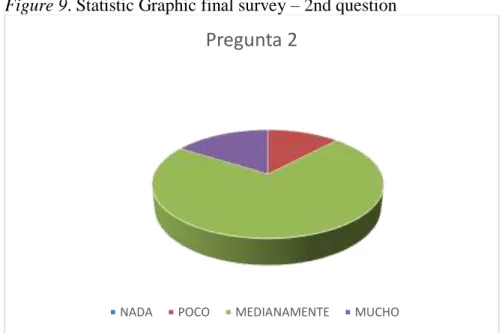
Figure 9. Statistic Graphic final survey – 2nd. question………...…...…...……...55
Figure 10. Statistic Graphic final survey – 3rd. question……….…..………...55
Figure 11. Statistic Graphic final survey – 4th. question……….…...………...56
Figure 12. Statistic Graphic final survey – 5th. question……….…...………...56
Figure 13. Statistic Graphic of the scores obtained by the students of grade 1001 in the mock Saber 11 of 2019……….……….…...………...58
Figure 14. Statistic Graphic of the scores obtained by the students of grade 1002 in the mock Saber 11 of 2019……….………..………….…...………...60
CHAPTER 1 INTRODUCTION
The National Open and Distance University UNAD in its social mission to support the development of communities and progress of the Colombian education sector. It has made different cooperation agreements with educational institutions such as CEAD Distance Adult Education Centers.
The agreement established between the CEAD of Fusagasugá and the Municipal Educational Institution Ciudad Eben Ezer of the same municipality, takes into account the applied project called "Evaluation of the influence of M-Learning in strengthening vocabulary for the test Saber 11 of English in the I.E.M. Ciudad Eben Ezer of Fusagasugá"; a study determining the impact of mobile device use on the learning and skills building process of students to improve their results in the English subject on the “Saber 11” status test.
This study will be developed with a group of twenty-four (24) tenth grade students, agreed upon by the selected school's English teacher and UNAD teacher, to carry out the investigative process - taking into account that in 2020, they will present the respective status test, from which data will be derived and compared against results from previous years. Ultimately, this will demonstrate the effectiveness of M-Learning as a pedagogical strategy in strengthening students' skills and knowledge against their ICFES-type assessment.
The above proposal will be assessed as a grade work option, since it establishes the need to generate interesting pedagogical alternatives for adolescents. The tools involved motivate
Finally, the main aspect of this research activity is to establish the effectiveness of M-Learning with the use of mobile phone to strengthen language skills and practice the components of the test “Saber 11”. Through interactive vocabulary practice activities, association of images, phrases and reading comprehension - these being the fundamental characteristics in the lexical enrichment of the young apprentices – students will have access to a greater understanding of the evaluation. Practice will determine the effectiveness of the process, reflected by the improved results of students in the 2020 “Saber 11” test.
Significance of the Study
The UNAD University, in the quest to strengthen the social and academic processes of the communities has made agreements with different educational institutions of the municipality of Fusagasugá. Therefore, within its academic processes has involved the I.E.M. Eben Ezer City, a situation that has allowed an interinstitutional work that seeks to strengthen teaching-learning processes of young people in their final school stage.
Among the specific actions in the area of English carried out by the UNAD in the I.E.M Eben Ezer City, it is evident that the academic performance of the latest promotions in the subject is not as positive as they would like, this situation becomes noticeable in the results obtained in the last year in the Saber 11 status test. This low performance in this area has difficult the academic possibilities of young graduates, because the low results obtained have limited their access to scholarships in relation to the higher education.
limited to textual content in English language school processes and in which the possibilities it offers to the use of technological tools in learning a language have not been considered at least one mobile device, its use does not go beyond that of social networks.
Statement of the Problem
Taking into account aspects mentioned for the object population of this research; the students had been familiar with a text translation approach from basic elementary, a situation that had given them a wrong idea of their ability to learn the language and only for some time more participation of apprentices in classes has long been generated and some of them took on an interactive role with their teacher, feeling more confident in conveying their concerns to them, an aspect that has generated a slight positive change in the academic performance of students.
In dialogue with some students, they mentioned that English was tough to learn because, although they had studied it during their previous school years, they could not use it as they would like. That is, they are frustrated that they cannot communicate fluently and are worried about the results they can get on the Test Saber 11 which is defined by MEN (2014) as the evaluation of the level of Middle Education aligned with the evaluations of Elementary Education to deliver data to the educational community in the growth of the basic skills to be developed a student during the passage through school life.
For this reason, vocabulary learning for the reader understanding of descriptive texts is the starting point for the realization of this application process, because due to the lack of vocabulary mastery, the necessity to improve their reading comprehension and thereby achieve good results in the Test Saber 11.
Foreign Language Standards; this study focuses on strengthening vocabulary for reading understanding of Descriptive Texts B1. In this regard, Mirici (2003) states that students are advised to take aptitude language tests to be trained within their own course of preparation. However, vocabulary learning alone doesn't seem enough. As students also informed having feelings and negative practices towards vocabulary knowledge, the researcher student has decided to address this problem by using mobile devices as a motivating agent for the vocabulary learning through different apps and online activities.
In this sense the student-researcher is aware that the use of smartphones in the classroom is prohibited in most public schools; however, to determine aspects of the applied project, it is allow its controlled use since this group of students will receive for four months in two-hour day a week vocabulary-strengthening and reading comprehension classes under the development of specific activities that are carried out through the use of the mobile phone, where the
management will be consensus with the students.
Considering the above, after students have clear guidelines for cell phone handling in the investigation process, disciplinary inconveniences are avoided and the use of these devices is exclusively for educational purposes.
Objectives General Objective
Specific Objectives
• Identify the English language skills which the test Saber 11 ° evaluates, in the students of the
I.E.M City Eben Ezer de Fusagasugá from the results obtained in previous years, the mock Icfes Test, and the processes reported by the teacher.
• Design and apply the corresponding actions to the M_Learning pedagogical strategy,
considering the results of the characterization of the students and the skills assessed by the Saber 11 test.
• Determine the effectiveness of the M_Learning pedagogical strategy in the development of the skills assessed by the Saber 11 test.
CHAPTER 2 LITERATURE REVIEW Test Saber 11
are assessed. The classic dialogue where you must choose the right option that the character can answer in that dialogue. Part 4: with 18% of the English questions, grammar knowledge is evaluated, there is a text with blank spaces where you must choose the correct word, which fits in that blank part. Part 5: it has 16% of the questions. Here you must understand a text and answer questions based on the text. Part 6: it has 11% of the questions, you must read a text just like part 5, only the questions are not propping of the text, they are inference, such as the author's intention and aspects of the text to be highlighted. Part 7: with 22%, being the one with the most questions, it is like part 4 but with a greater touch of demand.
Similarly, Decree 869 of 2010 sets out as objectives of the exam Saber 11, Check the degree of development of the competencies of students who are about to finish the eleventh degree of middle education. Provide educational institutions with relevant information on the competencies of applicants to enter higher education programs, as well as those admitted, to serve as the basis for the design of leveling programs prevention of desertion at this level. Monitor the quality of education of the country's educational establishments, based on the basic standards of competences and quality references issued by the Ministry of National Education. Provide information that serves as a strategic reference for the establishment of national, territorial and institutional education policies, among others.
The Colombian MEN (2009) empowers to The ICFES (Colombian Institute for Education Evaluation) to relied on the Common European Framework of Reference for Languages (CEFR) as a reference in the construction of its evaluation indicators in the Saber 11 status test, with the purpose of carrying out the evaluation of institutional processes and make decision making easier at completely levels of the teaching system (ICFES, 2009: para. 3).
Bilingual program, the National Ministry of Education – MEN included in its 2005 mandate measurement standards based on the CEFR. According to this plan, in 2019 all Graduate students of public and private school institutions must be located at level B1.
On the other hand, to measure the fulfillment of the objectives of the Colombian Bilingual program, the MEN has also entrusted the design and application of two examinations of
competences based on the CEFR (Ministry of National Education, 2005). Below the
management of ICFES and in alliance with the British Council Colombia and Cambridge ESOL, the English test Saber 11 was designed.
This test, in its English component, it is divided into seven parts, all of them with multiple selection questions. In this exam, they only assess reading, vocabulary and grammar skills, while listening, speaking and writing skills are not evaluated by difficulty with the technological elements and processes that are required for it.
Reading Comprehension
Reading comprehension depends on the reader's English proficiency and knowledge, but also on the characteristics of the text you are reading. This is very close to how Carver and Darby (as quoted in Carver, 1992, p. 348) have defined reading comprehension, as they claim that it is a process of communication of thought that comprises two factors: the rate at which thoughts are obtained and the accuracy with thoughts are interpreted. Therefore, the result of these two factors comes with the efficiency in which thoughts are transmitted.
Vocabulary Learning
Vocabulary learning is indispensable in the communication processes between them
reading. This fact is corroborated by Fauziati (2005) who has been correct in saying that, without enough vocabulary, an effective message cannot be given, or ideas cannot be expressed in
writing or oral. Based on Oxford's (1990) explanation, memory strategies served as "a highly specific function: helping students store and retrieve new information"(p.37). She found out that "language learners have a serious problem remembering the large amounts of vocabulary
necessary to achieve fluency" (p.39).
As a result, some kinds of methods, procedures, exercises and practices have been suggested in the field of teaching vocabulary (Schmitt, 2000) and it has been proposed that education vocabulary should not only involve of teaching specific words, but also trying to equip students with the plans needed to increase their acquaintance of vocabulary (Morin and Goebel, 2001).
M-Learning
Over the past decade, the growth of wireless data networks has conceived the connection of mobile devices such as electronic tablets and smartphones to the internet network with the ability to access educational content instantly and in anywhere you find access to the web; this phenomenon gives rise to a new mode of distance learning called "mobile learning". Elkheir and Mutalib (2015) define M-learning as a combination of E-learning (Electronic learning of the English language through the Internet with the use of various computer tools and the
development of online activities) and mobile computing (Use of portable mobile devices with the capacity to store and share information online) that fuses mobile and wireless technology to deliver learning practices.
Among the different definitions given to the M-Learning, it should be considered one of the most concrete and basic, but in turn it conforms to this process and given by the researchers (Pinkwart, Hoppe, Milrad and Perez, 2003; Quinn, 2000) define it as the direct descendant of the e-learning supported by resources, tools and digital electronics, also M-learning is the E-learning that is supported by mobile devices and broadcast of wireless; or simply, is when the Learning takes place with mobile devices and it is supported by wireless transmission.
As for the above, it is essential to mention the large number of functionalities of the M-Learning in English language teaching that can be given through the continuous use of different translation, pronunciation, association and organization of texts, phrases and words in different languages that allow the unlimited practice of its users and undoubtedly favors the acquisition of new vocabulary, a factor that enriches the grammatical understanding of the language that you want to learn and optimizes the understanding of texts.
and tablets to encourage students' interest in some subject and consequently make them spend more time in their learning process. Issa and Isaias (2016) and Baron (2016) determined the M-Learning strategy as a positive factor by using mobile devices connected to the internet to encourage communication and collaboration between individuals regardless of where they are.
(Ramírez, 2009) offers a very clear definition of M-learning, in which he interprets it as a way of learning in an educational frame of reference different from the classroom and a teacher, doing it through a mobile device, in which the motivation to learning plays a fundamental role in knowledge; and that considers the use of mobile devices, well-conceived favors the design of virtual educational environments making the teaching-learning process focus on the apprentice, who is the protagonist of his training so it is necessary to contribute to the development of a Critical and innovative thinking that knows how to work in a collaborative environment.
Thus, the concept of using mobile devices to improve the learning processes, involves designing suitable activities such as carrying out projects or work collaboration that helps facilitate student work in a double sense: on the one hand, encouraging their individual work, and on the other, stimulating interaction with their groupmates (Fiad and Galarza, 2015).
(McQuiggan, 2015) stated that "mobile devices are widely predicted to be the wave of the foreseeable future in educational technology. Therefore, through the advancement of technology, the invention of new mobile devices will never come to an end and will apply to the educational context if their effectiveness is positive in the field", with the above we can argue that the use of devices mobile sought for educational purposes does not stop, on the contrary, they are
increasingly necessary, indispensable and of priority use, these are permanently updated and modified with more advanced technology.
expand the individual and group cognitive environment of the educated by building knowledge, providing new alternatives and advantages from didactics in the different areas and in the particular case of teaching a second language, since it allows the teacher to generate new
innovation strategies when guiding a class. However, the benefit of using any mobile device will be beneficial if the teacher directs the process towards a teaching and pedagogical purpose for learning English, where these elements are mediators of available and relevant content in the web and students.
In the context of public schools, students usually have a low level of English proficiency and they are afraid to interact in English; it is there that the use of the devices plays an important role and becomes an effective instrument within the classroom, so that students move from being passive recipients of what they learn through books, or photocopies to being active participants and having through a device that is own and used daily, the tools necessary to manipulate, download, reuse various audiovisual resources that allow autonomous learning in a different environment to the traditional, as Fernando Huedo Duque states: In case of being introduced into the classroom, digital resources are often regarded as a fun to break with the traditional dynamics of the class due to the motivation and excitement they arouse among students, and not as a true tool Didactics. (Duke, 2013)
Mobile devices
The development of the M-Learning in the schoolroom requires the usage of so-called mobile devices, according to Baz, Ferreira, Alvarez and García (2008) this is "a small device with some processing capabilities, with permanent or intermittent connection to a network, with limited memory, which has been designed specifically for a function, but can perform other more general functions" (p.1). For this research, it is necessary that both students and teachers have smartphones because they have various functions and capabilities necessary for the development of M-Learning, because they will have to make reproductions, recordings, downloads,
development of online activities among other activities.
From the perspective of (Ramírez, 2009), “A mobile device is a processor with memory that has many input forms (keyboard, screen, buttons, etc.), also forms of output (text, graphics, screen, vibration, audio, cable). Some mobile devices linked to learning are laptops, phones cell phones, smartphones, digital personal assistants (Personal Digital Assistant, PDA), portable audio players, iPods, clocks with connection, platform of games, etc .; connected to the Internet, or not necessarily connected (when the material materials have already been archived) ”.
Smartphones allow a greater capacity to store data and perform computer-like activities and enable internet connectivity via Wi-Fi and email better than a conventional mobile phone. In addition, they can be music players, cameras and video, etc., also, it must be recognized that all smartphones allow the user to install programs or applications additional to those already installed by default, as well as the skill to read documents in PDF and Microsoft Office format; that is, today these devices have new and varied functionalities in relation to the old mobile phones, empowering them as suitable for the development of Mobile Learning.
(2008) argue that: “From the humble origins of the cell phone, a digital device called a
smartphone emerged, which in addition to voice communication, includes features such as a full qwerty keyboard, text messaging, email, Web access, removable storage, FM radio, digital music player, software options for games, financial management, personal organizer, GPS and maps. ” (p. 20) June Jamrich and Dan Oja talk about the features that smartphones possess.
Pei Zheng and Lionel Li (2006), after an investigation, affirmed that the new era of technology will bring about the massive use of electronic communication; and that smartphones will fulfill these functions. They also mention that mobile wireless technology is probably the most active area in computing and current communications and that cell phones have evolved to be multifunctional smart devices that apart from providing communication through voice and text messages, facilitates the processing of data and have improved wireless connectivity.
To conclude,it is essential to establish the differences between Smartphones and cell phones as a determining aspect to give clarity regarding the devices and the conception that some people have about Smartphones. Regarding this, it can be said that smartphones are cell phones with a touch screen and keyboard and with which you can do more activities apart from making and receiving calls and text messages; unlike cell phones that are devices with functional limitations that restrict them from making and receiving calls, taking poor quality photographs and listening to music.
Language competition
Lyons (1969), stated it as the 'ability that the person achieves to know how to use a language correctly, bringing him to know the procedures, needs, intentions, purposes, purposes, etc.', on the other hand Hymes (1972 ), defined the Communicative Competence as the 'ability that the speaker acquires to know how to use a language with ownership leading him to distinguish the various possible social situations'. In this way we have the Competence in Linguistic
Communication used to organize the ideas of our thinking (Understanding), also to express our inner world (Expression) and finally to relate in society (Relationship).
The Common European Framework of Reference for Languages (CEFR)
The Council of Europe (2001), defines The Common European Framework of Reference for Languages (CEFR) a standard that serves as an international reference to measure the level of comprehension, oral and written expression of a language.
The Colombian National Bilingual Program
Guerrero, C. H. (2008) determines that The National Bilingualism Program is oriented toward “having citizens able to communicate in English in such a way that they move the country into universal communication processes, into the global economy, and into a cultural openness with internationally comparable standards.
On that way, he says that in the Colombian context, English language is considered a foreign language. Given its importance as a universal language, the Ministry of Education has established, as one of the core points of its educational policy, the improvement of the quality of the teaching of English, leading to better performance levels in this language.
According to Fandiño-Parra, Y. J., Bermudez-Jiménez, J. R., Lugo-Vásquez, V. E. (2012) the main objective of the National Bilingualism Plan (NBP) is to have citizens capable of
communicating in English, with internationally comparable standards, that insert the country into the processes of universal communication, in the global economy and in cultural openness. Among the specific objectives, the NBP seeks that from 2019 onwards all students finish their secondary education with an intermediate level (B1 according to the Basic Standards of Foreign Language Proficiency: English). Likewise, as of this year, all English teachers in the country are expected to have at least intermediate-advanced level (B2 according to the Basic Foreign
Language Proficiency Standards: English).
Basic Learning Rights (DBA)
The Ministry of National Education (MEN, 2015) specifies them as a group of elementary knowledge focused on the educational community that articulate teaching processes and promote conditions of educational equality to All Colombian students. DBAs are raised for each school year from first grade to eleven.
In this way, it arises a possible learning path for students to achieve the learning objectives set by the Ministry of National Education (MEN) for each grade group. Basic learning rights alone do not constitute a curricular proposal since these are complemented by approaches, methodologies, strategies and contexts that are developed in educational institutions, within the framework of the Projects Educational Institutional and are specified in the area plans.
Therefore, the Ministry of National Education (MEN, 2015) puts the DBA to disposition of the entire educational community as an educational tool, because it provides a reference that allows to the territorial entities to launch curricular initiatives adapted to the needs of each Educational Establishment. Basic Learning Rights presents an example of a route, which may or may not serve reference to articulate the disciplinary areas and classroom planning by grades and levels. For teachers, shows an example of a route for the grades of basic and secondary
(MEN, 2015) Presents the basic English learning rights the eleventh grade:
• Identifies the purpose of medium length oral and written texts related to topics of general and academic interest and shares it with others.
• Explains orally and in written forms the causes and effects as well as the problem and the solution of a situation.
• Identifies opinions of the author in oral and written texts related to his/her school environment.
• Writes opinion texts about academic topics using a clear and simple structure.
• Expresses his/her position on a familiar topic in written and oral form, taking into consideration his/her audience.
Competent teachers in technology management
At the present time, teachers try to understand the new way in which their students learn and what would be the best way to teach them from their professional training and they face this challenge as expressed by Prensky, who said that as educators of digital immigrants, teachers are not speaking the same language as your students Teachers have not yet managed to understand the evolution of the technological world in which new generations have already become familiar. In other words, students could teach teachers because they are more involved on the technology subject (Prensky, 2001).
skills and are lagging behind the new generations of students immersed in technological modernity.
Considering the above, it is clear that there is resistance to the integration of ICTs in teaching by teachers, who received an education totally remote from ICTs (Sunkel, s / f). But It should also be mentioned that there are some teachers who they have assumed the new role of innovation in the processes of teaching and use technological resources in their classes; Applied activities in virtual platforms and classrooms that allow interactivity, simultaneity, peer feedback and learning optimization. These platforms allow to provide a diversity of experiences
educational and are available and accessible from different devices, places and moments; they constitute a main factor for the commitment that teachers must have to integrate the technology in their learning units, given That is the way how current students learn (UNESCO, 2013).
Therefore, it is necessary for teachers to be competent in the management of technological resources in their classrooms and for that purpose, training and updating in pedagogical innovations based on the use of ICT, should be the point to which all Colombian teachers should point if they do not want to be considered as obsolete elements in current education.
Information and communication technologies (ICT)
First, I take an interesting definition of ICT in Adell (1997, p. 56), who says that they are “the whole process and products derived from the new tools (hardware and software),
information media and communication channels related to storage, processing and digitized transmission of information ”.
expresses that ICT “revolves around to four basic means: computer science, microelectronics, multimedia and telecommunications ”. And most importantly, they turn
in an interactive and interconnected way, which allows get new communicative realities, and enhance those that They can be isolated.
Cabero (2005), expresses that technology should not be perceived as a technical instrument, but as a cultural instrument of the mind and formative at the same time and that
these must become significant tools for training by empowering different cognitive skills and facilitate an intellectual approach between attitudes and skills of the subject.
Taking into account the references mentioned above, I think that the fundamentals in the Colombian educational context are all the characteristics and possibilities that no one but ICT offers to the teaching and learning processes and I believe that the education system should promote the articulation of the processes pedagogical with the use of information technology and communication to be more effective.
State of the art
more than 1,500 random questions, where you establish a personal learning game structure (Week, 2017).
TOMSA. It is a tool created by a group of systems engineering students of the Industrial University of Santander (UIS) of Bucaramanga in 2014, focused on the preparation and digital training for the test Saber 11, which provides specific educational content of the component of English that evaluates this exam, able to adapt to the different learning styles of students interested in taking these State evaluation. It was featured by the Colombian Ministry of Technology and Communications as an effective tool for entrepreneurship and educational support (MINTIC, 2017).
PreSaber ESE 11 is a virtual preparation course for the ICFES exam, created by the company Education and Business in the city of Medellín in 2013, which provides training services to students and teachers, this program contains more than forty explanatory videos, interactive activities and more than 20 virtual drills with immediate comments (answers and justification). In addition, it includes virtual advice with teachers (ESE, 2017).
Ukanbook is an educational platform created by the teacher José David Arevalo in 2012 and recognized by the Colombian Ministry of Technology through its APPS program, aimed at students in tenth and eleventh grade, who seek to improve performance by presenting Saber 11 tests, using a simulator with ICFES tests in order to know the test and prepare to develop it. (MEN, 2014).
strategies that improved vocabulary memorization and cohesive them into a mobile application, in this way determine the importance of choosing the appropriate learning strategy for the context and its subsequent integration with the technology.
EDMODO was founded in 2008 by Jeff O'Hara and David Youngman; After some years of testing and improvement in 2013, this tool acquired the Root-1 startup (Android operating
system that allows users of Smartphones, tablets and other devices to obtain privileged control of their device, with which certain functions of storage, installation and uninstallation of programs that the manufacturer don’t provide. Borg (2013)) to become an educational app store, but its
most important achievement was in 2014, with the launch of Snapshot, a component of the tool with a set of process evaluation tools designed to measure the educational progress of students, which is why Edmodo Snapshot received the award for the best educational evaluation solution, and the company allied itself with two great British issuers. Oxford University Press and
Cambridge University Press- to provide educational content on their platform and introduce Snapshot in the United Kingdom.
This application designed on a free, social and educational platform, where teachers and students can create work groups, notes, alerts, assign tasks and develop evaluations is an app whose focal goal is to permit communication between educators and apprentices. It is a social media service grounded on the microblogging shaped for explicit practice in education that offers teachers of a private virtual place where posts, files and links can be collective, a
WhatsApp is an application that was launched in 2009 and since then WhatsApp has been located as one of the Most popular instant messaging networks in the world and has been incorporated in the M-Learning in recent years; This app in January 2016 reached the immense number of one billion users in 41 different languages. The above means in terms of percentages, that one of each of seven people on the planet constantly use this application of messaging (Cremades, Cuenca, & Onieva, 2016). The strong positioning of this messaging network has been produced by its broad advantages in contrast to applications similar, one of these characteristics, is the variety of formats in which the information can be sent (Text, Photos, Screenshots, audio and video).
Previous research points to similar aspects like the most Outstanding for choosing this application: real-time communication, be able to share images, music or videos for free (Padrón, 2013). The trend of wide use could be supported by the characteristics described by Vaquera (2014), who emphasizes on The WhatsApp and has some communication elements traditional (oral and written), turning it into a hybrid language that allows the immediate sending of messages, the condensation of these and the violation of some grammar rules In this sense and according to Bloom's Taxonomy for the digital era (Churches, 2008) the degree of appropriation of applications may vary from recall to creation, generating with experience and skills
CHAPTER 3 METHODOLOGY
This applied degree project belongs to the School of Education Sciences (ECEDU ) of the National University Open and Distance UNAD and the line of deepening and research of this program is "Bilingualism. This research, called "Assessment of the influence of M-Learning in strengthening vocabulary for the test Saber 11 English in the I.E.M. City Eben Ezer of
Fusagasugá" is framed in the mixed method as it is sought obtain the information
corresponding to the impact of the implementation of this pedagogical strategy on a group of tenth graders who will present the status test in 2020.
In the face of this method Chen (2006) defines the mixed approach as "the methodical incorporation of quantitative and qualitative approaches into a single study in order to acquire a more comprehensive "photograph" of the situation", similarly Johnson et al (2006) in a "sense they visualize mixed investigation as a continuum where quantitative and qualitative methods are mixed, converging more on one of them or giving them "weight".
Regarding the above, the implementation of this to investigative methodology allows the collection and analysis of quantitative and qualitative data, as well as its integration to make inferences a product of the obtained information.
Type of Study
results in reports or texts is not enough, consequently action research in any aspect is a scientific category with the same importance of pure science.
In this order of ideas, the approach to problems is constituted by stages, each of them composed of a planning process, action and obtaining information about the result of these actions and considering the above, research–action, part of personality theory and field theory, articulated in a theory-practical relationship that leads to social action about certain facts to analyze and determine how the present situation is, what the urgent problems are and what needs to be addressed in these situations.
Therefore Lewin (S.F), mention that the research- action, conforms to the project as it allows interaction as a mechanism to create processes in which the actors of the research process provide solutions, creates proposals that fit the time, space and reality in which the participating population is located, and allows each of the students individually and collectively to generate actions that allow the acquisition of cognitive skills.
Research-Action- (AI) can be defined as a type of research applied that is done in everyday or daily work environments‖ (Rojas Ginche, 2009, p.2). the author adds that his character is basically exploratory and can be done before, during or after the execution of a school
The concept AI research-action; comes from the model developed Kurt Lewin (1944, cited by Rojas Ginche, 2009) and identify the next stages (Kemmis y McTaggart, 1988):
1. Observation: Characterization and recognition of the preliminary state.
2. Planning: Development of an action plan that seeks to solve a problem or satisfy a need identified in the previous stage.
3. Application: Act to implement the strategy and observe its effects in the context in which it takes place.
4. Results and Reflection: The respective critical analysis of the processes and results is carried out.
5. Conclusions and Suggestions: In this final step of the research, there are given the deductions of all the process.
Description of the applied project stages 1. Stage 1. Observation and characterization:
In this initial stage, the methods used were the consultation in the official web page
1.1. Characterization of the research Population
The population under study of this applied research project, is a group of twenty-four students of tenth grade 1001 of the Municipal Educational Institution Ciudad Eben Ezer of Fusagasugá.
1.2 Description of the Educational Institution
Figure 1. Official Shield and Anthem of the I.E.M Ciudad Eben Ezer of Fusagasugá Students I.E.M ciudad Eben-Ezer, Facebook august 2017, illustrations recovered from
https://www.facebook.com/estudianteseben/photos/a.391708094561068/466606923737851/?typ e=3&theater
Who are they?
They are an Educational Institution that offers preschool education, primary, secondary and technical media in public health promotion and prevention, this school located in the
southwestern commune of Fusagasugá, urban area. Their graduates meet a work and
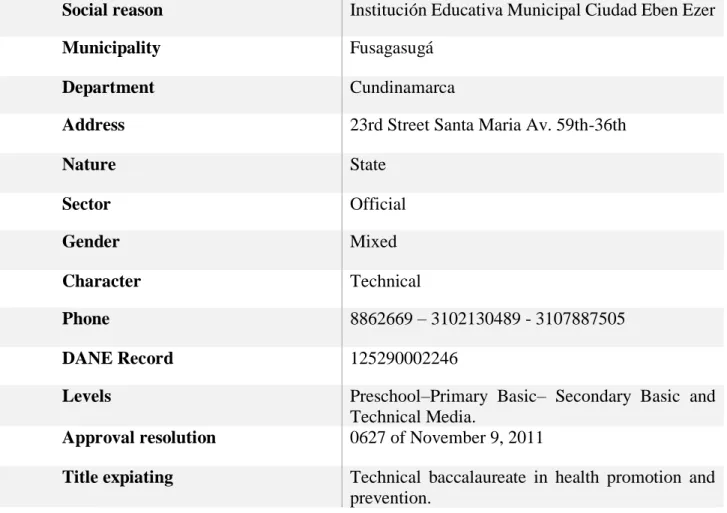
Table 1. Characterization of the Educational Institution
Elements Information
Social reason Institución Educativa Municipal Ciudad Eben Ezer
Municipality Fusagasugá
Department Cundinamarca
Address 23rd Street Santa Maria Av. 59th-36th
Nature State
Sector Official
Gender Mixed
Character Technical
Phone 8862669 – 3102130489 - 3107887505
DANE Record 125290002246
Levels Preschool–Primary Basic– Secondary Basic and Technical Media.
Approval resolution 0627 of November 9, 2011
Title expiating Technical baccalaureate in health promotion and prevention.
General official data of the I.E.M City Eben Ezer of Fusagasugá.
Table 2. Characterization of the study population
Elements Information
Population 24 students
Can Tenth
Socioeconomic stratum 1.2 and 3
Ages 14.15 and 16 years old
Housing location Urban Area
1.3. Characterization of the English level of the I.E.M Ciudad Eben Ezer de Fusagasugá: In the first phase of the research, the results obtained by eleventh students in the Saber 11 2018-2 test will be taken as a reference, to know the general level of English of the school in the last years and in front of it, to be able to determine the level of English of eleventh grade students versus the results achieved in the state exam.
It is essential for the development of the applied M-Learning project to be able to determine the performance of the scholars in the English subject by analyzing the results provided by the ICFES in which the level of student competencies in percentage results of students can be visualized. in a general way, information presented and supported in the
respective statistical graphs, which allow comparison with the results obtained in the test Saber 11 in 2017-2 and 2018-2; in this way the general level of English of the educational institution can be established accessing the CIMAT platform of the (MEN).
2. Stage 2. Planning:
(Development of an action plan to improve what is already happening). In this part was stablished the schedule and activity plan having into account the lesson plan created by the English teacher of the I.E.M. Ciudad Eben Ezer from Fusagasugá and the detected needs and difficulties of students according to the test Saber 11.
2.1. Location of the activities: The research project will be carried out at the installations of the I.E.M. Eben Ezer City of Fusagasugá with twenty-four students of the course tenth (10-01).
programs of the UNAD - CEAD Fusagasugá, who determined the contents of the institutional curriculum that the researcher student had to work with some specific themes that are frequently evaluated in the Saber 11 test, for that reason the issues raised to be developed were: Advertising - Simple future - Simple past - Present perfect - Reading comprehension and general vocabulary.
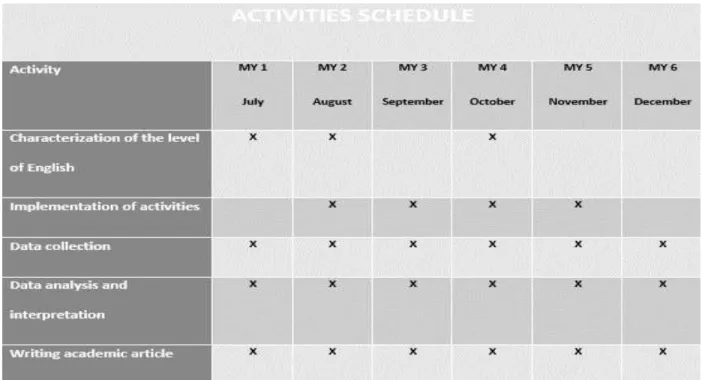
2.3. Activities schedule
Table 3. Schedule of Stages and activities of the project (Graphical description)
Presentation of the research stages and activities in the correspondent months to be developed.
3. Stage 3. Application:
In this phase of the process, the development of activities began through some applications in the mobile phones of the students, focused on strengthening vocabulary and reading
As well was developed the feedback of activities at the beginning of each class for clarification of doubts and concerns that students present in the development of the different activities. 3.1. Description of the implementation of activities
After doing the respective characterization of the English level of the apprentices proceeds to carry out the implementation of the actions inherent in the research process as follows:
At this stage of the research process applied the student researcher designs an activity in PPT format type presentation for each class, addressing a topic assigned by the teaching professor who owns the Educational Institution and that corresponds to the curriculum that is developing with its students, which contains a specific grammatical and/or theoretical
explanation, a video summarizing the topic and a series of exercises to be developed in the classroom, which allow online practice; interactive reinforcement activities are also developed for each topic in the
Having the reference of (Pérez Salazar, 2014) who indicates that Educaplay contributes to strengthening the learning of the apprentices through the creation and development of
multimedia educational activities and that in addition any user registered on the platform can design them with an attractive and professional result, in just a few minutes, This app is
Presented with an advantage over other applications because it can be played from any browser, either online or also from any media such as CD, DVD etc.
crossword puzzles, word soups, column relationship, word organization, among others) that yield the respective score obtained in line by each of the apprentices
Another tool that was fundamental in the process of applying the M-Leaning strategy with the tenth grade students of the educational institution Ciudad Eben Ezer de Fusagasugá was the WhatsApp Application, a strategy that not only facilitated communication and interaction between students and research teacher ; It was also the path by which the results of the activities developed by the apprentices on the mobile devices were sent.
3.2. Application of the preliminary survey of student’s perception of English language learning experience in school
To determine the initial perception of the students about their English learning process before of the application of the M-Learning pedagogical strategy, were applied the next survey:
INITIAL SURVEY
1. Do you consider that your experience in learning the English language in your school life has been? a. EXCELLENT
b, GOOD c. REGULAR d. BAD
2. Which of the following English language communication skills is more difficult for you? a. READ
b. WRITE c. TALK d. LISTEN
3. Do you think that your learning process of the English language has been? a. DIFFERENT
b. EASY c. BORED d. DYNAMIC
4. Is learning English for you? a. INTERESTING
d. INTRASCENDENT
5. When have you had to communicate using the English language you have generally felt? a. FEAR
b. QUIETNESS c. SHAME d. SAFETY
3.3. Application of the M-Learning strategy:
In this part of the research, the classes adjusted to the lesson of the English teacher of the Eben Ezer de Fusagasugá City educational institution were developed, framed and designed to be developed on the students' cell phones as follows:
3.3.1. Designed activities in ppt format
The next activities were designed by the investigator teacher, attending the class schedule given by the English Teacher of the I.E.M Ciudad Eben Ezer and developed with the students on base to the M-Learning pedagogical strategy during the research process.
3.3.2. Links of activities designed in educaplay
Sending practice and reinforcement activities to each of the students through the
WhatsApp application designed on educational platforms such as EDUCAPLAY, as a tool for consolidating information and learning for schoolchildren.
The next links correspond to the activities developed by the students and created by the researcher teacher in the Educaplay platform.
✓ https://es.educaplay.com/recursos-educativos/4736632-complete_with_simple_future.html ✓ https://es.educaplay.com/recursos-educativos/4780994-future_simple_will.html
✓ https://es.educaplay.com/recursos-educativos/4781186-english_test_future_simple.html ✓ https://es.educaplay.com/recursos-educativos/4781079-match_the_sentences.html ✓
https://es.educaplay.com/recursos-educativos/4830524-animal_names_crossword_puzzle.html
✓ https://es.educaplay.com/recursos-educativos/4781079-match_the_sentences.html
✓ https://es.educaplay.com/recursos-educativos/4752040-listening_and_writing_activity.html ✓ https://es.educaplay.com/recursos-educativos/4134961-insects_in_english.html
✓ https://es.educaplay.com/recursos-educativos/4130404-wild_animals.html
✓ https://es.educaplay.com/es/recursoseducativos/4449380/html5/irregular_verbs_past_particip l.htm
3.4. final perception survey on the application of m-learning activities
This survey was applied to determine the perception of the population study about the process and methodology developed during the semester and the impact It generated in their English level competences and skills to face the Test Saber 11
1. Do you believe that the M-Learning project with its activities has improved your English
vocabulary?
a. NOTHING b. LITTLE BIT c. REGULARY d. MUCH
2. To what extent has the M-Learning project strengthened your English-language reading
comprehension?
a. NOTHING b. POCO c. MEDIANLY d. MUCH
3. Do you consider that the activities developed during the implementation of the M-Learning
project have been? a. ENTERTAINED b. DIFFERENT c. BORED d. DYNAMIC
4. Does learning the English language through your mobile phone work for you?
a. INTERESTING b. INDIFFERENT c. IMPORTANT d. INTRASCENDENT
5. How would you rate the M_Learning project developed during this semester?
a. BAD b. REGULAR c. GOOD
d. EXCELLENT
3.5. Instruments used to collect the information
The main focus of this project is action-research for data collection and different
approach (CABS). According to Clark (2010), mixed method is a research approach, popular in the social, behavioral, and health sciences, in which researchers collect, analyze, and integrate both quantitative and qualitative data in a single study or in a sustained long‐term program of inquiry to address their research questions.
which is expected to be post-intervention will be applied in order to measure the change achieved with the intervention program and whether the skill was acquired by the students.
From the qualitative approach, data collection methods will be used as a field journal where information is recorded according to Sampieri (2014) is used to:
a. Description of the environment (initial and posterior) covering places, people, relationships and events.
b. Diagrams, tables, and schematics (sequences of events or timeline of events, links between concepts of approach, networks of people, among others.
c. List of objects or artifacts collected in the context, as well as the photograph and videos that were taken (indicating date and time) and why they were collected, their meaning and contribution to the research.
d. Aspects of research development (as we go so far, what we lack, what we should do) On the other hand, students will give their opinion on the application of activities
3.6. Data collection
From the first phase of the applied M-Learning project at the IEM Eben Ezer City in Fusagasugá, digital information that evidences the activities carried out during the research process is stored and organized and is outlined in the written academic document that consolidates all the information and is presented at the end of the investigation as follows.
The information obtained during the process is systematized in instruments such as field diary, photographic evidence album, surveys with their respective percentage graphic
interpretation; and it is presented by means of the mentioned elements since they facilitate the interpretation and conclusion of results.
3.7. Information analysis
The analysis of the information will be carried out through an evaluative instrument called “internal mock Saber 11 2019” developed by Milton Ochoa through his company “Martes de Prueba” that has among its services the evaluation of students' knowledge prior to the
presentation of the Saber 11 test. This process is done through a simulation with content similar to that of the ICFES evaluation every year . The objective of this service is to identify the weaknesses of those who present the simulation and provide feedback to the institutions
regarding the actions they must take to improve the skills of their students when they present the Saber 11 test. Ochoa, M (2015).
3.8. Data analysis and interpretation:
It is essential to achieve the objective of the M-Learning project, the analysis and
performance of students in the specific area of English and subsequently, during the development stages of the research, it provides the necessary information and data to structure a final report, which will surely determine the impact of the project on the population that was applied.
Writing of the academic article:
For the consolidation of the information obtained at each stage of the applied M-Learning project, it is necessary to record each and every aspect that gave shape and structure to the research taking into account the guidelines of the university Open and distance UNAD for the presentation of written works and the respective formats in which the information is collected; therefore, the formats provided online by the institution are taken as references and there the proposal or preliminary draft and the written work that underpins the implementation process is structured.
3.9. Measurement of the Effectiveness of M-Learning
This process is made through an evaluative instrument called “internal mock Saber 11 2019” developed by Milton Ochoa through his company “Martes de Prueba” that has among its services the evaluation of students' knowledge prior to the presentation of the Saber 11 test. This process is done through a simulation with content similar to that of the ICFES evaluation every year . The objective of this service is to identify the weaknesses of those who present the simulation and provide feedback to the institutions regarding the actions they must take to improve the skills of their students when they present the Saber 11 test. Ochoa, M (2015).
and with this information the impact of the process of strengthening and implementation of the M-Learning pedagogical strategy of the first group (10-01) of tenth grade students is determined, comparing their results with the students of the second tenth students group (10-02) are
established the similarities or differences.
CHAPTER 4 RESULTS
4.1 Results obtained by eleventh grade students of I.E.M Ciudad Eben Ezer of Fusagasugá in the test Saber 11 in 2017 and 2018
Table 4. Performance levels according to the MCE in the test Saber 11 obtained by students from the I.E.M Ciudad Eben Ezer of Fusagasugá in the years 2017 and 2018.
Note: The first table shows the results obtained by the students of the educational institution I.E.M Ciudad Eben
Ezer de Fusagasugá in 2017, classified in percentage in the first column, in the different English classification levels
(A-, A1, A2, B1, and B +).
It is clearly evident that all students are located in the lowest levels (A-51%, A1 26% and A2 21%),
Note: In the second table, although there was a slight improvement in comparison with the previous year 2017,
because some students migrated from the lowest level A- (18%) to the next level A1 (54%) and the percentage of
students in level A2 (24%) improved slightly; The zero (0%) percent of students have managed to reach higher
levels B1 and B +, evidencing difficulties of the students in the presentation of the test Saber 11 2018.
4.2. Results obtained of the preliminary initial perception of the students about their English language learning experience in school:
INITIAL PERCEPTION SURVEY APPLIED TO STUDENTS ABOUT THEIR ENGLISH LEARNING EXPERIENCE IN SCHOOL
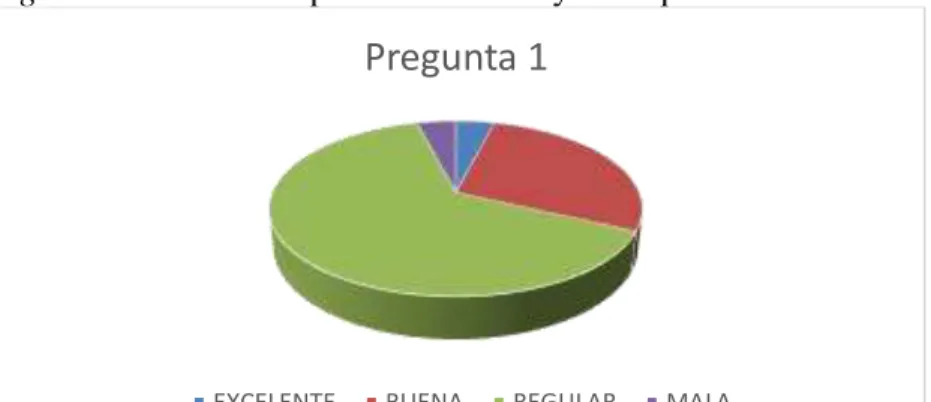
1. Do you consider that your experience in learning the English language in your school life has been?
a. EXCELLENT b, GOOD c. REGULAR d. BAD
Figure 3. Statistic Graphic initial survey - 1st question
Note: In this question most students perceive their English language learning experience as Regular.
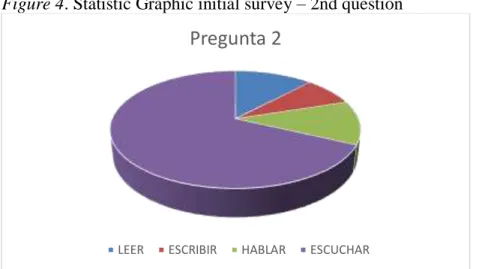
2. Which of the following English language communication skills is more difficult for you?
a. READ b. WRITE c. TALK d. LISTEN
Pregunta 1
Figure 4. Statistic Graphic initial survey – 2nd question
Note: In this question most students expressed that the skill that is most difficult in the English language is listening.
3. Do you think the learning process of the English language in school has been? a. DIFFERENT
b. EASY c. BORED d. DYNAMIC
Figure 5. Statistic Graphic initial survey – 3rd question
Note: In this question the highest percentage of students expresses that learning the English language for them has been difficult.
4. Does learning the English language work for you? a. INTERESTING
b. INDIFFERENT c. IMPORTANT d. INTRENCE
Pregunta 2
LEER ESCRIBIR HABLAR ESCUCHAR
Pregunta 3
Figure 6. Statistic Graphic initial survey – 4th question
Note: In this question most students express that the English language is important to them.
5. When have you had to communicate using the English language you have generally felt? a. FEAR
b. QUIETNESS c. SHAME d. SAFETY
Figure 7. Statistic Graphic initial survey – 5th question
Note: In this final question, half of the students express that the feeling of having to express themselves in English is a shame.
Results of the survey: The general analysis of this survey makes it possible to determine that the students' English learning process has not been satisfactory to them due to various factors such as the teaching methodologies applied by teachers in the previous years, disinterest in learning English, considering It is a difficult process between the most mentioned aspects. Although young learners perceive that English learning it is something important, most of them feel negative feelings when having to study it.
Pregunta 4
INTERESANTE INDIFERENTE IMPORTANTE INTRASCENDENTE
Pregunta 5
4.3. Results obtained from the final survey about the perception of students about the M-Learning activities developed.
FINAL PERCEPTION SURVEY APPLIED TO STUDENTS ABOUT THE APPLICATION OF M-LEARNING PEDAGOGICAL STRATEGY
1. Do you think that the M-Learning project with its activities has improved its English vocabulary?
a. NOTHING b. A LITTLE c. MEDIANLY d. MUCH
Figure 8. Statistic Graphic final survey - 1st question
Note: In this question most students perceive that the M-Learning pedagogical strategy has moderately improved their English vocabulary.
2. To what extent has the M-Learning project strengthened your English-language reading comprehension?
a. NOTHING b. POCO c. MEDIANLY d. MUCH
Pregunta 1
Figure 9. Statistic Graphic final survey – 2nd question
Note: In this question most students perceive that the M-Learning pedagogical strategy has moderately improved their English reading comprehension.
3. Do you consider that the activities developed during the implementation of the M-Learning project have been?
a. ENTERTAINED b. DIFFERENT c. BORED d. DYNAMIC
Figure 10. Statistic Graphic final survey – 3rd question
Note: In this question the highest percentage of students think that the activities of the M-Learning process developed during the semester have been entertaining and dynamic.
Pregunta 2
NADA POCO MEDIANAMENTE MUCHO
Pregunta 3
4. Does learning the English language through your mobile phone work for you?
a. INTERESTING b. INDIFFERENT c. IMPORTANT d. INTRENCE
Figure 11. Statistic Graphic final survey – 3rd question
Note: In this question most students express that learning the English language through the mobile phone is interesting.
5. How would you rate the M_Learning project developed during this semester?
a. BAD b. REGULAR c. GOOD d. EXCELLENT
Figure 12. Statistic Graphic final survey – 5th question
Note: The first table In this final question half of the students express that they would rate the M-Learning pedagogical process developed with them as good.
Pregunta 4
INTERESANTE INDIFIRENTE IMPORTANTE INTRASCENDENTE
Pregunta 5
Results of the survey: The general analysis of this final survey makes it possible to determine that the tenth grade students who participated in the development of M-Learning activities, perceive their participation as positive, they felt motivated in the process and interested in the use of the mobile phone as a tool to practice the topics. Also, some of them expressed that their English knowledge had improved since they were participating in the research.
4.4. Results obtained by the tenth-grade students (10-01 and 10-02) in the mock of the test Saber 11 2019 English
Table 5. Results of the mock Test Saber 11 obtained by students of grade 1001
Note: The last table shows the individual results of Mock evaluation of the Saber 11 test, conducted by the Milton