LEARNING’: EXPLORING
THE USE OF
METACOGNITIVE
STRATEGIES IN ONLINE
COLLABORATIVE
PROJECTS FOR
DISTANCE
PROFESSIONAL ENGLISH
LEARNING
Elena Bárcena, Elena Martín-Monje & Noa Talaván UNED
Abstract
This article explores the use of metacognitive strategies in the context of online collaborative language projects, on the basis of the authors’ claim that they can unveil spurious conventional assumptions on the general nature of online language learning, and thereby enable informed, self-regulated, and potentially effective individual learning processes. This research is situated in a recently completed pilot project called The Professional English Workbench, which involved task-based group formation and a rubric-based multi-cyclic (self- and hetero-) evaluation process that aimed at eliciting and enhancing the use of metacognition. As explained in the article, this project was undertaken by volunteer students from a number of subjects related to professional English in three Tourism subjects at UNED (according to a tertiary distance education institution which uses a blended learning
Resumen
methodology focusing on online learning via its virtual platform). Both the mechanics of the project and the analysis of the results are presented, making reference to the initial research questions, which were related to the students’ view on the collaborative tasks undertaken and the potential improvement of metacognitive competence in the context of the whole second language learning process.
Keywords: Professional English, Computer Assisted Language Learning, collaborative and project-based learning, metacognition and multi-cyclic evaluation.
en la educación en línea a través de su plataforma virtual. Tras presentar tanto el funcionamiento del proyecto como el análisis de los resultados, se da respuesta a las preguntas de investigación iniciales, relacionadas con la opinión de los alumnos acerca de las tareas de colaboración llevadas a cabo y las posibilidades de mejora de la competencia metacognitiva en el contexto del proceso de aprendizaje de una segunda lengua.
Palabras clave: inglés profesional, aprendizaje de lenguas asistido por ordenador, aprendizaje colaborativo y basado en proyectos, metacognición y evaluación multi-cíclica
1.
I
NTRODUCTIONLanguage teachers have devoted a lot of effort in the last couple of decades to promoting autonomous learning (Allford and Pachler 2007; Eneau and Develotte 2012) and, to a lesser extent, to the use of metacognitive strategies by students (Naiman et al. 1996; Sáiz et al. 2012). Both concepts are closely related and present in all fields in education. In particular, there is a substantial body of literature related to learner autonomy in the field of languages (Dickinson 1987; Ciekanski 2007; O’Rourke and Carson 2010) and also to the role of metacognition and the development of metacognitive strategies within this field (Oxford 1990; Graham 1997; Bozorgian 2012).
instance when we take up a new, challenging activity and ask around in the hope that other people’s tips will make it more feasible, or when students notice that they have more difficulties learning A than B and should practise the former more intensively. However, there is enough evidence of the benefits of incorporating metacognitive episodes in the learning process (Clark 1978; Horwitz 1987; Freeman 2001) to encourage teachers to design projects, tasks, activities and the like that enhance the engagement in them.
The study presented here shows the results of The Professional English Workbench (henceforth, the PEW)1 research project, which was recently undertaken by the authors to help distance university students in the development of their metacognitive competence and the application of self-awareness and introspection strategies in the study of professional English (henceforth, PE). The PEW had a double cognitive goal: firstly, to produce annotated electronic catalogues of free Web resources (e.g., Computer Assisted Language Learning (henceforth, CALL) programs, language corpora, etc.), for the development and online practice of the different communicative competences and processes that intervene in PE learning as per the Common European Framework of Reference for Languages: Learning, Teaching, Assessment (henceforth, CEFR; Council of Europe 2001): lexicon, grammar, listening, writing, etc. The second goal was to work collaboratively in English, with the aim of practising written interaction in this language.
Furthermore, the PEW had a twofold metacognitive goal: firstly, in order to test Web-based tools and programs which are suitable for the development of specific aspects of PE learning, students were expected to engage in a metacognitive episode in order to reflect upon the applicability and usefulness of each resource to online PE learning, both individually and then collaboratively, and to make the results of their evaluation explicit by filling out a rubric template. Secondly, students had to engage in a similar metacognitive episode in order to evaluate the work produced by their peers, improving/completing the information if necessary. It should be noted that, for this project, two evaluation cycles were established, but the process could have been applied iteratively to cover more than one or two language aspects.
1 The research described in this paper was undertaken during the academic year 2011-12 in
2.
T
HEORETICALF
RAMEWORKThere has been a noticeable shift from the abundance of methods and approaches in language teaching that characterized most of the 20th century to the current post-method and constructivist era that promotes the redundant sounding formula of ‘learner-centred learning’ (Kumaravadivelu 2001; Nunan 1998; Richards 2001). This is particularly evident in LSPs (Languages for Specific Purposes), where contents and instruction are usually expected to be firmly adapted to meet learners’ occupational and/or academic needs (Hutchinson and Waters 1987). There are, however, still many language teachers that decide to follow a specific didactic method, technique or approach, mainly the well-known Communicative Approach (Richards and Rodgers 2001) or the Action-oriented Approach (Reason and Bradbury 2001) put forward by the CEFR. Kumaravadivelu (2001) is the main advocator of the so-called post-method and advises teachers to focus on the specific social context of the classroom and analyze their own students’ cognitive needs. This follows the footsteps of Constructivism, in that it minimizes assumptions on both the nature and the path towards effective learning, and is centered in the learner’s own profile, background and experiences, capabilities and limitations, personal learning styles, and consequently, the related cognitive (and metacognitive) strategies that optimize all of the above.
building blocks upon which new linguistic (and conceptual) contents are added (Martín-Monje 2011).
Metacognition, according to Flavell (1979, 1987), is a form of high-order thinking that belongs within the list of mental capabilities that have been acknowledged to play a key role in meaningful learning, such as reasoning, justifying, comparing, contrasting, illustrating, etc. (Bárcena 2009) – and also personality development, social interaction, reading, oral skills, writing, language acquisition, etc., to name a few. If experts assume that metacognition has a positive impact on learning (Nunan 1997), it is important for teachers, course designers, materials developers, etc., to determine how learners can be guided and encouraged to better apply their mental resources to understanding, problem solving, etc., through metacognitive control. In particular, metacognition is to be viewed by educators as a key aspect in the process of construction of the students’ own knowledge and its significance (Bednar et al. 1992; Meng 2012), and teaching practice should, therefore, aim at activating, supporting and enhancing their own construction of meaningful knowledge using their existing cognitive structures (Perkins 1992; Meng 2006). Examples of metacognitive processes include undertaking independent brainstorming, planning how to approach a given learning task, monitoring comprehension, and evaluating progress toward the completion of a task (Livingston 1997).
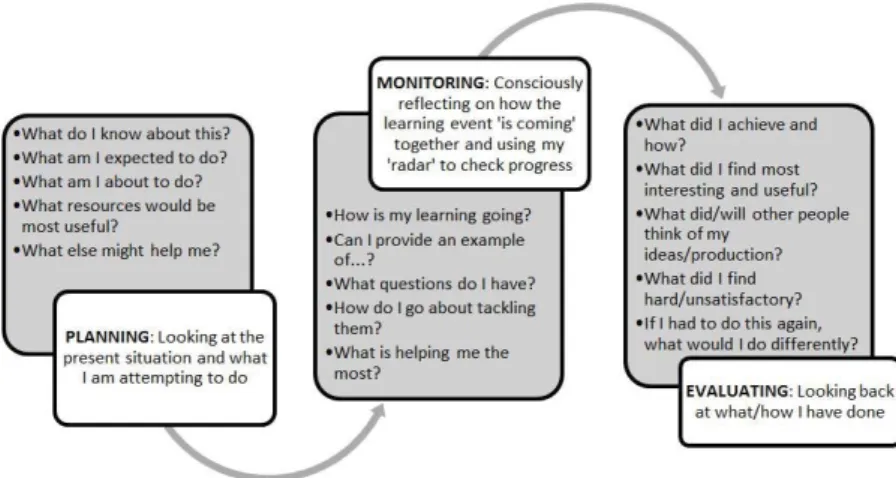
Evaluation can be taken as a first order metacognitive strategy, particularly if it is preceded by (pre-)planning and monitorized execution phases, and explicitly decomposed or broken down into significant sub-processes and criteria (as per a rubric), and applied to oneself and/or others (Choi 2006). Figure 1 presents a functional model, developed by the authors and adapted from Costa (1985), which presents the decomposition of metacognitive learning.2 As such, it is an abstraction, since metacognition is not put into practice as a strictly linear process that moves systematically and unidirectionally from planning to evaluating. More than one metacognitive process may take place at the same time, and the learner’s mind may be revising their previous decisions while considering the next ones. Furthermore, metacognitive and cognitive strategies interact, and most learners constantly move backwards and forwards from one to the other during the learning process.
2 This model was included in the documentation of the virtual community used in the
Figure 1: A functional model of metacognitive learning.
The rationale behind developing metacognition in language learning (henceforth, LL) is closely linked to the concept of learner-centred learning and the application of psychodidactic constructivist principles. The concept of metacognition has gained relevance in LL in the last few decades (Cohen 1998; Macaro 2006), and empirical research has been undertaken that directly link LL success to the development of metacognitive competence (Victori and Lockhart 1995; Nunan 1997; Fazeli 2012). The CEFR also shows the importance of developing communicative language strategies along with “a certain linguistic awareness”, a process that “can be seen as the application of the metacognitive principles: Pre-planning, Execution, Monitoring, and Repair Action to the different kinds of communicative activity: Reception, Interaction, Production and Mediation” (57), taking into consideration that the development of communicative language proficiency involves dimensions and capabilities other than the strictly linguistic. Teaching a language with a focus on metacognition involves helping the student identify the strength of their cognitive capabilities, their epistemological gaps and the fuzzy borders between both, as well as their own learning style, preferences and needs, through feedback, questionnaires, checklists, tests, oral recordings, etc., planning classroom and homework tasks, gathering and organising materials that enable self-introspection, and guiding them towards regular error monitorization and (self-)evaluation (Oxford 1990).
x Planning: in the first stage, students would prepare for and plan their learning activity, reflecting upon their current knowledge and experience in relation to the specific learning goal and the means available to undertake it (e.g., selecting and using a CALL resource).
x Monitoring: in the second stage, students would monitor their own progress during activity execution, being attentive to any improvement in their own knowledge/performance, and considering its potential suitability for other students with different learning styles (for example, thinking about the target user profile of the program/resource and how to optimize its use).
x Evaluating: in the third stage, students would engage in collaborative evaluation, exchanging and contrasting their views with those of others who, in turn, would generate partial modifications that would lead to further discussion/negotiation.
Now that a theoretical framework has been proposed, in the following sections a collaborative online project recently undertaken at UNED (the Spanish national distance university) by the authors is described, where this framework can be applied. Following socioconstructivist principles, the project involves collaboration and task-based group formation, as well as a rubric-based multi-cyclic (self- and hetero-) evaluation process aimed as eliciting and enhancing students’ metacognition. Both the mechanics of the project and the analysis of the results are presented, making reference to the following research questions: Which aspects of the project did they value the most/least, including the collaborative tasks and the evaluation stages? Did they manage to improve their metacognitive competence?
3.
M
ETHODOLOGYthe authors decided to explore the potential of a collaborative project that should elicit and enhance a central metacognitive component as a determining effect on the entire LL process. This experiment is described below.
3.1. THE PROCEDURE
The PEW project took place over a period of twelve weeks (which is roughly the length of most subjects (and language courses) in UNED). Students were offered the possibility to join one of five working groups to search for (preferably free) online programs, tools and resources, and produce annotated catalogues that would complement the training of one of the capabilities/processes covered in their respective courses. Therefore, each group had to focus on one specific linguistic aspect of their interest, namely: vocabulary, grammar, speaking and listening, reading comprehension or written production, depending on their own interests. The topics that each group was to cover were the following: travelling (travel agencies, tourist guides, tours, etc.), accommodation (hotels, private rental, etc.), catering (at different levels: restaurants, bars, home delivery catering services, etc.), entertainment (shows, sports, games, indoor and outdoor leisure activities, etc.), environment (the climate, landscape and wildlife, sustainable tourism, etc.), culture (art, history, intercultural communication, etc.), and management (economy, business, marketing, media, contracts, etc.), all of them part of the compulsory syllabus of the course.
The procedure that participants were asked to follow was organized in five different stages: registration and group formation, data collection and evaluation, access to other groups’ work and informal group discussion, peer-to-peer (henceforth, P2P) evaluation, and final general discussion.
metacognitive strategies based on the model developed by the authors, and discuss it together.
x In the second stage (weeks 2-5), students were asked to collect a set of tools and materials from the web that they considered, at first sight, to be potentially useful for the development of the assigned linguistic capability. They had to work collaboratively in their corresponding group: gathering materials from the Web, trying them out and, if potentially useful, presenting them to their peers for consideration. The whole group would then proceed to discuss the level and user profile of each resource, how to optimize their use, etc. Once consensus was reached, the student who proposed the item would fill out a rubric template (previously provided by the teachers; see appendix 2), to reflect a synthesis of the group’s views, and store it in a shared folder in Google Drive. The students took turns in the process for each resource identified, in order to ensure an even distribution of work.
x In the third stage (weeks 6-7), the students had a period of two weeks to read the catalogue that had been produced by the other four groups and made available in Google Drive. They were also asked to experiment with the tools in it and discuss their opinion about them within their own group.
x In the fourth stage (weeks 8-11), each group was assigned a catalogue previously elaborated by one of the other groups (which was designed for a different linguistic aspect from the one they had been working on in the first part of the project). The main goal of this stage was that the students collaboratively evaluated the catalogue and the information contained therein (following the same guidelines as per the first phase) and improved it either with new items and/or more additional descriptions.
x The fifth and final stage (week 12) was included so that the students would fill out a final questionnaire about the project. It was also intended to provide a brief extension period in case there were unforeseen delays. Since there was no postponement of deadlines none during the experiment, in this final week students were invited to use the common PEW forum to express their personal views and impressions on the project, particularly its usefulness (specifying the nature of any progress observed) and any suggestions for future editions (see appendix 3 for a sample of the students’ messages in this regard).
3.2. THE PARTICIPANTS
degrees at UNED,3 who had registered in the corresponding online form, after receiving the call for participation from the teaching team (see appendix 1).4 Of these students, 76%5 belonged to the Inglés Profesional (Professional English) subject of the new Degree in Tourism, 20% came from the Lengua Inglesa I (English Language I) subject and only 4% came from the final Trabajo Fin de Carrera (Final Degree Project), both from the now phased-out Degree in Tourism. This was expected, as PE was by far the largest subject of all three.
Although the required language level of the first two subjects was A2+ and that of the latter was B2+ this did not pose a problem, since the students volunteering were those who already have a level above the group’s average, which in the authors’ experience is the trend in voluntary participants of this type of optional projects.
Ninety-four percent of the students came from different Spanish regions. There were 6% non-Spanish natives (Romanian, Ukrainian and Italian), and no English native (or quasi-native) students that could have taken the lead in the project or affected the results. 80% of the students were female (a slightly higher percentage than in the respective subjects) and their age was between 23 and 49 years old, the average being 34.
3.3. THE COLLABORATIVE ENVIRONMENT
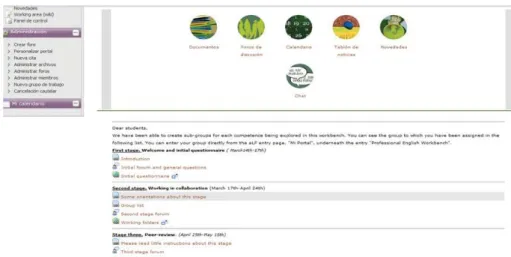
The PEW project was undertaken in UNED’s e-learning platform aLF (see figure 2 for a snapshot of its interface), which is assumed by the authors to be appropriate for the present research work: while this environment allows for efficient student-student collaboration through its many collaborative tools (forums, wiki, etc.), the physical separation of each student facilitates self-introspection and control. Pastor et al. (2010) provide a description of aLF in relation to the challenges involved in distance education:
3 Given the highly open nature of Tourism as an LSP (language for a specific purpose) in
general and these subjects in particular, the authors of this article do not consider that the study domain conditions or confines this research to a certain language variant. However, given the small-scale dimensions of this pilot project, further research would be necessary to provide evidential support for this claim.
4 This number was considered to be adequate for the purposes of the project, as it enabled
close observation by the researchers. Furthermore, participation was to be voluntary to enhance student involvement and motivation.
5 All the percentages in this study have been rounded to the nearest whole number to facilitate
The development of aLF has been focused on two aspects: the addition of collaborative interaction tools (first problem) and to provide several workspaces where to share information from different groups, classes or communities (second problem). So, from the user’s viewpoint, aLF provides a large variety of tools organized around three clearly distinguished workspaces: a personal one, the communities (to which the user belongs) and the courses (being undertaken by the user).
Figure 2. The aLF (Learning Management System) interface.
For both phases of the experiment, a rubric was provided by the teaching team, with key predefined criteria aimed at ensuring the breadth and depth of the activity and its undertaking in an introspective, self-regulated manner (see appendix 2 for the rubric used and the five criteria therein: content, descriptive summary, grammar, vocabulary, and structure and organization). As Goodrich (1996, 2000) notes, educators can enhance learning when they go beyond the most basic application of rubrics by seeking out and including thinking-centred criteria, and by engaging students in serious self–and peer assessment. As this author remarks: “Blurring the distinction between instruction and assessment through the use of rubrics has a powerful effect on your teaching and, in turn, on your students’ learning” (2000:16).
3.4. THE DATA COLLECTION TOOLS
The PEW had two main sources of information: questionnaires (before and after the project) and observation (direct and indirect). They were both structured to provide similar data that could be reciprocally checked. Questionnaires were selected as the main source of information as they are the most widely used research tool in social sciences (Robson 2002). Two questionnaires were used: the first one was designed to carry out a study of the participants’ profile, LL practices and project expectations, while the second questionnaire was used to learn about the participants’ opinions regarding the usefulness of the activity overall, the metacognitive development and the LL improvement achieved.
Following Robson’s (2002) questionnaire typology, the PEW used online self-completion questionnaires with a mixed design, where most of the questions were closed (multiple choice), and one or more open questions were included at the end. Both questionnaires were designed with the following general criteria: single-topic; brief and concise; with clear and simple language; positively formulated; and avoiding excesses (neither too general nor too detailed), guidance in the answers, and superfluous elements that could complicate the analysis unnecessarily. They were piloted with a small sample of participants before administration and a series of modifications in the design were introduced.
words, “enter[ed] a field setting with an openly acknowledged investigative purpose, but [were] able to study from the vantage point of one or more positions within the membership” (1995:144). Two types of observation were used: direct and indirect. The former was undertaken through daily note taking on the students’ progress in the wiki and, to a lesser extent, their activity in the community. The latter, which was of a secondary nature, was undertaken through the analyses of other occasional types of rapport between the participants (email, phone calls, etc.).
Figure 3. Students’ timed response to the call for participation.
4.
D
ATAA
NALYSIS ANDD
ISCUSSIONA total number of 34 students participated in the project from beginning to end (after an expected gradual dropout of 28% —a common characteristic of distance learning projects that is not to be penalized). The subjects showed a highly positive attitude from the start. The students’ eagerness to participate was reflected in the haste shown to register: the immense majority of the group did it within the first 72 hours of the period provided, several days before the deadline, as shown in figure 3. Filling out the first questionnaire was part of the registering process. The final questionnaire was also filled out by most of the participants in a period of 72 hours.
NAME OF THE WORKING GROUP
DATE OF DATA
RECORDING NO. OF MESSAGES
POSTED IN THE WIKI
NO. OF ITEMS IN EACH CATALOGUE
Lexical Competence Writing
Grammatical Competence Oral Skills
Reading
21 Apr. 2012 21 Apr. 2012 21 Apr. 2012 21 Apr. 2012 21 Apr. 2012
59
35
61
21
57
18
11
25
8
23
Table 1. Indication of the volume of work undertaken by the students.
As for the volume of the catalogues (see table 1), some groups added more items than others, something that, according to the students, was severely conditioned by the availability of programs and tools in the Internet. It should also be noted that little interaction took place in the Oral Skills group, where discussion and negotiation were sometimes reduced to consent after individual work. The lack of experience of students with online LL was more evident with oral resources and had a negative impact on the attitude of the corresponding group.
Before the project, the students considered their own level of English to be “acceptable” (58%, i.e., 3 in a scale of 0 to 5), and no one declared it to be “elementary”. Their view on their own capabilities is shown in table 2 below:
LINGUISTICASPECT/SCORE 0 1 2 3 4 5 6 7 8 9 10
ORALEXPRESSION 0 0 12 12 22 16 18 8 12 0 0
WRITTENEXPRESSION 4 4 4 4 28 20 20 16 0 0 0
ORALCOMPREHENSION 0 0 4 8 4 26 22 20 16 0 0
GRAMMATICAL
COMPETENCE
0 6 10 2 14 30 26 12 0 0 0
LEXICALCOMPETENCE 0 4 0 0 8 24 32 16 12 4 0
WRITTENCOMPREHENSION 0 0 0 4 4 12 8 20 32 16 4
TOTAL 4 14 30 30 80 128 126 92 72 20 4
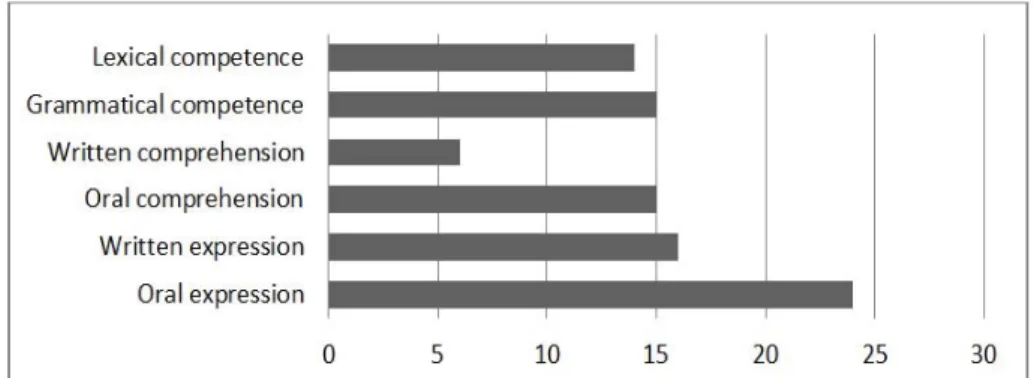
Figure 4. Students’ PE needs.
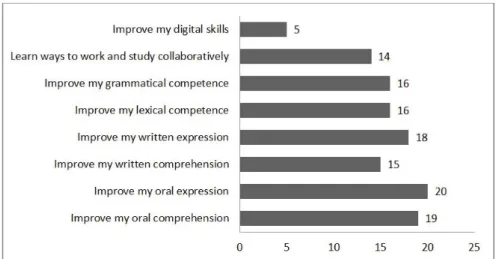
As can be seen in table 2, the students’ views of their own level in the different linguistic aspects considered for the PEW coincided almost 100% with both their learning needs (see figure 4) and expectations for the project (see figure 5), which showed the students’ thoroughness in doing the questionnaire task and, accordingly, the reliability of the results obtained. It is to be noted that the result of the addition of the scores in all the linguistic aspects also roughly coincides in proportion to the result of the single question on the students’ view of their overall English level (5 on a scale of 0 to 10; see table 2).
Students declared that they needed to improve the following aspects: oral production (92%), written production (60%), oral comprehension (58%), grammatical competence (57%), lexical competence (56%), and reading comprehension (24%). Their expectations about the project were very highly conditioned by their perception of their own PE capabilities and needs and, accordingly, as shown in figure 5, the majority were motivated to participate in the PEW for LL, rather than for the experience of engaging in a collaborative project (51%) or for improving their digital skills (20%). The collaborative work as such was a novel type of experience that did not attract the students’ attention in itself.
Figure 5. Students’ expectations of the PEW.
Figure 6. How the students learn PE.
the groups),6 and produced catalogues which were acceptable in size and depth, although they contained a considerable number of formal mistakes (mainly to do with grammar, spelling and punctuation). As expected, there were complaints from a few students, who occasionally made their impatience apparent when they felt disoriented, confused or misinformed about where to find the project documentation and what they were expected to do; how and when they were going to receive some kind of compensation in their subject grade for their participation in the project; insufficient time to undertake the tasks; the absence or lack of diligence of their group peers; and they even showed frustration when they encountered difficulties in finding tools suitable for the competence they were working on.
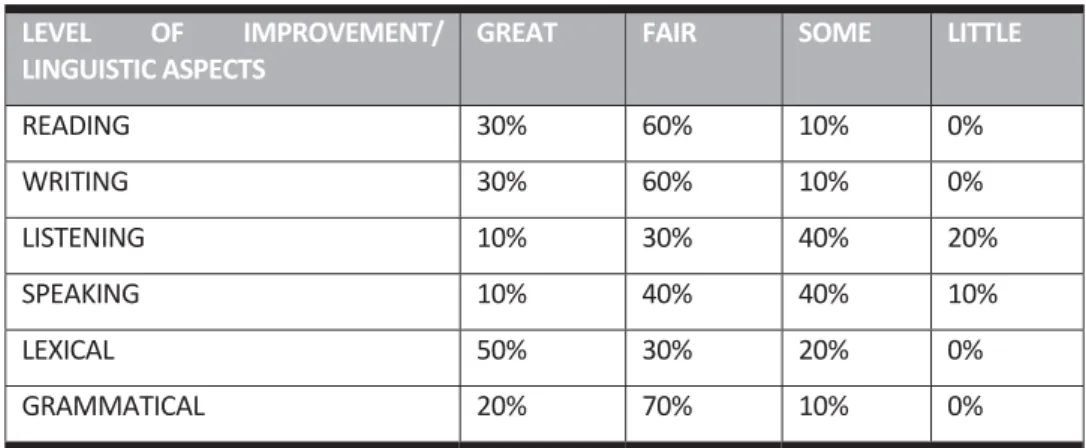
After the project, students expressed that the experience had been useful to practise writing skills, particularly reading comprehension, rather than the oral ones, the lowest being oral production. On the assumption that virtually any linguistic activity can actually help improve an individual’s communicative language competence to some extent, students were asked to reflect (on a scale of 0 to 4) upon the extent to which each specific linguistic communicative competence/ process had been developed in their own case. The results can be seen in table 3 below:
LEVEL OF IMPROVEMENT/
LINGUISTICASPECTS
GREAT FAIR SOME LITTLE
READING 30% 60% 10% 0%
WRITING 30% 60% 10% 0%
LISTENING 10% 30% 40% 20%
SPEAKING 10% 40% 40% 10%
LEXICAL 50% 30% 20% 0%
GRAMMATICAL 20% 70% 10% 0%
Table 3. Students’ analysis of their own linguistic improvement.
These results were partly due to the written interaction within the project, and partly to the higher number of tools and resources found by the groups that involved extensive reading. It is rather significant that the students who worked on grammar
6 The teachers had foreseen the possibility of assigning a student monitor to each group if
and vocabulary built up catalogues of written (with occasional audio) resources. It should be noted that, despite the fact that these results were different from the initial goals (see section 3.2), the students found the experience worthwhile as a whole for LL: 80% approx. found the PEW useful selecting 3 on a scale of 0 to 4, 8% found it very useful selecting 4, and 12% found it little useful selecting 2.7
As for the students’ expectations about learning PE collaboratively, before the project they generally showed a mildly open and positive attitude, although somewhat indifferent, towards engaging in this type of experiment (despite the fact that 68% of them had never participated in a collaborative project before, 12% only in one, and no one in more than two such projects). This lack of previous experience was interpreted positively as a levelling factor between the students. Again, in the course of the project students changed greatly regarding their view of the collaborative experience. Not only did they find the tasks enjoyable and well organised, they also declared that the collaborative evaluation of the selected digital resources had helped them become more reflexive, aware and introspective about their LL. They considered the collaborative work to be a most fruitful learning experience which had surpassed their initial expectations, as reflected in figure 7 (50% selected 3 on a scale of 0 to 4, 30% selected 4, 10% selected 2 and 10% selected 1).
Figure 7. The students’ evaluation of the impact of the social work on their LL.
7 Due to the heterogeneous nature of the participants and of the project tasks, linguistic
The eight methodological aspects that the students considered useful, to various degrees, were the following (ordered from highest to lowest):
x Being instructed to be inquisitive about their own learning.
x Being guided by the teacher and receiving their feedback and reassurance when requested.
x Using a rubric provided by the teachers to undertake the initial part of the project.
x Having their own messages and project production corrected/revised by their peers.
x Reading their peers’ views in the wiki/forum. x Having an organized P2P evaluation system.8 x Helping others with their doubts and queries. x Using a rubric to evaluate their peers’ work
As can be inferred from this list, firstly, the majority of the students valued the explanations and guidelines that were explicitly provided by the teachers in the PEW community. Secondly, the list also shows that there was a great dependence on the teacher’s role, expertise and authority, since it was the aspect with the second highest consideration and, with no exception, all the students preferred teacher to peer evaluation (there were messages in the forum confirming this; see appendix 3). Thirdly, the students expressed a strong preference for receiving peer help, rather than providing it. This apparent selfishness revealed their unawareness of the “Learning by Teaching” approach, i.e., the positive cognitive and epistemological benefits of transferring knowledge and skills to their peers (Gartner et al. 1971), which is at the core of collaborative learning. Fourthly, the students rated the application of the rubric to their peers’ work low, in comparison to the rest of benefits of the project. Since the use of the rubric in relation to their own work was rated high, this datum could be due once again to their unawareness of the positive effect of hetero evaluation for learning progress or, more importantly, to the fact that Spanish students feel uncomfortable judging the work of others, which is a commonly observed phenomenon with deep social and cultural roots.
Before the project, the students expressed their confidence about their computing abilities at user level (92% considered themselves to be above average and none declared themselves to be computationally illiterate) and did not appear to have any interest in developing their digital skills further in the project. An important finding was that they were regular computer users (82% said that they
8 It must be noted that when asked if they would rather have P2P evaluation on its own or as a
used computers at least once a week and only 12% of them did so occasionally). This familiarity was interpreted positively as it ensured that technical complexity would not interfere with the execution of the project (as was the case). It also justifies the students’ indifference for developing their digital skills any further. During the project, there were not any significant technical difficulties on their part. After the project, the seven technological aspects that they considered useful, to various degrees, were the following (ordered from highest to lowest):
These results closely reflected the use that the students made of the different technologies during the project and their experience with them: the more the students used them, the higher they were rated. The aLF platform, for example, is used on a daily basis for both academic and administrative purposes by UNED students, so they are extremely familiar with it. For most of them, however, it was the first time that they belonged to a separate community within a course subject, although the interface was merely a simplified version of the general platform. In particular, the students expressed their disappointment with the wiki for not allowing the uploading of documents and found it rather cumbersome to have to go to the cloud to access and modify the catalogues. Regarding the Internet, the students expressed how interested they were by the enormous amount of free resources that they found for the practice and development of certain communicative language competences and processes, although they also declared being somewhat overwhelmed and confused by such abundance. As for the wiki, more than half (58%) of students had never used one and found its use easy and intuitive. As for the other communication tools, the low score in the final questionnaire was probably due to the fact that they were hardly used during the project.
Regarding the methodology of the PEW, it should be noted that triangulation was achieved in the students’ questionnaires and messages and the teachers-researchers’ observation, which enhances the reliability and validity of this qualitative piece of action research. Furthermore, regarding the metacognition and collaboration aspects of the research, it must be emphasized, firstly, that after undertaking a project with such extensive metacognitive engagement, the students considered that they had made a qualitative improvement in their communicative language competences, but in inverse order to their initial expectations. This fact revealed certain previous naivety on the part of the students, who were expecting to develop oral and productive skills in a working environment that is eminently written, complemented with CALL tools and resources which involved considerable reading and were, in general, more receptive than productive.
projects before, so many acknowledged their lack of familiarity and expectations about social learning. Undertaking an online collaborative language project metacognitively revealed to the students the specific epistemological value of the social component of such projects, and helped them distinguish the implications of the social learning tasks from those of the individual ones. However, the students in general did not rate the social aspects of the project as highly as the individual ones, since they continued to value, firstly and foremost, teacher feedback and evaluation over P2P. Furthermore, the students claimed to prefer receiving input from their peers, rather than providing it to them, thereby failing to grasp the inherent benefits of collaboration. As for the technological dimension of the project, the students claimed subsequently to be more aware of both the functionality and the didactic value of each technology used and, as such, their comments about technical questions became more accurate as the project proceeded.
5.
C
ONCLUSIONThis paper explored the impact on PE learning of a collaborative online project with a major focus on metacognition. One of the goals of the project was to elicit student introspection about their LL process and awareness of the significance of such introspection. The authors predicted that, in the context of online LL and specifically collaborative projects, this would be achieved via the explicit exposure to a three-phase Planning-Monitoring-Evaluating functional model of metacognitive learning (adapted from Costa 1985), the undertaking of conventional individual tasks like filling out questionnaires, and also through social tasks (like the rubric-based multi-cyclic evaluation of LL resources proposed). After the experience, the students declared that they had changed many previous misconceptions about the nature of LL and, in particular, online LL, and felt more confident, independent and in control of their own learning, and more ready to make a real, creative use of the English language. The authors agree that after the project there was evidence that students had improved their linguistic awareness, metacognitive perception and critical judgement capacity towards LL and use.9
9 Language improvement was beyond the scope of this study, and was, therefore, not
The authors of this article have advocated the use of metacognitive strategies in LL, which may be commonplace practice to some students, but is still something alien and even unheard of to many others. The volume of evidence in support of metacognitive LL makes the teaching of relevant skills a valuable use of instructional time for second language teachers, as a sort of didactic scaffolding mechanism, until students can select the most suitable metacognitive strategies, adapt them to circumstances, combine them creatively, etc., according to their learning styles and goals. If strong metacognitive skills empower second language learners, online education teachers are required to provide alternatives which are, at least, as efficient as those of their classroom-based colleagues.
Technological and methodological advances enable the design of online LL projects that allow students to access explicitly (metacognitive) learning models, undertake practical individual tasks and, most importantly, engage in collaboration, where the sheer physical isolation of each student is expected to foster self-introspection and control. As with any scaffolding mechanism, early project designs have to be subsequently substituted by others, as evidence of student epistemological, cognitive and metacognitive development is shown, rendering them to play increasingly more independent and creative roles in their own LL process. This iterative teaching procedure requires a way of measuring metacognitive ability and the implications and ultimate effectiveness of each type of strategy in second language progress. As Camillo (2011:7) pointed out, “observing the unobservable raises challenges for research on both metacognition and language learning”. These are all important questions that still require an answer.
R
EFERENCESAllford, Douglas and Norbert Pachler. Language, Autonomy and the New Learning Environments. Bern: Peter Lang, 2007.
Bárcena, Elena. “Designing a Framework for Professional English Distance Learning”.
Helping People to Learn Foreign Languages: Techniques and Technologies. Ed. I.K. Brady. Murcia: Servicios de Publicaciones de la UCAM / Quaderna Editorial, 2009: 89-103.
Bednar, Anne, Donald Cunningham, Thomas Duffy and David Perry. “Theory into Practice: How Do We Link?” Constructivism and the Technology of Instruction: A Conversation. Eds. Thomas and David Jonassen. Hillsdale, N.J.: Lawrence Erlbaum Associates, 1992: 17-34.
Bozorgian, Hossein. Metacognitive strategy instruction in English as a Foreign Language (EFL) listening skill. PhD Thesis, Queensland University of Technology, 2012. URL:http://eprints.qut.edu.au/54724/. 10/06/2013.
Brindley, Jane, Christine Walti and Lisa Blashke. “Creating Effective Collaborative Learning Groups in an Online Environment.” The International Review of Research in Open and Distance Learning 10.3 (2009): 1-10.
Camillo, Isabell. Metacognitive Strategies in Second Language Learning - A Comparative Analysis, 2011. URL: http://es.scribd.com/doc/49751756/Metacognitive-Strategies-in-Second-Language-Learning. 20/5/2013.
Ciekanski, Maud. “Fostering learner autonomy: Power and reciprocity in the relationship between language learner and language learning adviser.” Cambridge Journal of Education 37.1 (2007): 111-127.
Clark, Eve. “Awareness of language: Some evidence from what children say and do.” The child's conception of language. Eds. Anne Sinclair, Robert Jarvella and Willem Levelt. New York: Springerverlag, 1978: 17-43.
Cohen, Andrew. Strategies in Learning and Using a Second Language. London: Longman, 1998.
Cohen, Louis, Lawrence Manion, and Keith Morrison. Research Methods in Education. London: Routledge, 2007.
Costa, Arthur, ed. Developing Minds. Alexandria, Vancouver: Association for Supervision and Curriculum Development, 1985.
Council of Europe. Common European Framework of Reference for Languages: Learning, Teaching, Evaluating. Cambridge: Cambridge University Press, 2001.
Dickinson, Leslie. Self-Instruction in Language Learning. Cambridge: Cambridge University Press, 1987.
Eneau, Jerôme and Christine Develotte. “Working together online to enhance learner autonomy: Analysis of learners’ perceptions of their online learning experience.”
ReCALL 24.1 (2012): 3-19.
Fazeli, Seyed Hossein. “The Use of Metacognitive English Language Learning Strategies beased on Personality Traits.” Theory and Practice in Language Studies 2.3 (2012): 531-539.
Flavell, John H. “Metacognition and Cognitive Monitoring. A New Area of Cognitive-Development Inquiry.” American Psychologist 34 (1979): 906–911.
_____. “Speculation about the Nature and Development of Metacognition.” Metacognition, Motivation, and Understanding. Eds. Franz Weinert and Rainer Kluwe. Hillsdale, NJ: Lawrence Erlbaum, 1987: 21-29.
Freeman, Donald. “Second Language Teacher Education.” The Cambridge Guide to Teaching English to Speakers of other Languages. Eds. Ronald Carter and David Nunan. Cambridge: Cambridge University Press, 2001: 72-79.
Gartner, Alan, Mary Conway Kohler and Frank Riessman. Children teach children. Learning by Teaching. New York: Harper and Row, 1971.
Glaserfeld, Ernst. Constructivism in Education. Oxford: Pergamon Press, 1989.
Godwin-Jones, Bob. “Blogs and Wikis: Environments for On-line Collaboration.” Language Learning and Technology 7.2 (2003): 12-16.
Goodrich, Heidi. “Understanding Rubrics”. Educational Leadership 54/4 (1996): 14-18. _____. “Using Rubrics to Promote Thinking and Learning.” Educational Leadership 57.5
(2000): 13-18.
Graham, Suzanne. Effective Language Learning. Clevedon: Multilingual Matters, 1997. Holec, Henri. Autonomy and Foreign Language Learning. Council of Europe. Oxford:
Pergamon Press, 1981.
Horwitz, Elaine. “Surveying Student Beliefs about Language Learning.” Learner Strategies in Language Learning. Eds. Anita Wenden and Joan Rubin. London: Prentice Hall, 1987: 119-129.
Hutchinson, Tom and Alan Waters. English for Specific Purposes: A Learning-centred Approach. Cambridge: Cambridge University Press, 1987.
Kirschner, Paul. “Using Integrated Electronic Environments for Collaborative Teaching/learning.” Research Dialogue in Learning and Instruction 2.1 (2001): 1-9. Kumaravadivelu, B. “Toward a Postmethod Pedagogy.” TESOL Quarterly 35.4 (2001):
537-560.
Lei, Emily. Metacognition: A Literature Review. Harlow: Pearson, 2011.
Lim, Cher and Ching Chai. “An Activity-theoretical Approach to Research of ICT Integration in Singapore Schools: Orienting Activities and Learner Autonomy.”
Computers and Education 43.3 (2004): 215-236.
Lindlof, Thomas and Bryan Taylor. Qualitative Communication Research Methods. Thousand Oaks, CA: Sage Publications, 1995.
Livingston, Jennifer. Metacognition: An Overview. 1997. URL:
Macaro, Ernesto. “Strategies for Language Learning and for Language Use: Revising the Theoretical Framework.” The Modern Language Journal 90.iii (2006): 320-337. Martín-Monje, E. “Interactive Materials, Collaborative Work and Web 2.0 in the Context of
ESP.” Technological Innovation in the Teaching and Processing of LSPs. Eds. N. Talaván, E. Martín-Monje and F. Palazón. Madrid: UNED Publications, 2011: 101-113.
McGroarty, Mary. “Constructive and Constructivist Challenges for Applied Linguistics.”
Language Learning 48.4 (1998): 591-622.
Naiman, Neil, Maria Frohlich, H.H. Stern and Angie Todesco. The Good Language Learner.
Clevedon: Multilingual Matters, 1996.
Nunan, David. The Learner-Centered Curriculum. Cambridge: Cambridge University Press, 1988.
_____. “Strategy Training in the Language Classroom: An Empirical Investigation.” RELC Journal 28 (1997): 56-81.
O’Rourke, Breffni, and Lorna Carson, Eds. Language Learner Autonomy: Policy, Curriculum, Classroom. Bern: Peter Lang, 2010.
Oxford, Rebecca. Language Learning Strategies: What every teacher should know. Boston: Heinle, 1990.
Palincsar, Annemarie S. “Social Constructivist Perspectives on Teaching and Learning.”
Annual Review of Psychology 49 (1998): 345-375.
Pastor, Rafael, Roberto Hernández, Salvador Ros, Timothy Read, Manuel Castro and Roberto Hernández. “An Enterprise E-learning Solution: The Practical case of the UNED in the EHEA.” Proceedings of EDUCON 2010 (2011): 611-619.
Perkins, David N. “Technology Meets Constructivism: Do they Make a Marriage?”
Constructivism and the Technology of Instruction: A Conversation. Eds. Thomas Duffy and David Jonassen. Hillsdale, N.J.: Lawrence Erlbaum Associates, 1992: 45-55.
Piaget, Jean. “The Psychogenesis of Knowledge and its Epistemological Significance.”
Language and learning. Ed. Massimo Piattelli-Palmarini. Cambridge, MA: Harvard University Press, 1980: 377-384.
Reason, Peter and Hilary Bradbury. Handbook of Action Research: Participative Inquiry and Practice. London: Sage Publications, 2001.
Richards, Jack and Theodore Rodgers. Approaches and Methods in Language Teaching.
New York: Cambridge University Press, 2001.
Robson, Colin. Real World Research. Oxford: Blackwell Publishing, 2002.
Steffe, Leslie and Jerry Gale, Eds. Constructivism in Education. Hillsdale, NJ: Lawrence Erlbaum Associates, 1995.
Victori, Mia and Walter Lockhart. “Enhancing Metacognition in Self-directed Language learning.” System 23 (1995): 223-234.
Vygostky, Lev. Mind in Society. Cambridge, MA: Harvard University Press, 1978.
Wenden, Anita. Learner Strategies for Learner Autonomy. Englewood Cliffs: Prentice Hall International, 1991.
A
PPENDICESAPPENDIX 1.CALL FOR PARTICIPATION AND INSTRUCTIONS
CALL FOR PARTICIPATION –INSTRUCTIONS FOR PHASE I OF THE PEW PROJECT
Dear students,
The teaching teams of the subjects Inglés para Fines Profesionales (Grado de Turismo),
Lengua Inglesa I and Trabajo Fin de Carrera (both from the Diplomatura de Turismo) have jointly set up a collaborative project for you to participate in. We believe that, among other things, it will enhance your interactive skills in English and, more importantly, it will give you an opportunity to reflect upon your Professional English learning process and ultimately take control of it, which in itself is an opportunity for you to improve it! This is a two-phase project and for the first phase you are asked to identify a set of (preferably free) tools and materials from the web that you consider useful for the development of a particular communicative language competence and build up an annotated catalogue with those items. You may also design your own materials and tools if you feel up to it!
You will be divided into small groups and use aLF’s wiki (in the case you don’t know, aLF is the name of UNED’s LMS, where all your courses and communities are located). The set of tools and materials that you’ll present at the end of the project must be the result of discussion and collaboration between all the members of the group. You will be evaluated both for the way you undertake such collaboration (in English, of course!) and for the quality of the tools and materials selected (especially the accompanying descriptive summary, which must contain a short but detailed description (between 50 and 150 words) of the nature and use of the materials and an evaluation about their effectiveness – after having experimented with them, of course!).
In the second phase of the project you will be given the catalogue developed by a neighbouring group (which will be for a different communicative language competence) and you will have to both evaluate it and add to it new materials and/or complementary descriptive summaries.
Participation in this project is, of course, optional and only the first 50 students who register for it will be able to take part. If you decide to participate, you will not only have fun participating in an interesting project, but you will have a great opportunity to improve your English, be rewarded with up to 1 point in your final mark… AND you will be granted 2 free ECTS credits (libre configuración). Only those who complete the project will be evaluated and the catalogues will be permanently available in the virtual course for you, your peers and future students to use. As you can see, it’s well worth taking part!
If you decide to participate in this project, you should do the following:
1. Fill out the form provided by the following link before March 13th:
https://spreadsheets.google.com/viewform?formkey=dDdiRG9BUzFQR3BwOTJ CVTFOdFVRYnc6MQ
2. Fill out the initial personal questionnaire that you will find there by March 21st.It
is crucial that you take time to reflect upon your own Professional English learning and how to make the most of this project as a learning experience. 3. If you are one of the first 50 to register and, therefore, admitted to the project,
you’ll be added to its virtual community. You’ll also be assigned to a group and a communicative language competence after your preferences have been taken into account. Join the group and get acquainted with your partners. You must also carefully read the Metacognitive Strategies document that can be found in the PEW online community and discuss it with your new group peers in the wiki. 4. Start working collaboratively with your group from March 22nd onwards for a
period of 4 weeks. Note that you may organize yourselves in any way you like (we suggest that the member who proposes a given item should be in charge of elaborating the description – try to take it in turns so that the workload is even). For that purpose, you must fill out the evaluation template (rubric) that you will find in the PEW community with the group’s opinions.
5. Upload the final document (a commented list of tools and materials) to Google Drive by April 19th.
6. Between 20th and 27th April you should try out the tools in the catalogues built
by the other groups.
7. On April 28th, for the next four weeks, take the list elaborated by the group
working on the next competence down from yours (in the list below, for example, if you are working on Lexical competence then move onto Grammatical competence; if you are working on Writing competence, then move onto Lexical competence, and so on) and try to improve it in any way you consider pertinent (more tools, better descriptions, etc.). Do so collaboratively, as per the first part of the project.
8. Upload this improved version by May 27th.
9. Fill out the final personal questionnaire by June 3rd. It is crucial that you take time to reflect upon what you (and others) have found useful in the project and what impact it has had on your professional English.
You will be assigned ONE of the following competences: 1. Lexical competence
2. Grammatical competence
3. Oral competence (both receptive and productive) 4. Reading competence
5. Writing competence
The real world domains that you must cover (ALL of them) are the following: 1. Travelling
4. Entertainment (including shows, games and sports, indoor and outdoor leisure activities)
5. The environment (including climate, landscape and wildlife, sustainable tourism) 6. Culture (including art and history, intercultural communication)
7. Management (including business and economy, marketing and the media, documentation, insurance, contracts)
Please note the following sequence:͒͒
1. Those of you who work on Lexical Competence will evaluate the work undertaken by the Grammatical Competence Group.
2. Those of you who work on Grammatical Competence will evaluate the work undertaken by the Oral Competence Group.
3. Those of you who work on Oral Competence will evaluate the work undertaken by the Reading Competence Group.
4. Those of you who work on Reading Competence will evaluate the work undertaken by the Writing Competence Group.
5. Those of you who work on Writing Competence will evaluate the work undertaken by the Lexical Competence Group.
The following articles contain useful information to undertake the evaluation of learning tools and materials:
1. Jinkyu Seam Park (2006) Language Learning Software Evaluation: Top-down or Bottom-up? http://www.asian-efl-journal.com/pta_july_06_jsp.php
2. National Foreign Language Resource Centre (1998)
http://nflrc.hawaii.edu/Networks/NW31/NW31t.pdf
3. ZHANG Ya-ni (2007) Literature review of material evaluation
http://www.linguist.org.cn/doc/su200706/su20070605.pdf
Good luck!
INSTRUCTIONS FOR PHASE II OF THE PROJECT
Dear students,
This is a reminder about the second phase of the project. You are requested to follow these steps:
1. Improve their list of materials and tools of the catalogue assigned with new items and/or additional descriptions to the existing ones between April 28th and May 26th.
2. Upload your improved version by May 27th. 3. Fill out the final questionnaire by June 3rd.
Finally, note that it is necessary to undertake all the tasks (including the final questionnaire) in order to complete the project and be awarded with up to 1 point towards your final grade. Please do not hesitate to ask your teachers should you have any queries.
APPENDIX 2. THE RUBRIC TEMPLATE AND A SAMPLE OF THE DESCRIPTIVE
SUMMARY
NAME OF
RESOURCE: URL:
Poor Fair Good Excellent Score
Contents 2 3 4 5
There should be at
least one tool/material for each
of the following topics:
1. Travelling 2. Accommodation 3. Catering 4. Entertainment 5. The environment
6. Culture 7. Management
Key items
missing. List of items of little interest. Rather complete selection of useful items. Adequate selection of highly useful and attractive items. Descriptive
summary(*) 2 3 4 5
Minimal
summary of the purpose and features of the material/tool. Summary of the purpose and features of the material/tool but with important elements missing. Summary that clearly explains the purpose and features of the material/tool, although missing the odd feature. Summary that thoroughly explains the purpose and features of the material/tool.
Grammar 2 3 4 5
Low intelligibility. Intelligible, but unclear.
Clear but persistent use of short and simple structures. Adequate use of syntactic structures expressed in formal style.
Vocabulary 2 3 4 5
Structure and
organisation 2 3 4 5
Weak, incoherent.
Repetitive pattern in sentences. Some trouble sequencing.
Simple
pattern in sentence. Some ideas well
developed.
Combination of simple and complex sentences. Ideas well developed and
connected.
(*) DESCRIPTIVE SUMMARY
Short descriptionÆEnglish learning software that provides entertaining immersive environments that help children learn English by participating. Most include pronunciation help and a number provide assistance in the learner's native language. These packages are also dedicated to helping children learn the basics such as the ABCs, numbers and basic phrases and do not focus on extended speech.
User profile and levelÆVery young learners, levels A1-A2. Strongest pointsÆPronunciation practice of discrete sounds.
Limitations for use on a Tourism course ÆTypical infantile contents and scenarios. General language.
A
PPENDIX3.
A
S
AMPLE OFS
TUDENTS’
O
PINIONS(P
OSTED ON THEF
ORUM ANDV
IAE-M
AIL)
x Thank you very much for this opportunity
x Many thanks for this type of initiatives...and for your help.
x I am very satisfied to have taken part in this innovative project. I have learnt many things about how I learn English and will change some things I do now.
x Thanks, I learn a lot about how I learn and about how I should learn! I wish I had done this before.
x Thank you, I have become a lot more reflexive about the learning of my Professional English and that will help me in the future when I want to work online with web programs.
x I liked learning with others – it takes longer but it makes you think a lot more. x This project was a very good idea. Now you could tell us the process to obtain the
credit, and how we know if we have the extra point in the final mark.
x I have enjoyed this project a lot. I wanted to work harder and learned more from it, but I could not spend more time in the project because the dates were very near to the exams.
x I wanted to spend more time working in this project but I didn’t have enough time. x In general, the work has been very positive, but aLF platform should improve a lot;
it was very difficult for me to find all the information, my classmates’ posts, the teachers’ messages, etc.
x Even if the virtual platform has had problems sometimes, the teaching team has been very supportive all the time. When you study in distance education it is very important to know that the persons on the other side can deal with all your queries. x At the beginning I have felt a bit lost surfing through the virtual classroom but I
have got at any time the support of the educational team.
x It has been a shame that could not have exchanged opinions and information with other group of competence in spite of having tried it. But it has encouraged me to see that other (Lexical Competence) was creating good ideas. Looking their work I tried to improve my competence (good idea in the project to have direct entry to other competences).
x This Project has been very useful to help us to search tools that help us improve our level of English, but it has also been hard to identify our English for tourism divided into competences, especially as regards grammar.
How to cite this article:
Bárcena, Elena, Elena Martín-Monje & Noa Talaván. “‘Thinking About Learning’: Exploring the Use of Metacognitive Strategies in Online Collaborative Projects for Distance Professional English Learning.” ES. Revista de Filología Inglesa 35 (2014): 7-39.