Edited by ATM c/ Muntaner, 315-321 08021 Barcelona
Teléfono +34 93 362 00 20 Fax +34 93 362 00 22 e-mail: [email protected] web: www.atm-transmet.org Depósito legal: B27470-2005 Printed by Estudi 6, Barcelona
2 MANAGEMENT OF THE TRAMWAY SYSTEM 28
2.1. Diagonal - Baix Llobregat Tramway 28
2.2. Sant Martí - Besòs Tramway 31
3 ROLLING STOCK 34
4 INTEGRATED FARE SYSTEM 36
4.1. Sales and use of the integrated fare system (IFS) 37
4.2. Intermodality index 40
5 FINANCING THE SYSTEM 41
6 OTHER ACTIONS 43
6.1. Planning of public transport services 43
6.2. Sermetra 44
6.3. Area of exterior projection 45
CHAPTER 3 SYSTEM STATISTICS 49
1 TransMet FIGURES 2004 50
2 STUDIES AND SURVEYS 53
2.1. Daily Mobility Survey 2001 (EMQ‘01) 53
2.2. Working Day Mobility Survey 2004 (EMEF’04) 60
CHAPTER 4 AUDIT REPORT 67
CHAPTER 5 BUDGET 2005 107
We have gone through a year of transi-tion, of change, with the incorporation of new managers and the arrival of new rep-resentatives.
Finally the Government of Catalonia, the Government of Spain and the MTA have been able to finalise the negotiations and close, for a completed period, the 2002-2004 contract-program. This important fact is also the expression of a paradox. We have closed the contract-program when its validity had already expired. And if it is important to have closed it to be able to advance on safe ground and know where we stand, it is no less surpris-ing that this situation has forced the MTA and all its operators to work with outside financing, with treasury policies, always pending advances that did not arrive and entangled in un-recommendable financial precariousness.
At the end of 2004 and for a moment, always below our expectations and needs, we were actually fully up to date. We did so leaving a few things along the way. But we did it.
But now the moment of truth has arrived. A time for planning the future in the short, medium and long term. In the short term our needs can still be satisfied and maybe we will be able to define a transi-tion contract-program for the period
2005-2006. But the 2007-2010 contract-program must make a daring approach to a new period, and a new scale, for the whole metropolitan transport system.
The time has come to show that the mobil-ity infrastructures of the Barcelona Metropolitan Area have an enormous number of needs, both in financial invest-ments as well as the cost of the manage-ment and maintenance of a network that is growing, one that must grow, and which must be modernised and improved techni-cally to be able to satisfy a growing demand and the obvious necessities of a society which must move more efficiently on public transport every day.
Finally, I would like to point out that the cost of the services provided by the oper-ators of the MTA and the importance of this service is very low profile. It ends up being taken for granted, a mere reference on the landscape. But if financing health is a problem of State, on its own scale, so is the problem of financing public transport and mobility, even though at times it does not seem so.
Joaquim Nadal i Farreras
1
1 ADMINISTRATIVE BODIES MAKING UP THE MTA
The Metropolitan Transport Authority (MTA) is an inter-administrative Consortium of voluntary character created in 1997 and comprised of all the adminis-trative bodies of public transport services in the Barcelona Metropolitan Area.
The Administrative bodies making up the consortium are the Generalitat (Government) of Catalonia (51%) and local administrations (49%), comprised of the Barcelona City Council, the Metropolitan Transport Body (EMT) and
the Association of Municipalities with Urban transport services of the Barcelona Metropolitan Area (AMTU). There is also the presence of representatives of the Central State Government as observers in the administrative bodies of the MTA.
2 ADMINISTRATIVE, ADVISORY AND CONSULTING BODIES
The administrative, advisory and consulting bodies of the MTA are made up of representa-tives of the different organisations and administrative bodies associated with Public Transport.
Board of Directors
The Board of Directors is the governing body of the MTA. The board is made up of eight-een members with full rights - nine representing the Generalitat (Government) of Catalonia, seven representing local Administrative bodies (Barcelona City Council and EMT) and two representing the AMTU -, and two observers representing the Central government. The meetings are also attended by the Managing Director and the Technical Director.
The composition of the Board of Management on December 31, 2004 was:
President Joaquim Nadal i Farreras
1st Vice-president Xavier Casas i Masjoan
2nd Vice-president Maite Arqué i Ferrer
Members Martí Carnicer i Vidal
Jordi Casso i Samsó Jordi Cots ii Domínguez Ricard Fernández i Ontiveros Jordi Follia i Alsina
Jordi Hereu i Boher Jordi Julià i Sort
Josep Mayoral i Antigas (1) Manel Nadal i Farreras Oriol Nel·lo i Colom Dídac Pestaña i Rodríguez Jordi Portabella i Calvete Lluís Tejedor i Ballesteros
Member and Managing Director Ramon Seró i Esteve
Observers José Mª Cacho i Herrero
Miguel Pozo de Castro
Secretary Carme Sardà i Vilardaga (2)
Executive Committee
The Executive Committee of the Board of Directors is comprised of six members, three in representation of the Generalitat (Government) of Catalonia, two in representation of local Administrative bodies and one in representation of AMTU.
It has the general function of examining, and presenting to the Board of Directors, propos-als for planning instruments of the Metropolitan Public Transport System, financing agree-ments and service contracts with administrative bodies and operators, the fare system and annual budgets, among others.
Members of the Executive Committee, on December 31, 2004:
President Ramon Seró i Esteve
Members Maite Arqué i Ferrer
Jordi Hereu i Boher Jordi Julià i Sort Manel Nadal i Farreras
Secretary Carme Sardà i Vilardaga (1)
(1) since July 21, 2004, replacing Ms. Montserrat Viñas i Pons
Legal Advisory Commission
This commission provides aid and advisory services to the Executive Committee. It is com-prised of representatives of the Autonomous Government of Catalonia, Barcelona City Council, EMT, AMTU and the MTA itself.
Technical Commission
This commission provides aid and technical advisory services to the Executive Committee. It is comprised of representatives of the associated administrative bodies and the public operators.
Economic Commission
Integrated fare system Follow-up Committee
The Board of Directors of November 15, 2000 agreed to the creation of the Integrated fare system Follow-up Committee (CSIT) composed of the administrative bodies and oper-ators involved, as technical support for follow-up of the integrated fare system within its area of management.
Operators' Technical Platform
The Operators' Technical Platform of Metropolitan Transport is the organ of collaboration and consultation of the Consortium of the MTA in questions of a technical nature and is composed of representatives of the operators of public transport in the metropolitan region.
Users and Beneficiaries Platform
ORGANIZATIONAL STRUCTURE OF THE MTA
On December 31, 2004 the composition of the MTA payroll was:
Directors and managers
Ramon Seró i Esteve, General Director Marc A. Garcia i López, Technical Director (1)
Josep Caldú i Cebrián, Head of Administrative Department
Mayte Capdet i Sorribes, Head of the Communication and Studies Department
Carme Fàbregas i Casas, Head of the Information Systems and Engineering Department Xavier Roselló i Molinari, Assistant Technical Director
Angel Sangrós i Bondia, Head of the Project Development Department Francesc Calvet i Borrull, Head of the Planning Unit
Maria Montaner i Maragall, Head of the Operator Liaison Unit Lluís Rams i Riera, Head of the System Financing Unit
(1) appointed the Board of Management on December 3, 2004, in substitution of Mr. Jordi Prat i Soler
Technical and support staff
Montserrat Alegrí i Garcia Xavier Andreu i Sedó Lluís Avellana i Pla Magda Baró i Callejas Jordi Clària i Martínez Anna Farrero i Vallès Montserrat Ferré i Corretja Núria Fontova i Jordana Sonia Gómez i Gil
Montserrat Hernández i Rovira
2
1 INFRASTRUCTURE PLANNING
1.1. Annual follow-up report on IMP 2001-2010
The second IMP 2001-2010 follow-up report was presented before the MTA Board of Management on July 26, 2004. The most significant aspects of this report were.
Investment made
The amount of investment in the degree of material execution of each action, as well as for the three programs and the whole of the IMP. This required obtaining detailed information on the work really executed through certification of the work provided in each case by the responsible organisa-tion: the General Directorate of Ports and Transport (DGPT), in the majority of actions, but also GISA (with assessment of actions for line L9) and the ATM itself (in the case of the tramway).
It is important to note that whereas the actions associated with the new L9 metro
line and the two sections of tramway already in progress have their own financ-ing mechanism, the actions marked with an asterisk (*) are included in the 3rd Agreement for Financing Infrastructures (CFI), already finalised between the General Administration of the State and the Autonomous Government of Catalonia, and signed on July 23, 2004.
Details of each action and program are shown in the tables below. A summary is included at the end.
In these two first years of application of the IMP 2001-2010, preparatory activi-ties (drafting of informative studies or con-struction projects) have begun in almost all actions; they have come into service (Can Cuiàs light rail, two sections) or the works of the main projects are in execu-tion (L9, extension of L5 and L3, etc.) which means 66.7% of the planned actions have been adjudicated; finally, the work already completed represents an investment of 978.2 M€, 15% of the total investment planned in the programs of the IMP 2001-2010.
Action Budget(1) Work Investment (2) Degree
program (M€) adjudicated (M€) of adjudication of executión
(M€) (%) (%)
Extension of the network 5.665,78 3.948,21 878,32 69,69 15,50
Modernisation and 583,20 295,92 86,75 50,74 14,88
improvement
Interchanges 347,36 155,12 13,13 44,66 3,78
Total IMP(3) 6.596,34 4.399,25 978,20 66,69 14,83
(1) Estimate appearing in the IMP 2001-2010 or the construction projects (2) Source: DGPT (CFI), GISA (L9) and ATM (Tramway)
(3) Without the program of activities on the state railway network
Program for extension of the network
Action Current situation (July 2004)
AX01 - Extension L1 Hospital de Bellvitge–El Prat (Pl. Catalunya) Completion of the model for the informative and environmental impact study. The central interchange of El Prat is pending AX02 - Extension L1 Fondo–Badalona Centre Not initiated
AX03 - Connection L2 Sant Antoni–Fira Montjuïc 2 First draft of the constructive project presented
AX04 - Extension L2 Pep Ventura–Badalona Centre* Construction project being drafted. Released in the second half AX05 - Extension L3 Canyelles–Trinitat Nova* Work adjudicated and in execution
AX06 - Extension L4 La Pau–Sagrera TAV* Work adjudicated and the section Santander – Sagrera in execution AX07 - Extension L5 Horta–Vall d'Hebron* Work adjudicated and in execution
AX13 - Extension FGC Pl. Espanya-F. Macià-Gràcia/Provença Pre-study of demand and layout issued AX14 - Extension Terrassa Rambla–UPC/Vallparadís*. Work adjudicated and in execution
AX15 - Extension FGC Sabadell Rambla-Pl. Espanya Informative study under review by Patrimoni Cultural. Model of the constructive project of the Pl. Espanya interchange issued AX16 - Cable car Esparreguera–Olesa* (included in action MM11) Work adjudicated and under construction
AX17 - Line Castelldefels-Sant Boi-Sarrià Project of the layout of the section Castelldefels-Sant Boi issued. Construction project being drafted.
AX18 - Light rail Trinitat Nova–Can Cuiàs. Superstructure* Came into service on December 14, 2003 AX19 - Platform reserved for buses Caldes de Montbui-Mollet/Santa Perpètua Informative study drafted
Line L9 (Actions AX08-11)
L9. Section Sagrera Meridiana–Can Zam/Gorg Project and work on infrastructure and stations adjudicated. In execution
L9. Sections Airport–Parc Logístic–Zona Universitària–Sagrera Meridiana Work adjudicated and in execution
L9. Tunnel Airport–Parc Logístic Work adjudicated
L9. Sectorial projects (lifts, escalators, fare system) Adjudicated Tramway
AX12a - Diagonal - Baix Llobregat Tramway Coming into service on April 3, 2004
AX12b - Glòries-Besòs Tramway Comes into service on May 8, 2004
Rolling stock (L9, renovation L5 and others, 89 trains) Adjudicated
Program for extension of the network
Action Budget (1) Investment Execution Remarks
(M€) made (2) (M€) (%)
AX01 - Extension L1 Hospital de Bellvitge–El Prat (Pl. Catalunya) 132,28 -
-AX02 - Extension L1 Fondo–Badalona Centre 128,86 -
-AX03 - Connection L2 Sant Antoni–Fira Montjuïc 2 146,89 -
-AX04 - Extension L2 Pep Ventura–Badalona Centre*–Can Ruti 120,20 0,469 0,39 30,06 M€
AX05 - Extension L3 Canyelles–Trinitat Nova* 86,67 4,750 5,48
AX06 - Extension L4 La Pau–Sagrera TAV* 54,09 0,073 0,13
AX07 - Extension L5 Horta–Vall d'Hebron* 134,03 30,568 22,81
AX13 - Extension FGC Pl. Espanya-F. Macià-Gràcia/Provença 159,63 -
-AX14 - Extension Terrassa Rambla–UPC/Vallparadís*–Can Roca 143,04 5,074 3,55 40,27 M€
AX15 - Extension FGC Sabadell Rambla-Pl. Espanya 136,67 -
-AX16 - Cable car Esparreguera–Olesa* (included in action MM11) 4,48 2,792 62,32
AX17 - Line Castelldefels-Sant Boi-Sarrià 757,27 -
-AX18 - Light rail Trinitat Nova–Can Cuiàs. Superstructure* 30,00 28,527 95,09 AX19 - Lane reserved for buses Caldes de Montbui-Mollet/Santa Perpètua 72,06 - -Line L9 (Actions AX08-11)
L9. 4th Section. Bon Pastor - Can Zam. Infrastructure and stations - 118,149 -L9. 4th Section. Sagrera TAV - Gorg. Infrastructure and stations - 105,761
-L9. 2nd and 3rd Section. - 6,125
-L9. Drafting of projects - 13,247
-Total Line L9 2.614,52 243,282 9,31
Tramway
AX12a - Diagonal - Baix Llobregat Tramway 241,25 190,894 79,13
AX12b - Sant Martí - Besòs Tramway 168,94 128,611 76,13
Rolling stock (L9, renovation L5 and others, 89 trains) 534,90 -
-TOTAL Program for Extension of the network 5.665,78 878,322 15,50
* Action included in the 3rd Agreement for Financing Infrastructures (CFI)
(1) Estimate appearing in the IMP 2001-2010 or the construction projects
to Badalona Centre (CFI)
Program of modernisation and improvement
Action Current situation (July 2004)
MM01 - Conversion of L4 into L2. La Pau-Pep Ventura* In service
MM02 - New Metro stations Maresme (L4)* In service
Cardenal Reig (L5)* Issue of the constructive project in October Virrei Amat (L5)* Issue of the constructive project in September MM03 - Improvements to stations + new vestibules
(Vallcarca, Sants, Hospital de Bellvitge) Adjudication of construction projects for new vestibules for stations on L4 Llacuna, Bogatell, Poblenou and Selva de Mar.
Construction project in development for Vallcarca, beginning of a new construction project in Hospital de Bellvitge and in execution the work on Sants Estació (L3)
MM04 - Adaptation metro stations for PRM (Lines L1, L3, L4 and L5)* Work adjudicated for lines L1, L4 and L5. Adjudication in September for L3
MM05 - Renovation of the metro track Sections completed on L3
MM06 - Improved operation and maintenance Under the management of FMB
MM07 - Security in the Metro system Adjudicated the system of centralised video-surveillance (48 stations) (FMB)
MM08 - ATP-ATO L4 Not initated
MM09 - Semi-underground to Pallejà (FGC)* Work adjudicated and Phase I in execution. Phase II construction project in progress. MM10 - Laying of double track El Palau-Martorell (FGC)* Work adjudicated and in execution MM11 - Laying of double track Martorell-Olesa (FGC)* Pending declaration of environmental impact.
Beginning of works on the platform and sub-station power supply. MM12 - Suppression of level crossings (FGC)* Completed 2 level crossings at Callús and 2 more being drafted,
works to begin on the Piera level crossing in September, the construction project for Vallbona completed and that of Masquefa being drafted
MM13 - Adaptation to mobility handicapped people (FGC) Construction projects for adaptation being drafted MM14 - Extensions to platforms in Bonanova and Tres Torres (FGC)* In service
MM15 - Signaling and traffic control (FGC) Work undertaken by FGC
MM16 - New station at Amadeu Torner Not initiated
Program for extension of the network
Action Budget (1) Investment Execution Remarks
(M€) made (2) (M€) (%)
MM01 - Conversion of L4 into L2. La Pau - Pep Ventura* 25,23 25,224 9,98
MM02 - New Metro stations Maresme (L4)* 29,03 14,971 51,5 32,76 M€aasds
Cardenal Reig (L5)* - 0,143
-Virrei Amat (L5)* - 0,026
-MM03 - Improvements to stations + new vestibules
(Vallcarca, Hospital de Bellbitge) 156,56 0,437 0,28
MM04 - Adaptation of Metro stations for PRM (Lines 1, 3, 4 and 5)* 116,60 3,079 2,64 66,11 M€aasds
MM05 - Renovation of the metro track 25,24 -
-MM06 - Improved operation and maintenance 40,27 5,007 12,43
MM07 - Security in the Metro system 18,03 -
-MM08 - ATP-ATO Line 4 18,03 -
-MM09 - Semi-underground to Pallejà (FGC)* 44,60 4,432 9,94
MM10 - Laying of double track El Palau-Martorell (FGC)* 46,12 20,573 44,61
MM11 - Laying of double track Martorell-Olesa (FGC)* 18,76 3,794 20,22
MM12 - Suppression of level crossings (FGC)* 5,37 2,812 52,36
MM13 - Adaptation to mobility handicapped people (FGC) 13,46 0,376 2,79 MM14 - Extensions to platforms in Bonanova and Tres Torres (FGC)* 6,97 5,878 84,33
MM15 - Signaling and traffic control (FGC) 12,92 -
-MM16 - New station at Amadeu Torner 6,01 -
-TOTAL Modernisation and improvement program 583,20 86,752 14,88
* Action included in the 3rd Agreement for Financing Infrastructures (CFI)
(1)Estimate appearing in the IMP 2001-2010 or the construction projects (2)Source: DG Ports and Transports (CFI), GISA (L9) and MTA (Tramway)
to he CFI
Interchange Program
Action Current situation (July 2004)
IN01 - Interchange Pl. Catalunya (metro L1-L2-L3-L4, FGC and RENFE) Informative study being drafted
IN02 - Interchange l'Hospitalet Centre (metro L1-L9 and RENFE) Basic project drafted (in collaboration with the Ministry of Development and the Town Hall of l’Hospitalet)
IN03 - Interchange Sagrera Meridiana Work adjudicated
IN04 - Arc de Triomf Interchange* Study of alternatives for remodelling and improved accesses under review. The construction project for the Arc de Triomf corner issued. Imminent adjudication of the draft of a joint construction project for Arc de Triomf-Malraux
IN05 - Interchanges related to the HST Responsibility of GIF, new passing tunnel destined to the HST IN06 - Interchange Martorell Central (FGC, RENFE and Bus Station) Including double track for FGC Palau-Martorell (MM10) IN07 - Interchanges on the line Papiol - Mollet (RENFE and FGC) Completed the study of demand for the line and the
interchanges (MTA). Joint informative study for Vullpallleres drafted. Start of a construction project for FGC at Vullpalleres compatible with the above.
IN08 - Interchanges on line Castelldefels - Sant Boi - Cornellà To be planned as part of the constructive project for L12
IN09 - Quatre Camins Interchange* In service, opened on July 4, 2003
IN10 - Dissuasion car parks (FGC) The study of alternatives and demand for the Plaça Doctor Pearson to Rubí being drafted
Program for extension of the network
Action Budget (1) Investment Execution Remarks
(M€) made (2) (M€) (%)
IN01 - Interchange Pl. Catalunya (Metro L1-L2-L3-L4, FGC i RENFE) 127,78 - -IN02 - l'Hospitalet Centre Interchange (metro L1-L9 and RENFE) 30,95 -
-IN03 - Interchange Sagrera Meridiana 105,88 -
-IN04 - Arc de Triomf Interchange * (+Sants Station) 12,02 7,770 64,64
IN05 - Interchanges related to the HST 30,05 0,273 0,91
IN06 - Martorell Central Interchange (FGC, RENFE and Bus Station) 3,01 - -IN07 - Interchanges on the line Papiol - Mollet (RENFE and FGC) 11,42 - -IN08 - Interchanges on line Castelldefels - Sant Boi - Cornellà 15,02 -
-IN09 - Quatre Camins Interchange * 4,16 5,090 122,36
IN10 - Dissuasion parking areas 2,77 -
-IN11 - New bus stations and car parks at metro stations 4,30 -
-TOTAL Interchange Program 347,36 13,133 3,78
* Action included in the 3rd Agreement for Financing Infrastructures (CFI)
Program of activities on the state railway network
The follow-up of these actions whose design, planning and execution is responsibility of the Ministry of Development, is slightly more difficult. Based on the information available from the Ministry on the adjudications and that obtained from the meetings of the Follow-up Commission for the RENFE?MTA Agreement, it is possible to conclude that the El Papiol?Mollet line (Cerdanyola?Sant Cugat?Rubí?Castellbisbal?Martorell section) is planned to come into partial service for passengers (action XE01) during 2005, and that the actions associated with the arrival of the HST are suffering delays because of changes to the layout.
It is also important to note that action XE09 – New tunnel Sants-Sagrera should be exclud-ed from IMP as, after its approval, the Ministry reachexclud-ed an agreement with the Autonomous Government of Catalonia and Barcelona City Council that the new tunnel would not be dedicated to suburban services but the new high speed line and UIC gauge.
1.2. Development of actions related to the IMP
1.2.1. Viability studies derived from the IMP
In order to develop the IMP 2001-2010 approved by the Governing Council of the Autonomous Government of Catalonia in June 25, 2002, the MTA has carried out four via-bility and layout studies and new actions to analyse its social yield:
• Viability study of the new ring railway line Mataró – Granollers – Sabadell – Terrassa – Martorell – Vilafranca del Penedès – Vilanova i la Geltrú
• Viability study Sabadell (Plaça Espanya) – Castellar del Vallès (FGC)
• Study of layout and mode alternatives of the extension of line L2 Badalona Centre – Can Ruti
• Study of the viability and layout alternatives for the Cornellà Centre-Almeda-Hospital de Bellvitge tramway.
1.2.2 Informative studies and construction projects
On the other hand, the MTA has actively participated in the follow-up commissions promot-ed by the DGPT, the Informative studies and construction projects of the following 21 actions of the IMP:
• Extension of line L1 Feixa Llarga – El Prat. Shunting siding and improved accessibility • Extension of line L2 between Sant Antoni and Fira 2
• New station on line L4 at Virrei Amat with connection with L5 • New station on line L5 at Sant Ramon
• New vestibule at the station of Can Vidalet on line L5
• Widening of the platform in direction Sarrià of Provença station of the FGC • New vestibule on the Roselló side of the Provença station of FGC
• New station at Vullpalleres (FGC)
• Extension of platforms and improved accessibility to the station Peu de Funicular of FGC
• Improved accessibility to FGC stations (adaptation to mobility handicapped) • Lane reserved for buses on the A-2 highway between Avinguda Diagonal and
Molins de Rei, on the C-58 highway and the Maresme C-31 highway • Arc de Triomf Interchange
• Pedestrian underpasses to RENFE stations
• Adaptation for people with reduced mobility and widening of the platforms at Gràcia station (FGC)
• New vestibules at the stations of Bogatell, Llacuna, Poblenou and Selva de Mar on line L4
• Improved evacuation of all the FMB network
• Study of alternatives for improved accessibility to Plaça Catalunya • Study of alternatives for improved accessibility to the Clot interchange • Remodelling of the Mercat Nou station on line L1
1.2.3. Other railway related studies and collaborations
On the one hand make special mention of the participation of MTA in the ”Viability study of the implementation of a railway service for passenger transport (RENFE) to the SEAT assembly plant in Martorell”, analysing the improved accessibility in this impor-tant destination.
On the other hand, the MTA actively participated in the Technical Investigation Commission on the circumstances and causes of the collision of two trains on line L3 of the FMB on October 31, 2004.
1.2.4. Nomenclature and user information
A study has been commissioned for the names of the stations and accesses to sections 1, 2 and 3 of line L9 of the metro, currently under construction, so that the final names are approved when signing is to be installed before it comes into service.
2 MANAGEMENT OF THE TRAMWAY SYSTEM
2.1. Diagonal - Baix Llobregat Tramway
The tramway came into service in 2004.
On February 11 the underpass beneath RENFE for the Cornellà Interchange, included in the project of the tramway, was opened to permit connecting Carretera d’Esplugues with Avinguda Can Corts without having to travel around the loop used until then.
On April 3, 2004 line T1 and T2 came into complete service and line T3 to Montesa. The need to adapt the route travel time of the trams to the changes of the traffic light sequence in Diagonal meant changes in the intervals and the operating speed on coming into serv-ice in regard to those planned in the Operating Project of July 28, 2003.
During the test period with trams on the line (from January to March 2004) there was a high accident rate because of incidents with road traffic. This meant that the persons responsible for mobility in the Town Councils where the tramway operates and the MTA had to adopt additional measures regarding signalling at stops and all along the route.
On May 9, 2004, Tramvia Metropolità, SA, suspended the service because of serious operating problems derived from adherence of the bituminous product used to seal the rails to the roadbed. Once the cleaning and reparation had been completed the service was re-established on May 15, 2004. The simple removal of the material on track laid in grass or the removal of 2 cm below the upper face of the rail in the case of track on cement or asphalt was enough to eliminate the risk of new incidents.
On May 29, 2004 the section of T3 to P28 (Sant Martí de l’Erm) came into service.
2.1.1. Projects
On July 26, the Board of Management of the MTA approved an increase of the planned investment and this was specified in Complementary Project No. 2 for urban development, the Complementary Signalling and the Project of changes to Sant Just Desvern.
Complementary Project No. 2 included the urban improvements requested by The City Councils of Barcelona, l’Hospitalet de Llobregat, Esplugues de Llobregat, Cornellà de Llobregat and Sant Joan Despí to the value of (without VAT) of 2,352,048.96 €.
The Board of Management of the MTA, in its session of October 27, approved Modified Project No. 4 for the Sant Just Desvern section for a budget increase of 7,587,325.00 € (VAT not included). The most important actions incorporated in this modification, apart from the change of one section of track from single to double together with all its operational elements, were: archaeological excavations in the area of Pla del Vent with the transfer the unique roman structure “lacus”, the construction of a new drainage network, the replace-ment of water supply pipes of 1000 mm, improvereplace-ment in the quality of the materials, the lighting system and landscaping in the area between P28 (Sant Martí de l’Erm) and P31 (Regional Council).
2.1.2 Works
Among the actions carried out for the tramway works during 2004 was the execution of the landscaped area of Torre Melina, passing the electricity supply line under Carretera de Collblanc, the urban development works in the section of Laureà Miró where the tramway does not pass, the urbanisation over the Cornellà interchange, the urbanisation of the area around the Sant Martí de l’Erm stop, the placement of cameras and pedestri-an protection barriers pedestri-and the adoption of measures to reinforce the signalling, the works on the AP2 underpass, archaeological excavation of the area of Pla del Vent, the transfer of the unique roman structure “lacus”, the beginning of work on a new drainage network and the replacement of 800 m of 1000 mm diameter water supply pipe.
Chapters Certificate cost at origin (€)
Constructive project (Modification 4)
Civil work (42) 108.858.271,74
Systems (39) 35.407.349,73
Rolling stock (41) 47.028.610.84
A2 underpass (20) 3.012.649,77
Complementary Urbanisation Project No. 1
Civil work (30) 10.013.847,12
Systems (7) 238.674,24
Complementary Urbanisation Project No. 2
Civil work (5) 1.980.852,14
Project for Signalling and Track Safety
Civil work (5) 1.035.111,57
TOTAL CERTIFIED 207.575.367,15
2.1.3. Operation
Regarding the use of the tramway, during 2004 it has consolidated 30,000 passengers on work days and the day with the largest number of passengers (without including open days) was December 22 with 34,013 users.
The operating speed since coming into service follows a significantly increasing tendency even though it is still far from the objective of the network (19 km/h).
The total number of passengers transported by the Trambaix since its inauguration and dur-ing 2004 was 5,850,297. This figure includes trips made durdur-ing open days and those with the promotional T-Tram ticket.
16,8 16,6 16,4 16,2 16 15,8 15,6 15,4 15,2 15 Km/h
may jun jul aug sep oct nov dec
T1
Real operating speed for each month
T2
Weighted for the three lines
T3 35.000 30.000 25.000 20.000 15.000 10.000 5.000 0 Mean passeng ers
apr may jun jul aug sep oct nov dec
Weekdays
Mean daily passengers by type of day 2004
2.2. Sant Martí - Besòs Tramway
On 8 of May 2004, phase 1A of the line T4 of the tramway system Sant Martí – Besòs came into service. It travels from the RENFE station at Sant Adrià, (P30) along Taulat, Avinguda Diagonal to Plaça de les Glòries, with provisional terminus at Glòries (P3).
On May 9, 2004, Tramvia Metropolità del Besòs, SA, as already mentioned, suspended the service because of problems with the sealing material.
On July 14, 2004 phase 1B of the T4 line of the tramway system Sant Martí – Besòs came into service, It continued the route of phase 1A along Avinguda Meridiana and Wellington, with terminus at stop P20 (Ciutadella | Vila Olímpica).
2.2.1. Projects and works
Leaving line T4, completely finished apart, still pending is the execution of the sections from Cristòfol de Moura, Alfons el Magnànim side, the section, responsibility of GISA, of the Gran Via de les Corts Catalanes underpass, which involves 2 km of tram track, and the connection of this with Plaça de les Glòries continuing along one side of Gran Via.
Based on the Agreement of the Board of Management of the MTA of July 27, 2004, which approved the draft of a Modified Project in the city limits of Badalona and Sant Adrià de Besòs, Tramvia Metropolità del Besòs, SA is proceeding with the draft of the said Modified Project.
Trambaix Passengers 2004
(1) Including promotional T-Tram trips and open days
Month Passengers april 427.432 may 431.898 june 586.913 july 650.308 august 433.491 september 702.439 october 747.253 november 756.233 december 761.911 TOTAL 5.497.878
In view of the above causes, as well as the delay in the works for the Gran Via underpass and the municipal parking area in Cristòfol de Moura, it is important to note that comple-tion of the works may be delayed until the end of December 2005 or the first quarter of 2006.
The agreement of the Board of Management of the MTA of December 3, 2004 authoris-es Tramvia Metropolità del Bauthoris-esòs S.A. to draft a Modified Project for the layout of the Rambla of Poble Nou along one side Gran Via.
On the same date, the Board of Management approved Modified Project No. 1 for the Tramway from Sant Martí – Besòs without any budget increase, the Complementary Project for the RENFE station of Sant Adrià with a budget of 569,037.65 €(VAT not includ-ed) and the Complementary Project of Signalling and Track Safety with a total budget of 283,325.21 €(VAT not included).
2.2.2. Operational data
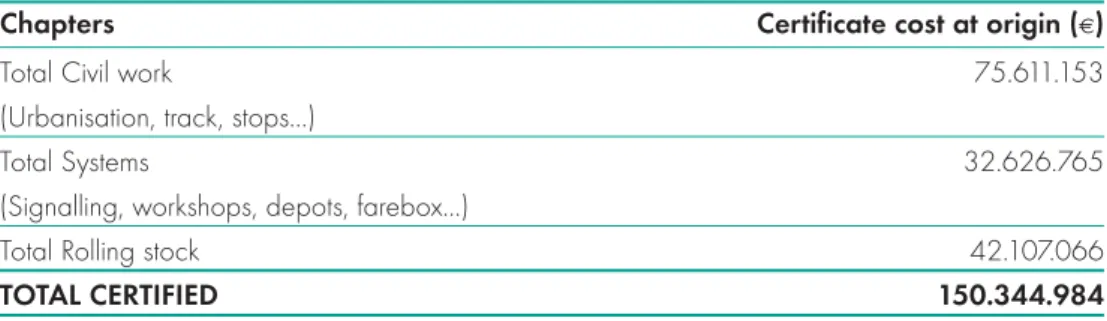
Using the same system as for the Baix Llobregat Tramway, the following tables show the follow-up of the operation and accidents for the Tramway Sant Martí – Besòs Tramway.
16.000 14.000 12.000 10.000 8.000 6.000 4.000 2.000 0 Mean passeng ers Weekdays
Mean daily passengers by type of day
Saturdays
may jun jul sep oct nov dec
Chapters Certificate cost at origin (€)
Total Civil work 75.611.153
(Urbanisation, track, stops...)
Total Systems 32.626.765
(Signalling, workshops, depots, farebox...)
Total Rolling stock 42.107.066
TOTAL CERTIFIED 150.344.984
The figures for September correspond to the last weeks of operation of the Forum International of the Cultures 2004. The situation of the last few months, with demand not separated for working days and Saturdays, can be interpreted as the commercial or leisure use of the tramway. There is not yet a demand due to obliged mobility derived from the existence of an important trip generating destination. In the future this role will correspond to 22@ and the development associated with this urban initiative of Barcelona City Council.
The graph of commercial speed shows a clear upward tendency with values close to those stated in the Operation Plan, that is 19 km/h.
The total number of passengers transported by Trambesòs since its inauguration and during 2004 was 1,837,740. This figure includes trips made with the T-Tram promotional ticket.
18,5 18 17,5 17 16,5 16 15,5 15 Km/h
may jun jul sep oct nov dec
T4
Real operating speed for each month
aug
Trambesòs Passengers 2004
(1) Includes promotional T-Tram trips
Mes Passengers may 89.174 june 184.869 july 261.559 august 259.311 september 336.077 october 222.945 november 202.304 december 209.533 TOTAL 1.765.772
3 ROLLING STOCK
On July 23, 2004 a contract was signed for the leasing of 50 trains manufactured by Alstom which are to provide service on the future line L9 of the Barcelona metro, currently under construction. This signature furthers the operations of renovation and extension of the fleet of trains of the metro network to provide a better quality service for transport public in the area of Barcelona.
The contract was finalised between the MTA, the specific company, Arrendadora Ferroviaria, SA -comprised of ICF Holding, La Caixa, Caja Madrid and Société Générale-and the manufacturer of the trains Alstom Transporte, SA.
The same act also formalised the supply contract between the same three agents, which defines the manufacturing process, supply and commissioning of the trains, and mainte-nance of rolling stock.
This signature was conditioned by the final signature of the different contracts related to financing the operation which finally took place on September 13, 2004.
The total cost for manufacturing the 50 trains is 296.6 million Euros.
Type of trains
• Automatic driverless system (ATC, Automatic Train Control)
• 5 carriages with independent air-conditioning (four motor units and one intermediate carriage)
• Length of the train: 86 m
• Diaphanous interconnection between carriages, where the interior distribution of seats and spaces has been studied to match the location of accesses to stations on line L9:
o Central carriage with large capacity space and lengthwise seating.
o Intermediate carriages with spaces for the mobility handicapped and length-wise seating.
o End carriages with space for bicycles, crosswise seating for long trips, without drivers cabin and with panoramic view of the track.
• 4 double doors per carriage with simultaneous opening of platform doors • Mixed structure of aluminium and steel to save weight and energy
• System of video surveillance and continuous Train – PCC connection (Central Command Post)
• System of video information inside the carriages, dynamic route panels and public address with direct connection to the Control Centre.
The materials used are highly resistant to fire and with low smoke emission. They are also fitted with an automatic smoke detection system and are prepared for the installation of an mist fire extinguishing system.
Schedule and type of contract
The schedule for delivery of the leased rolling stock expects reception of the first train in April 2006. The 13 trains required to put the first section of line L9 Sagrera Meridiana-Gorg / Can Zam into service must be delivered by November 2006, whereas the total of 50 trains should be available by June 2008.
The contract is for leasing and establishes a period of 18 years; once this period has elapsed, MTA may decide whether to extend the lease contact, or to acquire the trains at a price of about 50% their initial value.
Renovation of the fleet of Barcelona metro
This rentingoperation forms part of the process of extension and renovation of the rolling stock of Barcelona metropolitan railways and will represent an important renovation of the train fleet. At this time following leasing operations are in progress:
• 39 trains for the renovation and extension of the fleet for lines 5, 2 and 3 of the Barcelona metro, formalised with CAF and Alquiler de Trenes, AIE, on August 8, 2003.
4 INTEGRATED FARE SYSTEM
The project of the integrated fare system for the Barcelona metropolitan area, promoted by the associated administrative bodies, was approved by the Board of Directors of the MTA on November 15, 2000, its objectives were:
• Create an easy-to-understand fare system based on user accepted principles • Favour the perception of the metropolitan public transport system as an integrated
net-work
• Contribute to positioning public transport as a system that is more attractive to users
The zoning system adopted was 6 fare rings divided into zones.
The schedule for incorporation of different operators into the project was:
Year 2001
Barcelona Bus (previously Asser), Authosa, Autocars R. Font, Autocorb, Autos Castellbisbal, Cingles Bus, Cintoi Bus, Empresa Casas, Empresa Plana, Empresa Sagalés, FGC, Fytsa, Hispano Igualadina, La Vallesana, Martí Colomer, Mohn, Oliveras, Rodalies RENFE (first ring), Rosanbus, Sarbus, Soler i Sauret, TMB, Transports Generals d'Olesa, Transports Lydia, Transports Públics, Tusgsal and the urban services of Sabadell (TUS) and Sant Cugat del Vallès (Sarbus and Saiz Tour).
Year 2002
Year 2003
The urban services of Terrassa (TMESA), El Papiol (Autos Castellbisbal), Granollers (Buses e Granollers), Vallirana (Soler i Sauret), Molins e Rei (Molins Bus UTE), Cerdanyola del Vallès (Sarbus), Vilassar-Cabrera e Mar (Empresa Casas), Igualada (TUISA); it also integrated the intercity service promoted by the town of Mollet del Vallès and the interurban services of the companies Hispano Llacunense and SA Masats Transports General.
Year 2004
- January 3: CRA La Hispania, SA - 7 January: Autocars Vendrell, SL - April 3: Trambaix
- May 8: Trambesòs
- July 1: La Hispano Hilarienca, SA
- Adhesion agreements have been signed with the intercity service of Eurolines Peninsular and of the urban service of Sant Vicenç dels Horts (Tibus, SA), pending integration in early 2005
4.1. Sales and use of the integrated fare system (IFS)
In 2004 the income for the sale of integrated tickets was 299,119,448.77 €(without VAT). This income represents a growth of 10% compared to the figure at closure of the year 2003, which was 271,885,709.86 €(without VAT).
The accumulated monthly turnover for 2004 compared to 2003 is shown in the following graph. 350 300 250 200 150 100 50 0 Thousands of € jan 24,5 22,8 feb 48,5 45,2 apr 101,9 92,9 may 127,6 117,4 jun 152,9 139,3 jul 176,5 161,1 mar 77,2 70,3 aug 193,2 175,0 sep 220,5 198,8 oct 246,8 225,5 nov 273,5 249,1 dec 299,1 271,8 accumulated sales 2004
accumulated sales 2003
accumulated sales 2004 accumulated sales 2003
A total of 38,314,462 units of integrated MTA tickets (excluding the T-Esdeveniment) have been sold representing a growth of 5.13% (36,443,513 units sold in the 2003 financial year).
The table below shows, by type of MTA ticket, the total sales, trips corresponding to the sales and the farebox for the 2004 financial year.
The total number of validations with integrated MTA tickets during 2004 was 609,747,973. This represents an increase of 4.6% compared to validations in the 2003 financial year (582,711,266).
The monthly validations for the year 2004 compared to 2003 is shown in the graph below. 700 600 500 400 300 200 100 0 Tr ip s jan 49,4 49,0 feb 100,2 97,4 apr 207,4 198,4 may 261,0 251,5 jun 313,3 299,0 jul 364,2 348,6 mar 157,8 150,4 aug 395,8 376,7 sep 447,0 423,1 oct 501,8 480,8 nov 558,0 533,2 dec 609,7 582,7 Acc. validations 2004
Acc. validations 2003
Accumulated MTA ticket validations
units trips income
% % %
sold sold (1)
T-DIA 231.725 0,60 1.853.800 0,37 1.038.452,54 0,35
T-10 35.900.104 93,55 359.001.040 71,67 226.655.837,01 75,77
T-50/30 1.385.584 3,61 69.292.700 13,83 37.158.448,23 12,42
T-Mes 700.532 1,83 55.730.571 11,13 26.967.281,96 9,02
T-Esdeveniment 61.365 0,16 439.930 0,09 164.478,84 0,05
T-Trimestre 17.016 0,04 4.037.219 0,81 1.904.933,13 0,64
T-Jove 29.787 0,08 7.0699.244 1,41 3.347.493,46 1,12
T-Familiar 49.444 0,13 3.461.080 0,69 1.882.523,60 0,63
TOTAL 38.375.827 100 500.885.584 100 299.119.448,77 100
(1) as per assignation per ticket in the Table Regulation of the Chamber of Commerce
Of the total of validations of MTA tickets for 2004, the T-10 ticket represented 71.8% of the trips with integrated tickets, followed by the 50/30 which represented 13.7% and the T-Mes with 11.7% of the trips as shown in the table below.
This distribution of the use of integrated tickets tends to stabilise if compared to the distribu-tion of previous years.
As for the incidence of integrated tickets on the total number of trips there is clear consoli-dation of the use of integrated tickets which represent a quota of almost 70% of the valida-tions in the system.
Validations of MTA tickets 2004
Validations % use
T-DIA 997.908 0,16
T-10 437.815.185 71,80
T-50/30 83.547.839 13,70
T-Mes 71,279,053 11,69
T-Esdeveniment 814.896 0,13
T-Trimestre 4.318.019 0,71
T-Jove 6.579.690 1,08
T-Familiar 4.395.083 0,72
TOTAL 609.747.673 100
Growth of validations of integrated tickets
2001 2002 2003 2004
T-10 71,80% 72,34% 72,18% 71,80%
T-50/30 11,70% 13,33% 13,32% 13,70%
T-Mes 16,32% 12,30% 11,90% 11,69%
Others 0,18% 2,03% 2,60% 2,81%
TOTAL 100% 100% 100% 100%
Incidence of integrated tickets on the system
2001 2002 2003 2004
validations MTA tickets 461.616.879 551.995.924 582.711.266 609.747.673
total validations for the system 755.430.000 800.050.000 837.127.500 868.213.552
The transformation of tickets into trips, in order to compare the growth over the last few years, gives a totals number of trips sold for 2004 of 909.4 million as shown in the graph below. This represents an increase of 161 million trips since the implementation of the integrated fare sys-tem, an increase of 21.5%.
4.2. Intermodality index
The 2004 financial year was the second year of application of the distribution of the fare-box through the follow-up bit.
On 31-12-04 the database of the integrated fare management system counted 97,854,111 validations of integrated tickets with follow-up bit.
The table below shows intermodality for 2004 in comparison to that for 2003.
Intermodality index 2003 and 2004
index 2003 % index 2004 %
T-DIA 6,66 9,55
T-10 19,85 20,14
T-50/30 26,19 26,22
T-Mes 14,00 20,27
T-Esdeveniment 12,64 18,99
T-Trimestre 19,52 21,56
T-Jove 19,52 21056
T-Familiar 17,36 20,11
950,0 900,0 850,0 800,0 750,0 700,0 650,0 600,0
Trips solds (Millions)
5 FINANCING THE SYSTEM
Contract program 2002-2004
On December 13, 2004 the Contract program was signed between the General Administration of the State (AGE) and MTA. The program is for the period 2002-2004 to a total of 1,175 million Euros.
On the other hand the deficit in contributions for the period 2002-2004 and the final liq-uidation of the 1998-2001 Contract program has been estimated at 195 million Euros; the different administrative bodies will settle this debt with the MTA during the period 2006-2009. ORIGIN APPLICATION 380 479 153 163 669 232 115 47 40 72 Estado (AGE) Generalitat de Catalunya EMT Ajuntament de Barcelona TMB FGC Bus EMT Bus DGPT
Tramway + Renfe + Desp. ATM
Inv. Infrest. Tram
ATM
1.175 1.175
The tables below show the financing of public transport in the Barcelona Metropolitan Area under the Contract program for the period 1998-2004, comparing the income from farebox with the subsidies from all public administrative bodies.
900 800 700 600 500 400 300 200 100 0
1998 1999 2000 2001 2002 2003
Farebox
2004 Subsidies
219 229 269 293 301 323 343 218 221
263 313 333
480 361 100% 90% 80% 70% 60% 50% 40% 30% 20% 10% 0%
1998 1999 2000 2001 2002 2003
% Farebox
2004 % Subsidies
50% 49% 49% 52% 53% 53% 58%
50% 51% 51% 48% 47% 47% 42%
Income and subsidies (%)
Income and subsidies (M€current) Planned settlement of the deficit in contributions
Administrative bodies 2006 2007 2008 2009 TOTAL
AGE 18,590 18,590 18,591 18,591 74,362
ATM 30,132 30,133 30,134 30,134 120,533
GENERALITAT 23,084 23,084 23,084 23,084 92,336
BARCELONA COUNCIL 4,331 4,331 4,332 4,332 17,326
EMT 2,717 2,718 2,718 2,718 10,871
6 OTHER ACTIONS
6.1. Planning of public transport services
Programs for new Collective Public Transport Services
The MTA maintains a database of applications made by different municipalities of the Barcelona Metropolitan Area for the implementation of new interurban collective transport services by road. These applications shall be analysed with the competent associated administrative bodies (DGPT and EMT).
Revision of the Plan for Night Bus Services
After of three years of operation of the night bus network TPC Nit, and in view of the infor-mation obtained on passengers carried, the initial plans have been revised to adapt them to the demand patterns identified during this period of time. During 2005 further analysis will be made in conjunction with the administration operating the services (DGPT) to decide whether to introduce changes in the network to make it even more efficient.
Collaboration with the Forum of Cultures 2004
In 2003 the Forum of Cultures 2004 and the MTA signed a collaboration agreement that considered aspects relative to the planning and issue of various specific transport tickets.
In regard to planning, the MTA drafted a plan to reinforce the various metro and bus lines that provided services to the Forum, including metro line L4, TMB bus lines and the night buses. In this same sense, the MTA designed the reinforcement of 7 of the night bus lines that already provided services, and drafted and managed agreements for the provision of services between the Forum, the DGPT - the Administration operating the lines-, the opera-tor providing the service on each of the lines and the MTA which participated in aspects of the integrated fare system.
Collaboration with City Councils of the Barcelona Metropolitan Area
The line of collaboration with the various City Councils of the Barcelona Metropolitan Area that had already been initiated in previous years, increased significantly during 2004. The specific collaborations with City Councils have been:
• La Roca del Vallès: follow-up of the current agreement between the Town Hall, the DGPT, the MTA and the operator regarding supervision of the offer and evolution of demand of the subsidised line.
• Matadepera: study of mobility and proposed remodelling of the service inside the town and to Terrassa.
• Sant Vicenç dels Horts: collaboration with the Town Hall to design a new network adapted to future fare integration.
• Igualada: proposed new bus network for all towns in the Conca d’Òdena area: Igualada, Vilanova del Camí, Santa Margarida de Montbui i Òdena, which includes the urban services of Igualada and interurban services between these towns. • Santa Eulàlia de Ronçana: proposed urban line for inner services and connection
with Granollers.
• Montcada i Reixac: on the suggestion of the Town Hall, analysis of the delays on the bus lines passing through this town using information provided by SAE.
• Sant Pere i Sant Antoni de Vilamajor: analysis of the current situation and proposed improvement of the service.
• Vallromanes: study of the adaptation of the fare zones to the bus lines serving the town.
• Parets del Vallès, Montmeló and Montornès del Vallès: provision of information to carry out a study of the accessibility to industrial estates in these towns.
• Corbera de Llobregat: meetings prior to the review study of the Quartre Camins shut-tle service.
6.2 Sermetra
The company Sermetra, SL with capital provided by the MTA and BusMet Services, SL was inscribed in the Company Register on July 27, 2004.
The purpose of this company is maintenance of the integrated fare system and the Operational Aid Systems fitted to the bus fleet of the Barcelona Metropolitan Area, includ-ing the lease of the necessary common infrastructures as well as workinclud-ing systems derived from the evolution of these systems.
On December 23, 2004 an agreement was signed between the MTA, BusMet Services, SL and Sermetra, SL defining the system for financing Sermetra, it was agreed that:
a) Control and Management Centre, whose purpose is the centralised management of incidents and breakdowns: financed by the MTA.
b) Maintenance and repair of common components of the Ticket Sale and Validation System: financed by the operators.
c) Maintenance and repair of the operators System of Exploitation Aid (SAE): financed 50% by the operators and the other 50% by the MTA.
6.3 Area of exterior projection
6.3.1 EMTA
The MTA is a founding member of the European Metropolitan Transport Authorities (EMTA). The purpose of the EMTA is to promote and organise the relations between European organisations responsible for public transport by encouraging the exchange of information, experiences and research, and to make its voice heard before community insti-tutions. It is made up of the transport authorities of 31 cities in 18 States and with 90 mil-lion inhabitants. This year a joint position has also been formulated on the proposal for community regulations on public transport services.
On the other hand, the EMTA has organised a working group to study the accessibility to means of transport by PRM, with the active participation of the MTA. This group commis-sioned a study on the “Application of new IT technologies to provide information on pub-lic transport to PRM in real time”. This study was presented in Brussels this year.
6.3.2. Participation in European projects
Civitas - Miracles
Avatars
The purpose of the Avatars European project is the development and testing of software that simulates the movement of people in large installations in order to simplify their design and draw up emergency plans. The task of the MTA in this project is to validate and pub-lish the results.
Urban Transport Benchmarking Initiative
The General Directorate of Transport and Energy (DG TREN) of the EU launched a bench-marking initiative in November 2003 consisting of the definition of a series of indicators used to determine the behaviour of a city in regard to the use of public transport and its contribution to sustainability. The MTA presides the working group in charge of “Demand Management”. This group is also made up of the transport authorities of the cities of Paris, London, Warsaw, The Hague, Dublin and Oulu. The group has already presented its con-clusions in Brussels.
6.3.3 Otras relaciones institucionales
Mobility Observatory
The Mobility Observatoryis a document drafted at regular intervals by a working group comprised of the Ministries of the Environment and Development, as well as various Spanish transport authorities, including the MTA, and the Polytechnical University of Madrid. Once the document has been dratted its publication is programmed and pre-pared.
Foundation for Sustainable and Safe Mobility
This public body, constituted by the Autonomous Government of Catalonia (Department of PTOP), Barcelona City Council and the Association for the Promotion of Public Transport, promotes all activities that potentiate sustainable mobility. To date it has created the com-pany Catalonia Carsharing, which began its activities this year.
CERIDC
3
1 TransMet FIGURES 2004
Basic data 2004
FMB (metro) FGC (1st Ring) Rodalies Renfe (1st Ring) Tranvía Metropolitano TB (buses)
Other EMT buses
Total 1st ring IFS
Other FGC
Other Renfe suburban** Buses Generalitat Other urban buses
Total other IFS TOTAL 6 2 4 4 104 77 197 2 4 196 72 268 465 86,6 24,0 94,0 18,5 887,3 1.939,0 3.049,4 119,0 332,0 4.910,0 775,0 6.136,9 9.186,3 66,5 12,0 nd 1,1 40,9 22,2 142,7 16,4 63,6 27,7 10,4 118,0 260,7 343,3 43,0 nd 7,7 205,0 60,3 659,3 33,0 113,9 26,3 35,7 208,9 868,2 3,4% 4,,7% nd --0,7% 5,4% 4,0% 3,3% 1,7% 5,3% 4,2% 2,8% 3,7% Lines Lenght network (km) Vehicles-km (millions) Trips (millions) ∆ 04 / 03
(%) 156,41 15,74 nd 3,10 92,54 29,05 296,84 31,30 96,29 24,61 16,53 168,73 465,57 Income (M€€)
* Provisional data
Rail transport. Year 2004
* Provisional data
** Data on Renfe Rodalies are for total integrated fare system nd Not available
Lines Lenght Station Car-km Trains/hour Trips Income network (km) (millions) peak and direction (millios) M€ Zone one IFS
Metro
Line 1 20,7 30 16,2 16 67,2
Line 2 12,4 17 9,5 16 56,8
Line 3 16,6 24 14,2 17 99,1
Line 4 17,2 22 13,0 13 51,1
Line 5 16,6 23 13,3 20 67,8
Line 11 2,3 5 0,4 9 0,7
Cable car 0,8 2 0,5
Total 6 86,6 123 66,5 91 343,3 156,41
FGC
Barcelona-Vallès Line 12,0 18 7,2 30 30,8 11,26
Llobregat-Anoia Line 12,0 10 4,8 11 12,2 4,49
Total 2 24,00 28 12,0 41 43,0 15,74
Renfe Rodalies
C-1 29,1 8 nd 10 nd
C-2 35,1 10 nd 2 nd
C-3 3,3 6 nd 2 nd
C-4 26,5 4 nd 13 nd
Total 4 94,0 28 39 nd
Tramvia Metropolita
Trambaix 3 12,0 25 0,8 8 5,9 2,40
Trambesós 1 6,5 14 0,3 4 1,8 0,70
Total 4 18,5 39 1,1 12 7,7 3,10
Total 1st FSI 16 223,1 218 78,5 183 394,0 175,25
Summary of Rail transport
Car-km ∆04 / 03 Trips ∆04 / 03 Income (millions) (%) (millions) (%) M€
Metro 66,5 3,8% 343,3 3,4% 156,41
FGC 28,3 1,1% 75,94 4,1% 47,05
Renfe Rodalies 63,6 1,6% 113,9 1,7% 96,29 *
Tramvia Metropolità 1,1 --- 7,7 --- 3,10
Total Rail Transport 159,5 2,4% 540,9 4,6% 302,84
Lines Lenght Station Car-km Trains/hour Trips Income network (km) (millions) peak and direction (millios) M€
Rest of IFS FGC
Barcelona-Vallès Line 32,0 14 9,0 20 25,5 22,23
Llobregat-Anoia Line 87,0 29 7,3 7 7,3 9,03
Gelida Funicular 0,9 3 0,1 0,04
Total 2 119,9 46 16,4 27 33,0 31,30
Renfe Rodalies (**)
C-1 61,8 16 18,3 10 32,2
C-2 94,8 20 19,1 14 37,4
C-3 56,4 12 5,4 2 7,9
C-4 119,0 28 20,7 13 36,3
Total 4 332,0 76 63,6 39 113,90 96,29 *
Total Other FSI 6 451,9 122 79,9 66 146,9 127,59
Oliveras SA 2,2 5,6 10,0% 2,13
Rosanbus SL 2,3 7,1 19,6% 2,78
TCC (SA, SL) 1,6 2,5 6,7% 6,10
Tusgsal 9,7 30,7 1,3% 12,07
Soler i Sauret SA 0,4 1,0 9,3% 0,34
Transports Lydia SL 0,2 0,4 -2,2% 0,11
Total 1st Ring IFS 63,2 265,4 1,71% 121,59
Resto of the IFS
Intercity transport Vehicles-km Trips ∆04 / 03 Income (millions) (millions) (%) M€
Interurban transport
Autocars R. Font SA 0,8 0,9 2,9% 0,64
Barcelona Bus SL* 0,3 0,3 --- 0,38
Cingles bus SA* 1,2 1,1 --- 0,75
CRA La Hispania SA 1,4 1,2 --- 1,11
Empresa Casas SA 3,9 2,6 7,5% 2,67
Empresa Sagalés SA 2,6 2,6 --- 2,51
Empresa Plana 1,1 1,4 --- 1,07
FYTSA 2,0 2,4 10,7% 2,48
La Hispano Igualadina 3,2 1,6 8,0% 2,60
La Vallesana SA 0,9 0,9 0,1% 0,69
Sarbus (Martí i Renom SA) 3,4 5,1 0,8% 3,86
Soler i Sauret SA 1,9 3,1 3,7% 2,30
Others (15) 5,0 3,5 16,6% 3,54
Total intercity transport 27,7 26,3 5,31% 24,61
Municipal urban transport
Other urban buses Vehicles-km Trips ∆04 / 03 Income (millions) (millions) (%) M€
Autobusos de Granollers 0,4 0,9 -5,6% 0,55
CTSA-Mataró Bus 1,1 5,0 2,9% 2,32
Transports Públics Sa (Rubí) 0,6 1,5 7,2% 0,60
TUS, S. Coop. CL (Sabadell) 2,8 12,9 0,8% 6,04
Sarbus+Saíz (Sant Cugat) 0,9 1,1 -0,1% 0,33
TMESA (Terrassa) 2,5 10,4 2,4% 5,12
TCC (Vilanova i la Gesltrú) 0,4 0,6 10,8% 0,39
Others (24) 1,8 3,2 34,8% 1,18
Total 10,4 35,7 4,18% 16,53
Summary of bus transport
Vehicles-km ∆04 / 03 Trips ∆04 / 03 Income (millions) (%) (millions) (%) M€
EMT Buses 63,2 0,5% 265,4 1,7% 121,59
Interurban transport 27,7 21,9% 26,3 5,3% 24,61
2 STUDIES AND SURVEYS
2.1. Daily Mobility Survey 2001 (EMQ‘01)
During 2004 exploitation of the daily mobility survey carried out in 2001 continued. The last 5 publications were:
Volume 7 Analysis of the subjective dimension of mobility
Mobility has a subjective component: perception. This volume analyses the declared use of means of transport, the reasons for the use of cars, the degree of awareness of the pub-lic transport offer, an estimate of the monthly cost of pubpub-lic transport and a private vehicle, the degree of knowledge of the MTA and the integrated fare system. All from the percep-tion of the people surveyed.
A total of 37.1% of those surveyed knew about the integrated fare system, with an average score of 8.02. It is important to note that close to one fourth of individuals gave it a score of 10.
Volume 8 Analysis of the mobility in the main municipalities of the BMA
This volume analyses mobility in the main municipalities of the BMA. The towns subject to analy-sis are those with the largest demographic volume and regional capitals that have less than 50,000 inhabitants, the result was 18 townships: Barcelona, L’Hospitalet de Llobregat, Badalona, Sabadell, Terrassa, Santa Coloma de Gramenet, Mataró, Cornellà de Llobregat, Sant Boi de Llobregat, El Prat de Llobregat, Rubí, Viladecans, Cerdanyola del Vallès, Granollers, Vilanova i la Geltrú, Sant Cugat del Vallès, Sant Feliu de Llobregat and Vilafranca del Penedès.
A detailed study structured in three different parts was developed for each one:
- the characterisation of global mobility (trips with origin and/or destination in the municipality analysed): territorial relation, modal distribution, reasons for the trip, type of day, analysis of intermodality,
- characterisation of the mobility of residents in the municipality analysed, and - finally the opinion of residents in the municipality regarding key aspects of mobility:
perception of the use of different modes, assessment of the means integrating the transport offer and reasons for the use of a private vehicle.
declared preferred use men women total
on foot 26,1% 31,7% 29,0%
public transport 29,6% 42,3% 36,2%
private vehicle 44,4% 25,9% 34,8%
total 100% 100% 100%
Volume 9 Analysis of mobility to the first ring
Analysis of mobility to the first ring from a double point of view: trips of residents to the first ring and, on the other hand, trips to the first ring made by the group of residents over 3 years of age in the MTA geographical area.
The eighteen municipalities of the first ring have been structured in three zones: Besòs, Barcelona and Llobregat.
A total of 30,308,179 weekly trips were made to the first ring by residents over 3 years of age.
In the period of the study the population analysed was 2,562,871 inhabitants, therefore the average is 11.8 trips per inhabitant per week.
Regarding the modal distribution, note that public transport (35.7%) and travel by foot (35.3%) show a predominant position, whereas the private vehicle presents a much lower market share (29.0%).
Volume 10 Mobility analysis from the perspective of fare zones and main lines
The analysis of mobility by fare zones shows that 86% of trips are made, entirely within the area of residence:
- residents in the central area are those showing the greatest self-control (92.2%) - residents in the zones of ring 6 and ring 3 have the second level of self-control. These
areas include the major cities in the area of the MTA (Martorell, Terrassa, Granollers, Mataró, Manresa, Vic, ...)
- the residents in intermediate areas show a lower percentage of self-control. This situ-ation assumes its maximum expression in the case of residents in the zones of ring 2. Distribution of the population and trips by area of residence
individuals trips
frequency percentage frequency percentage
Barcelona 1.464.667 57,1% 14.242.230 56,9% 11,77 1,00
Besòs area 391.539 15,3% 5.264.567 17,4% 13,45 1,14
Llobregat area 706.666 27,6% 7.801.382 25,7% 11,04 0,93
Total 2.562.871 100% 30.308.179 100% 11,83 1
average
trips ratio
(1)
The structure in mainline connections, apart from adapting to a basically radial mobility, is also based on criteria of availability of infrastructures (fast highways and railways). Six areas have been distinguished: the central area (zone 1) and five main communication lines spread radially around first ring.
Percentage of self-control per area of residence
Percentage of self-control per area of residence
(*) Trips with origion and destination in the zone of residence on the total trips made
Trips within the area of residence expressed in thousands
Uo to 70,0%
70,1 to 75,0% 75,1 to 80,0%
80,1 to 85,0%
> 85,0%
Volume 11 Analysis of mobility networks in the BMA
Based on the flow of mobility observed in the EMQ’01, an analysis was made of territori-al movement within the BMA). An approximation to the purpose of the study was made by network analysis; the basic nodes of the network are the 164 municipalities making up the BMA and the relations studied are the flow of trips between them.
The analysis was at an intermediate level between the minimum unit (municipality) and the global network (BMA): groups of municipalities that show a level of association that is high enough to consider them homogeneous subgroups (areas of cohesion).
The statistical technique used was cluster analysis: it classifies a group of objects, bodies or individuals in groups that are as homogeneous as possible on the basis of information in terms of a series of different variables.
After applying this technique and analysing the results, it was decided that the best solu-tion involves considering that the BMA is comprised of ten areas of cohesion , clustersor groups of municipalities: the central area, the area of Garraf, the area of Alt Penedès, the area of Baix Llobregat north, the area of Vallès Occidental, the area of Vallès Oriental, the area of Montseny, the area of Alt Maresme, the area of Central Maresme and the area of North Barcelonès.
Main trips between corridors per origin and destination
Trips express in thousands
Only cases >= 25 thousand trips are considered
Even though the BMA comes close to a multipolar model, Barcelona presents a capacity of attraction far above that of the other nodes, superimposing its area of influence on that of other metropolitan sub-centres.
Analysis of the internal structure of the areas of cohesion was based on the calculation of three basic indicators: main external relations, nodal degree and degree of centralisation. Applying the same method to the study of the network global, shows how the incidence of Barcelona extends over the major part of the territory. However it does lose presence and intensity with distance. In relative terms, 57.1% of municipalities emit significant flows. The channelling capacity of Barcelona is reduced by the presence of horizontal structures (sec-ond range polarity).
Main external relations: Barcelona as a destination
Main external relations: excluding the cases of Barcelona as a destination
The most outstanding sub-centres are the major cities: Terrassa, Sabadell, Mataró, Vilanova i la Geltrú, Vilafranca del Penedès and Martorell.
Apart from these cities, there is also the presence of new central nodes (Cerdanyola, Sant Cugat or Mollet) and edge cities(Sant Celoni, Sant Sadurní d’Anoia, Calella or Arenys de Mar), towns located on the edge of the region, along the coastline or on inland limits.
2.2. Working Day Mobility Survey 2004 (EMEF’04)
The MTA and Barcelona City Council commissioned the Institute of Regional and Metropolitan Studies of Barcelona with the second edition of the Working Day Mobility Survey (EMEF’04).
The universe to be studied was comprised of residents in the BMA over 15 years of age. During the period of the study the population to be analysed was a total of 3.7 million indi-viduals.
The objective of the research was to analyse mobility on working days. For this reason infor-mation was gathered on trips carried out on the last working day, from Monday to Friday not a public holiday.
The residents in the area of the study were classified in two basic types depending on their types of mobility: general population and professionals. On the other hand, a second dis-tinction was established within the first category: general population without mobility and general population with mobility.
The three basic profiles thus defined range from the absence of mobility to the maximum degree of mobility. The population was distributed as follows: general population without mobility (13.2%), general population with mobility (84.4%) and professionals (2.4%).
On a working day, residents in the BMA over 15 years of age make 12.4 million trips. Analysis of the distribution of these trips according to the reason and the main system of transport reveals that obligatory mobility (33.9%) predominates over non-obligatory mobil-ity (27.0%), whereas the rest of the trips correspond to returns to home (39.1%).
Distribution of the population and trips according to basic mobility profiles
individuals trips
frequency percentage frequency percentage
General without mobility 493.697 13,2% 0 0,0% 0,00
General with mobility 3.163.765 84,4% 11.019.414 89,1% 3,48
Professionals 89.509 2,4% 1.352.695 10,9% 15,11
Total 3.746.971 100% 12.372.109 100% 3,30