Acta Botánica Malacitana, 8: 47-58
Málaga, 1983
THE FAMILY
THELYPTERIDACEAE
IN EUROPE
R. E. HOLTTUM
SUMMARY: Thelypteridaceae are mainly tropical ferns, the total number of species is about one thousand. The five European species represent five different groups, each of which has recently been accorded generic status. Thelypteris palustris Schott (including three varieties) extends throughout north temperate regions, with a closely allied species south of the equator; chromosome numter n=35. Phaegopteris connectilis (Michx) Watt (triploid with base number 30) and Oreopteris limbosperma (All.) Holub (n=34) are members of small genera confined to north temperate re-gions. Stegnogramma pozoi (Lag.) K. Iwa-cs. (n=36) represents a genus of 12-15 species, mainly in Africa and Asia, with one in Mexico. Christella dentata (Forsk.) Brownsey & Jermy is a wide-ranging and variable tetra-ploid species of a pantropic genus (c. 60 app) the centre of distribu-tion of wich appears to be Burma-Assam (base number 36).
The genus Cyclosurus (s. str.) comprises a small pantropic group of species with grow (like Thelypteris) in open permanently swampy ground; I belive Cycicsorus and Thelypteris to be closely related genera. Stegno-gramma is related to Sphaerostephanos which (in arrangement of Holttum) is the most diversified genus in the Old World with c. 140 spp. in Mal-esia . Christella is probably also related to Sphaerostephanos though less near-ly than Stegnogramma.
RESUMEN: Las Thelypteridaceae son helechos principalmente tropicales, comprende aproximadamente mil especies. Las cinco especies europeas presentan cinco grupos diferentes cada uno de los cuales ha recibido re-cientemente un estatus genérico. Thelypteris palustris Schott (incluyendo tres variedades) se extiende por las regiones templadas del norte, con un conjunto de especies próximas al sur del ecuador; el número cromosómi-co es n=35. Phegopteris cromosómi-connectilis (Michx) Watt (triploide cromosómi-con número básico 30) y Oreopteris limbosperma (All.) Holub (n=34), son miembros de pequeños géneros confinados a las regiones templadas del norte.
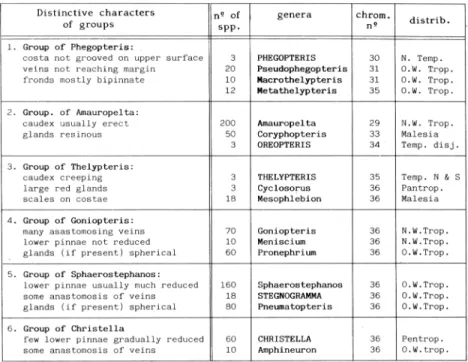
This family comprises almost one thousand species, distributed mainly in the wetter parts of the tropics. In mainland Europe there are five species, and of these two occur only in Spain (one of them also in Crete). In New Zealand there are four species, one of which occurs also in Spain. By contrast, there are about 440 species in Malesia, which I have been studying intensively during the past twelve years, following the work of R.C. Ching on the species of Chi-na and India. Simultaneously Dr. A.R. Smith in California has been studying the species of the New World, and our work has met in a consideration fo the species of Africa which have relations both to west and east of that continent. The result of all this study has been the recognition of a new set of natural groups of species which I have ranked as genera. These differ from the generic concepts in Copeland's Genera Filicum (1947) where the two principal genera (Las-trea and Cyclosorus) are both composite and some natural groups of species overlap both "genera". The European species belong to five distinct genera each of which belongs to a different group of generá in my scheme, the main part of which is set forth in Table I. The principal group omitted is confined to Malesia and the Paci-fic; there are also some temperate North American and Asian species the position of which is not yet clear, a tropical American group
(Steiropteris) and a small genus in Asia which has trilete spores.
In the 19th centry the species in this family, rarely well descri-bed, were not distinguished from Dryopteris and other genera having son i of a similar shape. The most important character distinguishing thelypteroid ferns was first noticed by Carl Christensen in his study of the tropical American species which he had included in Dryopteris in his Index Filicum (1905); this caracter is the universal presence of unicellular acicular hairs on the upper surface of all axes of fronds. He rightly claimed that species sharing this character had also other characters in common which marked them as a distinct taxonomic group. R.C. Ching later pointed out that another common character is the presence of two vascular strands at the base of the stipe, the two uniting upwards to form a single strand U-shaped in section (Flora Europaea has the erroneous statement that the stipe in this family has 5-7 vascular strands, which is true of Dryopte-ris). A combination of these two kinds of character, which are not functionally connected, is sufficient to mark a fern as a member of the family Thelypteridaceae, with only one exception, namely Hypode-matium (limestone plants of tropical and subtropical Asia) which has very different scales and perhaps is most nearly allied to Athyritun.
Other less distinctive characters also mark the family. The scales which cover very young fronds at the crozier stage have unicellular outgrowths, usually acicular but sometimes spherical, from the surfa-ces of many cells, in most cases not only marginal ones; scales of true Dryopteris and other genera with similar son i have no superfi-cial hairs, and projections on their margins are of a different cha-racter. The large proportion of tropical thelypteroid species which have anastomosing veins all show a sinus-membrane with an excur-rent vein passing to the base of it. The difference between Thelypte-ridaceae and Dryopteris, and also the diversity of the fcirmer, is shown by their chromosome numbers, which have a range from 27 to 36 in Thelypteridaceae whereas Dryopteris has 41 (some related gene-ra have 40). A chagene-racter of many species in the family, but not well shown by those in Europe, is the presence of swollen aerophores at the bases of pinnae. Another frequent character is the presence of unicellular glands, either on the surfaces of fronds or on sporangia, or both; such glands are of several different kinds, characteristic
of different genera or groups of genera; three kinds are shown by European species. Generic distributions are interesting. Two European genera (Phegopteris and Oreopteris) have a north temperate distribu-tion, one (Thelypteris) is worldwide, the other two (Christella and Stegnogramma) mainly in the tropics of the Old World.
Distinctive characters
of groups n, ofsP13.
genera chrom.
n2 distrib.
1. Group of Phegopteris:
costa not grooved on upper surface 3 PHEGOPTERIS 30 N. Temp. veins not reaching margin 20 Pseudophegopteris 31 0.5. Trop. fronds mostly bipinnate 10 Macrothelypteris 31 0.5. Trop. 12 Metathelypteris 35 0.5. Trop.
2. Group. of Amauropelta:
caudex usually erect 200 Amauropelta 29 N.W. Trop. glands resinous 50 Coryphopteris 33 Malesia
3 OREOPTERIS 34 Temp. disj.
3. Group of Thelypteris:
caudex creeping 3 THELYPTERIS 35 Temp. N & S large red glands 3 Cyclosorus 36 Pantrop. scales on costae 18 Mesophlebion 36 Malesia
4. Group of Goniopteris:
many asastomosing veins 70 Goniopteris 36 N.W.Trop. lower pinnae not reduced 10 Meniscium 36 N.W.Trop. glands (if present) spherical 60 Pronephrium 36 0.W.Trop.
5. Group of Sphaerostephanos:
lower pinnae usually much reduced 160 Sphaerostephanos 36 0.W.Trop. some anastomosis of veins 18 STEGNOGRAMMA 36 0.W.Trop. glands (if present) spherical 80 Pneumatopteris 36 0.W.Trop.
6. Group of Christella
few lower pinnae gradually reduced 60 CHRISTELLA 36 Pentrop. some anastomosis of veins 10 Amphineuron 36 0.W.trop.
Table 1.- Thelypteridaceae: Principal groups of genera
THE PHEGOPTERIS GROUP OF GENERA
to both ends; in Japan both diploid and tetraploid forms have been
found but there is no report on the morphological distinctions bet-ween them.
Linnaeus gave the name Polypodium phegopteris to the European species, and it remained in Polypodium in the systems of Swartz and Hooker. In 1852 Fée established a genus Phegopteris for terrestrial ferns with exindusiate round son i and fronds not articulate to the rhizome as are those of true Polypodium. Fée still placed his genus next to Polypodium. It contained a considerable diversity of species, but was adopted by other authors, including Beddome whose Indian ferns under that name include species now placed in Dryopteris,
Cte-nits, Gymnocarpium, Hypolepis and Monachosorum. Mettenius (1856)
also adopted the genus (Fil. Hort. Lips. pp. 14, 81) but he trans-ferred it from Polypodiaceae to Aspidiaceae and subdivided it criti-cally. Diels (1899) finally united indusiate and exindusiate ferns under the name Nephrodium, which was changed to Dryopteris in Christensen's Index filicum of 1905. Christensen was very conscious that his Dryopteris represented a complex mixture, but he refused to make a formal subdivion into separate genera until he had lear-ned enough to distinguish them clearly. Copeland included
Phegopte-ris in Lastrea (Genera Filicum, 1947) which compPhegopte-rised all
Thelypteri-daceae which have free veins, an unnatural mixture. The first au-thor to recogize Phegopteris in its present restricted sense was Ching.
The distinctive characters of the genus are: semicircular wings along the rachis connecting the pinnae, the main veins in some of the wings arising directly from the rachis; scales on the rachis thin, transclucent with filiform apices, their margins bearing slender uni-cellular hairs, transitions from such scales to hairs present on the lower surface of costae of the pinnae; costae prominent on the upper surface, not grooved; veins not reaching the margin except some dis-tal ones; son i near the apices of veins, exindusiate (or with very small indusia in P. decursivepinnata); spores have a complex raised
irregular reticulum of fine meshes, much as in Macrothelypteris, ve-ry different from Pseudophegopteris.
Select synonymy of the European species:
Phegopteris connectilis (Michx) Watt, Canad. Nat. (1870) 29;
Mor-ton, Amer. Fern J., 57 (1967) 177; Holttum, Blumea 17 (1969) 10. Basionym: Polypodium connectilis Michx, Fl. Bor. Amer., 2 (1803) 271.
Earliest name, with variants: Polypodium phegopteris Linn., Sp.
Pl. (1753) 1089.
Lastrea phegopteris Bory Diet. Class., 9 (1826) 233; Copel., Gen.
Fil., (1947) 137.
Phegopteris polypodioides Fée Gen. Fil., (1852) 243; Manton, Probl. Cyt. and Evol. Pterid., (1950) 83; Ching, Acta Phytotax. Si-nica, 8 (1963) 312; Hirabayashi, J. Jap. Bot., 44 (1969) 115.
Phegopteris vulgaris Mett., Fil. Hort. Lips., (1856) 83: Bedd., Handb. Ferns Brit. India, (1883) 290.
Thelypteris phegopteris Slosson in Rydb. Fl. Rocky Mts., (1917)
1043; Flora Europaea, 1 (1964) 14.
THE OREOPTERIS GROUP OF GENERA
The majority of ferns in all three genera have glands on the surface of their fronds; these glands are somewhat resinous and are
different in each genus. Those in Oreopteris are spherical and free from the surface of the frond; the larger glands in Amauropelta are hemispherical, but there are varied smaller spherical ones; those in Coryphopteris are sessile, red-translucent, often collapsing when dried for the herbarium. Plants in all genera have an erect, or nearly erect, caudex, which in Amauropelta and Coryphopteris may reach 30 cm. or more tall, giving the plants the aspect of miniature tree-ferns. Amauropelta is the largest genus, comprising about 200 species, the great majority in tropical America (A.R. Smith, American Fern Journ., 64: 83-95, 1974) with six species in Africa and adjacent Islands (Holttum, J. S. Afr. Bot., 40: 130-136, 1974) and three in the islands of the Pacific (Holttum, Allertonia, 1: 193-195, 1977). Coryphopteris comprises about fifty species, on the mountains of
Ma-lesia, always near the crests of ridges, also on the mountains of a few islands in the Pacific as far as Tahiti (Holttum, Blumea, 23: 19-47, 1976).
Oreopteris was first recognized as a distinct genus by Holub in
1969 (see synonymy below). The type species was first named
Polypo-dium oreopteris in 1787. It was transferred by different subsequent authors to seven other genera, among them Lastrea Bory (1826). Bory included a mixture of diverse species in his genus and later authors who adopted the name used it in different senses. John Smith (Histo-ria Fil icum, 1875) cited Dryopteris filix-mas as type species. Beddo-me, in his work on Indian ferns, included in it species of
Dryopte-ris, Ctenitis, Hypodematium, Lunathyrium and several thelypteroid genera. Christensen (Index Filicum: XXI, 1905) recognized that this confusion existed, and in his Monograph of Dryopteris (1913) ranked
Lastrea as a subgenus to include the species now known as Amauro-pelta only. Copeland (1947) again recognized Lastrea as a genus, restricting it to thelypteroid ferns with free veins (but he also in-cluded Gymnocarpium, which is not thelypteroid) and cited L. oreop-teris as type species. Ching (1963) in his new subdivision of the family, and Pichi Sermolli (1977) accepted the same type. But Holub (1969) pointed out that the original list of species in Lastrea inclu-ded Polypodium thelypteris Linn. which is in effect the type species of Thelypteris. Therefore Lastrea is illegitimate, according to the present Code, for which reason Holub proposed the new generic name
Oreopteris. In view of the great confusion of names under the genus Lastrea in the 19th century, I welcome this proposal for practical reasons. Holub adopted the original specific epithet as a generic na-me, so a new specific epithet has to be found for the type species;this was provided by Allioni when he published the name Polypodium
Urn-bospermum.
O. limbosperma is distributed throughout most of western Europe,
southwards to the Pyrenees and northern Italy, eastwards to the Cas-pian Sea. . There is a closely related species (O. quelpaertensis
(Christ) Holub) in Japan, Korea, and from Kamchatka to Alaska and British Columbia; a third species in Sikkim (O. elewesii (Bak. ) Holt-tum) is more distinct, with pinnae less deeply lobed, lower pinnae asymmetric, and smaller glands.
pe-rispore consisting of well-developed irregular inter-connecting ridges; Chromosome number ( known for all species) 34.
Select Synonymy for the European species:
Oreopteris limbosperma (All. ) Holub, Folia Geobot. Phytotax., 4 (1969) 46.
Basionym: Polypodium limbosperma All. Auct. Flor. Piedm., (1789) 49.
Synonym: Thelypteris limbosperma (All. ) H.P. Fuchs, Amer. Fern J., 48 (1958) 144; Flora Europea, 1 (1964) 13.
Earliest name and some of its variants: Polypodium oreopteris Ehrh. in Willd. , Fl. Berol. Prodr.
(1787) 292.
Lastrea oreopteris Bory, Dict. Class., 9 (1826) 233; Copel, . Gen.
Fil., (1947) 136; Ching, Acta Phytotax. Sinica, 8 (1963) 298.
Nephrodium oreopteris Desv., Mem. Soc. Linn. Paris, 6 (1827) 257; Hook., Spec. Fil., 4 (1862) 89.
Phegopteris oreopteris Fée, Gen. Fil., (1852)
243.
Thelypteris oreopteris Slosson in Rybd. Fl. Rocky Mts (1917) 1043; Clapham, Tutin & Warbrug, Fl. Brit. Isles, (1952) 46.
Illegitimate name: Polypodium montanum Vogler, Dissert. , (1781) non Lam. 1773.
Nephrodium montanum Bak., Syn. Fil., (1867) 271; Diels in Engler & Prantl, Nat. Pflanzenfam. I, Abt. 4 (1899) 173.
THE THELYPTERIS GROUP OF GENERA
The genus Thelypteris in the restricted sense here adopted con-sists of two or three North Temperate species and one southern spe-cies; the latter has a disjunct distribution in Africa south of tha Sa-hara, the mountains of southern India, North Sumatra and New Gui-nea, and the North Island of New Zealand. The southern species dif-fers from the northern ones most conspicuously in the presence of rather large persistent almost circular scales on the lower surface of costae. All species grow only in permanently wet ground in rather exposed places. (Ching in 1963 included also Nephrodium griseum Bak., known only from one specimen from South India. In my judge-ment, this specimen represents an abnormal form of a species of
Pseudocyclosorus).
The other genera in the group, Cyclosorus and Mesophlebion (also the monotypic genus Ampelopteris) agree in the presence of rather large red spherical glands at the ends of hairs on the stalks of sporangia and also sometimes on the lower surface of fronds. Such glands are absent in Thelypteris, but the costal scales of that genus end in a red glandular cell, seen on newly-developed scales. All genera agree in the presence of scales on the lower surface of cos-tae; in most other members of the family such scales are rare
(Phe-gopteris, Macrothelypteris and Coryphopteris also have them). Cyclo-sorus, of which the type species is C. gongylodes (Schkuhr) Link, consists of a pantropic complex (with one outlier in Algeria) which includes tetraploids in America, with one distinct species in Africa. Like Thelypteris they are all plants of open freshwater swamps; ma-ny Angiosperms of this habitat are also widely distributed.
dis-tance from the base of its costule . This condition occurs to some ex-tent also in Cyclosorus, where the basal veins anastomose to form an excurrent vein passing to the sinus-membrane between two adja-cent lobes, as in most tropical members of the family.
The generic name Cyclosorus needs some explanation, as it has here a significance different from that adopted in Copeland ' s Genera Filicum (1947) and in Flora Europaea . Link published the name Cy-closorus for a single species Aspidium gongylodes Schkuhr, the type of which was a specimen from the Orinoco Rive.r belonging to the pantropic complex above mentioned ( there were several earlier bino-mals which applied to other specimens of the same complex ) . C.
gon-gylodes was included in Aspidium or Nephrodium by all later authors
of the 19th century and in Dryopteris by Christensen in his Index Filicum (1905) . When Christensen studied all tropical American spe-cies for his Monograph of Dryopteris (1913) he ranked Cyclosorus as a subgenus and included in it, besides the type species, a distinct natural group of species which have a different habit and a diffe-rent pattern of pubescence, also ( when present ) a diffediffe-rent type of glands on the stalks of sporangia. In Asia is a larger group of spe-cies which are clearly allied to these other spespe-cies placed in subg .
Cyclosorus by Christensen, for which reason Ching (1938) adopted
the generic name Cyclosorus for them, and to them he added other species of Asia which are not closely related. All these species have anastomosing veins, and Ching separated them by this character from those which earlier (1936) he had placed in Thelypteris. Copeland accepted Ching ' s arrangement and included in Cyclosorus a much larger and more diverse group of species from Malesia . I adopted this system for the species of the Malay Peninsula in my book on the ferns cf that area (1955) but expressed doubts as to the natural-ness of the generic concepts, noting that at least one species in
Thelypteris was more nearly related to a species in Cyclosorus than
to any other in its own genus. Copeland ' s scheme was also accepted for Flora Europaea (there was no effective alternative ) and so one European species is there included in Cyclosorus as C. dentatus; this is further discussed below under the name Christella dentata and certainly belongs to a different group of genera.
The history of the name Thelypteris also needs comment. 'It was first published as a generic name by Schmidel in 1763, with a refe-rence to Acrostichum thelypteris Linn. but no binomial in the new genus ; it was accompanied by a long description and an excellent series of illustrations. Several authors (including Copeland ) rejected the name as illegitimate, but it is now acepted and is conserved against Dryopteris Adanson , as there is some doubt as to which was published first. It was ignored by most subsequent authors who transferred Acrostichum thelypteris Linn. to Aspidium, Lastrea,
Ne-phrodium or Dryopteris. The name Thelypteris was revived by
The best taxonomic account of Thelypteris s. str. is by Fernald (1929) in which he recognized one species, T. palustris, divided into four varieties, It was not until 1967 that Morton published new infor-mation which established the status of two binomials which antedate
T. palustris Schott (1834) : Pteris confluens Thunb. 1800 for a South African specimen, and Nephrodium thelypteroides Michaux 1803 for a specimen from Canada. The former is the oldest valid binomial ap-plying to any species of the genus, so that anyone who wishes to follow Fernald in recognizing only one species must use the name T.
confluens (Thunb . ) Morton. I prefer to regard the southern species, to which Thunberg ' s type belongs, as distinct. This leaves the pro-blem that the next oldest name is Nephrodium. thelypteroides Michaux . Those who regard the northern forms of Thelypteris as constituting one species distinct from the southern T. confluens must use the name
Thelypteris thelypteroides Holub. In accepting this solution Holub
re-cognized two varieties, var. thelypteroides in North America and var.
glabra in Europe. Anyone who wishes to continue to use the name The-lypteris palustris for plants in Europe must recognize that they
cons-titute a species different from the American ones. For practical purpo-ses, and to avoid further confusion of names, I think that the latter course is preferable. A key to all species, including var. haleana Fernald (overlooked by Holub ) , based on Fernald ' s paper, is as fol-lows.
KEY TO THE SPECIES AND VARIETIES OF THELYPTER1S
1. Scales on costae almost circular, large, per-sistent; indusium bearing acicular hairs and
a few small glandular hairs T. confluens 1. Scales on costae narrow to ovate, smaller,
usua-lly not persistent; indusia bearing either glan-dular or acicular hairs, not both kinds:
2. Indusia bearing glandular hairs only ... T. palustris 2. Indusia bearing acicular hairs T. thelypteroides
3. Costal scales middle fertile
narrow, caducous; veins in
pinnae mostly simple var. thelypteroides 3. Costal scales ovate; veins in middle
fer-tile pinnae mostly forked var. haleana
Select synonymy of the species of Thelypteris:
Thelypteris palustris Schott, Gen. Fil. (1834) ad t. 10; Ching,
Acta phytotax. Sinica 8 (1963) 298; Flora Europaea, 1 (1964) 13. Oldest name : Acrostichum thelypteris Linn., Sp. Pl. (1753) 1071. Synonym : Thelypteris thelypteroides (Michx ) Holub, var. glabra Holub, Taxon, 21 (1972) 332.
Illegitimate name : Polypodium palustre Salisb 1796, non Burm. fil.. 1768.
Thelypteris thelypteroides (Michx) Holub, Taxon, 21 (1972) 332. Basionym : Nephrodium thelypteroides Michx, FI.Bor.Amer. (1803)
267; Morton, Amer.Fern Journ., 57 (1967) 172 (type from Canada ) . Synonyms : Lastrea thelypteris var. pubescens Lawson, Edinb. New Phil. Journ., n.s. 19 (1864) 277. Thelypteris palustris var. pu-bescens Fernald, Rhodora, 31 (1929) 34.
Variety: var. haleana Fernald 1.c. ( S.E. United States and Ber-muda ) .
Thelypteris confluens (Thunb . ) Morton, Contr. U.S.Nat. Herb.,
38 (1967) 71; Schelpe , Fl. Zamb. Pterid. (1970) 190. (type from South Africa ) .
Basionym : Pteris confluens Thunb . , Prodr. Fl. Cap. (1800) 171. Synonyms : Aspidium thelypteris ( Linn. ) var. squamigerum Schle-chtend . , Adumb. Fil. Prom. B. Spei (1825 ) 23. Thelypteris palustris
var. squamigera Weatherby, Contr. Gray Herb., 73 (1924) 40; Fernald 1.c. 34. Thelypteris squamigera (err. typ . squamulosa) Chine. Acta
Phytotax. Sinica 8 (1963) 298. (type from South Africa ) . Nephrodium squamulosum Hoe( fil , Fl. Nov. Zeyl., 2 (1854 ) : 39. (type from New
Zealand.
THE SPHAEROSTEPHANOS GROUP OF GENERA
Sphaerostephanos, in the revised concept proposed by me in 1971,
is the largest genus of thelypteroid ferns in the Old World ( about 170 species ) . A distinctive character of a majority of species is the pre-sence of sessile spherical yellow glands which are firm and almost vitreous in appearance, not shrivelling when dried . These glands may be present on all parts of the plant including sporangia, but in some species occur only on indusia or sporangia, or they may be replaced by acicular hairs on sporangia. The son i are usually round and indusiate but may be elongate, as in the type species of the ge-nus. The great majority of species have lobed pinnae with anastomo-sing basal veins, and abruptly much reduced lower pinnae , the true stipe being sometimes very short. Species of Pronephrium ( in the
Go-niopteris group ) have similar glands, where present, but their pinnae
are shallowly lobed to entire and there are no reduced basal ones ; it is a complex group, and perhaps part of it should be transferred to the Sphaerostephanos group.
The European species which I place in this group is named
The-lypteris pozoi in Flora Europaea ; it belongs to a group of species
named Leptogramma by John Smith in 1841. In 1963 lwatsuki united
Leptogramma to Stegnogramma B1 . , and as the latter is earlier it
replaces Leptogramma for our species. The chief difference is that the type species Stegnogramma aspidioides has anastomosing veins. I accept Iwatsuki ' s arrangement. The characters of Stegnogramma as thus amended are : elongate exindusiate son, the sporangia bea-ring slender acicular hairs ; finely spinulose spores ; pinnae more or less 'deeply lobed, the basal ones not or little reduced; veins free or anastomosing ; stipe-scales bearing many short acicular hairs on their surface.
The genus Stegnogramma, as enlarged by Iwatsuki , has one spe-cies (originally named Gymnogramma pilosa Mart. & Gal. ) in Mexico and Guatemala, one in the Azores, Madeira and most of Africa, a few in mainland S.E. Asia and Japan and on the mountains of Male-sia . The type species occurs in Java, Sumatra and Borneo. A few other tropical American species have a similar aspect but do not be-long to the genus.
Select Synonymy for the European species:
Stegnogramma pozoi (Lagasca) K. lwats., Acta phytotax. Geobot.
19 (1963) 124.
Basionym and its variants: Hemionitis pozoi Lagasca, Nov. Gen. et Sp. (1816) 33. Thelypteris pozoi Morton, Bull. Soc. Hot. Fr. 106 (1959) 234; Schelpe, Fl. Zamb. Pterid. (1970) 199, with full synony-my. Leptogramma pozoi Heywood in Fedde Repert., 64 (1961) 19. (ty-pe from Spain).
Synonyms and their variants:
1. Polypodium tottum Willd., Spec. Pl., ed 4, 5 (1810) 201, non Thunb. 1800. Gymnogramma totta Schlechtend., Adumbr. Fil. Prom. B. Spei (1825) 15. Nephrodium tottum Diels in E. & P. Nat. Pflanzen-fam. I, Abt. 4 (1899) 170 (type from South Africa).
2. Acrostichum pilosiusculum Wikstr ., K. Vet. Akad. Handl. 1825 (1826) 439. Leptogramma pilosiuscula Alston, Bol. Soc. Brot., Ser. 2A, 30 (1956) 17. (type from Madeira).
3. Polypodium africanum Desv., Mem. Soc. Linn. Paris, 6 (1827) 239. Dryopteris africana C. Chr. Ind. Fil. (1905) 250. Aspidium afri-canum Aschers. & Graebn., Syn Mitteleur. Fl. ed. 2, 1 (1912) 28, 153. Lastrea africana Copel., Gen. Fil. (1947) 138. (type from South Africa).
4. Polypodium eliasii Sennen & Pau, Bull. Soc. Geogr. Bot. Mans
20 (1910) 94. (type from Spain).
THE CHRISTELLA GROUP OF GENERA
The name Christella (which commemorates Hermann Christ) was proposed by Léveillé in his Flora of the Kweichow (Koui-tchéou) Pro-vince of China but rather vaguely defined and without citation of a type species. The species which he assigned to his genus are almost all thelypteroids and belong to four different genera of my scheme of 1971. In order to give a definite meaning to the name I had to select a type species. I selected Christella parasitica (Linn. ) Lév. as type because this species belongs to the group which Christensen (wrongly, in my opinion) united to the type species of Cyclosorus (see above discussion under the Thelypteris group); this group pre-viously had no distinctive name. The single European species C.
dentata is closely related to C. parasitica. The most distinctive
cha-racter in the genus is the presence of unicellular elongate glands on the stalks of sporangia, in many species also on the lower suface of pinnae. The spores have a perispore of rather thick irregular ridges or tubercles. The fronds are almost always gradually reduced towards the base but the lowest pinnae are not minute as they often are in the Sphaerostephanos group. Both surfaces of pinnae, between the veins, often also indusia, bear more or less abundant acicular hairs. The majbrity of species have anastomosing veins but a few in the Western Pacific and a larger number in America and Africa have free veins. A. R. Smith has made a detailed study of the Ame-rican species (see synonymy below).
The centre of distribution of the genus is Assam-Burma-W. China where there is the greatest diversity of species, most of which are forest plants and have been little studied in the living state. C.
dentata is a tetraploid and as at present defined is very variable. It is adapted to open positions and has spread greatly as a result of the destruction of forest during the past century; it now occurs all over the tropics and subtropics of the Old World where sufficien-tly moist conditions occur, and (within the past fifty years) through human agency into the New World where now it is also widespread.
The type of the species was collected by Forsskal in Arabia (Yemen) in 1773.
C. dentata, C. parasitica and related species were the first
group of tropical ferns investigated by Prof. I. Manton and her as-sociates by modern cytogenetic experiments. Both C. dentata and C.
parasitica are tetraploids, and Manton proved that they have one diploid parent in common. This diploid (named Cyclosorus repandulus in studies by Manton and associates) is also very widely distribu-ted, but is not adapted to such exposed conditions as C. dentata. It has been named several times, from Timor, Mauritius, Guyana, Borneo, New Guinea and the Philippines; I believe that the oldest na-me is Aspidium hispidulum Decne from Timor.
The other genus which 1 have associated with Christella is
Am-phineuron, the type species of which (A. opulentum (KauIf.) Holttum) is also very widely distributed and adapted to rather exposed situa-tions; Singapore plants were found to be tetraploid. Amphineuron is
not so clearly definable as Christella and needs more study from
li-ving plants. It is most diversified in Malesia, where some species form very large plants. Some species have quite free veins, a few have basal veins always anastomosing, and some have basal veins Just meeting below the sinus or just failing to meet. Their unicellu-lar glands are variable, some being elongate and resinous, often collapsing on drying, so that dried specimens are often difficult to identify with certainty. A opulentum has become naturalized in va-rious parts of the New World.
As with so many widely-distributed ferns, C. dentata has had many names, each epithet transferred to various different genera by subsequent authors, so that the synonymy is very complex. A fairly full statement is given in my monograph of the genus
Christe-Ila in 1976 (see synonymy).
Select Synonymy of Christella dentata:
Christella dentata (Forsskal) Brownsey & Jermy, Brit. Fern. Gaz.
10 (1973) 338; Hoilium, Kew Bull. 31 (1976) 314.
Basionym and its variants: Polypodim dentatum Forssk., Fl. Aegypt. Arab.
(1773) 185.
Dryopteris dentata C. Chr., Vid. selsk. Skr. VIII, 6 (1920) 24 (comment on type). Thelypteris dentata E.St.
John, Amer. Fern Journ., 26 (1936) 44; A. R. Smith, Univ. Cal.Publ. Bot., 59 (1971)
57.
Cyclosorus dentatus Ching, Bull. Fan Mem. Inst. Biol. Bot., 8 (1938) 206; Flora Europaea, 1 (1964) 14; Molesw. Allen Bol. R. Soc. Espag. Hist. Nat. (Biol.),67
(1969) 75.Synonyms and their variants:
1. Polypodium nymphale G. Forst., Fl. Ins. Austr. Prodr. (1786) 81. Aspidium nymphale Schkuhr, Kr. Gew., 1 (1806) 38, t. 34; Blume
Enum. Pl. Jay. (1828) 157. Dryopteris nymphalis Copel., Bull. Bishop Mus., 59 (1929) 46. Thelypteris nymphalis Reed, Phytologia 17 (1968) 297. Christella nymphalis Pic. Ser., Webbia, 31 (1977) 252. (type from New Zealand) .
2. Aspidium molle Sw. in Schrad. J. Bot. 1800, 2 (1801)
34,
nom. nov for Polypodium molle jacq. 1789, non Schreb. 1771. Nephro-dium molle R. Br., Prodr. Fl. N. Ho11. (1810) 149; Hook., Spec. Fil. 4 (1862) 68, p.p.; Bedd., Handb. Ferns Br. India
(1883) 277,
p.p.3.
Aspidium violascensLink, Hort.
Berol.,2 (1833) 115.
Nephro-dium violascens Fee, Gen. Fil.
(1852) 305.
(type cult. Berlin).Comunicación presentada a la Reunión
Internacional de Pteridología(Algeciras,1980)