Variables Influencing Pre-Service Teacher Training
in Education for Sustainable Development: A Case
Study of Two Spanish Universities
Olaya Álvarez-García 1,*, Luis Ángel García-Escudero 2, Francisca Salvà-Mut 1 and
Aina Calvo-Sastre 1
1 Faculty of Education, University of Balearic Islands, 07122 Palma, Spain 2 Faculty of Science, University of Valladolid, 47002 Valladolid, Spain * Correspondence: [email protected]
Received: 12 July 2019; Accepted: 5 August 2019; Published: date
Abstract: This paper analyzed the relationship that certain demographic and educational variables
might have on the training in environmental education (EE) received by undergraduate students enrolled in a Degree in Primary Education (DPE) at two Spanish universities. For this purpose, they were given a questionnaire to assess the link between certain personal and educational characteristics relating to the students in the sample (n = 274) and three components of an environmental competence (EC) model: environmental knowledge, attitudes, and behaviors. The results indicate that variables like gender, the students’ habitual place of residence, the type of leisure activities they undertook, and some educational factors had a significant impact on the acquisition of the said competencies. In light of these outcomes, the paper reflects on the possible role that non-university contexts might play in environmental education for pre-service teachers.
Keywords: education for sustainable development; environmental education; pre-service teacher
training; environmental competencies; influential variables
1. Introduction
Given today’s alarming environmental scenario, with the obvious effects of global problems like climate change [1–3] and the planet’s diminishing biodiversity [4–6], a more acute environmental awareness must be fostered to guarantee responsible citizenship. The recently drafted Agenda 2030 proposes a worldwide plan of action to deal with interrelated problems and its seventeen Objectives for Sustainable Development (OSD) include one (the fourth, OSD4: Quality Education) that aims to reinforce the role of education in promoting responsible local and global behavior by citizens [7]. It is important to remember, nonetheless, that calls for education in environmental practices began back in the 1970s with the development of what was termed “environmental education” (EE) [8,9] and the subsequent adoption of a more holistic systemic vision in the form of education for sustainable development (ESD) [10,11]. Our current environmental scenario only serves to confirm the need to foster competencies that aim to actively involve citizens in helping combat today’s environmental problems.
Among the other institutions, schools must play a key part in achieving this goal, with a fundamental role played by teachers as the group most strongly influential in guaranteeing the quality of education [12–14]. This is why well-trained teachers are absolutely essential, with special emphasis placed on certain aspects of their professional development, in particular, their pre-service and continuous training.
pre-service training stage, as the trainee teachers are not uniform blank slates, some sociodemographic characteristics, experiences, or educational factors prior to or during their teacher training studies may influence their training in environmental issues. This paper aspires to find these out, since it could help improve the environmental training given to future teachers.
1.1. Environmental Education and Education for Sustainable Development
EE’s origins can be traced back to a growing awareness, in the mid-1960s, of the need for a change in people’s approach to the environment. The end purpose, as indicated in the Belgrade Charter (1975) [8], was to foster citizens with a close awareness of the environment and its associated problems, hence encouraging them to act both individually and together in helping combat existing environmental problems and prevent future ones [8].
With the introduction of the concept of sustainable development (SD), and by extension, education for sustainable development (ESD), after the 1992 UNESCO World Summit [15], EE became a component of a more complex globalized system focused on sustainable human development. This research study’s theoretical basis, which considers EE to be an essential component of ESD aimed at redirecting human relations with the environment, is supported by the different relational perspectives between EE and ESD as highlighted by diverse authors [16,17].
Within this context, environmental literacy (EL) can help to define what training in EE/ESD should encompass. EL entails an awareness and concern for the environment and its associated problems, and it requires the necessary knowledge, skills, and motivation to work toward overcoming current and future environmental problems [18,19], with end goals that coincide with those of EE [20,21].
1.2. Variables that Can Influence Teacher Training in Environmental Education
The inadequate training in environmental education received by primary school teachers has been highlighted in different international studies, given the scant attention paid to the subject during their degree course [22–25]. However, according to some studies, certain variables of training programs such as the inclusion of EE as a specific subject [26,27] or other sociodemographic factors can influence pre-service teacher training in EE. In other words, a raised environmental awareness among pre-service teachers might not just be influenced by the training they receive during their degree course, but also by social and cultural relations or by the physical setting.
Some research studies have assessed future primary school teachers’ degree of EL, identifying a link between gender and the components of EL (environmental knowledge, attitudes, and behaviors). For instance, women have been highlighted as having more positive environmental attitudes than men [28], although in other studies, no significant differences have been found [29]. Some research studies have analyzed the impact of the habitual place of residence on the environmental behavior of pre-service teachers [30], finding that rural places of residence had a positive influence on certain categories of environmental behavior such as environmental citizenship, actions that denote an interest in nature, responsible consumption, and environmental activism. Other studies [30–32] have highlighted the existence of significant differences between teacher training students who are preparing to teach scientific subjects and those specializing in social sciences in terms of their environmental knowledge and behavior, with the former achieving better outcomes.
1.3. Research Aim and Questions
The purpose of this research study was to analyze the link between different personal and educational factors and the acquisition of environmental competencies (ECs) among students studying for a Degree in Primary Education (DPE) at two Spanish universities. To do so, two goals were defined based on the following research questions:
• Do educational factors (like the educational pathway prior to university, taking a subject related to EE during the degree program or outside university, or the DPE student’s grade point average) influence the acquisition of ECs?
The initial hypothesis is that students who followed a scientific pre-university pathway and students with better academic results at university will have the best ECs. Additionally, studying a subject related to EE during the degree or separate from it will have a positive influence on the acquisition of ECs.
• Is there a link between some personal variables (gender, habitual place of residence, leisure activities, and the mother and father’s level of education) and the acquisition of ECs by the DPE student?
We posed the hypothesis that there are significant differences in the acquisition of ECs depending on the person’s gender. Likewise, living in a rural setting, doing leisure activities in natural surroundings, and having a mother or father with a higher level of education will indicate students with better ECs.
2. Materials and Methods
This descriptive case study reports the results of a survey of pre-service teachers enrolled in a DPE program at two Spanish universities during the 2014–2015 academic year. Their responses to the survey were used to explain some variables that might influence the acquisition of certain ECs.
2.1. The Participants
The study was based on a sample of 274 students in their final year of a DPE at two Spanish universities. Under Spanish legislation, different competencies in the field of environmental sustainability must be contemplated in the curriculums of pre-service primary school teacher training courses in order to ensure adequate training in this area. However, the way the legislation is enforced leaves much to be desired, leading to universities whose teacher training curriculums take the environment into account to widely differing extents [33]. More specifically, from our analysis of the environmental sustainability competencies included in the curriculums of the universities used in our case study and their integration in the subjects [34], only one of the universities could be seen to have a training program with a strong environmental component, while the other only contemplated it to a low degree.
The DPE covers a total of four academic years and students admitted to the degree course can have studied experimental sciences or social sciences as their pathways prior to university. Regarding the gender of the students, 77% of the subjects were women and 23% were men, with a mean age of 23.19.
2.2. Instrument
A questionnaire was used to gather the data. Through a series of open and closed-ended questions, the DPE students’ ECs were analyzed and compared in relation to a series of personal and educational variables.
Environmental Educators [36], and finally, even though it is more strongly focused on what primary school students should learn, the Excellence in Environmental Education—Guidelines for Learning (K–12) [20]. At the same time, an analysis was conducted of empirical models in different geographical contexts used to assess the pre-service teachers’ level of EL [28–30,32,37–40].
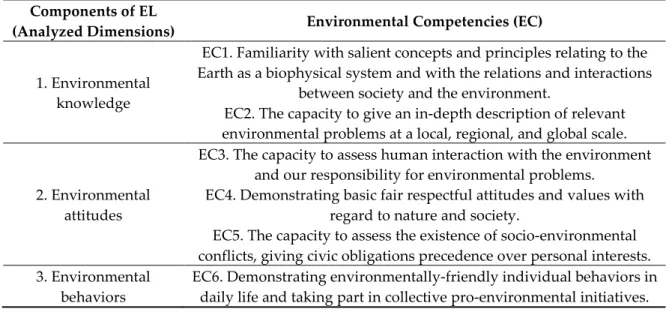
Table 1. Model of ECs for pre-service teachers, based on the considered components of EL. Components of EL
(Analyzed Dimensions) Environmental Competencies (EC)
1. Environmental knowledge
EC1. Familiarity with salient concepts and principles relating to the Earth as a biophysical system and with the relations and interactions
between society and the environment.
EC2. The capacity to give an in-depth description of relevant environmental problems at a local, regional, and global scale.
2. Environmental attitudes
EC3. The capacity to assess human interaction with the environment and our responsibility for environmental problems.
EC4. Demonstrating basic fair respectful attitudes and values with regard to nature and society.
EC5. The capacity to assess the existence of socio-environmental conflicts, giving civic obligations precedence over personal interests. 3. Environmental
behaviors EC6. Demonstrating environmentally-friendly individual behaviors in daily life and taking part in collective pro-environmental initiatives.
The instrument’s contents were validated by a panel of five experts in EE, selected in accordance with the following criteria: (i) Close familiarity with the subject of the environment and/or education; (ii) Experience in the field of formal EE; and (iii) Researcher in the field of education and EE. The first draft of the questionnaire was evaluated to check its capacity to measure the defined dimensions, its length, the order of the items, the language, the instructions, the clarity of the items, and the appropriateness of the answers. An open-ended question was also included to provide suggestions, recommendations, or to express other observations. Later, a second version of the instrument was used in a pilot test with 54 subjects with similar characteristics to the population under study: final year students at one of the university’s Faculty of Education. Cronbach’s alpha was used to measure the reliability of the questionnaire. The values of the reliability coefficients (α) for each EC were EC3
= 0.711; EC4 = 0.523; EC5 = 0.735; and EC6 = 0.837. In the case of EC1, it was measured by using the percentage of correct answers for each question.
In the different sections of the questionnaire, the following dimensions were analyzed:
a) Personal data. Sociodemographic data and information on their personal and academic backgrounds were gathered to determine the influence of personal and educational variables on the acquisition of ECs by future teachers. The demographic data consisted of their age, sex, and habitual place of residence (rural or urban). To uncover the sample’s academic background, information was compiled on the educational pathway they had followed prior to being admitted to university, in accordance with the categories established in the Spanish legislation on university access, Spanish Royal Decree 412/2014 [41], in addition to information about their university studies by taking the grade point average of their academic transcript, based on four categories ranging from pass to excellent.
To collect information on certain academic variables that might influence the acquisition of certain ECs, data were compiled on studies of EE or related subjects taken as part of the degree course or in other non-university contexts.
awareness raising activities (“Bird watching” and “Nature photography”). A last category was added to include any activity not encompassed by the others.
Finally, information was gathered on the mother and father’s level of education by recording the highest qualification they had achieved. To define these categories, we used the classification system utilized by the Spanish National Statistics Office (the INE according to its acronym in Spanish).
b) Environmental knowledge. To assess this component of EL, two basic environmental competencies were established, only one of which (EC1) was contemplated in this study. The aim of EC1 was to measure the pre-service teachers’ understanding of basic ecological principles and processes and interrelations between social and environmental systems, in addition to associated environmental problems [18,20,21,35,36], by using a scale of 15 items with closed-ended answers and only one correct option.
c) Environmental attitudes. Likert-type scales were used ranging from a value of 1 (“Totally disagree”) to 5 (“Totally agree”). The first of these competencies, EC3, measures the degree to which the students assume their responsibility for the environment through related individual, collective, and governmental actions. This scale is made up of eight items based on two previous studies [28,42]. EC4 is made up of six items that assess the feelings and values associated with the environment [28,38]. EC5 is made up of eight items that were used to assess how motivated the students were in helping to overcome socio-environmental problems [37].
d) Environmental behaviors. Twenty-one items were used to assess EC6. These analyzed the frequency of a series of environmentally-friendly actions by the students by using a Likert scale where 1 represented “Never” and 5 “Almost always”. Its design was based on a previous study [37] with the addition of some items of our own.
2.3. Data Analysis
To analyze the data, the degree students from both universities were treated as if they were a single population and only the scale-based competencies were taken into account. In other words, the second competency (EC2) was excluded from the analysis as it is qualitative in type.
Prior to analyzing the data, to guarantee the quality of the gathered information, the data from the questionnaires were filtered using the following exclusion criteria: (a) less than 50% of the questionnaire had been answered; or, (b) the unintelligibility of the interviewee’s answers.
The questions for EC1 (environmental knowledge) were re-codified, using 1 for a correct answer and 0 for a wrong answer. The minimum possible score was 0 and the maximum score 15. For the Likert-type questions (EC3, EC4, EC5, and EC6), values from 1 to 5 were assigned in accordance with the ratings that were given. For items answered with a negative statement, the codified answers were reversed.
To determine the extent of their environmental knowledge, distributions of frequencies and percentages were used. For the attitudes and behaviors, the mean values of the scales were taken.
Finally, to find out whether there was any association with the selected variables, two types of tests were performed. To assess the level of association between the EC under analysis and a dichotomous categorical variable (the educational pathway prior to university, training in EE during the degree course or in a non-university context, the students’ gender, and habitual place of residence), independent sample Student’s t-tests were conducted for the comparison of means. To assess other variables with three or more categories, an ANOVA was performed. In both cases, a
significance level of α = 0.05 was taken and all data were processed using the SPSS 20 software package (company, city, country).
3. Results
Two types of pre-university educational pathways were considered: “scientific” and “non-scientific”. The distribution of the sample is shown in Table 2. Twenty-seven individuals out of 274 were eliminated from the study since they had not followed a pre-university educational pathway with direct access to university or had otherwise omitted this information. Out of the 247 individuals in the final sample, the mean values of the DPE students who had chosen a pre-university scientific pathway were found to be slightly higher in all cases. However, no statistically significant differences were observed in the ECs’ level of acquisition by types of pathway.
Table 2. Values from the Student’s t-test for the relationship between the ECs and type of pre-university educational pathway.
Competence Pre-University Pathway No. Mean SD t-Value DF p-Value
EC1 Non-scientific Scientific 206 8.78 1.94 41 9.12 2.02 −1.014 245 0.311
EC3 Non-scientific Scientific 206 3.90 0.47 41 3.89 0.49 0.190 245 0.850
EC4 Non-scientific Scientific 206 3.87 0.46 41 3.91 0.46 −0.467 245 0.641
EC5 Non-scientific Scientific 206 3.98 0.48 41 3.99 0.47 −0.172 245 0.864
EC6 Non-scientific 206 3.17 0.42 −1.242 49.69 0.220 Scientific 41 3.29 0.55
3.2. The Influence of Training in EE on the Acquisition of ECs
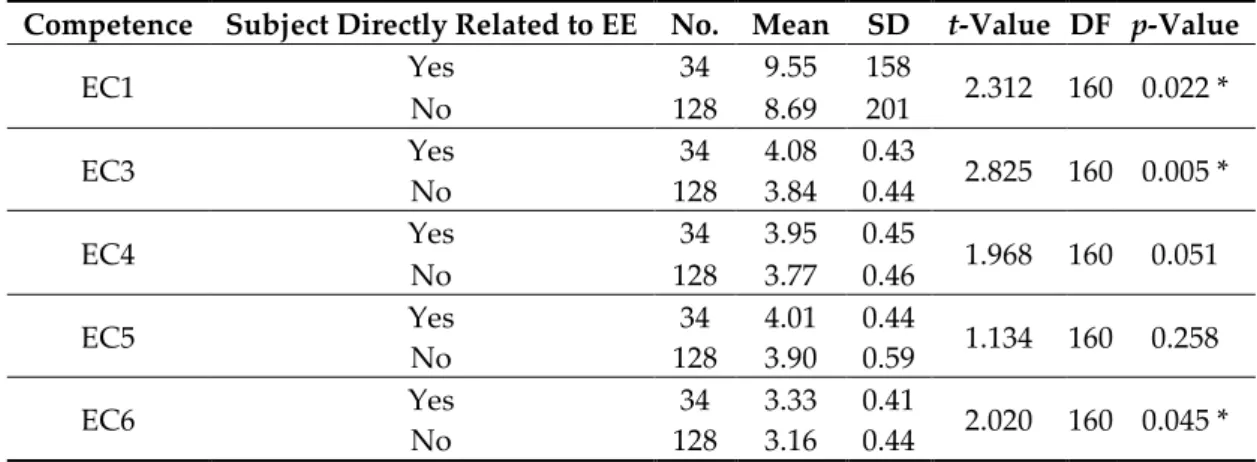
Only 2.2% of the students said that they had received training in EE outside the degree course and so a decision was made not to analyze the influence of this variable. Although EE is not included as a specific subject in the DPE offered by the universities in the sample, from our analysis of the curriculums, one university features a subject entitled “Science, health, and sustainability”, which was deemed to be related to EE. As a result, to assess the influence of training in EE on the acquisition of ECs, two levels of categorical variables were taken: students who took the above subject and those who did not. Consequently, the sample in this case was made up of 162 students, only 34 of whom had taken the said subject (Table 3).
The results showed that taking this subject had a positive influence on the level of environmental awareness (EC1) with these students achieving a mean value of 9.55, as opposed to 8.69 for students who did not take the subject. Similarly, the students who took the subject were also observed to be more environmentally responsible (EC3) than their peers, with signs of more respectful and fair environmental attitudes (EC4). Finally, taking subjects related to EE during the DPE had a significant influence on the environmental behaviors of the teacher training students (EC6).
Table 3. Values from the Student’s t-test for the relationship between the ECs and having studied a subject related to EE.
Competence Subject Directly Related to EE No. Mean SD t-Value DF p-Value
EC1 Yes No 128 8.69 34 9.55 158 201 2.312 160 0.022 *
EC3 Yes No 128 3.84 0.44 34 4.08 0.43 2.825 160 0.005 *
EC4 Yes 34 3.95 0.45 1.968 160 0.051 No 128 3.77 0.46
EC5 Yes No 128 3.90 0.59 34 4.01 0.44 1.134 160 0.258
3.3. The Relationship between the Grade Point Average from the Transcript of Records and the Acquisition of ECs
The analysis was based on three categories of grade point averages (5 to 6.5, 6.6 to 7.5, and 7.6 to 9), where we ignored the category “over 9” because there were no students in it and the “not known/no answer” category, which only applied to four students. Consequently, the total sample for this analysis was n = 270. The data showed (Table 4) that there was no positive correlation with the mean values. That is, as the grade point averages increased, the mean EC values did not necessarily also rise. It should be noted that for EC4, the criterion of the homogeneity of variance was not fulfilled and so, in this case, a non-parametric test was applied, the Kruskal–Wallis test. From the analysis, it was observed that there was no association between the grade point average and the acquisition of
ECs at the considered α = 0.05 significance level.
Table 4. Values from the ANOVA test for the relationship between grade point average and the ECs. Competence Transcript of Records No. Mean DF F p-Value
EC1 Between 6.6 and 7.5 Between 5 and 6.5 175 11 8.27 8.66 2 1.543 0.216 Between 7.6 and 9 84 9.05
EC3 Between 6.6 and 7.5 Between 5 and 6.5 175 11 3.88 3.87 2 1.388 0.251 Between 7.6 and 9 84 3.98
EC4 * Between 6.6 and 7.5 Between 5 and 6.5 175 135.04 11 145.77 0.201 2 0.904 Between 7.6 and 9 84 135.11
EC5 Between 6.6 and 7.5 Between 5 and 6.5 175 11 4.04 3.95 2 0.407 0.666 Between 7.6 and 9 84 4.01
EC6 Between 6.6 and 7.5 Between 5 and 6.5 175 11 3.35 3.16 2 1.652 0.194 Between 7.6 and 9 84 3.24
3.4. The Relationship between Gender and the Acquisition of the ECs
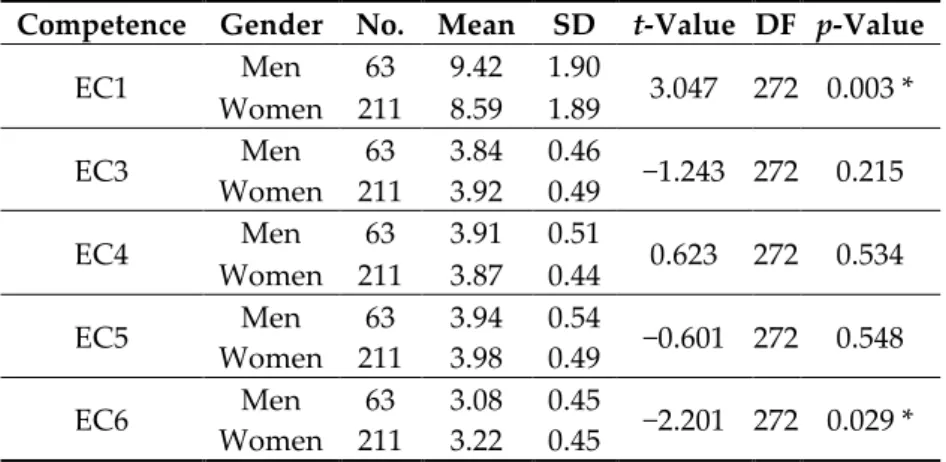
The results of the analysis of this dichotomous variable (Table 5) showed statistically significant differences in the acquisition of ECs depending on the gender of the students. The male students had a better environmental knowledge than their female peers (EC1) while the female students were found to have better environmental behaviors than their male peers (EC6).
Table 5. Values from the ANOVA test for the relationship between grade point average and the ECs. Competence Gender No. Mean SD t-Value DF p-Value
EC1 Women 211 8.59 1.89 Men 63 9.42 1.90 3.047 272 0.003 *
EC3 Women 211 3.92 0.49 Men 63 3.84 0.46 −1.243 272 0.215
EC4 Men 63 3.91 0.51 0.623 272 0.534 Women 211 3.87 0.44
EC5 Women 211 3.98 0.49 Men 63 3.94 0.54 −0.601 272 0.548
3.5. The Influence of the Habitual Place of Residence on the Acquisition of the ECs
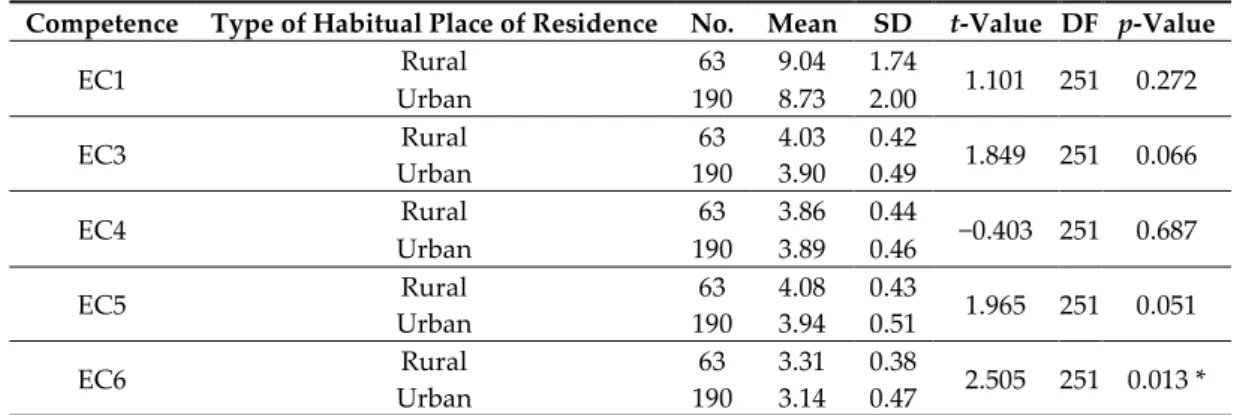
The habitual place of residence was divided into two categories: “rural” or “urban”. There were 253 students in the final sample, given that 21 questionnaires could not be taken into account because this information was missing (Table 6). From the test, it was statistically proven that pre-service primary teachers living in rural settings described themselves as having environmentally-friendlier behaviors than those living in urban areas (EC6).
Table 6. Values from the Student’s t-test for the relationship between habitual place of residence and the ECs.
Competence Type of Habitual Place of Residence No. Mean SD t-Value DF p-Value
EC1 Rural 63 9.04 1.74 1.101 251 0.272
Urban 190 8.73 2.00
EC3 Urban Rural 190 63 4.03 3.90 0.42 0.49 1.849 251 0.066
EC4 Rural 63 3.86 0.44 −0.403 251 0.687
Urban 190 3.89 0.46
EC5 Urban Rural 190 63 4.08 3.94 0.43 0.51 1.965 251 0.051
EC6 Urban Rural 190 63 3.31 3.14 0.38 0.47 2.505 251 0.013 *
3.6. The Relationship between Leisure Activities and the Acquisition of the ECs
The influence of activities in natural surroundings on the acquisition of the ECs was assessed using the following categories: (i) “None” for those students who did not do any activity of this kind; (ii) “Natural environment” for students who did at least one of the three activities classified in the questionnaire as “Nature routes”, “Sport in natural surroundings”, and/or “Camping”; (iii) “Environmental awareness” for those students who said they did at least one of the two activities from the questionnaire that implied a greater environmental awareness, “Birdwatching” or “Nature photography”; and (iv) “Both” for those students who undertook at least one activity from each of the “Natural environment” and “Environmental awareness” categories. The sample was made up of a total of 274 cases.
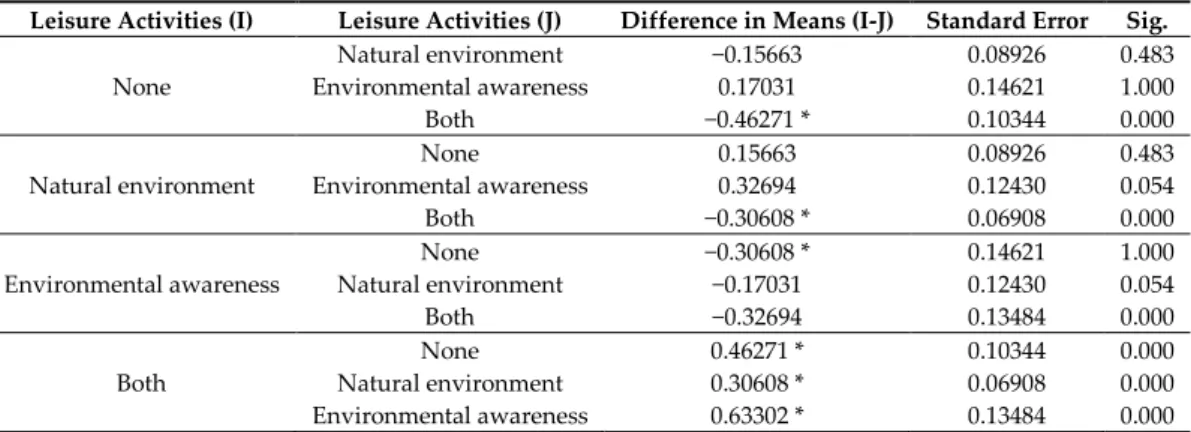
The statistical tests that were conducted (Table 7) showed an association between the students’ leisure activities and their environmental behaviors (EC6). Given the statistical significance of the difference in means, an analysis was conducted to find out with which variables this association occurred by carrying out a “post hoc” comparison of the means tests. Following the Bonferroni correction (Table 8), it was concluded that when activities in natural surroundings and environmental awareness raising activities were simultaneously done (that is, the “Both” category), these DPE students had environmentally-friendlier behaviors (EC6).
Table 7. Values from the one-way ANOVA test for the association between leisure activities and the ECs.
Competence Type of Leisure Activities No. Mean SD F Sig (bil)
EC1
None 27 8.70
3 0.412 0.745 Natural environment 184 8.83
Environmental awareness 13 8.23 Both 50 8.82
EC3
None 27 3.80
3 0.735 0.532 Natural environment 184 3.93
Environmental awareness 13 3.80 Both 50 3.89
Environmental awareness 13 4.00 Both 50 3.81
EC5
None 27 3.93
3 2.219 0.086 Natural environment 184 3.98
Environmental awareness 13 3.67 Both 50 4.05
EC6
None 27 3.01
3 11.667 0.000* Natural environment 184 3.17
Environmental awareness 13 2.84 Both 50 3.47
Table 8. Values from the Bonferroni correction for the association between EC6 and leisure activities.
Leisure Activities (I) Leisure Activities (J) Difference in Means (I-J) Standard Error Sig.
None Environmental awareness Natural environment Both −0.15663 0.17031 −0.46271 * 0.08926 0.14621 0.10344 0.483 1.000 0.000
Natural environment Environmental awareness None Both 0.15663 0.32694 −0.30608 * 0.08926 0.12430 0.06908 0.483 0.054 0.000 Environmental awareness None Natural environment Both −0.30608 * −0.17031 −0.32694 0.14621 0.12430 0.13484 1.000 0.054 0.000
Both Natural environment None Environmental awareness 0.46271 * 0.30608 * 0.63302 * 0.10344 0.06908 0.13484 0.000 0.000 0.000
3.7. The Influence of the Mother and Father’s Level of Education on the Acquisition of the ECs
To determine whether the level of education of their mothers and fathers might affect the acquisition of some ECs, three categories were established: (i) “Compulsory secondary school education or less” for mothers and fathers whose highest qualification was this; (ii) “Vocational training” for mothers and fathers whose highest qualification was mid or higher level vocational training; and (iii) “First or postgraduate degree” for mothers and fathers with either of these degrees. The total sample in which to analyze the mothers’ level of education was made up of 264 individuals, while it was made up of 255 individuals for the fathers. Ten mothers and 19 fathers were eliminated respectively because they failed to provide this information.
The results showed that at the usual levels of significance (α = 0.05 and α = 0.01), there were no statistically significant differences between the acquisition of the ECs and the mother or father’s level of education (Tables 9 and 10 ,respectively). The data presented show that the mother and father’s level of education did not influence the environmental knowledge, attitudes, and behavior of future primary teachers.
Table 9. ANOVA values for the association between the mother’s level of education and the ECs.
Competence Mother’s Level of Education No. Mean SD F p-Value
EC1
Compulsory secondary school level or less 136 8.91
2 1.427 0.242 Vocational training 72 8.87
First or postgraduate degree 55 8.44
EC3 Compulsory secondary school level or less 136 3.86 Vocational training 72 3.96 2 0.829 0.438 First or postgraduate degree 55 3.91
EC4
Compulsory secondary school level or less 136 3.87
2 1.906 0.151 Vocational training 72 3.94
First or postgraduate degree 55 3.78
Vocational training 72 4.01 First or postgraduate degree 55 3.96
EC6 Compulsory secondary school level or less 136 3.15 Vocational training 72 3.19 2 1.652 0.194 First or postgraduate degree 55 3.27
Table 10. ANOVA values for the association between the father’s level of education and the ECs.
Competence Father’s Level of Education No. Mean SD F Value p
-EC1 Compulsory secondary school level or less Vocational training 136 70 8.77 4.01 2 0.867 0.422 First or postgraduate degree 49 3.96
EC3
Compulsory secondary school level or less 136 3.89
2 1.856 0.158 Vocational training 70 3.87
First or postgraduate degree 49 4.03
EC4 Compulsory secondary school level or less Vocational training 136 70 3.88 3.88 2 0.188 0.829 First or postgraduate degree 49 3.83
EC5 Compulsory secondary school level or less Vocational training 136 70 3.15 3.20 2 0.341 0.711 First or postgraduate degree 49 3.21
EC6
Compulsory secondary school level or less 136 3.15
2 0.570 0.566 Vocational training 70 3.20
First or postgraduate degree 49 3.21
4. Discussion
The results of the analysis of the educational and personal variables that might influence the acquisition of ECs by pre-service primary school teachers at the universities under study gave rise to the following interpretations. First, prior research indicates that students who study scientific subjects during their degree course have better environmental knowledge and eco-friendlier attitudes [43] or eco-friendlier behaviors [31,32]. In the case of the DPE in Spain, there was no differentiation by branches of knowledge. However, in the stage prior to university, the students followed different educational pathways and, in this case, the obtained results confirmed that this variable did not play a determining role in the extent to which ECs are acquired by the DPE students. It seems that these differences could be influenced due to personal interests in environmental issues or by other formal training in environmental topics and EE.
According to this, a difference was noted in the students who had studied a subject deemed to be related to EE as part of the curriculum at one of the universities, when compared with their peers. These students stood out for their better environmental knowledge (EC1), more environmentally-responsible attitudes (EC3), and eco-friendlier behaviors (EC6). Prior studies along these lines also confirmed that students who received specific training in EE were more environmentally literate (in aspects like their environmental knowledge) than students without this training [25].
Another hypothesis that was posed in this research study was the possible positive influence of specific training courses in EE given by other non-university centers. Due to the low level of DPE students with such characteristics, it was impossible to test this hypothesis empirically. However, as such a low percentage of students was found with some kind of non-university training in EE, this might indicate a general lack of motivation or time to boost their education in this field on a voluntary basis.
Regarding the demographic variables that were assessed, in this study, the male students were shown to have more environmental knowledge than the females (EC1). In contrast, the female students’ behaviors were eco-friendlier than their male peers (EC6). However, environmental attitudes are not dependent on gender (EC3, EC4, and EC6). In keeping with the contradictory results achieved by other aforementioned studies [28,29,40], there does not seem to be a clear pattern in the relationship between gender and the ECs acquired by pre-service primary school teachers during their initial training.
When it came to the assumption that the habitual place of residence (rural or urban) might play an influential role, the results of the study pointed to a positive relationship between living in a rural environment and environmentally-friendly behaviors. This was confirmed by the statistical tests that were conducted: future primary school teachers who lived in a rural setting were proven to have environmentally-friendlier behaviors than those living in urban areas (EC6). A previous study [30] also demonstrated the existence of better practices in some environmental behavior categories of pre-service teachers living in rural environments. However, this situation could not be confirmed for their environmental knowledge or attitudes.
In accordance with the results that were obtained, leisure activities in a natural setting had a positive influence on environmentally-friendly behavior by pre-service teachers. People who undertook activities in natural surroundings or activities that implied a greater environmental awareness such as nature photography or birdwatching acted in an environmentally-friendlier way (EC6). No significant differences were found in environmental attitudes (EC3, EC4, and EC5), as was also the case of research carried out prior to the study by Tuncer, Tekkaya, Sungur, Cakiroglu, Ertepinar, and Kaplowitz (2009) [28].
According to Goldman, Yavetz, and Pe’er (2006) [30], the mother’s level of education influenced some environmentally-friendly practices such as recycling. This specific variable could not be demonstrated in our study because no in-depth analysis was made of the types of environmental behavior. The said authors also highlighted the positive relationship between the mother’s level of education and environmental knowledge: the higher the mother’s level of education, the greater the environmental knowledge. They also pointed to a positive relationship between the mother’s level of education and some attitudes: the more educated the mother, the eco-friendlier the student’s attitudes will be [32]. This was not the case in our study. Our results coincided with those of Timur, Timur, and Yilmaz (2013) [40] where the mother and father’s level of education did not influence the degree to which pre-service teachers acquired ECs.
Nevertheless, it should be noted that the results and interpretations presented so far must be treated with some caution; first, because this study did not identify and assess all the possible demographic and educational variables that might influence the acquisition of ECs. The questionnaire gathered data on certain variables that should be used to delve further into the possible influence of non-university factors on future teacher’s training in EE, although other variables such as personal experiences relating to the environment might also be useful in taking the study one step further.
Evidently, in light of the obtained results, a wide variety of factors can influence the degree to which these competencies are acquired. The aim of this study was to analyze the important work that is carried out by teaching staff to introduce EE to education systems. University lecturers in DPE programs must be expected to play an influential role in the acquisition of these competencies, in addition to influencing the curricular development of the content of different subjects and methodologies used in the classroom: variables that were not exhaustively analyzed in this study.
5. Conclusions
determined by demographic factors such as gender, or they might be influenced by educational variables, particularly, the enrolment in degree subjects directly related to EE.
On the other hand, the acquisition of ECs could be even more strongly influenced by non-university contexts such as the place of residence (rural vs. urban) or leisure activities by the students in natural surroundings. Universities could create study programs that are more connected with reality and with the needs of an environmentally responsible society. These programs seem to fail to motivate the students environmentally or provide them with values applicable to everyday life and to their futures as teachers.
References
1. IPCC. Climate Change 2007: Synthesis Report. Contribution of Working Groups I, II and III to the Fourth Assessment Report of the Intergovernmental Panel on Climate Change. Available online: https://www.ipcc.ch/report/ar4/syr/ (accessed on 2 May 2019).
2. IPCC. Climate Change 2014: Synthesis Report. Contribution of Working Groups I, II and III to the Fifth Assessment Report of the Intergovernmental Panel on Climate Change. Available online: https://www.ipcc.ch/report/ar5/syr/ (accessed on 2 May 2019).
3. IPCC. Climate Change 2018: Synthesis Report. Global warming of 1.5°C. Available online: https://www.ipcc.ch/sr15/ (accessed on 2 May 2019).
4. Intergovernmental Science-Policy Platform on Biodiversity and Ecosystem Services (IPBES) 2019. Nature’s Dangerous Decline ‘Unprecedented’ Species Extinction Rates ‘Accelerating’. Available online: https://www.ipbes.net/news/Media-Release-Global-Assessment (accessed on 23 May 2019).
5. WWF. Informe Planeta Vivo 2016: Riesgo y resiliencia en el Antorpoceno. Available online: http://awsassets.panda.org/downloads/informe_planeta_vivo_2016.pdf (accessed on 20 May 2017).
6. WWF. Informe Planeta Vivo 2018: Apuntando más alto. Available online: http://awsassets.wwf.es/downloads/informe_planeta_vivo_2018.pdf (accessed on 12 March 2019).
7. Sustainable Development Goals. Knowledge Platform. Available online: https://sustainabledevelopment.un.org/sdgs (accessed on 13 April 2019).
8. UNESCO. The Belgrade Charter: A Framework for Environmental Education. Available online: https://unesdoc.unesco.org/ark:/48223/pf0000017772 (accessed on 28 April 2019).
9. UNESCO. Environmental Education in the Light of the Tbilisi Conference; UNESCO: Paris, France, 1980. Available online: https://unesdoc.unesco.org/ark:/48223/pf0000038550 (accessed on ).
10. UNESCO. International Conference on Environment and Society: Education and Public Awareness for Sustainability, New York, NY, USA, 20 April–1 May 1997; UNESCO: Thessalonika, Greece, 1997.
11. UNESCO. United Nations Decade of Education for Sustainable Development (2005-2014): International Implementation Scheme; UNESCO: Paris, France, 2005. Available online: https://unesdoc.unesco.org/ark:/48223/pf0000148654 (accessed on ).
12. Hattie, J. Teachers Make a Difference. What is the Research Evidence? In Proceedings of the Annual Conference on Building Teacher Quality Australian Council for Educational Research, Melbourne, Australia, 9–21 October 2003.
13. Barber, M.; Mourshed, M. How the World’s Best-Performing School Systems Come Out on Top; McKinsey & Company: New York, NY, USA, 2007. Available online: http://mckinseyonsociety.com/how-the-worlds-best-performing-schools-come-out-on-top/ (accessed on).
14. OCDE. Teachers Matter: Attracting, Developing and Retaining Effective Teachers. Overview; OCDE: Paris, France, 2005.
15. UNESCO. Conferencia Para el Medio Ambiente y el Desarrollo; Informe Final; UNESCO: Paris, France, 1992. 16. Hesselink, F.; van Kempen, P.P.; Wals, A. ESDebate. International Debate on Education for Sustainable
Development; IUCN: Gland, Switzerland, 2000. Available online:
http://www.mma.gov.br/port/sdi/ea/deds/arqs/iucn_esdebate.pdf (accessed on ).
17. Locke, S.; Russo, R.O.; Montoya, C. Environmental education and eco-literacy as tools of education for sustainable development. J. Sustain Ed. 2013, 4, 1–13.
19. Marcincowski, T. The relationship between environmental literacy and responsible environmental behaviour in environmental education. In Methods and Techniques for Evaluating Environmental Education; Maldague, M., Ed.; UNESCO: Paris, France, 1991.
20. North American Association for Environmental Education (NAAEE). Excellence in Environmental Education: Guidelines for Learning (K–12); North American Association for Environmental Education: Washington, DC, USA, 2010.
21. Hollweg, K.S.; Taylor, J.R.; Bybee, R.W.; Marcinkowski, T.J.; McBeth, W.C.; Zoido, P. Developing a Framework for Assessing Environmental Literacy; North American Association for Environmental Education: Washington, DC, USA, 2011.
22. Miles, R.; Harrison, L.; Cutter-Mackenzie, A. Teacher Education: A Diluted Environmental Education Experience. Aust. J. Environ. Educ. 2006, 22, 49–59. doi:10.1017/S0814062600001658.
23. Boon, H.J. Climate change? Who knows? A comparison of secondary students and pre-service teachers. Aust. J. Teach. Educ. 2010, 35, 104–120.
24. Puk, T.; Stibbards, A. Ecological concept development of preservice teacher candidates: Opaque empty shells. Int. J. Environ. Sci. Educ. 2010, 5, 461–476.
25. Tal, T. Pre-service teachers’ reflections on awareness and knowledge following active learning in environmental education. Int. Res. Geo. Environ. Educ. 2010, 19, 263–276. doi:10.1080/10382046.2010.519146. 26. Junyent i Pubill, M. Educació ambiental: Un enfocament metodològic en formació inicial del professorat d'Educació Primària. Dr. Thesis, Girona University, Girona, Spain, 2013. Available online: http://www.tdx.cat/handle/10803/7967 (accessed on).
27. Van Petegem, P.; Blieck, A.; Pauw, J.B.D. Evaluating the implementation process of environmental education in preservice teacher education: Two case studies. J. Environ. Educ. 2007, 38, 47–54.
28. Tuncer, G.; Tekkaya, C.; Sungur, S.; Cakiroglu, J.; Ertepinar, H.; Kaplowitz, M. Assessing pre-service teachers' environmental literacy in Turkey as a mean to develop teacher education programs. Int. J. Educ. Dev. 2009, 29, 426–436. doi:10.3200/JOEE.38.1.47-54.
29. Muda, A.; Ismail, N.S.; Suandi, T.; Rashid, N.A. Analysis of cognitive and affective component of environmental literacy of pre-service teachers from institute of teacher education Malaysia. World Appl. Sci. J. 2011, 14, 114–118.
30. Goldman, D.; Yavetz, B.; Pe'er, S. Environmental literacy in teacher training in Israel: Environmental behavior of new students. J. Environ. Educ. 2006, 38, 3–22. doi:10.3200/JOEE.38.1.3-22.
31. Goldman, D.; Yavetz, B.; Pe'er, S. Student Teachers’ Attainment of Environmental Literacy in Relation to their Disciplinary Major during Undergraduate Studies. Int. J. Environ. Sci. Educ. 2014, 9, 369–383.
32. Pe’er, S.; Goldman, D.; Yavetz, B. Environmental literacy in teacher training: Environmental attitudes, knowledge and behavior of beginning students. J. Environ. Educ. 2007, 39, 45–59. doi:10.3200/JOEE.39.1.45-59.
33. Sureda-Negre, J.; Oliver-Trobat, M.; Catalan-Fernández, A.; Comas-Forgas, R. Environmental education for sustainability in the curriculum of primary teacher training in Spain. Int. Res. Geo. Environ. Educ. 2014, 23, 281–293. doi:10.1080/10382046.2014.946322.
34. Alvarez-García, O.; Sureda-Negre, J.; Comas-Forgas, R. Assessing environmental competencies of primary education pre-service teachers in Spain: A comparative study between two universities. Int. J. Sustain. High. Edu. 2018, 19, 15–31. doi:10.1108/IJSHE-12-2016-0227.
35. Simmons, B. Standards for the initial preparation of environmental educators. Available online: http://www.ncate.org/LinkClick.aspx?fileticket=Fm%2FqA4uarLk%3D&tabid=676 (accessed on 27 October 2013).
36. Simmons, B. Guidelines for the Preparation and Professional Development of Environmental Educators. Available online: http://resources.spaces3.com/e42d12db-f327-46ca-94c2-647060d23e74.pdf (accessed on 27 October 2013).
37. Yavetz, B.; Goldman, D.; Pe’er, S. Environmental literacy of pre-service teachers in Israel: A comparison between students at the onset and end of their studies. Environ. Educ. Res. 2009, 15, 393–415. doi:10.1080/13504620902928422.
39. Teksoz, G.; Sahin, E.; Ertepinar, H. A new vision for chemistry education students: Environmental education. Int. J. Environ. Sci. Educ. 2010, 5, 131–149.
40. Timur, S.; Timur, B.; Yilmaz, S. Determining primary school candidate teachers’ levels of environmental literacy. Anthropologist 2013, 16, 57–67. doi:10.1080/09720073.2013.11891335.
41. Ministry of Education, Culture and Sport. Spanish Royal Decree 412/2014. de 6 de Junio, por el que se Establece la Normativa Básica de los Procedimientos de Admisión a las Enseñanzas Universitarias Oficiales de Grado. Available online: http://www.boe.es/boe/dias/2014/06/07/pdfs/BOE-A-2014-6008.pdf (accessed on 30 April 2014).
42. MSU-WATER Social Assessment. Stakeholder Attitudes Beliefs and Uses of Water Resources; Michigan State University: East Lansing, MI, USA, 2001–2006.
43. Tikka, P.M.; Kuitunen, M.T.; Tynys, S.M. Effects of educational background on students' attitudes, activity levels, and knowledge concerning the environment. J. Environ. Educ. 2000, 31, 12–19. doi:10.1080/00958960009598640.
44. Yavetz, B.; Goldman, D.; Pe’er, S. How do preservice teachers perceive ‘environment’ and its relevance to their area of teaching? Environ. Educ. Res. 2014, 20, 354–371. doi:10.1080/13504622.2013.803038.