The diatomic dication SiC
2+in the gas phase
Reinaldo Pis Dieza, Julio A. Alonsob,c
a
Departamento de Qu´ımica, CEQUINOR, Centro de Qu´ımica Inorg´anica (CONICET, UNLP), Facultad de Ciencias Exactas, UNLP, CC 962, 1900 La Plata, Argentina. b
Departamento de F´ısica Te´orica, At´omica y Optica, Universidad de Valladolid, E-47011 Valladolid, Spain.
c
Donostia International Physics Center, 20080 San Sebastian, Spain.
Abstract
The diatomic dication SiC2+ in the gas phase is studied using the
state-averaged version of the CASSCF method and the state-specific MRMP per-turbation theory to recover dynamical correlation effects. Thirteen different electronic states of the dication were found and characterized, ten of them being metastable electronic states. The ground state is characterized by a3Π
electronic state. The leading configuration state functions are provided for each electronic state. For completeness, a similar study is presented both for SiC and for SiC+. The present results are in excellent agreement with results
obtained by other authors. The adiabatic ionization energies of SiC+to form
SiC2+ are within a range from about 16 eV to about 19.5 eV. This finding
indicates that a projectile, whose ionization energy lies within that range could be eventually used to produce the dication. Lifetimes and radiative transition dipole moments are also calculated and reported.
Keywords: SiC2+, SA-CASSF, MRMP2
1. Introduction
Small molecules formed by silicon and carbon, as the simple neutral SiC molecule, have been identified in astrophysical environments several years ago. [1, 2] The first experimental observation of SiC in the gas phase was performed in 1988 by Bernath et al., [3] whereas the first theoretical study of that species dates from 1974 when Lutz and Ryan carried out a series of
Email address: [email protected](Reinaldo Pis Diez)
*Manuscript
configuration interaction calculations on the three lowest-energy electronic states of SiC. [4] In spite of several theoretical studies performed on neutral SiC after the work of Lutz and Ryan, the recent works of Borin and cowork-ers, [5] Pramanik and Das, [6] and Shi et al. [7] seem to present the more exhaustive studies on a variety of low-lying electronic states of SiC. In the first case and in the latter case the complete active space self-consistent field (CASSCF) methodology was used to deal with the static correlation prob-lem. The state-averaged version of CASSCF, known as SA-CASSCF, was used by Borin et al. Dynamical correlation effects were taken into account by means of the internally contracted multi-reference configuration interac-tion (IC-MRCI) method. Correlainterac-tion consistent cc-pV5Z and aug-cc-pV6Z basis sets were used in those works. Pramanik and Das, on the other hand, utilized the multi-reference configuration interaction method, including sin-gle and double excitations (MRCISD) with relativistic core potentials and specially designed valence basis sets. The potential energy curves of about twenty-five electronic states of SiC, including singlets, triplets and quintets, were reported by those authors, with emphasis not only on geometric and electronic properties but also on spectroscopic constants.
Very recently, too, Pramanik and coworkers calculated the electronic states and spectroscopic properties of SiC+ using large scale calculations
within the context of the MRDCI method and the same type of core poten-tials and basis sets described in the previous paragraph. [8] The potential energy curves of fourteen electronic states of SiC+, including doublets and
quartets, were reported by those authors, with emphasis on geometric, elec-tronic and spectroscopic features. Moreover, those authors provide a good overview of previous theoretical works on SiC+, emphasizing that no
exper-imental information is available for that species.
The diatomic dication SiC2+ was first observed in the gas phase in 1978
by Nakamura and Kuroda, who used atom probe mass spectrometry with a silicon carbide tip. [9] These findings were recently confirmed by Tang et al. using essentially the same technique for Ti-Si-N hard-coatings contain-ing C impurities. [10] In addition, SiC2+ was also observed with two other
sup-plementary material of the present work for the first time. The experimental identification of SiC2+ is also discussed.
On the other hand, no detailed theoretical studies exist for SiC2+
, even though an early preliminary effort to perform semiempirical calculations on SiC2+was made by Dietze et al. [11] In the present work, an exhaustive study
of various electronic states of SiC2+
, including singlets, triplets and quintets, is carried out within the context of the SA-CASSCF method to deal with static correlation effects and the state-specific multireference Møller–Plesset perturbation theory (MRMP2) for dynamical correlation effects. For com-pleteness, the lowest-energy electronic states of neutral SiC and monocation SiC+ are also calculated and compared with experimental and theoretical
results of other authors.
2. Calculation details
The MCSCF part of the calculations was carried out by means of the state-averaged version of the complete active space self-consistent field (SA-CASSCF) method. [14, 15] The graphical unitary group approach [16, 17] (GUGA) was used to solve the CI problem. The active space was formed by the 2s and 2p C atomic orbitals (AO) and the 3s and 3p Si AOs, that is, eight electrons in eight orbitals. The 1s C AO and the 1s, 2s and 2p Si AOs were kept frozen in the inactive space. Symmetry was exploited by means of the C2v point group, and the different irreducible representations (IREP) of the group were used to label the configuration state functions (CSF) used in the GUGA. The aug-cc-pVTZ basis set was used both for C and Si. [18, 19] For neutral SiC, 492, 408 and 432 CSFs were generated for the A1, A2
and B1,2 IREPs, respectively, for the singlet electronic state. In the case of
the triplet electronic state, 584, 584 and 592 CSFs were created for the A1,
A2 and B1,2 IREPs, respectively. Finally, 184, 184 and 176 CSFs were formed
for the A1, A2 and B1,2 IREPs, respectively, to study the quintet electronic
state.
For SiC+, 616, 560 and 588 CSFs were generated for the A
1, A2 and B1,2
IREPs, respectively, for the doublet electronic state. 320, 352 and 320 CSFs were formed for the A1, A2 and B1,2 IREPs, respectively, for the quartet
electronic state. To study the sextet electronic state, 60, 48 and 54 CSFs were considered for the A1, A2 and B1,2 IREPs, respectively.
To investigate the singlet electronic state of SiC2+, 328, 272 and 288 CSFs
CSFs were formed for the A1, A2 and B1,2 IREPs, respectively, for the triplet
electronic state, whereas the quintet electronic state was studied after 96, 116 and 104 CSFs for the A1, A2 and B1,2 IREPs, respectively, were generated.
Three states were averaged for each IREP and for each electronic multi-plicity of every diatomic species. In this way, the potential energy curves for 81 different electronic states for SiC, SiC+
and SiC2+
were constructed be-tween 1.60 and 10.0 ˚A. A grid containing 56 points was used to that end. The grid is far more dense around the equilibrium distances, whereas it becomes sparser when the atoms approach dissociation.
Dynamical correlation effects were introduced on the multireference wave-functions by the state-specific multireference Møller–Plesset perturbation theory (MRMP2) developed by Hirao. [20, 21] MRMP2 calculations were car-ried out on the corresponding minima of the SA-CASSCF potential energy curves obtained as described in the previous paragraphs. When metastable states were achieved, as in SiC+
and SiC2+
, MRMP2 calculations were also performed on the corresponding maxima or top of the energy barriers. The 1s C AO and the 1s, 2s and 2p Si AOs were kept frozen during the calculations. The aug-cc-pV5Z basis set was used in this case both for C and Si. [18, 19]
Equilibrium bond distances, harmonic vibrational frequencies and zero-point energies were estimated from the potential energy curves obtained at the SA-CASSCF/aug-cc-pVTZ level of theory, whereas dissociation energies and energy separations between states were calculated at the MRMP2/aug-cc-pV5Z level of theory. These two last quantities include the zero-point correction. Radiative transition dipole moments were also calculated. In this case, the aug-cc-pVQZ basis function was used due to software limitations.
All the calculations were performed with the GAMESS-US package. [22, 23] Equilibrium distances, harmonic vibrational frequencies and zero-point energies were derived from numerical fitting of the potential energy curves obtained at the SA-CASSCF/aug-cc-pVTZ level of theory to a quadratic function of the energy with respect to the interatomic distance.
Lifetimes were also calculated to gain insight into the possibility of exper-imental detection of the metastable states found. The simple, semiclassical WKB approximation [24] is used for this purpose. The lifetime is calculated as
τ = 1
νT (1)
coefficient, given by
T = exp(−2
~
Z
{2m[V(r)−E]}1/2dr). (2)
In the above equation m is the reduced mass of the diatomic molecule,V(r)
is the total potential energy as function of the internuclear distance r, and E is the energy evaluated at the lowest vibrational state. The integral is
calculated between the classical turning points of the potential energy curve.
3. Results and discussion
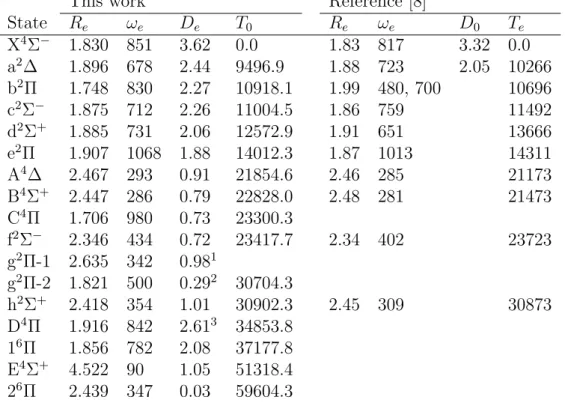
Table 1 summarizes the results obtained in this work for the neutral SiC diatomic molecule. Moreover, a comparison with other experimental and theoretical results is provided in the table. The relative ordering of the first thirteen electronic states of SiC is well reproduced by the methodology used in the present work. The ground state of SiC is predicted to be 3Π, in
accordance with other results, see Table 2 for the electronic configuration in terms of CSF for all reported states. The notation used for π orbitals, π2(↑;↑) for example, indicates the population of the two components of such
orbitals, which are separated by a semicolon. The equilibrium distances obtained in this work are in general slightly larger than the values shown by other authors, although there is a good agreement with the values informed by Pramanik and Das, [6] which used the MRCISD method. Dissociation energies are in a very acceptable agreement with the ones reported by Borin et al. [5], with differences no larger than about 0.10 eV. The only exception is the e1Σ− electronic state, for which a dissociation energy of 2.10 eV is
informed in ref. 5, whereas a value of 1.32 eV is found in the present work. Harmonic vibrational frequencies obtained with the methodology used in this work lie within the range of frequencies calculated by other authors, although in various cases it is observed that they are smaller than the values shown in other works. The energy separations calculated in this work show the same behavior of the harmonic vibrational frequencies, that is, they lie within the range of calculated and experimental values, but they are smaller than values obtained by other authors in some selected cases. It is found, furthermore, that twelve electronic states of SiC correlate to the triplet electronic ground states of Si and C, the only exception being the E3Π state, which correlates
to the Si (1D) + C (3P) states. These findings are in complete agreement
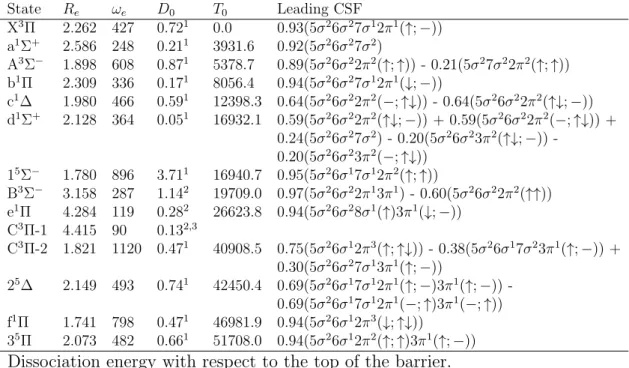
The results achieved for SiC+ are shown in Table 3. It is seen from
the table that the relative ordering of the first eight electronic states of the monocation found in the present work is in agreement with the ordering reported by Pramanik et al. [8] The electronic configurations in terms of CSF are shown in Table 4. The equilibrium distances agree very well with those shown by Pramanik et al., with discrepancies not larger than 0.04 ˚A. The exception is the b2Π state, for which an equilibrium distance of 1.748
˚
A is found in the present work, whereas a value of 1.99 ˚A was obtained in ref. 8. Harmonic vibrational frequencies are well described in general, with the larger differences with respect to those reported in ref. 8 being about 40 cm−1. Exceptions are the d2Σ+state, for which the discrepancy is as large as
80 cm−1, and the b2Π one, for which two frequencies are provided in ref. 8.
Dissociation energies can be compared for the two lowest-energy states only. It can be seen from the table that the present results are larger than the ones reported by Pramanik et al. by about 0.30-0.40 eV. Energy separations are very well described by the present methodology. Moreover, it is found that the D4Π state is a metastable state characterized by an appreciable energy
barrier of 1.63 eV with respect to the dissociation limit and located at 2.261 ˚
A. Interestingly, Pramanik et al. also found some metastable states for SiC+,
but those were not discussed. Finally, it is found that thirteen electronic states of SiC+
correlate to Si+
(2
P) + C (3
P) states. The only exceptions are the h2Σ+ state, which correlates to the Si+ (2P) + C (1D) states and the
16Π and 26Π states, which are related to the Si+(4P) + C (3P) states. These
findings are in agreement with those reported by Pramanik et al. [8]
The results reported in the two previous paragraphs indicate that the present methodology is sufficiently reliable to be used to describe the elec-tronic states of SiC2+
.
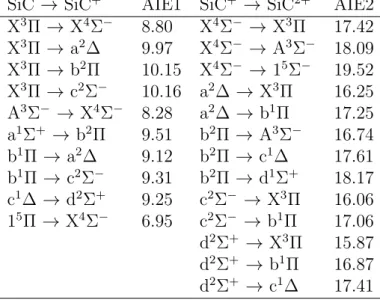
Table 5 shows the results obtained for SiC2+. Thirteen electronic states
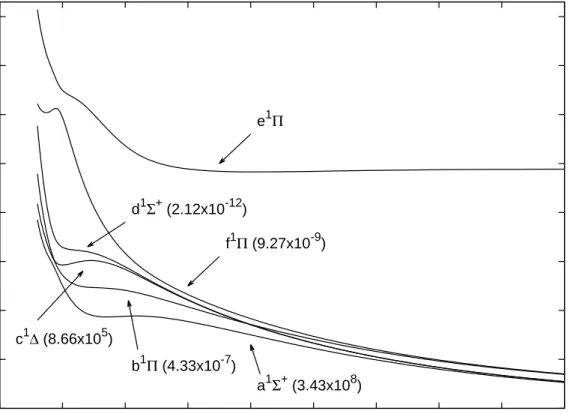
were found for the doubly charged molecule and their potential energy curves are shown in Figures 1 and 2. Ten states were found to be metastable states. The exceptions are the B3Σ− and e1Π states, which are bound states with
large equilibrium distances, see Table 5, and the 15Σ− state, which exhibits
an energy barrier but the minimum is located below the dissociation limit, see Figure 1. Another interesting case is the C3Π state, which shows both
a stable minimum at 4.415 ˚A and a metastable minimum that appears at 1.821 ˚A, see Figure 1. That behavior explains why the C3Π electronic state
appears twice in Table 5. The ground metastable state of SiC2+ is found to
state, namely, a1Σ+, A3Σ− and b1Π.
Calculated lifetimes are shown in Figures 1 and 2 for the metastable states found in the present work. It can be seen from the figures that the lifetimes of the X3Π, A3Σ−, 25∆, 35Π, a1Σ+ and c1∆ metastable states are
virtually infinite, suggesting that they are good candidates to be experimen-tally detected. Interestingly, the lifetimes of the X3
Π and A3
Σ− metastable
states are equal to 1.24×1070 and 8.02×1070 seconds, respectively, when
they are calculated from their own potential energy curves. However, a close inspection to the potential energy curves of the X3
Π, A3
Σ−, a1Σ+ and b1Π
metastable states clearly shows that the curves cross each other, see Fig-ure 3. Although those crossings does not alter the dissociation channels of the X3
Π and A3
Σ−metastable states, they offer dissociation paths with much
lower lifetimes to those states, see Figure 1. The C3Π, b1Π, f1Π and d1Σ+
metastable states present lifetimes in the range from about 10−7 seconds to
about 10−12 seconds, indicating that their experimental detection could be
more difficult than in the previous cases.
It can be seen in Table 5 that the a1Σ+ and b1Π metastable states can
be described by a leading CSF, whereas the A3
Σ− metastable state needs
two CSFs for an adequate characterization. The X3Π, A3Σ−, a1Σ+, b1Π,
c1∆, d1Σ+ and f1Π states correlate to the Si+ (2P) + C+ (2P) atomic states.
The B3
Σ− and C3Π correlate to the Si2+ (1S) + C (3P) states. The three
15Σ−, 25∆ and 35Π quintet states correlate to the Si+(4P) + C+(2P) atomic
states. Finally, the high-energy e1Π singlet states correlates to the Si2+ (1S)
+ C (1
P) states. It is important to emphasize that the dissociation limit described by the Si+ (4P) + C+ (2P) atomic states is only 0.047 eV lower in
energy than the Si2+ (1S) + C (3P) one at the MRMP2/aug-cc-pV5Z level of
theory. Thus, the two asymptotes are almost indistinguishable for the scales shown in Figures 1 and 2.
Radiative transition dipole moments, in their length form, are shown in Table 6. The transition moments are calculated at the equilibrium distance of the lower-energy state involved in the transition. It is seen in the table that the transition moments can be divided into three groups. The first group presents transition dipole moments around or lower than 0.01 atomic units. The second one exhibits transition dipole moments between 0.2 and 0.1 atomic units. Finally, the third group contains only two transitions, which present large transition dipole moments. Those transitions are b1Π→
e1Π and X3Π →C3Π.
lowest-lying states of SiC and SiC+. The present results are in excellent agreement
with AIE reported by Pramanik et al. [8] The energy needed to create adia-batically the X4
Σ−ground state of SiC+from the ground state of neutral SiC
is reported to be 8.76 eV by Pramanik et al., whereas the AIE relating those two states is found to be 8.80 eV in the present work. The second lowest-energy electronic state of SiC+
, the a2
∆, is reported to be 10.04 eV above the ground state of SiC by Pramanik et al., [8] whereas the AIE calculated in the present work is 9.97 eV. The c2Σ− electronic state of SiC+ is reported to
be 10.17 eV above the ground state of SiC, [8] whereas the same state of the monocation is found to be 10.16 eV above the ground state of neutral SiC according to present methodology. Besides those results, Table 7 shows also the AIE of some low-lying electronic states of neutral SiC, like A3
Σ−, a1Σ+,
b1Π, c1∆, and 15Π. Moreover, the table shows the AIE of SiC+, relating
the lowest-lying electronic states of the monocation to the lowest-lying ones of SiC2+
. Interestingly, the AIE2 involving the ground states of both SiC+
and SiC2+ is found to be 17.42 eV. Table 6 summarizes thirteen different
AIE2, which lie within the range from about 16 to about 19.50 eV. Those values suggest that SiC2+
could be created from SiC+
by simple reactions like SiC+ + X+ → SiC2+ + X or SiC+ + X2+ →SiC2+ + X+, in which the
species X and X+ present ionization energies within the range of the AIE of
SiC+
. Some few examples are F, Be+
, Al+
and As+
, for which the ionization energies are 17.42, 18.21, 18.83 and 18.59 eV, respectively. [25]
4. Conclusions
The diatomic dication SiC2+ in the gas phase was studied from a
theo-retical point of view using the state-averaged version of the complete active space self-consistent field and the state-specific multireference Møller–Plesset perturbation theory. Thirteen different electronic states of the dication were characterized, ten of them being metastable electronic states. The ground state is characterized by a 3Π electronic state. Two other electronic states
exhibit a minimum without any energy barrier, but they are higher in en-ergy with respect to the ground state of SiC2+. Another triplet state presents
two minima, one of them, very shallow, appearing before the energy barrier, whereas the second minimum describes a metastable state for that triplet state. The leading configuration state functions are provided for each elec-tronic state.
be experimentally detected. Moreover, large radiative transition dipole mo-ments are observed between some metastable states of Π symmetry.
The adiabatic ionization energies of SiC+
to form the dication are within a range from about 16 eV to about 19.5 eV. This fact indicates that a pro-jectile with a ionization energy within that range could be eventually used to produce the dication from the monocation. Some examples are provided. For completeness, a similar study is presented both for SiC and for SiC+.
The present results are in excellent agreement with results obtained by other authors.
Acknowledgment
Klaus Franzreb and Peter Williams are gratefully acknowledged for their suggestion to display their unpublished mass spectra in the present theoreti-cal work. RPD is a member of the Scientific Researcher Career of CONICET, Argentina. The work of JAA was supported by MICINN and the European Development Fund (grant MAT2011-22781) and by Junta de Castilla y Le´on (grant VA050U14).
References
[1] A. Suzuki, Prog. Theor. Phys. 62 (1979) 936.
[2] J. Cernicharo, C. Gottlieb, M. Guelin, P. Thaddeus, J. Vrtilek, Astro-phys. J. Lett. 341 (1989) L25.
[3] P. F. Bernath, S. A. Rogers, L. C. OBrien, C. R. Brazier, A. D. McLean, Phys. Rev. Lett. 60 (1988) 197.
[4] B. L. Lutz, J. A. Ryan, Astrophys. J. 194 (1974) 753.
[5] A. C. Borin, J. P. Gobbo, R. de Souza Batista, L. G. M. de Macedo, Chem. Phys. 312 (2005) 213.
[6] A. Pramanik, K. K. Das, J. Mol. Spectrosc. 244 (2007) 13.
[7] D. H. Shi, W. Xing, J. F. Sun, Z. L. Zhu, Eur. Phys. J. D 66 (2012) 262.
[9] S. Nakamura, T. Kuroda, Surf. Sci. 70 (1978) 452.
[10] F. Tang, B. Gault, S. P. Ringer, P. Martin, A. Bendavid, J. M. Cairney, Scripta Mater. 63 (2010) 192.
[11] H.-J. Dietze, S. Becker, P. Franke, C. Weiss, J. Reinhold, Isot. Environ. Healt. S. 20 (1984) 281.
[12] K. Franzreb, P. Williams, Arizona state university, 2007. Unpublished experimental results.
[13] V. Brites, K. Franzreb, J. N. Harvey, S. G. Sayres, M. W. Ross, D. E. Blumling, A. W. C. Jr, M. Hochlaf, Phys. Chem. Chem. Phys. 13 (2011) 15233.
[14] B. O. Roos, in: G. H. F. Diercksen, S. Wilson (Eds.), Methods in Com-putational Molecular Physics, D. Reidel Publishing, Dordrecht, Nether-lands, 1983, p. 161.
[15] B. O. Roos, in: K. P. Lawley (Ed.), Advances in Chemical Physics, volume 69, Wiley Interscience, New York, 1987, p. 339.
[16] B. Brooks, H. F. Schaefer, J. Chem. Phys. 70 (1979) 5092.
[17] B. Brooks, W. Laidig, P. Saxe, N. Handy, H. F. Schaefer, Physica Scripta 21 (1980) 312.
[18] T. H. Dunning, J. Chem. Phys. 90 (1989) 1007.
[19] D. E. Woon, T. H. Dunning, J. Chem. Phys. 98 (1993) 1358.
[20] K. Hirao, Chem. Phys. Lett. 190 (1992) 374.
[21] K. Hirao, Chem. Phys. Lett. 196 (1992) 397.
[22] M. W. Schmidt, K. K. Baldridge, J. A. Boatz, S. T. Elbert, M. S. Gordon, J. H. Jensen, S. Koseki, N. Matsunaga, K. A. Nguyen, S. J. Su, T. L. Windus, M. Dupuis, J. A. Montgomery, J. Comput. Chem. 14 (1993) 1347.
[23] GAMESS-US, version 11 August (R1), 2011.
[25] A. Kramida, Yu. Ralchenko, J. Reader, and NIST ASD Team, NIST Atomic Spectra Database (ver. 5.2), [Online]. Available: http://physics.nist.gov/asd [2014, November 25]. National Insti-tute of Standards and Technology, Gaithersburg, MD., 2014.
[26] G. Verhaegen, F. E. Stafford, J. Drowart, J. Chem. Phys. 40 (1964) 1622.
[27] C. R. Brazier, L. C. O’Brien, P. F. Bernath, J. Chem. Phys. 91 (1989) 7384.
[28] M. Ebben, M. Drabbels, J. J. ter Meulen, J. Chem. Phys. 95 (1991) 2292.
-0.9 -0.85 -0.8 -0.75 -0.7 -0.65 -0.6 -0.55 -0.5
1 2 3 4 5 6 7 8 9 10
Energy+325.00 (atomic units)
Interatomic distance (A)
35Π (1.81x10¹⁸)
25∆ (1.28x1033)
C3Π (1.41x10⁻⁷)
B3Σ -15Σ
-A3Σ- (5.24x1042)
X3Π (3.65x1048)
Figure 1: Potential energy curves for the lowest-lying triplet and quintet states of SiC2+.
-0.9 -0.85 -0.8 -0.75 -0.7 -0.65 -0.6 -0.55 -0.5
1 2 3 4 5 6 7 8 9 10
Energy+325.00 (atomic units)
Interatomic distance (A)
e1Π
f1Π (9.27x10⁻⁹) d1Σ+ (2.12x10⁻¹²)
c1∆ (8.66x10⁵)
b1Π (4.33x10⁻⁷)
a1Σ+ (3.43x10⁸)
Figure 2: Potential energy curves for the lowest-lying singlet states of SiC2+. Calculated
-0.9 -0.85 -0.8 -0.75 -0.7 -0.65
1 2 3 4 5 6 7 8 9 10
Energy+325.00 (atomic units)
Interatomic distance (A)
X3Π a1Σ+ A3Σ -b1Π
Figure 3: Potential energy curves for the X3Π, A3Σ−, a1Σ+and b1Π metastable states of
SiC2+. The crossing points between the X3Π and a1Σ+ states on the one hand and the
A3
Table 1: Properties of low-lying electronic states of neutral SiC. Equilibrium bond dis-tances (Rein ˚A) and harmonic frequencies (ωein cm−
1) are obtained at the
CASSCF/aug-cc-pVTZ level of theory. Dissociation energies (D0 in eV) and energy separations (T0 in cm−1) are obtained at the MRMP2/aug-cc-pV5Z level of theory.
This work Other works
State Re ωe D0 T0 Re ωe D0 Te Reference
X3Π 1.749 948 4.32 0.0 1.726 954 4.38 0.0 [5]
1.74 930 0.0 [6]
1.7187 965.786 [7]
4.66 [26]
1.7221 [27]
964.6 [28]
1.718 965.16 [29]
A3Σ− 1.839 808 3.81 4138.7 1.811 860 3.90 3883 [5]
1.82 857 3985 [6]
1.8001 866.755 3752.14 [7]
1.8141 45782 [27]
a1Σ+ 1.675 985 3.68 5148.9 1.656 1023 3.77 6628 [5]
1.68 975 5325 [6]
1.6546 1008.45 4830.64 [7] b1Π 1.764 877 3.47 6900.1 1.741 942 3.51 7662.3 [5]
1.75 930 6725 [6]
1.7277 944.980 6627.69 [7] c1∆ 1.867 787 3.22 8875.2 1.834 814 3.34 8397 [5]
1.85 790 9135 [6]
1.8272 821.691 8349.91 [7] d1Σ+ 1.850 890 2.80 12252.5 1.808 979 12603 [5]
1.84 880 12705 [6]
1.7993 984.020 12645.47 [7] 15Π 1.960 652 2.47 14923.6 1.942 659 2.39 16095 [5]
1.97 635 14460 [6]
B3Σ+ 1.690 942 1.96 19042.4 1.652 1050 1.94 19658 [5]
1.68 890 19800 [6]
C3Π 1.887 592 1.63 21679.8 1.911 594 1.57 22642 [5]
1.95 580 21915 [6]
1.9125 615.122 22894.76 [7] 618.85 228292 [28] 1.919 615.72 228302 [7] e1Σ− 2.198 450 1.32 24232.0 2.130 503 2.10 24703 [5]
2.18 490 23245 [6]
2.1205 503.283 24680.14 [7] D3∆ 2.192 424 1.21 25059.2 2.133 495 1.22 25489 [5]
2.18 508 24485 [6]
2.1156 508.548 25562.65 [7] E3Π 2.021 495 1.90 25405.1 1.929 553 1.80 27080 [5]
1.94 600 25875 [7]
1.9149 553.291 26997.57 [7] F3Σ+ 2.128 642 1.14 25689.8 2.025 867 0.95 27644 [5] 2.0063 916.532 28014.40 [7]
1 This is reported as R 0. 2 This is reported as T
Table 2: Leading CSF contributing to the electronic configuration of low-lying electronic states of neutral SiC. CSF were obtained at the MRMP2/aug-cc-pV5Z level of theory.
State Leading CSF
X3Π 0.92(5σ26σ27σ12π3(↑;↑↓))
A3Σ− 0.95(5σ26σ27σ22π2(↑;↑))
a1Σ+ 0.87(5σ26σ22π4) - 0.22(5σ27σ22π4)
b1Π 0.94(5σ26σ27σ12π3(↓;↑↓))
c1∆ 0.67(5σ26σ27σ22π2(↑↓;−)) - 0.67(5σ26σ27σ22π2(−;↑↓))
d1Σ+ 0.60(5σ26σ27σ22π2(↑↓;−)) + 0.60(5σ26σ27σ22π2(−;↑↓)) +
0.30(5σ26σ22π4) - 0.21(5σ27σ22π4)
15Π 0.95(5σ26σ27σ12π2(↑;↑)3π1(−;↑))
B3Σ+ 0.73(5σ26σ17σ12π4) - 0.35(5σ26σ22π3(↑↓;↑)3π1(−;↑))
-0.35(5σ26σ22π3(↑;↑↓)3π1(↑;−))
C3Π 0.49(5σ26σ27σ12π2(−;↑↓)3π1(↑;−)) + 0.41(5σ26σ27σ12π3(↑;↑↓)) +
0.40(5σ26σ17σ22π3(↑;↑↓)) + 0.35(5σ26σ27σ12π2(↑;↓)3π1(−;↑))
-0.33(5σ26σ27σ12π2(↑;↑)3π1(−;↓))
e1Σ− 0.68(5σ26σ27σ22π1(↑;−)3π1(−;↓)) - 0.68(5σ26σ27σ22π1(;− ↓)3π1(↑;−))
D3∆ 0.68(5σ26σ27σ22π1(↑;−)3π1(−;↑)) - 0.68(5σ26σ27σ22π1(−;↑)3π1(↑;−))
E3Π 0.91(5σ26σ27σ12π2(↓;↑)3π1(−;↑) + 0.20(5σ26σ17σ22π3(↑;↑↓))
F3Σ+ 0.59(5σ26σ27σ22π1(↑;−)3π1(↑;−)) + 0.59(5σ26σ27σ22π1(−;↑)3π1(−;↑)) +
Table 3: Properties of low-lying electronic states of SiC+. Equilibrium bond distances (R
e
in ˚A) and harmonic frequencies (ωein cm−
1) are obtained at the CASSCF/aug-cc-pVTZ
level of theory. Dissociation energies (D0 in eV) and energy separations (T0 in cm−1) are
obtained at the MRMP2/aug-cc-pV5Z level of theory.
This work Reference [8]
State Re ωe De T0 Re ωe D0 Te
X4Σ− 1.830 851 3.62 0.0 1.83 817 3.32 0.0
a2∆ 1.896 678 2.44 9496.9 1.88 723 2.05 10266
b2Π 1.748 830 2.27 10918.1 1.99 480, 700 10696
c2Σ− 1.875 712 2.26 11004.5 1.86 759 11492
d2Σ+ 1.885 731 2.06 12572.9 1.91 651 13666
e2Π 1.907 1068 1.88 14012.3 1.87 1013 14311
A4∆ 2.467 293 0.91 21854.6 2.46 285 21173
B4Σ+ 2.447 286 0.79 22828.0 2.48 281 21473
C4Π 1.706 980 0.73 23300.3
f2Σ− 2.346 434 0.72 23417.7 2.34 402 23723
g2Π-1 2.635 342 0.981
g2Π-2 1.821 500 0.292 30704.3
h2Σ+ 2.418 354 1.01 30902.3 2.45 309 30873
D4Π 1.916 842 2.613 34853.8
16Π 1.856 782 2.08 37177.8
E4Σ+ 4.522 90 1.05 51318.4
26
Π 2.439 347 0.03 59604.3
1 Calculated at the CASSCF/aug-cc-pVTZ level of theory as no convergence
was achieved at the MRMP2/aug-cc-pV5Z one.
2
Dissociation energy with respect to the top of the barrier located at 2.200 ˚
A and 0.36 eV above the first minimum, g2Π-1.
3 Metastable state. Dissociation energy with respect to the top of the barrier
Table 4: Leading CSF contributing to the electronic configuration of low-lying electronic states of SiC+. CSF were obtained at the MRMP2/aug-cc-pV5Z level of theory.
State Leading CSF X4
Σ− 0.93(5σ26σ27σ12π2(↑;↑))
a2∆ 0.81(5σ26σ27σ12π2(↑;↓)) + 0.41(5σ26σ27σ12π2(↓;↑))
b2Π 0.88(5σ26σ22π3(↑;↑↓)
c2
Σ− 0.81(5σ26σ27σ12π2(↓;↑)) - 0.47(5σ26σ27σ12π2(↑;↓))
d2Σ+ 0.92(5σ26σ27σ12π2(↑↓;−))
e2Π 0.68(5σ26σ27σ22π1(↑;−)) - 0.58(5σ26σ22π3(↑;↑↓))
A4
∆ 0.68 (5σ26σ27σ12π1(↑;−)3π1(−;↑) - 0.68 (5σ26σ27σ12π1(−;↑)3π1(↑;−))
B4Σ+ 0.97(5σ26σ27σ12π1(↑;−)3π1(↑;−))
C4Π 0.87(5σ26σ17σ12π3(↑;↑↓)) + 0.30(5σ26σ22π2(↑;↑)3π1(−;↑))
f2
Σ− 0.56(5σ26σ27σ12π1(↑;−)3π1(−;↓)) - 0.47(5σ26σ27σ12π1(−;↓)3π1(↑;−))
-0.37(5σ26σ27σ12π1(−;↑)3π1(↓;−)) + 0.35(5σ26σ27σ12π1(↓;↑))
g2Π-2 0.55(5σ26σ17σ12π3(↓;↑↓)) - 0.42(5σ26σ22π2(−;↑↓)3π1(↑;−))
-0.37(5σ26σ22π2(↑;↓)3π1(−;↑)) + 0.33(5σ26σ22π2(↑;↑)3π1(−;↓))
h2Σ+ 0.83(5σ26σ27σ12π1(↓;−)3π1(↑;−)) - 0.41(5σ26σ27σ12π1(↑;−)3π1(↓;−))
D4Π 0.70(5σ26σ22π2(↑;↑)3π1(−;↑)) + 0.54 (5σ26σ17σ12π3(↑;↑↓))
16
Π 0.97(5σ26σ17σ12π2(↑;↑)3π1(−;↑))
E4Σ+ 0.89(5σ26σ28σ12π1(↑;−)3π1(↑;−)) + 0.32 (5σ26σ27σ12π1(↑;−)3π1(↑;−))
26Π 0.67(5σ26σ17σ12π2(↑;↑)3π1(−;↑)) - 0.46(5σ26σ17σ12π1(−;↑)3π2(↑;↑))
Table 5: Properties of low-lying electronic states of SiC2+. Equilibrium bond distances
(Re in ˚A) and harmonic frequencies (ωe in cm−
1) are obtained at the
CASSCF/aug-cc-pVTZ level of theory. Dissociation energies (D0 in eV), energy separations (T0 in cm−1) and leading CSF contributing to the electronic configuration are obtained at the MRMP2/aug-cc-pV5Z level of theory.
State Re ωe D0 T0 Leading CSF
X3Π 2.262 427 0.721 0.0 0.93(5σ26σ27σ12π1(↑;−))
a1Σ+ 2.586 248 0.211 3931.6 0.92(5σ26σ27σ2)
A3Σ− 1.898 608 0.871 5378.7 0.89(5σ26σ22π2(↑;↑)) - 0.21(5σ27σ22π2(↑;↑))
b1Π 2.309 336 0.171 8056.4 0.94(5σ26σ27σ12π1(↓;−))
c1∆ 1.980 466 0.591 12398.3 0.64(5σ26σ22π2(−;↑↓)) - 0.64(5σ26σ22π2(↑↓;−))
d1Σ+ 2.128 364 0.051 16932.1 0.59(5σ26σ22π2(↑↓;−)) + 0.59(5σ26σ22π2(−;↑↓)) +
0.24(5σ26σ27σ2) - 0.20(5σ26σ23π2(↑↓;−))
-0.20(5σ26σ23π2(−;↑↓))
15Σ− 1.780 896 3.711 16940.7 0.95(5σ26σ17σ12π2(↑;↑))
B3Σ− 3.158 287 1.142 19709.0 0.97(5σ26σ22π13π1) - 0.60(5σ26σ22π2(↑↑))
e1Π 4.284 119 0.282 26623.8 0.94(5σ26σ28σ1(↑)3π1(↓;−))
C3Π-1 4.415 90 0.132,3
C3Π-2 1.821 1120 0.471 40908.5 0.75(5σ26σ12π3(↑;↑↓)) - 0.38(5σ26σ17σ23π1(↑;−)) +
0.30(5σ26σ27σ13π1(↑;−))
25∆ 2.149 493 0.741 42450.4 0.69(5σ26σ17σ12π1(↑;−)3π1(↑;−))
-0.69(5σ26σ17σ12π1(−;↑)3π1(−;↑))
f1Π 1.741 798 0.471 46981.9 0.94(5σ26σ12π3(↓;↑↓))
35Π 2.073 482 0.661 51708.0 0.94(5σ26σ12π2(↑;↑)3π1(↑;−))
1 Dissociation energy with respect to the top of the barrier. 2
Dissociation energy with respect to the dissociation limit.
3 Calculated at the CASSCF/aug-cc-pVTZ level of theory as no convergence
Table 6: Radiative transition dipole moments, in atomic units, between the different stable states of SiC2+. The length form version of the transition dipole moments is shown. The
f1Π state is not included in the table due to the fact that no convergence was achieved
during the calculation of transition dipole moments for that state.
Singlet states Triplet states Quintet states
a1Σ+ → b1Π 0.1937 X3Π → A3Σ− 0.1294 15Σ− →25∆ 0.0
a1Σ+ → c1∆ 0.0 X3Π → B3Σ− 0.0072 15Σ− →35Π 0.0991
a1
Σ+ → d1
Σ+
0.0095 X3
Π → C3
Π 0.7380 25
∆ → 35
Π 0.1552
a1Σ+ → e1Π 0.1636 A3Σ− → B3Σ− 0.0039
b1Π → c1∆ 0.1838 A3Σ− → C3Π 0.0815
b1
Π → d1
Σ+
0.1732 B3
Σ− →C3Π 0.0040
b1Π → e1Π 0.8226
c1∆ →d1Σ+ 0.0
c1
∆ →e1
Π 0.0122
d1Σ+ → e1Π 0.0158
Table 7: Adiabatic ionization energies, in eV, to form SiC+ from neutral SiC, AIE1, and
to form SiC2+ from SiC+, AIE2. Electronic states involved in the processes are shown.
SiC → SiC+
AIE1 SiC+
→ SiC2+
AIE2 X3Π →X4Σ− 8.80 X4Σ− →X3Π 17.42
X3
Π →a2
∆ 9.97 X4
Σ− →A3Σ− 18.09
X3Π →b2Π 10.15 X4Σ− →15Σ− 19.52
X3Π →c2Σ− 10.16 a2∆→ X3Π 16.25
A3
Σ− →X4Σ− 8.28 a2∆→ b1Π 17.25
a1Σ+ → b2Π 9.51 b2Π → A3Σ− 16.74
b1Π → a2∆ 9.12 b2Π → c1∆ 17.61
b1
Π → c2
Σ− 9.31 b2Π → d1Σ+ 18.17
c1∆ →d2Σ+ 9.25 c2Σ− → X3Π 16.06
15Π → X4Σ− 6.95 c2Σ− → b1Π 17.06
d2
Σ+ → X3
Π 15.87
d2Σ+ → b1Π 16.87
The diatomic dication SiC
2+in the gas phase
Supplementary Material
Reinaldo Pis Dieza, Julio A. Alonsob,c
a
Departamento de Qu´ımica, CEQUINOR, Centro de Qu´ımica Inorg´anica (CONICET, UNLP), Facultad de Ciencias Exactas, UNLP, CC 962, 1900 La Plata, Argentina.
b
Departamento de F´ısica Te´orica, At´omica y Optica, Universidad de Valladolid, E-47011 Valladolid, Spain.
c
Donostia International Physics Center, 20080 San Sebastian, Spain.
Supplementary Material
Figure S1 shows the mass spectra measured by Franzreb and Williams for prolonged 17 keV 16O−ion beam bombardment of a silicon carbide (SiC)
surface both as semi-logarithmic and linear plots (inset). Some details with respect to the experimental work were provided elsewhere [1, 2].
According to Figure S1, SiC2+ is detected at half-integer m/z 20.5
(as-signed to29Si12C2+plus28Si13C2+). In addition, the two ion signals at integer
m/z 20 (shown in the linear inset divided by 20) and at integer m/z 21 are mostly attributed to 28Si12C2+ and 30Si12C2+ (plus 29Si13C2+), respectively.
The expected isotopic abundance of SiC2+ at m/z 20 vs. 20.5 vs. 21 is
16.2:1:0.55.
Note that SiO2+is also observed in Figure S1 at integer m/z 22 (28Si16O2+)
and at half-integer m/z 22.5 (29Si16O2+). See ref. [3] for a detailed study of
gas-phase SiO2+
.
The intense ion signals at m/z 16, m/z 17 and m/z 23 are due to16O+, 16O1H+ and 23Na+, respectively.
References
[1] J. Fiser, K. Franzreb, J. Lorincik, P. Williams, Eur. J. Mass Spectrom. 15 (2009) 315.
Email address: [email protected](Reinaldo Pis Diez)
*Manuscript
[2] T. V. Alves, W. Hermoso, K. Franzreb, F. R. Ornellas, Phys. Chem. Chem. Phys. 13 (2011) 18297.
Figure S1: Two positive ion mass spectra of SiC2+ acquired for 0.4 µA, 17 keV 16O−