ADVANCED BRIDGE MONITORING APPLICATION FOR
ANALYSING ACTUAL STRUCTURAL PERFORMANCE OF
UHPFRC CONSTRUCTIONS – WILD BRIDGE
Herbert Friedl, Olga Río, Bernhard Freytag, and Ángel Rodriguez
Summary
Ultra High Performance Fibre Reinforced Concrete (UHPFRC) presents one of the superior classes of new cement base composites with the potential to achieve the requirements for bridge constructions of the future. Not only the advantage of leading to a high economy in construction contribute to this objective but the advantage of reaching high service life and a reduction of maintenance will contribute as well. Nevertheless, only few prototypes have been built up now by using this material.
This paper is aimed at highlighting the first stages of a case study where the use of a structural health monitoring system to analyse actual structural performance of the Wild bridge will lead to gain practical experience regarding structural performance of UHPFRC road bridge constructions, to help in spreading the use of this profitable concept concrete and to the standardisation bodies’ goal.
The designed Structural Health Monitoring (SHM) concept will be carried out by using distributed fibre optic strain and temperature sensors, in combination with dynamic non destructive measurements for obtaining periodically updated information and an inverse FEM for developing actual performance life cycle models. To consider stress distributions in the arch due to dead loads from the bridge deck, the monitoring starts from the construction stage. The main goal is the analysis of the structural performance under different life cycle operational environments. The long term objective is developing performance based models for improving present UHPFRC design tools but also those regarding optimised prognosis strategy for maintenance planning in the field of transportation infrastructure.
1
Introduction
1.1 Non destructive testing methods – CMU
The majority of the existing European transport infrastructure was built forty to sixty years ago. Increasing traffic and ascending heavy goods loads are the major cause for the growing costs to maintain our existing transportation infrastructures. Extending infrastructure lifecycles together with reducing maintenance costs by selective measures is still a challenge for research scientists. Solutions may be seen in developing new sustainable materials and infrastructure components as well as in assessing the structural condition in real–time. The latter is a common research area to investigate and develop non-destructive-testing methods (NDT) as well as structural health monitoring systems (SHM). Structural health monitoring is a practice capable of producing a detailed assessment of the evolution of the structure’s health condition during all its life. Such a detailed knowledge database can produce savings through an optimization of the maintenance intervention and through the possibility of extending the life of the infrastructure while at the same time keeping an optimal safety level.
The process using sensor and measurement data to determine (mechanical) system properties is called system identification. This is one part in structural health monitoring. As there is a need to understand system behaviour and to qualify and quantify structural changes to assess a building’s condition a numerical model is needed as a complement. Applying system identification algorithms and modal analysis to determine the natural frequencies and mode shape functions (modal properties) on vibration measurement data reveals physical and dynamic behavior of structures. The modal properties are directly affected by changes in stiffness or mass of a solid body. Hence a damaged area with reduced stiffness (e.g. due to cracks) may change the modal properties. According to this an accepted method to identify structural changes is the fine-tuning of a finite element (FE) model by varying certain variables. The result is a close (or best) fit of the calculated values to measured values. This process is actually an optimization problem [1], [2]. Therefore computational model updating (CMU) methods use optimization algorithms to change mass or stiffness matrices of finite element models [1]. With these procedures an area of reduced stiffness may be located, quantified and identified as damage [3].
1.2 Material UHPFRC
Ultra High Performance Fibre Reinforced Concrete (UHPFRC) presents one of the superior classes of new cement base composites with the potential to achieve the requirements for bridge constructions of the future. UHPFRC is a novel compound material consisting of concrete, micro silica and small steel fibers. Its material properties, especially the high elastic modulus, account for its specific characteristics. In general UHPFRC structures exhibit an elastic modulus from 50 to 70 GPA. These characteristics are achieved by optimizing concrete mixture with micro silica and additive thin steel fibers. The outstanding durability of UHPFRC makes this material predestined for the construction of bridges.
1.3 Road bridge WILD
In Austria UHPC is introduced into the practice of road bridges through the realisation of the bridge WILD. The cross section of the arch, which spans 70 m doesn’t contain any passive reinforcement. The polygonal arranged UHPC segmental arches consist of individual 6 cm thin-walled and for this reason very light precast UHPC-segmental-box-girders made of C 165/185, which are assembled by the use of external tendons running inside of the arches.
Fig. 1 Building project bridge WILD [6]
The design is based on international recommendations on the one hand and on specific experiments on the other hand. More detailed information about the bridge construction is given in [8], [7] and [8].
2
Bridge Monitoring
2.1 Fibre Optic Methods for Structural Health Monitoring
inconveniences of conventional sensors in SHM. Fiber optic sensors (FOSs) are promising sensing alternatives in civil SHM systems and future smart structures. They exhibit several advantages such as, flexibility, embeddability, multiplexity and EMI immunity, as compared with traditional sensors [5]. Over the last few years optical fibre sensor systems have been developed and their use reported for the monitoring of large civil engineering structures. In this way they have shown themselves to be well suited to the measurement of strain and temperature simultaneously, in a number of different applications.
Fibre Bragg Gratings (FBGs) are made by laterally exposing the core of a single-mode fibre to a periodic pattern of intense ultraviolet light. This way an optical sensor is recorded within the core of a standard optical fiber. It reflects a narrow bandwidth of light which responds to changes in temperature and strain. Hundreds of FBG sensors can be recorded into a single optical fiber and interrogated simultaneously with a single instrument. The technology allows to monitor strain and/or temperature within large structures, particularly suited to perform design validation and test and structural health monitoring. [9] Each sensor has 2 wavelengths. The lowest wavelength λlow is for temperature compensation and the highest λhigh is for the strain calculation. The temperature can be derived from λlow as follows in equation 1.
Equ. 1
Herein defines S1, S2 and λTref Parameters from the sensor calibration
The strain can be derived from λhigh and from the temperature T as follows:
Equ. 2
Herein defines A,B,C and λhigh,nominal Parameters from calibration, with L0 as anchor distance and T0 as reference temperature [9].
2.2 Sensor Layout
For the sensor layout a combined monitoring system with fibre optic sensors and traditional sensing technologies was chosen. The Monitoring system consist fibre optic methods (strain and temperature) for static measurements and for dynamic measurements the sensor system encompasses strain gauges and triaxial accelerometers. The usage of a biaxial clinometer allows under consideration the plane of symmetry an optimised economic monitoring System. So it was only necessary to instrument one half of the arch (see Fig 2). The Sensor positions were well suited next to the nodes of the polygonal arch and around the cross section to gather information about changing stresses due to bending moments as well as shear stresses.
Fig. 2 Sensorlayout for the whole bridge
3
Outlook
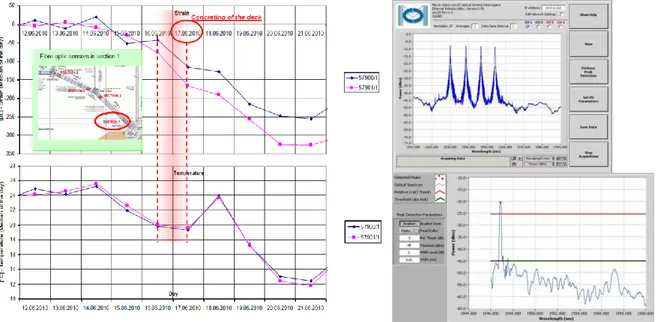
To consider stress distributions in the arch due to dead loads from the bridge deck, the monitoring starts from the construction stage. In Fig 3 the increasing of strain in the arch during concreting the deck is plotted. The values represent the median values per day which are calculated in post-processing.
The main goal is the analysis of the structural performance under different life cycle operational environments. To reach this goal the monitoring project is planned at least for five years. The long term objective is developing performance based models for improving present UHPFRC design tools but also those regarding optimised prognosis strategy for maintenance planning in the field of transportation infrastructure.
References
[1] Aktan A. E., Catbas N., Türer A., Zhang Z., “Structural Identification: Analytical Aspects”, Journal of Structural Engineering, Volume 124, Issue 7, pp 817-829, 1998 [2] Doebling A.W. and Farrar C.R. 1999. “The state of the art in structural identification
of constructed facilities.” Los Alamos National Laboratory
[3] Link M., “Updating of Analytical Models – Basic Procedures and Extensions, Modal Analysis and Testing” (J.M.M. Silva and N.M.M. Maia, eds), NATO Science Series, Kluwer Academic Publ., 1999
[4] Deix S., Ralbovsky M., “Uncertainties in Model Updating - Problems and
Reliability”, An international INCE symposium: Managing Uncertainties in Noise Measurements and Prediction, Le Mans, 2005.
[5] Li H.-N., et.al., “Recent applications of fiber optic sensors to health monitoring in civil engineering.” Engineering Structures 26, 1647–1657, 2004.
[6] Freytag B., et.al., „Großversuch WILD-Brücke - Versuchsgestützte Bemessung einer UHPC-Bogenbrücke.“ Beton- und Stahlbetonbau 104, S. 134 – 144, 2009.
[7] Reichel M. M.; Freytag B.; Sparowitz L., „Road Bridge WILD - UHPFRC for a segmental arch structure.” BFUP 2009 / UHPFRC 2009 Proceedings, S. 88 – 89 2009.
[8] Reichel M. M.; Sparowitz L., „Faserbewehrter Ultrahochleistungsbeton in der Praxis - Fertigteilbrücke in Völkermarkt - Konzept und Bemessung.“ Concrete Solutions - 53. Betontage. S. 44 – 45, 2009.
[9] FOS&S Fibre Optic Sensing &Sensing Systems, Calibration Sheet “Embeddable Strain Sensor ES-02”, 2010.
Herbert Friedl1
Olga Río2
Bernhard Freytag3
Ángel Rodriguez4
1
Austrian Institute of Technology, AIT, Austria (e-mail: [email protected]) 2
Research Centre on Safety and Durability and Materials, CSIC-UPM, Spain 3
Technical University of Graz, TU-Graz, Austria 4
![Fig. 1 Building project bridge WILD [6]](https://thumb-us.123doks.com/thumbv2/123dok_es/6715380.825595/3.892.133.559.577.763/fig-building-project-bridge-wild.webp)