Advanced computational methods for dam protections against
overtopping
A.Larese
1*, F. Salazar
1, J. San Mauro
1, E. Oñate
1, M.A. Toledo
2, R. Morán
21
International Center for Numerical Methods in Engineering (CIMNE) Technical University of Catalonia Barcelona Tech Cam-pus Norte UPC, 08034 Barcelona Spain
2
Technical University of Madrid (UPM) Escuela de Caminos, Canales y Puertos Calle Profesor Aranguren, s/n, 28040 Madrid Spain
*Corresponding autor: [email protected]
Abstract
The paper presents an overview on the computational tools developed in CIMNE for the analysis of the behavior of rockfill dams in overtopping scenarios, as well as for the design of protections systems against overtopping. In this latter case two different applications are presented: the design tool for a wedge shaped blocks (WSB) shoulder pro-tection and the computational models for the analysis of the hydraulic performance of highly convergent spillways. Advanced finite element techniques are combined with particle techniques and artificial neural networks in the framework of the Kratos Multiphysics for reaching the optimal solution procedure for any of the above mentioned problems. An extensive validation is carried out using experimental data provided by the SERPA group of the Tech-nical University of Madrid.
Key words:Overtopping in rockfill dams, Wedge-Shaped Blocks, Highly Convergent Spillways, Computational models, Finite Element Method, Particle Finite Element Method, Material Point Method, Discrete Element Method, Neural Networks
1
Introduction
In the last decades, computational engineering has dramatically increased its importance in several differ-ent engineering related fields. The number of available tools and programs is constantly growing, offering al-ways new features and capabilities while requiring eve-ry time less time and computational resources. Thanks to the recent advances in computational mechanics and to the nowadays excellent performance of person-al computers, the simulation of severperson-al complex multi-physic phenomena is now, not only possible, but also reliable and efficient.
The current paper is an overview of the recent advanc-es carried out at the International Center for Numerical
Methods in Engineering (CIMNE) in collaboration with the SERPA group of the Technical University of Madrid (UPM) for the development of computational models for the evaluation of performance of rockfill dams dur-ing overtoppdur-ing and for the design of protections sys-tems.
In the current work traditional finite element method is blended with innovative particle-based techniques to cover a wide range of different needs. The details of the computational models can be found in the relative references, detailed in every section.
(www.gidhome.com) is the pre and post processing tool used for visualization and preprocessing purposes.
Kratos Multiphysics is a framework developed at the International Center for Numerical Methods in Engi-neering (CIMNE) for the implementation of numerical techniques for the solution of engineering problems. Kratos is written in C++ and designed to allow collabo-rative development by large teams of researchers fo-cusing on modularity as well as on performance. (Dad-vand et al. 2010).
Kratos has a kernel-applications approach to facilitate its use by non-expert developers and maximize its re-usability by developers. The kernel includes all the basic ingredients of a code (from data structures, to solvers or parallelization features, just to mention a few), while the applications contain the physics of the specific problem (some classical applications are Fluid Dynamics and Structural Mechanics, while examples of novel applications are Mixed formulation, Material Point Method (MPM), Discrete Element Method (DEM) …).
The structure of the paper is the following: firstly, we present the computational models developed for the simulation of the failure of rockfill dams. Three differ-ent stages have been taken into consideration: the seepage in the rockfill external layers, the progressive failure of the downstream shoulder and the mechani-cal failure of the internal clay core. Secondly the com-putational tool created for the design of a shoulder protection system made of wedge shaped blocks is presented. Finally, the computational fluid dynamics models developed for the analysis of the hydraulic be-havior of highly convergent spillways is briefly de-scribed.
2
3d coupled models for the simulation of
failure of zoned rockfill dams
2.1
Motivation and objectivesWhile in a concrete dam, an overflow does not easily affect the integrity of the structure, in an embankment dam in most cases it compromises the dam body. If a dam or dike fails, loss of life and economic damage are direct consequences of such event.
The analysis of the possible consequences of an acci-dental overspill with the available technology is still impossible or very imprecise and the necessary eco-nomic measures for solving the problem are then still inefficient.
The objective of the present work is the study of the development of a tool for the simulation of the onset and evolution of the failure mechanism in rockfill and flow-through dams.
The purpose of the following sections is to give an overview of the computational methodology. The reader who wants to study the detailed description of the algorithms can consult the following references (Larese et al., 2012, 2013, 2015a, Iaconeta 2017, 2018). The developed techniques were validated with the data provided by experiments on small scale zoned rockfill dams performed at the UPM. More details of the campaign can be found here (Larese et al. 2011, 2013, Toledo et al. 2015, Morán 2015).
2.2
Methodology and resultsThe analysis is divided in three different stages: firstly the simulation of the seepage evolution in rockfill is simulated, secondly the rockfill response is calculated (with a coupled approach) and finally the mechanical failure of the core is simulated, once the downstream shoulder is no longer present.
2.2.1
Seepage and overtoppingAn efficient and parallel computational 3 dimensional (3D) fluid dynamic code solving the Navier-Stokes equations was developed (Rossi et al., 2013). The tool is able to track the evolution of the free surface using a level set technique, and it can be used for the simula-tion of any problem involving free surface flows, such as, the hydraulic analysis of dam spillways (e.g. Salazar et al. 2013 and 2015 Morera et al. 2014). Moreover, the formulation was conceived to be able to take into consideration the presence of a rockfill-like porous ma-terial and to simulate its internal seepage evolution (Larese et al., 2015a, 2015b).
with a non-linear resistance law governing the relation between velocity and the hydraulic gradient (Larese et al., 2015a). The length scale of the extreme phenome-na we are considering is not sufficient to allow the modification of the seepage line inside the clay core or the internal low permeability layers. The only part of the dam which might be affected by seepage variations is, therefore, the rockfill shoulder.
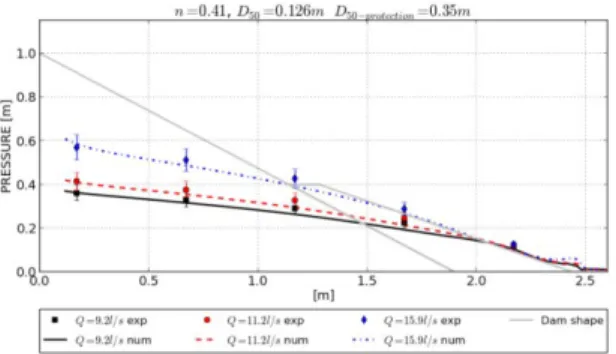
Figure 1 and 2 show an example of the validation cam-paign performed to assess the quality of the simula-tions. The geometry and material properties of the dam considered are detailed in Figure 1 while the bot-tom pressure level for different incoming discharges are detailed in Figure 2 (continuous or dotted lines) and compared with the correspondent experimental measurements (dots).
Figure 1 Geometry of the dam with protection on the down-stream toe and characteristics of the materials.
Figure 2 Numerical and experimental comparison of pressure heads distribution at the bottom of the multilayer dam. Three different incoming discharge have been considered: 9.2l/s(continuous line), 11.2l/s (dotted line), 15.9l/s (pointed line). Source [Larese 2015a].
The results confirm that the seepage tool describe with a high precision the seepage evolution and the free surface flow at the toe of the dam. It is also able to cor-rectly reproduce the pressure as well as the velocity field in the whole domain analyzed. The tool is ready for real scale testing.
2.2.2
Failure of the rockfillThe computational fluid dynamic (CFD) code presented in the previous section was coupled with a structural algorithm for the evaluation of the dam response to the hydrodynamic transient effects. The structural al-gorithm implements a visco-plastic model to capture the solid to fluid-like transition which triggers the be-ginning of failure of the rockfill downstream slope. A particle based technique has been used for naturally treating the large deformations of the mesh during the failure process (Larese et al., 2012). Different particle methods (PFEM and MPM) have been used for this purpose, giving encouraging results.
Figure 3 shows the final stage of the failure in a scale model of a homogeneous dam made of gravel material (D50 is 3.5cm and porosity is 0.4). The height of the dam is 1m and the slopes are 1V: 1.5H.
The validation concentrated mainly on the correct cal-culation of the advance of failure which was correctly simulated (the error was less than 5% in all the cases and less than 2% in the case of the failure discharge) [Larese et al. 2012, 2013]. Further investigation need to be carried on so to achieve an efficient 3D coupled model that addressed all the engineering needs.
Figure 3 Evolution of the free surface/seepage line (in blue) and of the deformation of the downstream shoulder in a ho-mogeneous dam for an incoming discharge of 90.68L/s. Source [Salazar et al. 2016].
2.2.3
Failure of the coreThe internal clay core is not designed to support the upstream push, especially in overtopping conditions. It was observed that the failure of the clay core under these circumstances is typically not caused by the su-perficial erosion, but by its sudden mechanical failure. The failure of the Tous dam in Spain in 1982 is an ex-ample of what explained above.
The simulation of the mechanical failure is a complex phenomenon since it imply considering a series of non-linearity (both material and geometrical) as well as a formulation which allows the treatment of the large deformations that occur during the failure. For this purpose the Material Point Method is chosen. This technique uses two different supports: a background fixed grid on which the calculation is performed (as in traditional FEM) and a collection of Lagrangian parti-cles where the historical variables are stored. These particles are the so called Material Points (MPs) and in practice they are the (moving) integration points used by the background grid. The advantage of this ap-proach is twofold: on the one hand it allows to get rid of the mesh deformation problems (this implies that there is no need for costly remeshing procedures) and is intrinsically parallel, ensuring a good efficiency [Iac-oneta et al. 2017 and 2018]. On the other hand it is a continuum-based approach leading to an accurate de-scription of the mechanical and material behavior.
The geometrical and material details of the model can be found in [Toledo et al. 2014] and [Ricoy et al 2016]. The author adopted a Mohr Coulomb failure criterion.
The weight of the upstream shoulder and the hydrody-namic load of the overflowing water induce the me-chanical failure of the core, as shown by the sequence of Figure 4. The height and shape of the fracture is highly influenced by the shape of the downstream filed rockfill shoulder.
Once the breakage is triggered the complete failure takes place in a very short time lapse.
Figure 4. Sequence of the mechanical failure of the clay core due to the hydrodimanic effect of the overflowing
2.3
ConclusionsTwo different numerical approaches have been devel-oped. The first one is designed for the analysis of the rockfill failure (including seepage and structural re-sponse), and the second, for the breakage of the inter-nal clay core. While the first is mainly induced by the hydrodynamic effect of the fast seepage evolution, the clay core suffers a mechanical failure where superficial erosion plays a minor role. Traditional finite element and continuum based particle techniques have been combined for the design of the coupled problem. The ongoing research work is giving promising results but need to be further validated and assessed by means of real test cases. The final objective is the achievement of a tool useful in the engineering practice and further joint activities with practitioners are needed for achiev-ing this goal.
3
Design of protection systems: wedge
shaped blocks (WSBs)
3.1
Motivation and objectivesWedge shaped blocks (WSBs) spillways constitute a promising technology for cost-effective design of em-bankment dam spillways, since they can be located over the downstream dam shoulder. The technology of WSBs firstly appeared in the late 60’s. Nevertheless, their use is still limited. This is mainly the consequence of a lack of systematic design procedure.
Figure 5. Scheme of the flow over and under WSBs. Above the blocks a positive pressure is made by the overflow while a negative pressure is appearing on the higher part of the tread. The unsaturated condition of the drainage layer below the blocks is necessary for the good performance of the sys-tem (avoiding the appearance of dangerous uplift pressure).
The most important design aspect of this type of struc-ture is the determination of the leakage flow through the joints. In fact, if this is not correctly defined, the drainage layer placed below the blocks could eventual-ly get saturated and an undesired uplift pressure could compromise the structural stability of the protection.
For the above mentioned reasons, CIMNE UPM and PREHORQUISA have been developing a tool for the de-sign of WSBs protection system that will be presented in the next sections. The consultation of the paper “A new evolution on the wedge-shaped block for overtop-ping protection of embankment dams: the ACUÑA block” by F.J. Caballero et al., from this same collection, is recommended for a comprehensive overview of the work performed.
3.2
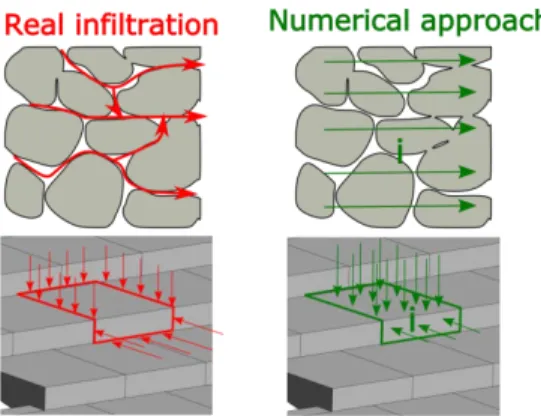
Methodology and resultsThe numerical technique used for the evaluation of the hydraulic head loss caused by the WSBs layer is the one presented in section 2.2.1 for the analysis of free surface and seepage flow. This analogy between rock-fill and blocks is explained in Fig. 6: in the above part of the figure, the homogenization procedure used for the flow through rockfill is presented and the analogous consideration for the blocks is shown in the lower part. The blocks layer and their orifices are considered as a continuum porous layer and the hydraulic head loss (i) is quantified considering a Darcy type resistance law i = A v, being v the velocity and A the Darcy’s coefficient only depending of the size and shape of the block and defining the permeability of the layer.
Figure 6. The presence of the layers of WSBs is simulated using a similar approach that those presented in Section 2.2.1 for the rockfill material. The drag and resistance to the flow is taken into consideration as if the WSBs were a contin-uous layer of porous material.
The calibration of coefficient A for a given block and the validation of the model are performed using the results of the experimental campaign carried out at UPM [Caballero et al 2016]. The discrepancies between physical and numerical infiltration flow ranges between 13.3 % and 5.0 % of the infiltration flow, both within the measurement uncertainty range of the recording devices.
The procedure is defined for both rockfill and homoge-neous dams (Figure 7). It includes the presence of both a flip bucket at the toe of the downstream shoulder and the presence of toe protection to drain the infiltra-tion flow.
Once the calibration and validation processes were completed, a set of 3D numerical simulations were car-ried out in order to obtain infiltration results for sever-al configurations of the spillway, beyond the limited capabilities of the laboratory facilities. In this way four spillway slopes (1.5, 2.0, 2.5 and 3.0), five discharge flows (200, 300, 400, 600, 1000 l/s/m) and four lengths of spillway (8, 16, 32, 48 rows) were simulated. Figure 8 shows the results for a dam with slope 3 and differ-ent length of spillways.
Figure 8. Evaluation of the infiltrated flow for four different overtopped flow discharges. The different symbols indicate the length of spillways considered (made of 8, 16, 32, 48 blocks respectively).
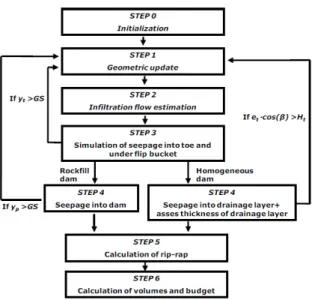
A wizard tool is defined to allow a straightforward de-sign procedure by the practitioner. The internal steps of the calculation procedure (invisible to the user) are schematically presented in Figure 9 (see San Mauro et al 2018 for more details):
Figure 9 Flowchart of the algorithm of the design procedure proposed. GS: maximum saturation rate input; Ht: height of toe; y: maximum seepage level under the flip bucket
struc-ture; yp: maximum seepage level into the dam; et: thickness of drainage layer and β: dam slope (source San Mauro et al 2018).
A neural network trained with the calculated cases, are used to evaluate the results for intermediate cases dif-ferent than those already evaluated (Figure 10). This neuronal network allows interpolating between results of numerical tests in an efficient way, without the need to fit a separate expression for each combination of slope and discharge. The maximum discrepancy re-garding numerical tests is 1.26%.
Figure 10 Comparison of the infiltrated flow calculated using the numerical solver of the neuronal network analysis.
A simple wizard is finally created in Shiny by Rstudio. This tool is able to find a design solution, carrying out the process of the algorithm in the order of seconds.
Figure 11 List of input/output parameters needed (and given) in the design procedure.
3.3
ConclusionsIn the previous sections the authors presented a design procedure for WSBs spillways. This objective is the cor-rect definition of the geometry of the spillway to en-sure the stability of the dam against sliding with a slop-ing toe protection, and to ensure the stability of blocks avoiding the appearance of uplift pressure. The design procedure is based on an iterative algorithm coded in R and implemented in an interactive tool based on Shiny.
This tool allows finding the design solution in a few seconds, finding an optimal economic solution from a range of blocks, and this is an important step forward to simplify and popularize the design of WSB spillways.
4
Simulation of the hydraulic performance of
highly convergent spillways
4.1
Motivation and objectivesSpillways with highly-converging chutes are a non-conventional kind of spillway in which the length of the crest is greater than the width of the stilling basin (Fig-ure 12). A pair of converging chutes leads the water in-to the stilling basin. This typology has two possible ad-vantages: it increases the discharge capacity and it reduces the hydraulic head for a given discharge flow. The first improves dam safety, whereas the second re-sults in higher storage capacity and power generation.
Figure 12 Example of a dam with highly convergent spillways (source Morera et al 2015)
The objective is the improvement in the definition of the design criteria for these types of spillway. This is obtained firstly, by the development and validation of a numerical tool able to simulate the 3D flow generated on these spillways. Secondly the tool is currently being used for the design of real intervention on existing dam: a proposal is done for the design of the Oroville lateral external spillway.
4.2
Methodology and resultsThe numerical technique used for the simulation of the hydraulic performance of the highly convergent spill-ways is based on the free surface tool presented in sec-tion 2.2.1 [Larese et al 2015a, Rossi et al 2013]. In this case no porous layer is present in the simulation and the tool solves the 3D Navier Stokes equations and us-es a level set technique for tracking the free surface evolution.
Figure 13 Numerical (above) and experimental (below) tests on a symmetric configuration of the converging chutes with slope 2:1.
The model has been validated with experimental tests carried out by the SERPA group at the Technical Uni-versity of Madrid. 9 different geometrical configura-tions have been analyzed (both symmetric and no symmetric, with and without dissipating steps at the toe, with different height of the retaining lateral bor-ders). For more details on the validation campaign, please, refer to Morera et al 2015 and San Mauro et al 2017.
Figure 14 Pressure distribution on the central axis of the stilling basin. In abscissa the distance from the toe of the dam.
lower part of the image the correspondent numerical simulation is showed.
A good accordance is registered when comparing the experimental and numerical pressure on the stilling ba-sin (Figure 14).
4.2.1
Case study: the emergency spillway of theOroville dam.
The Oroville dam was constructed in 1968 in California and has been operating without any accident until it became sadly famous for the accident that occured in February 2017, after a sequence of exceptional flood-ing events.
Figure 15 Images of the lateral emergency spillways before and after the accident of 2017 (above) and the snapshot of the simulation of the flooding in case a highly convergent chute would be present (below).
As a consequences of this accident the principal spill-way was severely damaged and the area downstream the lateral emergency spillway, suffered severe scour-ing and erosion.
The authors have analyzed the possibility of building a solution with highly convergent chutes and have as-sessed its performance on the exceptional flooding of 2017 (Figure 15).
The preliminary study carried out by the authors; demonstrated that the use of highly convergent
spill-ways would be helpful in the reduction of the area where reinforcing against erosion and scouring should be prepared. The overtopping flow would have inter-ested a concentrated area, without affecting a wide zone as in 2017 (Figure 15 and 16).
Figure 16 Geometry of the emergency spillway with highly convergent chutes (above) and velocity contour fill of the overtopping simulation (below).
Finally, the solution adopted for the repair of the emergency spillway of the Oroville dam consists of stepped reinforcement using rolling compacted con-crete. The implementation of a solution with lateral cashiers, as recommended by the technical FEMA guide itself, would have required a campaign of specific studies for its design, in absence of general criteria for its calculation, which was incompatible with the urgen-cy required to repair. Nevertheless the authors demonstrated that a solution with highly convergent chutes would have also be a suitable, less expensive, alternative.
4.3
Conclusions5
Acknowledgements
The research was supported by the project PRECISE (BIA2017-83805-R) and HIRMA (RTC – 2016-4967-5) by the Spanish Ministry of Economy and Competitiveness – MINECO. Dr. Larese would like to acknowledge also the support of the Spanish Ministry through her Juan de la Cierva fellowship (IJCI-2015-26484).
References
Caballero, F. J., Toledo, M. Á., Morán, R., San Mauro, J., & Salazar, F. (2016) “Advances in the understanding of the hydraulic behavior of wedge-shape block spillways”. II In-ternational Seminar on Dam Protection Against Overtop-ping. Ft. Collins, Colorado, USA, 7-9 September 2016
Casas, G., Mukherjee, D., Celigueta, M. A., Zohdi, T. I., & Onate, E. (2015). “A modular, partitioned, discrete ele-ment framework for industrial grain distribution systems with rotating machinery”. Computational Particle Me-chanics, 1-18.
Dadvand, P., Rossi, R., and Oñate, E. (2010). “An Object-oriented Environment for Developing Finite Element Codes for Multi-disciplinary Applications”. Archives of Computational Methods in Engineering. 17, 253–297.
Hewlett, H.W., Baker, R., May, R., and Pravdivets, Y.P. (1997). Design of stepped-block spillways. Construction Industry Research and Information Association. CIRIA Special Pub-lication 142, 1997. ISBN 0860174719
Iaconeta, I., Larese, A., Rossi, R., Guo, Z. (2017) Comparison of a Material Point Method and a Meshfree Galerkin Method for the simulation of cohesive-frictional materi-als, Materimateri-als, 10 , 1150,
Iaconeta, I. Larese, A., Rossi, R., Oñate, E. (2018) A stabilized, mixed, implicit Material Point Method for non-linear in-compressible solid mechanics problems. Submitted to Computational mechanics
Larese, A.; Rossi, R.; Oñate, E., Toledo, M.; (2011) “Physical and numerical modelization of the behaviour of rockfill dams during overtopping scenarios”. Proceedings of the 2nd International Congress on Dam Maintenance and Rehabilitation, pp. 479-487.CRC Press, 2010. ISBN 978-0415616485
Larese, A.; Rossi, R.; Idelsohn, S.R.; Oñate, E. (2012). “A cou-pled PFEM-Eulerian approach for the solution of porous FSI problems”. Computational mechanics.50 - 6,pp. 805 - 819. (2012). ISSN 0178-7675
Larese, A., Rossi, R., Oñate, E., Toledo, M., Morán, R., and Campos, H. (2013). “Numerical and Experimental Study of Overtopping and Failure of Rockfill Dams”. Interna-tional Journal of Geomechanics 2015 15:4.
Larese, A., Rossi, R., Oñate, E., (2015a) “Finite Element Mod-eling of free surface flow in variable porosity media”. Ar-chives for Numerical Methods in Engineering 22(4), pp 637-653 DOI: 10.1007/s11831-014-9140-x.
Larese, A.; Rossi, R.; Oñate, E., (2015b) “Simulation of the beginning of failure in rockfill dams caused by overtop-ping”. Dam Protection against Overtopping and Acci-dental Leakage, Eds. Toledo, Moran & Oñate Taylor & Francis group London ISBN 978-1-138-02808-1, pp. 111-118.
Morán, R., & Toledo, M. A. (2014). “Design and construction of the Barriga Dam spillway through an improved wedge-shaped block technology”. Canadian Journal of Civil Engi-neering, 41(10), 924-927.
Morán, R. (2015). “Review of embankment dam protections and a design methodology for downstream rockfill toes”. Dam Protections against Overtopping and Accidental Leakage. Toledo, Morán & Oñate (eds.). Taylor & Francis Group, London, 2015, p. 25-39.
Morera, L., San Mauro, J., Salazar, F., Toledo, M.A., (2015) Highly-converging chutes as an overtopping protection for concrete dams: physical and numerical modelling. Dam Protections against Overtopping and Accidental Leakage. Toledo, Morán & Oñate (eds.). Taylor & Francis Group, London, 2015
Rossi, R., Larese, A., Dadvand, P., and Oñate, E. (2013) "An efficient edge-based level set finite element method for free surface flow problems." International Journal for Numerical Methods in Fluids, 71(6), 687-716.
Salazar, F., San Mauro, J, Larese, A., Irázabal, J., Morán, R., Oñate, E., Toledo, M.A. (2016) Applications of numerical methods in design and evaluation of overtopping protec-tion systems. Proceeding of the 2nd Internaprotec-tional Semi-nar on Dam Protection Against Overtopping, Ft. Collins, Colorado, USA
Santasusana, M., Irazábal, J., Oñate, E., and Carbonell, J. M. (2016). “The Double Hierarchy Method. A parallel 3D contact method for the interaction of spherical particles with rigid FE boundaries using the DEM”. Computational Particle Mechanics, 1-22.
San Mauro, J., Toledo, M.Á., Salazar, F., Caballero, F.J., Mo-rán R. (2018) A methodology for the design of dam spill-ways with wedge-shaped blocks based on numerical modeling. Submitted to RIMNI
San Mauro, J., Salazar, F., Morán, R., Peraita, J., Toledo, M.Á., Conde, M.J., Flórez, V., Labalde, B. y Alcalde, F. (2017) Aliviaderos con cajeros altamente convergentes. ¿Posible solución para la presa de Oroville? Proceedings of the JIA 2017, A Coruña, Spain
Toledo, M.Á., Campos, H., Lara, A., and Cobo R., (2015) “Failure of the downstream shoulder of rockfill dams in overtopping or accidental leakage scenario”. K. Toledo, Morán & Oñate (eds.). Taylor & Francis Group, London, 2015.