Vaporization and gas-phase combustion of electrosprayed heptane in
a small chamber
F.J. Higuera*. J.M. Tejera
ETSIAE, Universidad Politecnica de Madrid, Plaza Cardenal Cisneros 3, Madrid 28040, Spain
A B S T R A C T
A model is formulated of the vaporization and gas-phase combustion of a dilute spray of electrically charged droplets of heptane with a coflow of preheated air in a mesoscale combustion chamber. The model includes an Eulerian/Lagrangian treatment of the gas and the droplets, an equilibrium vaporiza-tion submodel, and a single step mechanism for the combusvaporiza-tion of heptane vapor. The effects of the inlet air temperature, the fuel flow rate and the overall equivalence ratio are investigated. Two combustion modes are described for globally lean systems. When rapid vaporization leads to a kernel of high fuel vapor concentration, combustion may begin before the fuel diffuses in the air coflow, in a layer of in-tense reaction that locally depletes the oxygen and leaves behind a region of high temperature fuel vapor surrounded by a diffusion flame. When the vaporization rate and the maximum fuel vapor concentration are decreased by increasing the size of the droplets or the inlet velocity of the air, combustion occurs in a lifted lean premixed flame after the fuel has fully vaporized and mixed with the air coflow. Ignition and extinction conditions are discussed. The degree of accuracy that can be expected from the single step reaction mechanism is also discussed.
1. Introduction
The energy density of liquid hydrocarbons is about 100 times larger than that of the currently available batteries, which makes power-generation systems based on the combustion of these fuels a promising technology in the quest for better power sources for portable equipment and other applications [1,2]. Many con-ventional techniques and operation principles of macroscopic combustion systems become impractical for miniaturized system, although the extent of the modifications required is smaller for devices with overall dimensions of several centimeters intended to generate powers of 10-100 W, referred to as mesoscale devices, than for smaller microdevices. Difficulties are also smaller when the liquid fuel is vaporized and burned under steady conditions in a chamber coupled to a direct energy conversion module such as a thermoelectric or thermovoltaic generator, or to a Stirling engine, than when conventional engines using classical thermody-namic cycles are miniaturized. Only mesoscale, steady combustion devices are considered here.
Reduction or disappearance of turbulent mixing, heat transfer, and flame wrinkling in small systems are important differences with their macroscopic counterparts, though Wu et al. [3] were
able to stabilize a non-premixed flame in a mesoscale combustor by means of a vortex flow that extends the concept of whirl combustion of macroscopic combustors. Increased heat losses due to the augmented surface-to-volume ratio is another effect of miniaturization, which increases the vaporization and chemical times, and may compromise combustion efficiency. A third effect of miniaturization is the reduction of the residence time, which should be larger than the vaporization and chemical times in order to achieve complete combustion and prevent the emission of pollutants such as CO and unburned hydrocarbons.
The notion of heat recuperation or excess enthalpy for minia-ture devices, whereby part of the thermal enthalpy of the combustion products is used to preheat the reactants, was first studied by Weinberg and coworkers [4-6] and later extended to many meso- and micro-scale combustors to achieve steady combustion under conditions of large heat losses or lean mixtures, which would otherwise result in extinction.
charged droplets in their mesoscale combustor [9-12]. Electro-sprays have also been used in combination with flame-attaching grids in narrow tubes [13,14].
Catalytic combustion may improve combustion stability and reduce pollutant emission in the conditions of short residence times and low temperature typical of small scale combustors. Catalytic combustion in a series of catalyst-coated grids at the outlet of a chamber where fuel droplets vaporize in a coflow of preheated air has been successfully used by Gomez and coworkers [9-12]. Despite the favorable properties of catalytic combustion, gas-phase combustion may still retain some advantages in excess enthalpy mesoscale systems, stemming from their volumetric rather than superficial character, provided heat recuperation overcomes heat losses to a sufficient extent to make gas-phase combustion possible.
The purpose of this paper is to numerically study the feasibility of gas-phase combustion in a small chamber similar to those used by Deng et al. [11] in their experiments with multiplexed electrospray sources and catalytic grids. A two-way coupled model of the dispersion, vaporization and gas-phase combustion of a single electrospray from a multiplexed source in a coflow of hot air has been developed which is based on the model proposed in Ref. [15] to study the heating and vaporization of a spray of hep-tane droplets in a chamber. This model, which in turn builds on a model of Arumugham-Achari et al. [16], consists of a combination of an Eulerian mesoscale description of the gas and a Lagrangian description of the spray of droplets, carried out with a method of particles. The flow in the chamber is laminar (Reynolds number in the range 100-500), which makes the results free from the uncer-tainties of turbulence modeling. The model relies on the validation of Ref. [16] (see also references therein) against an individual electrospray source, and on the previous computations in Ref. [15], which were qualitatively compared to the experiments of Refs.
[9-12] to the limited extent permitted by the available data. The previous model is extended here to account for the combustion of heptane vapor by means of a single step mechanism calibrated to reproduce the ignition delay times measured for heptane-air mixtures in conditions similar to those found at ignition in the chamber. The degree of accuracy that can be expected from this drastic simplification of the heptane-air kinetic mechanism de-pends on the structure of the computed solutions and is discussed in Section 3. The model of Ref. [15] is also improved by using a more realistic droplet heating and vaporization submodel.
2. Formulation
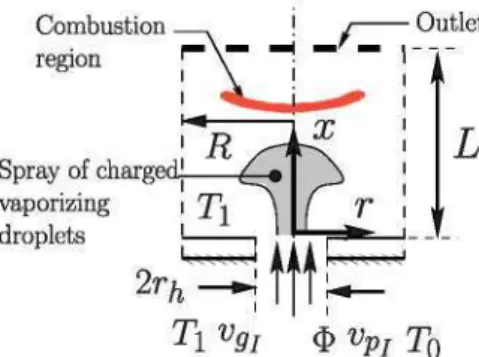
Kyritsis et al. [9] and Deng et al. [11] used two-dimensional periodic arrays of identical electrospray sources to inject small, nearly monodisperse, electrically charged fuel droplets through one of the bases of a cylindrical chamber. To approximately model this system, the invariance of the array under certain discrete angle rotations is replaced here by axial symmetry. A single electrospray source of the periodic array is considered that injects droplets and a coflow of air through a circular orifice of radius rj, at one of the bases of a cylindrical chamber, and symmetry conditions (see Eq. (16) below) are applied at a distance R from an axis through the center of the orifice, as sketched in Fig. 1. The source generates <t> droplets per unit time with radius a0, electric charge e0, temperature T0 and velocity vVv and the air enters the chamber with velocity vgI and temperature Tj > T0 through the same orifice. The droplets heat up and vaporize in the chamber due to the heat transferred by conduction from the hot air, generating fuel vapor that reacts with the oxygen of the air. The combustion products leave the chamber through the opposite base, at a distance L from the injection orifice.
Combustion region
Spray of charged) vaporizing droplets
* h
Outlet
L
7i
v
9l$
VpiT
0Fig. 1. Schematic of the investigated configuration with indication of relevant di-mensions. The grey area represents the vaporizing spray. The heptane vapor burns in a combustion region represented by a red line in the figure. (For interpretation of the references to color in this figure legend, the reader is referred to the web version of this article.)
A dilute spray is considered. The mean distance between droplets, id, is large compared to the radius of a droplet and small compared to the size of the chamber; i.e. a0 < 1& < L. In these conditions, an Eulerian, mesoscale description of the gas flow [17] combined with a Lagrangian, particle-in-cell description of the droplets [18,19] can be used.
2.1. Droplets
The droplets interact mainly through the surrounding gas and through the electric field induced by the electric charges they carry. Direct interactions between droplets are rare events when
a0 « ld.
The mass, momentum and energy conservation equations for droplet i are
dXj di/j
-
= V u m i-
= F i + eiEu drrijmc-fa =qgi-miLv, (1)
where Xj(t) and Vj(t) are the position and velocity of the center of the droplet, rrtj = |jrpta? with pt the density of the liquid and <3j(t) the radius of the droplet, Tj(t) is the temperature of the droplet, which is approximately uniform because the thermal conductivity of the liquid is large compared to the thermal con-ductivity of the gas, and e4(t) is the electric charge of the droplet,
whose time evolution is computed as described below. In these equations Ff is the force exerted by the gas on the droplet, qgi is the heat flux reaching the droplet, and m; is the vaporization rate.
These quantities depend on the radius, velocity and temperature of the droplet, and on the local velocity, vgj, temperature, Tgj, and composition of the gas seen by the droplet. Finally c and Lv are the specific heat and the latent heat of vaporization of heptane, and Ej is the electric field at the position of the droplet.
300
500 7007i(K)
900
300
500
700
900
Ti(K)
Fig. 2. (a) Vaporization time of a droplet of heptane of initial radius a0 = 8.75 fim,
temperature T0 = 293 K and velocity vPl = 10 m/s as a function of the
tempera-ture of the surrounding air, computed with the model of Abramzon and Sirignano
[20] (solid curve), and leaving out the effect of the slip flow (dashed curve), (b) Vaporization time of the same droplet at rest, computed using (2) and (3) in the last two equations (1) (solid, coincides with the dashed curve of (a)), neglecting the Stefan flow (dashed), and in the asymptotic limit Lv/RrTb -* co (dotted).
conditions (dashed curve), which is due to the rapid deceleration of the small droplet considered. On the basis of this comparison, the effect of the slip flow on qgi and m; is neglected in what
follows. In these conditions, the stationary energy and species conservation equations around the droplet can be solved in terms of the Spalding mass transfer numbers (see, e.g. Sanchez et al. [22]) to give
A.,:
m
AnaJigJCp
G-H
h
where the Clausius-Clapeyron relation and the 1/3 rule for the average thermal conductivity of the gas,
Wc
exp
w
kg(Ti) with 7]
RJi
1(2T( + Ta), (3)
are used. In these equations, WF and Tb are the molecular mass and boiling temperature of the heptane, RF and LeF are the gas
constant and Lewis number of the heptane vapor, Yftj and Yfi are
the mass fractions of heptane in the gas at the surface of the droplet and away from the droplet, and cp and W are the specific
heat and the mean molecular mass of the gas at the surface of the droplet. This latter quantity is approximately computed using the simplified expression WF/W = Yfsj + (l -YFsj)WF/WN , where WN
is the molecular mass of nitrogen. This approximation accounts for the large difference of the molecular masses of fuel and nitrogen, while taking the molecular masses of all other species equal to that of nitrogen [22]. The specific heat cp is assumed to be constant.
The effects of additional simplifications of (2) and (3) (not used in what follows) are illustrated in Fig. 2(b). The dashed curve in this figure shows the droplet vaporization time when the Stefan flow is neglected, which reduces (2) to kt = YFsi - YFi and qgi/4jiaikgi(Tgi - 7]) = 1, and the dotted curve gives results pertaining to the asymptotic limit LV/RFTb -> oo [23], in which vaporization occurs at 7j = Tb and is preceded by a stage of droplet heating without vaporization. As can be seen, the errors incurred by using these approximations are moderate in many cases. The error of the first approximation is largest at high temperatures, and the error of the second approximation is largest when the gas temperature approaches the boiling temperature of the fuel.
The Reynolds number of the slip flow, Ref = pgj \vt - vgj |aj//Xg,, is moderately small during most of the droplet evolution. In addition, consideration of the Stefan flow leads to a modification of the Stokes law that is small when kj = 0(1) [24]. Neglecting this correction, the force of the gas on the droplet is taken to be
Fi = -cfi (v{ - vgi), cf. = Qnfigfli (4)
where /2gi = /xg(fj)
The maximum electric charge that a droplet of radius af can
bear is given by the Rayleigh limit eRj = Sit (e0oaf\ [25], where a is the surface tension of the liquid and e0 is the electric
permit-tivity of the gas. This limit is reached when the droplet vaporizes keeping its electric charge, and then the droplet undergoes a Coulomb explosion which, for liquids of high electric conductivity, consists in the rapid emission of a large number of very small daughter droplets that carry a significant fraction of the electric charge of the parent droplet with only a very small fraction of its mass [26]. The results of Gomez and Tang [27] suggest that this is the mode of Coulomb explosion that occurs for the mod-erate conductivities usually achieved with doped heptane, with the droplet losing about 30% of its charge in the process. Thus, Coulomb explosions are idealized here as instantaneous events in which the mass of the droplet does not change while
ef decreases to (1 - a)e\ whenever ef > eR (5)
with a = 0.3. The daughter droplets vaporize rapidly, and the electric charges lost by the droplets that underwent explosions soon reappear as a population of charged nanometer-size residues (solvated ions) whose charge density, pr, obeys the conservation equation
dt V •[pr(Vg + KE)] = Sr, (6)
where vg is the velocity of the gas, K is the mobility of the residues, and Sr is the charge generated by Coulomb explosions
per unit volume and time, given by (13) below. Charged residues reach the metallic bases of the chamber, where they are absorbed. Droplets are continuously injected, <t> per unit time, at the injection orifice with a radial Gaussian distribution with standard deviation rc < rh, truncated at the orifice radius rh. The injection conditions read therefore
= 0, j-j = rand[G(r)], V\ = vp
with the cumulative distribution function 1 - exp (-r2/rc 2)
G ( r ) = i / 2, 2( f o r r < r" '
1 - exp (-r2/rc 2)
G(r) = 1 for r > rh.
Here x and r are distances along and normal to the symmetry axis, with x = 0 at the orifice, and i is a unit axial vector. Upon injection, the droplets evolve according to equations (1) until they disappear when they fully vaporize or hit one of the bases of the chamber.
2.2. Gas
Conservation equations for the mesoscale description of the gas [17] can be derived from the principles of conservation of mass, momentum and energy applied to the gas in elementary control volumes of size large compared to 1& but small compared to L. These volumes contain many droplets exchanging mass, momen-tum and energy with the gas, whose effect appears as distributed source terms in the gas equations. For a low Mach number mesoscale flow, leaving out radiation and using Fick laws for the diffusion of the fuel vapor and the oxygen, these equations are
dpg
dt • V • (PgVg) = S,
3Vg T7
Pg
dt
\dt
-Vp + V - r ' - F + pr£,
(8)
0)
-*-
vyi) =
v- ( ^
v yi ) + 0-
yi)v
PgCp dig
dt
vrJ
:V-(kgVTg)-Sh + qw,-SjW, ( 1 0 )
(11) plus the equation of state pgTg = pgoT0W/Wair. Here pg, Tg, vg and Yj are the mesoscale-averaged gas density, temperature, velocity
and species mass fractions (with j = F, 0 denoting fuel and oxygen hereafter); W/Wair is the mean molecular mass of the gas scaled with the mean molecular mass of the inlet air, which reduces to
W/Wair = [l + (18/7)Yf] with the approximation mentioned in
Section 2.1 and WF/WN = 2 5 / 7 ; r' is the viscous stress tensor given by the Navier-Poisson law; cp and Lej are the specific heat
of the gas and the Lewis numbers of the species, assumed to be constant; and pgo is the density of the gas at the inlet temperature of the droplets, T0.
Combustion in the gas phase is modeled with a drastically simplified single step mechanism. The mass of fuel consumed per unit volume and time is given by the Arrhenius law w =
PgBexp (-Ta/Tg)YFY0, where the frequency factor and activation temperature are chosen to approximately reproduce the ignition delay times measured by Ciozki and Adomeit [28] in shock tube experiments with heptane at about 3 atm. This is also the cham-ber pressure considered in what follows, so that the single step mechanism is expected to give a fair account of the autoignition of gaseous heptane-air mixtures in the chamber, which, as will be seen, is relevant to determine the ignition conditions. Specifically, the slope of the upper curve in Fig. 3 of Ref. [28] at about the "line of pressure variation" and an ignition delay time of 10 ms at 1000 K are chosen to determine B = 2.2 x 10⁶ s^1 and Ta = 104 K.
In addition, for heptane, sF l,s„ : 3.52 and q = 39, 974 kj/kg.
The laminar flame speed computed with the single step mech-anism and the simple power-law transport coefficients introduced in Section 2.1 is compared to the flame speed computed with the detailed mechanism of Jerzembeck et al. [29] and full mul-ticomponent transport properties. Results for a gas pressure of
400 500 600
T
u (K)700 800
Fig. 3. Laminar speed of a heptane-air flame as a function of the fresh gas temper-ature for two values of the equivalence ratio, (p = 0.35 (lower curve of each pair) and 0.7. Solid curves are for the detailed mechanism of Jerzembeck et al. [29],
dashed curves are for the single step mechanism described in the text [heptane consumption rate w = pgBexp(-Ta/Tg)YrY0 with B = 2.2 x 10⁶ s-1 and Ta = 104 K],
and dotted curves are for the Westbrook and Dryer single step mechanism [30].
3 atm and the two values <j> = 0.35 and 0.7 of the equivalence ratio are shown in Fig. 3 as functions of the fresh gas temperature. When (p = 0.35, the flame speed of the single step mechanism (lower dashed curve) is surprisingly close to the flame speed of the detailed mechanism (lower solid curve) in a wide range of fresh gas temperatures. When (p = 0.7, the single step mechanism underpredicts the flame speed (upper dashed and solid curves), but the agreement can be restored by multiplying the frequency factor B by 4.84. For comparison, the flame speed computed with the single step mechanism of Westbrook and Dryer [30] strongly overpredicts the flame speed at both values of the equivalence ratio (dotted curves in Fig. 3).
The ability of the single step mechanism to reproduce the laminar flame speed in wide ranges of gas conditions could be improved by the method proposed by Fernandez-Tarrazo et al. [31] (see Giusti et al. [32] for a recent extension to the com-bustion of alcohols), which is based on using values of the heat of reaction, the activation temperature and the frequency factor that depend on the local equivalence ratio and are chosen to fit the correct laminar flame speed and adiabatic flame temperature across the whole flammability range. This refinement could im-prove the prediction of combustion characteristics in nonuniform mixtures (see Section 3.3 below) but it has not been used here.
The mesoscale-averaged electric field satisfies
-V<p, V2(p-. Pe + Pr (12)
The source terms on the right-hand sides of Eqs. (6) and (8)-(12)are [15,22]
Sr. ,E(e.|3Q c _ c _ »
• StSV ' J — J F — SV
F _ Etfi+mife-yQ]
r — SV
E[fei+miCp(Tgi-Ti)] SV Pe
E £ i
SV
(13)
where the sums are over the droplets present in a control volume
SV centered at point x at time t, and 'E(ei\St) means sum of the charges of the droplets in SV that have undergone a Coulomb explosion in the time interval St around t. The limits SV -> 0 and
Boundary conditions for the gas equations, already specialized for an axisymmetric flow, are
•g = vg,i, Tg = Tu
Pgugh IP dx = 0 PgUgY0
Vg
hen dx
dx
h, (p
:0. for r
h < r < R for r < rh
(14)
at x = 0, the zero-gradient conditions 3&>£ 3Y, 37^
dx dx dx
at the chamber outlet, x -.
v. cp = 0
-. L, and
:0
dug dYj dJg dip
dr g dr dr dr
at r = R. Here ug and vg are the axial and radial components of the gas velocity, and cog is the only nonzero component of the vorticity. The hyperbolic equation (6) needs a boundary condition [pr = 0) only in regions of the boundary where vg + KE points inward. 2.3. Characteristic values and orders of magnitude
The characteristic electric field induced by the charge of the droplets in the region of the spray is Es = e0n0ts/£o, from the Pois-son equation (12). The ratio of electric to aerodynamic forces in the second equation (1) is of order IT = e0Es/CfVPl = m0n0e^/e0Cj•.
The drag of the droplets induces a motion of the gas in the region of the spray with characteristic velocity v& = M1/2vPl determined from the balance of inertia and momentum exchange terms in the momentum equation (9); i.e. pg^v^/ts ~ noc/,fpj>
which is a relevant balance insofar as the Reynolds number Re = pgjVgsts/IJ'g-t is large. The ratio of this velocity to the inlet gas velocity is %/%, = 6.53 x lO~2(i7,/rc)2/(.M1/20), where the
factor 6.53 x 10~2 is the stoichiometric fuel-to-air mass ratio.
The characteristic velocity of the gas downstream of the spray is VgC = (rh/R)2vg! in the absence of combustion, and larger than this by a factor 6.53 x W~2q(p/cpTi, due to the thermal expansion of the gas, when combustion occurs. The ratio of the residence (16) time of the gas in the chamber, tgc = L/vgc, to the chemical time tch = (Be~7a/7i yo o)_ 1 is a Damkohler number, tgCjtcb, which must be larger than a certain critical value for ignition to occur.
In terms of the three control parameters of the problem, 7.42 x 10⁹
n0 = -TTTTT^T^ m
(15)
The nondimensional form of problem (1)—(16) used for the numerical computations is given in the Appendix.
Values of the parameters are chosen for the simulations to be representative of some of the configurations investi-gated by Gomez and coworkers [9-12]. The chamber length is L = 38.1 mm, with a mean spacing between electrospray sources leading to R = 5.33 mm, an injection orifice of ra-dius 17, = 3.8 mm, and rc = 0.8 mm. The fuel is heptane doped with an electric conductivity enhancer, with physical proper-ties pi = 679.5 kg/m3, c = 2241 J/K kg, a = 2.01 x lCT2 N/m, Tb =371.6 K and L„ = 3.65 x 10⁵ J/kg. A base case is considered
in which a flow rate Qj, = 1.5 ml/h is atomized per electrospray source into droplets of diameter 2a0b = 17.5 /zm, carrying an elec-tric charge eob = 1.08 x 10~13 C, which are injected with velocity
fp, = 10 m/s and temperature T0 = 293 K. The mass of heptane per droplet is then mob = ^Jtpia^b = 1.907 x 10~12 kg, and the
number of droplets injected per source per unit time is <£>b = Qi/(|jra3 b) = 1.49 x 10⁵ s"1. The size and charge of the droplets
change when the flow rate of liquid atomized changes. The scaling laws for an electrospray in the cone-jet mode (see, e.g., [26]) provide the relations a0/aob = (e0/e0b)1/2 = <£(,/<£ = (Q/Qj,)1/2. Air
(Y00 = 0.23) preheated to a temperature Tj > T0 is injected in the chamber together with the droplets, with a velocity vgI such that the overall equivalence ratio (p = 3.52 ptQ_/(0.23jtr^pgiVgj) has a chosen value. The three main control parameters whose effect will be analyzed are the scaled flow rate of liquid Q]Qt>, the scaled inlet gas temperature TJ/TQ, and the overall equivalence ratio (p.
The characteristic stopping or adaptation time of the droplets, determined from the balance of inertia and aero-dynamic drag in the second equation (1), is ts=m0/Cf with ct• = 6?r/xg]ao. The characteristic heating and vaporization times
are th = ts(Tb - T0)/(T\ - T0) and tv = tsLv/cp(Ti - Tb), from analo-gous balances in the fourth and third equations (1), where order unity factors have been left out. These three times are of the same order because (Tb - T0)/(Ti - T0) and Lv/cp(T-[ - Tb) are of order unity, though heating and vaporization may be very much enhanced if they occur in regions where combustion has increased the gas temperature well above Tj. The characteristic penetration distance of the spray in the chamber is is = vPlts; the characteristic number density of droplets is n0 = <t>/(jrr2fP/); and
the characteristic mass loading of the spray is M = m0n0/pg].
6.5 x i r r
4 Q / Q"
io-
3a Ti
(Q/Qft)1/2
leading to the dimensionless parameters
L ~
Re = 4.83 :
_ 4.86x10⁵<ft
0.17 ( T , / Tq/Qi, 0) '
1 02 (a/Qi,)1'2
(Ji/T„)V2+K '
(Q/Qi)(Ti/To) e XP ( ~ j t ) ' t
.M = 1.16x 10 , n = 6.33 x
34.13
- 2 £ i Oj, T„
1 0- 9 ( a / Q i , )5 / :
c„To
(T,/T„Y
1.35 x 10².
(17)
Thus, for values of the control parameters of order unity, the inlet velocity of the droplets is large compared to the inlet velocity of the gas, and the latter is somewhat smaller than the velocity of the gas induced by the drag of the droplets. The mass loading is fairly small, implying that fuel vapor saturation is unlikely even in the absence of combustion, and the Reynolds number of the gas flow is fairly large.
The small value of n implies that electric forces do not play an important role in the motion of the droplets while their velocity is of the order of the inlet velocity vPl. However, radial electric forces become important when the droplets slow down due to the aerodynamic drag, and lead to a characteristic mushroom shape of the spray plume which, as will be seen, has a significant effect on the reactive flow.
2.4. Numerical methods
The numerical treatment of the problem is analogous to that of Refs. [15] and [33]. As in those works, axisymmetric solutions are sought.
Given the large number of droplets present in the chamber, a method of particles [18,19] is used in which each particle repre-sents a parcel of the one-droplet phase space containing a constant number of droplets. Each particle obeys the same equations (l)-(5) and (7) as the droplets it represents, but there may be many fewer particles in the discretization than droplets are in the real spray, the number of droplets per particle being a free parameter of the method. Each particle counts for as many droplets as it represents in the sums of equations (13). The statistical axisymmetry of the spray in the conditions of interest becomes exact axisymmetry for the method of particles formulation by assuming that a particle in-jected at a certain r amounts to 2?r£ identical droplets equispaced
£?
a
Ti/T
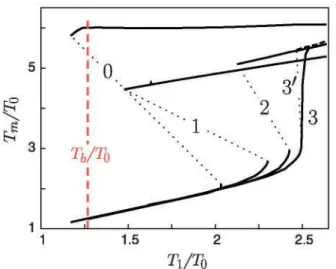
0Fig. 4. Mixing temperature at the chamber outlet scaled with T0 as a function of the inlet gas temperature scaled with T0 for Q/Qj, = 1, (p = 0.7 (0); Q/Qj, = 1, (p = 0.35 (1); Q/Qi, = 1.69, <p = 0.35 (2); Q/Q, = 2.25, <p = 0.35 (3); and Q/Q, = 2.25, (/) = 0.35 with satellite droplets (3', dashed). The upper branch of curve 3' is the short dashed segment at the right-hand side of the figure; its lower branch coin-cides with the lower part of curve 3.
The decomposition pgvg = V cpg + V x (x/zge^), with e^ a unit azimuthal vector, is carried to (8) and the curl of (9) to eliminate the pressure and obtain equations for the functions cpg and x//g. These equations are discretized together with (6) and (10)-(12) using second order finite differences, and marched in time along with (1) using second order schemes until the conditions at the chamber outlet stabilize (the flow is never strictly time-independent because discrete particles are continuously injected into the chamber). A Crank-Nicolson method is used for the viscous, diffusion and conduction terms, and an Adams-Bashforth method is used for the rest. A nonuniform 240 x 240 grid, finer around the symmetry axis and the injection orifice, and a dimensionless time step in the range 5 x 10~4-2 x 10~3 are used.
The toroidal volumes generated by rotating the grid cells around the symmetry axis are used for SV, and the time step is used for St in (13). The sums in these equations (actually in the equivalent dimensionless equations (A.14) for the particles of the particle method) are evaluated using a linear weighting particle-in-cell method [18].
The value of the numerical parameter r\ in (A.14), which is the number of droplets per particle scaled with ncL3 (see Appendix) is chosen for the mean number of particles in the computational domain to be in the order of 105, as numerical tests show that the
results are then independent of this number and of the grid. Upon convergence, the magnitudes pertaining to the droplets defined in (A.19) are averaged over 104 additional time steps.
3. Results and discussion
The mixing temperature at the chamber outlet, defined as Jo PgUgTgrdr
foPgUgrdr at X :
is shown in Fig. 4 as a function of the inlet air temperature, rl t for
various values of the flow rate of fuel and the overall equivalence ratio. The results show frozen (lower) and intense combustion (upper) branches that end at ignition and extinction points, except for curve 3, which displays a fast but continuous transition with increasing Tj. The dotted lines in the figure are not intended to represent intermediate branches, which are unstable and cannot be computed with the numerical methods used here; they are
in-L m ^ JH
0.14 0
r/L
0.14 0 0.14
r/L
Fig. 5. Results for Q/Qt = 2.25, (p = 0.35, and T, = 523 K (a), 723 K (b), 743 K (c)
and 763 K (d). Shown are the dimensionless droplet number density (5 black con-tours equispaced between 500 and 2000 plus 4 concon-tours equispaced between 10 and 300), some isotherms of the gas (red; dashed contours are for Tg < T] and
solid contours for Tg > 7"i; 6g = (Tg - T0)/(Ti - T0) is between 0.89 and 1 in (a), be-tween 0.88 and 1.27 in (b), bebe-tween 0.88 and 4.45 in (c), and bebe-tween 0.88 and 5.13 in (d)), Y, (10 grey levels between 0 (white) and 3.68 x 10⁻² in (a), 5.57 x 10⁻² in
(b), 5.96 x 10~2 in (c), and 6.36 x 10~2 in (d)), the gas-phase reaction rate (green, in (c) and (d)), the local equivalence ratio (dotted, contours 3.52y,/yo =0.25, 0.5
and 0.75, increasing toward the symmetry axis, in (c) and (d)), and gas velocity ar-rows. (For interpretation of the references to color in this figure legend, the reader is referred to the web version of this article.)
eluded just to connect upper and lower branch pairs. The ignition and extinction points shift towards lower inlet air temperatures when the equivalence ratio increases (compare curves 0 and 1). They shift towards higher inlet air temperatures, and the range of multiplicity narrows and even disappears, when the flow rate of fuel increases (sequence of curves 1-3). The mixing temperature in the upper branch increases with the equivalence ratio. For complete combustion and in the absence of heat losses, this temperature should be independent of the flow rate of fuel; the small differences shown in Fig. 4 will be discussed below.
3.1. Structure of the flow
0.14
Fig. 6. Results in the upper branch for Q_/Ch, = 1.69, cp = 0.35, and T = 623 K (a and b) and 773 K (c and d). Shown in (a) and (c) are the dimensionless droplet number
density (7 black contours equispaced between 200 and 3000), some isotherms of the gas (red; dashed contours are for Tg < T] and solid contours for Tg > 7"i; 6g =
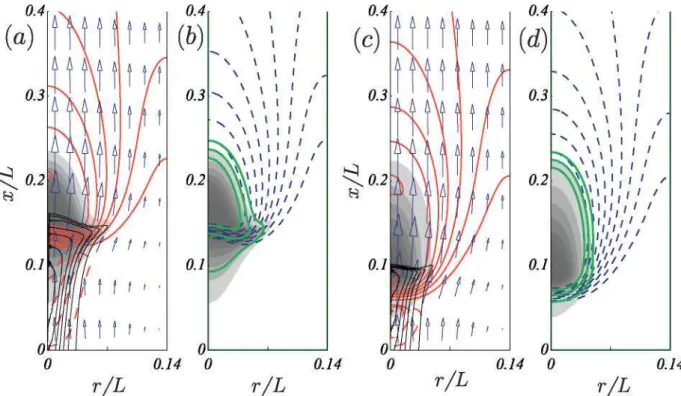
(Tg - To)/(T, - T0) is between 0.88 and 8.43 in (a), and between 0.93 and 6 in (c)), Y, (10 grey levels between 0 (white) and 4.82 x 10~2 in (a) or 1.94 x 10⁻¹ in (c)), and gas velocity arrows. Shown in (b) and (d) are Y0 (10 dashed blue contours equispaced between 0 and 0.23), the local equivalence ratio (green, contours 3.52YPIY0 = 0.2, 1 and 2,
increasing toward the symmetry axis, which act as markers of the diffusion flame), and V, (same grey levels as in (a) and (c)). (For interpretation of the references to color in this figure legend, the reader is referred to the web version of this article.)
Gomez [34]. Fly back is marked in Fig. 5(a) by the large droplet number density and the large fuel vapor concentration away from the symmetry axis in the lower part of the chamber. Fly back is due to the increase of the number of droplets in the spray when the inlet air temperature decreases and the vaporization last longer. The downward pointing electric field induced by the charge of these droplets around the injection orifice causes some newly injected droplets to fly back towards the base of the chamber.
Autoignition of the gaseous mixture generated by the vapor-ization of the spray first occurs at the top of the chamber. This leads to a lifted premixed flame that stabilizes at some distance above the spray, in a region where the velocity and tempera-ture of the fresh gas vary smoothly with streamwise distance. Vaporization in this combustion mode occurs without any effect of the heat released by the flame. The flame shifts downward, to a point of higher gas velocity, when the inlet temperature of the gas increases, because this increases the final combustion temperature and the burning velocity of the flame. Eventually the flame reaches the vaporizing spray and combustion transitions to a different mode that is described below.
Some results for QyQj, = 1.69 and (p = 0.35 (curve 2 of Fig. 4) are shown in Fig. 6. The size of the droplets and the inlet air ve-locity are smaller than in the case just discussed, and the droplets decelerate and vaporize faster. Only the lower part of the chamber is shown in Fig. 6. Fly back occurs in the lower branch at lower inlet air temperatures than before (results not displayed). Autoigni-tion of the gas mixture also occurs at a lower air temperature than before, owing to the smaller velocity of the gas. In contrast with the previous case, autoignition now leads to a jump to a state of intense combustion. The combustion mode found before for very high values of Tj exists now on the whole upper branch of curve 2. The structure of the flow in this mode consists of a lower region of intense reaction that locally depletes the oxygen and leaves
behind a ball of high temperature fuel vapor surrounded by a diffusion flame where this fuel burns with oxygen from the colder air stream that did not go through the lower reaction region. A weak lean wing flame exists in some cases that extends towards the air side from the head of the diffusion flame, but this wing is very short and does not seem to play an important role.
Combustion in the lower region occurs at the same time as vaporization, before the fuel vapor has had time to diffuse into the air stream. This fact accounts for the depletion of the oxygen in a globally lean system. The heat released by the chemical reaction increases the vaporization rate, which is faster than in the lower branch for the same value of the inlet air temperature.
The height of the lower reaction region above the injection orifice increases, and the size of the ball of high temperature fuel behind this region decreases, when the inlet air temperature decreases.
a
0.05
Fig. 7. Distributions of variables along the axis of the chamber for Q/Qt = 1.69, <t> = 0.35, and T,/T0 = 1.86, 1.96, 2.13, 2.30 and 2.47, increasing from right the left
in each figure, (a) Temperature of the gas (solid) and reaction rate (dashed, to be read off the scale at the right-hand side of the figure), (b) Fuel vapor mass fraction (solid) and oxygen mass fraction (dashed).
divergence of the spray is an effect of the electric repulsion of the droplets, as was mentioned before.
The height of the lower reaction region above the base of the chamber is controlled by the vaporization of the liquid fuel. This height is very small when Q/Qj, = 1 and (p = 0.35 (results not dis-played) because the size of the droplets and the inlet air velocity are then very small. In these conditions, the lower reaction region loses heat to the base of the chamber, which accounts for the slight defect of mixing temperature in the upper branch of curve 1 of Fig. 4.
To further assess the influence of the electric forces, com-putations have been carried out assuming that the droplets are neutralized before they enter the chamber, but they are not otherwise modified. In the dimensionless formulation of the Appendix, this amounts to setting V = 0 without changing other dimensionless parameters. Figure 8 compares results with and without droplet charge for a given set of parameter values. The lifted flame that exists with charged droplets changes to the other combustion mode when the charge is removed. The reason is that the radial dispersion of the spray is very small in the absence of charge, leading to a large concentration of fuel vapor that can sustain the locally rich lower reaction region.
Transition between the two modes can also be controlled by changing the radius of the injection orifice. The inlet velocity of the gas increases when this radius is decreased, which may lead to a
Fig. 8. Comparison of results for charged droplets (a) and uncharged droplets
(b). Values of the control parameters are Q/Qj, = 2.25, <f> = 0.35 and T] = 753 K. Shown are the dimensionless droplet number density (5 black contours equis-paced between 300 and 3500 plus 2 contours at 5 and 100), some isotherms of the gas (red; dashed contours are for Tg < T] and solid contours for Tg > 7"i;
6g = (Tg - To)/(T, - T0) is between 0.88 and 4.76 in (a), and between 0.97 and 6.29 in (!>)), V, (10 grey levels between 0 (white) and 6.16 x 10~2 in (a) or 2.38 x 10⁻¹ in
(b)), and the gas-phase reaction rate (green). (For interpretation of the references to color in this figure legend, the reader is referred to the web version of this article.)
lifted flame even for small values of the flow rate of fuel. Thus, nu-merical results for an injection orifice of radius rh = 1.9 mm, which is half the radius considered above and leads to a four fold increase of the inlet air velocity for given values of the flow rate of fuel and the overall equivalence ratio, show (results not displayed) that the single premixed flame of Fig. 8(a) is already obtained for Q/Qj, = 1.
3.2. Effect of satellite droplets
Deng and Gomez [34] indicate that this may be the case with electrosprays of heptane, the ratios of satellite-to-primary droplet radius and electric charge being about 1/3 and 1/33'2, respectively.
Due to their small size, satellite droplets carry only small fractions of the spray mass and charge, and they decelerate and vapor-ize faster than primary droplets. Additional computations have been carried out with a modified form of the injection condition (7) that accounts for satellite droplets. Denoting by a0 and e0 the
initial radius and charge of the primary droplets, and taking into account that the atomization process in an electrospray generates a sequence of alternate primary and satellite droplets, the number of droplet pairs injected per unit time is <t>' given by the volume conservation condition |jr[ao + (ao/3)3]<t>' = Q_, and the injection
condition replacing (7) is
Xj = 0, rj = rand[G(r)], i/j= vp,i 1 { ai = a0, Ti = T0, ei = e0 if i is odd I at t = . <2j = !<2o, Tj = To, ef = 3^jeo if i is evenj *- '
Some results computed with this condition for Q/Qj, = 2.25 and
(p = 0.35 are shown in Fig. 4 (curve 3'). This curve features igni-tion and extincigni-tion points, and a short range of multiplicity. The increased fuel vapor concentration due to the early vaporization of the satellite droplets favors the presence of the lower reaction region of the second combustion mode. This mode is obtained in the upper branch of curve 3' for Tj higher than about 735 K, where transition occurs to the combustion mode with a lifted premixed flame. This flame shifts upwards when Tj is further decreased, until blow off, which is the mechanism of extinction in this combustion mode, occurs at about T-[ = 715 K. When 0/0), = 1.69, 0 = 0.35, vaporization of satellite droplets reduces the height of the lower reaction region above the injection orifice, but it does not lead to significant changes in curve 2.
3.3. Effect of the simplified kinetics
The single step mechanism used in this work is a strong sim-plification of any realistic kinetics and cannot be expected to give correct results in the wide range of conditions displayed by the numerical computations. This range spans autoignition of the gas mixture downstream of the spray (at the ignition or rapid transi-tion points of Fig. 4), premixed flame propagatransi-tion [in part of the high temperature region of curves 3 and 3', and in parts of the up-per branches of curves analogous to 1 and 2 for smaller injection orifices (not shown)], and vaporization and combustion coexisting in a region of the chamber (in the second combustion mode de-scribed above). Therefore it is appropriate to discuss to what extent the computed results may be affected by the simplified kinetics.
The numerical results show that at ignition the chemical re-action first becomes important at the top of the chamber, where the spray has already vaporized and a heptane-air mixture has been formed. Since the frequency factor and activation energy of the Arrhenius reaction are determined from ignition delay time experiments at the pressure of the chamber (3 atm), the single step mechanism is expected to correctly describe the autoignition that occurs in the chamber.
Since the laminar flame speed of the single step mechanism is in good agreement with the speed computed with a detailed mechanism when (p = 0.35 (cf. Fig. 3), the results of the single step mechanism are also expected to be reasonably accurate for the mode of combustion with a lean premixed flame lifted above the vaporizing spray. This includes the prediction of extinction, when it occurs in this mode through blow off of the premixed flame.
The single step mechanism cannot give quantitatively correct results for the second combustion mode, for which vaporization and combustion coexist, and more realistic mechanism would significantly increase the numerical burden. However, this mode
of combustion appears to be robust, in the sense that the overall burning rate is determined to a large extent by the rates of va-porization and mixing, and combustion can be expected to occur whenever the chemistry is sufficiently fast to keep pace with these processes and supply the necessary heat. To test these ideas, addi-tional computations have been carried out replacing the Arrhenius law introduced in Section 2.2 with the single step mechanism of Westbrook and Dryer for heptane [30], which largely overpredicts the laminar flame speed at the pressure and temperatures of interest. The results show that when the original mechanism leads to the second combustion mode (e.g., in the upper branches of curves 0-2 of Fig. 4), the same occurs with the modified mech-anism, with only small changes in the flow field. The modified mechanism extends the upper branches of these curves to smaller values of the inlet air temperature, revealing an uncertainty in the location of the extinction point that cannot be resolved with single step mechanisms. Similar results are obtained when the upper branch of curve 0 is recomputed with the frequency factor
B multiplied by 4.84, which is the factor that brings the laminar
flame speed of the single step mechanism to agree with the flame speed of the detailed mechanism [29] for (p = 0.7. In summary, the results of the previous sections for the second combustion mode are expected to be reasonable away from the extinction point.
4. Conclusions
Steady gas-phase combustion in a mesoscale chamber fed with electrosprayed heptane and a coflow of preheated air through an injection orifice has been simulated numerically. The simulation includes the dispersion and vaporization of a dilute spray of small, electrically charged droplets of heptane and the combustion of the vaporized heptane. An Eulerian/Lagrangian method has been used that relies on the disparity of scales between the size of the droplets, the mean distance between droplets, and the size of the spray. Simple models have been used for the aerodynamic drag of the droplets, the conduction heat flux reaching their surfaces, their vaporization rate, and the loss of electric charge in Coulomb explosions. Combustion in the gas-phase has been modeled with a single step mechanism.
The effects of the inlet gas temperature (Tj), the fuel flow rate (Q) and the overall equivalence ratio ((p) have been analyzed. The mixing temperature evaluated at the chamber outlet as a function of the inlet air temperature features regions of frozen and intense combustion, with ignition and extinction values of Tj that depend on Q. and (p.
Acknowledgments
This work was supported through the Spanish MINECO projects
CSD2010-00011 and DPI2013-47372-C02-02.
Appendix A. Dimensionless problem
Problem (1)—(16) can be written in dimensionless form scaling distances (x, r) with L, times with tc = m0/Cf , where Cf = 6jr/Xg0a0, velocities with vc = L/tc, droplet masses, radii and
charges with m0, a0 and e0, the vaporization rates m;, forces Ff
and heat fluxes qgi with Cf , CfVc and Cf cp(T-[ - 7 b ) , the electric
field and electric potential with Ec and ECL, where Ec = e0ncL/e0
with nc = <t>/(fcL2), the gas density and pressure with pg0 and
pg0v2, and introducing the scaled droplets and gas temperatures ei = (Ti-T0)/(T1-T0) and 9g = (Tg - T0)/(^ - T0). Denoting the
dimensionless variables with the same symbols used before for their dimensional counterparts, the problem takes the form
Particles:
da] ~&t
, d V j
dr
-m,
sd ^
dr
•Ve,E,
-(q
gi-mC
v)
(A.1)
(A.2)
e\ decreases to (1 - a)e\ whenever e\ > eR = RaaV (A.3) with
, _mi(6gl-6i) 2 / 3
-1 - A I n1"7" Y
e X i_A > F j = - kaa j ( V j - va) 25
0—0
e x p l f t y ^ — ^ 1+18
1+K0Jka = ( l + y 0 ( )K, <?r 20,+ft,,
(A.4) where, as before, vgi, 0gi, Yfi and Et are the gas properties and the electric field interpolated to the position Xj of particle i. The injection conditions
Xj = 0, J-J = rand[G(r)], Vi = vPli
at t = ii]. (A.5)
are used, with
1 - exp (-r2/rc 2)
G(r) = T (- for r < rh,
1 - exp ( - r2/ r2) G(r) = 1 for r > rh,
where i\ = 2nCfJ;/mQ& is the number of droplets per particle scaled with ncL3.
Gas, charged residues and electric potential: 3 Pi
dt - V • ( p ^ ) = FS,
pg
lx
=~
V p +Ti
V'
T' " **
+^
P r £'
ny i
DY„ 1
Pr
Dt ^PrLe,
V • (k,VY
0)
25(A.6)
(A7)
w, (A.8)
(A.9)
Pg-
D&
1
Dt ^Pr
V . ( / ^ V ^ ) - ^ S
h+ ^ w ,
9Pr
9r
•V-[/%(!/*+ £ P E ) ] = J Sr,V2</9 = - pe - pr with E = -V</9,
with D(-)/dt = 9(.)/9t + v• V(-), pg( l + y ^ ) [ l + (18/7)YF] = l, r '
(A.10)
(All)
(A.12)
Vu,
(V^ )k
g=(\+y6
gy
and
i]
sv
ElQg r]
pgVexp
E[F(+m((Va
+ riK(0a-0()]
SV
Pe = V
vye
gE d
YYSr = /j a
(A.13)
E(ei|3Q
SrSV '
(A.14)
5V ' r e ' 5V
where the sums are now over the particles of the particle method (see Section 2.4).
The boundary conditions
= 0 :0 vg = Vg,i, 6g = \, cp
k„ 3Yf
PgUgYF
PgUgY0
R P r L ef 3x
k, SYr
Pg-i ugi'oc
for r < rh
Ve
at X :
v.
:0. 9x
0 < r = l , 5 l
9x
= o
:0
= 0,
9 «g _ 9Yf _ 3Y0 9x 9x 9x at x = 1, and
9r * dr dr at r = R, are imposed.
for rh < r < ft
(A.15)
dx
90,
dr
-.(p = 0
dip
"9?
(A.16)
(A.17)
Apart from the numerical parameter r\, the problem contains the 24 dimensionless physical parameters
V-- e
0c}ol?
pv=fhsfiL Le
A2o
T - T p ^P y
T0 ' c ' ' o o
Pb = Rfrt
m0V
J= •-Pso€!oD
71: Pl0% ca2
K,
CpPg0DF0 Le„ I, •so
"P, • JL
a, Ra
L v~ cp (T,-T0)
m°"l, n _ Kl
• c/0L • « - I
83r(c0CTa0)1 / 2 To ' '
cpftoDoo '
C/o ' A
Tfc-T„
CpTo io
T,-T0
= ? . '
C / o ^eo '
(A.18)
The asterisks in v* v* R*, r*h and r* are used to temporarily de-note dimensional magnitudes. The flow rate of heptane injected in the chamber is Q. = |jrajj<t>. The dimensionless inlet gas velocity can be written in terms of the overall equivalence ratio (p as
88 ( l + y ) . F Vg,~25n Y00r\4> '
For the base case of Section 2.3, the values of these parameters are
V = 5.064 x 1 0 -4, T = 2.715 x lCT6, K = 1.538 x l O5, Pr = 0.7,
LeF = 2.6, Le0
V = 2.205
1, cp/c
io-1 2 9b = 0.2676/y, vp
: 0.446, YF0 = 0.23, K = 0.75, f$a = 34.13, X = 134.72, ^b = 11.82, £„ = 1.246/y,
rh = 0.1, rc = 0.021, a = 0.3, Ra = 2.548, and K. = 16.345. The
variation of the dimensionless parameters with QJQj, follows immediately from the scaling laws of Section 2.3.
The mean number density, radius, density, velocity and tem-perature of the droplets are
nd = r]
Pd = r]
SV '
SV
ad.
i y >
Pd
SV '
' SV '
1
E a ^ i
Pd SV
(A.19) where S l j is the number of particles in SV.
References
[1] A.C. Fernandez-Pello, Micropower generation using combustion: issues and ap-proaches, Proc. Combust. Inst. 29 (2002) 883-899.
[2] D.C. Walther, J. Ahn, Advances and challenges in the development of pow-er-generation systems at small scales, Prog. Energy Combust. Sci. 37 (2011) 583-610.
[3] M.-H. Wu, Y. Wang, V. Yang, R.A. Yetter, Combustion in meso-scale vortex chambers, Proc. Combust. Inst. 29 (2003) 941-947.
[4] S.A. Lloyd, F.J. Weinberg, Burner for mixtures of very low heat content, Nature 251 (1974) 47-49.
[5] F.J. Weinberg, The first half-million years of combustion research and today's burning problems, Proc. Combust. Inst. 15 (1974) 1-17.
[6] A.R. Jones, S.A. Lloyd, F.J. Weinberg, Combustion in heat exchangers, Proc. R. Soc. Lond. Sen A 360 (1978) 97-115.
[7] WA. Sirignano, T.K. Pham, D. Dunn-Rankin, Miniature-scale liquid-fuel-film combustor, Proc. Combust. Inst. 29 (2002) 925-931.
[8] V. Sadasivuni, A.K. Agrawal, A novel meso-scale combustion system for opera-tion with liquid fuels, Proc. Combust. Inst. 32 (2009) 3155-3162.
[9] D.C. Kyritsis, I. Guerrero-Arias, S. Roychoudhury, A. Gomez, Mesoscale power generation by a catalytic combustor using electrosprayed liquid hydrocarbons, Proc. Combust. Inst. 29 (2002) 965-972.
[10] D.C. Kyritsis, B. Coriton, F. Faure, S. Roychoudhury, A. Gomez, Optimization of a catalytic combustor using electrosprayed liquid hydrocarbons for mesoscale power generation, Combust. Flame 139 (2004) 77-90.
[11] W Deng, J.F. Klemic, X Li, M.A. Reed, A. Gomez, Liquid fuel microcombustor using microfabricated multiplexed electrospray sources, Proc. Combust. Inst. 31 (2007) 2239-2246.
[12] A. Gomez, J.J. Berry, S. Roychoudhury, B. Coriton, J. Huth, From jet fuel to elec-tric power using a mesoscale, efficient Stirling cycle, Proc. Combust. Inst. 31 (2007) 3251-3259.
[13] L Yuliati, T. Seo, M. Mikami, Liquid-fuel combustion in a narrow tube using an electrospray technique, Combust. Flame 159 (2012) 462-464.
[14] M. Mikami, Y. Maeda, K. Matsui, T. Seo, L Yuliati, Combustion of gaseous and liquid fuels in meso-scale tubes with wire mwesh, Proc. Combust. Inst. 34 (2013) 3387-3394.
[15
[16
[17 [18 [19 [20 [21 [22 [23
[24 [25 [26 [27 [28
[29
[30
[31
[32
[33
[34
[35
F.J. Higuera, Dispersion and vaporization of a dilute spray of electrified droplets in a cofiowing hot gas - application to the vaporization chamber of a mini-combustor, J. Aerosol Sci. 91 (2016) 78-93.
A.K. Arumugham-Achari, J. Grifoll, J. Rosell-Llompart, A comprehensive frame-work for the numerical simulation of evaporating electrosprays, Aerosol Sci. Technol. 49 (2015) 436-448.
FA. Williams, Combustion theory, 2nd ed., Benjamin Cummings, Menlo Park, CA, 1985.
C.K. Birdsall, A.B. Langdon, Plasma physics via computer simulation, Taylor & Francis, New York, 1991.
R.W. Hockney, J.W Eastwood, Computer simulation using particles, Taylor & Francis, New York, 1988.
B. Abramzon, WA. Sirignano, Droplet vaporization model for spray combustion calculations, Int. J. Heat Mass Transf. 32 (1989) 1605-1618.
R. Clift, J.R. Grace, M.E. Weber, Bubbles, drops and particles, Academic Press, New York, 1978.
A. Sanchez, J. Urzay, A.L nan, The role of separation of scales in the description of spray combustion, Proc. Combust. Inst. 35 (2015) 1549-1577.
A. Linan, Theory of droplet vaporization and combustion, in: R. Borghi, P. Clavin, A. Linan, P. Pelce, G.I. Sivashinski (Eds.), Modelisation des Phenomenes de Combustion, CEA-EDF INRIA 59, Editions Eyrolles (1985), pp. 73-103.
S.S. Sadhal, PS. Ayyaswamy, Flow past a liquid drop with a large non-uniform radial velocity, J. Fluid Mech. 133 (1983) 65-81.
L Rayleigh, On the equilibrium of conducting masses charged with electricity, Philos. Mag. 14 (1882) 184-186.
J.F. de la Mora, The fluid dynamics of Taylor cones, Ann. Rev. Fluid Mech. 39 (2007) 217-243.
A. Gomez, K. Tang, Charge and fission of droplets in electrostatic sprays, Phys. Fluids 6 (1994) 404-414.
H.K. Ciezki, G. Adomeit, Shock-tube investigation of self-ignition of rc-heptane-air mixtures under engine relevant conditions, Combust. Flame 93 (1993) 421-433.
S. Jerzembeck, N. Peters, P. Pepiot-Desjardins, H. Pitsch, Laminar burning veloc-ities at high pressure for primary reference fuels and gasoline: experimental and numerical investigation, Combust. Flame 9156 (2009) 292-301. C.K. Westbrook, F.L Dryer, Simplified reaction mechanisms for oxidation of hy-drocarbon fuels in flames, Combust. Sci. Technol. 27 (1981) 31-43.
E. Fernandez-Tarrazo, AX. Sanchez, A.L nan, FA. Williams, A simple one-step chemical model for partial premixed hydrocarbon combustion, Combust. Flame 147 (2006) 32-38.
A. Giusti, M. Kotzagianni, E. Mastorakos, LES/CMC simulations of swirl-stabi-lized ethanol spray flames approaching blow-off, Flow Turbul. Combust. 97 (2016) 1165-1184.
F.J. Higuera, Neutralization of a spray of electrically charged droplets by a corona discharge, J. Fluid Mech. 801 (2016) 130-149.
W. Deng, A. Gomez, Influence of space charge in the scale-up of multiplexed electrosprays, J. Aerosol Sci. 38 (2007) 1062-1078.