Magnetic fabrics in cleaved marls and their link to
deformation processes (Southern Pyrenees, Spain)
Abstract:RT-AMS ellipsoids from Upper Cretaceous carbonate rocks in the Southwestern Pyrenees exhibit an unusual orientation for rocks within a well-cleavage domain: neither do all sites show the maximum axes in the intersection lineation nor are the minimum axes at the pole of the cleavage plane. The study of the subfabrics (LT-AMS and AARM) indicates that the paramagnetic grains (phyllosili-cates) respond to a layer parallel shortening, with the minimum axis perpendicular to S0. On the other hand, the ferromagnetic grains (magnetite) orient in relation to the strain field, which also produces the cleavage domain. The maximum axes of the ferromagnetic ellipsoids have a horizontal NNE-SSW direction. An extended version of this paper is published in Oliva-Urcia et al.(2009).
Keywords:magnetic fabrics, RT-AMS, LT-AMS, AARM, cleavage domain, Southern Pyrenees.
1University of Michigan, 1100 N. Univ. Ave., Michigan 48105, USA. 2Instituto Geológico y Minero de España, Unidad de Geología y Geofísica, Spain.
3Instituto de Ciencias de la Tierra Jaume Almera, CSIC, Barcelona, Spain.
4Universidad de Zaragoza, Spain. 5Universidad de Cadiz, Ciencias del Mar, Spain.
*e-mail: [email protected]
B. O
LIVA-U
RCIA1*, E. L. P
UEYO2, J. C. L
ARRASOAÑA3, A. G
IL4, P. M
ATA5, J. M. P
ARÉS1, A. M.
S
CHLEICHER1Magnetic fabrics analyses (RT-AMS: Room Temperature Anisotropy of the Magnetic Susceptibility) have been used since the fifties (Graham, 1954) in order to assess the petrofabric of rocks since for most minerals crystallography deter-mines both grain shape and AMS (Borradaile and Jackson, 2004). One of the goals of RT-AMS is to obtain the strain ellipsoid where few or no strain markers are present, since the magnetic fabric ellip-soid and the strain ellipellip-soid overlap (Kligfield et al., 1981). In this work we report a detailed analysis of the subfabrics of remagnetized Upper Cretaceous rocks at 9 sites from the western side of the South Pyrenean Zone (Internal Sierras, figure 1), where a
the tectonic setting. In addition, optical observations and chemical qualitative analyses with the Scanning Electron Microscope (SEM) together with High-reso-lution X-ray Texture Goniometry (HXTG) were per-formed in selected samples.
Methods
Samples (10 cores per site) were taken in the field with a portable water-refrigerated drill machine. 25 to 30 standard specimens were cut in the laboratory for each site. Room Temperature AMS (RT-AMS) analy-ses were performed in the magnetic fabrics laboratory of the University of Zaragoza using a KLY3 Kappabridge (AGICO). Three axes define the suscep-tibility ellipsoid: maximum (Kmax), intermediate (Kint)
and minimum (Kmin). Other parameters that give
information about the shape and degree of magnetic fabric development are: the magnetic lineation (L = Kmax/Kint) and the magnetic foliation (F = Kint/Kmin).
The corrected anisotropy degree, P’shows the inten-sity of the preferred orientation of minerals (total eccentricity), and the parameter Tis the shape param-eter, varying between prolate (0 > T> –1 ) and oblate ellipsoids (0 < T< 1). P’and T parameters are defined as in Jelínek (1981).
Low Temperature AMS (LT-AMS) and the Anisotropy of the Anhysteretic Remanence Magnetization
(AARM) analyses were done in the paleomagnetic lab-oratory of the University of Michigan. The LT-AMS was analyzed using a SI2B susceptometer with an inter-nal coil frequency of 19.2 kHz (Sapphire Instruments). Samples were immersed in liquid nitrogen (77 K dur-ing 30 min) and the AMS tensor was determined after 6 positions, measuring every position twice. The enhancement of the paramagnetic fabric at low tem-peratures follows the Curie-Weiss law: Xp = C/(T-Tc)
(see Parés and Van der Pluijm, 2002 for more details).
The AARM was analyzed using a SI-4 AF demagnet-izer (Sapphire Instruments). Samples are subjected to an AF demagnetization of 100 mT peak field in one position while a 0.05 mT field is applied in a window of 5-60 mT. This procedure is performed in 9 posi-tions for every sample, the remanent magnetization being measured for every position in a 2G-cryogenic magnetometer. The anisotropy tensor is calculated by the least-squares method (Girdler, 1961). The princi-pal axes of the ellipsoids were displayed on stereo-graphic projections.
Results
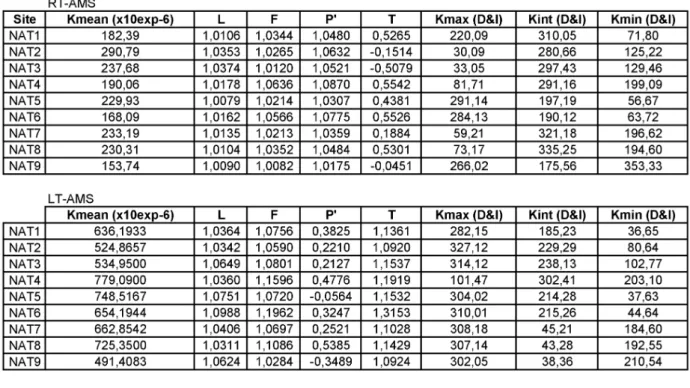
Magnetic Tensor Parameters (Km, P’, T)
RT-AMS: bulk susceptibility values (Km) range
between 150-300×10-6 (SI), see table 1, which is Figure 1.Location of the 9 sites in the thin-skin thrust system of the Internal Sierras, South Pyrenean Zone. Cross sections from Teixell and García-Sansegundo (1994).
typical for marls, fine grain sandstones and marly-limestones, where the paramagnetic fabric seems to be the dominant contributing factor although some ferromagnetic carriers may also contribute. The bulk susceptibility shows a relatively narrow range for the corresponding corrected anisotropy degree values (P’), which range between 1.01 and 1.09. The pre-dominant shape of the ellipsoid is oblate (Fig. 2) (except for sites 2, 3 and 9). Sites 4 and 6 largely show the more developed fabric followed by 8 and 1, whereas 1, 2 and 9 are the only ones with a prolate ellipsoid.
LT-AMS: the mean values of the susceptibility at low-temperature range between 500-800×10-6(SI), table
1. The enhancement of the bulk susceptibility at low temperature is between 1.8 and 4 times the suscepti-bility at room temperature. The shape of the ellipsoid is oblate (Fig 2). There is a correspondence between
the increase in the anisotropy degree (P) and the oblateness of the ellipsoid (T). The anisotropy degree (P) is high at lower temperature as expected (see Parés and Van der Pluijm, 2002) with respect to the cor-rected anisotropy degree at room temperature.
AARM: in contrast to the shape of the ellipsoid at LT,
Tvalues for the AARM indicate a prolate shape at all sites (Fig. 2 and Table 1). The prolate shape is typical for magnetite grains with grain size larger than single domain (Borradaile et al., 1999). The intensity of the AARM varies between 5 to almost 30 mA/m.
The directional characteristics of the ellipsoids (RT-AMS, LT-AMS and AARM) and paramagnetic fabric strength (HXTG) are listed below:
RT-AMS: all sites show well-developed fabrics in terms of grouping of axes in clusters, except for sites
to the intersection lineation (L1), or along a NE direction.
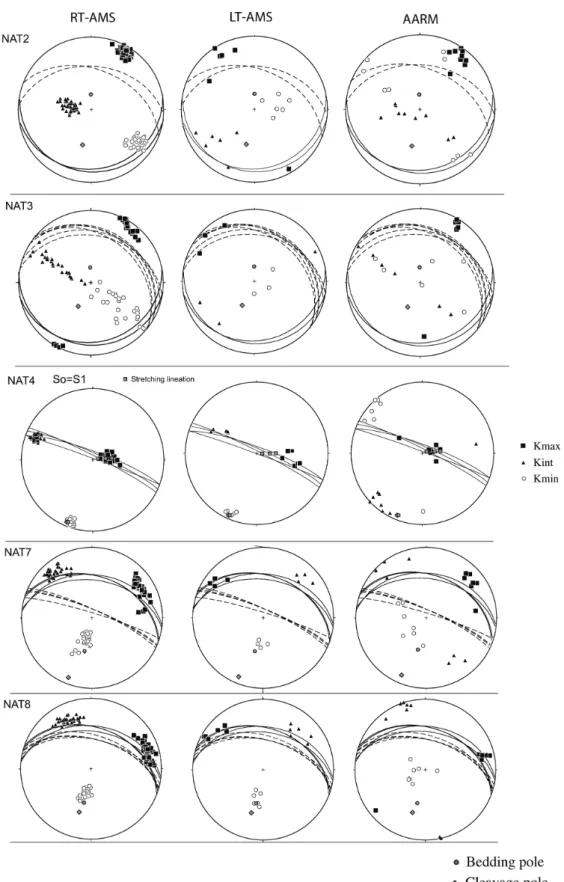
LT-AMS: the orientation of the ellipsoid remains sim-ilar in all the sites. Kmaxaxes cluster around the
inter-section lineation (L1), indicating that the long axes of the ellipsoid are both on the bedding and the cleavage planes (Fig. 3). Only in one case do Kmaxaxes coincide
with the stretching lineation as recorded in the field (site 4). Interestingly, for sites situated in a well-devel-oped cleavage area, Kminaxes cluster around the
bed-ding pole (except in site 9) whereas Kint axes cluster or tends to cluster on the bedding plane. In sites 1, 2 and 3 the grouping is less obvious but tends to be near the bedding pole except for the last mentioned.
The HXTG technique provides more information about the preferred orientation in the stacking of the phyllosilicates layers (mica and chlorite). The greater the m.r.d. (multiple of random distribution; Van der Pluijm et al., 1994) value, the better aligned the clay fabric. The strength in the stacking of the layers changes both from site to site and also between the mica and chlorite minerals. A similar range of varia-tions has been found in other shale-slate transivaria-tions with cleavage development in the slates (e.g. Ho et al., 1994). Overall, the mica minerals have a stronger fab-ric than the chlorite crystals, except for sites 4, 5 and 6, where m.r.d values for both minerals are very sim-ilar. The strongest fabric development in micas was determined at locality 4-1a (m.r.d. = 6.65).
AARM: the orientation of the ellipsoid of the rema-nent magnetization remains fairly constant, especially for the Kmaxaxes, which cluster on the bedding plane
and always along a NNE or SSW direction (Fig. 3). In sites 1, 2 and 3, Kmaxaxes fall between the bedding
and the cleavage planes, in the horizontal plane when
in situ projection is used, in the other sites Kmaxaxes
are always pseudo-parallel to the bedding plane. Except for site 4, the other sites show Kmaxaxes close
to the horizontal plane (less than 20º). The Kminaxes
tend to be either around the bedding pole (7) or clos-er to the bedding pole (1, 8), forming a girdle with Kint(2, 3, 6 and 9) or interchanging with Kint(4 and
5). In the latter case, Kmin axes cluster near the
bed-ding plane, whereas Kint axes cluster around the
bed-ding pole.
(IPG), chorite/mica being the most frequent. They are the carriers of the LT-AMS subfarbic. IPG are the result of the stacking of layers (from angstroms to microns) of phyllosilicates on (001) planes.
Iron-oxides
Rock magnetism and paleomagnetic analyses show that magnetite is the main carrier of the AARM. Concerning the nature and relative contribution of the magnetic mineralogy: 1) the acquisition of isothermal remanent magnetization (IRM) shows the presence of a soft magnetic mineral; 2) IRM of three components, giving the result of a soft magnetic car-rier with unblocking temperatures of 580 ºC, typical for magnetite; 3) low temperature curves with the Verwey transition at 120 K, also typical of magnetite (see Oliva-Urcia and Pueyo, 2007 for more details). The hysteresis loops indicate 60-70% of paramagnet-ic material present in the samples as expected from the bulk susceptibility distribution. In addition to all these data, it is necessary to mention the presence of a widespread remagnetization in the formations of the same age. The remagnetization is postfolding with an unblocking temperature range of 250-450 ºC and is carried by magnetite. The remagnetization was char-acterized in 80% of the studied sites, although a pri-mary component remains in 30% of the studied sites (see Oliva-Urcia and Pueyo, 2007 for more details).
Discussion
Two types of sites can be defined considering this data set and the orientation of the ellipsoids:
Type I: sites where the RT-AMS coincides with LT-AMS but is different from AARM ellipsoids, such as in sites 4, 5 and 6. These sites show the highest chlorite m.r.d. values. In these sites, Kminaxes are at the pole of
the bedding plane. Kmaxaxes are parallel to the
intersec-tion lineaintersec-tion except for site 4, where they are parallel to a vertical stretching lineation, measured in the field.
Type II: sites where RT-AMS coincides with AARM but is different from LT-AMS ellipsoid. Sites 1, 2, 3, 7 and 8 fit in this group although two subgroups can be defined here: IIa) sites where Kmaxis on the
References
AUBOURG, C., ROCHETTE, P. and VIALON, P. (1991): Subtle stretching lineation revealed by magnetic fabric of Callovian-Oxfordian black shales (French Alps). Tectonophysics, 185: 211-223.
AUBOURG, C., ROCHETTE, P. and BERGMÜLLER, F. (1995): Composite magnetic fabric in weakly deformed black shales. Phys. Earth Planet. In., 87: 267-278.
AUBOURG, C., FRIZON DE LAMOTTE, D., POISSON, A. and MERCIER, E. (1997): Magnetic fabrics and oblique ramp-related folding: A case study from the western Taurus (Turkey). J. Struct. Geol., 19, 8: 1111-1120.
BORRADAILE, G. J., WERNER, T. and LAGROIX, F. (1999): Magnetic fabrics and anisotropy-controlled thrusting in the Kapuskasing Structural Zone, Canada. Tectonophysics, 302: 241-256.
BORRADAILE, G. J. and JACKSON, K. (2004): Anisotropy of mag-netic susceptibility (AMS); magmag-netic petrofabrics of deformed rocks. Geol. Soc. Spec. Publ., 238: 299-360.
CHOUKROUNE, P. (1976): Structure et évolution tectonique de la zone nord-pyrénéene: Analyse de la déformation dans une portion de la chaîne à schistosité subverticale. Mem. Soc. Géol. Fr., 127: 1-116.
CHOUKROUNE, P. and SEGURET, M. (1973): Carte Structurale des Pyrénées. ELF-ERAP, Mission France, Boussens.
GIRDLER, R. W. (1961): The measurement and computation of anisotropy of magnetic susceptibility in rocks. Geophys. J. Roy. Astr. S., 5: 34-44.
GRAHAM, J. W. (1954): Magnetic susceptibility anisotropy, an unexploited petrofabric element. Geol. Soc. Am. Bull., 65, 12, 2: 1257-1258.
shows an intermediate orientation between LT-AMS and AARM. AARM shows an interchange between Kintand Kminwith respect to the other sites.
In most cases, LT-AMS ellipsoids have the Kmaxaxes
grouped perpendicular to the shortening direction in the intersection lineation (L1) and Kminin the bedding
pole, showing no relationship with the cleavage orien-tation. They follow the typical fabric pattern related to layer parallel shortening (Aubourg et al., 1997; Parés et al., 1999; Larrasoaña et al., 2004). The cleavage is developed afterwards without significant alteration of the phyllosilicate inherited magnetic fabric as in Aubourg et al.(1997). On the other hand, the AARM ellipsoids show a more complex relationship with the two petrofabric planes (bedding and cleavage). On the one hand Kmaxaxes group on the bedding plane near
the horizontal or the horizontal (in situ projection) except site 4 and, on the other, Kmaxaxes group
follow-ing a NNE-SSW direction. This orientation corre-sponds to the transport direction of thrusts and the lin-eations measured on ramps and on N-dipping cleavage planes in the tectonic setting of the area. These thrust units are prior to the development of the regional cleav-age domain (Choukroune and Seguret, 1973; Teixell et al., 2000). The stretching direction related to the tec-tonic transport direction has been postulated to inter-pret anomalous orientations of the RT-AMS ellipsoid and is carried for detrital titanomagnetites, whereas the phyllosilicates retain the orientation of the LPS prior to stretching; so a competition between these two fabrics occur, producing in some cases the scattering of the Kmaxaxes (Aubourg et al., 1991; 1995).
deformation history of the studied rocks require a meticulous study of the subfabrics and magnetic min-eralogy in order to properly interpret the petrofabric and its relationship to strain. The total fabric (RT-AMS) neither has a common pattern nor follows the typical orientation for a well-developed cleavage domain area. From this multidisciplinary approach, we can conclude:
The ferromagnetic grains (magnetite) control the low-field susceptibility (RT-AMS). There is a pre-dominance of sites where AARM ellipsoid mimics RT-AMS. Only in 2 sites (5 and 6) does the LT-AMS coincide with the RT-AMS (probably due to the pre-dominance of chlorite).
The preferred orientation of the paramagnetic grains is related to an early phase of syn-sedimentary com-pression (layer parallel shortening during the Upper Cretaceous). The ferromagnetic fabric due to mag-netite is related to the shear/stretching direction, as shown by the grouping of Kmax axes in the NNE
direction.
Acknowledgements
KLIGFIELD, R., OWENS, W. H. and LOWRIE, W. (1981). Magnetic susceptibility anisotropy, strain, and progressive deformation in Permian sediments from the Maritime Alps (France). Earth Planet. Sc. Lett., 55: 181-189.
LARRASOAÑA, J. C, PUEYO, E. L. and PARÉS, J. M. (2004): An inte-grated AMS structural, paleo- and rock-magnetic study of the Eocene marine marls from the Jaca-Pamplona basin (Pyrenees, N Spain); new insights into the timing of magnetic fabric acquisition in weakly deformed mudrocks. In: F. MARTÍN-HERNÁNDEZ, C. M. LÜNEBURG, C. AUBOURGand M. JACKSON(eds): Magnetic fab-ric, methods and applications. Geol. Soc. Spec. Publ., 238: 127-143.
OLIVA-URCIA, B. and PUEYO, E. L. (2007): Rotational basement kinematics deduced from remagnetized cover rocks (Internal Sierras, southwestern Pyrenees). Tectonics, 26, TC4014, doi:10.1029/2006TC001955.
OLIVA-URCIA, B., LARRASOAÑA, J. C., PUEYO, E. L., GIL, A., MATA, P., PARÉS, J. M., SCHLEICHER, A. M. and PUEYO, O. (2009): Disentangling magnetic subfabrics and their link to defor-mation processes in cleaved sedimentary rocks from the Internal Sierras (west central Pyrenees, Spain). J. Struc. Geol.,31: 163-176.
(1999): Evolution of magnetic fabrics during incipient deforma-tion of mudrocks (Pyrenees, northern Spain). Tectonophysics, 307: 1-14.
PARÉS, J. M. and VAN DERPLUIJM, B. (2002): Evaluating magnet-ic lineations (AMS) in deformed rocks. Tectonophysics, 350: 283-298.
TEIXELL, A. and GARCÍA-SANSEGUNDO, J. (1994): Mapa Geológico de España, Escala 1:50 000, 2ª serie, Hoja n° 118: ZURIZA. Instituto Tecnológico Geominero de España, Madrid.
TEIXELL, A., DURNEY, D. W. and ARBOLEYA, M. L. (2000): Stress and fluid control on decollement within competent limestone. J. Struct. Geol., 22: 349-371.