Co-axial refolding and inverted regional metamorphism
in the Tonga formation: Cretaceous accretionary thrust
tectonics in the Cascades crystalline core
Abstract: The Cascades crystalline core forms part of the Cretaceous magmatic belt of western North America and exposes a crustal section composed of primarily tonalitic plutons that intruded siliciclas-tic metasediments of an arc-derived accretional system, and local meta-basalt/chert sequences. This study is the first attempt to correlate the well-understood intrusive and P-T-t history of the metasedi-mentary and plutonic terrane with the kinematics and tectonic boundary conditions by rigorous analy-sis of structures documented in the Tonga formation exposed at the western edge of the core. The Tonga formation comprises pelite-psammite metasediments, which increase from greenschist (~300-350 °C) to amphibolite grade (~500-600 °C) from south to north. This metamorphic gradient is inverted relative to a major westward-verging and downward-facing fold system that dominates the internal architecture of the formation and implies that the initial regional metamorphic signature was established prior to the early fold generation. Subsequent co-axial fold superposition is seen as a con-sequence of the persistent accretional W-vergent thrusting in the foreland of the magmatic arc.
Keywords: fold, interference, co-axial, Cascades, Tonga.
1Dept. of Earth Sciences, University of Southern California, Los Angeles, CA, USA.
2Marathon Oil Company, Houston, TX, USA.
3Geology Department, San Jose State University, San Jose, CA, USA.
4Dept. of Earth & Planetary Sciences, Macquarie University, Sydney, Australia.
*Now at: Shell International Exploration & Production, Inc., e-mail: [email protected]
L. A. J
ENSEN1*, H. L
EBIT2, S. P
ATERSON1, R. M
ILLER3ANDR. V
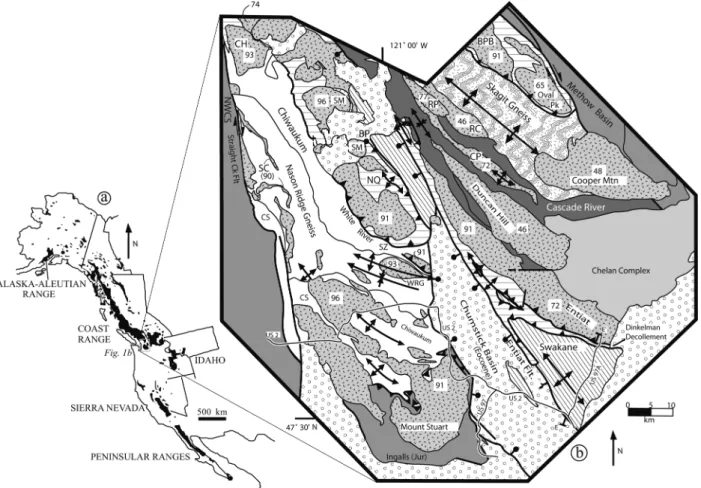
ERNON4The central section of the Cascades Range, exposed in Washington state, forms part of the Cretaceous accre-tional/magmatic arc extending over 4,000 km along western North America from Baja California to British Columbia (Fig. 1a) (e.g. Misch, 1966; Brown, 1987; Tabor et al., 1989). Two models exist for the evolution of the Cascades crystalline core with one invoking magmatic loading (e.g. Brown and Walker, 1993) as the major cause for rapid loading, conse-quent regional metamorphism and vertical uplift (Evans and Berti, 1986). Conversely, other workers
east (Miller and Paterson, 1992; Miller et al., 1993; Paterson and Miller, 1998; Miller et al., 2006). Building on previous extensive mapping and meta-morphic and petrologic analysis in the Cascades, we use the Tonga formation as a means to a comprehen-sive tectonic synthesis incorporating detailed analysis of the kinematics and timing of structural evolution, magma emplacement, and metamorphism.
Geological setting
The Cascades crystalline core is divided into two major domains, the Wenatchee block to the west and Chelan block to the east, which are separated by the brittle, Eocene Entiat fault (Fig. 1b). Both domains are characterized by voluminous tonalitic intrusions of Cretaceous ages in the Wenatchee domain and
Cretaceous to Eocene ages in the Chelan domain (Matzel, 2004; Miller et al., 2006). The predominant country rock in the Wenatchee domain is the Chiwakum schist, a Late Jurassic-Early Cretaceous siliciclastic sequence probably derived from a volcanic arc (Duggan and Brown, 1994; Brown and Gehrels, 2007), and revealing a multi-stage history of deforma-tion and contact and regional metamorphism. Amphibolite-grade regional metamorphism (M1), which is poorly preserved in other parts of the Wenatchee block, is accompanied by intense regional deformation and isoclinal folding. Extensive pluton-ism represented by the Mt. Stuart batholith and relat-ed intrusives generatrelat-ed contact metamorphism (M2). An increase in pressure on the contact assemblages and the formation of high-pressure mineral phases occurred, reflected by a second, well-expressed phase
of regional metamorphism (M3), indicating substan-tial loading (Brown and Walker, 1993; Evans and Davidson, 1999; Stowell et al., 2007).
Analysis
Tonga formation
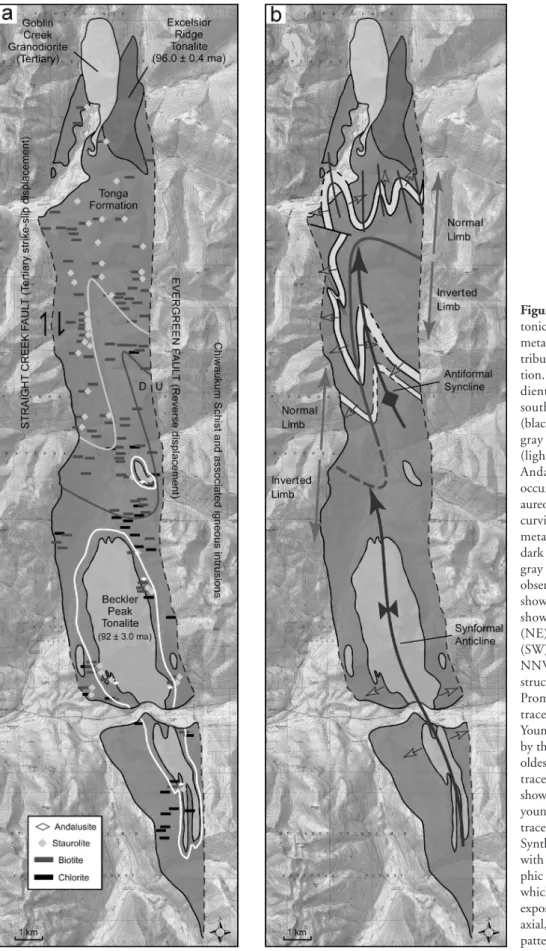
The Tonga formation is exposed in a fault-bound-ed, N-S elongate tectonic domain that comprises pelite-psammite metasediments ranging from greenschist to amphibolite grade (Fig. 2a). Metamorphic grade increases roughly from south to north across sigmoidally curved, acute metamor-phic isograds, indicating a metamormetamor-phic gradient that is inverted relative to a major westward-verg-ing and downward-facwestward-verg-ing fold system that domi-nates the internal architecture of the formation (Fig. 2b). Metamorphic index mineral occurrences were compiled from this and previous studies (Yeats, 1958; Heath, 1971; Duggan, 1992; Tabor
et al., 1993), and associated isograd maps were constructed on the basis of the occurrence of chlo-rite to the south, andalusite and localoverprinting staurolite within pluton aureoles, and staurolite (with the absence of chlorite or any contact meta-morphic minerals) to the north. Based on bulk rock composition of the Tonga formation using the original samples obtained for Rb-Sr analysis (cour-tesy of Ned Brown, Western Washington University), a pseudosection was constructed (courtesy of Michael Brown and Tim Johnson, University of Maryland) in order to examine the P-T-t history synergistically with the observed defor-mation and structures.
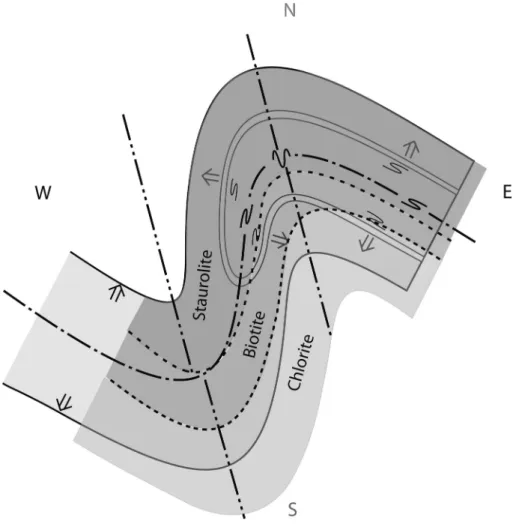
Unlike in the neighboring, more highly metamor-phosed meta-sediments to the east (i.e. the Chiwaukum Schist), sedimentary structures are remarkably well-preserved in the Tonga formation. Recognizable depositional features, including graded bedding, laminae, rip-up clasts, and flute casts, allowed for the determination of younging directions throughout the unit. These features are particularly evident in the lower section of the Tonga formation, which crops out as decameter-scale meta-sandstones used as the primary marker horizon to track the fold-ing patterns (Fig. 2b). Usfold-ing facfold-ing directions and bedding-cleavage relationships, detailed field map-ping indicates a stratigraphically overturned section that forms a large-scale antiformal syncline(exposed in the NE domain) and related synformal anticline(SW domain). The overturning of the strata and the geom-etry of gently N-plunging minor folds imply up-sec-tion a pre-existing tight, recumbent anticline refolded into a co-axial (Type III) fold interference pattern (Fig. 3). The core of this early anticline, exposed in the northern domain, corresponds with the higher metamorphic conditions of the inverted phic gradient and early Cascades regional metamor-phism, rarely decipherable in the adjacent Chiwaukum schist. In the latter, the M1 phase is largely obscured due to overprinting by later high-grade regional metamorphism (M3), related to its deeper Mesozoic burial and crustal loading within the accretional/magmatic arc complex.
Discussion
The co-axial, superposed folding in the Tonga forma-tion and the overall N-S arrangement of the
stituent fold generations suggests a strong component of E-W shortening in the foreland of the Cascades core. The initial folding may correspond to the initi-ation of subduction processes and related accretion in the sedimentary wedge. The first, isoclinal fold gener-ation is exposed in the Tonga formgener-ation primarily as a large overturned limb, as a preserved expression of a much larger fold system whose deeper and more internal levels are observed to the east (e.g. Chiwaukum schist). The overturned geometry in conjunction with the observed inverted metamorphic zonation, implies that the regional metamorphic (M1) signature was established prior to or immediate-ly preceded the earimmediate-ly fold generation (Fig. 4). The metamorphic isograds were observed to cut up-sec-tion across the meta-sedimentary sequence such that horizontally restored isograds suggest bedding initial-ly inclined towards the east. Such dip would be in accordance with the eastward polarity of Cretaceous subduction and an early accretionary geometry in the Cascades.
The isoclinal folds and related inverted regional meta-morphic zonation are superposed by a generation of
close, upright, W-vergent folds. The axial trends of both fold generations are sub-parallel, resulting in a Type III fold interference pattern. This type of approximately co-axial fold superposition is common in accretionary systems and intense fold-and-thrust belts dominated by nappe tectonics (e.g. Alps). Such systems display successive fold generations that express repeated instability and amplification within a persistent bulk kinematic regime, again implying an E-W-oriented contractional system for the Cascades. The late fold generation also appears to control the emplacement of magmatic intrusions in the Tonga formation, as plutons are localized along and elongate parallel to the regional fold hinges. The hook- or mushroom-shaped map pattern of the Mt. Stuart igneous intrusion (Fig. 1b) serves as an example of such a relationship where episodes of magma intru-sion correlate with different regional folding events (Miller et al., 2006).
The central and southern portion of Tonga formation records subsequent contact (M2) and regional (M3) metamorphism, and appears to be a lower-grade equivalent of the Chiwaukum schist, as protoliths and
References
BROWN, E. H. (1987): Structural geology and accretionary histo-ry of the Northwest Cascades System, Washington and British Columbia. Geol. Soc. Am. Bull., 99: 201-214.
BROWN, E. H. and WALKER, N. W. (1993): A magma-loading
model for Barrovian metamorphism in the Southeast Coast Plutonic Complex, British Columbia and Washington. Geol. Soc. Am. Bull., 105: 479-500.
BROWN, E. H. and GEHRELS, G. E. (2007): Detrital zircon
con-straints on terrane ages and affinities and timing of orogenic events in the San Juan Islands and North Cascades, Washington. Can. J. Earth Sci., 44: 1375-1396.
DUGGAN, K. M. (1992): Regional significance of the Tonga Formation, North Cascades. MSc Thesis, Western Washington University, Bellingham, Washington, 130 pp.
DUGGAN, K. M. and BROWN, E. H. (1994). Correlation of the
Tonga Formation and the Chiwaukum Schist, North Cascades, Washington; implications for Late Cretaceous orogenic mecha-nisms. Tectonics, 13: 1411-1424.
EVANS, B. W. and BERTI, J. W. (1986): Revised metamorphic
his-tory for the Chiwaukum Schist, North Cascades, Washington. Geology, 14: 695-698.
EVANS, B. W. and DAVIDSON, G. F. (1999): Kinetic control of metamorphic imprint during synplutonic loading of batholiths; an example from Mount Stuart, Washington. Geology, 27: 415-418.
HEATH, M. T. (1971): Bedrock geology of the Monte Cristo area, North Cascades, Washington. PhD Thesis, University of Washington, Seattle, Washington, 164 pp.
MATZEL, J. P. (2004): Rates of tectonic and magmatic processes in
the North Cascades continental magmatic arc. PhD Thesis, Massachusetts Institute of Technology, Cambridge, Massachusetts, 249 pp.
MILLER, R. B. and PATERSON, S. R. (1992): Tectonic implications of syn-emplacement and post-emplacement deformation of the Mount Stuart batholith for mid-Cretaceous orogenesis in the North Cascades. Can. J. Earth Sci., 29: 479-485.
MILLER, R. B., BROWN, E. H., MCSHANE, D. P. and WHITNEY,
D. L. (1993): Intra-arc crustal loading and its tectonic implica-tions, North Cascades crystalline core, Washington and British Columbia. Geology, 21: 255-258.
MILLER, R. B., PATERSON, S. R., LEBIT, H., ALSLEBEN, H. and
LÜNEBURG, C. (2006): Significance of composite lineations in the
mid- to deep crust: a case study from the North Cascades, Washington. J. Struct. Geol., 28: 302-322.
MISCH, P. (1966): Tectonic evolution of the Northern Cascades of Washington State; a west-Cordilleran case history. Can. I. Min. Metall. (Spec. Vol.), 8: 101-148.
PATERSON, S. R. and MILLER, R. B. (1998): Magma emplacement during arc-perpendicular shortening: an example from the Cascades crystalline core, Washington. Tectonics, 17: 571-586.
PATERSON, S. R., MILLER, R. B., ALSLEBEN, H., WHITNEY, D. L.,
VALLEY, P. M. and HURLOW, H. (2004): Driving mechanisms for
>40 km of exhumation during contraction and extension in a con-tinental arc, Cascades core, Washington. Tectonics, 23: TC3005.
STOWELL, H. H., BULMAN, G. R., ZULUAGA, C. A., TINKHAM, D. K., MILLER, R. B. and STEIN. E. (2007): Mid-crustal Late
Cretaceous metamorphism in the Nason terrane, Cascades crys-talline core, Washington, USA: Implications for tectonic models. In: R. D. HATCHERJR., M. P. CARLSON, J. H. MCBRIDEand J. R. MARTÍNEZ-CATALÁN(eds): 4-D Framework of Continental Crust. Geol. Soc. Am. Memoir, 200: 211-232.
TABOR, R. W., HAUGERUD, R. A., BROWN, E. H., BABCOCK, R. S.
and MILLER, R. B. (1989): Accreted terranes of the North Cascades Range, Washington - Spokane to Seattle, Washington, July 21-29, 1989. In: 28th International Geological Congress, Field Trip Guidebook T307, 62 pp.
bulk rock composition of each unit are also similar (Tinkham, 2002). Exposure of the Tonga formation’s bounding faults is limited, but the observed structur-al and metamorphic relationships suggest that a late, E-dipping reverse fault (Evergreen fault) placed the deeper, higher-grade Chiwaukum schist adjacent to the lower-grade Tonga formation.
Conclusions
The Tonga formation provides a unique geological unit for understanding the interplay between defor-mation and metamorphism within the Cretaceous arc system of western North America. Within the Tonga formation, excellent marker beds and preserved sedi-mentary younging directions, distinct within the
TABOR, R. W., FRIZZELL, V. A., BOOTH, D. B., WAITT, R. B., WHETTEN, J. T. and ZARTMAN, R. E. (1993):Geologic map of the
Skykomish River 30- by 60-minute quadrangle, Washington. U.S. Geological Survey, Miscellaneous Investigations Series Map I-1963, scale 1:100 000.
TINKHAM, D. K. (2002): MnNCKFMASH phase equilibria, gar-net activity modeling, and gargar-net Sm-Nd chronology: applications to
the Waterville Formation, Maine, and south-central Nason terrane, Washington. PhD Thesis, University of Alabama, Tuscaloosa, Alabama, 234 pp.