
Effectiveness of HIV prevention for women: What is working?
28
0
0
Texto completo
(2) TITLE PAGE: Effectiveness of HIV prevention for women: What is working? ABSTRACT. The HIV-AIDS remains a public health problem which disproportionally affects women. However, prevention strategies have rarely considered their specific efficacy for them. For this reason, this study examines the differential effectiveness of six intervention elements based on socio-cognitive theories addressing young women. A controlled between-groups design examined the change in risk profile among 167 young Spanish women (mean age: 21.3 years old) involved in five sexual risk prevention interventions (informative talk, attitudinal discussion, role-play, fear induction and informative website) and one control non-intervening group (waiting list). Our findings support the differential efficacy of some HIV preventive intervention elements comparing others for women. In particular, the attitudinal discussion stands out followed by the informative talk and the role play. Contrarily, the fear induction component did not reveal relevant improvements. This study provides new evidence related to HIV prevention. Particularly, the higher efficacy of motivational components for these young Spanish women is revealed. KEYWORDS: Spanish women; differential effectiveness; HIV-AIDS prevention; intervention elements..
(3) RESUMEN El VIH-Sida supone un problema de salud que afecta, desproporcionadamente, a las mujeres. Sin embargo, los programas preventivos raramente han considerado el impacto específico que, sobre ellas, ha tenido. Por este motivo, este estudio examinar la eficacia diferencial de seis elementos (charla informativa, discusión actitudinal, juego de roles, inducción al miedo y web informativa) de intervención dirigidos a mujeres basados en teorías sociocognitivas. Mediante un estudio controlado de comparación entre grupos se examinó el cambio en el perfil de riesgo de 167 mujeres jóvenes españolas (promedio de edad: 21,3 años) que participaron en cinco intervenciones dirigidas a prevenir conductas sexuales de riesgo (charla informativa, discusión actitudinal, juego de roles, exposición al miedo y una web) además de un grupo control sin intervención (en lista de espera). Nuestros hallazgos apoyan la eficacia diferencial de unos elementos de intervención para prevenir el VIH en comparación con otros en el caso de las mujeres. En particular, destaca la discusión actitudinal (basada en componentes motivacionales) seguido de la charla informativa (que incluía conocimientos básicos) y el juego de roles (basado en el componente de habilidades). Por el contrario, la exposición al miedo no reveló mejoras importantes. Este estudio aporta nuevas evidencias relacionadas con la prevención del VIH. En concreto, con la mayor eficacia de los componentes motivacionales para esta muestra de mujeres jóvenes españolas..
(4) INTRODUCTION The HIV-AIDS epidemic and the rates of STI remain a major public health problem around the world; women are increasingly suffering the consequences as their prevalence has augmented1. Commonly, women are at a greater risk of heterosexual transmission of HIV because of their biological predisposition but, mainly, as a consequence of gender inequality2. For example, in many countries, women deal with more barriers to negotiate condom use and are more likely to be subjected to nonconsensual sex3,4. Spain is less affected from the feminization of HIV compared to other countries of the world but, in relation to sexual infections, it occupies one of the most disturbing positions in Europe5. In this country, new HIV infections normally occur among young people who, frequently, have had a secondary school education or a higher degree. Moreover, as is the case the world over, HIV-AIDS affects men and women differently6. However, most of these women are unaware or show a relaxed attitude regarding the need for safe sexual behavior7. In particular, Spanish girls have a self-informed misconception about HIV-AIDS, reveal attitudes conducive to risk and unsafe practices in their sexual behavior8,9. Specifically, Spanish women usually show a higher risk perception or knowledge than men, but most of the times they reveal fewer safer behaviors, such as condom use10. Gras, Soto and Planes (2002) revealed in a study among Spanish young people, that fifty percent of women did not systematically use condoms in their sexual encounters. This could be explained by perceived barriers in women to condom use11. Moreover, women have shown greater self-efficacy in dealing with condom use in public situations compared to private ones12. This would modulate the use of condoms for women, added to other intrapersonal variables such.
(5) as attitudes, norms and some characteristics of relationships13. In particular, there are diverse situations which affect women and influence sexual behavior, such as partnerinduced violence14 or dissatisfaction with their body image15. In addition, cultural values which promote gender inequality norms (such as machismo) make difficult for women practicing safe sex16. Therefore, gender seems to be a significant influence on the progress of the epidemic17,18,19. Nevertheless, common prevention strategies have rarely considered women’s particularities20,21,22 and traditional models in HIV prevention may be inadequate for women19. Certainly, there are some efforts to improve the effectiveness of HIV prevention aimed at women through peer programs designed for women. A study among young women23 revealed the effectiveness of a single session based on sociocognitive models which included components of information, attitudes and skills practice compared to an informative single-session. In this context, the effectiveness of a computer-based HIV intervention was also revealed with a small group session mainly focuses on HIV risk-reduction knowledge, condom use and relationship abilities by modeling the skills24. In addition, the effectiveness of a skills training program was exposed for young women25, compared to a general health promotion program, which included components of information, attitudes and abilities to condom use and negotiation. In this sense, another study got better results through a program, based on Social Cognitive Theory and Theory of gender and power, which contained individual, relational, social and structural components in relation to a STD/HIV prevention video26. In particular, there have also been some experimental studies addressed to women in which specific prevention (based on socio-cognitive models) have revealed moderate efficacy for many of the risk factors27. Certainly the higher effectiveness of comprehensive programs has been supported28,29. However, there are.
(6) serious limitations to include that type of conditions because of the lack of economical and timing resources addressed HIV prevention. Therefore, most of the HIV preventive agents need to design cost-effective and useful prevention programs30, prioritizing the most effectiveness intervention components. In light of this, if we consider the gap of knowledge about the differential effectiveness among these intervention elements for young women, it should be necessary studying in depth. For this reason, our research analyzes the modulating effect of five intervention elements on HIV/AIDS risk behavior among Spanish young women through the following hypotheses. Considering these aspects, the hypotheses which have based our study are the following: 1.- Young women participants involved in intervention condition will improve more HIV prevention variables than young women who are involved in a non-intervention group (waiting list). 2.- Young women participants involve in informational component (talk or website group) will improve more their HIV knowledge than young women implicate in motivational and behavioral skills components. 3.- Young women participants who take part in motivational component (attitudinal discussion or fear induction) will reveal better HIV prevention attitudes than women involve in informational and behavioral skills components. 4.- Young women participants included in behavioral skills component (role-play group) will show more safe behaviors than participants involve in informational and motivational components. METHOD Participants.
(7) This study included the participation of 167 young Spanish women recruited voluntarily by advertising in local press of Castellón and Valencia (both in Spain) and on the website of UNISEXSIDA (the research lab of HIV-AIDS prevention belongs to Universitat Jaume I). These advertisements announced the possibility to participate in this research which was developed in publicly-funded universities (Universitat Jaume I and Universitat de València) and the opportunity to get economical compensation. The participants’ mean age was 21.3 years old (SD=2.28) and, regarding sexual orientation, they self-identified as heterosexual (92%), homosexual (5%) or bisexual (2.5%); 2.5% chose not to answer this question. All of them had studied secondary school and selfidentified as the middle-class. Measure The AIDS Prevention Questionnaire (Ballester, Gil, Guirado & Bravo, 2004) examines psychosocial risk indicators of HIV/AIDS transmission according to the main sociocognitive models31,32,33. All participants completed the pre-test version (65 items) and the post-test version (54 items), which is shorter because it does not include certain dispositional variables. Both of them explore knowledge, beliefs, attitudes, selfefficacy, behavioral intentions and informed behavior about HIV/AIDS topics (ways of getting infected, prevention methods, HIV-AIDS consequences and social solidarity). Regarding information, there are 12 items including yes/no questions and Likert scales which explore transmission routes, preventive methods, the infection process in seropositive people, HIV testing and HIV treatment. In particular, there are items such as “Contraceptive pill protects women from HIV infection (yes/no)” or “Mosquito” bite is a transmission route for HIV (yes/no)”. On the topic of attitudes, there are 8 items which evaluate health relevance by Likert scale (Is health important for you from a value of 0 to 10-?), seriousness of HIV-AIDS (“In your opinion, AIDS is a disease.
(8) which is: light, moderate, serious, deadly”), or condom perception (“Do you trust in the use of condom? Not at all, a bit, quite a lot, a lot”), which is also examined by multiplechoice question. Self-efficacy is evaluated by examining how women cope with seven risky situations according to the Likert scale, ranging from 0 (Absolutely disagree) to 6 (Totally agree). For example, “Remember even if you use alcohol or other drugs”, “Feeling comfortable by putting a condom on” or “Stop at the moment of greatest excitement to use it”. In addition, there are two items focusing on condom use “In a scale ranging from 0 (not at all) to 100 (totally), to what extent are you able to use condom?”). Six Likert scales are related to risk and perceived fear, for example, “In your opinion what are the probabilities of getting infected by HIV? From 0 –none- to 100 -lot-”. Preventive behavior intention was assessed by Likert scales in different practices (vaginal sex, oral sex and anal sex, casual and steady partner and after consuming drugs) ranging from 0 (never) to 3 (always), a general question (Would you use a condom next time? ranging from 0-no- to 100-yes, very much -) and a multiplechoice question (In case you have a possible sexual intercourse and you don’t have condom: I would practice sex, I would practice sex but avoiding risky behaviors, I would avoid having sex, I would search for a condom to practice sex). Preventive behavior was evaluated through Likert scales for different sexual acts (vaginal sex and anal sex, casual and steady partner and after consuming drugs) ranging from 0 (never use condom) to 3 (always use condom). Additionally, the questionnaire explores situational factors related to risky sexual behavior through yes/no questions (Were you concerned about your risky practice?). HIV testing is explored through 9 items, yes/no questions (“Have you had a HIV test?” “Are you going to test soon?”) and open questions (“Indicate the main advantages of testing for HIV”). Finally, the questionnaire explores solidarity through 5 items, multiple choice (If you realize your friend is.
(9) seropositive: I would meet him/her more frequently, I would avoid meeting him/her, I would be the same, I would not meet them at all), Likert scale (In a scale from 0 to 100, To what extent should society be more supportive and sympathetic with seropositive people?) and the yes/no question (Would you take care of an infected friend?). For this study, we only analyzed four items related to information about sexual transmission routes (Likert scale ranging from 0-none- to 4 –a lot-), perceived fear of HIV-AIDS (Likert scale ranging from 0-none- to 100 –a lot-), condom confidence (Likert scale ranging from 0-none- to 4 –a lot-) and safe behaviors for different acts (vaginal and anal sex) and relationships (steady and casual partner). To analyze this item we have grouped the answers into two categories: (1) “safe sex behavior” includes “always use condoms” and “not engaging in risky sex behavior” and (2) “risky sex behavior” includes using condom “rarely” and “sometimes”. The questionnaires revealed psychometric appropriateness34 internal consistency (Cronbach’s alpha of 0.700) and test-retest reliability (correlation of 0.830). Study design Young women participated in a randomized control trial in which they were distributed in groups according to 6 conditions (5 brief intervention conditions and 1 nonintervention condition). Recruitment. Two hundred women were recruited by advertising in local press and the website of UNISEXSIDA. They were informed in our lab about the study (objective, method, role of participants and ethical issues) and they were asked to participate. They gave us their informed consent and took part in the study. For this participation, women had to meet the following inclusion criteria: (a) young age and (b) Spanish ethnicity (c) having sexual experience. Finally, 167 women were interested in taking part in experimental components and evaluations. Participants completed measures at baseline.
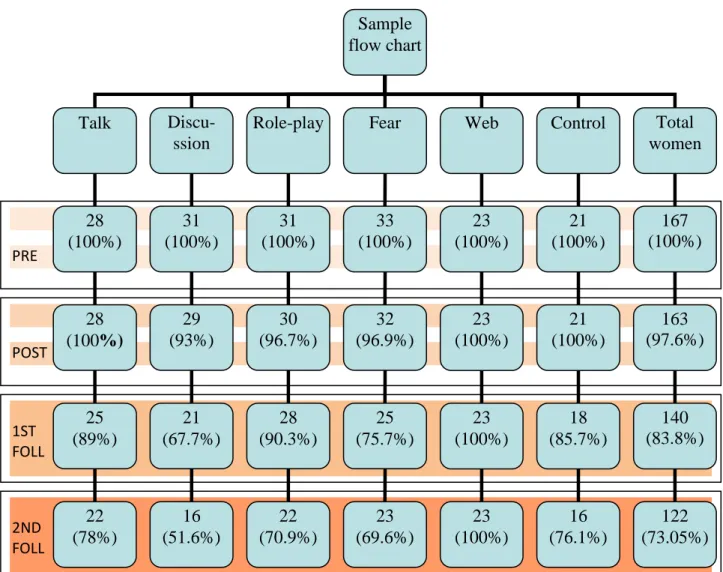
(10) (100%), post-test (97.6% of them), after 1 month at first follow up (83.8%) and 4 months afterwards at the second follow-up (73.05%) (see Figure I). They were paid 10 € each for completing the study. In addition, the possibility to participate in the most effectiveness preventive component was offered to women involved in non-intervention condition. Figure I about here Intervention elements. The intervention elements were based on a brief preventive intervention, according the main socio-cognitive theories31,32,33, focused on general issues relating to HIV and AIDS: transmission routes, prevention methods, biopsychosocial impact of the epidemic and HIV antibody test. These intervention elements, all of them adapted for young Spanish women, included three moments which lasted approximately one hour: (1) an introduction where the teaching agent informed the women about the topics of the session and tried to generate confidence among participants, (2) the development of the core intervention element and (3) a summary of the session and offering motivation to continue the follow-ups. In particular, there were five intervention elements (besides the non-intervention, the waiting list): − Informative talk (Talk). An educator provided general knowledge about HIV topics (HIV epidemiology, routes of transmission, preventive behaviors, HIV test and the infection process of HIV-AIDS) through oral communication and without illustrative tools. Participants facing to educator received this information passively because they only have to listen. At the end, voluntarily, women could ask questions to clarify any doubts about the contents. The educator tried to create a friendly atmosphere, using an adapted vocabulary for these young people, although did not facilitate debate..
(11) − Attitudinal discussion (Discussion). An educator facilitated a participative atmosphere and created a debate among participants. Young women took an active part in the discussion about different topics which were initiated by the educator using vocabulary of youngsters. Topics were related to risk behavior, seriousness of HIV AIDS, HIV epidemiology preventive behaviors, HIV test and the infection process of HIV-AIDS. The educator coordinate the young women’s turns, who were sat down in circle, and participated when they had exposed misconceptions or made erroneous conclusions about HIV-AIDS, in order to clarify their doubts. − Role-play. An educator explained common risky sexual situations for young women and distributed roles to participants. Young women had to represent these roles (for example, friend who tried to persuade the need of condom use or girl friend who refuse to have sex without condom) to practice their communicative skills and abilities for condom negotiation through role-play performances. In addition, all participants trained putting on a condom in a plastic penis base. At the same time, the other participants were sharing their feedback about their representations and also the educator. In addition, they exposed some possibilities to improve their communicative skills and ability to put on a condom. − Fear induction (Fear). This element included showing fear-inducing images with scary music. Video messages were adapted for young women and described the impact of HIV in people and the probability to be infected. Other aspects such as routes transmission and preventive methods were mentioned lightly. Young women participants only watched this video and cannot ask doubts. The educator introduced the video and the activity, but did not explain concepts..
(12) −. Informative Website (Web). In this element, participants were sat separately in different computers and read HIV information by themselves on a website addressed young people (www.unisexsida.uji.es). This website contains information related to HIV epidemiology, routes of transmission, preventive behaviors, HIV test, the infection process of HIV-AIDS and HIV treatments. Firstly, the educator explained the different parts of this website and, then, young women search on the information. In this component the educator did not facilitate debate or answer questions.. Data analysis Data processing was performed with the SPSS-19 statistical program. We carried out Cohen’s d and the Analyses of Variance (ANOVA) or the Friedman test to study differences through the follow-ups. To examine differences among the intervention elements we considered the Analyses of Variance (ANOVA) for information, fear of HIV infection and confidence in condom use. On the other hand, we have carried out Chi square for safe sex in different acts or relationships. RESULTS Information about means of sexual transmission (see table 1). Most of the intervention elements have improved the pre-test scores with statistical significance whereas the control group has not shown an improvement. In particular, according ANOVA and Cohen’s d, the attitudinal discussion reveals better results, followed by the role play and the informative talk. Moreover, the fear intervention obtains significant results at pretest/post-test comparison and, the website intervention also does for the pre-test 2nd follow up comparison. On the other hand, there are statistical differences among the intervention elements at post-test and at follow-ups. In all cases, the attitudinal discussion obtains the best scores followed by the role play and the informative talk..
(13) Table 1 about here Confidence in condom use (see table 2). In this case, in terms of ANOVA, the most relevant intervention elements are the attitudinal discussion and the fear induction. In addition, some comparison by Cohens’d of website and informative talk, have revealed an improvement with statistical significance. The last one has gotten the best results at post-test in which there are significant statistical differences. Table 2 about here Perceived fear of HIV/AIDS (see table 3). Regarding the impact of each intervention element, the role play and the informative talk are the only ones obtaining statistical significance for their improvement. For the role play, as well for the other intervention elements, the better results are shown at follow-ups and not at post-test. Table 3 about here Safe sex (see table 4 and 5). Regarding sexual acts (vaginal and anal sex), the attitudinal group and the informative talk reveal the best results, improving significantly for both. In addition, the role play group attains significant results statistically for vaginal sex whereas the website gets significant results for anal sex. Table 4 about here In relation to the type of partner, the attitudinal discussion is the only one which improves both conditions. However, the informative talk obtains significant results for steady partner and the role-play obtains significant results for casual partner. Table 5 about here DISCUSSION This study provides preliminary evidence about the differential effectiveness of intervention elements for HIV-AIDS prevention aimed at young women, who are suffering most of the consequences of the epidemic. In general, as the first hypothesis.
(14) supported, young women involved in some intervention condition have gotten better results than those who experienced non-intervention. In particular, the attitudinal discussion has facilitated the best progress of HIV risk factors. However, other intervention elements such as the informative talk or the role play have improved important variables for HIV prevention. Therefore, our findings support past studies about effectiveness of prevention intervention for women35. This is probably because the main constructs (information, motivation, self-efficacy or behavioral skills) were also based on socio-cognitive models and theoretical guidance. Moreover, learning was active and participatory and the contents were adapted culturally for these young women36,27. In addition, our results allow us to consider the impact of these different elements. In particular, the motivational elements would be the most effective, specifically, the attitudinal group which improved knowledge, attitudes and safe sex. Moreover, the informative element (mainly the talk) has also obtained important progresses in different aspects; as well as the role-play. On the other hand, the fear induction has obtained worse results for HIV prevention among these young women37. In general, contrarily our hypotheses, specific intervention components have improved different variables and those effective intervention conditions have obtained valuable results in different constructs. For example, the attitudinal discussion has revealed the best result for confidence in condom use (motivational element) but also for information or safe behavior in vaginal sex. For perceived fear of HIV infection (motivational element), the informative talk and the role play have revealed the best results and while this is not the case for information on HIV transmission (more related to informative talk) or safe sex (regarding role play) in which motivational elements have shown higher results. This may be explained by the characteristics of these young women who.
(15) may lack more motivational variables and not skill deficiencies or have misguided beliefs. The reinforcement of behavioral skills is not so relevant because this context reveals an acceptable level of gender equality which allows more facilities for women to access and negotiate their sexual health38. Consequently, as in past studies, those intervention elements based on motivational activities would be more successful39,40. In any case, once again, young women have demonstrated their capability to change risk factors in HIV prevention through adapted intervention elements23,24. In addition, if we consider the more effectiveness of comprehensive intervention28,29 we should incorporate some of our intervention components to develop an appropriate programs address Spanish young women. In this sense, taking into account our results, these programs would contain a motivational intervention component (principally an attitudinal discussion) and a role play because both joined together may improve information, attitudes and skills related to HIV prevention. Limitations to the current study include the number of participants which was not large enough to incorporate several control variables such as type of partner (casual or regular) or sexual orientation. The last one has not reveal statistical differences although it should be required a large range of participants to consider this result. On the other hand, the longer period of evaluation would allow a long term analysis of the intervention elements’ results. Moreover, it should be added more condition related to attitudinal condition for generalizing this result. In addition, the women’s behavior was self-reported through a questionnaire which would be modulated by social desirability. Despite the aforementioned limitations, our findings have implications for research and practice and identify core elements to improve HIV interventions such as attitudinal interventions41. Therefore, in the future, studies should improve the most effective intervention addressed at young women, depending on their psychological and social.
(16) characteristics. As a result, we would optimize behavioral interventions for HIV prevention in young women.. ACKNOWLEDGEMENT This study was supported by the Foundation for Research and prevention of AIDS in Spain (ref. 12.436)..
(17) REFERENCES 1. CIANELLI R, FERRER L, NORR K, et al. Mano a mano-mujer: An effective HIV prevention intervention for Chilean women. HEALTH CARE WOMEN INT. 2012; 33(4): 321-341. 2. UNAIDS/Joint United Nations Programme on HIV/AIDS. Women out loud: How. women. living. with. HIV. will. help. the. world. end. AIDS.. www.unaids.org/es/resources/publications/2012/. Accessed September 20, 2012. 3. BOWLEG L, LUCAS K, TSCHANN J.M. “The Ball was always in his court”: an exploratory analysis of relationship scripts, sexual scripts and condom use among African American women.. PSYCHOL WOMEN QUART. 2004;. 28(1): 70-82. 4. WHO/World Organization Health (2009). Integrating gender into HIV/AIDS programmes in the health sector: tool to improve responsiveness to women’s needs.. www.who.int/gender/documents/gender_hiv_guidelines_en.pdf.. Accessed January 20, 2013. 5. INSTITUTO DE SALUD CARLOS III (2011). Nuevos diagnósticos de infección por VIH en clientes de una red de centros específicos de VIH/ITS, 2003-2009. www.isciii.es/ISCIII/es/contenidos/fd-servicios-cientifico-tecnicos/ fd-vigilancias-alertas/fd-enfermedades/fd-sida/InformeNuevosDiagnosticos 2003_2009.pdf. Accessed September 1, 2012. 6. GARCÍA-SÁNCHEZ I. Diferencias de género en el VIH/Sida. GACETA SANITARIA. 2004; 18(2): 47-54..
(18) 7. LAMEIRAS M, RODRÍGUEZ Y, DAFONTE S. Evolución de la percepción de riesgo de la transmisión heterosexual del VIH en universitarios/as españoles/as. PSICOTHEMA. 2002; 14(2): 255-261. 8. BALLESTER R, GIL MD, GIMÉNEZ C, RUIZ E. Actitudes y conductas sexuales de riesgo para la infección por VIH/Sida en jóvenes españoles. REVISTA DE PSICOPATOLOGÍA Y PSICOLOGÍA CLÍNICA. 2009; 14(3): 181-191. 9. GRAS ME, SOTO J, PLANES M. Comportamiento anticonceptivo en estudiantes. universitarios. y. riesgo. de. infección. con. el. virus. de. inmunodeficiencia humana (VIH). ANUARIO DE PSICOLOGÍA. 2002; 33(1): 97-110. 10. FAÍLDE J, LAMEIRAS M, NÚÑEZ AM. (2007). Conducta sexual segura y hábitos de salud en jóvenes españoles de 14 a 24 años. SUMMA PSICOLÓGICA. 2007; 4(2): 21-33. 11. ROBLES S, PIÑA JA, MORENO D. Determinantes del uso inconsistente del condón en mujeres que tienen sexo vaginal, oral y anal. ANALES DE PSICOLOGÍA. 2006; 22 (2): 200-204. 12. BALLESTER R, GIL MD, RUIZ E, GIMÉNEZ C. Autoeficacia en la prevención sexual del Sida: la influencia del género. ANALES DE PSICOLOGÍA. 2013; 29(1): 76-82. 13. HARVEY SM, BECKMAN L J, GEREND MA, et al. A conceptual model of women's condom use intentions: Integrating intrapersonal and relationship factors. AIDS CARE. 2006; 18(7): 698-709..
(19) 14. SWAN H, O’CONNELL DJ. The impact of intimate partner violence on women’s condom negotiation efficacy. J INTERPERS VIOLENCE. 2012; 27(4): 775-792. 15. CALADO M, LAMEIRAS M, RODRÍGUEZ Y. Influencia de la imagen corporal y la autoestima en la experiencia sexual de estudiantes universitarias sin trastornos alimentarios. INTERNATIONAL JOURNAL OF CLINICAL AND HEALTH PSYCHOLOGY. 2004; 4(2): 357-370 16. GONZÁLEZ-GUARDA RM, PERAGALLO N, URRUTIA MT, VASQUEZ EP. HIV risk, substance abuse and intimate partner violence among Hispanic females and their partners. J ASSOC NURSES AIDS CARE. 2008; 19(4): 252–66. 17. AMARO H, RAJ A, REED E. Women's Sexual Health: The Need for Feminist Analyses in Public Health in the Decade of Behavior. PSYCHOL WOMEN QUART. 2001; 25(4): 324-334. 18. ZWEIG J, DUBERSTEIN L, ALEXANDER K. Adolescent Health Risk Profiles: The Co-Occurrence of Health Risks Among Females and Males. J YOUTH ADOLESCENCE. 2001; 30(6): 707-728. 19. GÓMEZ C. Preventing HIV in U.S. Women and Girls: A Call for Social Action. WOMENS HEALTH ISSUES. 2011; 21(6): 287–294. 20. AMARO H, RAJ A. On the margin: Power and Women’s HIV Risk Reduction Strategies. SEX ROLES. 2000; 42(7/8): 723-749. 21. LI X, HONG Y, POSTON D. Preventing HIV in women: A top priority in China's efforts in fighting AIDS. AIDS CARE. 2001; 23(Suppl 1): 1-4..
(20) 22. WECHSBERG W, LUSSENO WK. The need for culturally appropriate, gender-specific global HIV prevention efforts with vulnerable women. J PREV INTERV COMMUNITY. 2010; 38(2): 85-88. 23. DIXON D, WADE T, NGALAME P, WHITE L, HERBST J, PAINTER T. Efficacy of a Single-Session HIV Prevention Intervention for Black Women: A Group Randomized Controlled Trial. AIDS BEHAV. 2010; 14(3): 518–529. 24. WINGOOD GM, CARD JJ, SOLOMON J, et al. Preliminary efficacy of a computer-based HIV intervention for African-American women. PSYCHOL HEALTH. 2011; 26 (2): 223-234. 25. CHOI KH, HOFF C, GREGORICH SE, GRINSTEAD O, GOMEZ C, HUSSEY W. The efficacy of female condom skills training in HIV risk reduction among women: A randomized controlled trial. AM J PUBLIC HEALTH. 2008; 98(10): 1841-1848. 26. DICLEMENTE RJ, WINGOOD GM, ROSE ES, et al. Efficacy of STD/HIV sexual risk-reduction intervention for African American adolescent females seeking sexual health services: A randomized controlled trial. ARCH PEDIATR ADOLESC MED. 2009; 163(12):1112-1121. 27. PERAGALLO N, GONZALEZ-GUARDA R, MCCABE B, CIANELLI R. The Efficacy of an HIV Risk Reduction Intervention for Hispanic Women. AIDS BEHAV. 2012; 16(5):1316–1326. 28. CHARANIA MR, CREPAZ N, GUENTHER-GRAY C, et al. Eficacy of structural-level condom distribution interventions: a meta-analysis of U.S. and international studies, 1998-2007. 2011. AIDS BEHAV; 15 (7): 1283-1297..
(21) 29. KIRBY DB, LARIS BA, ROLLERI LA. Sex and HIV education programs: their impact on sexual behaviors of young people throughout the world. J Adolesc Health. 2007;40(3): 206-217. 30. ROTHERAM-BORUS MJ, SWENDEMAN D, CHOVNICK G. The past, present, and future of HIV prevention: integrating behavioral, biomedical, and structural intervention strategies for the next generation of HIV prevention. ANNU. REV. CLIN. PSYCHOL.. 2009;. 5:. 143-67.. doi:. 10.1146/annurev.clinpsy.032408.153530. 31. AJZEN I. The theory of planned behavior. ORGAN BEHAV HUM DECIS PROCESS. 1991; 50 (2): 179-211. 32. BANDURA A. Teoría del aprendizaje social. 3rd ed. Madrid: Espasa-Calpe; 1987. p.279 33. ROSENSTOCK I, STRECHER V, BECKER M. Social Learning and the Health Belief Model. HEALTH EDUC QUART.1980; 15(2): 175-183. 34. BALLESTER R, GIL MD, GIMÉNEZ C. El “Cuestionario de Prevención del Sida (CPS): Análisis de la fiabilidad y validez. X Congreso Nacional sobre el Sida. 2007. San Sebastián, p. 135. 35. DEMARCO R, KENDRICKS M, DOLMO Y, DOLAN S, RINNE K. The Effect of Prevention Messages and Self-Efficacy Skill Building with Inner-City Women at Risk for HIV Infection. J ASSOC NURSES AIDS CARE. 2009; 20(4): 283-292. 36. MALLORY C, FIFE B. Women and the Prevention of HIV Infection: An Integrative Review of the Literature. J ASSOC NURSES AIDS CARE. 1999; 10(1): 51-63..
(22) 37. EARL A, ALBARRACÍN D. Nature, decay, and spiraling of the effects of fear-inducing arguments and HIV counseling and testing: a meta-analysis of the short- and long-term outcomes of HIV-prevention interventions. HEALTH PSYCHOL. 2007; 26 (6): 496-506. 38. SINGH S, WULF D, SAMARA R, CUCA Y. (2000). Gender Differences in the Timing of First Intercourse: Data from 14 Countries. INTERNATIONAL FAMILY PLANNING PERSPECTIVES; 26(1): 21-43. 39. CAREY M P, BRAATEN LS, MAISTO SA, et al. Using information, motivational enhancement, and skills training to reduce risk of HIV infection for low-income urban women: A second randomized clinical trial. HEALTH PSYCHOL, 2000; 19(1): 3-11. 40. WEIR BW, O’BRIEN K., BARD RS, et al. Reducing HIV and partner violence risk among women with criminal justice system involvement: A randomized controlled trial of 2 motivational interviewing-based interventions. AIDS BEHAV. 2009; 13 (3): 509-522. 41. GALBRAITH JS, HERBST JH, WHITTIER DK, et al. Taxonomy for strengthening the identification of core elements for evidence-based behavioral interventions for HIV/AIDS prevention. HEALTH EDUC RES. 2011; 26(5): 872-885..
(23) TABLES Table I. Differential impact of elements on “Information about means of sexual transmission”. Group. Pre. Post. 1 Month. 4 Month. Cohens’d. n=167. n=163. n=140. n=122. ANO. (100%). (97.6%). (83.8%). (73%). VA. PrePre-post. (p). Pre-follow2. X. X. X. X. (SD). (SD). (SD). (SD). 3.21. 3.82. 3.84. 3.68. 12.95. 0.86. 0.88. 0.66. (0.68). (0.54). (0.37). (0.47). (.002). (0.43;1.29). (0.42;1.35). (0.19;1.12). 3.09. 3.86. 3.85. 3.93. 40.82. 1.00. 0.98. 1.06. (0.74). (0.44). (0.35). (0.25). (.000). (0.55;1.45). (0.45;1.50). 3.00. 3.83. 3.67. 3.77. 14.12. 1.03. 0.86. 0.98. (0.75). (0.37). (0.47). (0.42). (.001). (0.59;1.48). (0.43;1.30). (0.47;1.49). 3.06. 3.40. 3.32. 3.26. 1.10. 0.42. 0.31. 0.24. (0.78). (0.71). (0.55). (0.86). (.304). (0.05;0.78). (-0.08;0.72). (-0.16;0.65). 2.78. 3.63. 3.21. 3.30. 3.62. 0.82. 0.41. 0.50. (0.99). (0.49). (0.73). (0.63). (.067). (0.34;1.31). (-0.01;0.84). (0.07;0.94). 3.18. 3.50. 3.53. 3.36. .000. 0.40. 0.43. 0.22. (0.75). (0.73). (0.66). (0.67). (1.000). (-0.10;0.91). (-0.13;1.01). (-0.37;0.81). ANOVA. .915. 3.35. 5.85. 4.26. (Fd=5). .473. .007. .000. .001. follow1. Talk. Discussion (0.45;1.68). Role-play. Fear. Web. Control.
(24) Table II. Differential impact of elements on “Condom confidence”. Group. Pre. Post. 1 Month. 4 Month. Cohens’d. n=167. n=163. n=140. n=122. ANO. (100%). (97.6%). (83.8%). (73%). VA. PrePre-post. (p). Pre-follow2. X. X. X. X. (SD). (SD). (SD). (SD). 2.53. 2.82. 2.72. 2.77. 3.16. 0.44. 0.29. 0.36. (0.63). (0.39). (0.45). (0.42). (.090). (0.05;0.83). (-0.10;0.69). (-0.06;0.79). 2.58. 2.55. 2.66. 2.75. 6. 0. 0.17. 0.33. (0.56). (0.82). (0.57). (0.44). (.027). (-0.36;0.36). (-0.25;0.60). (-0.16;0.84). 2.41. 2.53. 2.57. 2.54. 1.41. 0.16. 0.21. 0.17. (0.71). (0.50). (0.50). (0.50). (.247). (-0.19;0.52). (-0.15;0.59). (-0.24;0.59). 2.36. 2.34. 2.56. 2.52. 4.53. -0.34. -0.08. -0.15. (0.82). (0.65). (0.50). (0.51). (.045). (-0.70;0.01). (-0.47;0.31). (-0.256;0.25). 2.04. 2.13. 2.43. 2.13. 3.25. 0.13. 0.59. 0.13. (0.63). (0.81). (0.66). (0.69). (.085). (0.27;0.54). (0.15;1.04). (-0.27;0.54). 2.37. 2.50. 2.53. 2.81. 4.23. 0.20. 0.24. 0.66. (0.61). (0.63). (0.87). (0.40). (.067). (-0.29;0.69). (-0.30;0.79). (0.01;1.31). ANOVA. 1.94. 3.24. .688. 1.99. (Fd=5). .090. .008. .633. .080. follow1. Talk. Discussion. Role-play. Fear. Web. Control.
(25) Table III. Differential impact of elements on “fear perceived”. Group. Pre. Post. 1 Month. 4 Month. Cohens’d. n=167. n=163. n=140. n=122. ANO. (100%). (97.6%). (83.8%). (73%). VA. PrePre-post. (p). Pre-follow2. X. X. X. X. (SD). (SD). (SD). (SD). 62.14. 62.60. 78.80. 73.54. 6.21. 0.01. 0.27. 0.35. (43.47). (41.10). (35.15). (40.71). (.021). (-0.35;0.38). (-0.02;0.78). (-0.16;0.68). 66.83. 67.37. 75.71. 71.25. 1.53. 0.01. 0.23. 0.11. (36.26). (36.40). (32.75). (36.07). (.235). (-0.34;0.37). (-0.19;0.66). (-0.37;0.60). 76.09. 81.83. 84.25. 82.27. 5.18. 0.17. 0.24. 0.18. (32.39). (30.04). (30.06). (31.46). (.033). (-0.18;0.53). (-0.13;0.62). (-0.23;0.60). 81.96. 82.43. 82.52. 90.86. 0.45. 0.01. 0.01. 0.29. (29.15). (22.98). (22.67). (15.04). (.508). (-0.33;0.36). (-0.37;0.41). (-0.12;0.71). 76.95. 71.95. 77.52. 77.52. 0.55. -0.12. 0.01. 0.01. (38.42). (39.33). (40.42). (40.31). (.463). (-0.53;0.28). (-0.39;0.42). (-0.39;0.42). 64.06. 72.87. 71.53. 77.27. 2.83. 0.20. 0.16. 0.29. (41.36). (39.24). (42.10). (34.37). (.123). (-0.29;0.69). (-0.37;0.71). (-0.30;0.89). ANOVA. 1.34. 1.51. .369. .896. (Fd=5). .249. .187. .869. .486. follow1. Talk. Discussion. Role-play. Fear. Web. Control.
(26) Table IV. Differential impact of elements on “percentage of safe sex behavior in vaginal and anal sex”. Group. Vaginal. Pre. Post. 1 Month. 4 Month. Fried. n=167. n=163. n=140. n=122. man. (100%). (97.6%). (83.8%). (73%). 71. 89. 86. Wilcoxon. Pre-post. Pre-follow1. Pre-follow2. 11.85. -2.23. -2.00. -2.44. (.008). (.025). (.046). (.014). 9.31. -1.63. -2.00. -2.23. (.025). (.102). (.046). (.025). 11.40. 0. -1.66. -2.64. (.010). (1.00). (.096). (.008). 19.05. -1.89. -3.00. -3.00. (.000). (.058). (.003). (.003). 8.02. -2.44. -1.41. -2.11. (.046). (.014). (.157). (.035). 2.20. -0.57. 0.00. -1.41. (.532). (.564). (1.00). (.157). 3.47. -2.00. -0.63. -1.41. (.324). (.046). (.527). (.157). 5.25. -1.34. -1.41. -1.89. (.154). (.180). (.157). (.059). 1.94. -0.44. -0.47. -0.57. (.585). (.655). (.655). (.564). 10.41. -2.23. -1.73. -1.00. (.015). (.025). (.083). (.317). 3.60. -1.34. -1.00. -1.34. (.308). (.180). (.317). (.180). 4.90. 0.00. -1.73. -1.34. (.179). (1.00). (0.83). (.180). 93. Talk Anal. Vaginal. 82. 68. 96. 67. 96. 84. 100. 90. Discussion Anal. Vaginal. 71. 58. 90. 77. 100. 71. 100. 81. Role-play Anal. Vaginal. 84. 76. 87. 88. 84. 82. 90. 88. Fear Anal. Vaginal. 76. 87. 85. 91. 88. 91. 91. 83. Web Anal. Vaginal. 78. 50. 100. 69. 91. 63. 83. 69. Control Anal. 75. 75. 94. 94. 8.72. 9.15. 7.17. 6.19. .121. .103. .188. .288. 1.95. 8.68. 7.04. 9.07. .855. .122. .217. .106. Vaginal Chi2 (Fd=5) Anal.
(27) Table V. Differential impact of elements on “percentage of safe sex behavior in steady and casual partner”. Group. Steady. Pre. Post. 1 Month. 4 Month. n=167. n=163. n=140. n=122. (100%). (97.6%). (83.8%). (73%). 64. 89. 82. Wilcoxon Friedman Pre-post. Pre-follow1. Pre-follow2. 10.87. -2.64. -1.89. -2.44. (.012). (.008). (.059). (.014). 6.23. -1.73. -0.57. -1.73. (.101). (.083). (.564). (.083). 10.75. -1.13. -1.89. -2.82. (.013). (.257). (.058). (.005). 9.57. -1.13. -2.23. -2.23. (.023). (.257). (.025). (.025). 7.61. -2.23. -2.44. -1.89. (.055). (.025). (.014). (.058). 10.11. -2.44. -0.70. -2.23. (.018). (.014). (.480). (.025). 6.52. -1.36. -0.90. -2.33. (.089). (.102). (.366). (.020). 6.65. -1.13. -1.13. -2.23. (.084). (.257). (.257). (.025). 3.00. -0.81. -0.57. -0.47. (.392). (.414). (.564). (.655). 7.36. -1.73. -1.73. -1.00. (.061). (.083). (.083). (.317). 4.63. -1.66. -1.13. -1.00. (.200). (.096). (.257). (.317). 7.08. -2.00. -1.63. -1.89. (.069). (.046). (.102). (.059). 86. Talk Casual. Steady. 89. 65. 100. 74. 93. 84. 100. 90. Discussion Casual. Steady. 84. 58. 94. 74. 100. 77. 100. 77. Role-play Casual. Steady. 81. 70. 100. 82. 87. 79. 97. 91. Fear Casual. Steady. 85. 74. 94. 83. 94. 70. 100. 78. Web Casual. Steady. 87. 44. 100. 75. 100. 63. 91. 63. Control Casual. 63. 88. 87. 94. 4.73. 3.17. 3.94. 8.48. .449. .673. .558. .132. 5.93. 7.79. 7.12. 7.05. .313. .168. .211. .217. Steady Chi2 (Fd=5) Casual.
(28) FIGURE 1. Sample flow chart. Sample flow chart. PRE. POST. 1ST FOLL. 2ND FOLL. Talk. Discussion. Role-play. Fear. Web. Control. Total women. 28 (100%). 31 (100%). 31 (100%). 33 (100%). 23 (100%). 21 (100%). 167 (100%). 28 (100%). 29 (93%). 30 (96.7%). 32 (96.9%). 23 (100%). 21 (100%). 163 (97.6%). 25 (89%). 21 (67.7%). 28 (90.3%). 25 (75.7%). 23 (100%). 18 (85.7%). 140 (83.8%). 22 (78%). 16 (51.6%). 22 (70.9%). 23 (69.6%). 23 (100%). 16 (76.1%). 122 (73.05%).
(29)
Figure
Documento similar
No obstante, como esta enfermedad afecta a cada persona de manera diferente, no todas las opciones de cuidado y tratamiento pueden ser apropiadas para cada individuo.. La forma
The expansionary monetary policy measures have had a negative impact on net interest margins both via the reduction in interest rates and –less powerfully- the flattening of the
The program is based on the following pillars: (a) students become the main agents of their learning by constructing their own knowledge; (b) the teacher must be the guide to
Finally, experiments with solar [17–34], atmospheric [35–45], reactor [46–50], and long-baseline accelerator [51–59] neutrinos indicate that neutrino flavor change through
Here we report that infection of human cells with HIV-1 conveys the proteolytic cleavage of GCN2 and that purified HIV-1 and HIV-2 proteases produce direct proteolysis of GCN2 in
In conclusion, the results of this study analyzing treatment outcomes for LDV/SOF against HCV genotype 1 in treatment- naïve noncirrhotic patients suggest that HIV infection is a
the lack of support and guidance for professional and work development is the one issue on the working conditions of the staff where there is more room for improvement,
“ CLIL describes a pedagogic approach in which language and subject area content are learnt in combination, where the language is used as a tool to develop new learning from a
