
Colombia and Ecuador
11
0
0
Texto completo
(2) Colombia and Ecuador. Caribbean Sea B biotype B. tabaci. N. A and B biotypes B. tabaci and T. vaporariorum B biotype B. tabaci and T. vaporariorum T. vaporariorum A and B biotypes B. tabaci. Pacific Ocean Colombia. Ecuador. Figure 1.. Survey area and distribution of whitefly species (Bemisia tabaci and Trialeurodes vaporariorum) in Colombia and Ecuador. Uncoloured areas were not sampled.. whitefly incidence. Nine areas were chosen to represent the lowlands along the Pacific coast of Ecuador and the Atlantic coast of Colombia where cotton (Gossypium hirsutum L.), soybean (Glycine max [L.] Merr.) and tomato (Lycopersicon esculentum Mill.) are grown on large farms that occupy a significant proportion of the agricultural land. Eleven areas were chosen to represent the highlands of northern Ecuador and the main. agricultural areas along the three mountain ranges in Colombia. Highland areas in both countries are occupied by small-scale farmers who grow common and snap bean (Phaseolus vulgaris L.), tomato, potato (Solanum tuberosum L.) and other horticultural crops for consumption and sale. Between 10 and 20 data sets were collected and processed in each survey area. A complete data set consisted of a producer questionnaire. 275.
(3) Whiteflies and Whitefly-borne Viruses in the Tropics. Whiteflies and natural enemies were identified at CIAT and whitefly biotypes determined using esterase banding patterns in polyacrylamide gel electrophoresis (PAGE) and random amplified polymorphic DNA/ polymerase chain reaction (RAPD-PCR) analysis (Quintero et al., 1998). Biological samples for whitefly species and biotype identification were taken at 215 sites; 74 samples for identification of natural enemies were collected. Whitefly populations were sampled in 14 crops. In the tropical highlands, emphasis was placed on common bean (73% of samples taken), tomato (18%) and potato (7%). In mid-altitude valleys, most samples were taken on tomato (58%) and common bean (18%). Cucurbits (38%), tomato (31%), pepper (Capsicum annuum L.) (10%) and eggplant (Solanum melongena L.) (5%) were the crops most intensively surveyed in the tropical lowlands. Yield losses due to the greenhouse whitefly on snap beans were measured.. Increased Biological Understanding Species An analysis of whitefly species composition along an altitudinal gradient suggests that T. vaporariorum and B. tabaci occupy well-defined. 276. niches and habitats (Figure 2). In the tropical lowlands, 91.5% of samples collected were identified as B. tabaci, whereas 100% of the whiteflies collected in the tropical highlands were T. vaporariorum. The species co-exist in all mid-altitude valleys where samples were taken, with T. vaporariorum predominating. Thus, in Colombia and Ecuador, T. vaporariorum occurs between 780 and 2830 m above sea level and is the only species present above 1600 m, whereas B. tabaci is the only species present at lower elevations (500 m or less) (Quintero et al., 2001). This distribution of the two major whitefly species may be related to climatic conditions, especially temperature regimes, which are determined in the tropics principally by elevation. As much of the agricultural production in the Andes is concentrated in mid-altitude valleys, our findings clearly show the need for a correct identification of the whitefly species concerned. If it is assumed, for example, that B. tabaci is the major pest in mid-altitude valleys and highlands, IPM packages will be ill targeted. Our findings also dispel the notion, prevalent among technical. Whitefly species (%). and biological samples of whiteflies and natural enemies from one of that producer’s fields. Three hundred and twenty-five data sets were processed, based on visits and interviews with 274 farmers and 168 extension agents, private technical assistants, insecticide salesmen and government officers in charge of rural development projects. Insecticide resistance was also assessed in whiteflies from 40 sites, as detailed in Chapter 4.3 (this volume).. 100. 100. 91.5. 80 60.8. 60 40 25.5. 20 0. 13.7. 8.5. 0. 0. Tropical lowlands (<400 masl). Bemisia tabaci A Figure 2.. 0. Mid-altitude Tropical valleys (400- highlands 1000 masl) (>1000 masl). Bemisia tabaci B. Trialeurodes vaporariorum. Composition of whitefly populations in three major ecological zones, as defined by altitude (masl = metres above sea level), in Colombia and Ecuador..
(4) Colombia and Ecuador. assistants and extension personnel, that B. tabaci is the key pest in the highlands and mid-altitude valleys of the Andean zone. T. vaporariorum is the key pest in this region.. Biotypes No evidence for the existence of different biotypes of T. vaporariorum was found in more than 400 samples examined by RAPD-PCR. Thus it is concluded that there is no basis for continued biotype analysis of the greenhouse whitefly within the context of the TWF-IPM Project. Both A and B biotypes of B. tabaci were detected among the 214 samples evaluated by RAPD-PCR (Figure 3). The B biotype is the only one of importance along the coast of Ecuador. It is present also throughout the northern (Atlantic) coast of Colombia and in the Departments of Valle, Huila, Tolima and Cundinamarca. The A biotype of. 1. 2. 3. Tv. A. B. Figure 3.. 4. 5 6. 7. 8. B. tabaci was detected only in four departments in Colombia: Córdoba, Sucre, Valle and Huila (Figure 2). The prevalence of the B biotype in the coastal areas of Ecuador and Colombia represents a serious threat to agriculture in the region. Recent work (CIAT, unpublished results) has shown that the presence of the B biotype can also be a major threat to agriculture in mid-altitude valleys such as the Cauca Valley in Colombia. In a survey conducted in 2003, the B biotype was present in 63% of samples taken (as opposed to 11.5% in 1997). The increased incidence of the B biotype was also evidenced by the common occurrence of such physiological disorders as irregular ripening of tomato, and silver leaf symptoms on squash (Cucurbita moschata Duchesne). This underlines the need for continuous monitoring of whitefly species composition.. 9 10 11 12 13 14 15. B. tabaci biotype B. B. M. A Tv 100. k in the hRAPD k patterns obtained with primer OPA-04 for a sample of whitefliesCh collected northern coastal zone of Colombia. Lane 1: Trialeurodes vaporariorum (control); lane 2: Bemisia tabaci biotype A (control); lane 3: B. tabaci biotype B (control); lanes 4-12: B. tabaci biotype B (field sample); lane 13: B. tabaci biotype B (control); lane 14: B. tabaci biotype A (control); lane 15: T. vaporariorum (control); lane M: marker (1 kb ladder).. 277.
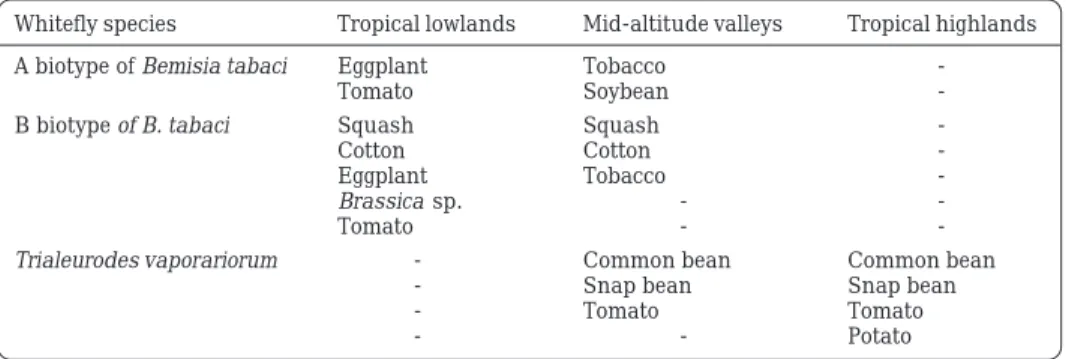
(5) Whiteflies and Whitefly-borne Viruses in the Tropics. Reproductive hosts In Colombia, T. vaporariorum was found breeding on common bean and snap bean, tomato, potato, squash, cucumber (Cucumis sativus L. var. sativus), eggplant, pepper, pea (Pisum sativum L.), tobacco (Nicotiana tabacum L.), cabbage (Brassica oleracea L.), coriander (Coriandrum sativum L.) and several species of ornamentals. In midaltitude areas, T. vaporariorum also reproduces on cotton and soybean. All T. vaporariorum samples in Ecuador were taken on common bean and tomato. Snap bean and common bean are by far the most important reproductive hosts for T. vaporariorum in Colombia and Ecuador, followed in order of decreasing importance by tomato and potato (Table 1). In Colombia, the A biotype of B. tabaci was recorded breeding on soybean, tobacco, tomato, cotton, poinsettia (Euphorbia pulcherrima Willd. ex Klotzch), broccoli (Brassica oleracea L. var. italica Plenck) and eggplant. In both Colombia and Ecuador, the B biotype was found reproducing on cotton, tomato, eggplant, squash, pepper, cucumber, common bean, snap bean, soybean, tobacco, cabbage, lettuce (Lactuca sativa L. var. capitata L.), sweetpotato (Ipomoea batatas [L.] Lam.), melon (Cucumis melo L.), watermelon (Citrullus lanatus [Thunb.]. Table 1.. Matsum. & Nakai), pumpkin (Cucurbita ficifolia Bouché), lima bean (Phaseolus lunatus L. var. lunatus), forage Arachis (Arachis pintoi Krapov. & W. Gregory), grape (Vitis vinifera L.), poinsettia and additional Brassica species. Table 1 shows the main crops affected by B. tabaci. In greenhouse studies on the comparative biology of biotypes A and B on 20 cultivated host plants, the B biotype bred faster than the A biotype on cauliflower (Brassica oleracea L. var. botrytis L.), cabbage, squash and tomato. Percentage emergence of the B biotype was significantly higher on 13 out of the 20 host plants studied; the A biotype did not breed on squash or beet (Beta vulgaris L. subsp. vulgaris). The B biotype did more damage to lettuce, squash, cabbage, cauliflower, cucumber, Brassica sp., soybean and watermelon than did the A biotype. Snap bean was affected also and suffered significant reductions in biomass as a result of damage by the B biotype. Common bean, on the other hand, was not as severely affected as other host plants. The B biotype successfully colonized plants of four Cucurbita species tested. The A biotype did not survive to the adult stage on pumpkin. Main crops serving as reproductive hosts of whiteflies in major agro-ecological zones of Colombia and Ecuador.. Whitefly species. Tropical lowlands. Mid-altitude valleys. A biotype of Bemisia tabaci. Eggplant Tomato. Tobacco Soybean. -. B biotype of B. tabaci. Squash Cotton Eggplant Brassica sp. Tomato. Squash Cotton Tobacco. -. Trialeurodes vaporariorum. 278. -. Common bean Snap bean Tomato -. Tropical highlands. Common bean Snap bean Tomato Potato.
(6) Colombia and Ecuador. and squash. On Cucurbita mixta Pangalo (= Cucurbita argyrosperma C. Huber subsp. argyrosperma) and Cucurbita pepo L., the B biotype reached the adult stage in ca. 20 days, 33% faster than the A biotype. The ability of the B biotype to successfully colonize hosts that are not attacked by the A biotype and its ability to reproduce faster on certain host plants are important diagnostic tools (Brown et al., 1995; Schuster et al., 1996). When C. moschata, C. ficifolia and C. pepo plants were infested with either A or B biotype adults, full expression of silverleaf symptoms, as described by Yokomi et al. (1990) and Costa and Brown (1991), were obtained 21 days after infestation with the B biotype. No silvering was observed on any plant infested with the A biotype. Apart from silverleaf, other symptoms of B biotype attack that have been described in the literature were observed in numerous different fields: uneven ripening of tomato (Schuster et al., 1996; Polston and Anderson, 1997), chlorotic pods and petioles on snap beans (Hassan and Sayed, 1999), white stem streaking of Brassica spp. and phytotoxic disorders on poinsettia and lettuce (Brown et al., 1995).. lecanii (Zimm.) and Paecilomyces fumosoroseus (Wize) were found in the Departments of Antioquia, Cauca Valley and Cundinamarca in Colombia (López-Avila et al., 2001). Additional studies by Manzano et al. (2000) demonstrated that A. fuscipennis is abundant on common bean crops where no chemical treatments have been made, and remains active even after heavy pesticide use. Some studies have been conducted on the biology or efficacy of this species as a natural enemy of T. vaporariorum in the Andean zone (Márquez and Valencia, 1991; Medina et al., 1994; Manzano et al., 1999). Recent results (Manzano et al., 2000) suggest that A. fuscipennis could potentially be a good biological control agent of T. vaporariorum in Colombia, in environments that are not overly dry or warm. However, as the parasitoid seems to be negatively affected by certain combinations of climatic conditions, its limitations need to be further studied in order to ascertain its true potential as a natural enemy. The entomopathogen V. lecanii has been tested under laboratory and field conditions in Colombia (González and López-Avila, 1997) with variable, usually poor, results.. Natural enemies Survey work confirmed that Amitus fuscipennis MacGown and Nebeker is the most common parasitoid of T. vaporariorum in the highlands of Colombia and Ecuador. Other natural enemies of T. vaporariorum recorded were the parasitoids Encarsia hispida DeSantis, Encarsia pergandiella Howard, Encarsia nigricephala Dozier and Encarsia sp., and the predators Delphastus pusillus Leconte, Hippodamia convergens (GuérinMénenville), Cycloneda sanguinea (L.), Coleomegilla maculata (DeGeer) and Chrysoperla sp. The fungi Verticillium. The natural enemies of B. tabaci, found at many different sites in Colombia and Ecuador, included the aphelinid parasitoids E. hispida, E. pergandiella, E. nigricephala, Encarsia sp. and Eretmocerus sp., as well as the predators D. pusillus and Chrysoperla sp. The relative importance and efficiency of these natural enemies has not been assessed.. Yield losses Three trials aimed at measuring losses due to T. vaporariorum on snap bean were conducted during 1998 and 1999.. 279.
(7) Whiteflies and Whitefly-borne Viruses in the Tropics. The establishment of these trials coincided with the appearance in Colombia of another serious pest of common bean, the melon thrips, Thrips palmi Karny. As a result, the trials had to be redesigned to account for the incidence of the new pest. In large replicated plots, different insecticide regimes were established to measure yield responses and to partition losses due to thrips and whiteflies. The latter was achieved by using spinosad (Tracer®) Dow Chemical Co.) as a selective insecticide for T. palmi control and buprofezin (Applaud®, ICI) in mixture with monocrotophos (Azodrin®, Shell Co.) for whitefly exclusion. The mean loss due to T. palmi was 4.1 t/ha or 46% of the potential yield. T. vaporariorum caused losses of 2.1 t/ha or 23% of potential yield (Rendón et al., 2001).. Increased Socio-Economic Understanding Farmers’ perceptions of the whitefly problem From 88% to 100% of farmers surveyed were male; 41% to 63% were owners who had been on their farms for over 5 years, planting an average of 1.2 ha with three or more crops planted in succession through the year. Table 2 shows that most farmers knew the insects; they were able to identify them as whiteflies and seemed to be aware of whitefly-related problems. The whitefly was regarded as an endemic pest by about 49% of farmers in the tropical highlands of Colombia and Ecuador, by 23% in mid-altitude valleys (400-1000 m) in Colombia and by 82% in the tropical lowlands of Colombia and Ecuador. A minority claimed to be able to predict whitefly epidemics, which they usually associated with dry weather. Whitefly problems in the survey area are. 280. distributed extensively, the insects being present in 72% of farms visited. The lowest incidence was in the Departments of Cauca and Cauca Valley, Colombia, where the insects were present in 46% of farms visited. Whiteflies ranked as the most important pest of common bean in 50% of the sites visited, and as the key pest in 45% of the tomato farms that were surveyed. A relatively small percentage of farmers gave whiteflies the highest rating as pests when compared with other insects on the farm (for example, T. palmi on common bean or fruit borers on tomato) but a significant proportion thought that whiteflies could reduce yields by 50% or more. Up to 30% of melon growers and 34% of those planting tomato indicated that they have abandoned crops as a result of devastating whitefly attacks. Most farmers (76% of those growing cucurbits, 80% of those growing tomato) could identify the insects as pests but very few associated the presence of whiteflies with virus diseases (Table 2).. Technicians’ perceptions of the whitefly problem Virtually all extension agents and technical assistants interviewed considered that whiteflies were a major problem on tomato and common bean. Most (80%-93%) regarded whiteflies as pests, while 27%-39% considered that whiteflies act as both pests and vectors. Up to 70% thought that the situation in most crops had changed as a result of whitefly incidence. Very few were aware of new technologies to solve the problem, considered that the area planted to several crops had been reduced or that insecticide use had increased as a result of whitefly incidence. All acknowledged that using insecticides was the only recommendation they could make to farmers..
(8) Colombia and Ecuador Table 2.. Main characteristics and perceptions of farmers surveyed in the whitefly-affected areas of Colombia and Ecuador.. Percentage of farmers who:. Tropical highlands. Mid-altitude valleys. Tropical lowlands. Are male. 88. 100. 100. Own their land. 63. 41. 64. Have lived on the farm for more than 5 years. 64. 41. 68. Receive technical assistance. 15. 18. 42. Plant three or more crops simultaneously. 47. 68. 36. “Rotate”a crops and/or fields. 82. 79. 59. Plant more than twice a year. 56. 64. 11. Know whiteflies. 82. 92. 88. Regard whiteflies as a problem. 67. 64. 65. Regard whiteflies as endemic. 49. 23. 82. Relate whitefly incidence to climatic conditions. 53. 59. 83. Consider that they can predict whitefly incidence. 24. 14. 53. Give highest rating to whiteflies as pests. 15. 18. 21. Consider that whiteflies can cause 50% or more yield losses. 40. 14. 40. Identify whiteflies as pests. 71. 32. 80. Identify whiteflies as virus vectors. 0. 5. 0. Identify whiteflies as both pests and vectors. 1. 9. 7. a.. Rotation in this case sometimes means shifting the crop from one place on the farm to another.. Insecticide use. who recommended a wide array of insecticides (up to 34 different brands) for whitefly control. The three crops most heavily sprayed were tomato, common bean and potato but, as shown in Table 3, many applications did not have whiteflies as the main target insect. Nevertheless, the heavy use of insecticides against other pests favours the development of the high levels of resistance detected in whiteflies in the Andean zone (Chapter 4.3, this volume).. All farmers who attempted control of whiteflies (up to 70%) in mid-altitude and highland areas of Colombia and Ecuador used insecticides as the sole method of control. Virtually all applications against whiteflies were preventive, with little or no regard for insect populations and the phenological stage of crops. Few farmers received formal technical assistance; instead, they received frequent visits by insecticide salesmen. Table 3.. Percentage of farmers using insecticides to control whiteflies and other pests on selected crops in major ecological zones of Colombia and Ecuador.. Crop. Ecological zone. Using insecticides. Whiteflies. Spraying against: Whiteflies and other insects. Other insects 17. Common bean. Tropical highlands. 89. 33. 39. Common bean. Mid-altitude valleys. 75. 0. 75. 0. Tomato. Tropical highlands. 90. 11. 63. 16 34. Tomato. Mid-altitude valleys. 92. 8. 50. Tomato. Tropical lowlands. 86. 38. 48. 0. Potato. Tropical highlands. 86. 0. 0. 86. 281.
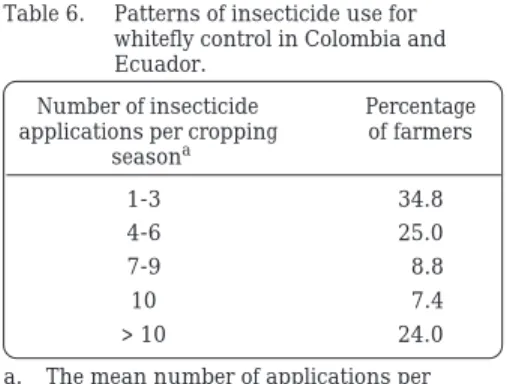
(9) Whiteflies and Whitefly-borne Viruses in the Tropics. Up to 57% of insecticide applications were reportedly made with organophosphate insecticides (OPs) alone. However, OPs also were reported as being used in mixtures with carbamates and pyrethroids (Table 4) to the extent that 80%-100% of the applications had OPs as ingredients. Given the high levels of insecticide resistance to OPs and pyrethroids that were detected in our studies, it is not surprising that a significant proportion of farmers (up to 60%) were beginning to use novel insecticides. This was most evident in tomato-growing areas in the tropical lowlands and in the midaltitude valleys of Colombia. Farmers had easy access to at least 36 different active ingredients and 40 commercial brands. Most insecticides used belong to the. Table 4.. Percentage of farmers using organophosphates (OP), carbamates (CAR) and pyrethroids (PYR) to control whiteflies in major ecological zones of Colombia and Ecuador.. Insecticide group. Tropical MidTropical highlands altitude lowlands valleys. OP. 55. 33. CAR. 4. 0. 57 2. PYR. 4. 0. 8. OP + CAR. 5. 45. 5. OP + PYR. 24. 22. 25. CAR + PYR. 0. 0. 0. OP + CAR + PYR. 8. 0. 3. Table 5.. toxicological category I (extremely dangerous), as defined by Metcalf (1994) and are used with minimal safety precautions for handling and application. In the survey, the most widely used group of pesticides were OPs, with 40% to 50% share of the use, followed by carbamates and pyrethroids (Table 5). Novel products such as insect growth regulators, juvenoids and nicotinoids were reported as becoming popular (Rodríguez and Cardona, 2001). Also used were soaps, oils and botanicals. Insecticides were reportedly applied to tomato and snap bean as often as three times a week (Rodríguez and Cardona, 2001). The number of applications per cropping season varied among regions but it is interesting to note that 24% of farmers surveyed made 10 or more applications (Table 6). Most farmers used very low (0.2 cc/L) or very high (4.8 cc/L) dosages of concentrate, well below or above the 2 cc/L average dosage usually recommended by manufacturers. Up to 71% of farmers surveyed in Colombia and 55% in Ecuador took their own decisions on timing of applications as opposed to those who have access to technical assistance. More than half reported spraying on a calendar basis, regardless of infestation levels, and relatively few had received any kind of technical assistance.. Percentage participation of organophosphate, carbamate and pyrethroid insecticides in chemical control of whiteflies in selected tropical highland areas of Ecuador and Colombia.. Insecticide category. Northern Ecuador– southern Colombia. Departments of Cauca and Cauca Valley, Colombia. Department of Antioquia, Colombia. Organophosphates. 40. 50. 50. Carbamates. 22. 14. 25. Pyrethroids. 22. 9. 13. Novel productsa. 16. 23. 12. 0. 4. 0. Others (soap, oils, etc.) a.. Includes insect growth regulators, juvenoids and nicotinoids.. 282.
(10) Colombia and Ecuador Table 6.. Patterns of insecticide use for whitefly control in Colombia and Ecuador.. Number of insecticide applications per cropping seasona. Percentage of farmers. 1-3. 34.8. 4-6. 25.0. 7-9. 8.8. 10 > 10 a.. 7.4 24.0. The mean number of applications per season against the B biotype of Bemisia tabaci in the tropical lowlands of Colombia and Ecuador is 6.5.. Conclusions In general, the results of both the biological surveys and the interviews with producers and their technical advisors underline the need for IPM research and implementation. A highly dangerous situation has developed for small-scale farmers in Colombia and Ecuador over the past 15 years: commercial pressures and an inadequate knowledge base have influenced farmers to adopt a “chemical culture”, involving excessive dependence on pesticides. The situation has been aggravated by the introduction into the region of the B biotype of B. tabaci, a major pest of annual crops. The results, their consequences and recommendations for further action are discussed in more detail in Chapter 4.4.. References Brown, J. K.; Frohlich, D. R.; Rosell, R. C. 1995. The sweetpotato or silverleaf whiteflies: Biotypes of Bemisia tabaci or a species complex? Ann. Rev. Entomol. 40:511-534.. Costa, H. S.; Brown, J. K. 1991. Variation in biological characteristics and esterase patterns among populations of Bemisia tabaci, and the association of one population with silverleaf symptom induction. Entomol. Exp. Appl. 61:211-219. González, J. G.; López-Avila, A. 1997. Evaluación de cepas nativas de Verticillium lecanii (Zimm.) en el control de la mosca blanca de los invernaderos Trialeurodes vaporariorum (Westwood). Rev. Colomb. Entomol. 23(1-2):25-30. Hassan, A. A.; Sayed S. F. 1999. Chlorotic pod: A new physiological disorder of green-podded snap beans (Phaseolus vulgaris L.) associated with silverleaf whitefly infestation. Egypt. J. Hortic. 26:213-228. López-Avila, A.; Cardona, C.; García, J.; Rendón, F.; Hernández, P. 2001. Reconocimiento e identificación de enemigos naturales de moscas blancas (Homoptera: Aleyrodidae) en Colombia y Ecuador. Rev. Colomb. Entomol. 27(3-4):137-141. Manzano, M. R.; van Lenteren, J. C.; Cardona, C. 1999. Some biological characterisitics of Amitus fuscipennis MacGown and Nebeker (Hymenoptera: Platygasteridae), parasitoid of the greenhouse whitefly. IOBC Bull. 23(1):169-172. Manzano, M. R.; van Lenteren, J. C.; Cardona, C.; Drost, Y. C. 2000. Developmental time, sex ratio, and longevity of Amitus fuscipennis MacGown and Nebeker (Hymenoptera: Platygasteridae) on the greenhouse whitefly. Biol. Control 18(2):94-100. Márquez, M. L.; Valencia, S. A. 1991. Evaluación de Encarsia formosa Gahan y Amitus fuscipennis MacGown and Nebeker, en el control de Trialeurodes vaporariorum (Westwood) en crisantemo (Chrysanthemum morifolium Rainat.). B.Sc. thesis, Universidad Nacional de Colombia, Medellín, CO. 132 p.. 283.
(11) Whiteflies and Whitefly-borne Viruses in the Tropics. Medina, P. S.; Saladarriaga, A. V.; Pérez, G. 1994. Biología de Amitus fuscipennis MacGown and Nebeker, bajo tres condiciones ecológicas, en Rionegro (Antioquia). Rev. Colomb. Entomol. 20(3):143-148. Metcalf, R. L. 1994. Insecticides in pest management. In: Metcalf, R. L.; Luckmann, W. H. (eds.). Introduction to insect pest management. 3rd edition. John Wiley, NY, USA. p. 245-284. Polston, J. E.; Anderson P. K. 1997. The emergence of whitefly-transmitted geminiviruses in tomato in the western hemisphere. Plant Dis. 81:1358-1369. Quintero, C.; Cardona, C.; Ramírez, D.; Jiménez, N. 1998. Primer registro del biotipo B de Bemisia tabaci (Homoptera: Aleyrodidae) en Colombia. Rev. Colomb. Entomol. 24(1):23-28. Quintero, C.; Rendón, F.; García, J.; Cardona, C.; López-Avila, A.; Hernández, P. 2001. Especies y biotipos de moscas blancas (Homoptera: Aleyrodidae) en cultivos semestrales de Colombia y Ecuador. Rev. Colomb. Entomol. 27(1-2):27-31.. 284. Rendón, F.; Cardona, C.; Bueno, J. 2001. Pérdidas causadas por Trialeurodes vaporariorum (Homoptera: Aleyrodidae) y Thrips palmi (Thysanoptera: Thripidae) en habichuela en el Valle del Cauca. Rev. Colomb. Entomol. 27(1-2): 39-43. Rodríguez, I.; Cardona, C. 2001. Problemática de Trialeurodes vaporariorum y Bemisia tabaci (Homoptera: Aleyrodidae) como plagas de cultivos semestrales en el Valle del Cauca. Rev. Colomb. Entomol. 27(1-2):21-26. Schuster, D. J.; Stansly, P. A.; Polston J. E. 1996. Expressions of plant damage by Bemisia. In: Gerling, D.; Mayer, R.T. (eds.). Bemisia: 1995. Taxonomy, biology, damage, control and management. Intercept, Andover, GB. p. 153-165. Yokomi, R. K.; Hoelmer, K. A.; Osborne, L. S. 1990. Relationships between the sweetpotato whitefly and the squash silverleaf disorder. Phytopathology 80:895-900..
(12)
Figure


+4


Documento similar
After the Spanish withdrawal from the territory in 1975, Morocco waged a brutal military campaign against the Polisario, and large numbers of people fled to refugee camps, where
The article presents a longitudinal research including contents analysis to study the use of social networks in five American (Argentina, Chile, Colombia, Ecuador and
This research study examines the presence and impact of the 165 universities that are part of the four Andean countries (Colombia, Peru, Ecuador and Bolivia) on the most
The landscape of media and communication companies in Ecuador is little known, in terms of their corporate organisation, structure, human resources, and products and
This idea of the city as a museum was to be further developed by Ungers in 1999, when he proposed the idea of inserting an organisation of public and representative spaces in the
For a short explanation of why the committee made these recommendations and how they might affect practice, see the rationale and impact section on identifying children and young
tremula (Bendz and Haglund, 1968) but it was not detected in the male catkins. In order to verify if the compound identi fied in leaves by these authors by means of PC and TCL was
In the preparation of this report, the Venice Commission has relied on the comments of its rapporteurs; its recently adopted Report on Respect for Democracy, Human Rights and the Rule
