
SYNTHESIS OF CARBON BASED SUPPORT FOR RUTHENIUM ELECTROCATALYST FOR ORR FORMED BY GRAPHITE AND ASPHALT CARBON PYROLYZED
11
0
0
Texto completo
(2) XVIII International Congress of the Mexican Hydrogen Society. 1. Introduction The lifestyle of our modern society has caused a constant increase in the world energy consumption [1]. The consequences of fulfilling the demand, mainly through the combustion of fossil fuels, have brought a negative impact on the environment. Fuel cells are electrochemical devices that generate an electric current from chemical reactions. These devices allow a better use of energy vectors such as hydrogen and/or methanol, for the production of electricity, since they are more efficient compared to traditional fuel-burning electric generation, as well as being environment-friendly, because water and heat are their main reaction products. For this reason, they continue to be a viable option in combination with other renewable energy sources to contribute in the reduction of the carbon footprint generated by the power electricity industry. One of the technical barriers that have prevented the establishment of this technology is the slow kinetics of the oxygen reduction reaction (ORR) in the cathode of the cell. The effectiveness of Platinum (Pt) as a catalyst for this reaction It is well documented. However, its high cost associated with its scarcity and wide field of applications, has triggered a large number of researches, seeking to obtain a material with adequate electrocatalytic properties at reasonable price. For this purpose, supported catalysts have been of special interest, since they allow a better dispersion and stability of the metallic particles, provide access to a greater amount of atoms of the active phase, thus reducing the amount of metal loading and decreasing their cost [2]. The use of different types of supports for this purpose has been widely studied [3][4][5][6]. Carbonbased supports are the most commonly used due to their chemical stability in acidic and basic environments and their ease to recover the metal by just burning the support [2]. Within ideal characteristics of an electrocatalyst support for PEM fuel cells include: must be a good electrical conductor, avoid agglomeration of the active phase, present high surface area, present adequate pore size distribution that allows interaction between the polymeric electrolyte and the catalyst, be resistant to corrosion, chemically inert and do not contain impurities that may inhibit target chemical reactions [7]. The most used carbon material support is carbon black; this material has good conductive properties, corrosion resistance and low cost [6]. However, there are alternate available materials that may contribute to the desired ideal characteristics of an electrocatalyst support such as graphite and asphalt. Graphite is a blackish gray substance made of crystallized carbon. Carbon atoms are arranged in hexagonal ring planes stacked one on top of the other [9]. Only three of the four valence electrons of each carbon atom are involved in the formation of hybrid sp2 bonds with three other atoms of the same plane, this means that the fourth electron forms a π bond. These last electrons are mobile, so graphite has good electrical conduction properties [2] [10]. A situation to be highlighted is that although the carbons that contain sp2 hybridization present a large number of free electrons for their π bonds, these electrons are partially inert to be used in the ORR. In the case of nanostructures doped with heteroatoms such as nitrogen (N) and sulfur (S), the π electrons of the carbon can be activated by conjugation with the pair of free electrons of the dopants, obtaining. September 18th to 21st, 2018 in Mexico City, Mexico.. 399.
(3) XVIII International Congress of the Mexican Hydrogen Society. better results [11][12][13][14]. Besides, according to the above mentioned ideal properties of a support, graphite has a better resistance to corrosion than amorphous carbon, which is an important feature for its application in fuel cells. Furthermore, asphalt is classified as a set of macromolecules of polycyclic aromatic rings of carbon and hydrogen with heteroatoms such as nitrogen (N), sulfur (S) and oxygen (O) and metals (V and Ni), with chains of alkanes at their ends [15]. It is one of the main precursors of sludge and sediments in the process of extraction and treatment of crude oil. Although it has some commercial uses, it is mainly considered a waste product. In addition, asphalt is considered a rich material in carbon and heteroatoms. Moreover, an additional consideration in the catalytic phenomena deals with the presence of active sites. Therefore, during the synthesis of a catalyst it is always sought to generate the largest possible number of these. According to the literature, within an electrocatalyst the simultaneous presence of a transition metal, carbon and heteroatoms are important components for the creation of active sites [8]. For this reason, in the present research it is proposed that the combination of graphite and asphalt, as raw materials, could provide improved physical and chemical characteristics during the synthesis of a carbon-based support than the black carbon support commonly used in today´s metal electrocatalysts for the ORR of a PEM fuel cell at the cathode. Furthermore, this work presents the synthesis, characterization and electrochemical evaluation of a support material obtained by the pyrolysis of asphalt-graphite at 600°C (S-AG) and its comparison against the most used carbon support, the Vulcan XC72R (Cabot), using Ruthenium (Ru) at 20% as the electrocatalyst active phase. 2. Materials and Methods Synthesis For the support preparation, a commercial solid asphalt bar and graphite powder (Meyer) were used as raw materials. The graphite was subjected to a milling process in high energy ball mill Spex 8000 M in a 7:1 ratio for 8 hours. 20% W ruthenium (Ru) was used as an active phase, by employing RuCl3xH2O (Sigma-Aldrich) as the metal precursor, while NaBH4 (Sigma-Aldrich) was used as a reducing agent. For the synthesis of the support (S-AG) by pyrolysis a BarnsteadThermolyne model 21100 tubular furnace was used in combination with a stainless steel reactor equipped with an inner quartz tube to hold the sample. The initial mass in the pyrolysis reactor contained a mixture of 70% asphalt and 30% graphite. The first stage consisted of a pretreatment in air, with a flowrate of 100 ml/min, at a heating rate of 5°C/min to reach 250°C, for 60 minutes, this with the purpose of increasing the yield of the pyrolysis product up to 4%. Subsequently, a N2 flowrate of 100 ml/min was introduced to the reactor and this further heated using a heating rate of 5°C/min, up to a temperature of 600°C, for 120 minutes. The obtained material was manually grounded in an agate mortar. For the synthesis of the electrocatalyst, the impregnation method was used. In a 125 ml Erlenmeyer flask, 1 g of NaBH4 and 45 ml of water were mixed and stirred until complete dissolution of the sodium borohydride at room temperature (25°C). Then a 0.1 M solution of RuCl3 was added dropwise, with the help of a hypodermic syringe, while keeping a. September 18th to 21st, 2018 in Mexico City, Mexico.. 400.
(4) XVIII International Congress of the Mexican Hydrogen Society. moderate stirring at a temperature between 55-60°C for one hour. Then the synthesized support (S-AG) was added to this resulting liquid and it was kept under continuous stirring for two hours at the same temperature, filtered and rinsed several times with warm water (60°C). The resulting sample was exposed to a second reduction process in the tubular furnace, under a reducing atmosphere of 95% argon (Ar) and 5% hydrogen (H2), using a gas flowrate of 100 ml/min at a heating rate of 5°C/min up to a temperature of 420°C for 60 minutes. For the reference carbon support (Vulcan-XC72R, Cabot) the same former described impregnation procedure of Ruthenium (Ru) was employed. Characterization For the characterization of the synthesized electrocatalyst, a FlashSmart Elemental Analyzer of the Thermo Fisher Scientific brand was used to determined C, H, N, S, and O. For the crystal structure of the samples X-ray diffraction characterization (XRD) was achieved using a PANalytical diffractometer model XPert PRO, with X Celerator detector and a monochromatic radiation emitted by Cu Kα (λ = 1.5406 Å). The diffraction angle 2θ was varied from 5° to 90°, with a step size of 0.05°and time of 150 seconds. The Scherrer´s equation was used to determine the crystallite size. To determine the BET surface area, volume and pore distribution of the sample, a Quantachrome Instruments equipment model Autosorb-1C was used. The test was carried out in nitrogen at 77K for physisorption. Morphology characterization of the samples was made by scanning electron microscopy (SEM) using a Jeol JSM-7401F field emission microscope, the sample was prepared by adding methanol and placing it in a brass, copper, and zinc sample holder. The micrographs were taken with different working distances (WD). Electrochemical evaluation Cyclic (CV) and linear sweep voltammetry (LVL) were performed for the electrochemical evaluation of the catalyst. The equipment used was a Princeton brand potentiostat model VersaSTAT 3 and a rotary disc with a rotor speed regulator (PINE Instruments). An arrangement of three electrodes were employed, using a working electrode, a platinum electrode as a counter electrode (CE) and an Ag/AgCl electrode as a reference electrode (ER). The evaluation was performed in acid medium, using a solution of H2SO4 (JT Baker) 0.5 M as an electrolyte. Catalytic inks were prepared with 20 mg of catalyst sample, 1 ml of ethanol (JTBaker 99.6%) as a solvent and 30 μl of Nafion ® as an adhesive. This mixture was sonicated for 40 minutes. The inks obtained were deposited with the help of a micropipette, placing 30 μl of ink on a glassy carbon electrode of 5 mm in diameter, they were allowed to dry at room temperature for one day. The H2SO4 electrolyte was bubbled with nitrogen (N 2) for 20 minutes to displace any oxygen present in the solution. The material was activated by VC with a potential window of -0.2 to 1 V at 50 mV/s during 40 cycles while keeping N2 bubbling. After activation, the electrolyte was left bubbling with N2 for 15 minutes. Three VC cycles were run, at 20 mV/s, with the same potential window. Under the flow of N2, a VL, from1 to 0.2 V was run at 5 mV/s at a rotation speed of 2000 RPM. To check material activity for the ORR, the electrolyte was bubbled with O2 for 20 minutes. A VL was performed at 5 mV/s, at the same potential window at 5 mV/s with a rotation speed of 2000 RPM, while keeping the O2 bubbling during the test.. September 18th to 21st, 2018 in Mexico City, Mexico.. 401.
(5) XVIII International Congress of the Mexican Hydrogen Society. 3. Results and Discussion Characterization Table 1 present results obtained for the composition of the raw asphalt material determined by elemental analysis. It is observed that the elements of interest (C, N, and S) are present in the sample. The compositions in which these elements are found, agree well with those of asphalt reported by S. Akmaz et al. [16]. Table 1. Elemental Analysis CHNS/O of asphalt. Asphalt. C% 81.088. N% 0.443. H% 8.899. S% 3.788. O% 5.782. C% N% H% S% O% 82.202 1.372 2.815 6.351 7.26 EC 700 84.952 by theN.D. 1.377 preserves 4.73 the elements 8.941 Moreover, sample S-AG synthesized pyrolysis process of EC 800 80.883 N.D. 0.785 4.694 13.638 interest in the amounts shown in Table 2. Here, there is an increase of 10% of carbon with EC 900 86.421 N.D. 0.119 5.878 of the 7.582 respect to the asphalt sample and this is presumably due to the integration graphite Tabla 1 Resultados de análisis elemental CHNS/O del asfalto within the material, while keeping the heteroatoms of interest. EC 600. pirolizado a diferentes temperaturas.. Table 2. Elemental analysis CHNS/O of asphalt/graphite pyrolyzed at 600 ° C (S-AG). S-AG. C% 91.939. N% 0.721. H% 1.127. S% 2.755. O% 3.458. C% N% H% S% O% 82.202 1.372 2.815 6.351 7.26 EC1700 N.D. for sample 1.377S-AG RuM. 4.73The diffraction 8.941 peaks at 2θ = 38.2, Figure shows the84.952 XRD diffractogram 42.0 EC and800 43.8° are80.883 assigned to the planes (100), (002) and (101), which are characteristic signals N.D. 0.785 4.694 13.638 of hexagonal according to the literature the signals7.582 that do not correspond to EC 900 ruthenium 86.421 N.D. 0.119[17]. For 5.878 EC 600. the ruthenium, a literature review of articles related to the type of expected materials was carried Tabla 2 Resultados de análisis elemental CHNS/O del asfalto pirolizado a diferentes out. According to this review L. Liu et al [18] reported a diffraction signal observed in 2θ between temperaturas. 24.5-26º which corresponds to semicrystalline carbon. The expected signals assigned to the graphitic structure are located around 2θ = 43º [19] [20]. However, they are not easily distinguishable by their concurrence with ruthenium (Ru) signals, which are more intense. In order to estimate the average crystallite size, the XPowder software was used, by the method of Scherrer, resulting in an average size of 6 nm.. September 18th to 21st, 2018 in Mexico City, Mexico.. 402.
(6) XVIII International Congress of the Mexican Hydrogen Society. Figure 1. Diffractogram of the S-AG RuM electrocatalyst.. C%. N%. H%. S%. O%. Figure 2 shows the isotherm obtained S-AG RuM 7.26 sample. Here, EC adsorption/desorption 600 82.202 N21.372 2.815 from the 6.351 it can be observed a type II isotherm, which is characteristic of non-porous solids or containing EC 700 84.952 N.D. 1.377 4.73 8.941 macropores, agreeing with results found in the literature [21]. The hysteresis loop of the isotherm EC 800 80.883 N.D. (P/Po0.785 13.638 does not completely close at low relative pressures < 0.4). This4.694 effect can be explained by EC 900 86.421 0.119 5.878 the desorption mechanism, which is the end N.D. of the capillary condensation. In these7.582 cases, this fall is insufficient to connect the desorption to the adsorption lines. Furthermore, the material presented a BET surface area of 120 m2/g.. Figure 2. adsorption/desorption N2 Isotherm for sample S-AG RuM.. September 18th to 21st, 2018 in Mexico City, Mexico. C% N% H% S% EC 600 82.202 1.372 2.815 6.351 EC 700 84.952 N.D. 1.377 4.73 EC 800 80.883 N.D. 0.785 4.694 EC 900 86.421 403 N.D. 0.119 5.878. O% 7.26 8.941 13.638 7.582.
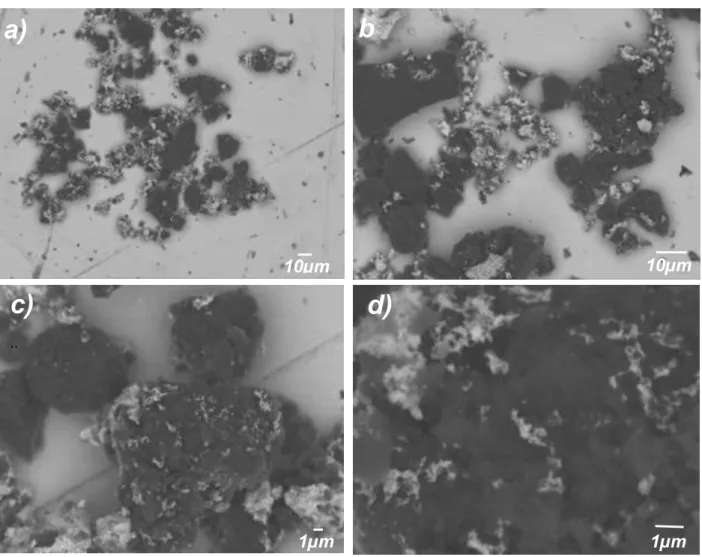
(7) XVIII International Congress of the Mexican Hydrogen Society. Figure 3 presents scanning electron microscope (SEM) micrographs taken at different magnifications by secondary electrons of the S-AG RuM sample. The carbon support (S-AG) exhibits irregular morphology, variable in each particle with different sizes among particles. Here in these micrographs the expected components in the electrocatalyst can be identified. The carbonaceous composition of the electrocatalyst is distinguished by presenting a dark color, and the presence of ruthenium metal active phase (Ru) can be distinguished by a lighter color. Also, ruthenium particles present agglomerations, which is undesirable for the purpose of this material.. b. a). ). 10µm. 10µm. c). d). ... 1µm. 1µm. .. .. Figure 3. SEM images of S-AG RuM Electrocatalyst, taken at different magnifications: a) 500, b) 1,000 c) 3,000 and d) 10,000.. Electrochemical evaluation. September 18th to 21st, 2018 in Mexico City, Mexico.. 404.
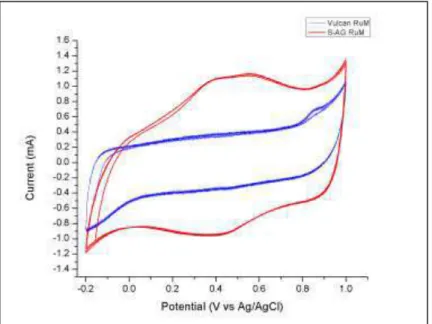
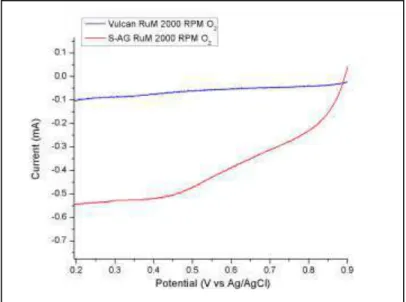
(8) XVIII International Congress of the Mexican Hydrogen Society. The capacitive activity of the material was evaluated by cyclic voltammetry (CV) in N2. Figure 4 shows the CV curves in N2 of the materials. Both S-AG RuM and the Vulcan RuM, present good energy storage capacitance, according to the supercapacitance properties associated with carbon materials as reported in the literature [22].. Figure 4. VC of the S-AG RuM and Vulcan RuM electrocatalyst.. Figure 5 shows the linear voltammetry of the S-AG Ru in N2 and O2, which verify its electrocatalytic activity. The first significant signal occurs approximately at 0.7 V. it presents a slight-pronounced drop compared to the characteristic behavior observed in Pt/C materials under the ORR [23]. Furthermore, Figure 6 shows an electrocatalyst activity comparison of ruthenium (Ru) supported in S-AG and carbon Vulcan in O2 at 2000 RPM based on their linear voltammetry response. It can be deduced that while being the same ruthenium material, the synthesized S-AG carbon support helps to improve the activity of the electrocatalyst, even though the difference between this and Carbon Vulcan is approximately of 30 mA, which is a significant amount.. September 18th to 21st, 2018 in Mexico City, Mexico.. 405.
(9) XVIII International Congress of the Mexican Hydrogen Society. Figure 6. Linear Sweep Voltammetry of Electrocatalyst S-AG RuM Vs Vulcan RuM at 2000 RPM in O2.. 4. Conclusion. September 18th to 21st, 2018 in Mexico City, Mexico.. 406.
(10) XVIII International Congress of the Mexican Hydrogen Society. The carbon-based support obtained by the pyrolysis of asphalt and graphite (S-AG) exhibit some important characteristics that make possible to be used as an electrocatalyst support. This S-AG combines the good conductivity and superficial area of graphite with the increase of active sites due to the presence of asphalt’s heteroatoms, since this is a self-doped carbonaceous material containing elements of interest such as nitrogen (N) and sulfur (S). The free electrons of these atoms, presumably modify the electronic distribution in the material, thus helping the electron donation by the neighboring carbon. The methodology employed to synthesize the support by pyrolysis is a simple route, which does not require the use of specialized equipment, while employing easily available raw materials, doing this procedure an inexpensive process. The electrochemical evaluation showed a good performance of the S-AG support compared to the conventional Vulcan XC72R, working with ruthenium (Ru) as the active phase of the electrocatalyst, in acid medium. Results presented here, will follow with the study of this material in order to determine its functionality and corrosion resistance under specific conditions of PEM fuel cells, which are more aggressive over extended periods of time.. References [1]. RENEWABLES 2017 GLOBAL STATUS REPORT n.d.. [2]. Auer E, Freund A, Pietsch J, Tacke T. Carbons as supports for industrial precious metal catalysts n.d.. [3]. Seger B, Kongkanand A, Vinodgopal K, Kamat P V. Platinum dispersed on silica nanoparticle as electrocatalyst for PEM fuel cell. J Electroanal Chem 2008;621:198–204. doi:10.1016/j.jelechem.2007.09.037.. [4]. Huang SY, Ganesan P, Popov BN. Titania supported platinum catalyst with high electrocatalytic activity and stability for polymer electrolyte membrane fuel cell. Appl Catal B Environ 2011;102:171–7. doi:10.1016/j.apcatb.2010.11.026.. [5]. Seger B, Kamat P V. Electrocatalytically active graphene-platinum nanocomposites. role of 2-D carbon support in pem fuel cells. J Phys Chem C 2009;113:7990–5. doi:10.1021/jp900360k. Bayrakçeken A, Smirnova A, Kitkamthorn U, Aindow M, Ays¸ A, Bayrakç Eken A, et al. Vulcan-Supported Pt Electrocatalysts for PEMFCs Prepared using Supercritical Carbon Dioxide Deposition. Chem Eng Commun 2008;196:194–203. doi:10.1080/00986440802290110org/10.1080/00986440802290110.. [6]. [7]. Dicks AL. The role of carbon in fuel cells. J Power Sources 2006;156:128–41. doi:10.1016/j.jpowsour.2006.02.054.. [8]. Popov BN, Li X, Liu G, Lee J-W. Power source research at USC: Development of advanced electrocatalysts for polymer electrolyte membrane fuel cells. Int J Hydrogen Energy 2011;36:1794–802. doi:10.1016/J.IJHYDENE.2009.12.050.. [9]. Speight JG. Handbook of petroleum product analysis (2nd edition). J Chem Inf Model 2013;53:1689–99. doi:10.1017/CBO9781107415324.004.. [10]. Yan Z, He G, Shen PK, Luo Z, Xie J, Chen M. MoC-graphite composite as a Pt electrocatalyst support for. September 18th to 21st, 2018 in Mexico City, Mexico.. 407.
(11) XVIII International Congress of the Mexican Hydrogen Society. highly active methanol oxidation and oxygen reduction reaction. J Mater Chem A 2014;2:4014–22. doi:10.1039/c3ta14251e. [11]. Awan Z, Zahoor A, Christy M, Hwang YJ, Lim YR, Kim P, et al. Improved electrocatalytic activity of carbon materials by nitrogen doping Evaluation of electrocatalytic properties of various nanostructured manganese oxides for nonaqueous lithium-air batteries View project Improved electrocatalytic activity of carbon m. Appl Catal B Environ 2014;147:633–41. doi:10.1016/j.apcatb.2013.09.043.. [12]. Maldonado S, Stevenson KJ. Influence of nitrogen doping on oxygen reduction electrocatalysis at carbon nanofiber electrodes. J Phys Chem B 2005;109:4707–16. doi:10.1021/jp044442z.. [13]. Sahoo M, Ramaprabhu S. Nitrogen and sulfur co-doped porous carbon – is an efficient electrocatalyst as platinum or a hoax for oxygen reduction reaction in acidic environment PEM fuel cell? Energy 2017;119:1075– 83. doi:10.1016/j.energy.2016.11.066.. [14]. Bhange SN, Unni SM, Kurungot S. Nitrogen and sulphur co-doped crumbled graphene for the oxygen reduction reaction with improved activity and stability in acidic medium. J Mater Chem A 2016;4:6014–20. doi:10.1039/c6ta00073h.. [15]. Delgado JG. ASFALTENOS composición, agregación, precipitación, LABORATORIO DE FORMULACIÓN, INTERFASES REOLOGÍA Y PROCESOS UNIVERSIDAD DE LOS ANDES FACULTAD DE INGENIERIA ESCUELA DE INGENIERIA QUIMICA. n.d.. [16]. Akmaz S, Gurkaynak MA, Yasar M. The effect of temperature on the molecular structure of Raman asphaltenes during pyrolysis. J Anal Appl Pyrolysis 2012;96:139–45. doi:10.1016/j.jaap.2012.03.015.. [17]. Durón S, Rivera-Noriega R, Nkeng P, Poillerat G, Solorza-Feria O. Kinetic study of oxygen reduction on nanoparticles of ruthenium synthesized by pyrolysis of Ru3(CO)12. J Electroanal Chem 2004;566:281–9. doi:10.1016/J.JELECHEM.2003.11.065.. [18]. Liu L, Kim H, Lee JW, Popov BN. Development of ruthenium-based catalysts for oxygen reduction reaction. J Electrochem Soc 2007;154:A123–8. doi:10.1149/1.2402108.. [19]. Liu XY, Huang M, Ma HL, Zhang ZQ, Gao JM, Zhu YL, et al. Preparation of a carbon-based solid acid catalyst by sulfonating activated carbon in a chemical reduction process. Molecules 2010;15:7188–96. doi:10.3390/molecules15107188.. [20]. Paraknowitsch BJP, Zhang J, Su D, Thomas A, Antonietti M. Ionic liquids as precursors for nitrogen-doped graphitic carbon. Adv Mater 2010;22:87–92. doi:10.1002/adma.200900965.. [21]. Keller JU, Staudt R. Gas adsorption equilibria : experimental methods and adsorptive isotherms. Springer; 2005.. [22]. Zhang LL, Zhao XS. Carbon-based materials as supercapacitor electrodes. Chem Soc Rev 2009;38:2520–31. doi:10.1039/b813846j.. [23]. Wang S, Jiang SP, White TJ, Wang X. Synthesis of Pt and Pd nanosheaths on multi-walled carbon nanotubes as potential electrocatalysts of low temperature fuel cells. Electrochim Acta 2010;55:7652–8. doi:10.1016/j.electacta.2009.09.003.. September 18th to 21st, 2018 in Mexico City, Mexico.. 408.
(12)
Figure

Documento similar