
TítuloBehavioral microfoundations of retail credit markets :a theoretical and experimental approximation
452
0
0
Texto completo
(2) THESIS CO-DIRECTOR’S DECLARATION. I certify that the thesis of the PhD candidate David Peón Pose fulfills all the requirements to be awarded with a doctoral degree. Certifico que a tese do doutorando David Peón Pose cumpre todos os requerimentos para optar ao grao de doutor. Certifico que la tesis del doctorando David Peón Pose cumple todos los requisitos para optar al grado de doctor.. A Coruña, 25.09.2014. Dr. Anxo Calvo Silvosa Associate Professor Departamento de Economía Financeira e Contabilidade Universidade da Coruña. THESIS CO-DIRECTOR’S DECLARATION. I certify that the thesis of the PhD candidate David Peón Pose fulfills all the requirements to be awarded with a doctoral degree. Certifico que a tese do doutorando David Peón Pose cumpre todos os requerimentos para optar ao grao de doutor. Certifico que la tesis del doctorando David Peón Pose cumple todos los requisitos para optar al grado de doctor.. Santiago de Compostela, 25.09.2014. Dr. Manel Antelo Suárez Associate Professor Departamento de Fundamentos de Análise Económica Universidade de Santiago de Compostela. ii.
(3) I’ve been a miner for a heart of gold. xopa, cando todo empezou non estabades aquí cando rematou, non había no mundo nada máis importante. iii.
(4) ACKNOWLEDGEMENTS / AGRADECEMENTOS. Tentar agradecer nunhas breves liñas a todas as persoas e institucións que, durante os máis de catro anos de desenvolvemento e elaboración desta tese doutoral, prestaron a súa colaboración desinteresada ou influíron nos meus pensamentos e coñecementos sintetizados na mesma, sería de todo inacadable. Vaia o meu recoñecemento e agradecemento por tanto a todos vós, profesores, persoal e alumnos da FEE pola vosa axuda, e en particular a todos os compañeiros do Departamento de Economía Financeira e Contabilidade. Quixera agradecer persoalmente a aqueles que realizaron achegas de moita valía na elaboración dos artigos e publicacións que resultaron desta tese: os compañeiros Ángel Fernández, Cristina Anido, Emma Iglesias, Fernando de Llano, Flora Muíño, José A. Novo, José M. Seijas, Manuel Gómez, Marcos Vizcaíno, Paolo Rungo e Rafael Gómez, así como a Andrea Ceschi, Javier Iglesias, Juan Vilar, Jose A. Vilar, Manuel F. Grela, Tomasz Michalski, revisores anónimos e editores dos diversos journals. O meu agradecemento especial a Enrico Cervellati e Jorge Rodriguez pola súa orientación. Colaboraron moi especialmente na elaboración dalgunhas partes da tese os compañeiros Paulino Martínez no deseño da aplicación informática e Xosé M. Filgueira en axuda técnica. Por último, agracecer a todos e cada un dos 126 alumnos participantes no experimento a súa participación. Expreso finalmente a miña gratitude a todos aqueles os que, sen a súa colaboración, esta tese nunca tería sido unha realidade. Ao Grupo BBVA por facilitarme a miña dedicación á tese durante catro anos. Ao Departamento de Economía Financeira e Contabilidade da UDC por todas as facilidades para o desempeño das miñas actividades docentes e de investigación. A miña enorme gratitude e recoñecemento aos meus directores de tese, Dr. Manel Antelo e Dr. Anxo Calvo, pola súa sabedoría, orientación, e apoio en todo momento. Tivestes moita paciencia... E moi especialmente a meus pais e irmans, e a María, a quen lle debo todo o seu apoio estes anos, a paciencia e o ánimo nas interminables horas e preocupacións que deu de si este traballo, e por sacar adiante ás nosas xoias, Anxo e Pablo. Quérovos.. DECLARATION. “I certify that the contents of this document are entirely my own work and that any quotation or paraphrase from the published or unpublished work of others is duly acknowledged.” Signature:. Date: September 25th, 2014. iv.
(5) ABSTRACT. The recent financial crisis has renewed interest in the role credit plays, particularly when granted by the banking sector, to amplify the economic cycle. This thesis focuses on the credit supply side to study the informational efficiency of bank-based financial systems when granting credit to the economy. After a revision of the main areas of the literature that are devoted to such purpose, we set the behavioral economics and finance as a conceptual framework for our research. Thus, we firstly discuss the limits to apply the classic paradigm in financial markets, the efficient market hypothesis, to bank-based systems, and offer an alternative approach in three steps, based on the behavioral literature. Then, we implement an experimental research to test the first step. The experiment consists of a business simulation game designed to replicate the basics of a bank to set its credit policies. The results are tested against the participants’ profiles in terms of overconfidence and prospect theory, to determine whether these behavioral biases might explain different credit policies across banks. Finally, we offer a theoretical model to analyze the second and third steps in the behavioral approach. Assuming some banks are run by too optimistic managers, the model shows how rational banks would herd to follow their biased competitors, and describes the limits of arbitrage in the industry that would prevent informational efficiency to be restored.. RESUMO BREVE. A recente crise financeira renovou o interese no papel xogado polo crédito, en particular bancario, na amplificación do ciclo económico. Esta tese céntrase no lado da oferta ao obxecto de estudar a eficiencia informativa dos sistemas bancarios cando conceden crédito á economía. Tras unha revisión das principais áreas da literatura centradas en dita cuestión, fixamos a economía e finanzas conductuais como marco conceptual da nosa investigación. Deste xeito, debatemos primeiro sobre as limitacións para aplicar a hipótese do mercado eficiente, paradigma clásico nos mercados financeiros, aos sistemas bancarios, e suxerimos un enfoque alternativo en tres pasos, baseado na literatura conductual. Logo, poñemos en práctica unha investigación experimental ao obxecto de testar o primeiro paso: un xogo de simulación deseñado para replicar o esquema básico no que un banco establece as súas políticas de crédito. Os resultados son contrastados cós perfís dos participantes en termos de exceso de confianza e a teoría prospectiva, para determinar se ditos sesgos poderían explicar diferentes políticas de crédito entre bancos. Para rematar, ofertamos un modelo teórico para analizar o segundo e terceiro paso. Asumindo que algúns bancos son dirixidos por xestores optimistas de máis, o modelo mostra como os bancos racionais seguirían aos seus sesgados competidores, e describe os límites da arbitraxe na industria que impedirían restablecer a eficiencia informativa. v.
(6) RESUMEN BREVE. La reciente crisis financiera ha renovado el interés en el papel que juega el crédito, particularmente bancario, para amplificar el ciclo económico. Esta tesis se centra en el lado de la oferta para estudiar la eficiencia informativa de los sistemas bancarios a la hora de conceder crédito a la economía. Tras una revisión de la literatura centrada en dicho objeto, establecemos la economía y finanzas conductuales como marco conceptual de nuestra investigación. Asi, comentamos en primer lugar los límites para aplicar la hipótesis del mercado eficiente, paradigma clásico en los mercados financieros, a los sistemas bancarios, y ofrecemos un enfoque alternativo en tres pasos que se basa en la literatura conductual. Después, llevamos a cabo una investigación experimental para testar el primer paso: un juego de simulación diseñado para replicar el esquema básico en el que un banco establece sus políticas de crédito. Los resultados se contrastan con los perfiles de los participantes en términos de exceso de confianza y la teoría prospectiva, para determinar si estos sesgos podrían explicar las diferentes políticas de crédito. Por último, ofrecemos un modelo teórico para analizar los pasos segundo y tercero. Asumiendo que algunos bancos tienen gerentes demasiado optimistas, el modelo muestra cómo los bancos racionales seguirían a sus competidores sesgados, y describe los límites del arbitraje en la industria que impedirían restaurar la eficiencia informativa.. RELEVANT ACRONYMS. AMH: Adaptive Market Hypothesis. EUT: Expected Utility Theory. BAPM: Behavioral Asset Pricing Model. GMM: Generalized Method of Moments. BF: Behavioral Finance. CCAPM: Consumption CAPM. BPT: Behavioral Portfolio Theory. IPO: Initial Public Offering. BV/MV: Book value to market value. M&A: Mergers and Acquisitions. CAPM: Capital Asset Pricing Model. NPL: Non-performing Loans. CPT: Cummulative Prospect Theory. NPT: Normalized Prospect Theory. d/P: Dividend yield. OC: Overconfidence. DDM: Dividend Discount Model. PCA: Principal Component Analysis. DJIA: Dow-Jones Industrial Average index. P/E, PER: Price to Earnings ratio. E/P: Earnings yield. PT: Prospect Theory. EMH: Efficient Market Hypothesis. SEO: Seasoned Equity Offerings. EMM: Efficient Markets Model For bibliographic references cited in the text, the first time a reference appears in a Chapter it is identified using all authors’ names (e.g., Jorda, Schularick and Taylor, 2011) when there are up to three authors or (Brunnermeier et al., 2009) when there are four or more authors. Subsequent citations in the same Chapter are in the form (Jorda et al., 2011) when there are three or more authors. A list in alphabetical order of all bibliographic references cited in the Doctoral Thesis is provided at the end.. vi.
(7) TABLE OF CONTENTS. INTRODUCTION. 3. Object of study. 5. Objectives. 6. Methodology. 7. Structure of the thesis. 9. PART I – GENERAL REVIEW OF THE MAIN FRAMEWORKS ON INFORMATIONAL EFFICIENCY OF RETAIL CREDIT MARKETS Chapter 1. Theories of credit and banking efficiency. 17. 1.1. Introduction. 17. 1.2. Retail credit markets. 17. 1.3. Analysis of economic efficiency in the banking sector. 21. 1.3.1. Efficient structure vs. Market power paradigms. 21. 1.3.2. Different concepts of economic efficiency. 22. 1.3.3. Efficiency measurement methods. 25. 1.3.4. The problem with risk in efficiency tests of financial institutions. 29. 1.4. Theories of credit. 30. 1.4.1. Microeconomics of credit. 30. 1.4.2. Macroeconomics of credit. Bubbles. 33. 1.5. Concluding remarks. 40. Chapter 2. Efficiency in financial markets: The efficient market hypothesis. 41. 2.1. Introduction. Efficiency in financial markets. 41. 2.2. Theoretical foundations of market efficiency. 42. 2.2.1. Financial market efficiency. A definition. 43. 2.2.2. Expectations. 45. 2.2.3. Information. 50. 2.2.4. Discount factor. 55. vii.
(8) 2.3. The testability of the EMH. Critiques from behavioral finance. 61. 2.3.1. Two alternative definitions of EMH. 62. 2.3.2. The joint hypothesis problem. 64. 2.3.3. Alternative approaches to question the EMH. 65. 2.3.4. Adaptive market hypothesis: An alternative theory to EMH. 69. 2.4. Empirical tests of the EMH. A short review. 71. 2.4.1. Weak form EMH tests. 72. 2.4.2. Semi-strong form EMH tests. 74. 2.4.3. Strong form EMH tests. 82. 2.5. Concluding remarks. 83. Chapter 3. Efficiency in financial markets: Behavioral finance. 85. 3.1. Introduction. 85. 3.2. The foundations of behavioral finance. 86. 3.2.1. The antecedents. 86. 3.2.2. Groundbreaking research. 88. 3.2.3. 1980 – 2000: A challenge to orthodoxy. 92. 3.3. The future of the behavioral economics and finance 3.4. Concluding remarks. 98 108. PART II – BEHAVIORAL FINANCE: CONCEPTUAL ELEMENTS TO ANALYZE EFFICIENCY IN RETAIL CREDIT MARKETS Chapter 4. A taxonomy of biases and anomalies. 111. 4.1. Introduction. 111. 4.2. Psychological biases. 113. 4.2.1. Heuristics and judgmental biases. 113. 4.2.2. Framing. 126. 4.2.3. Valuation / Errors of preference. 130. 4.2.4. Social factors. 137. 4.3. Behavioral consequences. 142. 4.3.1. Market anomalies. 143. 4.3.2. Decision effects. 151. viii.
(9) 4.4. Concluding remarks. 157. Chapter 5. Prospect theory and Overconfidence. 158. 5.1. Introduction. 158. 5.2. Prospect theory in the literature. 159. 5.3. Parametric specifications. 167. 5.3.1. The value function. 168. 5.3.2. The probability weighting function. 170. 5.3.3. Set of variables and attitudes towards risk. 171. 5.3.4. The problem with loss aversion. 173. 5.4. Elicitation methods and scaling. 175. 5.5. Overconfidence in the literature. 177. 5.5.1. The prevalence of overconfidence. 177. 5.5.2. Overconfidence vs. Thurstonian and Brunswikian theories. 178. 5.6. A theory of overconfidence. 181. 5.6.1. Overestimation. 182. 5.6.2. Overplacement. 183. 5.6.3. Overprecision. 183. 5.7. Set of variables, elicitation and scaling. 184. 5.7.1. Elicitation. 184. 5.7.2. Scaling. 186. 5.8. Concluding remarks. 187. PART III – AN EXPERIMENTAL APPROXIMATION AND THEORETICAL MODEL OF THE CREDIT CYCLE Chapter 6. A behavioral framework to test efficiency in retail credit markets. 192. 6.1. Introduction. 192. 6.2. Using behavioral economics to analyze credit policies in the banking industry. 193. 6.2.1. Behavioral finance and the EMH in capital markets. 194. 6.2.2. Applying BF to a new framework: Efficiency of credit policies in retail banking. 197. 6.3. Discussion: A behavioral analysis of informational efficiency in bank-based financial systems 204 ix.
(10) 6.3.1. The state of the art on credit markets and efficiency. 204. 6.3.2. Extending the EMH to retail credit markets: A discussion. 206. 6.3.3. A behavioral approach to test informational efficiency in retail credit markets. 208. 6.4. Applying the behavioral approach to a new framework: A research agenda. 208. 6.4.1. First step: Analysis of rationality. 209. 6.4.2. Second step: Correlated behavior. 213. 6.4.3. Third step: Limits of arbitrage. 218. 6.5. Conclusions. 219. Chapter 7. Experimental tests of behavioral biases. 221. 7.1. Objective. 221. 7.2. Behavioral tests. 223. 7.2.1. Priors. 224. 7.2.2. Overconfidence. 224. 7.2.3. Prospect theory. 228. 7.3. Assessing data quality. 230. 7.3.1. Goodness of tests on overconfidence. 234. 7.3.2. Goodness of tests on prospect theory. 241. 7.4. Hypothesis testing and results. 249. 7.4.1. Hypotheses. 249. 7.4.2. Results. 253. 7.5. Conclusions. 258. Chapter 8. Credit policies in an experimental setting. 260. 8.1. Objective. 260. 8.2. Experiment design. 261. 8.2.1. Literature on business simulation games. 261. 8.2.2. Searching for performance indicators in our game. 262. 8.3. Basics of the game. 264. 8.3.1. The game. 264. 8.3.2. Instructions to participants. 269. 8.3.3. Indicators – dependent variables. 270. 8.4. Data. 272 x.
(11) 8.5. Hypothesis testing and results. 273. 8.5.1. Hypotheses. 274. 8.5.2. Results. 279. 8.6. Conclusions. 286. Chapter 9. A behavioral model of the credit cycle. 288. 9.1. Introduction. 288. 9.2. A behavioral model of the credit boom. 290. 9.2.1. Analysis of rationality. 291. 9.2.2. Herd behavior. 294. 9.2.3. Limits of arbitrage. 298. 9.3. The effects of underconfidence and changes along the cycle. 299. 9.3.1. Pessimism and underconfidence in recessive periods. 300. 9.3.2. Dynamics of credit risk assessment. 301. 9.4. A dynamic model of the credit cycle. 303. 9.4.1. Standard scenario: Credit boom by a biased duopoly. 303. 9.4.2. A stressed scenario. 305. 9.5. Conclusions. 308. SUMMARY OF RESULTS. 310. CONCLUSIONS OF THE THESIS AND FUTURE INVESTIGATION. 314. BIBLIOGRAPHIC REFERENCES. 318. APPENDICES. 379. Appendix Experimental Research. 379. Appendix Theoretical Model. 415. Supplementary Material. 423. Resumo en Galego. 427. Resumen en Castellano. 433. xi.
(12) INDEX OF TABLES. TABLE 1.1 – Consolidated balance of credit institutions in Spain. 19. TABLE 1.2 – Spain: Consolidation of the Banking Sector. 20. TABLE 1.3 – Variables in the cost and profit functions by Berger and Mester (1997). 28. TABLE 2.1 – Tests of the weak form EMH. 72. TABLE 2.2 – Tests of the semi-strong form EMH. 75. TABLE 2.3 – Tests of the strong form EMH. 82. TABLE 4.1 – Schematic taxonomy of biases and anomalies. 113. TABLE 4.2 – Heuristics and judgmental biases. 115. TABLE 4.3 – Framing. 127. TABLE 4.4 – Valuation / Errors of preference. 130. TABLE 4.5 – Social factors. 137. TABLE 4.6 – Market anomalies. 143. TABLE 4.7 – Decision effects. 151. TABLE 5.1 – Value and weighting functions in the literature. 169. TABLE 7.1 – Summary of priors. 224. TABLE 7.2 – Summary of variables in the experiment. 225. TABLE 7.3 – Frequency tables for priors. 231. TABLE 7.4 – Descriptive statistics of the behavioral variables. 232. TABLE 7.5 – Normality test for the behavioral variables. 233. TABLE 7.6 – Overestimation and overplacement. 234. TABLE 7.7 – Overprecision. 237. TABLE 7.8 – A suggestion to avoid incidents in future research. 239. TABLE 7.9 – Reliability of individual M estimations. 239. TABLE 7.10 – PT parameters at the aggregate level. 242 xii.
(13) TABLE 7.11 – The fourfold pattern at the individual level. 245. TABLE 7.12 – Coefficients of determination. 246. TABLE 7.13 – Correlations among priors. 253. TABLE 7.14 – Correlation matrix. Priors and variables.. 254 256. TABLE 7.15 – Correlation matrix for objectivity TABLE 7.16 – Regression models. Behavioral biases to priors TABLE 7.17 – Factorial analysis. Overconfidence and PT TABLE 7.18 – Regression models. Behavioral factors to priors. 256 257 258. 266. TABLE 8.1 – Expected default rates of all niche clients TABLE 8.2 – Optimal ex post strategies for all niche clients. 269 271. TABLE 8.3 – Summary of game indicators. 272. TABLE 8.4 – Descriptive statistics of game indicators. 272. TABLE 8.5 – Normality test for the game indicators TABLE 8.6 – Correlation matrix. Variables and indicators TABLE 8.7 – Regression models. Game indicators to behavioral biases TABLE 8.8 – Factorial analysis. Game indicators – First stage TABLE 8.9 – Factorial analysis. Game indicators – Second stage. 279 281 282 282 283. TABLE 8.10 – Correlations among factors TABLE 8.11 – Regression models. Game factors to behavioral factors and variables. 283 285. TABLE 8.12 – Cluster analysis. Descriptive statistics. TABLE 9.1 – Possible market configurations of the low-quality niche. 295 297. TABLE 9.2 – Case analysis. xiii.
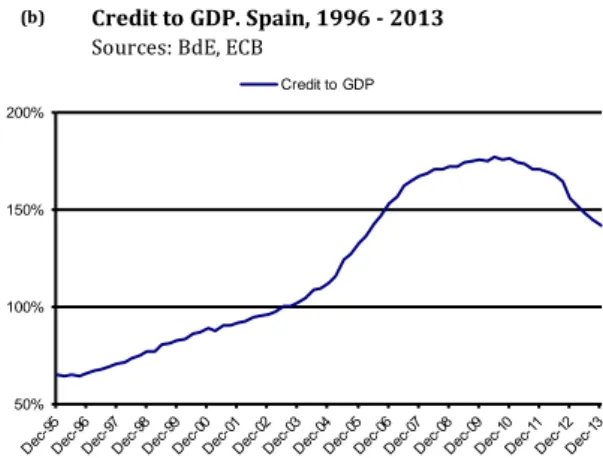
(14) INDEX OF FIGURES. FIGURE 0.1 – Total credit, credit ratio to GDP and delinquency ratio in Spain. 4. FIGURE 0.2 – Structure of the thesis. 9. FIGURE 5.1 – The value function. 164. FIGURE 5.2 – The probability weighting function. 164. FIGURE 7.1 – Outline of the experimental research. 222. FIGURE 7.2 – A sample question with positive prospects. 229. FIGURE 7.3 – A sample question with negative prospects. 230. FIGURE 7.4 – Participants. Age to academic year (‘level’). 232. FIGURE 7.5 – Correlation between E and P. 235. FIGURE 7.6 – The hard–easy effect. 236. FIGURE 7.7 – Correlation of parameters. 243. FIGURE 7.8 – Risk attitudes of the average participant. 244. FIGURE 7.9 – Risk attitudes of eight individual anomalies. 247. FIGURE 8.1 – Screenshot of the game at period 1. 265. FIGURE 8.2 – Updated macro information at period 3. 265. FIGURE 8.3 – Scenarios of the simulated and real games at period 8. 266. FIGURE 8.4 – Summary of the hypotheses tested. 278. FIGURE 8.5 – Cluster analysis. 284. FIGURE 8.6 – Cluster analysis. Dispersion diagrams for mean values. 285. FIGURE 9.1 – Possible equilibrium configurations in the low-quality niche. 296. FIGURE 9.2 – Probabilities of success, from quarters 1 to 24, in the first example. 304. FIGURE 9.3 – Loan volumes in a credit boom generated by a biased duopoly. 304. FIGURE 9.4 – Probabilities of success, from quarters 1 to 24, in the second example. 306. FIGURE 9.5 – Loan volumes in a stressed scenario. 307. FIGURE 9.6 – Monetary policy would end a recession. 307. xiv.
(15) “Most increases in the supply of credit do not lead to a mania, but nearly every mania has been associated with a rapid growth in the supply of credit” Ch. Kindleberger, ‘Manias, Panics and Crashes’.. 1.
(16) 2.
(17) INTRODUCTION. The worldwide financial meltdown of 2007–2008 and the sovereign debt crisis that followed afterwards in the Eurozone persuaded academics and economic authorities to reassess our views about some aspects of the functioning of market economies. Topics that were reviewed include the nature of economic cycles, the effectiveness of monetary policies, the role of derivatives, the effectiveness of banking regulation, and others. Thus, in regards to the financial meltdown, four major factors are cited to have caused it (Bean, 2010): the use of derivatives on a massive scale, a long period of low interest rates, the imbalances of globalization, and credit growth. Derivatives and structured securities such as collateralized debt obligations (CDOs) and credit default swaps (CDS) increased the risk appetite of investors and reduced their risk perception. Monetary policies from 2002 to 2006 have been criticized for being too loose, particularly in the U.S. and the Eurozone. Current account imbalances were at historic levels then and they were of counterintuitive sign, with capital flowing from the high-growing emerging countries to the aging, stagnant Western economies. However, the factor that has received most attention from researchers is perhaps credit. The episode renewed the interest in the role credit plays in economic cycles, leading to a revival of classic works by authors such as Charles Kindleberger and Hyman Minsky, among others. Indeed, the good performance of western economies during the years before the Great Recession was largely fueled by credit, feeding real estate bubbles that would come to a dramatic end with the financial crisis. Overconfidence made economic agents believe this time was different and good times would last forever. Perceived risk decreased and a higher leverage followed. In consequence, the ratio of financial liabilities to GDP between 1995 and 2007 rose in countries like the U.K. from 128% to 213%, and multiple housing booms developed simultaneously during the same period in distant countries as the U.S., Ireland, Spain, Russia, Singapore, China or the Arab Emirates. Jorda, Schularick and Taylor (2011) show that higher rates of credit growth relative to GDP tend to be followed by deeper recessions and slower recoveries. In economies where the weight of the banking sector is not much relevant, the ratio of bank lending to GDP often tends to remain low. For instance, in the U.S., from the 1950s to 1995, the ratio ranged from 7% to 14% (Himmelberg and Morgan, 1995). In bank-based financial systems, however, this ratio is often much higher and rose aggressively during the last crisis. In Spain, for instance, by mid 1990s the ratio was about 60% while it soared by 2009 to 175% ―see charts a and b of Figure 0.1 below. Credit to households and institutions from 1995 3.
(18) to 2008 provided by the Spanish banking sector boosted from 271 to 1,870 billion euros, almost seven times higher. During the same period, the GDP rose 58%. FIGURE 0.1 – Total credit, credit ratio to GDP and delinquency ratio in Spain (a). Credit to households and firms. Spain, 1996 - 2013. (b). Sources: BdE, INE. Credit to GDP. Spain, 1996 - 2013 Sources: BdE, ECB. GDP. Credit to GDP. Credit. 200%. 600 150%. 400. 100%. 200. 50%. 0. (c). Delinquency ratio (total). Spain, 1999 - 2014 Source: INE Delinquency ratio. 15.0%. 10.0%. 5.0%. 0.0%. Source: Own elaboration from BdE, ECB and INE. In addition, Reinhart and Rogoff’s (2011) historical analysis of financial distress episodes confirm two other facts. The first one evidences that private debt surges are a recurring antecedent to banking crises. The increased leverage of the economy during good times often lead to episodes of financial distress in recessive periods: delinquency ratios on loans and other credit instruments soar and bank profits become losses. Take for instance again the case of Spain, where by December 2007 only 0.93% of the credit granted to families and firms were bad loans, whereas by January 2014 the average delinquency ratio amounted 13.58% ―see Figure 0.1.c. Similar rates in market-based systems like the U.S., for instance, were only observable in credit cards and student loans, while on mortgages and auto loans the average delinquency ratio barely exceeded 5%. The effects of the financial meltdown of 2007 and 2008 over the banking sector were devastating, both in the U.S. and the Eurozone. The list of banks that were filed for bankruptcy, declared insolvent, liquidated, taken over by another private bank, received financial aid by a governments, or were 4.
(19) nationalized is extremely long: it would include the largest American investment banks (e.g., Lehman Brothers and Merrill Lynch) as well as commercial banks (e.g., Citigroup), the largest commercial banks of several European countries (e.g., HBOS, Fortis, Dexia, RBS, UBS, Bankia), banks as well as insurance companies and brokerage firms (e.g., AIG, MF Global), and private as well as public or government sponsored entities (e.g., FNMA and FHLMC, commonly known as Fannie Mae and Freddie Mac) and foundations (e.g., Spanish savings banks). The second fact pointed out by Reinhart and Rogoff (2011) is that banking crises often precede (and predict) sovereign debt crises. Indeed, they confirm a strong link between banking crises and sovereign default across the economic history of many countries. A link manifested as well in the recent Eurozone crisis as a negative feedback effect between sovereign debt and the balance of the private banks. Thus, banking crises that often follow after periods of indulgent lending practices have harmful consequences over not only the stability of the banking sector itself, but over the stability of the whole economy, too. Following these pieces of evidence, the analysis of the efficiency of the banking sector when granting credit to the economy reveals to be an interesting field of research. In what follows we summarize the main purpose of this thesis, as well as the approach we followed in our research. This is done in four instances. Firstly, we determine the object of study. Secondly, we enumerate the main objectives that were pursued. Thirdly, we specify the methodology implemented. Fourth, we describe the structure of the thesis and summarize the contents of each chapter. Object of study Since credit crises may be associated to both credit-supply and credit-demand effects, we must clarify in first instance that this doctoral research focuses on the credit supply side, in order to provide an alternative means to analyze the causes behind a credit boom. Credit booms would reveal either a banking sector unable to make a proper evaluation of credit demand and the risks involved or, at least, a banking industry where some participants were aware of those risks, but who chose to follow their competitors in order not to lose market share or to reduce the risk of underperformance. Thus, the object of study of this thesis is the efficiency of bank-based financial systems when granting credit to the economy. Consequently, the scope of our research are the retail credit markets, defined as the transactions between retail banks and their customers that involve some sort of credit granted (loans, mortgages, etc.), which are broadly funded with deposits from other clients. The main innovation is the conceptual framework we use for such purpose: the behavioral economics and finance. In market-based systems, the classic approach to examine efficiency is the Efficient Market Hypothesis, EMH. However, we will see imperfect competition and informational asymmetries in bank-based systems would leave this approach without content. Some alternatives emerged to provide an 5.
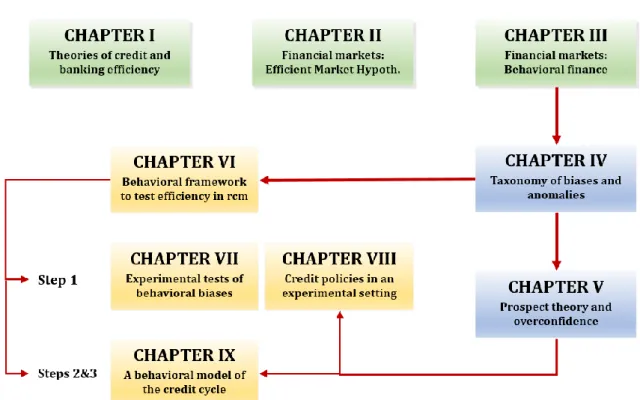
(20) interpretation of what determines how much credit banks should grant to borrowers ―alternatives that will be reviewed as well. Notwithstanding, a first contribution of this thesis is to provide a behavioral approach to analyze the efficiency of bank-based financial systems, allowing to explain how behavioral biases by participants in the banking industry might explain credit cycles. This behavioral approach allows to study the effects of behavioral biases by CEOs and employees in the industry over the credit policies implemented by the retail banks and their strategic behavior when they compete to grant credit to different niches of potential borrowers. That is indeed the main question we want to answer in this research: could it be that credit booms fueled by the banking sector are a manifestation of a herd behavior that appears as a consequence of different behavioral profiles and biases among participants in the industry? We provide a theoretical an experimental approach to answer such question. We find this to be a relevant question that deserves to be answered. The academic research that followed the financial crisis has analyzed issues such as the incentives, securitization, and the risk-taking moral hazard by banks, but little has been done to interpret the role that human psychology might have had. This is puzzling, since the behavioral economics has identified and explained a wide range of anomalies in areas as diverse as health, education, energy, insurance, and public choice. In particular, the most productive and successful area has been behavioral finance applied to financial markets: the excessive volatility puzzle, the evidence of overreaction, underreaction and an excessive trading, the preference of investors for dividends, the equity risk premium, the recurrence of financial bubbles, etc. Thus, we suggest to extend the insights of the behavioral economics and finance to the analysis of the informational efficiency in bank-based financial systems. This would complement the literature on credit bubbles by suggesting that the explanations already provided, such as the moral hazard and the role of incentives, could have been even more pervasive due to psychological biases. In addition, it would contribute to the open debate on questions such as the necessity to improve the macroprudential regulation (Brunnermeier et al., 2009) or the pros and cons of separating the monetary and credit functions by promoting a full-reserve banking system (Benes and Kumhof, 2012). Objectives The key goal of this thesis is to analyze the informational efficiency of retail credit markets through a behavioral approach. The main motivation is to provide a rationale that would explain how different behavioral biases by participants in the banking industry could explain an excessive lending by retail banks and a herd behavior among them. Such main goal may be dissected into several specific objectives. They follow in order below. First, we intend to review the main conceptual frameworks that have been used to analyze the informational efficiency of financial markets generally speaking, and the banking sector in particular. 6.
(21) We wish to provide an insight on the different approaches that are used in both instances, and to interpret the obstacles that limit the application of the classic approach in financial markets ―namely, the EMH― to the banking system. Second, we seek to provide an extensive review of the behavioral economics and finance as a conceptual framework for our experimental and theoretical research. In particular, we intend to highlight the clash between the opposite views of rationalists and behaviorists in the scope of financial markets. Third, we are in search of an alternative approach to test the informational efficiency of retail credit markets in a way akin to how efficiency is interpreted under the EMH in financial markets. Such alternative approach follows the behavioral literature to test market efficiency in financial markets, while it sidesteps the presence of informational asymmetries and imperfect competition within the banking industry that impede the extension of the EMH to bank-based systems. Fourth, we seek to provide experimental evidence of the effects that behavioral biases might have over the credit policies implemented by the banks. In particular, in regards to the biases we focus on two relevant areas of the behavioral literature: the effects observed for individuals with different risk profiles, according to prospect theory, and different levels of overconfidence. In regards to the credit policies, we seek to trace the effects in terms of prices, volumes and quality of credit. Fifth, we intend to provide a theoretical model that explains the behavior of banks of a different nature, some managed by excessively optimistic CEOs and others not, when they compete for potential borrowers to whom grant credit. Among the questions we seek to answer we may mention why and when rational banks would herd to follow their biased competitors, the effects of behavioral biases in banking competition along the economic cycle, and the lessons to be learned in the debate for an enhanced macroprudential regulation. Methodology We intend to extend the insights of the behavioral economics and finance to the analysis of the informational efficiency of the banking sector when granting credit to the economy. The purpose is to determine whether there is a rationale for human psychology ―in particular, different behavioral biases by participants in the banking industry― to explain a herd behavior that amplifies the boom and busts of credit cycles. The motivation for it is twofold. On one hand, we have seen that relaxed lending practices often antecede banking crises, and these often precede sovereign debt crises as well. The recent episodes of the worldwide financial meltdown and the Eurozone crisis are good examples of it. On the other hand, the behavioral finance is the field that has been more successful in criticizing the tenets of market efficiency, but little has been done about combining human psychology and banking crises. 7.
(22) We proceed as follows. Firstly, we identify the conceptual frameworks in the literature that may contribute to our work. These are the theories of credit and banking efficiency, which compile the different approaches available to analyze the efficiency of the banking sector, the efficient market hypothesis, which is the classic paradigm to test efficiency in financial markets, and the behavioral finance, which is the area that has succeeded in providing an alternative interpretation to the EMH in financial markets. Secondly, we focus on the behavioral finance as a conceptual framework in this research. Thus, we review the main behavioral biases and anomalies identified in the literature, with special attention on two areas of research: prospect theory and overconfidence. Third, we introduce a behavioral approach to analyze the informational efficiency in retail credit markets. It only requires to apply the classic approach, summarized by Shleifer (2000), the behavioral finance uses to analyze the informational efficiency in financial markets. To such purpose, we firstly discuss the conditions under which this approach would be valid when applied to retail credit markets. This provided, the behavioral approach would consist of a stepwise procedure in three steps: whether participants in the industry exhibit behavioral biases that may conform a market sentiment, whether market sentiment could exhibit trends or predictable patterns, and whether there are limits of arbitrage in retail credit markets. Fourth, in the core of this thesis, we provide a theoretical and experimental approach to answer those three questions in the stepwise approach. In particular, we implement an experimental research in order to test the first step, while we offer a theoretical model that explains how a herding behavior among rational and biased banks would induce a market sentiment along the cycle, and what would be the limits of arbitrage in retail credit markets that prevent efficiency to be restored. The experimental research consists of two types of tests: on one hand, a set of questionnaires devised to determine the psychological profile, based on prospect theory and overconfidence, of a given respondent; on the other, a business simulation game designed to replicate in an experimental setting how banks grant credit to their potential borrowers, in order to obtain information about how much credit and at what price different subjects would grant, under conditions of uncertainty and risk. A total of 126 undergraduate and postgraduate students from University of A Coruna (UDC) completed both types of tests. The implementation of these tests to the same group of participants allows us to trace the connection between behavioral profiles and risk attitudes in the game. This would help us to test the first step in the so-called behavioral approach: whether participants in the banking sector may exhibit behavioral biases that may conform a market sentiment. We propose, and calibrate, a series of independent variables for the behavioral profile of each participant, as well as a series of dependent variables representative of the credit policies they 8.
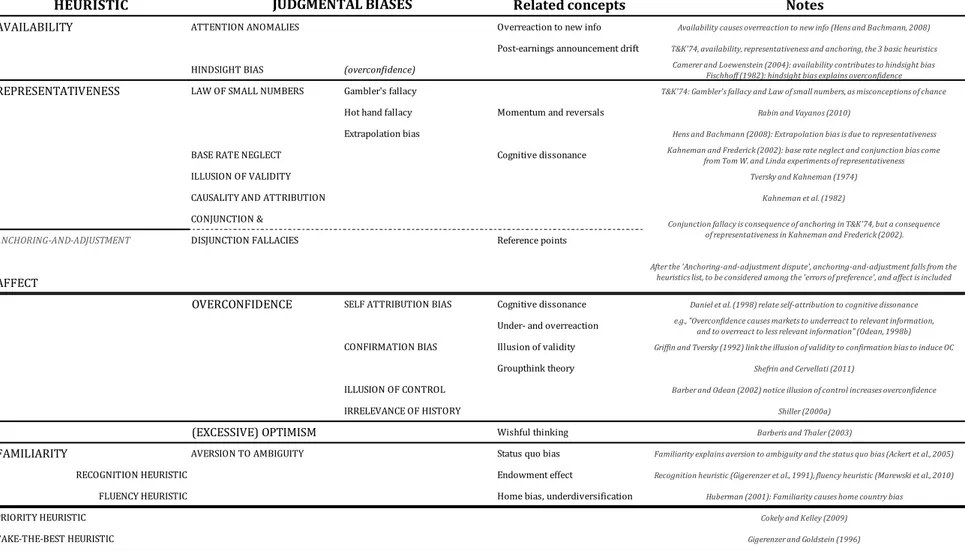
(23) implemented in the experiment. We structure the basic premise in a series of hypothesis to be tested. The statistical techniques used to that purpose include univariate statistics (normality tests, interquartile range, etc.), bivariate statistics (correlations, ANOVAs, regressions) and multivariate statistics: multiple linear regressions (MLR), principal component analysis (PCA), cluster analysis and correspondence analysis. A summary of conclusions is eventually provided. Steps two and three in the stepwise approach are tackled through a theoretical model. The basic hypotheses are, thereupon, that a herding behavior across participants in the industry might conform a market sentiment beyond fundamentals, and that the existence of limits of arbitrage would prevent efficiency in retail credit markets to be restored. To such purpose, we build a simple model of duopoly competition between banks of a different nature that shows how rational banks would herd to follow their biased competitors to grant excess credit during economic upswings. According to it, biased banks would lead the industry and unbiased banks herd under conditions we derive. Finally, we describe the limits of arbitrage that are implicit in the model. Then, we offer a dynamization of the model in order to provide an intuition of how the credit cycle would be amplified due to banking competition. A summary of conclusions is finally provided. Structure of the thesis The structure of the thesis is summarized in Figure 0.2 below. FIGURE 0.2 – Structure of the thesis. Source: Own elaboration. 9.
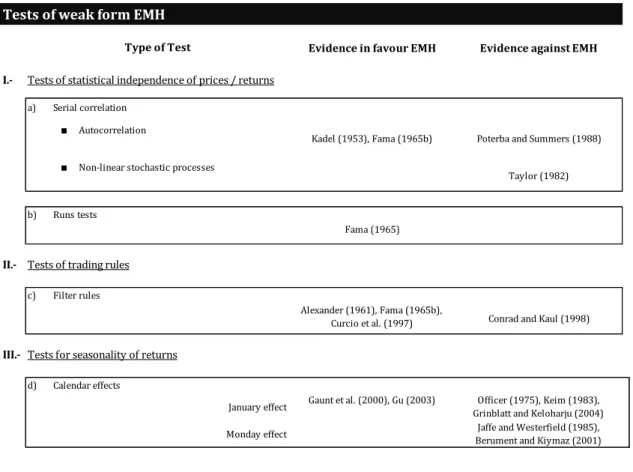
(24) The thesis is structured as follows. The main contents are presented in three parts plus a summary of results and a set of conclusions, followed by the references and appendices. Part I reviews the main conceptual frameworks identified in the academic literature that may contribute to analyze the informational efficiency of retail credit markets through a behavioral approach. These are the theories of credit and banking efficiency, the efficient market hypothesis, and the behavioral finance. Then, Part II extends our insights in behavioral finance and, in particular, overconfidence and prospect theory. Parts I and II will reveal convenient for the purposes of our research in Part III, where we offer an experimental research and theoretical model that provides a rationale for behavioral finance to challenge informational efficiency in bank-based systems as well. The main results of the dissertation, as well as a set of conclusions and guidance for future research are listed at the end. Part I is formed by three chapters, each of them devoted to review a different conceptual framework to analyze efficiency in retail credit markets. There we interpret how efficiency of the banking sector is analyzed, how it is analyzed when it refers to market-based systems, and how behavioral finance has come to dispute the orthodoxy in regards to market efficiency. Chapter 1 defines retail credit markets and goes on with the main theories of credit and banking efficiency. We identify the classic approach to analyze the efficiency of the banking sector. The review of the different theories and concepts of economic efficiency illustrates the way this approach differs to how efficiency is interpreted when analyzed in financial markets ―which is described in Chapter 2. The chapter ends with some theories that interpret what determines how much credit banks should grant and to whom: the microeconomics of credit ―that is, some theories on bank decision making when granting credit to individual borrowers― as well as the macroeconomics: some arguments that have already been suggested by researchers to justify how retail credit markets could malfunction. Chapter 2 describes the theoretical foundations of the efficient market hypothesis in financial markets. Firstly, we describe the essential role financial markets play in capitalist economies, which requires a pricing mechanism that provides an efficient reflection of information about fundamental values into prices. We then provide an extensive insight on the theoretical foundations of the EMH ―namely, the role of expectations, information, and the discount factor. Then it follows a discussion on the testability of the EMH. We enumerate several reasons why researchers have criticized the validity of the EMH as a refutable hypothesis, including the two alternative definitions of the EMH and the joint hypothesis problem. The analysis is completed with a taxonomy of the different approaches suggested for empirically testing the three forms of the EMH (weak, semi-strong and strong forms) and the most relevant results that have been obtained in the academic literature. Finally, Chapter 3 introduces the theoretical foundations of the behavioral economics and finance. Faced with the postulates by standard finance of rational expectations and market efficiency, the behavioral economics suggests instead a wider approach based on a combination of social sciences, 10.
(25) including psychology, sociology and demography. In line with this, the behavioral finance deals with the influence of psychology in financial decision making and financial markets. Thus, we firstly review the groundbreaking research on behavioral economics and finance. This would also help us familiarize with the myriad of biases and anomalies that pervade decision making and challenge the postulates of standard finance ―biases and anomalies to be extensively reviewed in Part II. The chapter ends with a brief summary of the most recent theories developed by behaviorist researchers in areas like decision theory, financial markets, corporate finance, debiasing, and others. Part II is formed two chapters, both devoted to provide a deeper insight on different aspects of the behavioral finance that will reveal essential for the theoretical and experimental research in Part III. Chapter 4 presents an original taxonomy and extensive review of the most relevant biases and anomalies. The taxonomy synthetizes the literature to provide a comprehensive approach in two broad categories: psychological biases and behavioral consequences. Psychological biases are classified into four groups: heuristics and biases, framing, valuation/errors-of-preference and social factors. Behavioral consequences may refer to decision effects (related to individuals) or to market anomalies. The subsequent sections of Chapter 4 are devoted to enumerate and analyze the most relevant of those biases and consequences, as well as the main contributions in the literature about them. Our goal will be to choose two specific areas on which to focus our research in Part III. Chapter 5 reviews these two areas more extensively, namely overconfidence and prospect theory. We begin with a vindication of our choice: they are two of the most-well studied areas in behavioral finance, both concepts have been suggested to explain a risk-seeking behavior by investors, and they could help explain as well how misperceptions by participants in the banking sector might have led them to engage in unsound credit policies. Then, the chapter provides further insight into prospect theory and overconfidence with the focus on several aspects that will be required in the experimental research in Part III ―in particular, the different measures available and how to calibrate the parameters at the individual level through a set of questionnaires. Part III is devoted to provide a rationale for psychology to challenge informational efficiency in bank-based systems. The analysis comes in three instances, divided in four chapters. Chapter 6 introduces an alternative to analyze the efficiency of bank-based systems. On one hand, we have the classic approach in market-based systems, the EMH. However, imperfect competition and informational asymmetries in bank-based systems would leave this approach without content. On the other, we have the stepwise procedure behaviorists have followed to test market efficiency considering the two elements that might challenge it: market sentiment and limited arbitrage. The approach we suggest is simply to apply the stepwise approach to retail credit markets. To such purpose, we firstly discuss the conditions under which it would be valid. First, it would be a plausible alternative to test 11.
(26) only the informational efficiency side of EMH, interpreted as whether through banking intermediation information is transmitted efficiently in the EMH sense. This way, the approach sidesteps the analysis of the allocative and operational efficiencies ―which in bank-based systems are often affected by imperfect competition and informational asymmetries. Second, the approach would be valid only for the aggregate credit market. This provided, the so-called behavioral approach would consist of a three-step process to determine (a) whether CEOs and employees in the industry exhibit beliefs that, based on heuristics and other forms of bounded rationality, could conform a market sentiment; (b) whether market sentiment could exhibit trends or predictable patterns; (c) whether there are limits of arbitrage in retail credit markets. Finally, Chapter 6 ends with a research agenda to suggest various ways the stepwise approach might be empirically tested. Of the suggestions there provided, Chapters 7 to 9 focus on the effects of prospect theory and overconfidence. The experimental research in Chapters 7 and 8 aims to test the first step in the stepwise approach. In particular, we focus on the effects of prospect theory and overconfidence, analyzed in detail in Chapter 5. Two broad questions are to be answered. First, Chapter 7 seeks to identify the existence of these behavioral biases among a series of participants in an experimental test. Second, whether these biases could feed, among that same set of respondents, a risk-seeking behavior in a simulated credit market ―which is analyzed in Chapter 8. The experimental sessions took place in the Faculty of Business and Economics at UDC during October, 2013. A group of 126 undergraduate and postgraduate UDC students participated in the experiment divided in five sessions. Participants in the same session completed all tests at the same time, each respondent in a separate computer. Chapter 7 deals with the description of the behavioral tests in the experiment, how they were designed, variables to be measured, hypotheses to be tested (regarding the effect of several priors over those variables), participants in the experiment, data and results obtained. The statistical analysis provided describes the behavioral tests in first instance: how they were designed and variables to be measured. Then it compares the results of the tests with the standard results in the literature, in order to confirm the validity of the tests implemented. Lastly, the hypothesis to be tested are introduced and the results obtained are interpreted. Chapter 8 deals with the strategy game designed to infer how the same 126 participants would behave when granting credit to the economy. For such purpose, they competed for a prize in a simulation game where they played the role of a bank granting credit to their customers under conditions of uncertainty and risk about the economic environment. The strategies they implemented resulted in three types of indicators (price, quantity and quality of credit) for the hypotheses to be tested. Chapter 8 includes a description of how the experiment was designed, the basics of the game, the hypotheses to be tested (regarding the effect of the behavioral variables over the outcomes of the game), how the experiment was implemented, data and results obtained.. 12.
(27) The combination of the research in Chapters 7 and 8 allows us to test the possible relationship between behavioral profiles and risk attitudes in the game, in order to determine whether the behavioral biases identified among participants in the experiment could feed a risk-seeking behavior in a simulated credit market. Then, Chapter 9 eventually provides a theoretical model that follows the second and third steps in the stepwise approach to determine how a duopoly of banks would compete to grant credit. The model provides two developments starting from the assumption that some banks in the industry might be biased in terms of overconfidence and excessive optimism ―particularly during the upswing of the economic cycle. In the first development, the second and third steps in the stepwise approach are analyzed: how would a duopoly of a rational and a biased bank compete when granting credit to the economy, whether herding strategies would appear, and whether limits of arbitrage in the industry are identifiable. We build a model of duopoly competition among banks to show that behavioral biases by participants in the industry explain how a credit bubble is fueled. According to it, biased banks would lead the industry and unbiased banks herd under conditions we derive. Finally, we describe the limits of arbitrage that are implicit in the model. The second development would contribute to explain how the credit cycle is amplified due to banking competition. We find pessimism would not be a powerful driver of credit cycles: instead, it is the euphoria during large upswings what seeds the next crunch. Finally, we offer a dynamization of our model to provide further insight on how boundedly rational competition would amplify the credit cycle. In addition, the model makes some predictions that are consistent with the empirical observation ―in particular, that the effects of the behavioral biases are more pervasive during upswings and the lower the quality of the niche market. Main results and conclusions. Finally, the presentation of the contents of this thesis ends with a disclosure of the main results obtained, as well as a set of conclusions and suggestions for future investigation. The appendices and bibliographic references are relegated to the end. All together, the research provided in this doctoral thesis could be a relevant contribution to identify the possible weaknesses of the banking industry, and hence to promote a complementary regulation ―particularly on macroprudential regulation and the role of central banking. Our model would show how behavioral biases might guide retail credit markets and why limits of arbitrage would imply bank-based systems are less likely to be informationally efficient than market-based ones. Would the behavioral approach introduced in this doctoral thesis provide further evidence on the pervasiveness of behavioral biases in the banking industry, then banking regulation should account for it. However, the solution is not more regulation per se, but better and different regulation. The behavioral approach we use would come in support of countercyclical regulation; how to implement it, 13.
(28) however, is beyond the scope of this thesis. Moreover, we must consider the possibility that the authorities, just like the private banks, might fail as well in their purpose to apply the required counterbalancing policies.. 14.
(29) PART I. GENERAL REVIEW OF THE MAIN FRAMEWORKS ON INFORMATIONAL EFFICIENCY OF RETAIL CREDIT MARKETS. 15.
(30) SUMMARY OF PART I. Efficiency is a recurrent concept in Economics, as it applies to a multitude of areas. However, it may be misleading as it has multiple interpretations, too: economic efficiency, market efficiency, social efficiency, business efficiency, Pareto efficiency, technical efficiency, allocative efficiency, informational efficiency… The perception that a rapid growth in the supply of credit above economic fundamentals and, consequently, an inefficient performance by financial institutions might have been a key factor behind the financial crisis, must be bounded to one of those scopes and interpreted in such terms. The aim of Part I is to provide a literature review of the main theories that analyze the efficiency of the financial system generally speaking, and of the banking industry in particular. These are the theories of credit and banking efficiency, the efficient market hypothesis (EMH), and behavioral finance. Then, Part II will extend our insights in behavioral finance and, in particular, overconfidence and prospect theory, since we will be using a behavioral approach for the theoretical and experimental analysis in Part III. Thus, the review provided in Parts I and II will reveal convenient for the purposes in Part III, as the theories described in the former are helpful to understand our contributions in the latter. Part I is organized as follows. In Chapter 1 we define retail credit markets and go on with the main theories of credit and banking efficiency. Chapter 2 describes the theoretical foundations of the efficient market hypothesis in financial markets and how behavioral finance challenges them. Finally, Chapter 3 introduces the theoretical foundations in behavioral economics and finance, which will later be extended in Part II.. 16.
(31) CHAPTER 1. THEORIES OF CREDIT AND BANKING EFFICIENCY 1.1. INTRODUCTION. Are bank-based financial systems efficient when providing credit to the economy? Trying to answer such question requires to address several issues in first instance. First, we must delimit the scope of our analysis. What are bank-based financial systems? How do banks grant credit to the economy? How do this industry differ from credit markets in market-based financial systems? For such purpose, we will define retail credit markets and provide an example to illustrate. Second, we identify the classic approach in the literature to analyze the efficiency of the banking sector. A brief review of the different theories and concepts of economic efficiency will suffice to illustrate why this approach differs to how efficiency is interpreted when analyzed in financial markets ―which is described in Chapter 2. Consequently, to answer whether banks are efficient when granting credit to the economy, we must review the different theories that interpret what determines how much credit banks should grant and to whom. This is what we will do in third instance. In particular, we will analyze both the micro and the macroeconomics of credit: that is, some theories on a bank decision making to extend credit to individual customers, as well as some other arguments that were proposed to justify how retail credit markets could malfunction. The chapter is organized as follows. Section 1.2 is devoted to delimit and define retail credit markets, followed by a description of the Spanish banking industry as an example. Section 1.3 introduces the analysis of economic efficiency in the banking sector according to different approaches in the literature. Section 1.4 introduces different theories of credit in the literature about how banks determine how much and to whom credit is granted.. 1.2. RETAIL CREDIT MARKETS. Financial systems consist of the set of institutions, markets and resources, whose primary purpose is to convey savings from savers to investors (Parejo et al., 2011). A traditional classification is to distinguish between bank-based and market-based financial systems. Following Xiao (2011), in bank-based systems most firms’ external funds are provided by banks with which they have long-term relationships, whereas banks’ main duty is to take deposits and lend directly to firms and individuals. Market-based 17.
(32) systems are characterized instead by firms that expect financial markets to meet their financial needs. Bonds play here the largest role in short term financing, and firewalls exist to separate the different types of financial services ―taking deposits and granting loans on one hand, underwriting and trading equities on the other. The Eurozone and Japan would be better described as bank-based systems ―as opposed to the U.K. and the U.S. (Levine, 2002; Allen, Chui and Maddaloni, 2004). Since the 19th century, two competing views have alternatively argued that bank-based systems are better at mobilizing savings, identifying good investments, and exerting corporate control, whereas market-based systems would be better in allocating capital, providing risk-management tools, and mitigating the problems of too-big-to-fail banks (Levine, 2002). The scope of analysis in this thesis will be the bank-based systems and, in particular, to set a behavioral approach to analyze whether the banking industry may be efficient when providing credit to the economy. Here, the efficiency concept we follow intends to be interpreted in a way akin to the Efficient Market Hypothesis in market-based systems. Therefore, we set our framework to be an informational efficiency analysis of the credit policies implemented by retail banks. We delimit retail banking as the transactions between banks and their customers (households and companies), and credit policies as the prices and volumes of credit banks set on loans and other credit instruments they provide to their clients. Consequently, we define retail credit markets2 as those transactions between retail banks and their clients that basically involve some sort of credit granted. These include personal loans, mortgages, credit accounts, credit cards and other credit instruments, which are broadly funded with deposits from other customers.3 Take the Spanish banking industry as an example. In Spain there are four types of institutions:4 banks; savings banks and CECA5 and credit cooperatives; other credit institutions (EFC and EDE);6 and the Government agency Instituto de Crédito Oficial, ICO. Banks and savings banks, which we will refer to as the banking system, represent the large majority of the industry. Table 1.1 summarizes the assets in the consolidated balance of these institutions by March 2011. According to it, the banking system granted 94.3% of all credits and loans to residents in Spain and 99.0% to those residents abroad the EU.. 2. From here onwards we will refer to retail credit markets, retail banking and bank-based system as equivalent concepts.. 3 Obviously, credit institutions often deal with a broader list of activities others than credit. For instance, the banking regulation. in Spain (Ley 3/1994, de 14 abril; Ley 44/2002, de 22 de noviembre) considers the following list of 15 typical activities by credit institutions: deposit taking; credits and loans, including consumer credit, mortgages and commercial credit; factoring; leasing; payment services; credit cards and travel checks; endorsements and guarantees; intermediation in interbank markets; dealing and brokerage; securities underwriting; services on corporate management, merges and acquisitions; wealth management; securities depository; business reports; safe custody services. 4 Ley 3/1994 and subsequent modification Ley 44/2002. 5 The Spanish Cajas de Ahorro (savings banks) are clustered in the organization CECA, Confederación Española de Cajas de Ahorro, which beyond providing representation services and other facilities to their members it may also act as a savings bank. Savings banks and CECA implemented in recent years a process of transformation into banking institutions, separating their financial activities from those merely associative. In the case of the CECA, this meant the launching of bank Cecabank in 2012. 6 The Establecimientos Financieros de Crédito (EFC) include former institutions on leasing and factoring services. The Entidades de Dinero Electrónico (EDE) are institutions whose primary activity is the issuance of means of payment (Parejo et al., 2011).. 18.
(33) TABLE 1.1 – Consolidated balance of credit institutions in Spain Consolidated Balance (ASSETS) (million euros and percentage; March 2011) CREDIT INSTITUTIONS ASSETS. TOTAL. Banking System Volume. 2,790,006. %. Volume. ICO. %. Volume. %. 46,894. 1.7%. 102,892. 3.7%. Credits and loans. 2,161,804. 2,038,519. 94.3%. 43,939. 2.0%. 79,346. 3.7%. Securities others than shares. 522,910. 496,594. 95.0%. 3,012. 0.6%. 23,304. 4.5%. Investment fund shares. 0. 0. Shares. 105,380. 105,105. a) Residents in Spain. b) Residents in other EU countries. 164,507. 2,640,220 94.6%. EFC & EDE. 0. 0. 99.7%. 34. 0.0%. 241. 0.2%. 160,219 97.4%. 3,693. 2.2%. 595. 0.4%. Credits and loans. 102,009. 97,797. 95.9%. 3,680. 3.6%. 532. 0.5%. Securities others than shares. 41,111. 41,050. 99.9%. 0. 0.0%. 61. 0.1%. Investment fund shares. 6. 6 100.0%. 0. 0.0%. 0. 0.0%. Shares. 21,382. 99.9%. 13. 0.1%. 2. 0.0%. 21,367. c) Rest of the World. 218,373. 216,297 99.0%. 765. 0.4%. 1,311. 0.6%. d) Unclassified. 273,419. 271,328 99.2%. 1,915. 0.7%. 176. 0.1%. TOTAL ASSETS Source: Banco de España, Boletín Estadístico (Parejo et al., 2011). Source: Parejo et al. (2011). As mentioned in the Introduction, before the worldwide financial meltdown of 2007 and 2008 high rates of credit growth relative to GDP were observed in most advances economies, but with a higher exposure in economies where the weight of the banking sector was relevant. Thus, one of the effects of the financial meltdown was the impact over some of the largest investment and commercial banks, both in the U.S. and Europe (Lehman Brothers, Merrill Lynch, Citigroup, Fortis, Dexia, RBS, UBS, etc.), which in some cases led to the demise of the company. In the case of the Spanish sector, credit to households and institutions boosted a 700% from 1995 to 2008 while, by the same period, GDP rose 58%. Then, following the global financial crisis after 2008, the delinquency ratio started to soar from 0.93% by December 2007 to 13.58% by January 2014 (recall Figure 0.1). In consequence, the Spanish banking sector experienced a large restructuring process to help them overcome the effects of the crisis. This process manifested itself through several public interventions, merges and acquisitions, but the most relevant fact was the de facto transformation of savings banks into banks.7 Following IMF (2012), Table 1.2 summarizes the restructuring process in the Spanish banking sector after 2009.. The analysis of the restructuring process of the Spanish banking sector ―and of savings banks in particular― is beyond the purposes of this thesis. Notwithstanding, let us mention that this transformation of savings banks into regular banks was conducted basically as follows: each savings bank launched a new bank of its property to operate their financial activities through it, while the former savings bank was transformed into a foundation. By 2014 the only exceptions are two, namely, Caixa Ontinyent and Colonya, Caixa Pollença. Both are minor, local entities that maintain the status of savings banks today. 7. 19.
(34) TABLE 1.2 – Spain: Consolidation of the Banking Sector 2009. 2010. 2011. 2012. Banco Santander. Banco Santander. Banco Santander. Banco Santander. Banesto. Banesto. Banesto. Banesto. BBVA Caixa Sabadell Caixa Terrassa Caixa Manlleu. BBVA. BBVA. Unnim. Unnim. La Caixa Caixa Girona. La Caixa. La Caixa. Cajasol Guadalajara. Cajasol-Guadalajara. Caja Navarra Caja Burgos Caja Canarias. Banca Cívica. Banco de Valencia. Banco de Valencia. BBVA. 2013 Banco Santander. BBVA. Caixabank Banca Cívica Caixabank. Banco de Valencia. Banco de Valencia. 21.11.2011. Caja Madrid Bancaja Caja Insular Canarias Caixa Laietana Caja Ávila Caja Segovia Caja Rioja. BFA - Bankia. Caixa Catalunya Caixa Tarragona Caixa Manresa. Catalunya Caixa. BFA - Bankia. BFA - Bankia. BFA - Bankia. 9.05.2012. Catalunya Caixa. Catalunya Banc. Catalunya Banc. 17.12.2012. Caixa Galicia Caixanova. Nova Caixa Galicia. Nova Caixa Galicia. Novagalicia Banco 17.12.2012. Banco Sabadell Banco Guipuzcoano. Banco Sabadell. CAM. CAM. Banco Gallego. NGB (ABANCA) 18.12.2013. Banco Sabadell. Banco Sabadell. Banco Gallego. Banco Gallego. Banco Gallego. Banco Popular Banco Pastor. Banco Popular Banco Pastor. Banco Popular Banco Pastor. Banco Popular. Banco Popular. Unicaja Caja jaen. Unicaja. Unicaja. Caja Duero Caja España. Unicaja. Unicaja. Ceiss. Ceiss. BBK Cajasur. BBK. Caja Vital Kutxa. Caja Vital Kutxa. Kutxa Bank. Kutxa Bank. Kutxa Bank. Caja Murcia Caixa Penedés Caja Granada Sa Nostra. Banco Mare Nostrum. Banco Mare Nostrum. Banco Mare Nostrum. Banco Mare Nostrum. Ibercaja. Ibercaja. Ibercaja. CAI Caja Círculo Caja Badajoz. CAI Caja Círculo Caja Badajoz. Caja 3. Ibercaja. Ibercaja. Bankinter. Bankinter. Bankinter. Bankinter. Bankinter. Cajastur CCM. Cajastur. Caja Extremadura Caja Cantabria. Caja Extremadura Caja Cantabria. Liberbank. Liberbank. Liberbank. Notes: Banks coded in red were intervened; banks in green were part of the institutional protection scheme. Source: IMF (2012), years 2012 and 2013 own elaboration 20. Banco Sabadell.
(35) According to IMF (2012), the industry was concentrated by 2011 in only ten groups, four banks (Santander, BBVA, Popular and Sabadell) and six former savings banks (Caixabank, Bankia, Unicaja, Catalunya Banc, Novagalicia Banco and Kutxa Bank). These ten groups held the large majority (79.2%) of the assets in the industry,8 with the other 20.8% corresponding to small private banks (11.9%), all other non-foreign banks (5,1%) and the cooperative sector (3,7%). This concentration was the result of merges and acquisitions of a total sum of more than fifty banks and savings banks that existed before 2009. Some of them remain intervened or part of the institutional protection scheme to date.. 1.3. ANALYSIS OF ECONOMIC EFFICIENCY IN THE BANKING SECTOR. The way efficiency is interpreted when applied to bank-based financial systems differs to how it is analyzed in market-based ones. The reason is that the approach used in financial markets, the EMH ―i.e., how agents analyze information to price securities, and whether through this process information is transmitted efficiently― collides with the classic paradigm of banking theory: market microstructure and asymmetries of information. Thus, Sections 1.3 and 1.4 are devoted to introduce different theories about how banks provide credit to the economy and banking efficiency. In what follows we first make a short review of the literature on banking efficiency. In perfectly competitive markets we expect inefficient firms to be driven out by the efficient. However, the empirical finding that substantial inefficiencies often arise leads to some interpretations. Could imperfect competition be a consequence of regulatory limits on competition or not perfectly integrated markets? Could it be that an oligopolistic structure makes banks implement collusive practices? May it be that it is efficiency what determines both the market structure and performance of the firms, so the positive relationship between market power and performance (profits) is spurious? There is an extensive research on industrial organization that finds a positive statistical relationship between profitability and market structure (Berger, 1995). Although this result is generally accepted, there is no agreement on the hypothesis which generates it (Fiordelisi, 2004). Two types of theories were suggested to explain this finding: Market Power hypotheses ―including the structure-conductperformance (SCP) and relative-market-power (RMP) models― and Efficient Structure (ES) hypotheses. 1.3.1. Efficient structure vs. Market power paradigms The Structure-Conduct-Performance (SCP) paradigm interprets performance as a result of the exogenous structure of the market which influences bank’s conduct (Mensi and Zouari, 2010). The SCP model. 8 These ten groups were Banco Santander (18.9% of the assets), BBVA (14.9%), Caixabank (12.1%), BFA-Bankia (11.9%), Banco. Sabadell (5.6%), Banco Popular (5.5%), Unicaja (2.7%), Kutxa Bank (2.6%), Catalunya Banc (2.5%) and Novagalicia Banco (2.5%), In addition, the assets abroad by Banco Santander and BBVA, which are larger than their domestic interests in both instances, were not considered for the purposes of this classification.. 21.
(36) assumes that a higher concentration allows banks to implement collusive practices, like setting lower deposit rates and higher loan rates, and consequently gain substantial profits (Bain, 1951; Stigler, 1964). An alternative paradigm is the Efficiency Hypothesis (Demsetz, 1973), which interprets market power and performance of banks as a consequence of their efficiency levels: banks which operate more efficiently than their competitors will gain higher profits resulting from lower costs, hence they hold an important share of the market. Consequently, the positive relationship between market power and performance is only spurious, what generates them both is efficiency. Both paradigms have been explored following different hypotheses. Smirlok (1985), subscribing to the efficiency hypothesis, considers market share as a proxy for efficiency. According to this interpretation, the efficiency hypothesis would prevail when a significant positive correlation between market share and profitability is detected (Mensi and Zouari, 2010). Other authors instead (e.g., Shepherd, 1986; Berger, 1995) advise against the use of such proxy and recommend a direct measure of efficiency. Shepherd (1986), for instance, considers the direct source of market power is the domination of participants over the individual market. Hence, it follows the emergence of a theory related to the SCP model, the Relative Market Power (RMP) hypothesis: only banks with a larger market share and well-differentiated products are able to exercise market power to determine prices and make supernormal profits (Berger, 1995). Nevertheless, the results may be ambiguous: a bank with a strong position in the market may either reinforce its domination over the market or achieve a higher efficiency (Mensi and Zouari, 2010). Thus, a particular case of market power hypothesis is the Quiet Life hypothesis (Hicks, 1935): a bank with a large market share is less centered on efficiency as the exploitation of market power generates automatic benefits, whereas an increase in market power generally comes with a deterioration of efficiency that makes banks unable of earning higher profitability. In order to solve this debate and methodological problems, Berger and Hannan (1997) suggest to explore the notion of efficiency to explicitly integrate efficiency variables in the equations. In particular, Berger and Mester (1997) summarize the literature on (banking) economic efficiency through the analysis of different efficiency concepts and measurement methods. The different interpretations of efficiency are described next, while the measurement methods are analyzed in subsection 1.3.3. 1.3.2. Different concepts of economic efficiency In conventional microeconomic theory, firms are assumed to minimize costs irrespective of the market structure or economic environment in which they operate. However, Liebenstein (1975) introduces a theory of the organization of the firm, and its relation to its environment, under which firms do not minimize costs (called X-inefficiency), and this may hold even under competition. An identical set of inputs at identical prices would lead to a wide variety of outputs under different organizational circumstances. The X in X-efficiency would represent an unknown factor responsible for a non-allocative type of inefficiency. Examples for these unexploited opportunities would be lack of motivation, human 22.
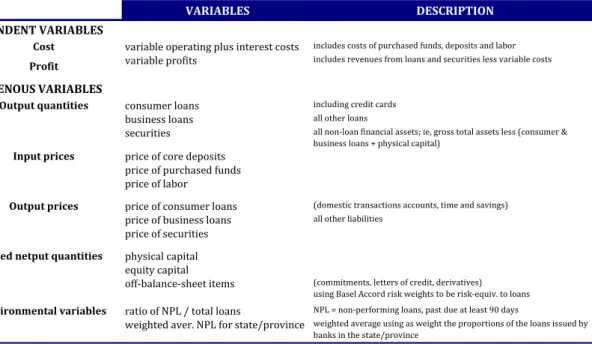
(37) inertia, and biases in human decision making. They would be a form of inefficiency, but not allocative inefficiency, as they are not related to prices and markets per se; they are related to intra-firm activities and to errors made by individuals inside those firms. Following this, Berger (1995) divides the efficiency hypothesis into the X-efficiency (XE) and scaleefficiency (SE) hypotheses. Under the X-efficiency, firms with superior management or production technologies have lower costs and therefore higher profits, which generates larger market shares that may result in higher concentration. The scale-efficiency instead assumes firms have essentially equally good management and technology, but some firms simply produce at more efficient scales than others, therefore having lower unit costs and higher unit profits. Under both interpretations, there is a positive relationship between profit and market structure, but it is efficiency what drives both profits and market structure, being the profit-structure relationship a spurious outcome. Fiordelisi (2004) focuses instead on three dimensions of the ES hypothesis ―namely, production technique, production scale, and resources allocation― to develop three alternative measures: technical efficiency ―firms that are the best in terms of quantities; allocative efficiency ―to produce outputs in optimal proportions, given prices and technology; and scale efficiency. Finally, Mester (1996) identifies three other levels of efficiency: scale efficiency ―whether banks are operating with the efficient level of outputs; scope efficiency ―whether banks are operating with the efficient mix of outputs; and X-efficiency ―whether banks are using their inputs efficiently. All these taxonomies, however, refer to a single interpretation of efficiency: cost efficiency. Berger and Mester (1997) two more ones: standard profit and alternative profit efficiencies. In their words, “these concepts have the best economic foundation for analyzing the efficiency of financial institutions because they are based on economic optimization in reaction to market prices and competition, rather than being based solely on the use of technology” (p. 898). These efficiency concepts are described next. Cost efficiency Cost efficiency is a measure of how close a bank’s cost is to what a best-practice bank’s cost would be for producing the same output. Here the dependent variable is costs, inputs are prices (of deposits, other funds, labor) and outputs are quantities (loans and securities). The cost function is given by9. 𝐶 = 𝐶(𝑤, 𝑦, 𝑧, 𝑣, 𝑢𝑐 , 𝜀𝑐 ) → ln 𝐶 = 𝑓(𝑤, 𝑦, 𝑧, 𝑣) + ln 𝑢𝑐 + ln 𝜀𝑐 ,. (1.1). where C represents variable costs, w input prices, y output quantities, z quantities of fixed netputs (inputs or outputs: e.g. off-balance-sheet items, physical capital, equity capital), v environmental variables (e.g. nonperforming loans over total loans), uc the inefficiency factor, and εc random error.. Equation (1.1) holds assuming inefficiency and random terms uc and εc are multiplicatively separable from the rest of the cost function, and applying natural logs. 9. 23.
Figure


+7


Documento similar
Government policy varies between nations and this guidance sets out the need for balanced decision-making about ways of working, and the ongoing safety considerations
No obstante, como esta enfermedad afecta a cada persona de manera diferente, no todas las opciones de cuidado y tratamiento pueden ser apropiadas para cada individuo.. La forma
In this respect, a comparison with The Shadow of the Glen is very useful, since the text finished by Synge in 1904 can be considered a complex development of the opposition
The Dwellers in the Garden of Allah 109... The Dwellers in the Garden of Allah
In this paper we present an agent-based computational model in which the owing of funds from savers to investors is intermediated by a stream of banks competing in fully
In the previous sections we have shown how astronomical alignments and solar hierophanies – with a common interest in the solstices − were substantiated in the
While Russian nostalgia for the late-socialism of the Brezhnev era began only after the clear-cut rupture of 1991, nostalgia for the 1970s seems to have emerged in Algeria
Díaz Soto has raised the point about banning religious garb in the ―public space.‖ He states, ―for example, in most Spanish public Universities, there is a Catholic chapel
