
Impact of information and communication technologies in agroecological cooperativism in Catalonia
8
0
0
Texto completo
(2) Original Paper. Agricultural Economics – Czech, 65, 2019 (2): 59–66 https://doi.org/10.17221/171/2018-AGRICECON. Among other channels, cooperatives hold a market share of 9.8% (growing its share by 2.3% compared to the same period the year before). When it comes to fresh groceries, traditional stores retain the highest sales turnover (33.8%), although being at the same time the ones experiencing the most acute market share drop compared to the same period in 2015 (–5.5%). The report showcases two relevant elements for this research. On the one hand, sales transferred from traditional to large-scale retail sectors, discount stores, supermarkets and cashand-carry wholesalers in their bid for fresh grocery. On the other hand, both the volume (+33.2%) and the value (+27.7%) of e-commerce purchases increased. Therefore, the consumption model that groups together all kinds of purchases prevails, and the role of information and communication technologies (ICT) is increasingly relevant. In this context, the large agri-food industry, which is basically concentrated in 10 large brands globally (Hoffman 2013), controls the whole value chain (Toribio et al. 2012), providing products at the lowest cost while complying with legal requirements. The core of most of the market is concentrated on a few agents, a lot of intermediaries and little attention to the long distances from where the groceries come from or the existing social justice conditions where they are produced, among other aspects (Mauleón 2009; Simón Fernández et al. 2012; Vivas 2014). Despite this hegemony, we can observe an alternative consumption model that pivots around SFSCs (Binimelis and Descombes 2010), characterised by a closer relationship between producer and consumer (Valls 2006; Maréchal 2008) based on a resocialisation process (Venn et al. 2006; Jarosz 2008). It promotes three elements: (i) the redistribution of value through a network that opposes agroindustrial consumption; (ii) the recovery of confidence between producer and consumer; and (iii) the articulation of new political and governance market structures that promote resilience and sustainability. Consumer groups and cooperatives, apart from establishing bonds with SFSCs, also promote agroecology that, in contrast with ecology, is not only focused on promoting a production based on the optimal use of natural resources that does not rely on synthetic chemical products and genetically modified organisms. It is also concerned with the social and political impact of the food production traceability (Badal et al. 2010). The fact that the collectives studied in this report take part in the market, understood as a tool 60. at the service of the well-being of humans and life reproduction in our planet, links them to the group of organisations that constitute the social and solidarity economy (SSE) (Pérez de Mendiguren et al. 2009). Furthermore, the emergence of agroecological consumer groups and cooperatives is also a political response against the homogeneity resulting from the expansion of global food supply chains (Khoury 2014). Therefore, they are part of the anti-globalisation movement and embrace the rhetoric of territorial defence, very significant in Catalonia, and that implies to pursue a recovery of the "identity of the sites" in order to promote social and economic alternatives that favour relocalisation (Nel lo 2014). Ultimately, if we add the values that the SSE promotes and the political link of the organisations with the social movements to the disintermediation and proximity variables that articulate the SFSCs, paying special attention to agroecology, we are contextualising a new consumption model also concerned with the social, economic, environmental and organisational criteria behind every product while defined by being politically transformative. It is because of this same reason that the term "agroecological cooperativism" encompasses the social, economic and political dimension of this consumption model. A model that requires the inter-cooperation of the involved actors to be scaled up (Martín-Mayor et al. 2017). That is, the relational flows ought to strengthen the construction of the social market, which is democratic, ecological and supportive by nature (Garcia 2002). It is at this stage where the adoption of ICT can facilitate the emergence of this array of potential relationships, creating a network of interconnections within the framework of a "network society" (Castells 1997). Through social media platforms, users can create profiles and connect (Boyd and Ellison 2008), generating new flows of content (Cormode and Krishnamurthy 2008). These networks can be dense and enclosed, the result of the narrow relationships between members of the same collective, or rather open and diffused, as a consequence of the flexibility of these same organisations (Wellman 1997). In any case, Miralbell (2012) signifies the usefulness of social network platforms as a tool that eases the exchange and – to some extent – the creation of knowledge, thanks to the potential enabled by the interaction between its users. Furthermore, digital platforms should be an instrument to scale the impact of traditional cooperativism, allowing a new type of organisations called platform cooperatives (Scholz 2016). In this sense, open technology and open knowledge.
(3) Agricultural Economics – Czech, 65, 2019 (2): 59–66. Original Paper. https://doi.org/10.17221/171/2018-AGRICECON must be the way that platform cooperatives connect with digital commons (Fuster and Espelt 2018). This new approach of cooperativism, connected to digital commons, is promoting an alternative to the unicorn platforms – like Uber or Airbnb – of collaborative economy (Fuster et al. 2017).. GOALS, HYPOTHESIS AND CASE STUDY This article, on the one hand, aims to analyse the extent this network of agroecological cooperativism, favours a self-managed, social, proximity-based and economically fair consumption, how it is articulated. On the other hand, it aims to assess the role ICT holds regarding the articulation of this network. The hypothesis is that consumer groups and cooperatives create a network of relationships with their producers and intermediaries through ICT that facilitates inter-cooperation, and therefore promotes agroecological cooperativism. In order to do so, we focus on the study of 56 active collectives present in the city of Barcelona (Espelt et al. 2015), the area with the highest volume of consumer groups and cooperatives in Catalonia and where SSE accounts for 7% share of gross domestic product (GDP) (Fernàndez and Miró 2016).. METHODOLOGY Drawing from other similar research (Juliá et al. 2006; Meroño and Arcas 2006), we have designed a methodology that blends on-site interviews and online research. The interviews have been conducted with a questionnaire including two sets of questions. On the one hand, we have integrated the indicators formulated by Pam a Pam (XES and SETEM 2015) in order to determine which organisations are part of the SSE in Catalonia, using the variables of proximity, fair trade and inter-cooperation, which are assessed with a 0 to 5 grading. Each indicator is discriminatory (it is either accomplished or not), and the different grades dictate their level of excellence. On the other hand, regarding ICT, we assess the value organisations give to ICT for their functioning, the tools used to manage organisational issues, and their digital footprint, among other relevant activities and contents. At the beginning of the interview, we gather information such as the number of affiliates and the listing of producers and intermediaries. The questionnaire provides quantitative (percentage of compli-. ance regarding SSE criteria or assessment of value given to ICT in the global functioning of the group, for instance) and qualitative data (a detailed report on how any given SSE criteria is observed or the description of a technological tool adopted, for instance). Given that one of the goals of the research is to uncover the role of intermediaries within the network, the questionnaire is also carried out with the second-grade cooperatives and with other intermediary organisations. In order to collect information concerning the digital footprint of producers and intermediaries in social networks, we have carried out a netnographic research based on links that appear on websites and official blogs, limiting this research to the 157 producers and 13 intermediaries included in the study sample between April 10–20, 2017. In the first place, a factual analysis has been conducted in order to corroborate their presence in each of the social networks studied: Facebook, Twitter and Instagram. To assess the results, we have conducted descriptive statistics for each of our variables and a correlation analysis of them (number of affiliates, proximity, fair trade, inter-cooperation, the value given to ICT, professionalisation and digital footprint in social media) in order to quantify the existing relationships between them and identify key elements. On the other hand, we have conducted a network analysis (visually represented with Gephi) to study the most relevant nodes, the existing connections between them and the role of second-grade organisations that act as intermediaries between producers and consumers.. RESULTS Consumer groups and cooperatives Most of the cooperatives and consumer groups function thanks to the voluntary commitment of their affiliates (91.2%). The rest (8.8%) count on professionals that take care of specific tasks: economic and orders management, logistics. Despite being fewer, professional groups have a higher average number of affiliates (71.5) compared to the ones run by volunteers (28.75). Likewise, they do not set themselves a specific growth limit, while volunteer groups do, causing waiting lists when new members want to join, a circumstance that often ends up with the creation of new groups. Regarding the three criteria used to study SSE, we notice that: the proximity criteria are accomplished 61.
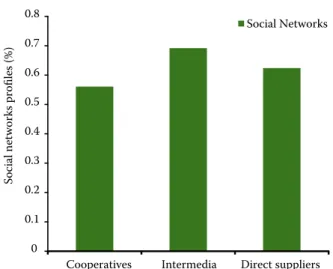
(4) Original Paper. Agricultural Economics – Czech, 65, 2019 (2): 59–66 https://doi.org/10.17221/171/2018-AGRICECON. without significant variation both by volunteer (81%) and professional (80%) groups. This indicates that the studied organisations prioritise purchasing local products. Drawing from the on-site interviews we conducted, we can assert that this takes place because these organisations have undertaken an internal consideration process and followed a policy consisting in limiting the geographical scope of the products they buy, providing at the same time sensibilisation tools to promote proximity trade. The fair trade criteria also show a high level of accomplishment, with a minimum variation between volunteer (73%) and professional (72%) groups. This indicates that these groups try to purchase fair trade products or products that certify decent salaries and the minimisation of intermediaries. As a result of the on-site interviews conducted, we can assert that this happens because these organisations have undertaken an internal consideration process and embrace as their policy to prioritise purchasing fair trade products or products that guarantee decent salaries and the minimisation of intermediaries. Likewise, they also offer sensibilisation materials that promote fair trade and communication channels with the producer when it comes to setting the prices. Actually, a lot of consumer groups regularly visit their main producers, show interest in their projects and encourage them to get involved in their assemblies. Some groups even help producers in hard-work tasks such as the sewing or the harvest. The inter-cooperation criteria show significant variation between voluntary (42%) and professional (84%) groups. Voluntary groups spread the SSE principles and activities and count on at least some suppliers that participate in it, while professional groups also search for SSE suppliers whenever a product or service is needed, and most of their suppliers come from SSE. Besides accomplishing the previously mentioned criteria, some of them even accomplish excellence by strategically contributing to the creation of the social market. Regarding their use of ICT, the groups grade their importance with an average of 7.9 out of 10, with no significant variation between volunteer and professional groups. The results of the interviews point that they make use of ICT to manage the internal joint orders with producers. The most used technology is Google, while some of them have developed or adapted open-source software. Regarding their social media footprint, the results show that 57.9% of organisations have open profiles 62. in at least one of the networks. Nonetheless, their usage varies significantly. There are some groups that post and update content often, linking with salient topics in their sector, by referring to producers, spreading political (against The Transatlantic Trade and Investment Partnership (TTIP), for instance) or sensibilisation (food waste, for instance) campaigns, while others barely do it, do not do it at all or keep their social media profiles private.. Suppliers and intermediary organisations The cooperatives and consumer groups from Barcelona count on 114 direct suppliers (91.7%) and 13 intermediaries (8.3%). 91.7% of the products are provided by a direct supplier and 8.3% by an intermediary. This figure, along with the average distance from the suppliers (278.7 km) reinforces the task that groups around SFSCs carry out. That is, SFSCs accomplish the two main elements that they ought to: proximity (81%) and disintermediation (90.7%). This indicator shows a slightly higher tendency as for volunteer groups not dealing with intermediaries (91.2%) compared to professional groups (87%). 71.42% of intermediary organisations are part of the institutions that form the SSE, while just 6.3% of producers have taken the SSE questionnaire. Regarding the three key SSE criteria concerning our research, we notice that proximity is accomplished in 67%, fair trade in 70% and inter-cooperation in 50% of the cases. As for social networks, 69.2% of intermediary organisations have an open profile on Facebook, while 46.2% also use Twitter and 15.3% other social networks, such as Instagram, YouTube or Google+. When it comes to producers, 62.4% of them are on Facebook, 36.9% on Twitter, 28% on Instagram and 14.6% on other social networks, such as YouTube, LinkedIn or Flickr.. Highlighted Elements The SSE criteria-based accomplishment comparison between cooperatives and suppliers (either direct or intermediaries) figure (Figure 1) shows that cooperatives accomplish a higher proximity ratio (81% compared to 67%) and fair trade (72% compared to 70%), whereas suppliers present higher inter-cooperation capabilities (50% compared to 44%). Despite the variation not being significant in quantitative terms, the results put on display a reinforcement of cooperatives, especially towards SFSCs, and slightly towards inter-cooperation,.
(5) Agricultural Economics – Czech, 65, 2019 (2): 59–66. Original Paper. https://doi.org/10.17221/171/2018-AGRICECON Cooperatives Suppliers. SSE accomplishment (%). 0.8 0.7 0.6 0.5 0.4 0.3 0.2. Social Networks. 0.7 0.6 0.5 0.4 0.3 0.2 0.1. 0.1 0. 0.8 Social networks profiles (%). 0.9. Proximity. Fair trade. 0. Inter-cooperation. Cooperatives. Intermedia. Direct suppliers. Figure 1. Social and solidarity economy (SSE) criteria-based accomplishment comparison between cooperatives (number = 56) and suppliers (number = 157). Figure 2. Presence in social media comparison between cooperatives (number = 56), intermediaries (number = 13) and producers (number = 144). Source: authors. Source: authors. while suppliers acquire a greater role in favouring inter-cooperation between agents. The Figure 2 compares social media presence between cooperatives, intermediaries and direct suppliers displays a lower level of interest among cooperatives (56%) to spread their activity in such networks compared to producers (69%) and intermediaries (69%). In order to measure the relationship between the studied variables: (i) proximity, (ii) fair trade, (iii) intercooperation, (iv) ICT usage, (v) social media presence, (vi) professionalisation, (vii) number of affiliates and (viii) intermediation, we have undertaken a correlation analysis (Table 1). The results show that variables behave independently of each other. Despite some similarities occurring, these are not significant in quantitative terms and show. relatively low values. This has, from our point of view, a double-sided interpretation that actually points in the same direction. On the one hand, the variables have been conceptualised consistently enough, as they show no redundancies. On the other hand, it is corroborated that – as the interviews prove– it is highly likely that these are variables that depend on highly independent approximations and decisions by nature, either due to their idiosyncratic differences or because other capabilities and strategies are required for its implementation—as in the case of ICT. In this regard, the independence shown by ICT and social media can be explained by the management character of the former and by the communication nature of the latter. The network of agroecological cooperatives of Barcelona (Espelt et al. 2017b), arranged by a number. Table 1. Correlation of variables studied (number of cooperatives = 56) NUM Number of affiliates (NUM). PRO. FT. ICO. ICT. PRF. IME. SM. –. –. –. –. –. –. –. –. Proximity (PRO). 0.12. –. –. –. –. –. –. –. Fair Trade (FT). 0.24. 0.54. –. –. –. –. –. –. Inter-cooperation (ICO). 0.41. 0.25. 0.09. –. –. –. –. –. ICT usage (ICT). 0.19. –0.04. –0.05. 0.16. –. –. –. –. Professionalisation (PRF). 0.63. 0.10. 0.00. 0.49. 0.11. –. –. –. Intermediation (IME). 0.38. 0.04. 0.17. 0.15. 0.28. 0.07. –. –. Social Media (SM). 0.12. 0.10. –0.02. 0.29. 0.18. 0.27. –0.18. –. all values are significant at 95% Source: authors. 63.
(6) Agricultural Economics – Czech, 65, 2019 (2): 59–66. Original Paper. https://doi.org/10.17221/171/2018-AGRICECON of connections and centrality, we notice that the cooperatives Mespilus and L’Aixada are the ones that display the most connections between consumer organisations and in the study overall. Meanwhile, Formatges de Puigcerver and Cal Valls are the producers with more presence among the cooperatives. It is worth noting the central position of Selvatana, a producer with just nine groups or cooperatives as clients but with a huge presence in the network. It is also necessary to underscore that the two intermediary organisations better positioned, Queviure and Món Verd, are listed the 30 th and the 43 rd.. CONCLUSION The first critical aspect in the definition of agroecological consumer groups and cooperatives are its self-management capabilities. The results of this article shed light on the consumer activity relations that these organisations (91.2% of them thanks to the voluntary commitment of its affiliates) establish with producers and intermediaries. In all cases, the less numerous group of organisations, the professional ones (8.8%) count on a larger number of affiliates (71.5 on average, compared to 28.8 in the case of volunteer-run organisations). Therefore, we can conclude that professional organisations have greater potential, as they exert their influence over a larger group of consumers compared to volunteer groups. In our definition of agroecological consumer groups and cooperatives, we articulated a double-sided approximation: their belonging to SFSCs and their connection with the values promoted by the SSE. On the one hand, regarding SFSCs (proximity and disintermediation), the data concerning the average spatial distance between suppliers and cooperatives shows that this figure equals an average of 278.7 km compared to an average of 3827.8 km regarding the products consumed by the Spanish citizenship as a whole (Simón Fernández et al. 2012). On the other hand, the consumption of products directly supplied by producers stands at 90.7%. In short, the two significant elements that define the nature of organisations belonging to SFSCs are accomplished. Regarding their link to the SSE, as we have pointed in the results section, the set of organisations studied do accomplish the criteria defined with the questionnaire, specified in the social, economic and environmental assessment of each project. Nonetheless, if we focus on the three SSE key criteria used in our research (proximity, fair trade and inter-cooperation) we notice that while the former 64. two are accomplished in more than 70% of the cases both in volunteer and professional organisations, the latter, inter-cooperation (which is critical for social market growth) (Fernàndez and Miró 2016), shows a significant variation, with an accomplishment ratio of 84% for professional groups and 42% for volunteer groups. Therefore, it constitutes a new indicator that reinforces the presence of professionals as a requirement for the expansion of a consumption model that draws from the SSE values. This is especially relevant as professional groups do not set themselves a growth limit, as it is the case for the groups run by volunteers. In addition, it is worth noting that the presence of intermediaries does not undermine the promotion of the social market, as 71.42% of the intermediary organisations studied are part of the SSE as well. Regarding technology usage, which obtains a high valuation (7.7), we also notice a relevant element: their attention is focused on the groups’ operative processes (82% usage in orders’ management) rather than on using them as a tool to spread their activity and promote their values (only 56.1% are present in social media platforms). No significant variation is appreciated in this case between professional and volunteer groups. Therefore, we can conclude that, as a whole, ICT usage is prioritised as a tool embedded in their operative processes rather than as a communication instrument. In this sense, in our presentation of results, we have corroborated that correlation variables (proximity, fair trade, inter-cooperation, ICT usage, social media presence, professionalisation, number of affiliates and intermediation) do not provide conclusive empirical reasons, although they certainly allow us to signal that the more family members are included, the greater the organisation’s openness is. An explanation may be that the social capital of its members increases along with the probability of positive and effective inclusion of members with ties and contacts in other organisations. Likewise, it seems that professional individuals could help to establish deeper cooperation with other organisations. In any case, it seems obvious that the network-based structure and the nature of consumer groups and cooperatives positively correspond with a diffuse and open network (Wellman 1997). In this regard, the on-site interviews confirm this aspect. Except for very specific instances, as with Poblenou cooperatives coordinator (with which the neighbourhood’s groups organize activities and manage orders of specific products jointly) or some other groups that.
(7) Agricultural Economics – Czech, 65, 2019 (2): 59–66. Original Paper. https://doi.org/10.17221/171/2018-AGRICECON articulate part of their offer through second-grade cooperatives (i.e. Quèviure), cooperatives present an odd, occasional level of relations between them. The fact that the two most relevant intermediary organisations, second-grade cooperatives Quèviure and Món Verd, occupy a low-level centrality in our network analysis (the 30 th and the 43 rd position, respectively) also sheds light on their moderate influence as inter-cooperation agents nowadays. Summing up, we can conclude that, in contrast with other consumer alternatives linked to the promotion of proximity products, for which technology is an essential aspect of their functioning, as it is the case with The Flood Assembly (Espelt et al. 2017a), consumer groups and cooperatives amplify the values promoted by the SSE and, therefore, the possibility of reinforcing the social market through self-management, specially if professional individuals take part in it. In any case, ICT emerge as a relevant element in the operative articulation of agroecological consumer groups and represent a critical asset in the development of SFSCs and the SSE. As we pointed in the introduction, the role of open software and open knowledge in the adoption of platform cooperativism should be an opportunity to scale the impact of cooperativism in the sense of their values (Fuster and Espelt 2018). According to the SSEbased assessment criteria used by Pam a Pam, which have been used in this research, usage of knowledge licenses and open-source software are related to the values promoted by SSE. Thus, in future research, it would be interesting to analyse how agroecological cooperatives are adopting digital commons to scale their impact as a cooperative platforms (Scholz 2016) and, with that, build an alternative to unicorn platforms (Fuster Morell et al. 2017).. Acknowledgements Oriol, it was fun working with you while you were among us. Now you are gone, but the good work remains. So long, friend. Ricard, Ismael, Núria and Toni.. REFERENCES Badal M., Binimelis R., Gamboa G., Heras M., Tendero G. (2010): Ground Level. Indicators of Food Sovereignty in Catalonia. Entrepobles Association & Institute of Ecological Economics and Political Ecology, El Tinter, SAL, Barcelona. Binimelis R., Descombes C.A. (2010): Commercialization in Short Circuits. Characterization and Typology. Agrarian School of Manresa & Verloc, Manresa.. Blanco I., Nel lo O., Brugué J., Jiménez E. (2015): Disadvantaged Neighbourhoods Facing the Crisis: Urban Segregation, Social Innovation and Civic Capacity. Autonomous University of Barcelona: Recercaixa, Bellaterra. Boyd D.M., Ellison N.B. (2008): Social network sites: Definition, history, and scholarship. Journal of ComputerMediated Communication, 13: 210–230. Castells M. (1997): The Net Society. The Information Age, Vol I. Alianza Editorial, Madrid. Cormode G., Krishnamurthy B. (2008): Key differences between Web 1.0 and Web 2.0. First Monday, 13. Espelt R., Peña-López I., Losantos P.; Rodríguez E., Martín T., Pons F. (2015): Mapping agro-food consumption groups in the city of Barcelona. Places of possibility? Rural societies in a neoliberal world. In: Proceedings of the XXVI ESRS Congress, Aberdeen, Aug 19, 2015. The James Hutton Institute, Aberdeen. Espelt R., Peña-López I., Vega N. (2017a): Digital platforms: consumer groups and cooperatives versus The Food Assembly, the case of Barcelona. In: The Collaborative Economy in the Era of Digital Capitalism. Magazine of Studies for the Social Development of Communication, 15. Espelt R., Peña-López I., Miralbell O., Martín T., Vega N. (2017b): Barcelona agroecology cooperatives nodes table sorted by number of connections and centrality. Available at http://www.cooperatives.barcelona/networt_position/ (accessed Nov 1, 2017). Fernàndez A., Miró I. (2016): Social and Solidarity Economy in Barcelona. La ciutat invisible, Barcelona. Fuster Morell M., Espelt R. (2018). How much are digital platforms based on open collaboration? An analysis of technological and knowledge practices and their implications for the platform governance of a sample of 100 cases of collaborative platforms in Barcelona. OpenSym 2018. Available at https://dl.acm.org/citation.cfm?id=3233970 (accessed Oct 1, 2018) Fuster Morell M., Carballa Smichowski B. Smorto, G., Espelt R., Imperatore P., Rebordosa M., Rocas M., Rodríguez N., Senabre E., Ciurcina M. (2017): Multidisciplinary Framework on Commons Collaborative Economy. Decode project. Garcia J. (2002): Objective: Social Market. Nexe, 9. Hoffman B. (2013): Behind the Brands. Oxfam, Oxford. Huerta A., Ponce E. (2010): The Groups and Cooperatives of Ecological Consumption in Catalonia. FCCUC, Barcelona. Jarosz L. (2008): The city in the country: Growing alternative food networks in Metropolitan areas. Journal of Rural Studies, 24: 231–244. Juliá J.F., García Martínez G., Meliá E. (2006): Internet, agrarian cooperative and rural development. The case of the cooperatives of the Valencian community. CIRIEC-Spain.. 65.
(8) Original Paper. Agricultural Economics – Czech, 65, 2019 (2): 59–66 https://doi.org/10.17221/171/2018-AGRICECON. Journal of Public, Social and Cooperative Economics, 55: 221–251. Khoury C.K. (2014): Increasing homogeneity in global food supplies and the implications for food security. PNAS, USA. Maréchal G. (ed.) (2008): Food Short Circuits. Eat Well in the Territories. Educagri Publishers, Dijon. Martín-Mayor A., Homs P., Flores-Pons G. (2017): The Change of Scale: a Lever for the Sustainability of Agroecological Cooperativism? Roca & Galès Foundation, Barcelona. Mauleón J.R. (2009): The Agri-Food System: Functioning and Consequences. Globalization and its Effects on Agriculture and Food. Autonomous University of Barcelona, Bellaterra. Meroño A.L., Arcas N. (2006): Equipment and management of information technologies in agri-food cooperatives. CIRIEC-Spain, Journal of Public, Social and Cooperative Economics, 54: 5–31. Miralbell O. (2012): Social Networking Websites and Knowledge Sharing. Analysis of the Adoption and Use of the Members of the Professional Virtual Tourism Communities. UOC-IN3, Barcelona. Nel lo O. (2014): Urban Movements and Defense of Collective Heritage in the Metropolitan Region of Barcelona. Ministry of Development, Madrid. Observatory of consumption and food distribution (2017): Report on the Consumption of Food in Spain. Ministry of Agriculture, Food and Environment, Madrid. Pérez de Mendiguren J.C., Etxezarreta E., Guridi L. (2009): Social economy, social enterprise and solidarity economy: different concepts for the same debate. Solidarity Economy Papers, 1: 1–41.. 66. Simón Fernández X., Copena Rodríguez D., Pérez Neira D., Delgado Cabeza M., Soler Montiel M. (2014): Kilometric food and greenhouse gases: Analysis of the transport of food imports in the Spanish State (1995–2007). Revibec: Magazine of the Ibero-American Network of Ecological Economics, 22: 1–16. Scholz T. (2016): Platform Cooperativism. Challenging the Corporate Sharing Economy. Rosa Luxemburg Stiftung, New York. Toribio J.J., Campos R., Gómez Bengoechea G. (2012): The Agri-food Chain in Spain. IESE, Madrid. XES & SETEM (2015): Questionnaire for Evaluating the Criteria of the Social and Solidarity Economy Pam a Pam. XES & SETEM, Barcelona. Valls E. (2006): The local market and the short circuits of commercialization. In: White Paper on the Ecological Agro-Food Production of Catalonia. Generalitat de Catalunya Department of Agriculture, Livestock and Fisheries, Barcelona. Venn L., Kneafsey M., Holloway L., Cox R., Dowler E., Tuomainen H. (2006): Researching European ‘alternative’ food networks: some methodological considerations. Area, 30: 248–258. Vivas E. (2014): The Business of Food. Who Controls our Food? Icaria Publishers, Barcelona. Wellman B. (1997): An electronic group is virtually a social network. Culture of the Internet, 179–205.. Received June 3, 2018 Accepted August 1, 2018.
(9)
Figure
Documento similar