
An update on the Symbiotic Genomes Database (SymGenDB): a collection of metadata, genomic, genetic and protein sequences, orthologs and metabolic networks of symbiotic organisms
7
0
0
Texto completo
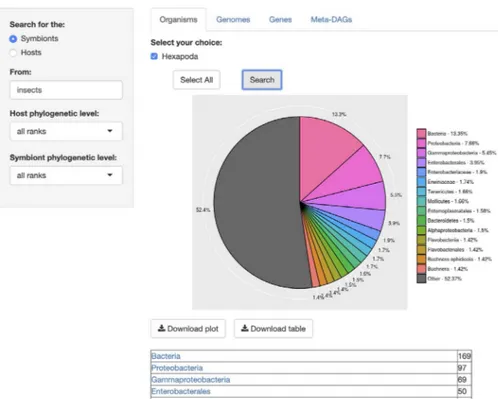
(2) Page 2 of 7. Database, Vol. 2020, Article ID baz160. improve SymGenDB and can help elucidate the mechanisms by which organisms depend on each other.. Symbiotic relationships between bacteria and eukaryotes occur naturally and ubiquitously in nature. It is a general principle in the evolution of eukaryotes, and an important selective force behind evolution. The correct functioning of all ecosystems depends on these interactions (1–4). To our knowledge, this is the first database completely devoted to symbiotic interactions. The Symbiotic Genomes Database (SymGenDB, previously named SymbioticGenomesDB; http://symbiogenomesdb.uv.es/) is a public resource that provides information on symbiotic relationships throughout the tree of life (5). We use bioinformatic tools and manual curation to create a comprehensive list of associations between symbiotic organisms, and match them to their metadata, their genomic and genetic content, their association to orthologous genes and their metabolic networks in a novel format known as Directed Acyclic Graphs (MetaDAGs) (6). SymGenDB focuses on accessibility, so we use ids from the primary databases, NCBI and KEGG (7–10), for taxonomy, organism’s names and gene ids, so the accessibility to information is as complete as possible and enables data to be compared across species/strains, among other advantages. In addition, we have included links to the same primary databases in the modules of SymGenDB, as well as links to each organism’s scientific literature. This process of compiling a comprehensive list with community-accepted controlled ids and accession identifiers ensures that the content of SymGenDB is cohesive, controllable and computable, and also complying to the FAIR principle (Findable, Accessible, Interoperable and Reusable) (11). In this work, we provide the first SymGenDB update and describe our newly released module that focuses on the metabolism of each organism included in the database. We also comment on the advanced query searches we have implemented and the new tools that allow us to visualize metabolic interactions in a new manner. Researchers in the world of symbiosis and other fields (microbiome, for example), can benefit from SymGenDB to explore associations between organisms and quickly generate data and testable hypotheses about the molecular mechanisms beneath these types of relationships.. Database contents—an overview SymGenDB consists of four modules that serve different purposes. The first three, organisms, genomes and genes,. have been previously described in the first publication of this database (5). Although a small overview is listed in the next segments for each module, we invite users to refer to the original paper for detailed functionality, and to browse the database and watch the videos of the quick tour we offer. This update maintains the same general architecture of the previous version of the database, although the scripts required major modifications to adapt to the new data source. While the previous version relied on MGDB (12), this version uses KEGG as the single source of data. The raw files from KEGG were parsed using custom scripts written in R to format the data and organize it in efficient objects that allow quickly retrieving the desired information.. Module organisms First, we encounter the module ‘Organisms’, where users can get an overview on an/the organism(s) involved in a symbiotic relationship. One of the best features of this database is that users can search for either a host or a symbiont, at any taxonomic levels, where the default = all taxonomic levels, as ‘all ranks’ (in accordance with NCBI (13, 14)). The output of this search consists of a chart containing the relative abundance of the organisms associated to the searched query, and a list of organisms by taxonomy level resulting from the search, with links to the Taxonomy Browser of NCBI (Figure 1). The chart and the list are both available for download.. Module genomes In the next module, ‘Genomes’, searches retrieve all the metadata included in the database for each resulting symbiont: Name (the complete name of the bacteria), Host (described as the isolation source, to avoid complications regarding host diversity), Taxonomy ID (NCBI’s ID), the number of CDS with orthologs, the Strain-specific CDS, the number of replicons within this genome and a link to the organism’s scientific literature (the first paper were the symbiotic relationship was described). For each replicon in the genome, we also provide information of the replicon name, its size, GC content, CDSs, genes, ncRNAs, rRNAs, tmRNAs and tRNAs. The search can also be performed at all different taxonomic levels, with the default = all taxonomic levels as ‘all ranks’ (Figure 2). Moreover, a table with all the metadata of the genomes included in the results, a fasta file with all genomes, a gff file of all genomes and. Downloaded from https://academic.oup.com/database/article-abstract/doi/10.1093/database/baz160/5735476 by Universitat de les Illes Balears user on 18 February 2020. Introduction.
(3) Page 3 of 7. Database, Vol. 2020, Article ID baz160. the orthologs shared by all these genomes are available for download in this module.. sapiens, its correct taxonomic name. Also, searches of more than one organism/genome/gene can be made at the same time. The only requirement is that queries must be separated by a comma (‘,’).. Module genes In the third module, ‘Genes’, users are able to search for specific genes in the genomes of symbiotic organisms. The search involves the input of two queries, first the name of the gene(s) to search for and then, the name of the symbiotic organisms to search for, or the name of the host of the symbiotic organism to search for. The output is a presence/absence list of genes with their KEGG id and description, in every genome available as a result. Each resulting gene is also linked to its KEGG gene web page (Figure 3). The ‘Gene ID’ and the ‘Gene Description’ features are both linked to the KEGG ortholog web page of each result. Both the gene table and the amino acid sequences of the results are downloadable. A couple of remarks to keep in mind while searching in all the modules at SymGenDB are as follows: the first one is that all synonyms of NCBI are linked to the organisms’ names to facilitate searches. For example, if a user wants to search for the symbionts associated to human, he/she can write the words ‘man’ or ‘human’ or common misspellings such as ‘Homo sapience’ and still get the output for Homo. Increased data content One of the most important aspects of databases in the genomic era is their maintenance and updates. SymGenDB became publicly available in 2015, and two updates to the data content of the database have been made since then. As of July 2019, SymGenDB contains 2328 symbiotic genomes, associated to 498 hosts (Table 1), presenting a roughly 25% increase from our previous version. The interactions between symbionts and hosts are manually curated from a cross reference of the lists of organisms included in KEGG and the JGI’s GOLD Genomes Online Database (15). These associations are mainly revised in peer-reviewed scientific papers from PubMed. Next, all the metadata and genomic data associated to a symbiont in the list is retrieved from the KEGG archives.. New module—MetaDAGs We have added a new module to SymGenDB consisting of the metabolic networks of all organisms modeled as. Downloaded from https://academic.oup.com/database/article-abstract/doi/10.1093/database/baz160/5735476 by Universitat de les Illes Balears user on 18 February 2020. Figure 1. SymGenDB’s Organisms module. For this example, we searched for the symbionts of insects included in SymGenDB. It is worth noting that we used the term ‘insects’ and the output shows the scientific name ‘Hexapoda’ because the database includes a hefty list of synonyms so users do not have to know/search only for scientific names. We searched for both the host and the symbiont’s phylogenetic level as default, and the result shows an abundance chart (only the first 15 most abundant hits are displayed in color, the rest are encompassed in grey) and a list of organisms showing all the hits. Each resulting ‘organism’ (or family, genus, class, etc.) is a link to its NCBI taxonomy page. The resulting list shown in this figure is cut short for spacing purposes..
(4) Page 4 of 7. Database, Vol. 2020, Article ID baz160. Figure 3. SymGen’s gene module. For this example, we searched for all the genes containing the letters ‘trp’ in the genomes of symbionts of insects. We selected all of the 169 available genomes. The resulting table is a list in a presence/absence format, where all the present genes are shown with their KEGG id and a link to their KEGG gene web page. The ‘Gene ID’ and the ‘Gene Description’ features are both linked to their KEGG orthology web page.. directed acyclic graphs (MetaDAGs). The MetaDAG of every organism is obtained as a suitable reduction of the reaction graph created with the metabolic data of each genome we retrieved from KEGG. In the reaction graph model, the nodes are the reactions and there is an arc (a. directed edge) between two reactions if some metabolite in the product of the source-arc reaction is in the substrate of the target-arc reaction. Next, the strongly connected components in the reaction graph are collapsed into a single node, called a metabolic building block. The result is a. Downloaded from https://academic.oup.com/database/article-abstract/doi/10.1093/database/baz160/5735476 by Universitat de les Illes Balears user on 18 February 2020. Figure 2. SymGenDB’s Genomes module. Continuing with the example on symbionts of insects, we searched for those genomes and selected 3 of the 169 available in SymGenDB’s. The resulting table (viewed horizontally for spacing purposes, although it is presented vertically in the database), consists of all the metadata of the genomes of our choice, with a link to the host’s taxonomy id from NCBI. It is important to show that one of the downloads available in this module is the orthology table of the chosen genomes (shown in red) which is very helpful for evolutionary research. Furthermore, the literature where this genome was first described is also made available to users (shown in orange)..
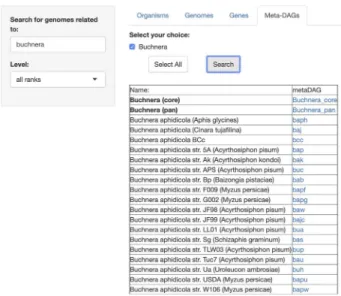
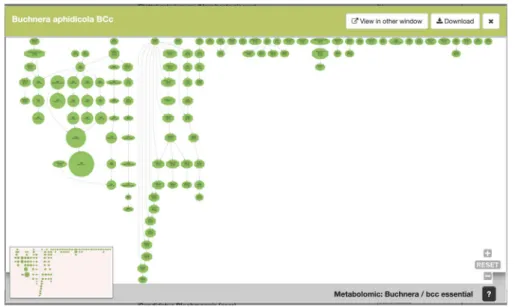
(5) Page 5 of 7. Database, Vol. 2020, Article ID baz160. Table 1. Update on the data content of SymGenDB Data. 1955 384 3 121 262 7567. Update July 2019 2328 498 3 808 086 8478. graph with no cycles, hence a directed acyclic graph called a MetaDAG. The MetaDAG keeps the connectivity of the metabolic network but reduces considerably the number of nodes, which facilitates its visualization. Notice that the nodes in the MetaDAG are the strongly connected components in the reaction graph, which consist of one or many reactions. In order to easily visualize the size of every metabolic building block of the MetaDAG, we scale the size of the corresponding node depending on the number of reactions included in the node, and use two colors to distinguish these: green when the metabolic building block has only one reaction, and yellow when there are two or more reactions. To contextualize the metabolic building blocks, we present an interactive metaDAG where users are capable to scroll over each node to visualize the reactions it contains, as well as to highlight their position in the global metabolic pathway’s map from KEGG. Furthermore, we distinguish cut nodes (those that, if removed, they disconnect the network), by drawing an octagon instead of a circle for the node. The methodology for these calculations is described in detail in Alberich et al. 2017 (6). For this last module, ‘MetaDAGs’, users are able to search for the genome-scale metabolic network as MetaDAGs, related to any symbiont (or first, search for the host and then select the symbiotic genomes associated to that host). As a running example, we present the search for the symbionts included in SymGenDB of the genus Buchnera, known symbionts of aphids (Figure 4). The result is a list of the bacterial strains included in the symbiotic relationship the user searched for, associated to a link. When the link of interest is clicked on, a new visualizer shows its MetaDAG in a dynamic manner, where the user can zoom in and out of any part of the graph, and click on any node to get a couple of pop-up windows. The first window has the information on the reaction(s) included in that node. In this pop-up window, users can also click on the image of each reaction to see it bigger and better and, by clicking on the link ‘more info’, get to KEGG’s reaction web page for that reaction. We have also included the information of other organisms that present the same reaction (by clicking on the link ‘graphs’ users get a full display), which can be very useful for orthology and evolutionary studies, among others. The second window shows the global metabolic pathways map from the KEGG’s web page with. Figure 4. SymGenDB’s new MetaDAGs module. In this example, we search for the symbionts of the genus ‘Buchnera’. The output is a list of organisms as bacterial strains, as well as the joint (pan) or intersecting (core) metabolism of the strains resulted in the search, included in the taxonomic level ‘genus’ (in bold). It is important to denote that in the case of the ‘pan’ and ‘core’ interacting metabolism, not only the genomes of the bacterial strains resulting from the search are presented. The complete set of strains of the same genus available in SymGenDB constitutes these MetaDAGs.. the reactions of the metabolic building blocks highlighted. This implementation contextualizes the metabolic building blocks to the well-known global metabolic description map. Furthermore, in the first result after searching for the MetaDAGs of interest, we also offer the core MetaDAG and the pan MetaDAG of the bacterial strains of the same genus. The core MetaDAG is obtained by considering the common metabolic building blocks present in all the MetaDAGs of the bacterial strains of the same genus. That is, the nodes (i.e. metabolic building blocks) in the core MetaDAG are the intersection of the nodes of the MetaDAGs of the bacterial strains of the same genus with the corresponding directed acyclic graph topology. On the other hand, the pan MetaDAG is obtained by considering the union of the nodes (metabolic building blocks) in all the MetaDAGs of the bacterial strains of the same genus with the corresponding directed acyclic graph topology. It is important to inform that in the case of the ‘pan’ and ‘core’ interacting metabolism, in certain cases where all the organisms of the same genus are not part of the symbiotic relationship searched for, not only the genomes of the bacterial strains resulting of the search are presented. The complete set of strains of the same genus available in SymGenDB constitutes these pan and core MetaDAGs. To continue with our example, Figure 5 shows an example of the graphical output of our MetaDAGs module. From the list of strains resulting from the search, we clicked on Buchnera aphidicola from Cinara tujafilina, and a preview. Downloaded from https://academic.oup.com/database/article-abstract/doi/10.1093/database/baz160/5735476 by Universitat de les Illes Balears user on 18 February 2020. Symbiotic genomes Hosts Orthologous genes Orthologous clusters. Previous version.
(6) Page 6 of 7. Database, Vol. 2020, Article ID baz160. Figure 6. SymGenDB’s new MetaDAGs module’s output where users can not only see the reactions included in their graph of interest in detail but also contextualize the reaction within the KEGG metabolic map. We have included a feature to highlight the reaction(s) of interest for this purpose.. of a graphical display of the MetaDAG is shown. This display can be viewed in another window (most MetaDAGs are big and space is needed to fully appreciate the graph, as well as to get into details), download the graph as a PDF and/or dismiss the preview. Lastly, Figure 6 is an example of the visualization of the pop-up windows that emerge from one node of the metaDAG of B. aphidicola from C. tujafilina.. •. •. Availability of web interface and services The web interface of SymGenDB has been modified from its previous version. We have included different tabs to make the interface and services of the database more understandable: •. Home, where an overview of the purpose of the database, as well as its metrics and a phylogenetic tree including all. •. the bacterial strains included in our catalogue is shown (http://symbiogenomesdb.uv.es/). Database, where in turn, all the different modules of the database are shown in tabs. This is where all the searches and results are presented (http://symbiogenomesdb.uv.es/ database.html). Functions, in the first paragraph of this tab users can find the basic description of each module of the database and below that, a detailed description of the functions and an overview on how to search in each module and the results to expect (http://symbiogenomesdb.uv. es/functions.html). Quick tour, another subset of tabs where in each tab we present a module, a video on how to search for the data in that module and a step-by-step guide on how to search in each module, with pictures for easier interpretation (http://symbiogenomesdb.uv.es/quick-tour.html).. Downloaded from https://academic.oup.com/database/article-abstract/doi/10.1093/database/baz160/5735476 by Universitat de les Illes Balears user on 18 February 2020. Figure 5. SymGenDB’s new MetaDAGs module’s output. In this example, we search for the symbionts of the genus ‘Buchnera’. The output is a preview of a graphical display of the MetaDAG you get by choosing Buchnera aphidicola from Cinara tujafilina. This dynamic display can be viewed in another window, downloaded as a PDF and all the information of the reaction(s) included in each node(s) is available by clicking on the node(s) of interest..
(7) Page 7 of 7. Database, Vol. 2020, Article ID baz160 •. 3.. 4.. 5.. Future directions. 6.. It is the author’s intent to continue to develop tools and data for the completion of the database, with new modules and organisms to include as well as updating the database, at least once a year.. 7.. 8.. Funding National Board of Science and Technology of México (CONACYT) (538243 to M.R.P.); FPI fellowship from the Ministry of Economy and Competitiveness (BES-2013-063548 to C.V.C.); Spanish Ministry of Science, Innovation and Universities and the European Regional Development Fund through projects DPI2015-67082-P and PGC2018-096956-B-C43 (FEDER/MICINN/AEI) and the Spanish Ministry of Economy and Competitiveness (projects SAF201231187, SAF2013-49788-EXP, SAF2015-65878-R and BFU201564322-C2-1-R, co-financed by FEDER funds); Carlos III Institute of Health (projects PIE14/00045 and AC15/00022); Generalitat Valenciana (project Prometeo/2018/A/133); Asociación Española contra el Cáncer (project AECC 2017-1485) and co-financed by the European Regional Development Fund (ERDF). The funders had no role in study design, data collection and analysis, decision to publish or preparation of any of the work.. 9.. 10. 11.. 12.. 13.. References 1.. 2.. Margulis,L and Fester,R (eds) (1991) Symbiosis as a source of evolutionary innovation: speciation and morphogenesis. Mit Press. Moya, A., Peretó, J., Gil, R., & Latorre, A. (2008) Learning how to live together: genomic insights into prokaryote–animal symbioses. Nat. Rev. Genet., 9(3), 218.. 14. 15.. Bennett,G.M. and Moran,N.A. (2015) Heritable symbiosis: the advantages and perils of an evolutionary rabbit hole. Proc Natl Acad Sci, 201421388. Moran, N. A. (2007) Symbiosis as an adaptive process and source of phenotypic complexity. Pro Natl Acad Sci, 104 (suppl 1), 8627–8633. Reyes-Prieto,M., Vargas-Chávez,C., Latorre,A. and Moya,A. (2015) SymbioGenomesDB: a database for the integration and access to knowledge on host–symbiont relationships. Database, 2015. Alberich, R., Castro, J. A., Llabrés, M., & Palmer-Rodríguez, P. (2017) Metabolomics analysis: finding out metabolic building blocks. PloS One, 12(5), e0177031. Coordinators, N. R. (2018) Database resources of the national center for biotechnology information. Nucleic Acids Res, 46(Database issue), D8. Kanehisa, M., Furumichi, M., Tanabe, M., Sato, Y., & Morishima, K. (2016). KEGG: new perspectives on genomes, pathways, diseases and drugs. Nucleic Acids Res, 45(D1), D353D361. Kanehisa, M., Sato, Y., Kawashima, M., Furumichi, M., & Tanabe, M. (2015) KEGG as a reference resource for gene and protein annotation. Nucleic Acids Res, 44(D1), D457–D462. Kanehisa, M., & Goto, S. (2000) KEGG: Kyoto encyclopedia of genes and genomes. Nucleic Acids Res, 28(1), 27–30. Wilkinson,M.D., Dumontier,M., Aalbersberg,I.J. et al. (2016) The FAIR Guiding Principles for scientific data management and stewardship. Scientific data, 3. Uchiyama, I., Mihara, M., Nishide, H., & Chiba, H. (2014) MBGD update 2015: microbial genome database for flexible ortholog analysis utilizing a diverse set of genomic data. Nucleic Acids Res, 43(D1), D270–D276. Wheeler, D. L., Barrett, T., Benson, D. A., Bryant, S. H., Canese, K., Chetvernin, V., ... & Feolo, M. (2007) Database resources of the national center for biotechnology information. Nucleic Acids Res, 36(suppl_1), D13–D21. Benson,D.A., Cavanaugh,M., Clark,K. et al. (2017) GenBank. Nucleic Acids Res. Mukherjee,S., Stamatis,D., Bertsch,J. et al. (2016) Genomes OnLine Database (GOLD) v. 6: data updates and feature enhancements. Nucleic Acids Res, gkw992.. Downloaded from https://academic.oup.com/database/article-abstract/doi/10.1093/database/baz160/5735476 by Universitat de les Illes Balears user on 18 February 2020. Citation, Acknowledgements and contact includes the citation for the first article published of the database (5), as well as the funding received for the creation of this project and a form for users to get in touch with the authors where any problem, doubt or suggestion is received and greatly appreciated (http:// symbiogenomesdb.uv.es/acknowledgements.html)..
(8)
Figure

Documento similar
In this study, integrating the results from genomic re- annotations of membrane-associated proteins with metabolic network analysis and structural analysis of the symbiosomal
Some common approaches to the prediction of protein-protein interactions include: (i) transferring interactions between protein orthologs of different species (referred
However, given the present scenario of scarce allosteric-site data, we decided to perform a large-scale analysis of protein ligand-binding pockets, as these
The genome of the soil bacterium Pseudomonas putida KT2440 encodes orthologs of genes crp (cAMP receptor protein), cyaA (adenylate cyclase) and cpdA (cAMP phosphodiesterase) of
The regulation of more than thousand vitamin D target genes in colon carcinoma cells, normal stem cells, cancer stem cells, stromal NFs and CAFs as well as immune cells of the
• Deletion of MUS81 reverts the increased recombination rates observed on NSMCE2 deficient cells, suggesting that MUS81-mediated resolution takes care of the joint
Doctoral thesis submitted to the Autonomous University of Madrid for the Degree of Doctor of Philosophy (Ph.D.) in Biomolecular Sciences. in possession of the
c) 27K Sympathetic paraganglioma; Meta: Metastasis. f) Diagnosis was clinically determined. g) Diagnosis of PC.. d) B: without metastasis or M:
