
catalyzed strategies: Synthesis of
4,n-dimethoxy-substituted benzo[b]furans
Verónica Guilarte, M. Pilar Castroviejo, Estela Álvarez and Roberto Sanz
*Full Research Paper
Open AccessAddress:
Área de Química Orgánica, Departamento de Química, Facultad de Ciencias, Universidad de Burgos, Pza. Misael Bañuelos s/n, 09001 Burgos, Spain
Email:
Roberto Sanz* - [email protected]
* Corresponding author
Keywords:
benzo[b]furans; o-zincation; palladium; selectivity
Beilstein J. Org. Chem.2011,7, 1255–1260. doi:10.3762/bjoc.7.146
Received: 29 April 2011 Accepted: 21 July 2011 Published: 12 September 2011
This article is part of the Thematic Series "Directed aromatic functionalization".
Guest Editor: V. Snieckus
© 2011 Guilarte et al; licensee Beilstein-Institut. License and terms: see end of document.
Abstract
A new route to regioselectively dialkoxy-functionalized benzo[b]furan derivatives has been developed from 3-halo-2-iodoanisoles bearing an additional methoxy group, which have been accessed through an ortho-zincation/iodination reaction. Two palladium-catalyzed processes, namely a Sonogashira coupling followed by a tandem hydroxylation/cyclization sequence, give rise to new and interesting dimethoxy-substituted benzo[b]furans.
Introduction
The directed ortho-metallation (DoM) reaction has been widely used as a powerful and efficient method for regioselective func-tionalization of aromatic compounds and different directing groups have been used to facilitate the deprotonation reaction [1-5]. Various strong bases such as alkyl lithiums and their derivatives (for instance, TMEDA-activated complexes [6] and heavier alkali metal tert-butoxide-complexed alkyl lithium reagents, known as superbases and introduced by Schlosser [7]), as well as lithium dialkylamides, have usually been employed to perform deprotonative metallations. Whereas the use of these strong bases has several limitations regarding the presence of certain functional groups (mainly carboxylic acid derivatives
reactions have turned out to be very useful processes and the structures and reaction pathways of TMP-zincates (TMP = 2,2,6,6-tetramethylpiperidine) have been studied in detail [15-19].
On the other hand, benzo[b]furan is a basic skeleton found in a variety of significant natural products [20], and some deriva-tives are also used as organic materials, due to their optical and electronic properties [21]. Thus, many synthetic efforts have been devoted to the synthesis of this type of compound [22,23]. In particular, several benzo[b]furan derivatives with oxygen-bearing substituents, such as hydroxy, or alkoxy, at the benzene moiety are known to be biologically active compounds [24-28] (Figure 1).
Figure 1: Some representative dihydroxybenzofuran derived natural products.
Among the various approaches developed for the synthesis of the benzofuran ring system, the cyclodehydration of α-aryloxy ketones [29], the Claisen rearrangement of an allyl aryl ether followed by Pd-catalyzed intramolecular oxidative cyclization [30], and the tandem Sonogashira coupling/heterocyclization of 2-halophenols with terminal alkynes [31], are some of the most used. However, their application to the synthesis of 4-substi-tuted benzo[b]furans is especially challenging, because the
meta-substituted starting materials tend to cyclize at the less hindered ortho-position, leading to the formation of 6-substi-tuted heterocycles or a mixture of 6- and 4-substi6-substi-tuted ones [32].
The DoM strategy, when linked with different cross-coupling Pd-catalyzed reactions, could provide a superior approach for the construction of polysubstituted aromatic and heteroaro-matic compounds [33-38]. In this context, we studied the
o-lithiation of 3-halophenols and the resulting 2,3-difunctional-ized phenol derivatives were applied to the synthesis of 4-func-tionalized benzo[b]furans [39], 4- or 7-alkoxyindoles [40], and
Scheme 2: Deprotonative zincation of 3-haloanisoles 1.
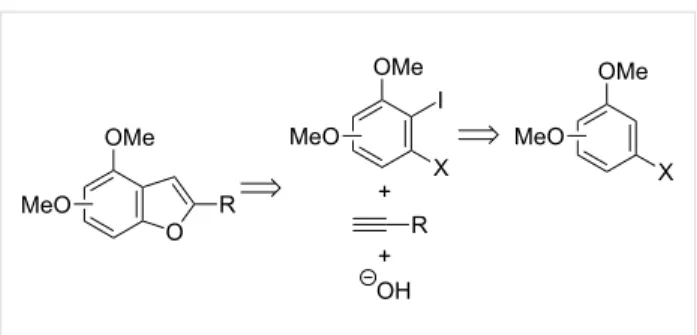
Pd-catalyzed cross-coupling reactions or halocyclization processes. Following our interest in the development of strate-gies for the synthesis of functionalized benzo[b]furan deriva-tives [39], we envisaged that 4,n-dimethoxybenzo[b]furans could be regioselectively synthesized from 3-halo-2-iodoanisoles bearing an additional methoxy group, by combining two palladium-catalyzed processes, that is a selective Sonogashira coupling and a tandem hydroxylation/ heterocyclization reaction. The required o-dihaloanisole deriva-tives could be prepared by a selective ortho-metallation reac-tion and subsequent electrophilic quenching with iodine (Scheme 1).
Scheme 1: Retrosynthetic analysis of 4,n-dimethoxy-substituted benzo[b]furans.
Results and Discussion
As established in our proposed retrosynthetic analysis (Scheme 1), we needed to develop a convenient synthesis of 3-halo-2-iodoanisoles bearing an additional methoxy group. Taking advantage of the deprotonative ortho-zincation of
meta-functionalized haloaromatics by using TMP-zincates, described by Uchiyama and co-workers [11,12], we previously developed efficient syntheses of 3-chloro-2-iodoanisole (2a) and 3-bromo-2-iodoanisole (2b) from the corresponding 3-haloanisoles 1, through their treatment with lithium di-tert -butyltetramethylpiperidinozincate, followed by electrophilic trapping of the intermediate arylzincate with iodine (Scheme 2) [40].
Table 1: Synthesis of methoxy-substituted 3-halo-2-iodoanisoles 4.
Entry Starting material X OMea Product Yield (%)b
1 3a Cl ortho 4a 70
2 3b Br ortho 4b 73
3 3c Cl meta 4c 88
4 3d Br meta 4d 75
5 3e Cl para 4e 78
6 3f Br para 4f 80
aPosition of the additional methoxy group relative to the existing one. bIsolated yield based on the starting material 3.
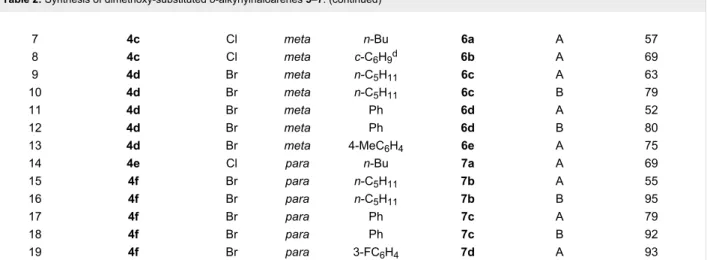
Table 2: Synthesis of dimethoxy-substituted o-alkynylhaloarenes 5–7.
Entry Starting material X OMea R Product Methodb Yield (%)c
1 4a Cl ortho n-Bu 5a A 65
2 4a Cl ortho c-C6H9d 5b A 79 3 4b Br ortho n-C6H13 5c A 91 4 4b Br ortho n-C6H13 5c B 90
5 4b Br ortho Ph 5d A 83
6 4b Br ortho Ph 5d B 87
with the same t-Bu2Zn(TMP)Li, easily prepared by reaction of preformed di-tert-butylzinc with lithium tetramethylpiperidide. Under these reaction conditions the zincation reactions took place regioselectively and, after treatment with iodine, afforded the corresponding 3-halo-2-iodoanisole derivatives 4 in good yields (Table 1). It is interesting to note that substrates 3c and
3d bearing the two methoxy groups in a meta relationship selec-tively undergo metalation at the position between the methoxy and the halide groups, irrespective of the nature of the halogen atom (chloro or bromo) (Table 1, entries 3 and 4).
Having an efficient protocol for the synthesis of dimethoxy-haloiodobenzene derivatives 4, and with the retrosynthetic analysis outlined in Scheme 1 in mind, we tackled the selective introduction of an alkynyl moiety at the iodinated position. The presence of two different halogen atoms in compounds 4
tetrabutylammo-Table 2: Synthesis of dimethoxy-substituted o-alkynylhaloarenes 5–7. (continued)
aPosition of the additional methoxy group referred to the existing one. bMethod A: alkyne (1.5–2 equiv), PdCl2(PPh3)2 (6 mol %), TBAF·3H2O (3 equiv), 50–60 °C. Method B: alkyne (1.2 equiv), PdCl2(PPh3)2 (3 mol %), CuI (5 mol %), Et2NH (1.5 equiv), DMF, 50 °C. cIsolated yield based on the starting material 4. d1-Cyclohexenyl.
nium fluoride as base [42] (Table 2, method A). Subsequently, we checked that the selective coupling could be carried out under standard Pd–Cu catalysis by controlling the reaction temperature [43,44] (Table 2, method B).
By either of these procedures, A or B, o-alkynylhaloarenes 5–7
were prepared usually in high yields from the corresponding dimethoxyhaloiodobenzenes 4 (Table 2). Starting from chloroiodo derivatives 4a,c and e good yields were obtained for the corresponding coupled products 5–7 by using the Pd/TBAF method A, with no significant side-products (Table 2, entries 1,2,7,8 and 14). However, under these conditions bromine-containing compounds 4b,d and f afforded variable amounts of dialkynylation products in some cases, and so the Pd/Cu catalyzed procedure B gave rise to better selectivities and yields of the desired alkynes 5–7 (Table 2, entries 4,6,10,12,16 and 18).
According to our retrosynthetic analysis (Scheme 1), the final step to achieve the benzofuran derivatives should be the incorporation of the hydroxy group followed by in situ heterocyclization. In recent years, the direct hydroxylation of aryl halides has been developed by several groups by using palladium- or copper-catalyzed protocols. Whereas the reac-tions under copper catalysis work well for aryl iodides [45-48], the palladium-catalyzed hydroxylation also takes place with aryl bromides and chlorides [49-51]. Thus, in our case we employed the Pd-catalyzed Buchwald protocol [49] in an attempt to synthesise the desired dimethoxybenzo[b]furan derivatives. Thus, reaction of the previously prepared o-haloaryl alkynes 5–7 with KOH, in the presence of catalytic amounts of
triisopropylbiphenyl) at 100 °C in a 1:1 mixture of H2 O:1,4-dioxane, gave rise to the corresponding benzo[b]furan derivatives 8–10 in moderate to good yields (Table 3, method C). In general, slightly better results were obtained starting from aryl bromides instead of aryl chlorides. In addition, we also observed better yields for the corresponding benzofuran deriva-tives 9 (Table 3, entries 5–9) derived from the starting
o-alkynylhalobenzene derivatives 6, bearing the two methoxy groups in a 3,5-relationship relative to the halide. Moreover, because of the extended reaction times needed for complete consumption of the starting materials, we developed an alternative protocol under microwave irradiation that shortens the time required for the coupling to a few minutes (method D), and the final products were obtained in similar yields to those obtained by the conventional coupling method C.
Conclusion
Table 3: Synthesis of dimethoxy-substituted benzo[b]furans 8–10.
Entry Starting material X R Product OMea Methodb Yield (%)
1 5a Cl n-Bu 8a 4,5-(MeO)2 D 55
2 5b Cl c-C6H9c 8b 4,5-(MeO)2 C 57
3 5c Br n-C6H13 8c 4,5-(MeO)2 D 55
4 5d Br Ph 8d 4,5-(MeO)2 C 50
5 6a Cl n-Bu 9a 4,6-(MeO)2 C 62
6 6b Cl c-C6H9c 9b 4,6-(MeO)2 C 73
7 6c Br n-C5H11 9c 4,6-(MeO)2 C 70
8 6d Br Ph 9d 4,6-(MeO)2 C 81
9 6e Br 4-MeC6H4 9e 4,6-(MeO)2 C 75
10 7a Cl n-Bu 10a 4,7-(MeO)2 C 60
11 7b Br n-C5H11 10b 4,7-(MeO)2 C 64
12 7c Br Ph 10c 4,7-(MeO)2 D 71
13 7d Br 3-FC6H4 10d 4,7-(MeO)2 D 65
aPosition of the methoxy groups referred to benzo[b]furan moiety. bMethod C: conventional heating (100 °C, overnight). Method D: MW (50 W, 150 °C, 12 min). c1-Cyclohexenyl.
Supporting Information
Experimental procedures and spectroscopic data for all new compounds. Copies of 1H NMR and 13C NMR spectra for new compounds.
Supporting Information File 1
Experimental and analytical data.
[http://www.beilstein-journals.org/bjoc/content/ supplementary/1860-5397-7-146-S1.pdf]
Supporting Information File 2
NMR spectra.
[http://www.beilstein-journals.org/bjoc/content/ supplementary/1860-5397-7-146-S2.pdf]
Acknowledgements
We acknowledge MICINN (CTQ2010-15358) and Junta de Castilla y León (BU021A09 and GR-172) for financial support. We are also grateful to MEC (FPU predoctoral fellowship to V.G.).
References
1. Hartung, C. G.; Snieckus, V. The Directed ortho Metalation Reaction – A Point of Departure for New Synthetic Aromatic Chemistry. In Modern Arene Chemistry; Astruc, D., Ed.; Wiley-VCH: New York, 2002; pp 330–367. doi:10.1002/3527601767.ch10
2. Clayden, J. Regioselective Synthesis of Organolithiums by Deprotonation. In Organolithiums: Selectivity for Synthesis;
Tetrahedron Organic Chemistry Series, Vol. 23; Pergamon: Oxford, 2002; pp 9–109.
3. Whisler, M. C.; MacNeil, S.; Snieckus, V.; Beak, P.
Angew. Chem., Int. Ed.2004,43, 2206–2225. doi:10.1002/anie.200300590
4. Anctil, E. J.-G.; Snieckus, V. In Metal-Catalyzed Cross-Coupling Reactions, 2nd ed.; de Meijere, A.; Diederich, F., Eds.; Wiley-VCH: Weinheim, 2004; pp 761–813.
5. Macklin, T.; Snieckus, V. In Handbook of C–H Transformations;
Dyker, G., Ed.; Wiley-VCH: New York, 2005; pp 106–119. 6. Eberhardt, G. G.; Butte, W. A. J. Org. Chem.1964,29, 2928–2932.
doi:10.1021/jo01033a029
7. Schlosser, M.; Choi, J. H.; Takagishi, S. Tetrahedron1990,46,
5633–5648. doi:10.1016/S0040-4020(01)87763-2 8. Mulvey, R. E.; Mongin, F.; Uchiyama, M.; Kondo, Y.
Angew. Chem., Int. Ed.2007,46, 3802–3824. doi:10.1002/anie.200604369
10. Kondo, Y.; Shilai, M.; Uchiyama, M.; Sakamoto, T. J. Am. Chem. Soc.
1999,121, 3539–3540. doi:10.1021/ja984263t
11. Uchiyama, M.; Miyoshi, T.; Kajihara, Y.; Sakamoto, T.; Otani, Y.; Ohwada, T.; Kondo, Y. J. Am. Chem. Soc.2002,124, 8514–8515. doi:10.1021/ja0202199
12. Uchiyama, M.; Kobayashi, Y.; Furuyama, T.; Nakamura, S.; Kajihara, Y.; Miyoshi, T.; Sakamoto, T.; Kondo, Y.; Morokuma, K.
J. Am. Chem. Soc.2008,130, 472–480. doi:10.1021/ja071268u 13. Naka, H.; Uchiyama, M.; Matsumoto, Y.; Wheatley, A. E. H.;
McPartlin, M.; Morey, J. V.; Kondo, Y. J. Am. Chem. Soc.2007,129,
1921–1930. doi:10.1021/ja064601n
14. Usui, S.; Hashimoto, Y.; Morey, J. V.; Wheatley, A. E. H.; Uchiyama, M.
J. Am. Chem. Soc.2007,129, 15102–15103. doi:10.1021/ja074669i 15. Clegg, W.; Dale, S. H.; Drummond, A. M.; Hevia, E.; Honeyman, G. W.;
Mulvey, R. E. J. Am. Chem. Soc.2006,128, 7434–7435. doi:10.1021/ja061898g
16. Uchiyama, M.; Matsumoto, Y.; Nobuto, D.; Furuyama, T.; Yamaguchi, K.; Morokuma, K. J. Am. Chem. Soc.2006,128,
8748–8750. doi:10.1021/ja060489h
17. Uchiyama, M.; Matsumoto, Y.; Usui, S.; Hashimoto, Y.; Morokuma, K.
Angew. Chem., Int. Ed.2007,46, 926–929. doi:10.1002/anie.200602664
18. Kondo, Y.; Morey, J. V.; Morgan, J. C.; Naka, H.; Nobuto, D.; Raithby, P. R.; Uchiyama, M.; Wheatley, A. E. H. J. Am. Chem. Soc.
2007,129, 12734–12738. doi:10.1021/ja072118m
19. Hevia, E.; Kennedy, A. R.; Klett, J.; McCall, M. D. Chem. Commun.
2009, 3240–3242. doi:10.1039/b903592c
20. De Luca, L.; Nieddu, G.; Porcheddu, A.; Giacomelli, G.
Curr. Med. Chem.2009,16, 1–20. doi:10.2174/092986709787002826 21. Hwu, J. R.; Chuang, K.-S.; Chuang, S. H.; Tsay, S.-C. Org. Lett.2005,
7, 1545–1548. doi:10.1021/ol050196d
22. Hou, X.-L.; Yang, Z.; Yeung, K.-S.; Wong, H. N. C.
Prog. Heterocycl. Chem.2009,21, 179–223. doi:10.1016/S0959-6380(09)70034-0 23. Yeung, K.-S.; Yang, Z.; Peng, X.-S.; Hou, X.-L.
Prog. Heterocycl. Chem.2011,22, 181–216. doi:10.1016/S0959-6380(11)22007-5
Helv. Chim. Acta2008,91, 159–164.
27. Stevenson, P. C.; Veitch, N. C. Phytochemistry1998,48, 947–951. 28. Joshi, A. S.; Li, X.-C.; Nimrod, A. C.; ElSholy, H. N.; Walker, L. A.;
Clark, A. M. Planta Med.2001,67, 186–188.
29. Kim, I.; Lee, S.-H.; Lee, S. Tetrahedron Lett.2008,49, 6579–6584. doi:10.1016/j.tetlet.2008.09.034
30. Youn, S. W.; Eom, J. I. Org. Lett.2005,7, 3355–3358. doi:10.1021/ol051264z
31. Heravi, M. M.; Sadjadi, S. Tetrahedron2009,65, 7761–7775. doi:10.1016/j.tet.2009.06.028
32. Tsuchikama, K.; Hashimoto, Y.-k.; Endo, K.; Shibata, T.
Adv. Synth. Catal.2009,351, 2850–2854.
33. Alessi, M.; Larkin, A. L.; Ogilvie, K. A.; Green, L. A.; Lai, S.; López, S.; Snieckus, V. J. Org. Chem.2007,72, 1588–1594.
doi:10.1021/jo0620359
34. Blanchet, J.; Macklin, T.; Ang, P.; Metallinos, C.; Snieckus, V.
J. Org. Chem.2007,72, 3199–3206. doi:10.1021/jo062385v
35. Nerdinger, S.; Kendall, C.; Cai, X.; Marchart, R.; Riebel, P.; Johnson, M. R.; Yin, C.-F.; Hénaff, N.; Eltis, L. D.; Snieckus, V.
J. Org. Chem.2007,72, 5960–5967. doi:10.1021/jo062543i 36. MacNeil, S. L.; Gray, M.; Gusev, D. G.; Briggs, L. E.; Snieckus, V.
J. Org. Chem.2008,73, 9710–9719. doi:10.1021/jo801856n 37. James, C. A.; Snieckus, V. J. Org. Chem.2009,74, 4080–4093.
doi:10.1021/jo9001454
38. James, C. A.; Coelho, A. L.; Gevaert, M.; Forgione, P.; Snieckus, V.
J. Org. Chem.2009,74, 4094–4103. doi:10.1021/jo900146d 39. Sanz, R.; Castroviejo, M. P.; Fernández, Y.; Fañanás, F. J.
J. Org. Chem.2005,70, 6548–6551. doi:10.1021/jo0508402 40. Sanz, R.; Castroviejo, M. P.; Guilarte, V.; Pérez, A.; Fañanás, F. J.
J. Org. Chem.2007,72, 5113–5118. doi:10.1021/jo070643y 41. Sanz, R.; Guilarte, V.; Hernando, E.; Sanjuán, A. M. J. Org. Chem.
2010,75, 7443–7446. doi:10.1021/jo101436f
42. Liang, Y.; Xie, Y.-X.; Li, J.-H. J. Org. Chem.2006,71, 2535–2537. doi:10.1021/jo051882t
43. Sanz, R.; Guilarte, V.; García, N. Org. Biomol. Chem.2010,8,
3860–3864. doi:10.1039/c004360e
44. Guilarte, V.; Castroviejo, M. P.; García-García, P.;
Fernández-Rodríguez, M. A.; Sanz, R. J. Org. Chem.2011,76,
3416–3437. doi:10.1021/jo200406f
45. Tlili, A.; Xia, N.; Monnier, F.; Taillefer, M. Angew. Chem., Int. Ed.2009,
48, 8725–8728. doi:10.1002/anie.200903639
46. Zhao, D.; Wu, N.; Zhang, S.; Xi, P.; Su, X.; Lan, J.; You, J.
Angew. Chem., Int. Ed.2009,48, 8729–8732. doi:10.1002/anie.200903923
47. Jing, L.; Wei, J.; Zhou, L.; Huang, Z.; Li, Z.; Zhou, X. Chem. Commun.
2010,46, 4767–4769. doi:10.1039/c0cc00434k 48. Yang, D.; Fu, H. Chem.–Eur. J.2010,16, 2366–2370.
doi:10.1002/chem.200903468
49. Anderson, K. W.; Ikawa, T.; Tundel, R. E.; Buchwald, S. L.
J. Am. Chem. Soc.2006,128, 10694–10695. doi:10.1021/ja0639719 50. Schulz, T.; Torborg, C.; Schäffner, B.; Huang, J.; Zapf, A.; Kadyrov, R.;
Börner, A.; Beller, M. Angew. Chem., Int. Ed.2009,48, 918–921. doi:10.1002/anie.200804898
51. Sergeev, A. G.; Schulz, T.; Torborg, C.; Spannenberg, A.;
Neumann, H.; Beller, M. Angew. Chem., Int. Ed.2009,48, 7595–7599. doi:10.1002/anie.200902148
License and Terms
This is an Open Access article under the terms of the Creative Commons Attribution License
(http://creativecommons.org/licenses/by/2.0), which permits unrestricted use, distribution, and reproduction in any medium, provided the original work is properly cited.
The license is subject to the Beilstein Journal of Organic Chemistry terms and conditions:
(http://www.beilstein-journals.org/bjoc)
The definitive version of this article is the electronic one which can be found at:

![Table 3: Synthesis of dimethoxy-substituted benzo[b]furans 8–10.](https://thumb-us.123doks.com/thumbv2/123dok_es/3905750.663679/5.892.94.804.174.619/table-synthesis-of-dimethoxy-substituted-benzo-b-furans.webp)
