This is an Accepted Manuscript, which has been through the
Royal Society of Chemistry peer review process and has been
accepted for publication.
Accepted Manuscripts are published online shortly after
acceptance, before technical editing, formatting and proof reading.
Using this free service, authors can make their results available
to the community, in citable form, before we publish the edited
article. We will replace this Accepted Manuscript with the edited
and formatted Advance Article as soon as it is available.
You can find more information about Accepted Manuscripts in the
author guidelines.
Please note that technical editing may introduce minor changes
to the text and/or graphics, which may alter content. The journal’s
standard Terms & Conditions and the ethical guidelines, outlined
in our author and reviewer resource centre, still apply. In no
event shall the Royal Society of Chemistry be held responsible
for any errors or omissions in this Accepted Manuscript or any
consequences arising from the use of any information it contains.
Accepted Manuscript
rsc.li/obc
Organic &
Biomolecular
Chemistry
www.rsc.org/obc
ISSN 1477-0520
COMMUNICATION Takeharu Haino et al.
Solvent-induced emission of organogels based on tris(phenylisoxazolyl) benzene
Volume 14 Number 1 7 January 2016 Pages 1–372
Organic &
Biomolecular
Chemistry
This article can be cited before page numbers have been issued, to do this please use: C. Virumbrales, S.
Suárez-Pantiga, M. Solas, M. Á. Fernández-Rodríguez and R. Sanz, Org. Biomol. Chem., 2018, DOI:
Organic
&
Biomolecular
Chemistry
COMMUNICATION
Área de Química Orgánica, Departamento de Química, Facultad de Ciencias,
Universidad de Burgos, Pza. Misael Bañuelos s/n, 09001 Burgos, Spain.
E‐mail: [email protected]
† Electronic Supplementary Information (ESI) available: Experimental details, Received 00th January 20xx,
Accepted 00th January 20xx
DOI: 10.1039/x0xx00000x
www.rsc.org/
Gold(I)
‐
catalyzed
diastereoselective
synthesis
of
1
‐
‐
oxybenzyl
‐
1
H
‐
indenes†
Cintia
Virumbrales,
Samuel
Suárez
‐
Pantiga,
Marta
Solas,
Manuel
A.
Fernández
‐
Rodríguez
and
Roberto
Sanz
*The gold(I)‐catalyzed oxycyclization of ‐aryl monosubstituted o‐
(alkynyl)styrenes gives rise to 1‐‐methoxy or 1‐‐hydroxybenzyl‐
1H‐indenes in a diastereospecific way. In contrast with ,‐
disubstitued o‐(alkynyl)styrenes, the stereochemical outcome of
the process, diastereospecific reactions, supports the higher
contribution of a gold intermediate with cyclopropylcarbene‐like
character.
Gold‐catalyzed cycloisomerization reactions of 1,n‐enynes
have received a good deal of attention in the last years
providing versatile routes to interesting carbocyclic structures
not easily prepared by classical methods.1 In this context, 1,5‐
enyne cycloisomerizations involving almost always 5‐endo‐dig
cyclizations2 have been less developed, despite their synthetic
usefulness for the preparation of interesting cyclopentene
derivatives.3 In this field, our group and others have been
specially interested in the study of the reactivity of o‐
(alkynyl)styrenes,4 as a particular type of 1,3‐dien‐5‐ynes.5
Although most of the previously reported cycloisomerizations
of o‐(alkynyl)styrenes led to naphthalene derivatives through
formal 6‐endo cyclizations,6 considering Gagosz and co‐
workers´ report about the synthesis of cyclopentenes through
5‐endo alkoxycyclization of 3‐acetoxy‐1,5‐enynes,7 we first
demonstrated that the corresponding 5‐endo cyclization
pathway could be induced by a proper selection of the olefin
substitution pattern. We found that ,‐disubstituted o‐
(alkynyl)styrenes undergo selectively 5‐endo cyclizations, using
cationic gold complexes bearing triphenyl phosphine as ligand
both in the presence or absence of silver salts.8 In this way,
indene derivatives, which are privileged scaffolds mainly due
to their applications in materials science and as ligands for
metallic catalysts,9 are easily accessed from simple starting
materials.10 After our seminal work, different authors have
reported related 5‐endo cyclizations of ,‐disubstituted o‐
(alkynyl)styrenes under gold‐ and other transition metal‐
catalysis.11 Using these ,‐disubstituted o‐(alkynyl)styrenes,
and external oxygen nucleophiles, we have been able to
prepare 1‐alkoxy‐ or 1‐hydroxy‐dialkylmethyl‐1H‐indenes.
However, when these starting materials possess two different
groups at the ‐position the stereoselectivity of the cyclization
had not been properly established in our previous work, and
we assumed that the oxycyclization was not stereospecific
likely due to a high contribution of a gold‐stabilized
homoallylic carbocation species as intermediate (Scheme 1a).8c
At this point, we decided to explore the gold‐catalyzed
nucleophilic additions to ‐aryl‐monosubstituted o‐
(alkynyl)styrenes.12 In this case two major issues, regio‐ and
stereoselectivity, should be addressed. Firstly, for the initial
Scheme 1 Gold(I)‐catalyzed alkoxycyclization of ,‐disubstituted o‐(alkynyl)styrenes
Organic
&
Biomolecular
Chemistry
Accepted
Manuscript
Published on 19 March 2018. Downloaded by Universidad de Burgos on 19/03/2018 17:01:39.
View Article Online
COMMUNICATION
Organic
&
Biomolecular
Chemistry
olefin attack, triggered by the gold‐activation of the alkyne, a
regioisomeric 6‐endo cyclization could be competitive with the
previously reported 5‐endo as the positive charge would be
located at secondary carbons in the carbocationic‐like
intermediate for both types of ring closures (Scheme 1b).
Secondly, the stereochemical outcome of these reactions, i.e.
stereospecific or non‐stereospecific nature of the process,
could contribute to shed light about the controversial
character of the involved gold intermediates, which could be
also influenced by the nature of the ligands on the gold
catalyst.13 Herein, we want to report our results about the
nucleophilic additions to ‐aryl‐monosubstituted o‐
(alkynyl)styrenes under gold‐catalysis, which take place
selectively through 5‐endo cyclizations and in a
diastereospecific manner leading to a new family of
functionalized indene derivatives (Scheme 1c).
To perform our goal, we selected (E)‐‐phenyl o‐
whereas complete conversions were obtained when gold
complexes with bulky biarylphosphines as ligands were
employed (entries 46). However, the best yield was obtained
conversion several unidentified products were observed. d Carried out with 2.5
mol% of catalyst.
halved without a serious impact on the reaction outcome
(entry 8), supporting its remarkably high activity for a wide
variety of Au‐catalyzed transformations that had been
elegantly shown by Gagosz and co‐workers.14 A brief silver salt
screening showed no beneficial silver effect or improvement
for this process (entries 911). Remarkably, in all the tests only one diastereoisomer of indene 2a was observed in the 1H NMR
of the crude reaction mixture, whose stereochemistry was
initially assigned based on previous literature reports.7a
Echavarren and co‐workers had established that gold
complexes with highly electron‐donating ligands, such as
NHCs, enhance the carbene‐like character of the gold
intermediates in cyclizations of 1,5‐enynes.13 Considering this
fact in the context of the ligand effects in gold catalysis,15 these preliminary results seem to support that the reactions of
these ‐aryl monosubstituted o‐(alkynyl)styrenes 1 would take
place through an intermediate that requires a higher
retrodonation of gold to stabilize the initially generated
carbocation and so, they proceed more efficiently with
different substituents at the triple bond, including
(hetero)aromatic, alkyl, alkenyl, and arylthio groups (entries
17). Interestingly, starting from geometrically pure E‐isomers
stereospecificity of the reaction. Regarding the aryl substituent
at the ‐position of the olefin, p‐tolyl‐ as well as 1‐naphthyl‐
substituted o‐(alkynyl)styrenes 1f‐i behaved the same way as
parent 1a providing high yields of the corresponding indene
derivatives 2f‐i and with complete control of the
stereochemical outcome of the reactions determined by the
stereochemistry of the starting enyne (entries 811).
Moreover, substrates bearing functionalized aryl groups, such
as 1j and 1k, also methoxycyclized leading to the
corresponding indenes 2j and 2k in good yields and in a
diastereospecific manner (entries 1213). Interestingly, with o‐
(alkynyl)styrene 1k possessing a butyl group as alkyne
Published on 19 March 2018. Downloaded by Universidad de Burgos on 19/03/2018 17:01:39.
View Article Online
Table 2 Gold‐catalyzed methoxycyclization of ‐aryl o‐(alkynyl)styrenes 1.
a competitive contribution of the carbocationic like‐character
of the gold intermediate considering the ability of the 4‐
methoxyphenyl group to stabilize carbocations at the benzylic
position. A similar observation had been reported by
Echavarren et al. in the alkoxycyclization of 1,6‐enynes.16
As we had previously demonstrated that water could also
be a useful nucleophile for the hydroxycyclization reactions of
,‐disubstituted o‐(alkynyl)styrenes,8c we decided to check if
(alkynyl)styrenes. Taking into account the potential synthetic
interest of 1‐(‐hydroxybenzyl)‐1H‐indenes for further
transformations, we decided to prepare a variety of
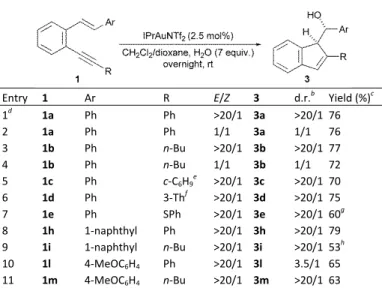
hydroxycyclizated products 3. A selection of starting (E)‐‐aryl
o‐(alkynyl)styrenes 1 efficiently underwent the
hydroxycyclization under the standard conditions, resulting in
formation of the expected alcohols 3 in high yields and in a
stereospecific manner. As established above, the nucleophilic
addition of water to (E)‐1a afforded one diastereoisomer of 3a,
efficiently underwent the hydroxycyclization reaction giving
rise to the corresponding alcohols as single diastereoisomers
although with 1e no complete conversion was achieved under
(alkynyl)styrene 1i complete conversion was again not
achieved (entry 9). Analogous to what was observed in its
methoxyclization, when o‐(alkynyl)styrene 1l, bearing an
electron‐rich 4‐methoxyphenyl group as aryl substituent of the
alkene, was used as starting material the diastereospecificity
was practically lost and the corresponding hydroxyindene
derivative 3l was obtained as a mixture of diastereoisomers
(entry 10). Moreover, in order to unambiguously establish the
relative stereochemistry of the diastereoisomer generated in
these gold‐catalyzed methoxy‐ and hydroxycyclizations of o‐
(alkynyl)styrenes 1, the structure of 3i was further assigned by X‐ray analysis.18
Having determined that the methoxycyclization reaction of
‐aryl o‐(alkynyl)styrenes 1 is stereospecific, i.e. the
stereoinformation is completely transferred in most of the
Table 3 Gold‐catalyzed hydroxycyclization of ‐aryl o‐(alkynyl)styrenes 1. Synthesis of
Published on 19 March 2018. Downloaded by Universidad de Burgos on 19/03/2018 17:01:39.
View Article Online
COMMUNICATION
Organic
&
Biomolecular
Chemistry
diastereoisomer, under the same conditions described for 1
(entry 1). Moreover, almost the same result was obtained
trisubstituted alkene that would contribute to stabilize the
carbocationic‐like character of the intermediate. However,
submission of o‐(alkynyl)styrene 4b, with an ethyl substituent
R substituent, the corresponding methoxycyclizated product
5c was obtained as a mixture of diastereoisomers clearly
disubstituted o‐(alkynyl)styrenes 4, possessing a more
nucleophilic trisubstituted alkene, their methoxycyclization
reactions are not completely stereospecific in all cases, with
variable degrees of stereoinformation loss that could also be
influenced by steric hindrance issues.
By analogy with our previously reported mechanistic
proposal for the methoxycyclization of ,‐disubstituted o‐
catalyzed enyne cyclizations,13 a likely mechanism to account
for the observed stereoselectivity issues is outlined in Scheme
2. An initial activation of the alkyne through coordination of
would be subsequently protodemetalated to afford the
functionalized indenes 2 and 3, the competitive contribution of
A´ to the intermediate gold complex structure would lead to a
partial loss of the stereoinformation from the configurationally
defined alkene. When this stereoinformation is totally
transferred to the final indene it seems to indicate a greater,
or almost exclusive, contribution of the cyclopropyl gold
carbene A, as well as its configurational stability. However,
when the final functionalized indene derivative is obtained as a mixture of diastereoisomers in spite of starting from only one geometrical isomer of the alkene, as it is the case with most of the ,‐disubstituted o‐(alkynyl)styrenes 4, it seems to point
out that a competitive contribution of the carbocationic
intermediate A´ is occurring, likely due to the higher
stabilization of the positive charge at the ‐carbon of the
substrate caused by its tertiary nature. In agreement with
Echavarren´s and Gagosz´s proposals,7,13 our results with ‐
monosubstituted o‐(alkynyl)styrenes support that the
intermediates in these Au‐catalyzed cyclizations are gold‐
stabilized homoallylic carbocations and not open carbocations,
and are probably better represented as cyclopropyl gold
carbenes instead of simple carbocations.19 In addition, the
rapid and stereospecific attack of the nucleophile to
configurationally stable cyclopropyl gold carbene A accounts
for the relative stereochemistry of the obtained indene
derivatives. For substrates 4b‐f, as well as with 1l, in which the
reactions are not completely stereospecific, the bond rotation
of the carbocationic intermediate should be faster than the
attack of the methanol, likely due to the higher weakeness of the cleaved bond in these cases. The stereospecific reaction of
4a shows that the homoallylic stabilization of the carbocation
is significant even for a substrate in which the positive charge
Published on 19 March 2018. Downloaded by Universidad de Burgos on 19/03/2018 17:01:39.
View Article Online
In conclusion, we have reported the gold(I)‐catalyzed
methoxy‐ and hydroxy‐cyclizations of ‐aryl‐monosubstituted
o‐(alkynyl)styrenes that take place in a regio‐ and
stereospecific way leading to interesting functionalized indene
derivatives in high yields and as single diastereoisomers. The
obtained results support that the intermediates in these gold‐
catalyzed cyclizations are better described as cyclopropyl gold
carbenes in which the positive charge is significantly stabilized
homoallylically. Further attack of the external nucleophile to
these intermediates is faster than the competitive rotation
around the weakest bond of the cyclopropyl ring. Only with
highly activated and/or sterically‐encumbered substrates,
which place the positive charge in a tertiary carbon, the
cyclizations are not completely stereospecific.
Conflicts
of
interest
There are no conflicts to declare.
Acknowledgements
We gratefully acknowledge Ministerio de Economía y
Competitividad (MINECO) and FEDER (CTQ2016‐75023‐C2‐1‐
these electrophilic promoted cyclizations attending to the
Baldwin´s classification should reflect the ring closure to both ‐bonds (5‐exo‐trig/5‐endo‐dig in these cases). See, for related processes catalyzed by other transition‐metal complexes, see: (b) J. W. Dankwardt, Tetrahedron Lett.,
monosubstituted o‐(alkynyl)styrenes, such as enol ethers,
had been previously reported: (a) Y. Liu, J. Guo, Y. Liu, X.
obtained free of charge from The Cambridge Crystallographic
Data Centre via www.ccdc.cam.ac.uk/data_request/cif.
19 For recent reviews about the nature of cationic
intermediates relevant to Au‐catalyzed enyne cyclizations,
see: (a) Y. Wang, M. E. Muratore and A. M. Echavarren,
Published on 19 March 2018. Downloaded by Universidad de Burgos on 19/03/2018 17:01:39.
View Article Online
COMMUNICATION
Organic
&
Biomolecular
Chemistry
Chem. Eur. J., 2015, 21, 7332; (b) R. J. Harris and R. A. Widenhoefer, Chem. Soc. Rev., 2016, 45, 4533.
Organic
&
Biomolecular
Chemistry
Accepted
Manuscript
Published on 19 March 2018. Downloaded by Universidad de Burgos on 19/03/2018 17:01:39.
View Article Online
40x21mm (600 x 600 DPI)