
Argentineans and the family
60
0
0
Texto completo
(2) ARGENTINEANS AND THE FAMILY. • 181.
(3) ARGENTINEANS AND THE FAMILY. •. Dra. Beatriz Balian de Tagtachian1 Catholic University of Argentina. I. INTRODUCTION2 The contemporary context presents, mainly from the 1970s onwards, some features in society that imply a greater socio-cultural heterogeneity, as well as political and economic complexity within a framework of growing technological development. Changes are also observed in family life. Some of these changes include: the improvement of life expectancy, the increase in the age of women when getting married, and a fewer children per woman. While in 1900 life expectancy at birth was 40 years, the average age for women to get married was 20, and women used to have an average of 6.5 children; in 2000, life expectancy was 75 years, women got married at 27 and the average number of children was 2.5 (Torrado, 2003:490). These features and other new aspects have given rise to questions about the characteristics and the role of the family at present. In such respect, sociologist Pierpaolo Donati believes that if the family is influenced by social transformations, society also is affected by changes in and of the family (Donati, 2013:XV). 1 Vice Rector for Research Pontificia Universidad Católica Argentina (UCA). [email protected] 2 The first report on this study was made by several researchers at UCA: Beatriz Balian de Tagtachian, Zelmira Bottini de Rey, Alicia Casermeiro de Pereson, María Inés Passanante and Solange Rodriguez Espínola. Argentinians and the Family. • 183.
(4) Taking this into consideration, this chapter attempts to develop successive concepts of the family in order to provide elements to interpret the characteristics of the family reality in Argentina. The first section introduces theoretical guidelines of a new socio-economic context as well as its impact on family life, from the point of view both of its structure and of its dynamics. Thus, Pierpaolo Donati’s work has been taken into account as a main reference, as well as the works of other authors such as Salustiano del Campo, Zygmunt Baumann and Anthony Giddens, among others. In a new socio-cultural context, the focus has been on the individualization processes that lead to speculation about whether the family is undergoing a deinstitutionalization process or if it ceases to be considered as a public institution and it is reduce to an private institution. As regards Latin America, it is necessary to consider the socio-economic vulnerability as well, taking especially into account the inequality between the different sectors of some countries. The second section presents original empirical research carried out through the Argentine Social Debt Survey (EDSA, for its Spanish acronym) of the Argentine Social Debt Observatory (ODSA, for its Spanish acronym) of the Argentine Catholic University (UCA, for its Spanish acronym) in the last quarter of 2013. This research focused on structural aspects relating to different types of households, the resources they relied on, and the opinions of their members on central aspects of family life such as marriage, child-parent relationships and community links. The empirical material gathered by ODSA has been supplemented with that from secondary sources, such as the Argentine National Institute of Statistics and Censuses (INDEC, for its Spanish acronym). The chapter ends with a brief section which emphasizes the main findings and proposes different actions aimed at strengthening 184 • The Conjugal Family: An Irreplaceable Resource for Society.
(5) the family as a social institution, as it works to establish itself as primary social good, according to Donati’s concept. II. THEORETICAL GUIDELINES A. The family as a group and as an institution The family is considered by the social sciences as an intermediary between each person and society. The classical theories expect the family to offer each child care and protection for his or her growth and development. It is also seen as a basic factor for shaping the child’s personal identity. From the social perspective, the family is expected to contribute with new individuals to society, thus providing for its demographic needs. Furthermore, the family is expected to prepare each member to act in society by teaching the basic patterns of behavior within a circle of affection and companionship. From this approach, the family can be analytically treated according to two wide perspectives: as a group and as an institution, which complement each other. The family as a group implies acknowledging it as a plurality of persons who are closely related to each other and perform different roles (father, mother, children, etc.). The family as an institution makes reference to the satisfaction of the needs of society which contribute to its development and sustainability. The family as a group implies an intimate and emotional association, with “face to face” relationships that constitute an experience of “us”. The family as a social institution entails the consideration of several factors such as: population growth, socialization, social position, as well as social and economic cooperation. Chilean sociologist Pedro Morandé suggests research on the family should also take into account its anthropological reality, Argentinians and the Family. • 185.
(6) as a place for human experience and where the communion of people may take place (Morandé, 2007), because the family ties comprise the person as a whole. The family is founded not only on functional criteria but on the bonds through which each person is received and accepted (Morandé, 2007). However, when faced with the changes in the contemporary context, a question comes to mind: are these social roles and characteristics of the family adequately complied with in the face of these changes, and other new features such as the easy ways of getting divorced, the increase in the number of consented domestic unions and different legal transformations which, together with organizational changes, coexist with new conceptual schemes. For instance, the concept of “family life cycle” led to the concept of “life trajectory” as well. In research on the family through the 1960s, the family life cycle was frequently mentioned and used to refer to different moments in a linear way. The idea was that families went through different stages: prenuptial, nuptial, expansion, peak, reduction. This structure was adequate as in most cases it was the first union for the parties, which consisted in marriage, and the dissolution was by death (exceptionally, by separation or divorce). (Goode, 1966). This type of family, considered as a group of people joined by marital bonds, was expected to offer emotional support, regulation of sexual behavior, generational continuity and protection of the young and disabled people, and to place people within a social order. (Calhoum, Light, Keller, 2000:306). Subsequently, in order to consider the new types of family relationships that have developed (both parents work outside the family home, one-parent families, parents and children from different marriages, families where grandparents play an active role, etc.), it was decided to add the concept of life trajectory, which focuses on the members individually and not on the family unit, and on new events not considered before. Thus, a possible sequence of 186 • The Conjugal Family: An Irreplaceable Resource for Society.
(7) feminine typology has been presented as an example: “age at the time of the first union; age at the time of birth of the first and last children –in the absence of dissolution-, age at the time of the dissolution of the first union, age at the time of re-marrying, age at the birth of the first and last children in the second union; age at the time each son or daughter leaves the family home according to the type of union, age at the death of spouse, if applicable, etc.” (Torrado, 2003:489). In the example of life trajectory, the aspects that seem to stand out are those referring to cohabitation, divorce, several marriages or unions and, in general, the analysis is performed from the point of view of the events in a woman’s life. To the extentthe idea of family as a group would prevail, as above mentioned, this “group” could be of different types: couple (married or not) with children (of the couple and/or of both or of only one partner), a father/mother with children. Some authors refer to this process (which causes a quite heterogeneous situation) as deinstitutionalization of the family as “the status of the institution is reduced to de facto situations which carry out similar tasks”. “It is the move of the family from public institution to private institution” (Salustiano del Campo, 2004: 454-455). For Ullrich Beck and Elisabeth Beck-Gernsheim, the weakening of the power of social rules and the increase of personal choice have contributed to that process. Cohabitation, reconstituted or blended families or one-parent families appear as individual options, alternatives to marriage (Roca Villagrasa, 2010:3). This process, which implies the weakening of controls and obligations (Del Valle, 2004:9) and as a consequence that of deinstitutionalization, is explained by reasons related to emotional gratification, both in the couple’s relationship and in childbearing (Roca Villagrasa, 2010:5). “The impact of all this on the life of human beings aims at one effect: the increase in autonomy and personal freedom, the self-management of opportunities and vital choices, the open Argentinians and the Family. • 187.
(8) possibility of building one’s one biography, the chance of gender equality” (Del Valle, 2004:14). “Who to love, who to live with, who to have children with, how to take care of them, how to arrange time and space, how to divide the chores, who are relatives or what are the relationships with them like…all these issues do not find an answer in rules and prescribed or socially preconfigured roles. They are based on the reciprocal action of individuals, with the ingredients supplied by their biographical contingencies (education, work, mobility, money, health) and openly experiencing situations, discovering new obligations, with the uncertainty of success or failure, in a temporary and uncertain manner…with the contradictions that search and learning imply and with the vulnerability that the continuous revalidation of bonds introduce” (Del Valle, 2004:15). In view of these observations, Polish sociologist Zygmunt Bauman observes: if the family becomes liquid-as in his famous expression--so does society (Bauman, 2010:49-50). Donati’s sociological approach defines the family as a primary relational good. (…) It is a social relation upon which the fulfillment of humanity, of the individual and of the society as a whole is dependent. (2013:38) In which sense can it be affirmed that this primary relational good is a social institution? Social institutions are stable sets of rules and values, positions and roles, groups and organizations with a structure for behavior in different specific areas of social life. They are generally accepted social structures which people consider to be vital for their welfare and coexistence. Although they respond to basic needs, each society presents transcultural variations in their organizations. (Gelles and Levine, 1995:188) From the point of view of sociology, the family is studied as a system with a relational structure because its members interact. The family is a group and every group is a system of social 188 • The Conjugal Family: An Irreplaceable Resource for Society.
(9) interaction and social relations, and a set of regulations which controls interaction. Social relations are institutionalized, that is to say, they produce “patterns” (guidelines, patterns of behavior), the meanings of which last through time and can be transmitted from generation to generation. This process implies the creation of uses, habits, customs, rules and values that guide action. Therefore, people conform to a set of regulations which is necessary for family life and the socialization of children, who need an “instituted” world to grow in. When faced with changes, some individuals ask themselves if they are witnessing the decay of the family. Sociologists Peter and Brigitte Berger respond to the problem posed by considering the family as an “institution” without which social life is impossible. However, they point out that the family is an institution that is adaptable to social changes (Berger and Berger: 1984). According to Pierpaolo Donati, transformations of the family should not be interpreted as a “ruin”. The possible “deinstitutionalization of the family represents only one side of the coin. On the other side, there are new institutionalization processes. All in all, the mediation –and thus educational– roles that the family performs in some way or the other must be reconsidered”. (Donati, 2013:80) B. Vulnerability and family typology In the context of Argentina and in Latin American countries in general it is necessary to take into account that families have other specific features. The family is generally “understood not only as a reproductive unit in charge of the education and socialization of children, but also as a welfare provider agency responsible for the provision of services of care and economic protection to its members” (Flaquer, 2003:330). However, in Latin Americathey are not all economically. Argentinians and the Family. • 189.
(10) independent and some of them appear as social units which, when faced with economic difficulties, need support services (soup kitchens, meal bags, subsidies, education assistance, medicine) for their regular performance. . The relational dimension, not the economic dimension, is the main aspect of the family structure insofar as families show (or not) capacity for caring, protecting and educating each and every one of their members. Members of those families who do not comply with these relational aspects will probably face problems such as weak self-esteem, mistreatment or even violence (Balian, 2001:65). If the economic and the relational dimensions are both taken into account, 4 types of families can be differentiated considering the economic and relational vulnerability as well. Each of the two dimensions can be considered according to two broad characteristics. The economic dimension includes two categories: independent families who do not receive external help of tangible goods for their development, and dependent families who receive different kinds of economic support for their survival, such as: meal bags, meals in soup kitchens (no school canteens), basic elements such as mattresses, clothes, shoes, school smocks or school materials and medicine. The relational dimension classifies those families whose members have never or seldom felt lonely and constitute and “us” as strong families. On the other hand, members of weak families often or always feel lonely and have no one to resort to. The two dimensions can therefore be cross-classified as follows: • Very vulnerable families due to economic and relational deficiencies; • Families which are only economically vulnerable because the relationship of “us” is strong;. 190 • The Conjugal Family: An Irreplaceable Resource for Society.
(11) • •. Families which are only relationally vulnerable because their economic situation provides them with independence but they have weak family bonds; and Families in integral conditions as they meet both economic and relational aspects with certain regularity.. Diagram of Family Typology Relational Dimension Weak personal. Strong personal. relationships Economically. Economic Dimension. dependent families Economically independent families. relationships. Very vulnerable families. Economically vulnerable families. Relationally vulnerable. Families in integral. families. conditions. Each type of family has an inner circle where they constitute a group with different internal economic and relational features but at the same time each family has a framework for social development due to its relationship with other social institutions in which family members take part as pupils, workers, citizens, volunteers, missionaries, servants…in short, in their different social activities. In general, in the present context families present a great heterogeneity according to different aspects: structure--those who are part of it; duration--as the “for life” idea is not so strong today; emotional-affective conditions; and diversity of economic situations--an issue which is necessary to consider both in Argentina and in other Latin American countries. This economic diversity is evidenced in basic aspects such as health, housing, education and employment. Thus, the social structure presents marked inequalities and is measured in an objective manner by the percentage in poverty, which sometimes reach up to a third Argentinians and the Family. • 191.
(12) part of the population. The different aspects show a strong social inequality and complexity of family life. C. Marriage, life as a couple and individualization From an historical point of view, in different human societies the institution of marriage has always had among its purposes to organize childbearing and the education of children, to provide adults’ sexual relationships with order and stability and to establish general rules that provide guidelines for their lives. It has thus been considered of public interest and therefore a common good. However, in contrast to this marital perspective, our times are witnessing an increase in the number of cohabitation situations which tend to be seen as casual and unstable. The level of sexual, affective and emotional satisfaction of individuals is usually considered as common goals of the relationship. Anthony Giddens construes this phenomenon as an effect of the modern individualization process. (Giddens, 2001; 96-97). The couple relationship would be for the personal gratification of both parties and is usually reduced to more or less temporary cohabitation experiences between individuals. Zygmunt Bauman refers to the post-modern society as a liquid society with neither stable nor solid bonds. In such a society people are not capable of loving forever. In today’s lexicon, the Polish sociologist notes a move from the term “relation” to a less binding one: the “network”. Unlike true family relationships, which lay the emphasis on reciprocal commitment, the term “network” implies a context made up of virtual relationships which are easy to begin and to break off. (Bauman, 2010; 11-14) Pierpaolo Donati believes that the couple is nowadays “individualized” in the sense that “individuals search for their own singular individualization” within the couple. The author states that “the worldwide institutionalization of divorce has been the most 192 • The Conjugal Family: An Irreplaceable Resource for Society.
(13) significant way of acknowledging the legitimation of the couple as a mere agreement between two individual bases, in the absence of other individuals and other bonds, only imposing guardianship conditions on the children, but always as individuals” (Donati, 2013: 146-147). Considering the couple as a subject in itself which comes to life and dies regardless of any other subject or relation, implies a substantial change of the relational nature of the family. The couple, free from other bonds, produces negative effects on the weakest (women, sick people and children). In this process, romantic love turns into love of oneself, into narcissism. The couple becomes the setting where the deteriorated charm of “one self ” lies. Such is Giddens’ idea of a couple as a “pure relationship”. This English sociologist believes that the pure couple would be based on the most self-gratifying exchange between the individual partners. (Donati, 2013: 154-155) At the end of the 20th century “the couple is seen as a place where both partners search for their self-assertion through the relationship. Each individual conceives the couple from his/her own perspective. And this is considered necessary so as to avoid alienating the individual. The couple’s social and cultural structure becomes the fruit of both partners’ subjective choices”. (Donati, 2013: 148-149) D. Parents and children Which aspects of cultural change stand out the most as regards the parent-child relationship? Social psychology has paid attention to the effect of separation and/or divorce of parents on their children. In this respect, it is worth mentioning the longitudinal research studies undertaken by Judith Wallerstein (Wallerstein: 1986 and 2001) in California which emphasize the consequences of divorce for children in the long. Argentinians and the Family. • 193.
(14) term.3 The monitoring of cases over time produces results after 2, 5, 10 and 25 years. Some findings of her research are: 1. The repercussions of parents’ divorce on children depend on their age, but after ten years, those kids who had been very young at the time of the break-up were better adapted to the situation. This is contrary to what was expected. Those who were teenagers at the time of the separation had very clear memories and had not achieved a good “elaboration” of the problem. 2. Boys are in general more vulnerable. Girls from “dissociated” families have no great differences with girls from undamaged families. 3. The feeling of being a “child of divorce” lasts even through adulthood. Wallerstein’s research has revealed the existence of two features: On the one hand, the subsequent adaptation of the child depends not only on the divorce itself but on the changes related to the “post-divorce period”. On the other hand, most dissociated families are not able to achieve a good “adjustment”. The results of Wallerstein’s research on the effect of divorce in children after 25 years dismiss the assumption that divorce is a temporary crisis typical of the time of the marriage break-up and show that the adaptation of children to the new situation depends on the resolution of the conflict. Children do not consider divorce as a solution and do not acceptably adapt their lives to this new situation. Thus, the consequences of divorce extend from childhood to adulthood. (Wallerstein, 2001).. 3 Judith Wallerstein is considered a world authority. This psychologist and researcher studied the effects of divorce on children in the University of California for 25 years.. 194 • The Conjugal Family: An Irreplaceable Resource for Society.
(15) When faced with divorce, upon the dissolution of the legal marital bond, former spouses maintain the parental bond only as parents. And the family in this way adopts a different structure. The once nuclear family becomes, due to divorce, a binuclear one with the mother’s home and the father’s home. This type of family structure requires the joint exercise of parenthood or shared parenting. Parents share the responsibility for the upbringing and education of their children. Maintaining a good parental relationship even after a breakup is a necessary condition for the development of children. (Wallerstein: 1986) In addition, the development of significant inter-generational ties, especially with grandparents, and the family’s capacity to take an active part in social networks and institutions, school in particular, are important for children’s socialization. E. Desirable framework: E.1. Conjugal Couple, Family, transmitter of social values and virtues Can the conjugal couple become the paradigm of love in the intersubjective I-you relationship? Donati reminds us that the most serious sociological research studies reveal that the conjugal couple is really “generated” and becomes “generative” if it is seen and used as a relational good: “If a couple wants to live and grow, it should produce an us as a relational individual that transcends individualities while respecting them and even making them more authentic, free and jointly responsible (capable of answering to the other) […] The three principles of freedom, equality and solidarity can cement the couple and guide their morphogenesis only if partners (members) do not seek their own self in a precarious us but contribute to the creation of a. Argentinians and the Family. • 195.
(16) relationship based on the us that can lead their way to the reciprocal gift in a continuous cycle of giving, accepting and exchanging the gifts received from the other.” (Donati, 2013:160) The quality of a couple’s relationship is different depending on the presence or absence of a generative project. This refers to whether the couple is just a useful addition for the reciprocal satisfaction of its members (the partners) or a relationship that produces relational goods that transcend the couple. In this way the conjugal couple as a generative relationship produces primary relational goods for itself and for the community. The couple can thus bear different meanings: one based on individualism and the search of one’s own gratification, and another one introduced by Donati who considers the couple as a relational good, a superior outcome achieved thanks to reciprocity. As regards children, Donati observes that at present there is a “strong emotional investment in relation to the child that goes hand in hand with a scarce awareness of the educational task and with a weak commitment to transmit the important values of life. Parents make a heavy emotional investment…and they tend to look for emotional gratification in their children” (Donati, 2011:9). The present challenge, for this Italian sociologist, is to preserve the emotional and affective aspects as well as the ethical dimension –of values– for children to get involved in family and social life. The family as an educator creates habits, and if said habits are good, the family promotes in this way personal and social virtues. Social virtues refer to relationships among people: “Social virtues are those usual ways of living according to the moral good, and are expressed in the relationships with others. They are ways of interacting with either people with whom one shares specific and reciprocal bonds or strangers.” (Donati, 2013: 202-203) Personal and social virtues develop in fact in relationships with significant people. The family is the first school of true and authentic love 196 • The Conjugal Family: An Irreplaceable Resource for Society.
(17) because it is the place of gift and reciprocity and as such it has become a teacher of virtues. Donati remarks that the virtues born out of the family relationship cannot fit in a list because this relationship covers all of a person’s life. He stresses the supra-functional characteristic of the family, “whose nature is to be a total social fact which involves all levels of human existence. The family is the only place of society where the individual is considered in his entirety. Therefore, as the family comprises all the dimensions of human life, it is the place where all virtues–-personal and social, private and public--are developed.” (Donati, 2013: 206) It should be noted that for the Italian author simple cohabitation is different from a family because cohabiting couples do not make a commitment for the future with the individual as a whole. According to Donati’s conceptualization the “supra-functionality of interpersonal relationships” would be missing. He then suggests a significant difference between couples who cohabit-–which could imply a certain temporariness--and married couples who have taken on a formal commitment. The family relationship creates an atmosphere of trust, cooperation and reciprocity which is propitious for learning personal and social virtues. E.2 The relational structure desirable in the family For Pierpaolo Donati the family is a social relation with distinctive characteristics. It is unique and irreplaceable. As it is a social relation, it is intangible (an intangible good) according to English social scientists. However, it has its own reality which is binding and decisive for every human being. The specific social relation, sui generis, that Donati calls family relationship consists in the combined interaction of four. Argentinians and the Family. • 197.
(18) components that are interlinked: gift, reciprocity, generativity, sexuality as conjugal love. (Donati, 2013:17). He refers to this relational structure as family “genome”. The combination of the four elements is necessary as they together constitute, in a certain manner, the shape of the family. In this way, the identity of the family is marked by full reciprocity between the sexes and the generations. “The concept of “full reciprocity” makes reference to the specific characteristic of family relationships of connecting individuals with their whole self, not only to the social role they play or the instrumental objective they try to achieve.” (Donati, 2013: 17-16). For Donati, primary relations of friendship and mutual attention can only be considered as family in a metaphorical sense. The family gift is the free gift to the spouse or son/daughter. Reciprocity implies a circuit of exchanges with the person who is recognized by a family bond. In that “sharing-coexisting, made of references-meanings and of connections-bonds-nexus appears that relationship we call “the family”. The couple relationship and the parent-child relationship are two diverse relationships that give rise to another one: the relational structure which interlinks them. The latter houses the reality –in a proper and full sense– that we call family”. (Donati, 2013:18) Donati aims at understanding the morphogenesis of the family in a growing pluralization scenario . He observes that the family relationship is a social form which undergoes quick and profound changes. In order to understand these changes it is necessary to conceive them as a social morphogenesis (genesis of the new forms). The author believes that it is important to observe if the bonds born out of the new family forms are able to settle cultural “patterns” capable of giving life by themselves and contributing to common good. (Donati, 2013: 52). 198 • The Conjugal Family: An Irreplaceable Resource for Society.
(19) F. Family and other social institutions The public and social dimensions of the family as an institution can be expressed through its participation in different levels. This implies social integration, performance of basic activities such as those related to work, education and entertainment, as well as those regarding commitment to the public interest. In this way, “the family can be considered both in its subjective aspects, in its intimate and private dimension… and in its role as educator of good and committed citizens who are willing to act and take on leadership roles in its different institutions and organizations to help weave a new fabric of society.” (Balian 2008:10) F.1 Family-work relationship The reconciliation between work and family not only implies the harmonization of family and labor demands and the management of time, but also requires judgment and capacity for dialogue about the present life of the family and its future aspirations. Donati considers that the more active, responsible and shared is the reconciliation between family and labor demands, the more the family is a resource for society. “Research studies on the tendency to “prioritize the professional career” reveal that this is a choice of the couple with usually negative repercussions.” (Donati, 2011: 10) Family-work dynamics imply making a decision in relation to the family organization. It is not only a matter of the time devoted to work but also requires careful consideration of the meaning of domestic chores and the care of the children. Research conducted in Europe reveals how the possibility that both members of the couple work outside the home is strongly conditioned by the presence of a support network: family of origin, and other primary networks (friends, neighbors) and secondary networks (organizations). Argentinians and the Family. • 199.
(20) F.2 Family and social capital The family is a source of social capital for society and not only for individuals. The concept of “social capital” is defined as a type of social relations in which people practice reciprocal trust and follow solidarity and cooperation rules. Social capital is formed by the structural characteristics of solidarity, cooperation and mutual help relations. Donati believes that the family relationship is the paradigm of social capital as it is the original form of cooperation and trust among its members: “Family social capital is thus considered an attribute of relations and not of individuals: it is an emerging and sui generis attribute of family relationships, it provides its members with steady and continuous social bonds based on the means of exchange which are symbolically generalized as gift and reciprocity.” (Donati 2013) G. Family and personalization process Donati’s idea of a relational good based mainly on reciprocity is an enhancement of the idea of individualization processes. In this respect we allow ourselves to point out that for that to be possible it would be necessary to revive the idea of person and also a personalization process. Individual, person and relational good would be the concepts to take into account in the re-institutionalization process of family life. The personalization process is placed between the individualization and the relational good. By stating that “man is a social being, it is implied that: a) the person comes to be what he or she is in and through the interpersonal community, which is not a superstructure but a constitutive element of the personal self, as his/her relationship with God was; b) in other words, the society is a mediator of personality; in the absence of such a mediation, 200 • The Conjugal Family: An Irreplaceable Resource for Society.
(21) the person cannot simply and purely act: “the us that links I and you constitutes at the same time the I and the you […]. The I and the you do not emerge in their constitutive selves but within a previous us.” (Ruiz de la Peña, 1988: 2006). III. METHODOLOGICAL GUIDELINES This research is based on a descriptive, quantitative empirical study using as its data collection instrument a multi-purpose survey known as the Argentine Social Debt Survey (EDSA, for its Spanish acronym) conducted by the Argentine Social Debt Observatory (ODSA, for its Spanish acronym) of the Pontifical Catholic University of Argentina. The EDSA has been implemented during the fourth quarter annually since 2004. The EDSA is carried out in urban agglomerations of over 80,000 inhabitants. The items selected in the different urban agglomerations are census block groups (“radios censales”) and households according to a probabilistic multi-stage design with a systematic selection of dwellings, households and adult population. The Argentine national sample includes 5689 households. Sampling error is +/- 1.3% with an estimation of population proportion of 50% and confidence level of 95%. The estimates made by EDSA are representative of a total of the urban population/households, but not of each one of the cities or agglomerations that are part of it. In relation to socio-economic stratification criteria, the research is carried out through the classification and organization of census block groups according to the average educational level of the head of household in each census block group which is divided in four categories: medium-high (first quartile), medium-low (second quartile), low (third quartile) and very low (fourth quartile). Argentinians and the Family. • 201.
(22) The geographical universe of this study includes a series of three types of urban agglomerations: 1. Greater Buenos Aires (City of Buenos Aires and districts within the so-called Buenos Aires conurbation); 2. Greater urban agglomerations (Greater Córdoba, Greater Rosario, Greater Mendoza and Greater Tucumán), and 3. Other urban areas (Mar Del Plata, Greater Salta, Greater Paraná, Greater Resistencia, Greater San Juan, Zárate, La Rioja, Goya, San Rafael, Comodoro Rivadavia, NeuquénPlottier-Cipoletti, Ushuaia and Río Grande). For the present research, a specific section on “Family and Parenthood” was included in the survey. The questions were suggested by the Pontifical Council for the Family based on the study “The Family as a Resource for Society”. IV. THE CONJUGAL COUPLE A. Types of household Although the different Argentine national censuses classify households in different manners, a household is defined as a group of people living under the same roof and sharing the cost of food. Households present different types of family characteristics: a couple without children, a couple with children (or one child), a head of household (without couple) who lives with at least one child. Less frequently, the presence of extended families-–a head of household and his/her children together with other relatives--is verified, as well as households composed of a family living with others with no ties of kinship at all. There are also non-family households, which consist of single households of only one individual. According to the national 202 • The Conjugal Family: An Irreplaceable Resource for Society.
(23) census, this type of household has been increasing in number in the last 30 years. In a multi-single-person household--appearing in a very low proportion--people living together need not be related to each other. Chart 1 shows the proportion of the main types of households appearing in the studied sample which represents the country’s urban population. Chart 1: Types of households. Single household 14% One-parent household 26 % Couple without children household 15% Couple with children household 45 % Data source: ODSA/EDSA 2013 - UCA For the analysis of population family characteristics, this report has taken into account the typology of households used by sociologist Donati (2012), but with adequate changes according to the country’s reality. Donati’s classification considered the following types of households: 1) single or one-parent, 2) couple Argentinians and the Family. • 203.
(24) without children, 3) couple with a child, and 4) couple with two or more children. The different types used in Argentina are the following ones: a) single household; b) one-parent household (different from the single household); c) couple without children and d) couple with children. The single household has increased in number in the past years. It is distinguished in this report from the one-parent household because while in Italy the two forms jointly represented 19% of the population, in Argentina they constitute together 40% (single household: 14% and one-parent household: 26%). On the other hand, it was not methodologically possible to differentiate households according to the number of children. In the 2010 Argentine census, the number of women having two children was higher than that of women with only one child. B. Socio-demographical aspects Some basic demographic aspects of households are shown below: B.1. Age and sex groups The analysis of households according to the age of the head of household takes three categories into account: 18-34 years, 35-59 years and 60 years or more. In households whose head is between 18 and 59 years, the results indicate the prevalence of households with children. One-parent households account for 82 % and households of couples with children 93%. In contrast, single-person households are 64% and those of couples without children 59%. When analyzing the over 60 category according to the different households, the greatest proportions logically correspond to one-parent households (36%) and to couples without children 204 • The Conjugal Family: An Irreplaceable Resource for Society.
(25) (41%) while households with children represent a much lower proportion –both one-parents households and those of couples with children account for an 18% and 7% respectively. In short, young people live with their children and those who are older either are alone or live with their partner without children, what could correspond to what is theoretically called the “empty nest” and is associated with the almost last stage of the theory of the family life cycle. When analyzing the sex of the head of household there appear contrasting characteristics of the contemporary reality. On the one hand, the man is mainly the head of household in couples without children (88%) and in couples with children (92%). On the other hand, women are chiefly the heads of one-parent households (72%). B.2. Age group and civil status When analyzing the civil status of the heads of household according to their age as seen in Chart 2, it can be observed that in the youngest category there are mainly singles and cohabitating couples, while in the over 35 groups the prevailing civil statuses are married and separated or divorcees--–i.e. two contrasting realities coexist. In the over 60 category the contrasting reality of married and separated persons is expanded to incorporate widows and widowers–-a typical characteristic of the older age.. Argentinians and the Family. • 205.
(26) Chart 2: Civil status prevailing in the age groups according to the types of household. Single household. 18-34 years. 35-59 years. 60 years and more. Singles. Separated persons/ divorcees. Widows. One-parent household. Couple without children. Singles. Separated persons/ divorcees. Widows. Singles. Married in a civil ceremony Separated/ divorcee Separated persons Widowers. Couple with children Consented domestic unions Married in a civil ceremony and in Church Married in a civil ceremony and in Church. B.3. Civil status and types of household Analysis of the main civil statuses according to type of household shows that single households correspond mainly to single never-married people (49%) and in a lower proportion to widows/widowers (27%) and separated persons/divorcees (22%). The one-parent household presents very similar proportions by different types of civil status: separated persons/divorcees (36%), singles (32%) and widows/widowers (29%).Couples without children are mainly married in a civil ceremony and in Church (42%), with a lower proportion living in consented domestic unions (32%) and married in civil ceremonies only (20%). Households of couples 206 • The Conjugal Family: An Irreplaceable Resource for Society.
(27) with children present the greatest proportion among those married in a civil ceremony and in church (42%) and a progressively lower proportion in those living in consented domestic unions (34%) and those married in a civil ceremony (23%). In households of couples with and without children, almost two thirds are married couples and one third represents couples living in consented domestic unions. Furthermore, a third part of one-parent households corresponds to single women. In short, when taking age, civil status, marital union and type of household jointly into account, two different situations arise: young people under 34 who are mainly single or living in consented domestic unions and, on the other hand, those of middle age (3559 years) and those over 60, who are mainly married in a civil ceremony or in a civil ceremony and in Church, but among whom there also are separated individuals and divorcees. Taking into account these different aspects, the heterogeneity of family structures due to the combination of age and civil status in the different types of households is clearly observed. From a theoretical perspective it can be inferred that we are dealing with a scenario in which one party presents a weakening of the social standards and controls, evidenced by unmarried unions and childbearing without getting married. This could be interpreted as a situation of partial deinstitutionalization of the family following the thoughts of Salustiano del Campo, who makes reference to this process, and of Roca Villagrasa, who emphasizes the alternate individual options that reflect personal autonomy. C. Opinions on marriage The population was polled about opinions on several statements related to marriage:. Argentinians and the Family. • 207.
(28) “A man and a woman are required for there to be a marriage”, “The marriage relationship seeks growth in mutual love”, “Marriage is above all for the personal gratification of partners”. C.1. Structure of marriage The Royal Spanish Academy definition of marriage states that it is the “union between a man and a woman with certain specific rituals or legal formalities” (Dictionary of The Spanish Language 22nd Edition). In turn, different documents of the Catholic Church define marriage as a sacrament by which man and woman are perpetually bound to each other and remain open to the transmission of life. However, some countries have legalized the marriage of people of the same sex due to the new cultural context. To this end, Argentina passed and enacted Act 26618 in July 2010. In view of these issues, the population studied was consulted by EDSA about their agreement with the following statement: “A man and a woman are required for there to be a marriage”. The results show that 40% were “very in agreement” and 32% were “in agreement”. The positive opinion totals 72%. The remaining 28% responded “in disagreement” or “very in disagreement”, that is to say that less than a third of those polled did not support the statement made. The differences between men and women are scarce but the results corresponding to the different age groups show a generation gap and a growing cultural tendency as can be seen in Table 1. Table 1. Level of agreement with “A man and a woman are required for there to be a marriage” by age group, in percent. 208 • The Conjugal Family: An Irreplaceable Resource for Society.
(29) A man and a woman are required for there to be a marriage. Age group polled 18 t o 34 years. 35 to 59 years. Very in agreement. 34%. In agreement. 60 years or more. Total. 39%. 52%. 40%. 27%. 35%. 35%. 32%. In disagreement. 22%. 15%. 9%. 16%. Very in disagreement. 15%. 10%. 3%. 10%. 2%. 1%. 1%. 2%. 100%. 100%. 100%. DK/NA. Total. 100%. Data source: ODSA/EDSA 2013. UCA. Looking at the “in disagreement” and “very in disagreement” categories in relation to the statement “A man and a woman are required for there to be a marriage”, the percentage among young people 18 to 34 years is 37%, among those 35 to 59 years is 25% and among the 60 or over group is 12%. The 25 point gap between the youngest group and the eldest one shows the different cultural perspectives on the structure of marriage according to generation. At the same time, when analyzing this opinion according to type of household, there are no great differences among them. The “very in agreement” and “in agreement” answers average 72%. Thus, the average disagreement about the man-woman structure is 28%. From a theoretical perspective these results can be construed as a confirmation of the deinstitutionalization tendencies, with the youngest generation the most affected one.. Argentinians and the Family. • 209.
(30) C.2. Marriage bonds Two other statements were submitted to the population so as to get to know its level of agreement with them: “Marriage is above all for the gratification of both partners” and “The marriage relationship seeks growth in mutual love”. The former statement has a more specific reference and could be theoretically considered in relation to the conceptualization of the individualization process made by Giddens, which makes reference to personal gratifications. The latter adds a significant nuance, as it makes reference to mutual correspondence, a dynamic that favors the constitution of a relational good based on reciprocity, according to Donati’s theoretical approach. The analysis of the level of agreement on both statements shows that percentage of the combined “very in agreement” and “in agreement” categories is higher in the second statement, reaching 93%, while in the first statement, referring to the personal gratification of partners, it is 86%. Table 2. Level of agreement with opinions related to marriage Statements The marriage relationship seeks growth in mutual love Marriage is above all for the personal gratification of partners A man and a woman are required for there to be a marriage. Very in agreement 42%. 38%. 40%. In agreement. Very in agreement + in agreement. 51%. 93%. 48%. 86%. 32%. 72%. Data source: ODSA/EDSA 2013. UCA. 210 • The Conjugal Family: An Irreplaceable Resource for Society.
(31) Marriage is above all for the personal gratification of partners. 38%. A man and a woman are required for there to be a marriage. 40%. 48%. 86. 32%. 72. Data source: ODSA/EDSA 2013. UCA.. For both statements there are no differences between men and For both statements are no both differences between women. In the analysis bythere age groups, estatements show men that and wom by age groups, both estatements show that those over 60 present a dif those over 60 present a difference of 5 and 4 points between “very between “very in agreement” andwhile “in agreement” responses, w in points agreement” and “in agreement” responses, the difference among youngests 1914 and 14 points, in 3Tables among thethe youngests is 19isand points, as seenasinseen Tables and 4. 3 and 4.. Table 3. “Marriage is above all for Table 3. Level Levelofofagreement agreementwith with “Marriage is above allthe for the perso personal gratification of both to partners” according to age group both partners” according age group Marriage is above all for the personal gratification of both partners. Age group polled. 18 to 34 years. 35 to 59 years. 60 years and more. Total. Very in agreement. 33%. 40%. 41%. 38%. In agreement. 52%. 45%. 46%. 48%. In disagreement. 8%. 9%. 9%. 9%. Very in disagreement DK/NA. 1%. 3%. 0%. 2%. 5%. 3%. 4%. 3%. 100%. 100%. Total. 100%. 100%. Data source: ODSA/EDSA 2013. UCA.. Data source: ODSA/EDSA 2013. UCA.. Table 4. Level of agreement with “The marriage relationship seeks gro love” according to age groups The marriage relationship seeks growth in mutual love. Very in agreement In agreement. Age group polled. 18 to 34 years 39%. 35 to 59 years 43%. 60 years and more 45%. Total Total 42%. Argentinians and the Family. 53%. 51%. 49%. 51%. In disagreement. 3%. 3%. 4%. 3%. Very in disagreement. 1%. 1%. 0%. 0%. DK/NA. 4%. 2%. 2%. 4%. 100%. 100%. 100%. 100%. Total. • 211.
(32) Very in disagreement DK/NA Total. 1%. 3%. 0%. 2%. 5%. 3%. 4%. 3%. 100%. 100%. 100%. 100%. Data source: ODSA/EDSA 2013. UCA.. Table 4. Level Level of agreement with Table of agreement with “The “The marriage marriagerelationship relationship seeks gro seeks growth in mutual love” according to age groups love” according to age groups The marriage relationship seeks growth in mutual love. Age group polled. 18 to 34 years. 35 to 59 years. 60 years and more. Total Total. Very in agreement. 39%. 43%. 45%. 42%. In agreement. 53%. 51%. 49%. 51%. In disagreement. 3%. 3%. 4%. 3%. Very in disagreement. 1%. 1%. 0%. 0%. DK/NA. 4%. 2%. 2%. 4%. 100%. 100%. 100%. 100%. Total. Data source: ODSA/EDSA 2013. UCA.. Data source: ODSA/EDSA 2013. UCA.. For type of household, the highest percentage supporting the statement “the marriage relationship seeks growth in mutual love” corresponds to households with couples (46%) while the single and one-parent households account for a 38% and 37% respectively. According to socio-economic status (SES), on the one hand the statement “Marriage is above all for the gratification of both partners” presents very slight differences in the “very in agreement” category according to different levels of SES (medium-high: 38%, medium-low: 37%, low: 40%, and very low: 37%). Likewise, for the statement “The marriage relationship seeks growth in mutual love”, the “very in agreement” and “in agreement” categories together amount to 93% or 94% among all socio-economic levels. However, when analyzing the “very in agreement” category alone,. 212 • The Conjugal Family: An Irreplaceable Resource for Society.
(33) it is observed that the proportion increases as the socio-economic level decreases (medium-high: 38%, medium low: 41%, low: 43% and very low: 47%). These results suggest that the relational dimension, not the economic dimension or demographic differences, is the main aspect of family structure, confirming the the theoretical discussion above about the distinction between economic aspects and personal relationships. In families of a very low status, strong personal relationships prevail, even when undergoing economic difficulties, which indicate the presence of an “us” according to sociologist Donati’s theoretical concepts. D. Emotional resources A poll on certain emotional aspects was conducted among the population. One of the questions referred to the feeling of happiness, the negative perception of which would create a feeling of dissatisfaction and sadness in life. When asked about how they felt, most people answered “very happy” (61%). The “happy” category received a lower percentage (26%), while the lowest proportion corresponds to the “not at all or a little happy” (13%). If considered jointly, the percentages corresponding to “happy” and “very happy” amount to 87%. Thus there is only a 13% deficit. There is a marked difference in happiness between the households of couples (with or without children) and single or one-parent households. The former averages 90.5% while the latter averages 84.5%, as seen in table 5. When considering the “happy” and “very happy” categories jointly, no great differences are observed. However, the interest is higher when the percentages corresponding to the “happy” and “very happy” categories are analyzed separately in both situations.. Argentinians and the Family. • 213.
(34) While single and one-parent households register 50.5% in the “very happy” category, couple households achieve a 67.5% in the same category, as seen in Table 6. Although these percentages include married couples and consented domestic unions, it is true that, regardless of the legality of the union and of the level of relationality, cohabitation is at least a starting point that could mature. Table 5. Feelings of happiness depending on the presence of a partner/spouse Feelings of happiness depending on the presence of a partner/spouse. Average (with partner/spouse). 90.5 %. Average (no partner/spouse). 84.5%. Couple without children. 91%. Single household. 85%. Couple with children. 90%. One-parent household. 84%. Data source: ODSA/EDSA 2013. UCA.. 214 • The Conjugal Family: An Irreplaceable Resource for Society.
(35) Table 6. Feeling “not at all or little happy”, “happy” or “very happy” according to the type of household. Unhappiness. Single household. One-parent household. Couple without children household. Couple with children household. Total average. Not at all or little happy. 18%. 16%. 9%. 10%. 13%. Happy. 31%. 34%. 24%. 22%. 26%. Very happy. 51%. 50%. 67%. 68%. 61%. 100%. 100%. 100%. 100%. Total. 100%. Data source: ODSA/EDSA 2013. UCA. E. In summary… The general panorama family households in Argentina reveals structural heterogeneity. On the one hand, there are households with a couple, the head of which is mainly a man, and on the other hand, there are one-parent households which are headed chiefly by women. Moreover, civil status is diverse , especially when considering age. Among the youngest groups, singles and consented domestic unions prevail. In groups of an older age, those married in a civil ceremony, or in a civil ceremony and in church, and separated individuals/divorcees, are more frequent. This structure reveals a partial deinstitutionalization according to Salustiano del Campo’s ideas. When considering the opinions that the population holds about the family, this first interpretation is reaffirmed, as a third part is in disagreement with the statement “A man and a woman are required for there to be a marriage”. Nevertheless, at the same time, there is. Argentinians and the Family. • 215.
(36) strong agreement with “The marriage relationship seeks growth in mutual love”, though the agreement is higher among older adults than among the youngest groups. Although some deinstitutionalization features are observed in the conjugal couple, relational aspects are also valued. Once again a difference between couple households and one-parent households is evidenced in that the former presents a higher proportion of happiness. The fact of having a couple is linked to statements of feeling happier. Finally, on the statement “The marriage relationship seeks growth in mutual love”, the lowest level of socio-economic status presents the highest percentage in the “very in agreement” category (47%) while the medium-high level is almost 10 points below it (38%). This idea of “us” even when undergoing economic difficulties evidences the prioritization of the relational value. V. CHILD-PARENT RELATIONSHIPS. A. Opinions on the child-parent relationship Child-parent relationships pave the way for the personal education and physical-psychical and spiritual balance of each child and youngster who are thus educated on affection, knowledge, beliefs, rules and values. Moreover, during this process parents are educated too due to the relational dynamics produced. This allows them to reflect and assess their own performance, especially in cases of separation or divorce, stressing the parental bond when the marital bond is broken, the impact of this has been much studied by social psychology 216 • The Conjugal Family: An Irreplaceable Resource for Society.
(37) Taking these aspects into account the survey sample was consulted about the following statements: “It is inherent in the marriage relationship to have children and educate them”. “The education of children is mainly the responsibility of their parents” “The education of children relies on society” High percentages are expected from the first two statements and lower from the third statement. These responses would indicate a more positive appreciation of the family role. A.1 Marriage, children and education The analysis of “It is inherent in the marriage relationship to have children and educate them” shows that the “very in agreement” and “in agreement” answers total 87%. See Table 7. However, there are variations with respect to age--the higher the percentages, the higher the age group. While the percentage of young people between 18 and 34 who are “very in agreement” is 38%, the percentage of those who are 60 years or more amounts to 50%. The proportions in agreement by economic level vary between 92% formediumhigh status and 81% for very low status, as Table 7 shows. The percentage in agreement progressively increases by household type, from one-person households to those of parents with children, both in the “very in agreement” and the “in agreement” answers. They amount to 78% in the single household, to 85% in the one-parent household, to 88% in the couple without children and to 90% in the couple with children households. See Table 8.. Argentinians and the Family. • 217.
(38) Table 7. Level of agreement with “It is inherent in the marriage relationship to have children and educate them” according to the socioeconomic level. It is inherent in the marriage relationship to have children and educate them. Socio-economic level Medium high. Medium low. Low. Very low. Total. Very in agreement. 43%. 43%. 43%. 43%. 43%. In agreement. 49%. 48%. 41%. 38%. 44%. In disagreement. 6%. 7%. 11%. 13%. 9%. Very in disagreement. 1%. 1%. 3%. 3%. 2%. DK/NA. 1%. 1%. 2%. 3%. 2%. 100%. 100%. 100%. 100%. 100%. Total. Data source: ODSA/EDSA 2013. UCA. Table 8. Level of agreement with “It is inherent in the marriage relationship to have children and educate them” according to type of household It is inherent in the marriage relationship to have children and educate them. Very in agreement. In agreement In disagreement. Single household. One-parent household. Couple without children household. Couple with children household. Total average. 39%. 41%. 45%. 44%. 43%. 39%. 44%. 43%. 46%. 44%. 17%. 10%. 9%. 8%. 10%. 218 • The Conjugal Family: An Irreplaceable Resource for Society.
(39) Very in disagreement. DK/NA Total. 2%. 3%. 1%. 1%. 2%. 2%. 2%. 2%. 1%. 2%. 100%. 100%. 100%. 100%. 100%. Data source: ODSA/EDSA 2013. UCA. For the statement “The education of children is mainly the responsibility of their parents”, he percentage of the “very in agreement” category increases with age: while in the 18-34 years group the percentage is 54%, in the following segments it is 60% and 61% respectively. Almost no parents disagree with this statement regardless of socioeconomic level. The “very in agreement” percentage increases when the socio-economic level decreases (medium-high: 54%, medium-low: 58%, low: 57%, very low: 62%) and the scale has an opposite tendency in the “in agreement” category, as seen in Table 9. Table 9. Level of agreement with “The education of children is mainly the responsibility of their parents” according to the socioeconomic level. The education of children is mainly the responsibility of their parents.. Socio-economic level Total. Medium high. Medium low. Low. Very low. Very in agreement. 54%. 58%. 57%. 62%. 58%. In agreement. 43%. 39%. 39%. 32%. 38%. 2%. 2%. 3%. 4%. 3%. In disagreement. Argentinians and the Family. • 219.
(40) Very in disagreement. 0%. 0%. 1%. 1%. 1%. DK/NA. 1%. 1%. 0%. 1%. 0%. 100%. 100%. 100%. 100%. 100%. Total. Data source: ODSA/EDSA 2013. UCA. It is worth mentioning the different intensity between the socioeconomic medium-high level and the very low level in the “very in agreement” and “in agreement” responses: 11 points (54% and 43%) in the medium-high level, and 30 points (62% and 32%) in the very low level. This variation reveals a higher degree of responsibility in the very low levels. Moreover, there are no relevant differences among the different types of households. In the “very in agreement” category, the single household achieves 53%; the one-parent household, 56%; couples without children, 57% and couples with children, 59%; which together with the “in agreement” answers amount to 95% in the single household and to 96% in rest of the household types. These results reveal the high value of children for family life in the Argentine society. A.2 Education of children and society The high responsibility of parents as regards the education of children is confirmed in the analysis of the statement “The education of children relies on society” as only a 10% is “very in agreement” with it. Moreover, in this category, the differences according to gender, age group and education level do not exceed 3% and as regards the socio-economic levels and types of households they are not beyond 4%. Thus, there is strong social agreement that the education of children does not rely on society.. 220 • The Conjugal Family: An Irreplaceable Resource for Society.
(41) The attitude in favor of the responsibility of parents in relation to the education of children is evidenced in the comparison of these two almost opposite statements which appear in Table 10. Table 10. Comparison between the two statements as regards the education of children.. Level of agreement. The education of children is mainly the responsibility of their parents. The education of children relies on society. Very in agreement. 58 %. 10 %. In agreement. 38 %. 22 %. In disagreement. 3%. 54 %. Very in disagreement. 1%. 12 %. DK/NA Total. 0%. 2%. 100 %. 100 %. Data source: ODSA/EDSA 2013. UCA. B. Help to children/grandchildren, nephews and nieces, and help from grandparents Two statements about the frequency with which help is needed in their own households were included in the survey. The possible answers were “always”, “often”, “seldom” and “never”. B.1 Intergenerational solidarity The statements were: “I consider myself capable of helping my children, grandchildren and/or nieces and nephews to face difficulties”. “My family relies on the help of grandparents”. Argentinians and the Family. • 221.
(42) The first one does not focus on children only but also on relatives of a younger generation. The second one one emphasizes the relationship with and the help received from an older generation. Both statements make reference to intergenerational solidarity which implies mutual support and living together in a reciprocally beneficial manner. For the first statement the “always” and “often” answers (67% and 27% respectively) amount to a 94% of positive responses. The analysis according to sex reveals a slightly lower proportion in women than in men (96% and 93% respectively), and according to age group it also shows a lower proportion in youngest group (18-34 years: 90%; 35-59: 97% and over 60: 96%). For the statement “My family relies on the help of grandparents”, the percentages reveal that the proportions are much lower in this case than with respect to the solidarity with future generations. However, a third part of those polled do not rely on the help of grandparents and thus the relationship with the youngest generations is stronger. Sex, age group and level of education shows few differences among the different categories, but differences are observed in the different socio-economic levels. The most noticeable differences are observed in the analysis according to types of household, where the lowest proportion of the “always” and “often” categories together corresponds to single households (48%) and the highest one to those of couples with children (70%). Intermediate percentages are seen in the one-parent household (65%) and the couple without children household (60%).. 222 • The Conjugal Family: An Irreplaceable Resource for Society.
(43) C. Cognitive resources ”Cognitive resources” refers to the behaviors necessary to face problems and the capacity to set goals and objectives aimed at one’s personal well-being. The main indicator used is the presence or not of personal projects in the individual’s life. The proportion of personal projects is larger in households with children. See Table 11. At the same time, within said group, the proportion is greater in households of couples. Having a couple and children would be a condition that favors several aspects such as sociability, reciprocity, development of relationships, shared goods, and, in general, they are aspects that prevent or temper individualism and isolation. Table 11. Proportion of personal projects in relation to the presence of children in the household. Proportion of personal projects in relation with the presence ofchildren in the household. Average (with children). 85.5 %. Average (without children). 79%. One-parent. 83%. Single household. 77%. Couple with children. 88%. Couple without children. 81%. Data source: ODSA/EDSA 2013. UCA.. Argentinians and the Family. • 223.
(44) D. In summary… Child-parent relationships are the basic nucleus of the personalization process. In one of the statements analyzed “It is inherent in the marriage relationship to have children and educate them” two different aspects can be distinguished. On the one hand the youngest age groups are less in agreement. On the other hand the proportions are higher in households of couples with children than in the other types. The other statement analyzed, “The education of children is mainly the responsibility of their parents”, has a large number of “in agreement” answers. Once again the percentages are lower among the youngest group. In addition, there are higher “in agreement” proportions in the very low social level. Intergenerational solidarity appears with a stronger intensity in relation to the youngest individuals and not to the eldest ones (such as grandparents). In turn, it is observed that the higher capacity to conceive projects is related to having children and also indirectly to having a couple, and this reinforces the importance of relationality -although it may not take place in a full manner.. VI. FAMILY SOCIAL CAPITAL AND COMMUNITY NETWORKS Social relations based on trust and guided by exchange and supportive reciprocity correspond to the concept of social capital. These ideas applied to the family make of it a resource that contributes to the human development of each member and to the positive impact on the community.. 224 • The Conjugal Family: An Irreplaceable Resource for Society.
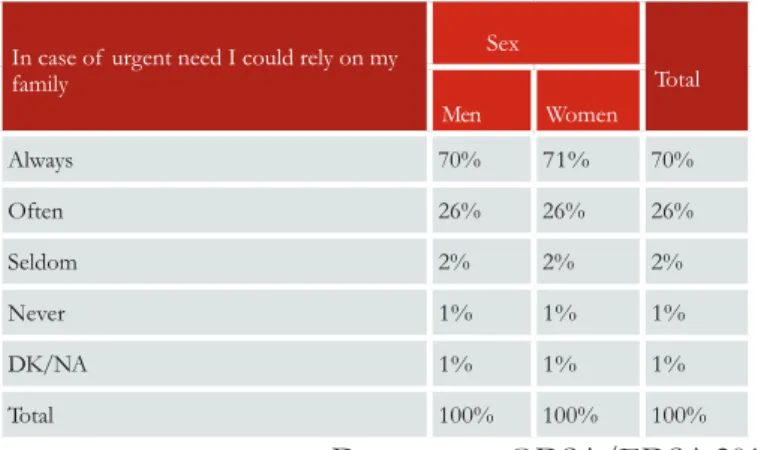
(45) A. Social capital and family Social capital implies reciprocal trust and capacities to act synergistically and create networks, as well as rules and shared values. In this way, the family becomes a public good due to its contribution to the general welfare and its collaborative work in a socio-cultural framework of respect. In order to get to know some aspects referring to trust, associativity and values, the survey sample was consulted about the frequency with which the following three statements relating to these issues took place in each family: “In case of urgent need I could rely on my family”. “I generally rely on the help of my family”. “My family has transmitted human and ethical values to me”. A. 1. The value of trust and help in the family The analysis of the statement “In case of urgent need I could rely on my family” shows that the “always” (70%) and “often” (26%) answers amount to 96%. Tables 12, 13 and 14 reveal the breakdown of the figures with respect to trust in the family, which is higher in older people and in very low levels and shows no difference between men and women. The analysis according to the age group reveals that in the three groups the total proportion is maintained though with internal variations. In the “always” category the youngest group totals 67% and those over 60 reach 74%. The analysis according to the socio-economic level reveals that the percentages are greater when the social level is lower. While the medium-high level reaches 66% in the “always” category, the percentages in the very-low level amount to 82%. Argentinians and the Family. • 225.
(46) Table 12. Frequency distribution for “In case of urgent need I could rely on my family”, according to the age group In case of urgent need I could rely on my family. Age group polled 18 to 34 years. 35 to 59 years. 60 year and more. Total. Always. 67%. 72%. 74%. 70%. Often. 28%. 25%. 22%. 26%. Seldom. 2%. 2%. 2%. 2%. Never. 1%. 0%. 1%. 1%. DK/NA. 2%. 1%. 1%. 1%. Total. 100%. 100%. 100%. 100%. Data source: ODSA/EDSA 2013. UCA. Table 13. Frequency distribution for “In case of urgent need I could rely on my family”, according to socio-economic level. In case of urgent need I could rely on my family. Socio-economic level. Always. 66%. 64%. Often. 30%. Seldom. Very low. Total. 71%. 82%. 70%. 31%. 26%. 15%. 26%. 3%. 3%. 2%. 1%. 2%. Never. 0%. 1%. 1%. 1%. 1%. DK/NA. 1%. 1%. 0%. 1%. 1%. Total. 100%. 100%. 100%. 100%. 100%. Medium high. Medium low Low. Data source: ODSA/EDSA 2013. UCA. 226 • The Conjugal Family: An Irreplaceable Resource for Society.
(47) Table 14. Frequency distribution for “In case of urgent need I could rely on my family”, according to sex. Sex. In case of urgent need I could rely on my family. Total Men. Women. Always. 70%. 71%. 70%. Often. 26%. 26%. 26%. Seldom. 2%. 2%. 2%. Never. 1%. 1%. 1%. DK/NA. 1%. 1%. 1%. Total. 100%. 100%. 100%. Data source: ODSA/EDSA 2013. UCA. The analysis of the statement “I generally rely on the help of my family” shows that “there are very few differences among the different age groups. For socio-economic level, the greater the percentage, the lower the level. As regards the “always” category, the medium-high level reaches 64%, the medium-low, 61%, the low level, 66% and the very low level, 78%, as seen in table 15.. Argentinians and the Family. • 227.
(48) Table 15. Frequency distribution for “I generally rely on the help of my family”, according to socio-economic level. I generally rely on the help of my family. Socio-economic level Very low. Total. 66%. 78%. 67%. 30%. 26%. 17%. 26%. 6%. 6%. 4%. 2%. 5%. Never. 1%. 2%. 3%. 2%. 2%. DK/NA. 0%. 0%. 0%. 1%. 0%. Total. 100%. 100%. 100%. 100%. 100%. Medium high. Medium low. Low. Always. 64%. 61%. Often. 28%. Seldom. Data source: ODSA/EDSA 2013. UCA. For type of household, the homes of couples have slightly larger proportions (couple without children: 70%; couple with children: 68%) than the other households (single: 59%; one-parent: 64%). Once again, the fact of having a couple appears as a key factor that implies collaboration and cooperation. A.2 Shared values The statement “My family has transmitted human and ethical values to me” achieves a total percentage of 96% when the “always” (76%) and “often” (20%) categories are added together. The analysis according to age reveals a slightly lower proportion among the youngest group and also very few differences among the types of household. The homes of couples with children and oneparent households record a 75% in the “always” category, while the single household reaches 73% and that of couples without children, 78%. 228 • The Conjugal Family: An Irreplaceable Resource for Society.
Figure




+7





Documento similar