
Sixth graders´writing production of stories in a foreign language
160
0
0
Texto completo
(2) 2. SIXTH GRADERS’ WRITING PRODUCTION OF STORIES IN A FOREIGN LANGUAGE ACCEPTANCE NOTE. The research titled sixth graders’ writing production of stories in a foreign language, presented by JESSICA PAOLA ROMAN CALDERON accomplish with the requirements to obtain the title of Bachelor's degree in foreign language teaching, therefore, it was approved by whom evaluated the research.. Mabel Diaz Advisor. JUROR. Bogota D.C, 17 de abril 2017.
(3) 3. SIXTH GRADERS’ WRITING PRODUCTION OF STORIES IN A FOREIGN LANGUAGE DEDICATION I want to start to dedicate this to God, thanks to him I am now where I should be, also because thanks to him, I was with health during all the research process. I want to dedicate this specially to my parents, my mother Sandra, my father Horacio and my little brother Kevin for their unconditional support , because they trust on be and also because without their help I could not finish this research in a good way. To my daughter the one for who I did and I am doing this effort to give her the best future. Finally, to my fiancé who as a foreign man supported me in the English process was constantly and meaningful during all the research. Thank you for the patience! I will never forget all the support that each one of you gave to me. Jessica Paola Roman Calderon.
(4) 4. SIXTH GRADERS’ WRITING PRODUCTION OF STORIES IN A FOREIGN LANGUAGE ACKNOWLEGEMENT I want to thank firstly to the Universidad Minuto de Dios and the program Bachelor's degree in foreign language teaching, because thanks to that modality I could continue developing my dream to be an English teacher in order to contribute with the formation of the future generations. Secondly, To the Professor and Master Mabel Diaz Franco, tutor of this research and the one who always trusted on me and on this research, also the one who with her wide experience in literature, her time and her valuable contributions guided me during the all way in the development of this research. Thirdly, To the Professor Maryluz Hoyos, who was the first reader of the project and who gave it a light on the way, giving to the research some contributions based on her wide experience working with children and teaching them a foreign language. Fourthly, to the Professor Angela Gamboa who taught me how to create rubrics to evaluate writing, it was a big help during the research. Finally, To the Andres Rosillo School, place where I got my high school graduation and place where I found the support that I needed to carried out this research and to the sixth graders, to whom I owe this opportunity to see my project accomplished, thanks for the commitment..
(5) 5. SIXTH GRADERS’ WRITING PRODUCTION OF STORIES IN A FOREIGN LANGUAGE CONTENT Pag. CHAPTER I: Introduction ………………………………………………………….. 7. Relevance ………………………………………………………………………. 10. Research problem ……………………………………………………………… 13 Research objectives………………………………………………………………15 Research questions ……………………………………………………………. 16 CHAPTER II : Literature Review …………………………………………………… 16 Theoretical framework ………………………………………………………… 22 Writing process ……………………………………………………….. 22. Written production teaching based in the process…………….. 24. Process for the textual production in Foreign Language……… 25 Narrative texts ………………………………………………………… 25 The story ………………………………………………………. 27. Story’s subgenres ……………………………………………... 27. Characteristics of the stories …………………………………….. 28 Story Elements ……………………………………………………30.
(6) 6. SIXTH GRADERS’ WRITING PRODUCTION OF STORIES IN A FOREIGN LANGUAGE Wordless picture books ……………………………………… 30 Scaffolding …………………………………………………………… 31 CHAPTER III: RESEARCH DESIGN …………………………………………. 33 Research paradigm ………………………………………………………….. 33 Research approach …………………………………………………………… 34 Population and context ………………………………………………………. 36 Data collection Instruments…………………………………………………… 38 Data collection ……………………………………………………………… 41 Ethics…………………………………………………………………………...41 CHAPTER IV ………………………………………………………………………. Visions of language ……………………………………………………….. Visions of learning ………………………………………………………… Visions of the classroom ………………………………………………….. Instructional Design ………………………………………………………. CHAPTER V: DATA ANALYSIS ………………………………………………… Comparative Analysis of the Result …………………………………………… CHAPTER VI: FINDINGS ………………………………………………………….
(7) 7. SIXTH GRADERS’ WRITING PRODUCTION OF STORIES IN A FOREIGN LANGUAGE Conclusion …………………………………………………………………… Research questions answers …………………………………………. Implications …………………………………………………………………….... Limitation ………………………………………………………………………… Further research ……………………………………………………………………. REFERENCES …………………………………………………………………………… APPENDICES ……………………………………………………………………........... Lesson plan ………………………………………………………………………...
(8) 8. SIXTH GRADERS’ WRITING PRODUCTION OF STORIES IN A FOREIGN LANGUAGE CHAPTER 1 Introduction Writing is an integral and necessary skill when learning a first and second language as communication .Nowadays the development of the communication skills specially in writing production in a foreign language could be a little bit difficult at school ,especially when the students’ English competence is not very well developed because of many reasons ,such as the lack of time that the curriculum allows the teacher to foster the production of texts using a foreign language as an important mean of communication, not only because it will allow them to achieve the goals of the grade in which they are, but also when they reach upper grades where they will have to face creation of more complicated texts. The writing production process is essential because through that, children can build knowledge, develop their imagination, discover their abilities and develop specific competences at the moment to write a story, those competences are: On one hand, the coherence that according to De Beaugrande (1981) is ‘ what makes a text semantically meaningful, achieved through syntactical features such as the use of deictic, anaphoric and cataphoric elements or a logical tense structure, as well as presuppositions and implications connected to general world knowledge’(p,84 – 112) and the cohesion, that is according to Halliday & Ruqayia ( 1976) ‘the grammatical and lexical linking within a text or sentence that holds a text together and gives it meaning’, those linguistic patterns belong to the writing production. In the coherence, the student should add the character, setting, conflict, plot and theme, in other words the sense of writing. Second, in the cohesion, they have to use the grammar mechanics, such as the punctuation, connectors, sentence structure and the grammar patterns in a specific topic In.
(9) 9. SIXTH GRADERS’ WRITING PRODUCTION OF STORIES IN A FOREIGN LANGUAGE addition, there are essential steps for the development of writing process, such as, brainstorming, outline, rough draft, evaluation and final draft. Those kinds of examples of writing competences will help the students' writing process to improve their writing production, because, students are not used to “thinking” in English, they are not used to inferring meanings from context and they forget vocabulary and grammar patterns which had supposed to be learned. During the writing process the teacher has to be very conscious about the student's writing production in a foreign language and should provide them the necessary tools for its production, for this reason the teacher during the teaching process about the production of a narrative text in a foreign language, should make a plan, make a contextualization and a review of the ideas; also, should check if the student accomplished to transmit their ideas through the writing production of a story, using the method that the teacher taught in the class and a good use of the cohesion an the coherence which are vital elements in the correct production of a text inside their writing. Additionally, the teacher also should motivate the student to write and rewrite, to know, to analyze and to evaluate their own process and production of any text but in this case the process and production of a narrative text, specifically a story in a foreign language. Thus, this proposal constitutes a theoretical referring, as it allows to identify, assess, examine and contrast the students' writing production of a narrative text in a foreign language and apply a writing strategy in the writing production through the use of wordless picture books, in order to support the sixth graders lack of proficiency in the production of narrative texts in a foreign language, problem detected in previous diagnostic tests applied by the English teacher from the Colegio Andres Rosillo..
(10) 10. SIXTH GRADERS’ WRITING PRODUCTION OF STORIES IN A FOREIGN LANGUAGE From these needs or difficulties, the proposal focused on evaluate the sixth graders’ writing production of narrative stories from Colegio Andres Rosillo during and after the implementation of wordless picture books as a writing strategy to improve the student’s proficiency in terms of cohesion and coherence in the production and in the process (brainstorming, rough draft) of narrative stories in a foreign language This research proposal will be structured the following way: In the first chapter, the research problem and the research questions will be found. Then, using the main question the objectives that are expected to achieve at the end of this proposal were stated. The chapter is also composed by the relevance of the research. Next, in the literature review chapter the analysis of three projects will be developed where the authors were focused on some aspects that could be very meaningful for this proposal. On the other hand, the main constructs that will support and allow this research to identify students' writing performance in English classes will be developed. After this part, the chapter three includes the research paradigm and the research approach that was used during the project, also the setting and the data collection instruments that were used to collect the information in order to support and answer the research question, were included on it. Finally, the last chapter will show general conclusions from the implementation, analysis and evaluation of the proposal. In this chapter the question proposed at the beginning of the project will show the results of the sixth graders’ writing process before, during and after the implementation of writing strategies in the creation of narrative stories in a foreign language..
(11) 11. SIXTH GRADERS’ WRITING PRODUCTION OF STORIES IN A FOREIGN LANGUAGE Justification Taking into account the previous paragraphs, during the observations made in the Colegio Andres Rosillo , I could determine that The purpose of this project is based on the required needs of the sixth graders of that school, to whom it applied two different writing tests, one in order to diagnose the students' level of proficiency in the writing process specifically the cohesion of a text in English and the second one in order to diagnose the ability of production of narrative stories in a foreign Language, in this case the English . The diagnostic test was implemented during February 22 and April 18 2016 and based on the results the design of this proposal was done. Based on the results and the analysis of it, it is evidenced that the sixth graders appear to present a low proficiency in the writing process and production of narrative stories in a foreign Language, because of the ignorance about the content of a narrative story and the lack of coherence and cohesion at the moment to write a story. Those results allowed someone to identify some mistakes that the sixth graders from Colegio Andres Rosillo had because of the lack of knowledge about the process to be followed in the creation of texts and the omission of some patterns used in the writing production of foreign language texts; and based on that, the creation of an strategy or to implement one that already exists to improve those errors were taught , in order to foster the importance that has the development of the writing production process and all the good things that would bring it to the students, in their school life. First, having good grades and achieving the objectives of the class, developing their writing skills not only in the production of texts using the Spanish language, but also, the production of texts in a foreign language. Second, the writing process allows to the.
(12) 12. SIXTH GRADERS’ WRITING PRODUCTION OF STORIES IN A FOREIGN LANGUAGE students, to improve the orthography, build knowledge, develop their imagination, and discover their writing abilities and they develop specific competences at the moment to write narrative texts. In addition, an important factor that talks about the writing production process is that, the practice, the continue feedback, the reinforcement, the motivation and the support to the communication skills, especially the writing skill where the process that the teacher should make together with the students in order to achieve and improve their learning process about the production of texts in a foreign language. Being the learning of the writing process a collaborative work between student and teacher, according to Vygotsky (1896 – 1934) , born the concept of ZPD (Zone of Proximal Development) where at the moment to teach writing texts in a native or foreign language to children, the teacher must recognize the complexity of that process; for that reason it is recommended that the teacher helps the students to improve that skill supported by the ZPD, because, as stated the creator of this concept , the Soviet psychologist Vygotsky (1896 – 1934) that ''in the zone of proximal development, students cannot complete tasks unaided, but can complete them with guidance''.(pag.21) Vygotsky also investigated about the school instruction on children and noted that children can understand language concepts quite naturally, but that mathematics and writing do not come naturally, in those cases, the students need a process explained through the instruction guided by the teacher at the moment to develop the writing process. for this reason, the teacher’s job is to move the child’s mind forward step-by-step in order to develop their abilities in writing production in a satisfactory way and then the teacher with the results could determine a strategy to improve their proficiency processes and their weaknesses when creating texts..
(13) 13. SIXTH GRADERS’ WRITING PRODUCTION OF STORIES IN A FOREIGN LANGUAGE Another important aspect to consider is about writing production in terms of narrative stories, is the power that has the images to help the students in the creation of stories, according to Blam(2014) ''majority of students can memorize and create content more effectively if it happens to be image-based'' and the images makes the learning process more fluid. Therefore, exist a meaningful writing strategy called Wordless Picture Books that trough a set of images allows the students to create their own version about that book, while they develop their writing production process at the same time. To sum up, this proposal is based on those terms developed on the previous paragraphs which will be a help to develop this research and to examine the sixth graders’ writing production of narrative stories from Colegio Andres Rosillo before, during and after the implementation of wordless picture books as a writing strategy. The ZPD ‘ Zone of proximal Development’ process and the important concepts for the production of narrative texts the cohesion and the coherence , its advantages for students' scholar life , defined previously, and the term of scaffolding such as a structure of "support points" for performing an action, that will be developed in a better way in the next chapter, play an important role in de decision to focus this proposal in evaluate the process of the sixth graders production of narrative texts in a foreign language , identifying the students’ strengths and aspects to improve in the production of narrative stories in a foreign language, evaluating the improvement of sixth graders' low proficiency in the writing production during the implementation of wordless picture books as a writing strategy, and finally, in contrast the students' writing production before and after the implementation of wordless Picture Books as a writing strategy in the creation of a narrative story in a foreign language..
(14) 14. SIXTH GRADERS’ WRITING PRODUCTION OF STORIES IN A FOREIGN LANGUAGE. Statement of the problem Being the written communication an important element in the students' educational life is necessary the reinforcement of that skill in order to achieve goals proposed in the school by the teacher. Colorin ( 2009) bu t what happen when the students appear to have a low proficiency in the writing production process when creating texts in a foreign Language , especially in the creation of narrative stories in English and the teacher can realize it?. well, it could be the moment to act in the reinforcement of the writing process and in the improvement of the English level changing a little bit the strategies used to teach how to write a text taking into account the cohesion and coherence and how is the process that the students have to follow to create a narrative story with all the element required for the production of it. In addition, the teacher also can act in the reinforcement of the writing process from the syllabus proposed by the school in order to make that the students achieve the class goals based on the production of narrative texts , in this case of stories in a correct way demonstrating a high knowledge about the cohesion and the coherence in the production of it .But sometimes making changes in the curriculum is not an easy process, as happens with the curriculum of the Colegio Andres Rosillo for the English classes in which the teacher of the sixth graders does not make much emphasis in developing the students' writing production process, and most of the activities planned in the syllabus are focused on teaching lots of vocabulary, such as sports, parts of the house and in the teaching the grammar structures such as the present simple, but there, the students only have to create sentences based on the patterns given by the teacher using the vocabulary learned. Therefore, the students during the whole first and second term did not.
(15) 15. SIXTH GRADERS’ WRITING PRODUCTION OF STORIES IN A FOREIGN LANGUAGE practice enough the writing production and as a result of this, the students started to present a low proficiency in their writing process, as shown in the results of the two diagnostic tests implemented on February 22 and April 18 2016. The first test had the purpose to create a text explaining the daily routines of one character (Homer Simpson), they had a set of images (daily routines) and each image had a sentence referred to the routine. This test had a rubric where the teacher and I could observe the lack of writing proficiency of the sixth graders, because, from 39 students just had a good quantitative grade 5 of them. They presented lacks in the cohesion, because, some of them did not know how to develop a paragraph and they did not know how to connect their ideas using connectors and in the coherence because, they had a lot of grammar mistakes. The second test , was a grammar assessment that I created for them in order to check and analyze a little bit more about their lack of their writing cohesion in a foreign language, where the topic was the simple present and the results were not as I expect, because only 10 students answered the majority of the questions correctly. Based on those results, I could conclude thanks to the English teacher comments that if their writing production would have a continuous assessment of their process, the students' writing proficiency would not be low. To conclude, the sixth graders' writing production from Colegio Andres Rosillo, needs to be examined and evaluated with more detail since the beginning until the end through the implementation of some strategies, in this case, the implementation of wordless picture books in order to improve their low proficiency in the writing production process, and this proposal pretended to support that offering the benefits to the sixth graders from that school..
(16) 16. SIXTH GRADERS’ WRITING PRODUCTION OF STORIES IN A FOREIGN LANGUAGE Research problem Sixth graders from Colegio Andres Rosillo located in Bosa; appear to present a low proficiency in the writing production of narrative stories in a foreign Language.. Research Objectives General Objective To evaluate the process of the sixth graders’ writing production of narrative stories from Colegio Andres Rosillo during and after the implementation of wordless picture books as a writing strategy. Specific objectives 1. To identify the sixth graders’ strengths and aspects to improve in the production of narrative stories in a foreign language. 2. To compare the process of sixth graders' low proficiency in the writing production of narrative stories in a foreign language during the implementation of wordless picture books as a writing strategy 3. To foster the language skills and stimulate sixth graders’ imagination through writing stories. Research Questions General Question.
(17) 17. SIXTH GRADERS’ WRITING PRODUCTION OF STORIES IN A FOREIGN LANGUAGE How is the process of the sixth graders’ writing production of narrative stories from Colegio Andres Rosillo during and after the implementation of wordless picture books as a writing strategy?. ..
(18) 18. SIXTH GRADERS’ WRITING PRODUCTION OF STORIES IN A FOREIGN LANGUAGE CHAPTER II Literature Review This literature review represents the studies that are focused on the writing process of students in order to support them in the writing production of narrative texts in English, teaching them how to write narrative texts in a foreign language inside the classroom and in order to improve their writing production through strategies such as the use of images or wordless picture books. Those researches also included some activities that the researchers applied to a specific group of students through the implementation of some methods or approaches in teaching how to write narrative texts in a foreign language such as the English in two of the researches and in Spanish in the third one, in order to obtain good results with their research. The first and the second are national research; the first one was made by Ariza Martinez (2005) from Universidad Nacional de Colombia, and has as its purpose: '' to show how teachers of English can guide their students to develop this written communicative competence''. (p.1) In this research, the researcher was focused on the process that the students had to follow at the moment to create a text in a foreign language, she also explained the steps that a person who ties to write something has to follow, such as, the drafting, focusing, structuring, re-viewing, general ideas and evaluating: those steps belong to the process- writing approach (p.38). The process before mentioned by Ariza Martinez ( 2005) is going to support this research because, it will give a foundation about the things that are going to be taught to the sixth’ graders from the Colegio Andres Rosillo in order to make them understand and analyze the correct process to carry on the production of a text in a foreign language..
(19) 19. SIXTH GRADERS’ WRITING PRODUCTION OF STORIES IN A FOREIGN LANGUAGE On the other hand, for this research it used an action research study as the methodology in order to involve the use of a series of activities related to the generation of ideas and focusing stages from the process writing approach. It was carried out with a group of 9th graders from República Del Ecuador School in 2004. (Ariza Martinez, 2005, p. 40). Additionally; the data were gathered from the collection of drafts and final products, where the teacher played the role of observer, guide and facilitator. (p. 40). Some of the instruments used there were activities about generation of ideas based on a set of pictures given by the researcher, were the students started to write their ideas using a brainstorming and they followed the steps of the writing process in order to write from a sentence to write a paragraph based on the set of images. The differences that were found between these researches with this research were: first of all, the population. She worked with nine graders different to this research that is going to work with a group of sixth graders. Another difference was that she just wanted to apply the writing process approach as her main methodology to improve her students' writing production of texts in a foreign language (English) on the contrary, this research is going to see the students' writing process and the students' writing production, included the cohesion and the coherence during the creation of a story in a foreign language. Finally, the last significant difference is about the main methodology that is going to be used in this research, which is based on the wordless picture books that are quite similar with the instrument that she used to generate ideas using pictures, images and cartoons to create a text in English. All in all, this research is very meaningful because there are many important things that are going to support this research, such as, the instruments that the researcher used to gather.
(20) 20. SIXTH GRADERS’ WRITING PRODUCTION OF STORIES IN A FOREIGN LANGUAGE information, the different type of test based on follow a set of images in order to create a text in English and one of her instruments was going to be adapted as an example for the design of a tool to evaluate the sixth’ graders writing process in a foreign language through images. Similar with this proposal, the second national research was about the writing production of narrative texts in primary students, in which according to Contreras & Ortiz (2011) in their research called ‘Producción escrita de textos narrativos (mini cuentos) en los estudiantes de grado cuarto de educación básica primaria de la institución educativa instituto nacional promoción social de San Vicente del Caguán’ stated the importance of the implementation of the educational workshop and teaching strategy for strengthening the processes of narrative writing minicuentos in primary students and how the production of short stories help the students to improve their low level in the production of narrative texts. The general objective of it is: Implementar una propuesta metodológica que permita mejorar la producción escrita de textos narrativos (mini cuentos) en los estudiantes de Básica primaria en la I.E. Instituto Nacional de Promoción Social del municipio de san Vicente del Caguan (Caquetá), and the research question is ¿Cómo potenciar la producción escrita de textos narrativos (mini cuentos) en los estudiantes de grado cuarto de educación básica primaria de la Institución Educativa Promoción Social? (p. 18). Although their research was made based on the writing production of narrative texts in Spanish, inside it, many important aspects were found which are going to support this research, it gave a light about how to measure, analyze and observe the students' writing production through the use of rubrics in order to see in a clearer way the students' results in each item, such as the writing process during the development of written activities for create a narrative text and the.
(21) 21. SIXTH GRADERS’ WRITING PRODUCTION OF STORIES IN A FOREIGN LANGUAGE writing production, the cohesion and the coherence that should has a narrative text , in this case a story in a foreign language. In addition, the population of this research is quite different to this one, they worked with 147 four graders from the Institucion Educativa Promocion Social and this research population is a group of sixth graders. Another difference is the research design , they chose a case study, because it allowed them to explore, describe, explain and evaluate a simple situation or a specific phenomenon, the contrary to this research design that will be an action research, which will be explained with more detail on the third chapter. The third difference is the method that they used to improve their students' writing production of (mini cuentos) in Spanish, which was a methodology based on Rodari writing workshops, different to the strategy or methodology applied in this research , which will be the creation of stories in a foreign language through wordless picture books. Contreras and Ortiz (2011) research is going to support this research giving it theoretical reference such as what a narrative text is, its types, its importance, the structure that a story has to have and how to write it in a correct way following the steps for writing narrative texts. Also, the rubrics that were founded in Contreras and Ortiz research are going to be an essential part for this research, because inside on each item of the rubric, the information to analyze the data could be enough to examine the sixth’ graders results in the creation of narrative text, in this case stories in a foreign language, Therefore, is a very good tool to answer the research questions. The last but not least, the third is an international research about '' Writing Wordless Picture Books to Facilitate English Writing'' Huang (2009) ,where the purpose of this study was to examine the effectiveness of the use of wordless books in terms of college students’ writing.
(22) 22. SIXTH GRADERS’ WRITING PRODUCTION OF STORIES IN A FOREIGN LANGUAGE skills in ESL classes in Taiwan, to see how wordless picture books serve as a resource for the English writing curriculum and to determine what difficulties and problems students encountered using this approach. Huang( 2009) (p,2) He stated two research questions for his study, 1: How do the students perceive the effectiveness of using wordless picture books? , 2: What challenges and problems do students encounter in this alternative way to improve their English writing by using wordless picture books? (p. 3). Furthermore, his participants were forty freshmen students at the Department of Applied English in one selected university of science and technology in Taiwan. These participants included eight male students, and thirty-two female students. The range of students’ was from nineteen to twenty years old. During the development of his research article he defined what is a wordless picture book and what are its main purposes in the reinforcement of the people writing skills specially in English as a foreign language, the methodology that he used to diagnose his students writing proficiency was General English Proficiency Test (GEPT), taken before the implementation of the wordless picture books as a writing strategy. This type of test shows students a set of images for each point in which they should write sentences in order to follow the images and tell the story based on their own way to understand the situation of each image and allows the teacher see the students' weaknesses and strengths and apply the strategy proposed in order to improve their lack in the writing production in a FL. The main differences are the amount of participants, because his participants are at the university, on the contrary to this research where the participants are still at school. On the other.
(23) 23. SIXTH GRADERS’ WRITING PRODUCTION OF STORIES IN A FOREIGN LANGUAGE side, the second difference is that there are some instruments to gather information about the production of a text in a FL, but there are not instruments to gather data about the participants' process during the creation of a narrative text through the implementation of wordless picture books ,and the third difference is that in his research he did not base on the production of narrative text using wordless picture books, he wanted to give his participants one tool to facilitate their English writing in general texts, and that strategy is going to be used to improve the sixth students' writing production of stories in EFL. This research is going to help in the development of the implementation using wordless picture books in order to facilitate and improve the sixth grader´s lack of the proficiency in the English writing production and motivate them to write stories in a foreign language using the images of the writing wordless picture books. Theoretical Framework In order to contextualize this research, it is necessary to explain the basis approaches and strategies in which I was going to center my project. Those ones were very useful at the moment to acquire new useful information that will allow me to create another view about teaching and learning how to improve the students' writing production and the implementation of strategies to support it. Writing process. According to Nordquist( 2015); ''The writing process is the series of overlapping steps that most writers follow in composing texts. Also called the composing process.'' where the teachers are the responsible to carry the students' writing process into an environment where that process receives a constantly feedback about the mistakes committed at.
(24) 24. SIXTH GRADERS’ WRITING PRODUCTION OF STORIES IN A FOREIGN LANGUAGE the moment to write the text, also the teacher is the one who provides the tools needed for the creation of texts based on the different kind of elements that composed that process. Those process according to Pringle (2016); could be defined such as '' an approach to writing that entails the recursive phases of pre-writing, drafting, revising, editing, and publishing'', and the uses of the combination of direct instructions given by the teacher, supports the writing process, helps the students to improve their writing process easier, because, they have the opportunity to be assessed in each phase or step with the purpose of produce an effective writing for a variety of purposes for the classes. This means that, as Pringle (2016) when the teacher supports the students' knowledge about the writing process through the teaching of the writing phases, such as, the pre- writing, where the student may plan their writing through images, diagrams, drawings, brainstorming in order to organize the ideas about what the student wants to write. Second, the drafting stage allows the student translate his or her ideas into a writing organization, without paying more care about the cohesion of the text and in this stage the teacher can provide an immediate feedback , in order to help the student to continue with the third stage that is , the revising step, where the student examines the content of the writing, the cohesion and makes some changes deleting or adding more information after the fourth step, the editing stage, where the student attends to correctness in conventions and takes the time to find errors in grammar, usage, mechanics, and spelling and then make appropriate corrections. Finally , after all this writing process , the publishing stage , is the students' final preparation of the piece of writing that will be hand it for the teacher before the presentation of it..
(25) 25. SIXTH GRADERS’ WRITING PRODUCTION OF STORIES IN A FOREIGN LANGUAGE Another definition of writing process, was developed by Calderon Luna & Rodriguez Silva, propuesta metodologica para mejorar la produccion escrita del cuento como texto narrativo en el grado tercero (2011), Who said that '' el proceso de escritura produce influencias reflexivas sobre la manera de percibir, producir y analizar el lenguaje; sobre las capacidades intelectuales de registrar, planificar, corregir y construir lenguaje'' (p 29). This definition is basically , what the writing process allows to develop in the students' life , all those influences that a good writing process can help the student as a writer to reinforce his or her language performance and to be conscious about the writing process that he or she are following. Inside this construct the following concepts that are related with this research will be developed and also those concepts will support it in terms of theory. Written production teaching based in the process. Inside this concept, Cassany (1999) ; proposes four approaches to develop the writing production inside the classroom, in order to achieve that the students create a text with sense and meaning, where they applied the necessary elements to fulfill this process successfully. Those approaches are focused on the approach based on grammar, in the approach based on functions, the approach based on content and the approach based in the process. The main idea of those processes is make an emphasis in the importance of the writing process, than, only teach or evaluate the final version of one narrative text without a previous explanation about the steps that a writer has to follow in the creation of it..
(26) 26. SIXTH GRADERS’ WRITING PRODUCTION OF STORIES IN A FOREIGN LANGUAGE That means that the teacher must develop and design each moment of his or her class, step by step in order to follow it and improve the narrative text production through the creation of stories, and this is one of the aspects that this is one of the aspects that has been taken into account when planning the research proposal. Taking into account the purposes this proposal is necessary to define the second construct in order to complement the first one and in order to contextualize the research a little bit more. Process for the textual production in Foreign Language. According with the foreign languages' curriculum guidelines, can presents three types of process; process based on the intra-textual level, process based on the inter-textual level and the process based on the extra-textual level. Ministerio de Educacion Nacional. The first process makes reference to process based on the level intra-textual in which the syntax and the semantics are composed for micro- structure, macro-structure and super-structure and those ones guarantee a correct process of cohesion and coherence; through the use of strategies according the type of text. MEN, Serie lineamientos curriculares Idioma Extranjeros, (p. 27) The second process is based on the inter-textual level, where the relationships between other texts are in the content of another text such as quotations, references, thoughts of other authors and those things help in the writing process and the reviewing the literature support the ideas. MEN, Serie lineamientos curriculares Idioma Extranjeros (p, 27).
(27) 27. SIXTH GRADERS’ WRITING PRODUCTION OF STORIES IN A FOREIGN LANGUAGE Finally, the pragmatic component is located in the process based on the level extratextual, where the communication has an important role, taking into account the participants, their vocabulary and their thoughts. Narrative texts According to Bruner (1988 & 1995) ‘‘the narrative is an act of speech, it is a text which intention is to guide a search for meaning within a framework of possible worlds.'' That means that, when the reader reads or listen a text, this invites the reader to feel identified with the topic and to create in his or her mind scenery on it and try to create his or her personal vision about the context and the topic that is on the lecture. This concept is based on the impact that causes the reading about a narrative text in the reader, and (MEN, Serie lineamientos curriculares Idioma Extranjeros) refers that not only the reading process of a narrative texts can cause those kinds of impact in a person, also the creation of a narrative text can help not only the writer to search meanings and create their own meanings about one topic, but also, helps the reader to comprehend those meanings in order to understand the purpose of the narrative text. On the other hand Contreras & Ortiz (2011) stated that ‘’Se llama narración a la acción de narrar algo real o ficticio, contado de forma que resulte creíble. Se puede narrar historias o sucesos utilizando distintos medios: forma oral o escrita, mediante gestos, a partir de dibujos, con grafías, fotogramas de películas…’’. They also mentioned some characteristics about the narratives that will be very meaningful for this proposal because at the moment to tell the.
(28) 28. SIXTH GRADERS’ WRITING PRODUCTION OF STORIES IN A FOREIGN LANGUAGE students what they will have to do is important that they also learn about the meaning and the characteristics that have a narrative text. According with Van Dijk (1798) a narrative text possess some characteristics that make a difference in front of another terms. An important characteristic is that, a narrative text must have as a referent an event or an action that be the interest of the writer. Another characteristic are the two moments that belong to narrative texts, called (complication and resolution) that constitute the core of a narrative text and that core has a set of events, which ones give the place, the time, the events of a specific situation. The third characteristic is called (setting) in which those situations or events are specific. The events and the setting, work together in order to construct the episode and a series of many episodes it’s called (plot) Van Dijk (1798). After this, a struggle between two people or things in a short story is called (conflict) and the final characteristic that has a narrative text is the (Theme) which is the central idea of the story. ELLSA ( 2004). There are some sub genres of the narrative; those are the micro story, the short story, the story and the long story. The genre that it will be implemented in this proposal is the story. The Story. According to Calderon Luna & Rodriguez Silva (2011); the story is ''Una narración breve de hechos imaginarios o reales, protagonizada por un grupo reducido de personajes y con un argumento sencillo'' (p. 36). They also said that, there are two different types of stories the popular story, being a short traditional narration of imaginary events has three sub types: the first one is the fairy tale, the second one is the fables and the third is about costumes stories. On the other hand, there is the literary story: where the author is usually known and where there is just one version of the text..
(29) 29. SIXTH GRADERS’ WRITING PRODUCTION OF STORIES IN A FOREIGN LANGUAGE Story’s subgenres. There are many stories’ subgenres, but there are one called Mini cuento, which is the one who is going to be worked in this research. Characteristics of the stories, The story is a kind of text that has particular characteristics that catch the reader's attention because of the content, also, the story has a structure, it contains an action and a consequence that will be developed in three steps; beginning, middle and end. It helps the story to function in a single sequence of events. A story is written to read from the beginning until the end, and it allows the writer to play with the characters, with the events and with other elements that will be developing next. Calderon Luna & Rodriguez Silva,(2011). According to Calderon Luna & Rodriguez Silva,(2011). There are different types of narrative texts, such as: Literary: novel, short story, fable, legend, epic, romance, etc. Graphic: comics, comic, joke ... Within the narrative genre highlights the following: Factual: includes: history, biography, autobiography, fable. The daily: there is the personal event, anecdotes, rumors and jokes. Story Elements. The following story elements are created in order to create a story with sense that present a unified impression of temper, tone, colour, and effect. Jagadisan (2010). 1. Setting: The time and location in which a story takes place, in this part the writer must have to describe the following elements: a) Place: Geographical location. Where is the action of the story taking place? b) Time: When is the story taking place? (Historical period, time of day, year, etc) c) Weather and social conditions: Is it rainy, sunny, stormy, etc?.
(30) 30. SIXTH GRADERS’ WRITING PRODUCTION OF STORIES IN A FOREIGN LANGUAGE 2. Plot: is how the author arranges events to develop his basic idea, there are five parts of the plot. a) Introduction/orientation: The beginning of the story where the characters and the setting is revealed. b) Rising action: This is where the events in the story become complicated and the conflict in the story is revealed (events between the introduction and climax). c) Climax: This is the highest point of interest and the turning point of the story. The reader wonders what will happen next; will the conflict be resolved or not? d) Falling action: The events and complications begin to resolve themselves. The reader knows what has happened next and if the conflict was resolved or not (events between climax and denouement). e) Resolution: This is the final outcome or untangling of events in the story. 3. Conflict: it belongs to the plot, without conflict there is no plot. There are two types a) External: A struggle with a force outside one’s self. b) Internal: A struggle within one’s self; a person must make some decision, overcome pain, quiet their temper, resist an urge, etc. 4. Characters: are the persons who work in a fiction and the person characteristic. The characters can be: a) Individual: Round, many sided and complex personalities..
(31) 31. SIXTH GRADERS’ WRITING PRODUCTION OF STORIES IN A FOREIGN LANGUAGE b) Developing: dynamic, many sided personalities that change, for better or worse, by the end of the story. c) Static: Stereotype, have one or two characteristics that never change and are emphasized e.g. brilliant detective, drunk, scrooge, cruel stepmother, etc. d) The Characteristics of a Person – In order for a story to seem real to the reader its characters must seem real. Characterization is the information the author gives the reader about the characters themselves. Characters are convincing if they are: consistent, motivated, and life-like (resemble real people). a) b) c) d). his/her physical appearance what he/she says, thinks, feels and dreams what he/she does or does not do what others say about him/her and how others react to him/her. 5. Theme: It is the author’s underlying meaning or main idea that he is trying to convey. The theme may be the author’s thoughts about a topic or view of human nature. The title of the short story usually points to what the writer is saying and he may use various figures of speech to emphasize his theme, such as: symbol, allusion, simile, metaphor, hyperbole, or irony. Wordless picture books. Huang, (2009 Define it, ´´as books that have no written text to accompany the pictures and are available in print.´´ (p. 2). The easiest ways where I can find it is online and this is more economic, also this book in some web pages allows print it without a specific permission. Those texts can be a meaningful strategy for this proposal, because, the fostering of writing stories through images allows the students to create their own version about those images showed in the wordless picture books using their imagination and at the same time they are reinforcing their writing production process..
(32) 32. SIXTH GRADERS’ WRITING PRODUCTION OF STORIES IN A FOREIGN LANGUAGE On the other hand, the use of wordless picture books in students who pretend to write in a foreign language as the English, according to Hsiu-Chih ( 2008), ‘’ The use of a wordless picture book with ESL learners improved their overall language skills and stimulated their imagination to write about the story’’. So, thanks to those books the students can relate what happens with the illustrations and based on that write a narrative text with all its components and using the foreign vocabulary learned in the English class. The implementation of those books help the students also in the development of their confidence of creating stories in a foreign language , because they can use the vocabulary that they remember and associate it with the set of the illustrations that show each book. Bishop & Hickman (1992). That is not means that the wordless picture books are going to replace the books with texts, this books are going to support the knowledge and are going to be an important tool in the production of stories in a foreign language. Being the wordless picture books an important tool inside the classroom in order to promote the writing for all students in young learners and students from 10 years onward; Wilson (2012) State that, ´´Teachers are often under the belief that wordless picture books are only for younger children but through the data collected there is evidence that older students, struggling students, and ESL students can benefit from wordless picture books because they have less words, and more illustrations´´(p. 55). Therefore, if the teachers used more those kinds of books in their English classes, the students will feel more comfortable at the moment to write a story using their words and their writing process in a foreign language. Scaffolding.
(33) 33. SIXTH GRADERS’ WRITING PRODUCTION OF STORIES IN A FOREIGN LANGUAGE Vernon (2001) State that ''Scaffolding is one process that allows teachers to organize a writing activity systematically to meet the needs of all students'' (P1). Therefore, the scaffolding allows the teacher to build knowledge upon students' strengths, also the teacher is the only one who can recognize the students' process and then , using steps in a process, modeling the steps, and then giving students the opportunity to try it themselves to improve their mistakes during the writing process. On the other hand, according to Bliss & Askew (1996), Bodrova & Leong(1998) and Palincsar (1998), Scaffolding allows the teacher to help students transition from assisted tasks to independent performances, it mean that It is a step-by-step process that provides the learner with sufficient guidance until the process is learned, and then gradually removes the supports in order to transfer them responsibility for completing the task to the student, so, the teacher support has to be permanent because his/ her help makes that the scaffolding be a successful process and the students could complete the tasks with the information provided by the teacher. The concept of Scaffolding according of the ZPD (Zone of Proximal Development) is the concept seen as scaffolding, a structure of "support points" for performing an action. This process help the teacher to be more competent while helps the student in his or her ZPD as a necessary and tapers off this aid as it becomes unnecessary; much as a scaffold is removed from a building after construction is completed. Also (Chaves & Brown) defined the scaffolding of ZPD as ´´the way the adult guides the child's learning via focused questions and positive interactions." That is mean that the teacher give the students all the support about one process that he or she wants to strengthen in the students’ knowledge at the beginning of the process and.
(34) 34. SIXTH GRADERS’ WRITING PRODUCTION OF STORIES IN A FOREIGN LANGUAGE through that process the teacher is going to let the student little by little in order to make that the student being capable of develop the process by itself. Bradley & Bradley (2004), Reported in their research the types of scaffolding in order to being especially effective for second language learners. The first one is about the Simplifying the language, where the teacher can simplify the language by shortening selections. The second one is asking for completion, not generation, where the teacher can have students choose answers from a list or complete a partially finished outline or paragraph. The third is using visuals, where the teacher can present information and ask for students to respond through the use of graphic organizers, tables, charts, outlines, and graphs. To conclude all this information collected during the writing of the literature review and the theoretical framework helped me in my research about the relevance that has the writing in the students' life and how as a future English teacher I can evaluate the sixth graders’ writing process before, during and after the implementation of writing strategies such as the implementation of wordless picture books, in the production of narrative stories in a foreign language, following the steps to the creation of narrative texts and fostering their interest in the writing production..
(35) 35. SIXTH GRADERS’ WRITING PRODUCTION OF STORIES IN A FOREIGN LANGUAGE CHAPTER III Methodology Research paradigm. In order to know the causes that make students have low proficiency in the writing skills at the moment to write texts, I choose mixed method approach to investigate the validity of the research and to determine if the use of wordless picture books can help develop writing for children. The quantitative study could help me to collect specific data that show me the specific causes. And the other component of my research will be a qualitative method designed to gather information for each student writing sample and regarding how the Sixth graders feel about themselves as writers, what their thoughts were about their actual writing, and what they thought they needed help with. The mix method according to Creswell (2003), ‘is one in which the researcher tends to base knowledge claims on pragmatic grounds (e.g., consequence-oriented, problem-centered, and pluralistic). It employs strategies of inquiry that involve collecting data either simultaneously or sequentially to best understand research problems’. (p. 18). Here, the data collection also involves gathering both numeric and text information, that as I explained in the previous paragraph each method will have a different purpose in order to complement, understand and support my research. Research approach. The approach for this research will be an action research study that according with Sagor (2000), is defined as a 'disciplined process of inquiry conducted by and for those taking the action. Therefore, this research will be in order to help the sixth graders in their writing production of stories in a foreign language. on the other hand, the Action research has a positive effect for many reasons, such as ,it is always relevant to the participants and helps.
(36) 36. SIXTH GRADERS’ WRITING PRODUCTION OF STORIES IN A FOREIGN LANGUAGE educators be more effective at what they care most about their teaching and the development of their students. Taking into account what an action research is and all its benefits, is necessary to take in mind what is the process that an action research has in order to see if a research has this approach or not. Sagor (2000) The first step is called ' selecting focus’ where the researchers are going to define, what element(s) of their practice or what aspect of student learning do they wish to investigate? The second step is ' clarifying theories' which involves identifying the values, beliefs, and theoretical perspectives the researchers hold relating to their focus. The third step is ' Identifying Research Questions' where, once a focus area has been selected and the researcher's perspectives and beliefs about that focus have been clarified, the next step is to generate a set of personally meaningful research questions to guide the inquiry. The fourth step is 'Collecting Data' where the data is used to justify their actions are valid (meaning the information represents what the researchers say it does) and reliable (meaning the researchers are confident about the accuracy of their data). Lastly, before data are used to make teaching decisions, teachers must be confident that the lessons drawn from the data align with any unique characteristics of their classroom or school. The fifth step is 'Analyzing Data' which once gather the results, the analysis brings to mind the use of complex statistical calculations; this is rarely the case for the action researcher..
(37) 37. SIXTH GRADERS’ WRITING PRODUCTION OF STORIES IN A FOREIGN LANGUAGE The sixth step is about ' reporting results' where, The reporting of action research most often occurs in informal settings that are far less intimidating than the venues where scholarly research has traditionally been shared. The seventh step is 'Taking Informed Action' where the researcher takes each piece of data uncovered (about teaching or student learning) and creates new strategies to support the research and here the educator will feel greater confidence in the wisdom of the next steps. As a result of reading the action research steps, it was a meaningful way to realize that this research will have as its approach an action research study for many reasons, the first one , is because I already have seen a problem and I had an evidence of it, second, because base on the approach chosen, I formulated research questions, which ,through the collecting of the data will give answers in order to gather information and start to work in some strategies that are going to support the improvement of the results; and the third is because the purposes that has an action research are connected with the purposes of this research, such as, create or implement any strategy in order to analyze, evaluate and try to solve a identified problem inside the context where the problem is. For those reasons this research chose an action research as its study. Population and Context Thirty-nine Sixth graders, nineteen boys and twenty girls, were selected for this study. They are between 11 to 13 years old. The social statuses in this group are 1 and 2. Those sixth graders were authorized to participate in this research by their parents or legal guardians, a letter was designed in order to inform them about the research and ask them to sign.
(38) 38. SIXTH GRADERS’ WRITING PRODUCTION OF STORIES IN A FOREIGN LANGUAGE the permission that they give to their children to participate. The letter can be find in the appendices. They study at the Colegio Andres Rosillo located in Calle 65C # 78A-23Sur Bosa Estación. This school has a unique schedule, therefore, the students study just in the morning. It is not a big school, is a tall building and it does not have green zones or park inside of it. The school has 11 grades starting for the 1st grade until 11th grades, they have two English teachers, one of them teaches in primary and the other one in secondary. Most of the sixth graders of that school had the same characteristics in their proficiency in writing; some of them were really good writing in a second language, but some others had a very low level at the moment to be asked to create a paragraph or a short text in a foreign language, in this case the English. To summarize this group of students had difficulties with their written expression, since their previous English teachers never had worked with them in the creation of texts, they just created some tenses, but they had never had the opportunity to create a paragraph using those sentences or using their ideas to express something and in the syllabus created by the directives do not make any emphasis in the improvement of the students' writing skills, their emphasis in English is about the oral production (speaking), where the English teacher used to show them images/posters in order to make them describe what they were seeing with their own words without asking them to write about it. In the observations, I could observe the way that this new teacher test the writing to the students, she applied new activities and exams that involved the students in a writing process and.
(39) 39. SIXTH GRADERS’ WRITING PRODUCTION OF STORIES IN A FOREIGN LANGUAGE she could determine that they had a low proficiency in their writing skills , also they were developing class portfolios where they had to write a paragraph describing their names, their ages , likes and dislikes and most of them only wrote sentences and the others tried to connect the sentences in order to create a text but they do not know the use of connectors or linking words to organize their ideas. Also they had to write in another paper their daily routine in a short text using the simple present and the hours but the same thing happened, the students again presented trouble in the organization of their ideas in order to create a text and again they demonstrated their low proficiency in their writing skills. To add, the time for the improvement of students' writing skills was not planned in the curriculum, therefore, the English teacher had to follow the other topics inside the syllabus, skipping the improvement of that skill and as consequence of that the lack of time for writing, the 6th graders from this School started to present a low proficiency in their writing skills. Instrumentation. The instruments are a mean that the researchers use to get and measure results taken for the ones that were designed, such as surveys, tests, questionnaires’, artifacts etc... According with Biddix (2009), it’s necessary to know the differences between what is instrumentation and what is instrument, he state that ´´the instrument is the device and instrumentation is the course of action (the process of developing, testing, and using the device´´. Therefore, between the instruments designed for the implementation of this research proposal, there are writing tests, Students writing samples, with its own rubric and check lists..
(40) 40. SIXTH GRADERS’ WRITING PRODUCTION OF STORIES IN A FOREIGN LANGUAGE Those instruments fall into two broad categories, researcher-completed and subjectcompleted, distinguished by those instruments that researchers administer, versus the ones that are completed by participants. The instruments were chosen in order to give an answer to the research question. In the following paragraphs the 4 instruments that were used inside this research proposal will be presented, with its function, if it is researcher-completed or subject-completed and the number of session that were taking inside the school to develop them, and how those ones are going to support with their results to answer the research question. The first instrument was divided in two parts. The first one was a pre- test and the second part was a Students' writing sample of a story in English. This instrument belongs to the subjectcompleted category, and it pretends to support and answer the specific question number1. Session number 1: Pre- test about vocabulary where the wordless picture book called ‘snowing day’ (Appendix 1), was showed to them in order to check how was their previous knowledge about simple words on English. For this instrument a format was designed to make what they had to do and write on the paper clearer. (Appendix 2). Session number 2: The second part of the Pre-test was taken. This part was about a Students' writing sample in English, when the main topic was their dreams. The second instrument used was a student’s writing sample about one of the wordless picture book that I gave them, where the students had to write their own version of the book ´´Terry yes you can´´ (Appendix 3). This instrument belongs to the subject-completed category, and it pretends to support and answer the specific question number 2. As For the development of. '.
(41) 41. SIXTH GRADERS’ WRITING PRODUCTION OF STORIES IN A FOREIGN LANGUAGE this instrument, a process of feedback, explanation of how should be a writing process and what should include a writing production made correctly with its coherence and cohesion was done, it was necessary to take 4 sessions . Session number 3: The wordless picture book was shown, picture by picture where first, each couple had to write a list with all the vocabulary that they observed in each picture in a piece of paper, including the names of the characters that they observed. Then, they started to create the beginning and the middle of that story as a first draft. It was collected and checked. Session number 4: The first draft was corrected and gave it to each couple in order to make them to write it on a new piece of paper and they had to add the end of the story. The second draft was collected and checked. Session number 5: The second draft was given it to each couple. They had to rewrite the beginning, the middle and the end of their version of the wordless picture book ‘Terry yes you can’ taking into account the corrections made in the previous 2 drafts, creating a 3 rd one. Session number 6: The final student writing sample was collected The third instrument used was the students’ own version of the one of the following wordless picture books: -The magic Bean -Pinky and Jones -The ugly duckling -Jackeline and the beanstalk.
(42) 42. SIXTH GRADERS’ WRITING PRODUCTION OF STORIES IN A FOREIGN LANGUAGE This instrument belongs to the subject-completed category, and it pretends to support and answer the specific question number 3. As in the previous instrument, for the development of this instrument, a process of brainstorming and feedback was done, with the difference that this one was individually. It was necessary to take 4 sessions and each session had a writing workshop, where the students were involved in a comfortable environment, with food and decoration based on the topic of the books that they chose. (Appendix 4). Session number 7: The wordless picture book was given to each student; each book had a colorful cover and was printed in color. The students had to write a list with all the vocabulary that they observed in each picture in a piece of paper, including the names of the characters that they observed. Then, they had to start creating the beginning and the middle of that story as a first draft. It was collected and checked. Session number 8: The first draft was corrected and given it to each student in order to make that them write it on a new piece of paper and they had to add the end of the story. The second draft was collected and checked. Session number 9: The second draft was gave it to the students. They had to re write in a piece of paper the beginning, the middle and the end of their version in of the wordless picture book taking into account the corrections made in the previous drafts. Session number 10: The students had to write on the book, behind each page the short story that they wrote according with each image..
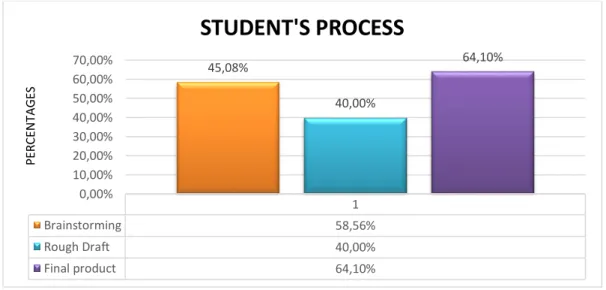
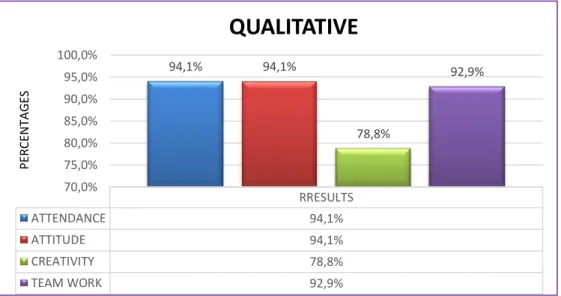
(43) 43. SIXTH GRADERS’ WRITING PRODUCTION OF STORIES IN A FOREIGN LANGUAGE Data Collection The first data was divided in two parts, the first part was a Pre-test about vocabulary in which the wordless picture book called ‘snowing day’ was used, and it was taken on August 8 th 2016. The second part was a Students' writing sample of a story in English, taken on August 15 th 2016, where they used their own dreams to create a character and, based on that, they created a short story. This data was collected at the beginning of the research, without previous explanations about how should be a writing process or what should include a writing production made correctly with its coherence and cohesion. This activity will be evaluated in a qualitative and quantitative way with a rubric. • The Qualitative way is going to evaluate each student performance in the development of the coherence at the moment to create a story if they take into account the topic, the characters, how they developed the situation which means that each student will have different comments in each item of the rubric. Such as; points of view, reactions etc… • The Quantitative way is going to be evaluate with two rubrics, one of them to evaluate the student performance in the development of the writing process taking into account the brainstorming and the drafting process; and the second one to evaluate the cohesion and give a general score to student's writing, taking into account the following grammar errors: present simple tense, present continuous, verb to be, repetition of words, grammar spelling mistakes and punctuation. The second data was a student’s writing sample about one of the wordless picture book that I gave them, in which the students had to write their own version of the book '' Terry yes you can'' developing it step by step after the explanation of how should be a writing process and what should include a writing production made correctly with its coherence and cohesion. Therefore, taking into account each image that the book has, they wrote the beginning in the first session on September 5th, in the second and third session 12th and 26th they did the middle and the end, finally, they handed the final product on October 3rd 2016..
Figure


+4


Documento similar
In the preparation of this report, the Venice Commission has relied on the comments of its rapporteurs; its recently adopted Report on Respect for Democracy, Human Rights and the Rule
On the other hand at Alalakh Level VII and at Mari, which are the sites in the Semitic world with the closest affinities to Minoan Crete, the language used was Old Babylonian,
The aim of this paper is to demonstrate that reading authentic literary material in the English as a Foreign Language (EFL) classroom can improve students’ language learning skills as
In Scenario III most of the means of production are privately owned and production is guided and income distributed largely through the oper- ation of markets. Therefore, there
Other interesting information gleaned about this aspect of foreign language learning/teaching includes the fact that six of the lecturers surveyed responded that they used parts
Method: This article aims to bring some order to the polysemy and synonymy of the terms that are often used in the production of graphic representations and to
In these and the rest of online media that reached a medium level of participation in relation to news production, the user acquires, to some extent, roles
Broadly, this thesis is about the production of space in market society. As shown in the publications and other texts that are brought together, I unpack the process of
