
Cooperative learning using comic strips to develop responsive listening
65
0
0
Texto completo
(2) Cooperative Learning Using Comic Strips to Develop Responsive Listening. 1|. NOTE OF ACCEPTANCE ____________________________ ____________________________ ____________________________ ____________________________ ____________________________. SIGNATURE ____________________________ SIGNATURE ____________________________ SIGNATURE ____________________________ Bogotá D.C. October, 2017.
(3) Cooperative Learning Using Comic Strips to Develop Responsive Listening. 2|. FORMATO RESUMEN ANALÍTICO EN EDUCACIÓN - RAE Código: FOR020GIB. Versión: 01. Fecha de Aprobación: 16-11-2017. Página 1 de 5. 1. Información General Tipo de documento. Trabajo de Grado. Acceso al documento. Universidad Pedagógica Nacional. Biblioteca Central Cooperative Learning Using Comic Strips to Develop Responsive. Titulo del documento. Listening. (Aprendizaje cooperativo usand tiras cómicas para desarrollar escucha receptiva).. Autor(es). Bernal Tovar, Jeisson Stiven. Director. Pérez, Francisco. Publicación. Bogotá, Universidad Pedagógica Nacional, 2017. 64 p.. Unidad Patrocinante. Universidad Pedagógica Nacional.. Palabras Claves. APRENDIZAJE. COOPERATIVO,. ESCUCHA. RECEPTIVA,. TIRAS CÓMICAS.. 2. Descripción Trabajo de grado en el cual se propuso analizar los efectos del aprendizaje cooperativo en la escucha receptiva, usando tiras cómicas en el colegio público Domingo Faustino Sarmiento IED. Por medio de la implementación de instrumentos de recolección de información se logró analizar datos relacionados con los procesos de escucha, trabajo en equipo y motivación. Se encontró que algunos estudiantes tuvieron un progreso en términos de escucha y trabajo en equipo. Por otra parte, también se evidenció motivación en los estudiantes a la otra de trabajar con tiras cómicas. Adicionalmente, los componentes de aprendizaje cooperativo y escucha receptiva tuvieron un impacto uno en el desarrollo del otro..
(4) Cooperative Learning Using Comic Strips to Develop Responsive Listening. 3|. 3. Fuentes Agray, N. (2001). Currículo emancipatorio y enseñanza de lenguas extranjeras, ¿ficción o realidad? Gist, 115-124. Al-Yaseen, D. W. (2014). Cooperative Learning in the EFL Classroom . International Academic Conference Proceedings , 92-98. Arango Johnson, J. A. (2009). El cómic es cosa seria. El cómic como mediación para la enseñanza en la educación superior Caso Universidad Nacional, Universidad de Medellín y Universidad Pontificia Bolivariana. Anagramas -Rumbos y sentidos de la comunicación, 15 -32. Obtenido de scielo.org.co. Brown, D. (2000). Teaching by principles an interactive approach to language pedagogy. California: PEARSON. Brown, D. (2004). Language Assessment Principles and Classroom Practices. Longman. Contreras, J., & Chapetón, C. M. (2016). Cooperative learning with a focus on the social: A pedagogical proposal in the EFL classroom. HOW, 125-147. Csabay, N. (2006). Using Comic Strips in Language Classes. English Teaching Forum, 24-26. Eisner, W. (1990). Comics and Sequential Art. Florida: Poorhouse Press. Funk, H. D., & Funk, G. D. (1989). Guidelines for Developing Listening Skills. The reading teacher. New Jersey: Wiley. Gavigan, K. W., & Tomasevich, M. (2011). Connecting Comics to Curriculum: Strategies for Givens, L. (2008). The SAGE Encyclopedia of Qualitative Research Methods. California: SAGE. Graham, S. (2011). Comic in the classroom: something to be taken seriously. language education in Asia, 92 -102. Grundy, S. (1998). Producto o Praxis del Curriculum. Madrid: Morata. Harbord, J. (1992). The use of the mother tongue in the classroom. . ELT Journal, 3-8. Herrera, F. P. (2009). EFL Reader: Cooperative learning structures of interaction and the development of EFL students. Colombian applied linguistics journal, 20-34. Johnson, D. W., & Johnson, R. (1989). Cooperation and competition: Theory and research. . Interaction Book Company. . Johnson, D. W., & Johnson, R. T. (1991). Social Skills for Succesful Group Work. En R. S. Krashen, S. (1982). principles and practice in second language aquisition. California: pergamon press inc. ..
(5) Cooperative Learning Using Comic Strips to Develop Responsive Listening. 4|. Liu, J. (2004). Effects of Comic Strips on L2 Learners' Reading Comprehension. TOESOL Quarterly, 225-243. McCloud, S. (1993). Understanding Comics: The Invisible Art. New York: Kitchen Sink Press. MerÇ, A. (2013). THE EFFECT OF COMIC STRIPS ON EFL READING COMPREHENSION . International Journal on New Trends in Education and Their Implications , 54-64. Miller, L. (2003). Developing Listening Skills with Authentic Materials. ELC 689 , 1-5. Mills, G. (2012). Chapeter 9 Action research. In G. Mills, Action Research: A Guide for the Teacher Researcher (pp. 261-274). Pearson Education Limited. Ministerio de Educación Nacional. (2002). Estándares básicos de competencias del lenguaje lenguaje . Bogotá. Norum, K. (2008). Artifacts. En L. M. Given, The Sage encyclopedia of qualitative research methods (págs. 25-26). California: SAGE. Rodríguez, N. C. (2011). The comic stripe as a tool to improve the English production skills in sixth grade students at Prado Veraniego school (undergraduate thesis)[CD ROM]. Bogotá, Colombia: Universidad Pedagógica Nacional. Rost, M. (2011). Teaching and Researching Listening. London: Longman. Rota, G. (2003). "Comics" as a tool for teaching biotechnology in primary schools. Electronic Journal of Biotechnology, 85-89. Sampieri, R. H. (1991). Metodología de la Investigación. México: Mcgraw . Sincero, S. M. (2008, Abril 24). Explorable. Retrieved from Types of Survey: https://explorable.com/types-of-survey Slavin, R. E. (1982). Cooperative Learning: Student Teams. What Research Says to the Teacher. Washington: ERIC. Strauss, A., & Corbin, J. (1998). Basics of Qualitative Research: Techniques and Procedures for Developing Grounded Theory. California: SAGE . Tuan, L. T. (2010). Infusing Cooperative Learning into An EFL Classroom . English Language Teaching, 64-77. Willig, C. (2013). Chapter 7 Grounded Theory Methodology. En C. Willig, Introducing Qualitative Research in Psychology (págs. 69-82). London: City University London. Willing, C. (2013). Basic Principles of Grounded Theory. En C. Willing, Introducin Qualitative Research in Psychology (págs. 69-82). Nueva York: Mcgrow Hill..
(6) Cooperative Learning Using Comic Strips to Develop Responsive Listening. 5|. Yang, G. (2008). Graphic Novels in the Classroom. Language arts, 185-192. Yeasmin, S., & Ferdousour, K. (2012). 'Triangulation' Research Method as the Tool of Social Science Research. BUP JOURNAL, 154-163.. 4. Contenidos El documento está dividido en seis capítulos en los cuales se desarrolló la investigación. El capítulo uno contiene información relacionada con la caracterización de la escuela y la población, estudios previos, problema, pregunta de investigación y justificación. En el capítulo dos se encuentran documentos teóricos y académicos los cuales funcionan como soporte para esta investigación. En el capítulo tres se describe tanto la metodología usada como los instrumentos de recolección de la información. En el capítulo cuatro contiene información sobre la propuesta pedagógica implementada. En el capítulo quinto se presenta el análisis de la información. Finalmente, en el capítulo seis se presentan las respectivas conclusiones y recomendaciones de esta investigación. 5. Metodología La metodología usada en esta investigación fue investigación-acción. De esta forma, fue necesario tomar en consideración ciertos pasos, los cuales empezaron con la identificación del problema (segundo semestre del 2016), creación de un plan de acción, recolección de datos, interpretación de los datos y análisis de los mismos (estos últimos tres realizados en el 2017). Por otra parte, la metodología usada en la propuesta pedagógica tomó en consideración las necesidades e intereses de los estudiantes. Así, se usaron tiras cómicas como herramienta para motivar a los estudiantes a trabajar en clase. Adicionalmente, en términos del desarrollo de la escucha se decidió trabajar con lecciones basadas en aprendizaje cooperativo en las cuales los estudiantes tenían que comunicarse entre ellos para alcanzar un objetivo específico.. 6. Conclusiones En relación con los objetivos de esta investigación es posible concluir varias ideas: - Primero, las tiras cómicas son una herramienta que podría funcionar en función de motivar e interesar a los estudiantes en el trabajo cooperativo..
(7) Cooperative Learning Using Comic Strips to Develop Responsive Listening. 6|. -Al usar tiras cómicas se debe hacer un uso variado de las mismas para que los estudiantes no sientan que se hace lo mismo cada clase. - Las lecciones basadas en aprendizaje cooperativo no solo requieren una planeación adecuada pero también el interés de los estudiantes para tener una buena dinámica de grupo. -El aprendizaje cooperativo podría tener efectos positivos y negativos en la escucha receptiva. -Los estudiantes que pudieron trabajar en cualquier grupo no solo desarrollaron su habilidad de escucha sino también otras habilidades como liderazgo, compromiso y la capacidad de aprender de otros. -Finalmente, la escucha receptiva fue clave cuando los estudiantes tenían que trabajar cooperativamente porque ellos necesitaban comunicarse y ayudarse entre sí para alcanzar una meta en común. Elaborado por: Revisado por:. Jeisson Stiven Bernal Tovar Francisco Pérez. Fecha de elaboración del Resumen:. 16. 11. 2017.
(8) Cooperative Learning Using Comic Strips to Develop Responsive Listening Abstract This research dealt with fifth graders from a public school placed in Bogotá in the locality of Suba. Through the observation process done in 2016-2, it was possible to determine that the main problem in this population was students’ deficiency in all their Enlgish skills (listening, speaking, writing and reading) as well as the lack of interest in listening to their classmates and teacher. Thus, in order to improve this last issue, a didactic sequence using comic strips implementing cooperative learning for students was created. The data collection instruments used were logs, rubrics, field notes and artifacts. In this way, this investigation is qualitative action research because its main objective was to analyse the effects of cooperative learning implementing comic strips to develop responsive listening among fifth graders. Key words: comic strips; cooperative learning; responsive listening.. 7|.
(9) Cooperative Learning Using Comic Strips to Develop Responsive Listening. 8|. Table of Content Chapter 1: Introduction ................................................................................................................. 12 1.1. Introduction to the study ....................................................................................... 12. 1.2. Context .................................................................................................................. 12 1.2.1 Local Context ............................................................................................ 12 1.2.2 Institutional Context .................................................................................. 12 1.2.3 Participants ................................................................................................ 13 1.2.4 Diagnosis ................................................................................................... 14. 1.3. Justification ........................................................................................................... 15. 1.4. Rationale of the study ........................................................................................... 16. 1.5. Problem Statement ................................................................................................ 17. 1.6. Research question(s) and objective(s) .................................................................. 18. Chapter 2: Theoretical Framework & State of the Art ................................................................. 19 2.1. Introduction ........................................................................................................... 19 2.1.1 Defining Comic ......................................................................................... 19 2.1.2 Difference between Comic Strips and Comic Books ................................ 19. 2.2. 2.1.3. Comic Strips as a Draw in Resource......................................................... 20. 2.1.4. Cooperative Learning................................................................................ 21. 2.1.5. Cooperative Learning as a Communication Enhancer.............................. 21. 2.1.6. Responsive Listening ................................................................................ 22. State of the art ....................................................................................................... 23. Chapter 3: Research Design .......................................................................................................... 25 3.1. Introduction ........................................................................................................... 25. 3.2. Research Paradigm................................................................................................ 25.
(10) Cooperative Learning Using Comic Strips to Develop Responsive Listening. 9|. 3.3. Type of Research .................................................................................................. 26. 3.4. Data Collection Instruments ................................................................................. 26. 3.5. Data management procedures ............................................................................... 28. 3.6. Data analysis methodology ................................................................................... 28. 3.7. Ethical Considerations .......................................................................................... 28. Chapter 4: Pedagogical Intervention and Implementation............................................................ 30 4.1. Introduction ........................................................................................................... 30. 4.2. Students and teacher talking time ......................................................................... 30. 4.3. Vision of language and learning ........................................................................... 30 4.3.1 Vision of language .................................................................................... 30 4.3.2 Vision of learning ...................................................................................... 31. 4.4. Instructional design ............................................................................................... 32 4.4.1 Lesson planning ........................................................................................ 32 4.4.2 Timetable................................................................................................... 34. 4.4. Significance of the results ....................................................................................... 35. Chapter 5: Interpretation and Data Analysis ................................................................................. 36 5.1. Introduction ........................................................................................................... 36. 5.2. Categories of analysis ........................................................................................... 36 5.2.1 Students’ reactions towards the creation of comic strips in the classroom. ................................................................................................................... 38 5.2.2 Students’ attitudes related to cooperative work. ....................................... 41 5.2.3 Factors related to students’ listening in the classroom.............................. 45. Chapter 6: Conclusions and Recomendations.............................................................................. 50.
(11) Cooperative Learning Using Comic Strips to Develop Responsive Listening. 10|. 6.1 Introduction ................................................................................................................. 50 6.2 Conclusions ................................................................................................................. 50 6.3 Recomendations .......................................................................................................... 51 References ..................................................................................................................................... 53 Appendix A Field Note 2 .............................................................................................................. 57 Appendix B: Diagnosis Test ........................................................................................................ 58 Appendix C: Some Students Answers ......................................................................................... 59 Appendix D: Students Answers to Group Work........................................................................... 60 Appendix E: Consent Form .......................................................................................................... 61 Appendix F: Lesson Plan .............................................................................................................. 64 Appendix G: Importance of Listening .......................................................................................... 48. LIST OF TABLES Table 1. Differences between comic books and comic strips (Duncan & Smith, 2009, p.6). ............................................................................................................................................... 20 Table 2. Vision of language and learning……………….………………………………..29 Table 3. Lesson Planning. ................................................................................................. 30 Table 4. Categories of Analysis. ....................................................................................... 34 Table 5. Analysed Factors When Using Comic Strips………………………………...…36 Table 6. Analysed Factors When Implementing Cooperative Work………………...…..39 Table 7. Information Gathered When Analysing Cooperative Work ……………...……39 Table 8. Class grades related to cooperative work……………………………………….40 Table 9. Analysed Factors In Responsive Listening……………………………...……...44 Table 10. Information Gathered When Analysing Responsive Listening…………...…..44.
(12) Cooperative Learning Using Comic Strips to Develop Responsive Listening. 11|. Table 11. Students’ Grades In Relation To Listening Inside Groups………………….45.
(13) Cooperative Learning Using Comic Strips to Develop Responsive Listening. 12|. Chapter 1: Introduction 1.1. Introduction to the study In this chapter the characterization of the school and population was developed. Then, a. rational of study to establish what other studies have been carried out in relation to the problem found in the population are presented. Finally, through the characterization and diagnosis the statement of the problem was established, as well as the research question and justification of this investigation. 1.2. Context 1.2.1. Local Context. The neighborhood where students lived is called Rionegro located in the locality of Barrios Unidos. The social strata is between one and three; which means that people are assigned according to their social status, education, or income in different levels from 1 to 6 being 1, 2 and 3 the lowest and 4, 5 and 6 the highest. This neighborhood is characterized for having an economy based on the selling and fixing of cars and motorbikes. Furthermore, there is a big mall called Iserra 100. This neighborhood also counts with easy access routes such as Suba Avenue and easy access to transmilenio stations. 1.2.2. Institutional Context. The I.E.D. Domingo Faustino Sarmiento is a public co-educational school that was founded in 1972. The school offers three levels of education: primary, middle and high school. For middle and high school, they have a program of technical education in commercial and financial operations, in accounting, and in community recreation. Additionally, the institution offers morning and afternoon shifts to cover a bigger number of students..
(14) Cooperative Learning Using Comic Strips to Develop Responsive Listening. 13|. In addition, this school has as vision and mission the same objective; to educate children for them to be able to succeed in society as professionals and human beings. To this purpose, the institution has an agreement with SENA (Servicio Nacional de Aprendizaje) which is a higher education institution. In regards to their educational model, the school promotes constructivism and significant learning as a way to include all population. 1.2.3. Participants. The school, in general, is divided into four branches; the observation was done in branch B where fourth and fifth graders are placed. This research dealt with students from the course 503 who were between nine and twelve years old. Most of them said that they lived with their parents and brothers; however, there were students who just lived with their mothers and other relatives such as aunts or grandparents. On the other hand, the communication among students was not good enough; during classes, students constantly fought against each other (Appendix A). In relation to the students’ interests, when they were not in the school, they preferred to do different activities. In general, students liked to watch TV, sleep, play soccer and read. According to students reading preferences, they liked comic strips, short stories and comic books. Additionally, they said that when they could not understand a text they read it several times to comprehend it. Furthermore, regarding their cognitive characteristics related to problem solving most of students preferred to use what they know or to create a plan in order to find a solution to their problems. Finally, in terms of their linguistic characteristics it is important to say that students had a lower English level than the one required for their course. This was given the fact that students.
(15) Cooperative Learning Using Comic Strips to Develop Responsive Listening. 14|. had never had a specific English class or English teacher in five years at school. Therefore, their English level was reduced to some words or expressions. 1.2.4. Diagnosis. Through the observation process done in 2016-2 with the field notes, language diagnosis and survey, it was possible to evidence several issues that students from 503 class had. One of them was that their English level was below the one required. This was noticed in the diagnosis test that was created taking into account the Estándares Básicos de Competencias en Lengua Inglesa given by the Colombian Ministry of Education (2006) in which is specified what students should know in all skills depending on the grade they are. The diagnosis’ questions were designed in order to answer to a real simple communicative context using all the skills (Appendix B). The purpose of the diagnosis was to understand the real students’ English level. In this way, upon the results, it was possible to find that most of the students from classroom 503 had a very low level of English in all skills (Appendix C). However, a bigger problem is that students had a lack of interest in listening to the teacher and, more importantly, to each other. This problem made difficult their English learning because as they did not listen to the teacher’s instructions and classmates’ opinions, they had difficulties comprehending what they had to do and how to do it. Continuously, students’ problems in terms of listening to their classmates were evidenced in the survey, students manifested not to like to work with other classmates, which made difficult the connivance among them (Appendix D). Thus, this directly affected the group work making harder to construct meaning among them, and therefore to learn English by interacting with others. All in all, with the use of the field notes, the diagnosis test and the survey it was possible to determine that students had two main issues. The first one was related to their.
(16) Cooperative Learning Using Comic Strips to Develop Responsive Listening. 15|. English level and the second one, and more important, was related to the fact that they did not listen to the teacher and their classmates. In this way, it was necessary to work on a strategy for students to improve and reflect on their listening issues in order for them to understand the importance of listening others inside and outside the classroom. 1.3. Justification Based on students’ interest and needs, it was possible to select a tool such as comic strip. for students to work on it cooperatively and improve their listening issues in terms of attitude and affectivity. In this way, as students had language and communication problems among them, the comic strip can work in several issues: (1) the comic strip can be simply adapted for their English level, (2) it can show the real use of language (despite it was adapted) and (3) it is short but with a big semantic content. It is worth clarifying that the comic strip was just the material for students to work cooperatively in function to achieve a goal in each session of class. Thus, the selection of comic strips appeared as a tool that may work in order to help students’ difficulties in the classroom by not only working on them but also creating them. In relation to the relevance of the research in terms of the institutional, local and national context, it finds its importance in terms of the promotion of values and skills through the English language learning. The I.E.D Domingo Faustino Sarmiento has as one of its main objectives to educate children who can succeed as human beings and professionals in society. Thus, listening is one of the most important skills for a person to succeed in a real communication context. As Brown (2004) affirms referring to listening in contrast to speaking, “whether in the workplace, educational, or home context, aural comprehension far outstrips oral production in quantifiable terms of time, number of words, effort and attention” (p. 119). Therefore, the development of listening skill might not only make students learn a foreign.
(17) Cooperative Learning Using Comic Strips to Develop Responsive Listening. 16|. language easily but also to succeed as a person who is part of a community locally and nationally. It is worth clarifying that comic strips were not a tool for developing listening, but the medium for students to work and listen to each other. 1.4. Rationale of the study The study of comic strips in terms of motivation, the development of language skills,. cooperative learning and teaching in general has been studied before in the Colombian context and also internationally. In Colombia, it was possible to find the study of Rodríguez (2011) in which she used comics strips as a teaching tool to improve English production skills. She comments that by using comic strips students improved their creativity, vocabulary, opinions sharing and students could be more expressive despite some of their language limitations. In addition to the study of comic in the Colombian context, it can be mentioned the study of Aragón, Gómez and Gómez (2009) in regards to teaching with comics at higher education level. The authors highlighted the benefits of using comics as a didactic and mediator tool that could work in high education classrooms when the context and purpose of the classes are clear. Furthermore, there are international studies which involve comics for teaching purposes. Rota (2003) in Montevideo, Uruguay used comics for teaching biotechnology in primary schools and she points out that the use of comics worked in terms of the development of students creativity, imagination, curiosity and interest in biotechnology. Additionally, in Indonesia, Klau (2015) presents the results of using comics strips to improve speaking skills. The researcher showed that students improved their speaking skills feeling also motivated to learn English and students also enriched their vocabulary along the different sessions. On the other hand, there have been also studies about comic strips that are not related to teaching. Levín (2012) analysed the comic strips of Clarín newspaper during Falklands conflict.
(18) Cooperative Learning Using Comic Strips to Develop Responsive Listening. 17|. finding that this way of mass media promoted patriotic values, critical thinking and ironic messages about Argentinian society. In contrast, Flores (2015) made a semiotic analysis about how women were represented in a specific comic book. The findings were related to censorship, women as the companion of heroes or women as villains. Finally, it is possible to evidence in the mentioned pieces of research how comic strips have been used for different purposes and not only for teaching. This shows how comic strips are a good tool to handle many topics. In regards to teaching the comic has been used to develop listening skills showing good results in terms of expressing thoughts; however, in the previous studies it is not clear if these thoughts were carefully listened among classmates in socializations or other type of activities. This is a gap found in the mentioned pieces of research which will be the specific issue of this research. 1.5. Problem Statement In order to establish a problem in this specific population, it was necessary to make. observations and diagnostics during the period of 2016-2. Taking into consideration what students answered in the survey, they manifested not to like to work with some of their classmates. This derived in some problems related to connivance and lack of responsive listening among them. This means that students rarely listened to each other when they were participating or working together. Additionally, in terms of their listening abilities they hardly listened to each other and also to the teacher’s instructions in class. During the observed sessions, students fought attacking one another physically and verbally several times. On the other hand, it is important to mention that as students had never had an English teacher in the school, their language level was below the one required for their class level; this could be evidenced in the diagnosis done in one class session..
(19) Cooperative Learning Using Comic Strips to Develop Responsive Listening 1.6. 18|. Research question(s) and objective(s) How can cooperative learning be used, while implementing comic strips, to improve. responsive listening with fifth graders from a public school in Bogotá? General Objective To analyse the effects of cooperative learning, while implementing comic strips, in responsive listening. Specific Objectives To understand the importance of responsive listening in cooperative learning using comic strips. To determine the function of comic strips in cooperative learning lessons..
(20) Cooperative Learning Using Comic Strips to Develop Responsive Listening. 19|. Chapter 2: Theoretical Framework & State of the Art 2.1. Introduction In this chapter, the constructs related to the project and a review of what it has been done. in this specific topic of interest, the use of comic stripes in teaching were presented. In relation to the constructs, it will be defined comic, comic strips, cooperative learning and responsive listening. 2.2 Theoretical framework 2.1.1. Defining Comic. Comic was simply defined by Eisner (1999) as sequential form of art. However, Mccloud (1993) gives a wider definition by saying that comics are juxtaposed series of varied images that intend to transmit or to produce an artistic response in the viewer. In this specific case, juxtapose means to place images side by side. Thus, comics are a series of images that together in a sequence provide meaning to the reader. In addition to the definitions above, comics could be defined as a visual medium that combine graphics and text creating a bridge between the information that we watch and the information we read in daily life (Yang, 2008). In addition, comics could also be defined as a different form of literature that mixes images and text in order to tell a story with a varied range of topics (Gavigan & Tomasevich, 2011). Therefore, comic books are not only a sequence of images and text but also are considered as a form of literature. 2.1.2. Difference between Comic Strips and Comic Books. There are two forms of comic: The comic books and the comic strips. Both involve the use of text and image to tell a story. However, one main difference is that “c” (Gavigan &.
(21) Cooperative Learning Using Comic Strips to Develop Responsive Listening. 20|. Tomasevich, 2011, p. 9). In addition, there could be more differences as shown in table 1.. Table 1 Differences between comic books and comic strips (Duncan & Smith, 2009, p.6). COMIC STRIPS. COMIC BOOKS. Very few panels.. Many panels.. The panel is the only unit of encapsulation.. Units of encapsulation include the panel, the. Layout is normally rigid.. page; the two page spread and insert panels.. Composition is usually simple.. Layouts can be creative. Composition can be complex.. As it could be evidenced, comic strips and comic books are different despite both use images and text to provide meaning. Its differences are mainly established in its length and complexity. Comic strips are simpler and shorter than comic books. Thus, by having mentioned in the statement of the problem that students have a very low level of English, comic strips not only might work as a tool for students to communicate but also as a tool for students to improve their English skills due to their simple way of composition. 2.1.3. Comic Strips as a Draw in Resource. Comic strips have been used in many different teaching contexts as a tool to motivate students to learn a language. Using this resource in the EFL classroom has had positive results in different aspects; Csabay (2006) established that using comic strips helped students to learn new vocabulary, improve their communicative competence and their cultural competence as well. In their investigations, González (2015) and Khoii & Forouzhes (2010) pointed out that using comic in the EFL requires a lot of effort not only from the teacher in preparing carefully the.
(22) Cooperative Learning Using Comic Strips to Develop Responsive Listening. 21|. activities but from students to provide meaning, learn, participate and understand what is said inside the comic strip; also the researchers mention that comic strips is a strategy that works in motivating students in the EFL classroom. Moreover, comic strips can be handled in teaching and learning English adapting them by using ICT’s. In his study, Graham (2011) highlighted the importance of using new technological strategies for students to learn and interact with the language from a different perspective. Finally, taking into consideration what have been said about using comic strips in the EFL classroom, the use of comic strips in this research can be understood as an excuse for students to interact, work, reflect and learn during the process of cooperative creation of their own work. 2.1.4. Cooperative Learning. In the diagnosis and the statement of the problem it was mentioned that students had problems related to listening to each other. In this way, students need to communicate among them assertively to promote a good class environment. One strategy that could make students communicate among them is the use of cooperative learning based lessons. Cooperative learning is defined by Cohen (quoted by Al-Yaseen, 2014) as the interaction among a group that leads the acquirement of knowledge. This means that by students constant communication, they could learn not only a language but also how to work in a team. On the other hand, cooperative learning could be understood as a technique that might develop social skills: resolution of conflicts, leadership, appropriate communication and others (Tuan, 2010). 2.1.5. Cooperative Learning as a Communication Enhancer. As it was mentioned before, cooperative learning could work in terms of improving communication. For this purpose, it is necessary to create and provide spaces in class for students to talk, reflect, share and listen to each other in order to help them not only in learning a.
(23) Cooperative Learning Using Comic Strips to Develop Responsive Listening. 22|. language but also to have a better classroom atmosphere. In this way, Contreras and Chapetón (2016) assert that cooperative learning is a pedagogical strategy that works in terms of language, personal and social learning when students are involved in different tasks. Furthermore, it is necessary to create a space that allows students to work cooperatively on learning tasks for students can benefit academically as well as socially (Slavin, 1982). Additionally, Johnson & Jonhson (1991) state that for cooperative learning to work, it is needed to teach small-group skills and also create interdependence in the achieving goal for students to communicate and feel interested in what they are doing. Thereby, in this research most lessons were planned taking into consideration that each student in the group depended on another in the creation of certain piece of work. The student creation of artifacts had to depend on their communication and cooperative work. Finally, taking into consideration the different points related to cooperative learning, it is possible to say that communication and social skills are possible to be developed by implementing cooperative lessons in the EFL. 2.1.6. Responsive Listening. Kline (2008) state that listening has always been left apart from the other skills such as speaking, writing and reading. However many authors recognize the importance of developing listening skills (Miller, 2003; Funk & Funk, 1989; Krashen, 1982). One of the types of listening is responsive, which consists of listening to a short length of information in order to provide a specific answer (Brown, 2004). Additionally, Rost (2011) establishes that responsive’s listening main issue is to be focused on the listener’s response; as the input information is short, students will be more able not to forget information and to provide significant answers to what they are listening. Thus, In order to improve in this type of listening there are several items in which it can be developed; by asking simple questions, giving commands, seeking clarification or.
(24) Cooperative Learning Using Comic Strips to Develop Responsive Listening. 23|. checking comprehension (Brown, 2000). Therefore, responsive listening in this research took into consideration students’ short interactions in cooperative activities and when sharing their works to the group, thereby students tried to listen and respond effectively to what other classmates were saying. Here it is important to clarify that as students asked, answered and listened to simple questions among them; they could be able to achieve a specific goal in each session of class. 2.2. State of the art As it was mentioned in chapter I, there have been carried out several pieces of research in. regards to comic strips, cooperative learning and English language teaching. In Colombia, it is possible to find the qualitative studies of Rodríguez (2011) and Lengua (2015) which despite their different contexts of research both assert in having positive results in their specific objectives in the use of comic and comic strips. The first research was carried out in a public school in Bogotá with sixth graders and used comics strips as a teaching tool to improve English production skills. The second research was developed in a public school in Bogotá with ten graders and used comic as a motivational tool in learning English as a foreign language. The use of comic and comics strips generated in the students of both schools motivation, development of their creativity and interest in learning English. In addition, in the first study students developed speaking skills and in the second research the communication of ideas in English creating comics improved. Additionally, in Colombia there have also been carried out studies related to cooperative learning. The qualitative studies of (Herrera, 2009) and (Contreras & Chapetón, 2016) dealt with EFL students from public schools in Bogotá; both worked with high school students. The first study had as main objective to determine if through cooperative learning (CL) students could.
(25) Cooperative Learning Using Comic Strips to Develop Responsive Listening. 24|. improve their oral presentation skills. Along six sessions of work, the researcher found two main results; the first one was related to social communication and oral skills, which improved during the implementation of CL lessons. The second one showed a better classroom atmosphere. On the other hand, the study of (Contreras & Chapetón, 2016) had as main objective through CL lessons foster students’ classroom interaction from dialogical perspective. The research showed that students improved their communicative skills as well as their interaction among them. Thus, it is important to mention that these two classroom interventions were related to this research in terms of not only context or English teaching but related on its main objective, which was to improve communication skills, specially listening, and use CL lessons to promote a better classroom environment. On the other hand, researchers around the world have used comic strips not as a motivational enhancer but to help students with their reading and speaking skills. The quantitative studies of MERÇ (2013) in Turkey, and (Klau, 2015) in Indonesia show that comic strips in EFL contexts are useful in terms of developing reading and speaking comprehension skills. Additionally, both of them highlight the importance of pictures as a complement of text in reading and speaking comprehension development. Finally, both studies showed that the comic strips must be chosen carefully according to the students’ level of English for it can be improved. Finally, all the studies mentioned above presented the use of comic strips and CL as positive tools in the EFL classroom. In the case of Colombian investigations, when students had to create their comic strips, they improved several skills including the communication through the comic strip itself, and speaking abilities by sharing it. In addition, the pieces of research related to CL show an improvement of communication and better class environment. Thus, taking into consideration the previous results in other investigations, this research’s aim intends.
(26) Cooperative Learning Using Comic Strips to Develop Responsive Listening. 25|. through CL lessons and using comic strips as a tool, foster students’ responsive listening in order for them to communicate better among them and to be able of succeeding in different cooperative tasks. Chapter 3: Research Design 3.1. Introduction In this chapter, the type of research and the data collection instruments that were used. in this research will be presented. In this way, the definitions of each of these concepts and the relevance of all of them in relation to the project will be specified. In addition, this chapter will contain the research paradigm, the data management procedures, the analysis methodology and some aspects related to the ethical considerations. 3.2. Research Paradigm Qualitative research is defined as the approach that “[…] explores new phenomena and. captures individuals’ thoughts, feelings, or interpretations of meaning and process” (Givens, 2008, p. 29). Thus, this research can be characterized as qualitative due to the nature of the research problem that was to understand how might cooperative learning, implementing comic strips, improve responsive listening among fifth graders. Additionally, it is important to mention that this research paradigm offers the researcher the possibility to analyse, discover and create relationships among data from a nonmathematical point of view (Strauss & Corbin, 1998). This means that the data obtained during the observations, students’ opinions, response logs and artifacts can be contrasted and interpreted in order to have a better understanding of it and the research itself. Qualitative research data can be used to describe in detail situations, events, people, behaviors and their different manifestations (Sampieri, 1991). Therefore, the analysed.
(27) Cooperative Learning Using Comic Strips to Develop Responsive Listening. 26|. information was not related to numbers but to students’ responses, thoughts and reactions towards the cooperative activities, listening to each other and comic strips. 3.3. Type of Research Action research is defined by Corey (quoted by Mills, 2012) as the process by which a. researcher studies a problem in a scientific way in order to handle, correct and evaluate certain procedures. For this to be achieved, it was necessary to take into account the cycle which was determined by the identification of a problem (which was done during the second semester of 2016), the data collection, interpretation of data, the plan of action and finally the evaluation (these last three cycles were done in 2017). Therefore, this was a scientific study which main objective was to handle, correct and evaluate certain procedures related to cooperative learning, comic strips and responsive listening in a specific population. 3.4. Data Collection Instruments Taking into consideration the type of research and the research paradigm used, it was. necessary to select four data collection instruments that helped to have a better understanding of both students’ and researcher’s opinions or thoughts along the different class sessions. The instruments related to students’ information are the artifacts and the response logs. On the other hand, the researcher handled rubrics and field notes. 3.4.1.1. Response Logs. Perritt (1997) defines response logs as the way of offering students the place to answer, reflect and express their doubts about certain topic. Thus, the aim of using response logs was to get to know the students’ opinions in regards to certain issue. In this specific case, their thoughts about the activities and interactions related to cooperative work and comic strips. The response logs were used at the end of each cycle..
(28) Cooperative Learning Using Comic Strips to Develop Responsive Listening 3.4.1.2. 27|. Artifacts. Artifacts are elements produced by people, a culture or society; they are an important source of data collection instrument due to the fact that they provide relevant information from the people who create them (Norum, 2008). Artifacts in this project were created cooperatively by the students in every class with the objective to analyse them. The elements produced in this research were related to the creation of different comic strips, in which students could show their perception of listening, their listening abilities and the cooperative work in the creation of them. Additionally, it is worth clarifying that most of the artifacts created by the students needed the cooperation of the whole group. Therefore, artifacts are relevant because they can show students’ thoughts, ideas, opinions and understandings of the activities covered in each session. 3.4.1.3. Rubric. According to the Northern Illinois University (2016), a rubric is “an explicit set of criteria used for assessing a particular type of work or performance and provides more details than a single grade or mark” (p.1). In this way, the rubrics were created and completed by the researcher taking into account certain criteria in order to check students responsive listening, cooperative work, use of English and time frames during the cooperative activities using comic strips. 3.4.1.4. Field notes. Field notes are “composed of the researcher’s observations of a setting during a data collection encounter, including notes about the context of a data collection episode” (Givens, 2008, p. 43). Field note taking was developed in this research in two moments. First during the observation of the classes and second during each intervention or lesson plan done with the population. The main purpose of using this instrument is to have a detailed subjective description.
(29) Cooperative Learning Using Comic Strips to Develop Responsive Listening. 28|. and interpretation of the events that happened in the classroom in order to be analysed and contrasted with other information. 3.5. Data management procedures As it was mentioned, the data collection instruments that were used in this research. were rubrics, response logs, field notes and artifacts. Thus, the procedure to analyse the information was based on triangulation. Triangulation is defined by Yeasmin and Ferdousour (2012) as the process of verification that provides certain validity by the use and combination of certain points of view in the same issue. Therefore, the importance of using triangulation in this project dealt with the reliability provided by the combination of different sources (data collection instruments) or opinions to the same matter which in this case are students’ and researcher’s opinions and observations related to the activities done in class. 3.6. Data analysis methodology The data analysis methodology that was used in this research was related to grounded. theory. One of its key strategies is constant comparison. Constant comparison is related to the creation of categories that emerge from data and by going deeper inside the categories, it is possible to create subcategories related to the main one (Willig, 2013). In this way, the information obtained in this investigation from the data collection instruments mentioned above was analysed, integrated and constantly compared in order to cover the whole complexity of the information. 3.7. Ethical Considerations As part of this project, it was necessary to establish some ethical considerations about the. participants’ information. First, as the participants were under-age students it was needed to ask for their parents’ permission in a consent form for them to be able to participate (Appendix E)..
(30) Cooperative Learning Using Comic Strips to Develop Responsive Listening On the other hand, when analysing students’ data their names were not mentioned but a nickname given by themselves as artists and creators of their work.. 29|.
(31) Cooperative Learning Using Comic Strips to Develop Responsive Listening. 30|. Chapter 4: Pedagogical Intervention and Implementation 4.1. Introduction In this chapter, students and teacher talking time, the vision of language and learning. related to this project were presented. Additionally, the instructional design and the significance of the results related to this research were shown. 4.2. Students and teacher talking time As it was mentioned before in the participants section, students had never had a specific. English teacher in five years at school; therefore, their English level was reduced to some words or expressions. Thus, during the cooperative lessons students’ use of English language in the classroom was limited; therefore, they were allowed to translate or to use their mother tongue to express their ideas orally. However, as students along class sessions were acquiring some vocabulary and expressions, they were asked to use them when they were writing or speaking. Harbord (1992) asserts that allowing the use of L1 is a more humanistic approach insofar as permits the student to express what they think. On the other hand, the teacher use of English language in the classroom was limited as well. In order to have a better understanding, the explanation of the activities were done in Spanish; but feedback, specific vocabulary and writing on the board were done in English. Finally, it is worth clarifying that the main objective of this research was not making students learn a foreign language but to try making students listen among themselves in cooperative activities. 4.3. Vision of language and learning 4.3.1. Vision of language. Language was understood in this research as a transparent resource Setati, Molefe & Langa (2008); students did not focus on which language to transmit what they are thinking, but.
(32) Cooperative Learning Using Comic Strips to Develop Responsive Listening. 31|. on the message itself. Language was, in terms of Setati et al. (2008), visible and invisible for students when using their mother tongue or English. This is to say that, language needed to be visible so it is understood by everyone in the classroom and invisible when they were working on their comic strips; language was not a distraction for writing and creating comic strips. In this way, “The learners are not concerned about the correctness of their grammar […], they are more focused on gaining an understanding of the problem and having both language versions serves as a resource that they can draw as and when they need to” (Setati et al., 2008, p.20). Therefore, language becomes an undefined resource for the student and teacher to communicate and work in the cooperative lessons using comic strips and also to understand the importance of listening. 4.3.2. Vision of learning. In relation to the language vision, the vision of learning was understood taking into consideration what Hackathorna, Solomonb, Blankmeyerb, Tennialb & Garczynskib (2011) state as the active learning in which each student is responsible for their own learning by participating and getting involved in different activities. In this way, students needed to work and interact with the given materials and communicate in their groups; additionally, students needed to achieve a goal cooperatively and individually each class. This mentioned goal, to be accomplished, needed certain criteria specified at the beginning of every class. Therefore, learning from this perspective involved the autonomy of the students, and the mediation and help from the teacher during the activities in each session of class. Both visions, learning and language were related to each other. This could be explained in the following table:.
(33) Cooperative Learning Using Comic Strips to Develop Responsive Listening. 32|. Table 2 Vision of language and learning. Vision of language. Vision of learning. Relationship between visions. 1. Language was not and end. 1. Learning was a cooperative. Along the class sessions,. itself.. and autonomous process.. both visions had to interact. 2. Language was a resource. 2. Learning was mediated by. by the use of constant. used by the student to. the achievement of a goal.. communication. This is to. communicate his or her. 3. Teacher and students. say that, as students and. ideas.. construct knowledge.. teacher communicated. 3. Language needed to be. 4. It involved the mediation. clearly the process of using. understood by everyone in. and help from the teacher.. the language and learning. the classroom (visible).. was more simple. Therefore,. 4. Language was a. there were created several. transparent resource.. cooperative lessons in which students used the language and learn autonomously.. 4.4. Instructional design 4.4.1. Lesson planning. According to the Center For Applied Linguistics (2008) a lesson plan is defined as the union of several activities that are focused on achieving one teaching objective at a time, this is, to have clear what students will be able to do at the end of each session. Thus, it was planned a didactic sequence divided into 2 cycles (table 2). The first cycle’s name was “the importance of.
(34) Cooperative Learning Using Comic Strips to Develop Responsive Listening. 33|. listening” and it went from lesson one to lesson four. The second cycle was named “listening in real life” and it covered from lesson five to lesson eight. To have a better understanding of this didactic sequence it was necessary to create a sample of a lesson plan (Annex F). Table 3 Lesson Planning. Weeks. Activities. Resources. Cycle 1 the importance of listening WEEK 1 WEEK 2. WEEK 3. 1. Introduction to comic strips.. Comic strip. What students know and vocabulary related to comic strips.. templates.. 2. What is listening? Students’ perceptions about listening. Students create cooperatively. Pencil, paper. their own concept of listening.. sheets, colors.. 3. Do you listen to others?. Paper sheets. Cooperative exercise, which is related to students’ perceptions of. and pencil.. their own listening abilities. WEEK 4. 4. Why do you think others should listen to you?. Paper sheets,. Working as a group, students understand the importance of listening.. notebook.. Cycle 2 listening in real life WEEK 5. WEEK. 5. I listen to my classmates in the classroom.. Notebook,. Exercise in which students listen to classmates’ likes and dislikes in. pencil and. terms of clothing in order to produce certain work using comic. comic strip. strips.. template.. 6. I listen to others outside the classroom..
(35) Cooperative Learning Using Comic Strips to Develop Responsive Listening 6. WEEK 7. 34|. Students need to look for someone outside the classroom to ask. Notebook,. simple questions, they listen to the answers in order to share them in. comic strip. a group and work on them using comic strips.. template.. 7. I listen and give opinions about my classmates work.. Colors, pencil. Students draw and create a superhero and present him/her in front of. and paper.. the class. The class should give opinions. WEEK. 8. Create your own reflexive comic strip.. 8. Students create in a computer web their own comic strip in which. Internet and. they reflect on their own process along the previous class sessions.. computers.. 4.4.2. Timetable. Objective 1 To understand the importance of responsive listening in cooperative learning using comic strips. Achievement Indicator 1 - The students construct their own listening. Feb. Mar. Apr. X. X. X. Feb. Mar. Apr. X. X. X. definition. Achievement Indicator 2 - The students comprehend the importance of listening. Objective 2 To analyse the function of cooperative learning in responsive listening. Achievement Indicator 1 - The students work cooperatively to achieve a goal.. Feb. Mar. Apr. X. X. X.
(36) Cooperative Learning Using Comic Strips to Develop Responsive Listening Achievement Indicator 2 - The students listen to their classmates as an. Feb. Mar. Apr. X. X. X. 35|. important part of the group work.. 4.4. Significance of the results In relation to the significance of the results, there are two ways in which these are. expected; the ones related to the research and the ones related to the students. On the one hand, with the project, it was expected to achieve all the objectives and to analyse the implementation of cooperative learning and comic stripes in the development of responsive listening. On the other hand, concerning the students, it is expected to improve several issues such as the communication among them, their English level, the comprehension of the importance of listening and their group work. Thus, through the completely didactic sequence it is necessary to establish specific goals in order to achieve the mentioned expected results..
(37) Cooperative Learning Using Comic Strips to Develop Responsive Listening. 36|. Chapter 5: Interpretation and Data Analysis 5.1. Introduction In this chapter the process of analysis of the results is described with the purpose of. identifying the effects of cooperative learning, while implementing comic strips, in responsive listening. In this way, this procedure was done analysing the data from eighteen students and using a data analysis method called grounded theory. Grounded theory was originally developed by sociologists Barney Glaser and Anselm Strauss. This theory provides, as a method, the possibility to identify categories, analyse them and create relationships among them. In this way, grounded theory provides different key strategies to gather and to analyse information. In this research was used constant comparative analysis. The main objective of this analysis is to link and integrate categories in such a way that the researcher does not merely build up them but also analyse the whole complexity and diversity of the data by contrasting and comparing it (Willing, 2013). Therefore, the triangulation of information was done by considering certain criteria in each variable of this investigation (comic strips, cooperative work and responsive listening). Thus, having clear of what aspects to analyse in each category, it was possible to contrast what it was found in each data collection instrument. 5.2. Categories of analysis The analysis of the results and the creation of categories were achieved after the. application of different data collection instruments such as field notes, evaluation rubrics, artifacts and response logs. Field notes were taken every intervention, this allowed the researcher to have a detailed description of the group dynamics and their process along the different sessions of class. Continuously, the evaluation rubrics permitted evaluating every class in a qualitative and quantitative way taking into consideration certain specific criteria related to.
(38) Cooperative Learning Using Comic Strips to Develop Responsive Listening. 37|. listening and cooperative work. On the other hand, artifacts and response logs were useful in terms of demonstrating students’ work, insights and opinions related to the activities done in class. Artifacts were created by students every session. Additionally, it is worth clarifying that two response logs were done; one at the end of the first cycle “the importance of listening” and another at the end of the second cycle “Listening in real life” both handed to the students at the end of the class. Therefore, the analysis took into consideration researcher’s point of view as well as students work and thoughts in order to be compared and contrasted. The categories that emerged in this research let the researcher understand the dynamics of the classroom and answer the main objective that was identifying the effects of cooperative learning, while implementing comic strips, in responsive listening. The categories emerged taking into account the information gathered from the data collection instruments (rubrics, response logs, artifacts and field notes). The categories resulting from the analysis are shown in the following table: Table 4 Categories of Analysis. Research Question. Categories of Analysis. Students’ reactions towards the creation of comic How can cooperative learning be used, while. strips in the classroom.. implementing comic strips, to improve responsive listening with fifth graders from a public school in. Students’ attitudes related to cooperative work .. Bogotá? Factors related to students’ listening in the classroom..
(39) Cooperative Learning Using Comic Strips to Develop Responsive Listening. 38|. Additionally, the analysis of these three categories was mainly done in qualitative terms. However, there was some part of the analysis in which quantitative data that were taken into consideration. This last mentioned information came from the evaluation rubrics. Sampieri (1991) states that when selecting a research paradigm it is suggested first understanding the whole complexity of the information in order to choose both or only one for research. Therefore, it was decided to analyse information with both paradigms; having qualitative as the predominant one, and quantitative just as a component of the first. 5.2.1. Students’ reactions towards the creation of comic strips in the classroom.. This category refers to the way students reacted towards the creation and use of comic strips. The reactions that students had were important in the successful development of creating comic strips. In this research, reactions were understood as a reply or response to the use and creation of comics in the classroom. As it was mentioned before in chapter 4, the creation of comic strips in the classroom was divided into two cycles (eight different sessions) in which activities that involved students’ need for cooperative work were planned. In this way, the main use of comic strips in this research was neither related to be a tool to learn English nor to evaluate listening, but a tool to encourage students to work and to be motivated. Since the first lessons when students had to create their artistic name, they showed interest in working using comic strips. Along the sessions, most of the students participated, asked and felt interested designing and working on comics. The following table can show what factors were taken into consideration in order to be analysed when implementing comic strips in the EFL:.
(40) Cooperative Learning Using Comic Strips to Develop Responsive Listening. 39|. Table 5 Analysed Factors When Using Comic Strips. VARIABLE/ CONCEPT Comic Strips. Factors Related To This Variable That Were Taken Into Consideration 1. Is Comic Strip a motivational enhancer for students? 2. How can comic strips be implemented in cooperative lessons?. First, the data gathered from the different collection instruments showed that students were interested in the use of comic strips in the classroom. It also evidenced that it is necessary to vary the use of comic strips in a way students do not feel tired of doing the same every class. Following claims can support these mentioned ideas: S4: Sí me gusta, es divertido y las actividades son diferentes. (Second Response Log, August 16th, 2017) S9: Me gusta, era divertido y nos gustaba porque entendíamos muy bien. (Second Response Log, August 16th, 2017) FN: After we created a mind map with their ideas, I told the students that they were going to work in couples solving a puzzle and creating a comic strip. Many students seemed to be interested and excited about the idea of working on a puzzle and also a comic strip. (Field Note 4. March 1st , 2017. Lines 3-8) González (2015) and Khoii & Forouzhes (2010) pointed out that using comics in the EFL requires a lot of effort not only from the teacher in preparing carefully the activities but from students to provide meaning, learn, participate and understand what is said inside the comic strip; also the researchers mention that using comic strips is a strategy that works in motivating students in the EFL classroom. Therefore, using comic strips with this particular population involved creativity in lesson planning so the lessons would not become repetitive for students..
(41) Cooperative Learning Using Comic Strips to Develop Responsive Listening. 40|. Thus, the evaluation system, group work and objectives varied every session. For instance, in some lessons students could choose with whom to work; in other lessons the researcher chose the groups, or sometimes they were chosen randomly. In terms of evaluation, some days it was done by completing stages, or the first ten to deliver work got a 5.0, the next five got a 4.0 and so on, and other times their work was evaluated just with an specific grade and criteria no matter who delivered it first. Additionally, it also required the students’ participation and interest in the different lessons. In the following picture it can be evidenced some of the different artworks students did along the two cycles:. As it can be seen in the picture, students created many works such as leaflets, puzzles, artistic names and others considering the structure of comic. This let students be engaged with different workshops and be motivated given the fact that they had a different goal to reach all sessions and.
(42) Cooperative Learning Using Comic Strips to Develop Responsive Listening. 41|. also the idea that they had to create something different every class. Therefore, using comic strips as a tool in the EFL classroom for students to be engaged and motivated might work; however, it is important to clarify that students’ work and interest in working with comic strips not only depended on lesson planning but on the variation of the activities. Finally, being the research question “How can cooperative learning be used, while implementing comic strips, to improve responsive listening with fifth graders from a public school in Bogotá?” And contrasting the information gathered from the artifacts, students’ opinions in the response logs and the field notes it was possible to state that comic strips had its importance in terms of being a tool that was used for motivating students to work. In this way, having these positive results could show that it is possible to engage students by using comic strips in the EFL. However, the use of this tool that not only requires careful planning but also students’ cooperation to understand and create comic strips. 5.2.2. Students’ attitudes related to cooperative work.. This category refers to the way students reacted towards working cooperatively. Students’ reaction were important in this investigation given the fact that every class session students had to work as a group in order to achieve a specific goal. Thus, students’ attitudes related to cooperative work can be understood in this research as the responses students had when they had to work cooperatively. The following factors were considered: Table 6 Analysed Factors When Implementing Cooperative Work.. CONCEPT Cooperative Work. Factors Related To This Variable That Were Taken Into Consideration 1. Do students work cooperatively to achieve a common goal? 2. Do students use their cooperative abilities to work as a group?.
(43) Cooperative Learning Using Comic Strips to Develop Responsive Listening. 42|. Taking into account the mentioned factors on table 6, it was possible to gather specific information from the data collection instruments. The following table shows the main results obtained from the four data collection instruments: Table 7 Information Gathered When Analysing Cooperative Work. CONCEPT. Cooperative Work. FIELD NOTES Cooperation varied depending on with whom students had to work.. RESPONSE LOGS Some students enjoyed working cooperatively.. ARTIFACTS Cooperation is key when creating an artwork.. RUBRICS Grades varied depending on the groups making dynamics.. As it was mentioned in the previous category, every session the dynamics of group making was different. In this way, students did not work with the same classmates every class. Therefore, the contrasted data showed two variables. First, some students reactions were different depending on with whom they had to work, and second, other students did not matter with whom they had to work in order to achieve a goal. The following claims can support the first idea: S7: No ayudo a trabajar a mis compañeros porque me fastidian. (First Response Log, March 1st, 2017) S6: A veces no me entiendo con el grupo. (First Response Log, March 1st, 2017) FN: I told the Students to make groups of four people and to select one captain in each group. While students were making the groups, some students did not want to work or be in any group. (Field Note 5, March 29th, 2017. Lines 4-8 ).
(44) Cooperative Learning Using Comic Strips to Develop Responsive Listening. 43|. During the sessions, students could choose their group, be selected randomly or be chosen by the teacher. There was a number of five students, out of eighteen, who only were more interested in working when they chose their group. However, when they were chosen randomly or by the teacher they did not work as well as when they chose their group. Positive effects of cooperative learning mainly depends on the internal understanding of the group; in this way, students help each other to learn because they care about the group and its members which derivate in the benefits of self-identity from group membership (Johnson & Johnson, 1989). Therefore, as sometimes students were selected randomly or by the teacher, they could not work cooperatively given the fact it is necessary for all students inside the groups to care and communicate assertively in order for them to function as a group, otherwise the cooperation would be broken. On the other hand, there were thirteen students who could work cooperatively no matter in which group they were. These students were able of understanding the dynamics of cooperation and the need of others to work on a specific task. The following claims can support the previous idea: S2: Ayudo a mis compañeros cuando no entienden, y yo les explico cuando entiendo. (First Response Log, March 1st, 2017) S5: trabajo en grupo con mis compañeros porque me gusta. (First Response Log, March 1st, 2017) FN: I let them choose their couple. After that, I gave the puzzle and the complete instructions, Students started to work in their couples. During the activity, I could realize that many students were working cooperatively by dividing tasks inside the couple. (Field Note 4, March 1st, 2017. Lines 9-12).
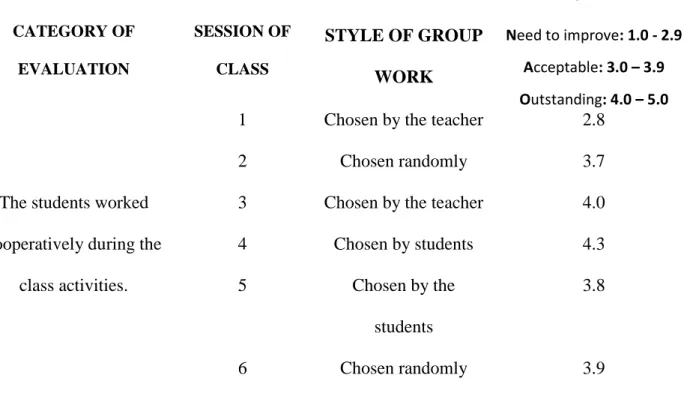
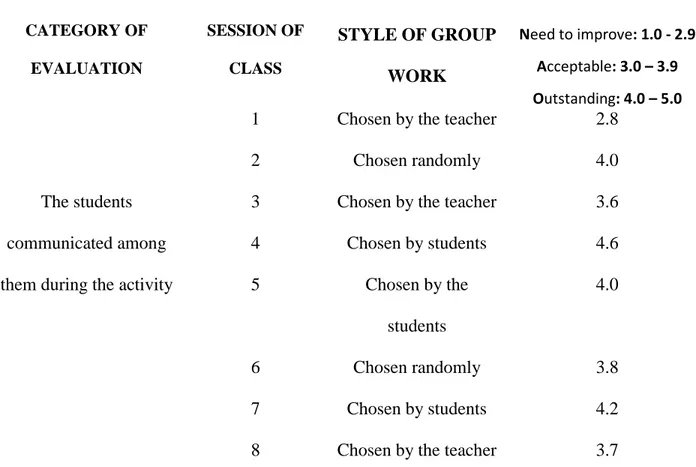
(45) Cooperative Learning Using Comic Strips to Develop Responsive Listening. 44|. Cooperative learning is a pedagogical strategy that works in terms of language, personal and social learning when students are involved in different tasks (Contreras & Chapetón, 2016). In this way, cooperation not only involves helping each other to succeed in a task; it also involves other types of abilities such as learning from others, leadership, communication, and others. Therefore, it is possible to state that most of the students understood and put in practice their cooperative abilities when they had to work as a group. Additionally, it was taken into consideration quantitative data from the evaluation rubrics that could help in terms of understanding from a numerical point of view how were students attitudes towards cooperative work along eight different sessions of class. The grading system was as follows: Needs to improve; the students did not accomplish the task required. Acceptable; the students accomplished the task required with some difficulties. Outstanding: The students accomplished the task required with no difficulties: Table 8 Class grades related to cooperative work. GRADE CATEGORY OF. SESSION OF. STYLE OF GROUP. EVALUATION. CLASS. WORK. Need to improve: 1.0 - 2.9 Acceptable: 3.0 – 3.9 Outstanding: 4.0 – 5.0. 1. Chosen by the teacher. 2.8. 2. Chosen randomly. 3.7. The students worked. 3. Chosen by the teacher. 4.0. cooperatively during the. 4. Chosen by students. 4.3. class activities.. 5. Chosen by the. 3.8. students 6. Chosen randomly. 3.9.
Figure
Documento similar
En nuestro caso la utilización del aprendizaje cooperativo para ayudar en la evaluación del portafolio elaborado por el estudiante obedece a una doble razón, por un lado
In this case we have chosen a questionnaire similar to the one used by Putnam (1993) and adapted by Pujolàs (2003), in which students indicate their degree
According to Gil (2010), cooperative learning is defined as a learning process based on group work, collective construction of knowledge and the development of mixed
These facts give an affirmative answer to the research question: Is it possible to improve the efficiency in TWC by using content created by other students in relation with
Using mobile personal devices to interact with pervasive smart learning objects and services that create contextualized learning ecosystems can enhance both the learning outcomes
Our results indicate that the student group who performed the gamified activities improved their classroom flow in all their variables, while the students who received a
It should be noted that this second discursive framework requires arguments which, by themselves, are not scientific and which will also be used by non-experts who need the advice
To extend the learning process teachers suggested conversations conveniently labeled (using hashtags) to open new ways of discussion and knowledge acquisition from
