
Collaborative strategies to enhance oral interaction in an EFL classroom
86
0
0
Texto completo
(2) ABSTRACT Classroom interaction is one of the most important aspects in the learning process of a foreign language, that is why this qualitative action research study aimed to enhance oral interaction in 41 seventh graders from I.E.D Rafael Bernal Jimenez, through the implementation of Collaborative Strategies in the class. This proposal came up from the needs analysis made during the observation period, where students presented a lack of oral interaction as well as a lot of difficulties to work in groups and a bad relationship between them. The study started being developed the first semester of 2017 and it finished the first semester of 2018. Data was collected through students’ productions, interviews, surveys and field notes. There was a period of implementation of the collaborative strategies which revealed to have encouraging and supportive responses for the interaction in a collaborative classroom.. Key words: Collaborative learning, oral interaction and EFL classroom.. 2.
(3) FORMATO RESUMEN ANALÍTICO EN EDUCACIÓN - RAE Código: FOR020GIB. Versión: 01. Fecha de Aprobación: 10-10-2012. Página 3 de 86. 1. Información General Tipo de documento. Trabajo de Grado. Acceso al documento. Universidad Pedagógica Nacional. Biblioteca Central. Título del documento. Collaborative strategies to enhance oral interaction in an EFL classroom. Autor:. Valencia Valencia, Saidy Farid. Director. Montaño, Johanna. Publicación. Bogotá. Universidad Pedagógica Nacional 2018. 86 p.. Unidad Patrocinante. Universidad Pedagógica Nacional. Palabras Claves. ORAL INTERACTION; COLLABORATIVE LEARNING.. 2. Descripción El siguiente trabajo de grado es una investigación-acción de tipo cualitativo que fue llevado a cabo en la Institución Educativa Distrital Rafael Bernal Jiménez en el grado séptimo. Dado a que se identifica tanto un problema de aprendizaje significativo como de interacción no solo en la lengua, sino entre compañeros, en este estudio se implementó el uso de estrategias colaborativas en las clases de inglés con el fin de promover dicha interacción, así como la relación entre los estudiantes. Para ello, se diseñó un plan de intervención pedagógica que constó de tres ciclos, los cuales permitieron que los estudiantes reconocieran la importancia de interactuar y ser conscientes de su aprendizaje y su rol en el grupo.. 3. Fuentes Ausubel, D. P. (1963). The Psychology of Meaningful Verbal Learning. New York: Grune and Stratton. Barry P. Teaching ESL: Incorporating a Communicative, Student-Centered Component TESOL 3.
(4) Quarterly, Vol. 17. Bryman, A. (2012). Social Research Methods. (4th Edition). New York: Oxford. Recovered from:http://books.google.com.co/books?id=vCq5m2hPkOMC&printsec=frontcover&dq=S ocial+Research+Methods+BY+Bryman&hl=en&sa=X&ei=orVSU5fyIInnsASUkYD4Dw &ved=0CCoQ6AEwAA#v=onepage&q=Social%20Research%20Methods%20BY%20Bry m an&f=false. Burns, A. (1999) Collaborative Action Research for English Language Teachers. Cambridge University Press, United Kingdom. Burns, A. (2009). Action research in second language teacher education. The Cambridge guide to second language teacher education. Burns, A. (2010). Doing Action Research in English Language Teaching. A Guide for Practitioners. Routledge: New York Creswell, J. (2014) Designing Research. Qualitative. Quantitative and mixed method approaches. Contreras León, J. J., & Chapetón Castro, C. M. (2016). Cooperative learning with a focus on the social: A pedagogical proposal for the EFL classroom. Cruz, K (2016). Communicative activities to foster collaboration and communication among A1 EFL learners. Universidad Pedagógica Nacional. Bogotá Grundy, S. (1987). Curriculum: Product or praxis? Lewes: Falmer Press. Golafshani, N. (2003). Understanding reliability and validity in qualitative research. The qualitative report, 8(4), 597-606. Hymes, D.H. (1972). On Communicative Competence In: J.B. Pride and J. Holmes (eds) Sociolinguistics. Selected Readings. Harmondsworth: Penguin. Johnson, D. W., & Johnson, R. (1999). Learning together and alone: Cooperative, competitive, and individualistic learning (5th Ed.). Boston. Allyn & Bacon Johnson, D. W., Johnson, R., & Holubec, E. J. (2008). Cooperation in the classroom (8th Ed.). Edina, MN: Interaction Book Company May, K.(1991). Interview techniques in qualitative research: concerns and 4.
(5) challenges. In Morse J, (ed) Qualitative nursing research. Newbury Park: Sage Publications. Nacional, M. d. (1998). Lineamientos Curriculares de Idiomas Extranjeros. Bogotá. Nacional, M. d. (2016). Derechos Básicos de Aprendizaje: inglés, grado sexto a 11. Bogotá. Panitz, T.(1999). Collaborative versus Cooperative Learning: A Comparison of the Two Concepts Which Will Help Us Understand the Underlying Nature of Interactive Learning. Cape Cod Community College, peninsula, Massachusetts . Mackey, A. (1999). Input, interaction and second language development. An empirical study of question formation in ESL. SSLA, 21, 557-587. Parsons R & Brown K (2002). Educator as reflective practitioner and action researcher. Stottok, B, Bergaus, M., & Gorra, A. (2011). Color Coding: An Alternative to Analyze Empirical Data via Grounded Theory. Leeds Metropolitan University, UK, 1-11. Strauss, A. L., & Corbin, J. M. (1998). Basics of Qualitative Research: Techniques and procedures for Developing Grounded Theory. London: Sage Publications, Inc. Thuan, L. T., & Nhu, N. T. (2010). Theoretical Review on Oral Interaction in EFL. Studies in literature and language. Terwel, J. (1999). Constructivism and its implications for curriculum. Curriculum Studies, 195199. Tudor, I. (2001). Visions of learning in the dynamics of the language classroom. Cambridge, UK: Cambridge University Press. Vygotsky, L. S. (1978). Mind in society. The development of higher psychological processes. London: Harvard University Pres.. 4. Contenidos La investigación presentada busca analizar el impacto del uso de las estrategias colaborativas para promover la interacción oral en la clase de inglés en grado séptimo. Con el fin de presentar los resultados encontrados, este documento se divide en seis capítulos: En el capítulo 1 se presenta la introducción, la presentación del problema y el foco de la 5.
(6) investigación. Así como también, los objetivos y las preguntas que guiaron el estudio y la justificación de este. En el capítulo 2 se desarrolla el marco teórico base de este estudio. De igual forma, se realiza una presentación de otros trabajos revisados también como base. Así mismo, los constructos teóricos que sustentaron la investigación: estrategias colaborativas para mejorar la interacción e interacción en el aula para promover el aprendizaje. Por otro lado, el capítulo 3 muestra el diseño de la investigación. Se define el estudio en el paradigma cualitativo de investigación y se caracteriza bajo la investigación acción. Luego, se realiza una descripción de los instrumentos que se usaron para recolectar los datos y los procedimientos empleados para este proceso. El capítulo 4 describe la intervención pedagógica de la investigación. En la primera parte se presentan las visiones de currículo, lengua, aprendizaje, y salón de clase concebidas. Luego se muestra la intervención pedagógica y se caracteriza cada fase que se siguió en cada uno de los ciclos del estudio. En el capítulo 5 se presenta el análisis de los datos y los hallazgos encontrados durante la investigación. Primero, se incluye una descripción del enfoque utilizado para el análisis de los datos, la perspectiva que se consideró para realizar el análisis de los datos y los procedimientos de validación codificación y triangulación que se realizaron. Finalmente, se describen las categorías que surgieron del análisis y se hace una discusión de los resultados. Para concluir, en el capítulo 6, se dan las conclusiones del estudio basadas en el análisis de los resultados. Se incluyen también las implicaciones del proyecto para la comunidad de enseñanza y aprendizaje del inglés en la institución donde se desarrolló el proyecto, y para los participantes del estudio incluyendo la investigadora. Igualmente, se discuten las limitaciones del estudio para finalmente presentar sugerencias para posteriores investigaciones.. 5. Metodología Este proyecto está guiado bajo los parámetros de la investigación-acción dado a que se abordó una problemática encontrada en una población específica, para luego proponer una intervención pedagógica. El estudio tuvo lugar en la ciudad de Bogotá, en la Institución Educativa Distrital Rafael Bernal Jiménez con 41 estudiantes de grado séptimo con edades entre los 11 y 16 años. Para la recolección de datos se utilizaron instrumentos tales cómo; diarios de campo, encuestas entrevistas y producción de los estudiantes. Por otra parte, se diseñó una propuesta pedagógica qué constó de dos ciclos, uno para la implementación de la propuesta, la cual estuvo comprendida de tres fases y el segundo para el análisis de datos y las conclusiones. Dicha propuesta se fundamentó en la implementación de estrategias colaborativas para promover la interacción oral en el aula.. 6. Conclusiones A partir de la implementación de estrategias colaborativas se evidenció que estas influenciaron la interacción oral de los estudiantes en cuanto a compartir sus ideas, motivación por la clase, conocimiento de su rol en el grupo y la adquisición de sentido de unidad, todo esto con el fin de alcanzar los logros propuestos en la clase. Al principio fue difícil la implementación, 6.
(7) especialmente cuando tenían que trabajar con otros compañeros diferentes a su grupo habitual, pero a lo largo del proceso, aprendieron a expresar y compartir sus ideas, además de confiar en los otros. Otro aspecto importante desarrollado fue el interés por la clase, durante el periodo de observación, los estudiantes se mostraban interesados pero dicho interés se limitaba a realizar sopas de letras, dibujos o colorear, pero sin ningún tipo de interacción o desarrollo de habilidades orales. Al final del estudio los estudiantes mostraron más interés en otro tipo de actividades y empezaron a ser más activos y participativos.. Elaborado por:. Valencia Valencia, Saidy Farid. Revisado por:. Montaño, Johanna. Fecha de elaboración del Resumen:. 05. 04. 2018. 7.
(8) Note of acceptance _______________________________________ _______________________________________ _______________________________________ _______________________________________ _______________________________________ _______________________________________. President of the Jury’s signature. Johanna Montaño Moreno Teacher Advisor. 8.
(9) TABLE OF CONTENTS CHAPTER 1 THE PROBLEM ....................................................................................................................................... 8 Description of the setting and context ..................................................................................................... 8 Population ................................................................................................................................................. 9 Statement of the problem….………………………………………………………..............................10 Research Question……….……………………………………………………………...…………..…12 Objectives ………………………………………………………………………………….………….12 Rationale of the study ……………………………………………….………………….……………..13 CHAPTER 2 THEORETICAL FRAMEWORK AND LITERATURE REVIEW .................................................. 14 State of art ............................................................................................................................................... 14 Literature Review ................................................................................................................................... 19 Collaborative learning vs Cooperative learning ………………………………….……………....19 Collaborative learning strategies to enhance interaction ……………………….………...…….20 Classroom interaction to foster learning ………………………………………..………..…......23 CHAPTER 3 RESEARCH DESIGN……………………………………………………………………….……....…26 Research paradigm………………………………………………………………………….…...….….26 Type of research ………………………...……………………………………………….………....….27 Data collection instruments……………………………………………………………….……….…...28 Procedures for data collection ………………………………………………………….………..….....30 CHAPTER 4 PEDAGOGICAL INTERVENTION…………………………………………………………..….….32 Vision of curriculum…………………………………………………………………………..……...32 Vision of language……………………………………………………………………………..……..33 Vision of learning ……………………………………………………………………………..….…..34 Vision of classroom……………………………………………………………………………...……35 Instructional design……………………………………………………………………………...........35. CHAPTER 5 DATA ANALYSIS AND FINDINGS ……………………..………………………....….40 Data analysis procedures……………………………………………………………………..............40 Categories of the Analysis………………………………………………………………………….....41 CHAPTER 6 CONCLUSIONS AND IMPLICATIONS…………………………………………………………....63 Conclusions…………………………………….…………………………………………………....63 Implications……………………………………………………………………………….………....66 Limitations of the study…………………………………………………………………...................66 Further Research………………………………………………………………………………..…....67 REFERENCES………………………………………………………..…………………………...…..68 ANNEXES………………………………………………………………………………………...…....70. 9.
(10) CHAPTER 1 THE PROBLEM Description of the setting and context This study took place at Rafael Bernal Jimenez I.E.D. (RBJ) Which is a public educational institution located in San Fernando neighborhood, in Barrios Unidos, (the 12th) district from Bogotá, Colombia. This neighborhood is close to two important streets which are: 72th avenue and 80th street, what facilitates the arrival of the students from different places of the city. The neighborhood counts mainly with residential areas belonging mostly to strata 2 and 3, but there are also industrial activities like the elaboration of furniture, lithography, shoes and others. The school mentioned, which is the setting where the project was developed, was founded in 1978, at the beginning it had morning and afternoon shift but currently, there is only one shift. It has two different branches, one for primary and the other for high school. These headquarters are separated by three blocks. The high school headquarter, which goes from 5th grade to 11th grade, consists of 2 buildings each one of three floors, one auditorium and two courtyards part of a spacious playground. In terms of educational resources, teachers have access to a photocopier where material they need for the classes can be printed, there is also one English laboratory and some classrooms count with TV sets but they are not used a lot. Regarding the institutional mission, RBJ leads a pedagogical process in which competent people is formed; people manager of a life project through humanistic though. 10.
(11) and technological knowledge that turn them into generators of a new critic, constructive and transformer society. In the future, the school aims to be recognized at district level by its leadership in the pedagogic and administrative use of Tics as technological, motivative and innovative tool with humanistic perspective in the approval of knowledge to institutional quality management oriented to reach the educative excellence, all of this by the year 2019. Furthermore, the institutional pedagogical project is focused on formation with human transcendence to leadership in science and technology. Population. Students from seventh grade (702), from the school mentioned, were the population selected for the current proposal, this grade had 41 students. There were students from 11 years to 15 years (and one student of 16), among boys and girls and some students were taking the grade by second time. They received their English classes in a very spacious and illuminated classroom, with one TV set, to which they got just for this class and it is beside the main courtyard.. In terms of location, the majority lived in nearby neighborhoods, such as: Barrios Unidos, patria, Benjamin Herrera, Simón Bolivar, la Estrada, among others. Only twelve students lived away and must take public transportation to arrive. Their journey started at 6:15 am to 3:00 pm, from Monday to Friday and the English class was taken on Monday and Tuesday from 9:30 am to 11:20, during the day they received 2 snacks which were given to them to eat in class.. The main activities they did in class were the ones that involved drawing and coloring images and word puzzles. To resolve word puzzles was the activity that they did 11.
(12) the most in an individual way but, they helped to each other working in small groups and some of them listened to music with headphones while doing the activities. About the organization of the classroom, when students arrived to class, the existent rows disappeared since they sat down close to other partners. Finally, an important fact found in field notes and interviews made to a sample of ten students and the home room teacher was that the discipline of the course was a problem that does not let to develop other kind of activities different to the ones already mentioned, this will be explained in the next section.. Statement of the problem Considering the Derechos Básicos de Aprendizaje en Inglés1 (DBA), in seventh grade, students have to perform certain communicative activities such as: to participate in short conversations giving information about itself, to write short and easy texts about actions, experiences and family plans; to understand the main idea and some details related to activities, places and people in a short descriptive text, to give and receive instructions, recommendations and suggestions, to describe, in an oral way, people, activities, events and personal experiences and to describe actions related to a topic of its family or school environment. However, the data collected during the diagnosis stage, through field notes, interviews (to students and the home room teacher) and surveys, showed that the class was mainly focused on learning vocabulary and translating, there was a lack of interaction and communicative activities in English, which were almost never done in most of the cases. “Los derechos básicos de aprendizaje” are a tool proposed by the educational ministry as a guide to identify the basic knowledge that students must learn in each grade of school education 1. 12.
(13) because of the discipline of the course. The class was always developed in Spanish and the activities done were specially written activities, without fostering interaction or enhancing the relationship between students because, as it was seen, students did not usually interact with others different to their group of friends and fights were usually seen during the class. It was clearly seen that in general terms, they did not have a good relationship with their classmates. On the other hand, students’ performances were limited to do activities which were always focused on writing and sometimes drawing in an isolated and decontextualized way that did not allow any kind of interaction or collaboration between them. Bad words were often said, and in this way, there was little communication among classmates; that is why it was a necessity to improve their relationship to promote a good interaction and collaboration and also to change the kind of class there were used to in which when they finished one activity, another one was given, usually a copy with an exercise or written on the board, keeping this way until the class was over; it was observed that this type of class was done to make them being quiet and sit down working avoiding speaking When an activity was in groups, it took most of the time one hour or almost two hours of the entire class, but students only cared about finishing fast to start talking with their friends and sometimes only one worked and the others did not do anything. Another important fact to consider is that, in Lineamientos curriculares de idiomas Extranjeros, MEN (1998), the use of the language should be contextualized in order to a foreign language interaction to be achieved. The problematic already mentioned comes from the need to engage students to interact among themselves by using activities in which they can realize that learning a language is more than only resolve word soups or written 13.
(14) exercises, also that they can be conscious of their learning process and how having a good relationship and help from their classmates might help, forgive the repetition, to this process. Considering this, the activities proposed were related to real situations and communication in which they must interact, because, although students enjoyed English class and the activities proposed by the other teacher, they said they would like to do other kind of activities and they were also conscious of the problems of behavior and the lack of interaction of the whole group. This was an asset for this study because most of the students were opened to develop more communicative activities in which they could know other ways of learning by collaborating between them and enhancing their relationship. Research Question and Objectives Research Question The research question that guided this study was: What is the impact of implementing collaborative strategies to enhance oral interaction between students from a seventh grade EFL classroom? Objectives General Objective To describe the impact of implementing collaborative strategies to enhance interaction between students from a seventh grade EFL classroom at Rafael Bernal Jimenez I.E.D. 14.
(15) Specific Objetives To identify what collaborative strategies students use to achieve a common goal To analyze the students’ responses to the implementation of collaborative strategies. Rationale of the study Classroom interaction and collaborative learning have been object of study for a long time, difficulties and benefits of this interaction have been stated in studies around the world. In addition to this, interaction is the basis of a good communication especially if we talk about learning a foreign language. That is why this research aimed to apply some collaborative strategies to know how they might help or benefit the approach to the foreign language, the interaction and consequently the relationship between students from seventh grade in the high school mentioned. According to Johnson & Johnson (1999) working together helps to accomplish shared goals in any environment. They state that in the ideal classroom, all students would learn how to work with others. This is the reason why this study focused on developing activities in which students must apply collaborative strategies, not just to get a good grade in the class but to learn how to interact and collaborate between each others, even in another situation different to the class. It was important for this study to guide the students through interaction using different kind of activities to promote real communication, because as Widdowson (1978) says, students must be aware of what they are doing when they undertook language tasks, bearing in mind that communication can occur when people know how to use the right words to express in a precise context.. 15.
(16) The current research might be favorable in the teaching field, because considering previous studies (see chapter 2), foreign language teachers have become aware of the fact that interaction is one of the key factors to achieve a meaningful language approach. Therefore, this research was designed also, to overcome difficulties in language skills by enhancing and setting an appropriate environment of communication, implementing the class time to reinforce lacks in the topics proposed by the school through collaborative learning and making students realize that the main objective in learning a language is to achieve communication. The main idea of this proposal was to describe how collaborative learning helps learners to foster interaction and how it helps to encourage a meaningful approach to the language, as well as the teaching aim designated to guide students to communicate in a precise and appropriate way taking help of their partners in the foreign language and enhancing their relationship.. 16.
(17) CHAPTER 2 THEORETICAL FRAMEWORK AND LITERATURE REVIEW This chapter presents the theoretical framework and the literature review, both basis, for the development of this research study. First, five different national and international studies related to collaborative working and classroom interaction in the learning of a foreign language are reviewed. Finally, the theoretical constructs that frame this research: collaborative learning to enhance interaction and classroom interaction to foster learning, will be explained. State of the art The first research project that was considered in this chapter was entitled Communicative activities: a way to foster collaboration and communication among A1 EFL learners, it was carried out by Martinez (2016), and it intended to analyze the influence of implementing communicative activities in collaborative learning and in the oral communication process in an EFL classroom. The research took place at Centro de Lenguas Universidad Pedagógica Nacional in Bogotá, in an A1 group and action research principles were applied in the study. The researcher implemented communicative activities to improve students’ communicative skills in the foreign language and to foster collaborative work in the classroom, to ensure the social aspect of the learning process. Activities like pair and group activities, role-plays, or dialogues were implemented to enable students to express their ideas and opinions and to interact with their partners and teacher using the target language.. 17.
(18) The results showed that these kind of activities activities influenced collaboration between students’ learning process. They could develop pair and group activities working together to reach a common goal, that is why this project was important for the current proposal because it analyzed how communicative activities and group working influence the learning process of a foreign language and how enhancing interaction between learners, the language is enhanced too. Another research taken into account was the one proposed by Cruz (2016), and it is called Communicative Activities to Promote Communication, this study was carried out at a public school in Bogotá. The aim of this research was to implement communicative activities to foster real communication between 40 students of a sixth grade which were not used to develop this kind of activities and had a low production in English to enhance the oral skills in this language and the communication. During the process, the researcher changed the way in which the class was given promoting interaction activities and a peaceful environment to develop the class. The classes were given taking into account “classroom chunks” which are phrases in English, it means that they had to practice with the language in the class. In this way students could realize the importance of communication and interaction in a foreign language, especially when this is being learnt, the class was mainly focused on experimenting and using the language as much as it was possible. The researcher found that not only oral skills were enhanced but also the social skills of the students which helped to improve the relationship between them and gave a peaceful environment to foster the development of the class and their willingness to use English, because such as in this project, the researcher had to deal with the behavior of the class and with a lack of communication in English. 18.
(19) This study is important for this research too, because it shows how the classroom interaction and environment helps to reach a better approach to the foreign language especially when the activities proposed are focused on enhancing communicative abilities. Also, it shows that the proposal helped to foster the relationship between students and being conscious about their leaning process, which is one of the goals of this study. The last national research taken into consideration was the one proposed Camargo, Miranda and Montoya (2008), called Cooperative based activities as a bridge in the interactive communication in English. This was an action research study, where researchers proposed and analyzed how the implementation of collaborative activities in an EFL classroom from an elementary school in Bogotá, with young learners, was useful to develop communicative skills in the foreign language. The activities proposed by the researchers involved interaction and a meaningful learning of the language taking also into account, the way they share with their classmates and their function in the group. The results showed that collaborative working among students allowed them to interact better and to recognize their role in the group and to enhance their social skills and their cognitive growth in the foreign language. In addition to this, they could recognize themselves as part of a real society and how to act in it. This research was considered for this study because such as the previous researches, it shows how collaborative activities in the classroom and communicative activities influence the enhancing of oral interaction and social skills in the process of learning a foreign language. Also, participants learnt how to work together enhancing, in this way. 19.
(20) their communication and relationship, which is one of the aims of this proposal, taking into account the characteristics of the population already mentioned. Besides national studies, two international studies were also taken into consideration. The first one was entitled Relationship Between Group Seating Arrangement in the Classroom and Student Participation in Speaking Activities in EFL Classes, done by Correa, Lara, Pino & Vera (2017). This study attempted to figure out the effects of changing the distribution of the classroom, from rows to group seating, to develop speaking activities and how this distribution influenced participation in students in EFL classes at a school in Chile. This was an action-research study and was divided into two phases, in the first phase students were organized by rows, in the second, in group seating. The authors recorded the classes and interviewed a sample of some students to analyze their perception about the two types of organization and how both had an effect in their participation during the speaking activities in class. The results showed that group seating enhance interaction between students and their motivation to participate in the activities proposed in class. Students got the opportunity to interact with other classmates and participate of the lessons, and most important, they realized the importance of the achievement of oral communication as the best way of participation. Also, they feel more comfortable and supported to practice oral skills when they were beside their partners. The previous study is relevant for this current project because it contributes to the analysis of the benefits of group seating and group working in EFL classes, showing that the participation and interaction between students in class increase helping to improve their. 20.
(21) skills in the target language and motivates to learn when they feel in confidence to speak with others. Finally, a dissertation presented by Khadidja (2010) called The Effect of Classroom Interaction on Developing the Learner’s Speaking Skill, aimed to show that classroom interaction could be the best pedagogical strategy to develop, not only the learners speaking skills, but also to foster their capacity to generate language. In this way, learners should have opportunities to use the language naturally interacting between themselves. The study was carried out in a third-year language program at an university from Algeria. The research was based on two questionnaires administrated to third year students and teachers of the Oral Expression class to get information about their perception of the impact of classroom interaction on developing communicative skills. With the analysis of the questionnaires the researcher could conclude that both, learners and teachers considered classroom interaction as an important pedagogical strategy in enhancing the abilities in the target language but also that it is a tool that needs to be more used in class and it is necessary to lose the thought that classroom interaction and group working are excuses to lost time. Despite of being carried out at an university, this study is relevant because it analyzes the perception of teachers and students of language teaching about how classroom interaction influences and helps in the learning process of a foreign language and, as this proposal attempts to enhance this classroom interaction through the implementation of collaborative strategies, it is important to know what teachers and trainee teachers think about this topic.. 21.
(22) Literature Review Collaborative Learning vs Cooperative Learning Cooperative learning and collaborative learning approaches have been object of study in the educational field, specially, since the socio-constructivist theory in which social learning is a process of peer or group interaction that is mediated and structured by the teacher and the context; both approaches share similarities and differences. According to Matthews, R. Cooper, J. Davidson, N & Hawkes, P. (1995) these approaches share some similarities which are: Stress in the importance of active learning, the teacher acts as facilitator, teaching and learning are experiences shared by both the student and the teacher, enhance higher order cognitive skills, greater emphasis is placed on students' responsibility for taking charge of her or his learning, involve situations where students must articulate ideas in small groups, help students develop social and teambuilding skills, increase student success and information retention and utilize student diversity. There are several differences between cooperative and collaborative approaches which are going to be shown in the following chart presented by the authors already mentioned:. 22.
(23) Table 1. Differences between cooperative and collaborative learning. The previous chart explains in a brief way the main differences between cooperative and collaborative approaches, which are very similar one to each other and it was seen, we can say that the main difference to determine one or other is the learner’s autonomy in the process; this is important to clarify the chosen approach for this study which is going to be collaborative learning. Also, the main constructs that frame this project will be defined in this section. These are related to collaborative learning strategies and classroom interaction. Collaborative learning strategies to enhance interaction. Considering that this research aims to know and analyze the effect of incorporating collaborative learning to enhance interaction in an EFL classroom from a public school in Bogotá, it is necessary to define what collaborative learning strategies and classroom interaction are.. 23.
(24) According to Panitz (1999) collaboration is a philosophy of interaction and personal lifestyle where individuals are responsible for their actions, including learning and respect the abilities and contributions of their peers. Taking this into account, Collaborative learning (CL) takes place when students work together to “achieve shared learning goals” (Barkley, Cross & Major, 2005, p. 4). This is seen as an active teaching and learning strategy which has benefits such as: content mastery, development of critical thinking and problem-solving skills, and improvement of interpersonal skills (Johnson, Johnson, & Smith, 1999). Johnson et al. (1990) pointed out 5 basic elements in CL which is not simply a synonym for students working in groups. A learning exercise only qualifies as CL to the extent when the following elements (that will be explained) are present: Positive interdependence. Team members are obliged to rely on one another to achieve the goal. If any team members fail to do their part, everyone suffers consequences. Members need to believe that they are linked with others in a way that ensures that they all succeed together. Johnson et al. (1990) say that when students clearly understand positive interdependence, they understand that each group member’s efforts are required and indispensable for group success and each group member has an unique contribution to make to the joint effort because of his or her resources and/or role and task responsibilities. Promotive interaction. Members help and encourage each other to learn. They do this by explaining what they understand and by gathering and sharing knowledge. Group members must be done interactively providing one another with feedback, challenging one another's conclusions and reasoning, and perhaps most importantly, teaching and. 24.
(25) encouraging one another. It is important that students feel comfortable because when they do not feel comfortable by working in groups the whole performance will be affected and each member’s intervention ends up in individual efforts. Individual accountability and personal responsibility. All students in a group are held accountable for doing their share of the work and for mastery of all the material to be learned. Johnson et al. (1990) add that Individual accountability is the structural element required to discourage and lower the likelihood of free riders or social loafing. Johnson and Johnson (2001) say that the purpose of cooperative learning groups is to make each member a stronger individual in his or her right; when students learn together, they can subsequently perform higher as individuals. Social skills. This concept was influenced by the socio-constructivism theory that states about the importance of the context and the interaction with others to create new knowledge. Students are encouraged and helped to develop and practice trust-building, leadership, decision-making, communication, and conflict management skills; they become more able to solve problems that demand collaboration among participants. Group self-evaluating or group processing. Team members set group goals, periodically assess what they are doing well as a team and identify changes they will make to function more effectively in the future. It involves a reflection about what actions of the members of the group were effective or not. It means that, all the members must assess the conducted actions and determinate the best ones. Collaborative learning, including these elements presented, is the instruction that involves members working in groups to accomplish a common goal (Johnson et al., 1990); 25.
(26) it means to reach a good communication, to develop an activity or exercise, to win a competence or even to reach a good grade in the class. Following these authors, in the ideal classroom, all students should learn how to work collaboratively with others. In this way, not only the interaction between all the students will be guaranteed but, also a good relationship and behavior. (these aspects, the main problematic situations with the population of this study). According to Vygotsky (1978), young learners have the necessity to enhance their abilities as speakers and listeners at school in order to promote their cognitive, linguistic, social and emotional development. Considering the previous concept, in his social cultural theory, Vygotsky says that the child’s learning process could be developed only when interaction and collaboration are presented. Although this study will focus on a seventhgrade EFL class, students are still in a basic level of the language and these concepts of interaction and collaboration are not seen in the group. now, let us define classroom interaction. Classroom interaction to foster learning Every communicative process requires interaction between at least two people who share information. Wagner (1994) defines interaction as a set of reciprocal events that require at least two objects and two actions, interaction occurs when these objects and events naturally influence one another. It means, when information is given and received between two or more people to achieve communication. Interaction in this pedagogical intervention is seen as an opportunity for all the participants, both students and teacher, to express their own ideas or comment on those of 26.
(27) others in a dialogical co-construction of knowledge. It is a cyclical process of interaction which means that the initiator of the interaction can be the teacher or the student and that there are no predicted or mechanical responses but a dialogical cycle of action and reflection where students can have an active role that allows them to have an active participation and their voices can be heard. In this sense, students will develop other kind of activities in addition to the ones they have already been developing, this activities with the aim to create interaction and communication in the classroom, aspects that are little worked, and in this way, to help in the improvement of their relationship. Contreras & Chapetón (2016) talk about the importance of classroom interaction in building knowledge about the language and developing skills that will help learners to improve their communicative competence and establish and maintain personal relationships. Classroom interaction depends mostly on the teacher and the type of activities that he/she develops during the class, these activities must promote an active communication between students. Classroom interaction is characterized for following teacher – student interaction or student–student interaction patterns. Teacher – student interaction is the most common interaction pattern followed in any classroom, the teacher controls and guides the interaction in the class and students are limited to answer questions and receive feedback from the teacher. (Thuan & Nhu, 2010). The student–student interaction occurs among learners as they are the main participants. Teacher’s role is to monitor the class while learners are developing the communicative activities proposed to reach the good communication and important, a meaningful approach or learning of the foreign language. The meaningful learning is defined by Ausubel (1963) as the way how individuals relate new knowledge to relevant concepts they already know. New knowledge must 27.
(28) interact with the learner’s knowledge structure, it means that, meaningful learning occurs when the learner chooses conscientiously to integrate new knowledge, afterwards, it depends also on the teacher’s activities orientation during the classes. Meaningful learning can be contrasted, according to Ausubel with rote learning. He believed in the idea of meaningful learning as opposed to rote memorization. The latter can also incorporate new information into the pre-existing knowledge structure but without interaction. Rote memory is used to recall sequences of objects, such as phone numbers. However, it is of no use to the learner in understanding the relationships between the objects. It involves a recognition of the links between concepts and has the privilege of being transferred to long-term memory. The most crucial element in meaningful learning is how the new information is integrated into the old knowledge structure. In the case of this proposal, the aim of incorporating collaborative learning and classroom interaction is that the students reach a meaningful approach to the foreign language as a result that will possibly emerge from the intervention proposed. That is why the designed activities in this research study are going to be oriented to this approach, which helps to reach a meaningful learning because students need to interact and remember words by taking the context and expressing what they feel to their classmates. In this chapter, five previous studies that served as frame of references and the constructs used as basis for the study were described. It was described also the reason why they were used for this proposal. The next chapter will explain the research design that was followed in this project.. 28.
(29) CHAPTER 3 RESEARCH DESIGN This chapter explains the methodological approach that the study followed. Aspects as the research paradigm, the type of study, the data collection instruments and the procedures will be presented and explained. All of them to clarify how this investigation process was carried out. Research paradigm The research paradigm that framed this study is the qualitative one which seeks to comprehend an educative situation considering the experiences of the individual and how they think and act in their environment. According to Creswell (2014), its aim is to gather a deep understanding of human behavior and the reasons that direct such behavior. Bryman (2005) points that there are five principles to make qualitative research which were followed during this study. The first one is the general research question, which provides an explicit statement of what the researcher wants to know, this question was formulated after a diagnosis and characterization process of the group; the second is sampling cases, in this part people from whom the researcher will recollect the information is selected, although this is the second step, the population was selected previously; the next step is data collection, in which the researcher establishes what needs to collect the information; then the data analysis, where the application of statistical techniques to analyze the data as establish categories is made; and finally the writing up, this is a final product with the following steps: introduction, literature review, research methods, results, discussion and conclusion. The Qualitative paradigm allows to gather and characterize data from the 29.
(30) children’s interaction, their context and social behaviors, aspects that were important in this investigation process. Type of research The project followed the principles of action research, because, as Burns (2009) states, it analyses a problem and develops a solution to be applied within one’s own social environment and in this way, it helps to enhance certain problematic, it is, following Burns, mainly qualitative. That is why, in this study, students from 702 grade from Rafael Bernal Jimenez high school were observed during the English class to know and comprehend how the class was developed, the interaction with their classmates, their strengths and weaknesses in oral interaction and how these aspects could be improved to propose and apply a pedagogical intervention which helped to give a solution. In agreement to Parson and Brown (2002), action research is developed in four phases which go in a cyclic way. It starts with a planning stage where the problem is identified, then a plan of action is developed, next step is to proceed to collect data, afterwards data is analyzed, and conclusions are formed to finally, adjust the theory and begin again if it is necessary. As the aim of this study was to incorporate collaborative strategies to enhance interaction, the population was observed during a period to identify a problem and propose an intervention, implement it in another period, collect and analyze the data and in a final period find the conclusions of the research.. 30.
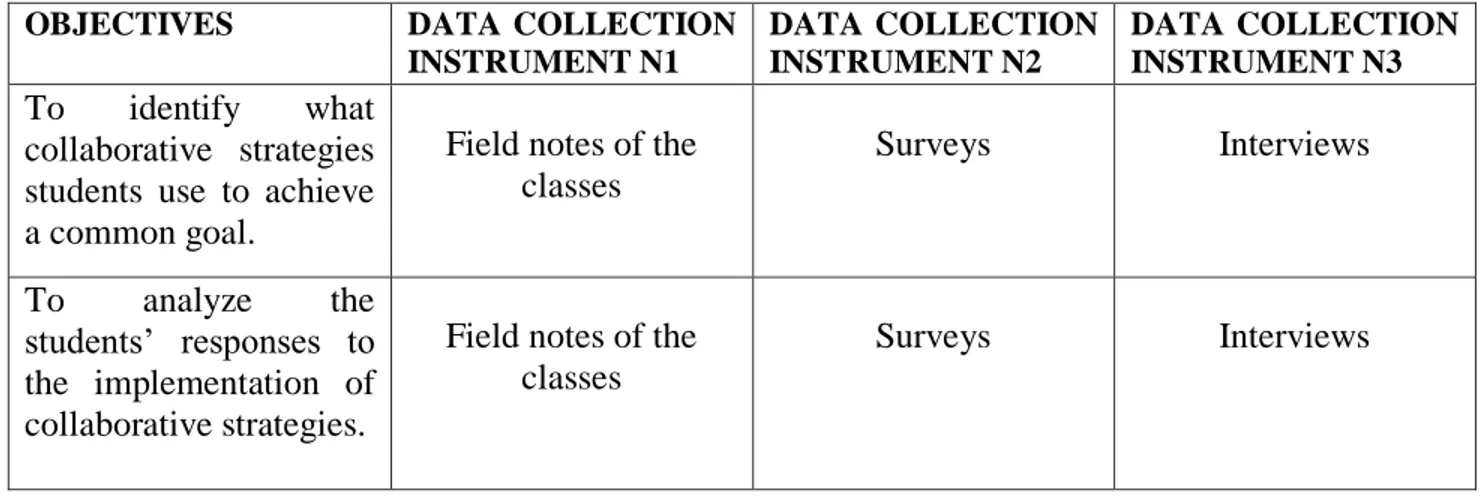
(31) Data collection instruments With the aim to collect information, this research used qualitative approach techniques for data collection as: the students’ production, field notes, surveys and interviews, all of this to respond to triangulation purposes. In accordance with Burns (2010) triangulation was a combination of several types of data that allowed the researcher to compare and cross-check if one source’s evidence is reflected in another one. It is also important to talk about triangulation to achieve the validity and reliability of the investigation process. Joppe (2000) cited in Golafshani (2003) points that validity is what determines whether the research truly measures that which it was intended to measure or how truthful the research results are. Researchers generally determine validity by asking a series of questions and will often look for the answers in the research of others. (p. 1). Joppe also defines reliability as the extent to which results are consistent over time and an accurate representation of the total population under study is referred to as reliability. (p. 1). Thus, to guarantee the validity and reliability of the research, the instruments already mentioned were used as it follows: Table 2. Plan of triangulation OBJECTIVES. DATA COLLECTION INSTRUMENT N1. DATA COLLECTION DATA COLLECTION INSTRUMENT N2 INSTRUMENT N3. To identify what collaborative strategies students use to achieve a common goal.. Field notes of the classes. Surveys. Interviews. To analyze the students’ responses to the implementation of collaborative strategies.. Field notes of the classes. Surveys. Interviews. 31.
(32) Field notes. Following Burns (2010) there are several types of field notes: factual, descriptive, and reflective field notes. In this study, the field notes were a combination between description and reflection exercises because what was happening in the classroom was described, then, this information was interpreted to reflect about the process to follow in the planning and intervention which took place when the observation period finished. During the period of observation class, which was once a week for three months approximately, field notes were taken writing the details of what happened and how students developed the activities proposed by the teacher in charge, such as the interaction between all the participants. (See annex 1). Surveys. According to Burns (1999) surveys allow to collect data through determined questions in a written format. According to this author there are three types of information that can be obtained, these are: factual or demographic, who the interviewees are and their background/experiences; behavioral, what they do, or did in the past; attitudinal, attitudes, opinions, beliefs, interests and values. There were multiple option surveys items and open-ended items in order to get the three types of information presented by Burns. These determined personal and academic aspects about students and the data collected helped to characterize and to know the problem which this study aimed to enhance or solve. There was one survey made to students as a diagnosis in the observation period and another survey at the end of the implementation period. (See annex 5). Interviews. Following Burns (2010) Interviews are a classic way to conduct a conversation that explores a focus area, it means, it is a conversation with a purpose. There are three fundamental types of research interviews, May K M. (1991) defines them as: structured, semi-structured and unstructured. Structured interviews are, essentially, verbally 32.
(33) administered questionnaires, in which a list of predetermined questions are asked, with little or no variation and with no scope for follow-up questions to responses that warrant further elaboration. Unstructured interviews are performed with little or no organization, it may simply start with an opening question, they are usually very time-consuming and can be difficult to manage, and to participate in. Finally, Semi-structured interviews consist of several key questions that help to define the areas to be explored, but also allows the interviewer or interviewee to diverge in order to pursue an idea or response in more detail. The type of interview used in this study was semi-structured, because the aim was to know specific aspects about the class, how it was developed but also, to know deeply more about the students’ thoughts about the class. There was one interview to a sample of ten students at the beginning of the observation period with the purpose to find out their academicals aspects and one final interview at the end of the implementation period to know their perception of what wias done; one interview since the point of view of the teacher in charge with the aim to know, from her perspective, what the most difficult for the students was, in terms of communicative skills, this also at the beginning of the process. Procedures for data collection Data was collected during three cycles starting the first on March 7 th/2017 with the first field note and finishing on May/2018 with the final interviews. As action research deals with ethical considerations when a study is developed, first an informed consent was sent to ask for children’s parents’ permission to allow the students to participate in the project on March /2017 such as an inform consent to ask the children and their parents if they wanted to participate considering that their identities were in the anonymity, their. 33.
(34) participation was voluntary and they were be able to quit the intervention whenever they wanted (see annex 4). The cycles were divided into the following: The first cycle was of observation and it took place from March 7th/2017 to May 31st/2017. The students and the teacher in charge answered a survey and an interview (10 students answered the interview) during the first month, the rest of the cycle field notes were taken, and the intervention proposal started to be planned. In the second cycle, which started on June/2017 to December/2017, the proposal was applied, field notes were taken during each class and there was an interview applied to ten students in the middle of the cycle. Finally, in the third cycle that started on February/2018 to June/2018, field notes were taken as well as in the previous cycles, all the students answered a final survey and a final interview was applied to another sample of ten students. (students’ productions were taken also into account) In this chapter, the research design was explained, likewise the type of study that followed action research principles. In the same way, the data collection instruments, their procedures were presented to clarify how this research was developed. The following chapter presents the pedagogical instruction and intervention proposed to answer the research question.. 34.
(35) CHAPTER 4 PEDAGOGICAL INTERVENTION This chapter aims to present and describe the curricular vision, the vision of language, vision of learning and vision of classroom in order to understand the focus of the study; these topics are presented as well as the instructional design that was applied and the the cycles of implementation, all of this, with the aim to collect and analyze the data collected. Curricular vision To follow a process of collaborative working to enhance interaction between students, it is necessary to see the curriculum from a constructivist perspective; as a way for the students to interact and confront real situations in order to reach common goals. In this sense, Terwel (1999) states that in a curriculum based on the constructivism, students have an active role in their learning process and promote a better face to face interaction in a collaborative learning environment. According to Vygovtsky’s perspective (1978) the teachers’ role is to explore the actual level of their children and determine the potential development they can achieve with the appropriate guidance and problem-solving activities with peers or in group work, which is one of the objectives of this study, where the students can achieve the goals proposed in class by interacting, sharing and helping each other. Also, following what Grundy (1987) says, the curriculum is not simply a set of plans to be implemented, but rather is constituted through an active process in which planning, acting and evaluating are all reciprocally related and integrated into the process, even the students had the chance to propose some 35.
(36) activities during all the implementation. Also, the rhythm of learning of them was taken into account when planning the topics for each class. Vision of language Taking into account that this study focused on interaction, the vision of language that underpins the pedagogical proposal was conceived since Tudor (2001), who states that a language is a means of achieving functional goals, a means of self-expression favors in which the learner wishes to express and determine as well as the learning goals. In this regard, Tudor, (2001) avers that language is also a means of self-expression to explore our interests. Tudor (2001) points out that language is a medium by which we build up personal relationships, express our emotions, and explore our interests. In this sense, this vision of language is involved into the humanistic perspective, this approach has five main components according to Tudor, these are: feelings, which include personal emotions and esthetic appreciation; social relations where friendship and cooperation are encouraged; responsibility that includes and accepts the need of public scrutiny, criticism, and correction; intellect which includes knowledge, reason, and understanding; and selfactualization that looks for full realization of one's qualities. It is important to consider that the population of the study was framed in a context in which the class focused on the main components of the language system such as grammar and vocabulary. This means that, the students have, in principle, a language’s learning goal based on a system code, which leaves individual’s interests, insights and feelings outside of a social practice where a meaningful learning is not granted. Hence, the. 36.
(37) language considered as self-expression, creates the possibility for the learners to express aspirations and interact with the others, one of the goals of this proposal. Vision of learning This project focused on a vision of learning seen as the product of interaction and collaboration which helped them to be more conscious and interested in their own learning process. As Mackey (1999) states, conversational interaction facilitates second language development, when developing any kind of activity in the classroom, students create a kind of "interdependence" that fosters relying on their peers all the time, using either Spanish or English. Mackey recognizes the importance of interaction and meaning negotiation as a contribution to the learning process. According to Mackey (1999), the more you interact the more successful your second language development is. This is supported by Tudor’s experimental vision on learning, which says that “learners are immersed in a variety of possibilities in the EFL classroom, where they can encounter interaction and experience, mainly, developed directly and reflectively”. (Tudor, 2001). As the students were used to working only with the aim of passing the signature, they were not interested in learning the language at all. This vision of learning helped to change a little bit the way they saw the language, how important was that they learnt and that there are different options of learning, showing them more ways or activities to make it interesting promoting the interaction and collaboration.. 37.
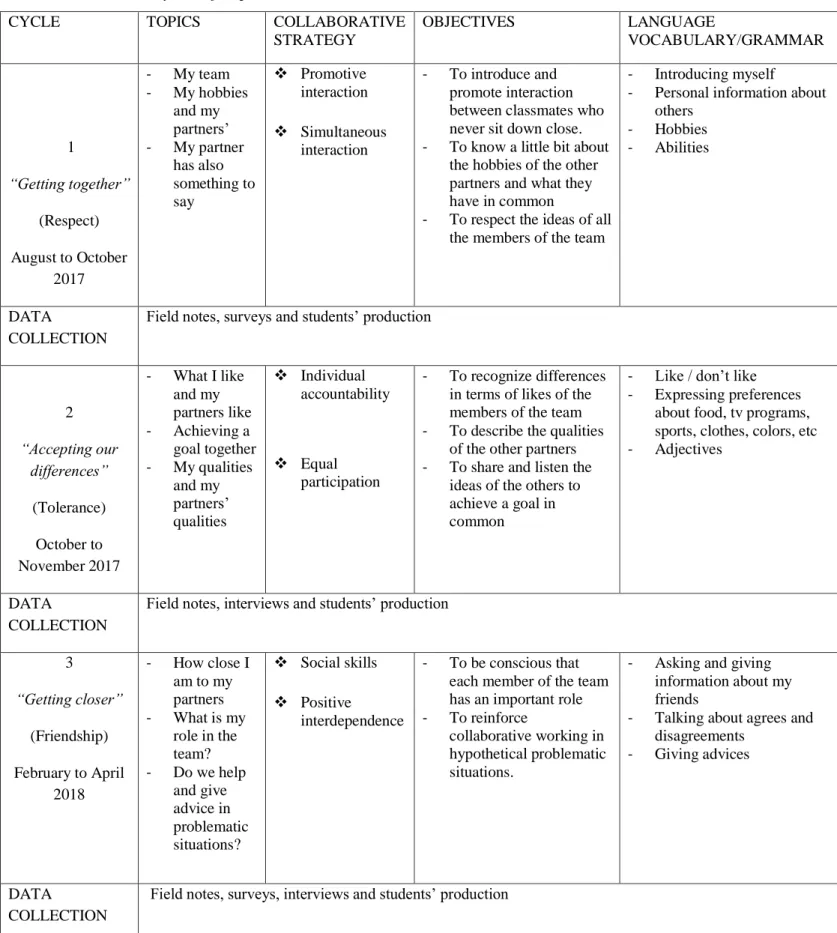
(38) Vision of classroom Considering the objectives of this study, the classroom was considered as a communicative space, in which the teacher must develop activities that allowed students to use and practice English in a positive environment, in which most of the activities should be developed as a team. As it was said in chapter 1, one of the principal problems of the group mentioned was the bad relationship among classmates, where they only talked to their closer friends. According to Barry (1989) creating a positive environment is an important aspect in teaching, because it could help to enhance, promote and encourage students’ learning. In this sense, for this proposal, it was essential to create and promote an atmosphere of interaction and respect during the class. Instructional design The pedagogical objective of this study was to enhance oral interaction through applying collaborative strategies, such as: Positive Interdependence, Individual Accountability, Equal participation and Social Skills, these strategies were implemented in three cycles, with sessions of two hours twice a week. All the sessions were structured in lesson plans (See annex 6). The proposal was based mainly in applying the collaborative strategies mentioned relating them with the topics they must study in seventh grade and some extra topics to promote their interest and interaction and to see how their attitude towards the class changed with the new methodology. Also, it was opened to be modified adding any other activity or a meaningful topic for students and for the research. The following table illustrates the three cycles and stages of the implementation and how the strategies were divided into each one. Off course, in some cases other strategies were used for them without necessarily being in the exact stage. 38.
(39) Table 3. Cycles of implementation CYCLE. 1. TOPICS. COLLABORATIVE STRATEGY. OBJECTIVES. LANGUAGE VOCABULARY/GRAMMAR. -. ❖ Promotive interaction. -. -. ❖ Simultaneous interaction. -. To introduce and promote interaction between classmates who never sit down close. To know a little bit about the hobbies of the other partners and what they have in common To respect the ideas of all the members of the team. To recognize differences in terms of likes of the members of the team To describe the qualities of the other partners To share and listen the ideas of the others to achieve a goal in common. -. To be conscious that each member of the team has an important role To reinforce collaborative working in hypothetical problematic situations.. -. -. “Getting together”. My team My hobbies and my partners’ My partner has also something to say. -. (Respect). -. Introducing myself Personal information about others Hobbies Abilities. August to October 2017 DATA COLLECTION. Field notes, surveys and students’ production. 2 “Accepting our differences”. -. (Tolerance). What I like and my partners like Achieving a goal together My qualities and my partners’ qualities. ❖ Individual accountability. -. ❖ Equal participation. -. -. Like / don’t like Expressing preferences about food, tv programs, sports, clothes, colors, etc Adjectives. October to November 2017 DATA COLLECTION 3. Field notes, interviews and students’ production. -. “Getting closer” (Friendship) February to April 2018. DATA COLLECTION. -. How close I am to my partners What is my role in the team? Do we help and give advice in problematic situations?. ❖ Social skills. -. ❖ Positive interdependence. -. -. Asking and giving information about my friends Talking about agrees and disagreements Giving advices. Field notes, surveys, interviews and students’ production. 39.
(40) Cycle 1. Getting together In this cycle of implementation, first, students knew how the methodology of each session was and that they would be immersed into a constant collaborative process. In general, all the lesson plans were designed to be developed in two hours and sometimes three. Each lesson plan was composed by a warm up, an explanation of a topic (sometimes a review of previous ones), an activity that usually was worked in groups of three and in few cases four, a correction and feedback often done on the board with the students’ participation. There were used resources as worksheets, songs, readings, etc., and the students’ production was the most important fact of the process. Due to technical inconvenients and the students’ behavior, the tv and the bilingualism classroom were not allowed to be used but it was not a problem for the research. This cycle aimed to implement two main collaborative strategies such as promotive interaction and simultaneous interaction to promote communication between students who were never close in class and to allow them to know about the other’s hobbies, what they had in common respecting also the ideas of the other members of the team when developing any activity and expressing their ideas in the target language. the topics were related to: introducing personal information of oneself and the others and hobbies (see annex 6). For example, in the first lesson plan applied called “knowing my team” they had to make groups with partners who they never worked with and ask about personal information filling a chart given, after that, they introduced their partners to the other groups; all of this with the objective that they knew other students and learn how to give information about others... 40.
(41) Cycle 2. Accepting our differences The second cycle, aimed that students recognized and accepted the differences in terms of likes of each members of the team, also that they could describe the qualities of the other partners and their own qualities, also in the target language, and that they could share and listen the ideas of the others to achieve a goal in common to reinforce collaboration and team work. In this part, collaborative strategies such as individual accountability and equal participation were applied in order to reach the objectives already mention, the topics covered included description of abilities and likes. In this cycle, the students had the chance to work on activities in which they had the chance to create and produce working together, for example, there was a lesson plan called “our super hero”, to develop this activity, first, they had to learn about abilities and remember how to give descriptions, then making teams and create a super hero; they drew, painted and wrote all the information about him/her giving all the description and abilities to finally presenting her/him in front of the class. To reach this, they had to share their ideas and collaborate with the group to agree and decide how to work. Cycle 3. Getting closer As this was the final cycle, the collaborative strategies applied were social skills and positive interdependence in order to students to be conscious that each member of the team had an important role and that, as partners they should help each other not only to reach good grades or finish an activity but also in other aspects, that is why they worked together to try to solve hypothetical problematic situations, give suggestions and organizing ideas... 41.
(42) For example, some activities were developed on the board or in different stages which obligated them to rely on the other and be responsible of a specific function. That is the case of a lesson plan called “ordering ideas”, in this class, some pieces of paper were given to each group, these papers were part of a story and they had to organize it. They passed one by one to the board to organize the story, when the paragraph was finished each member of the group passed again to the board to continue it with their own version but when one was on the board the others could not see what was written. Relaying and responsibility were important aspects to develop this kind of activities. This chapter presented the theoretical support of the pedagogical intervention that will be applied in this study. The vision of language and learning that follow the research were developed, also the instructional design was explained and characterized in the three cycles of intervention. In the following chapter the findings and the analysis done will be showed.. 42.
(43) CHAPTER 5 DATA ANALYSIS AND FINDINGS This chapter shows the analysis of the data collected as well as the findings of this research study. First of all, the approach for data analysis is presented as well as its procedures such as: assembling of data, coding and analysis. Secondly, the categories that emerged from the data collection process and the analysis of findings are explained.. Data analysis procedures. The data was analyzed following the Grounded theory. Strauss and Corbin (1998) state that the grounded theory allows the researcher to develop theory through grounding data that is systematically gathered and analyzed. In this process, there are three steps which are: Data collection, data management and data analysis. According to Cohen, Manion, & Morrison (2007) the grounded approach is emergent and systematic because the theory emerges from data. In this research categories emerged from the data, it means that the categories were not preestablished; this data was collected systematically during the second and part of the third cycle of implementation. It is important to mention that the analysis was done from an insider perspective of the observations of the classes because, the researcher in this project was immersed in the class context, thence, what Patton (2002, p. 329) called the emic perspective, which means that, rather than seeing and prescribing what is happening, the observer is able to feel and perceive what is inside the context by immersing as an active agent of the culture. All the data was analyzed according to what students produced during the activities in class; there was also data collected from the surveys and interviews (which were. 43.
Figure

Documento similar
ROTMENAS has made visible the mental health issues before and derived from the pandemic, so it has generated different intervention strategies to strengthen the collaborative work
Hence, Higher Education Institutions (HEIs) have sought to develop strategies to promote curricular and extracurricular activities that favor developing disciplinary
In relation to the learning strategies scales, EMI students have better learning strategies due to metacognitive self- regulation, time study management and effort regulation
That is, the dynamic aggre- gation of neighbor ratings based on a prediction of their performance, when seen as individual recommenders (as defined in section 3.3), is
Click here to view linked References.. The most important point defects and defect complexes have been explored and intrinsic defect formation energies were determined [21]. To
In what ways can feminism help to promote and enhance the degrowth movement as a matrix of potential alternatives to the dominant economic growth paradigm, which is deemed
The analysis revealed significant differences in categories such as word count, clout, emotional tone, or analytical thinking when comparing the texts written by an
The purpose of this study is to establish a methodology for proposing a Web 2.0 tool that provides to any community of end users the automatic generation of a
